

End-to-end data-driven weather prediction
Open accessThe DOI matches its Crossref record; 81 of the 81 references it cites were found in a registry or an index; none of the 19 sources its claims cite is checked for support yet.
Abstract
Weather prediction is critical for a range of human activities, including transportation, agriculture and industry, as well as for the safety of the general public. Machine learning transforms numerical weather prediction (NWP) by replacing the numerical solver with neural networks, improving the speed and accuracy of the forecasting component of the prediction pipeline 1–6 . However, current models rely on numerical systems at initialization and to produce local forecasts, thereby limiting their achievable gains. Here we show that a single machine learning model can replace the entire NWP pipeline. Aardvark Weather, an end-to-end data-driven weather prediction system, ingests observations and produces global gridded forecasts and local station forecasts. The global forecasts outperform an operational NWP baseline for several variables and lead times. The local station forecasts are skilful for up to ten days of lead time, competing with a post-processed global NWP baseline and a state-of-the-art end-to-end forecasting system with input from human forecasters. End-to-end tuning further improves the accuracy of local forecasts. Our results show that skilful forecasting is possible without relying on NWP at deployment time, which will enable the realization of the full speed and accuracy benefits of data-driven models. We believe that Aardvark Weather will be the starting point for a new generation of end-to-end models that will reduce computational costs by orders of magnitude and enable the rapid, affordable creation of customized models for a range of end users.
Overview
CoChat Summary
TL;DR
Aardvark Weather is an end-to-end data-driven weather prediction system that ingests raw observations and produces global gridded forecasts and local station forecasts without relying on numerical weather prediction at deployment time. It is competitive with operational NWP baselines for several variables and lead times, and its local forecasts are skilful up to 10 days.
Key findings
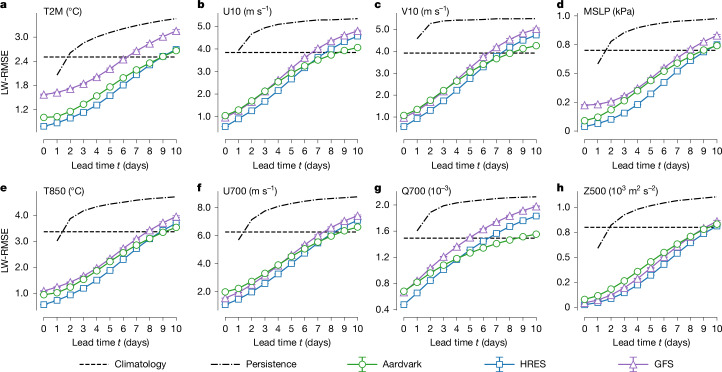
- On a global 1.50° grid, Aardvark matched or outperformed GFS across most lead times, with the only exception being geopotential at 500 hPa, and approached HRES performance for most variables; errors were larger at higher atmospheric levels and shorter lead times, and forecasts tended to become spectrally blurred at longer lead times.
- Aardvark ingests approximately 8% of the observations available to conventional NWP systems, and generating a full forecast from observational data takes approximately 1 s on four NVIDIA A100 GPUs, compared with approximately 1,000 node hours required by HRES for data assimilation and forecasting alone.
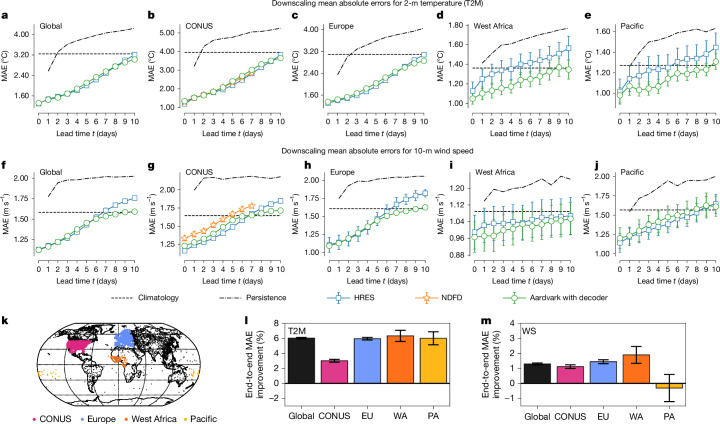
- Station forecasts for 2-m temperature and 10-m wind speed were skilful up to 10 days; for temperature, Aardvark was competitive with station-corrected HRES over CONUS and Europe, matched NDFD over CONUS, and outperformed station-corrected HRES in West Africa and the Pacific at all lead times; for wind speed, it had higher errors than station-corrected HRES over CONUS, significantly outperformed NDFD, was similar to station-corrected HRES over Europe up to 4 days and better thereafter, generally outperformed station-corrected HRES over West Africa, and performed slightly worse over the Pacific.
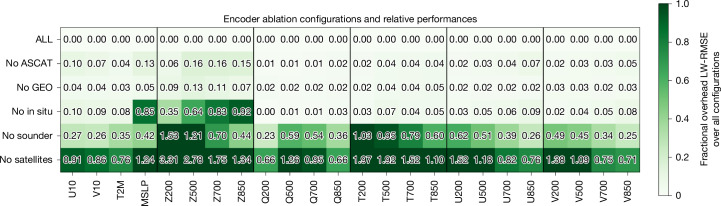
- End-to-end fine-tuning reduced 2-m temperature MAE by 6% over Europe, West Africa, the Pacific and globally, and by 3% over CONUS; for 10-m wind speed, improvements were 1–2% for all regions except the Pacific. Encoder ablations showed satellite data are crucial, with LEO sounder data most important, while in situ observations are most important for surface variables and also play a surprisingly large role in geopotential at lower levels.
Methods
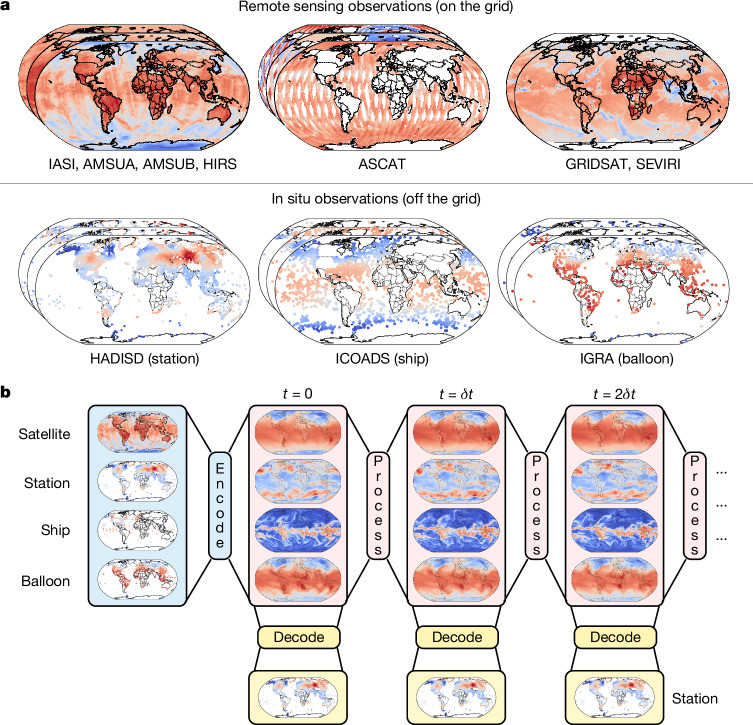
- Aardvark consists of three modules: an encoder that estimates a gridded initial atmospheric state from raw observations, a processor that autoregressively produces 24-h global forecasts out to 10 days, and task-specific decoders that produce local station forecasts; the architecture is a neural process combining SetConv layers with vision transformers for encoder and processor, and a lightweight U-Net plus SetConv and MLP for the decoder.
- Inputs include remote sensing data (ASCAT scatterometer, AMSU-A/B, MHS, HIRS/4, IASI, GridSat geostationary) and in situ data (HadISD land stations, ICOADS marine observations, IGRA radiosondes), plus temporal and orographic variables; training used ERA5 reanalysis for pretraining, with data before 2018 for training, 2018 as test and 2019 as validation.
- Global forecasts were evaluated against persistence, climatology, HRES and GFS using latitude-weighted RMSE with ERA5 as ground truth; station forecasts were evaluated against per-station persistence and climatology, station-corrected HRES, and NDFD over CONUS using MAE; end-to-end fine-tuning jointly optimized encoder, processor and decoder for specific variables and regions.
Limitations
- The paper states that Aardvark does not yet run at the resolution of IFS; further studies are required to increase grid resolution and produce forecast ensembles, for example through diffusion; further observational modalities will probably increase skill; integrating new instruments without training data may require simulated data; and observation drift can be mitigated by regularly fine-tuning all modules with recent data.
- The text makes evident that evaluation uses ERA5 as ground truth, although HRES analysis is of higher quality than ERA5, with discrepancies limited for the 2018 test year; Aardvark’s errors are larger at higher atmospheric levels and shorter lead times than operational baselines, possibly due to higher observation concentration near the surface; and forecasts tend to become spectrally blurred at longer lead times.
- The text also makes evident that the station-corrected HRES baseline is not necessarily state-of-the-art in downscaling, NDFD is only available over CONUS, the study considered a single downstream decoder for station forecasting, and the system operates at 1.50° resolution with five vertical levels.
Model-written summary. Check it against the paper before relying on it.
Integrity signals
Registry
Cites
Statistics
Figures
Verification
Claims the paper makes
0 Valid · 1 Not valid · 15 Not checked · 58 Own results and interpretations
A result the paper reports from its own data — it cites no other source for it, so there is none to check. The quote shows it is in the paper.
In the paper
“Over Europe, Aardvark had similar errors with the station-corrected HRES up to 4 days of lead time and outperformed it thereafter.”
§ End-to-end data-driven weather prediction > Evaluation of station forecasting
plain- Asserted: passes — The authors put it forward as true.
- Checkable: passes — It can be checked against evidence.
- Load-bearing: unclear — It is unclear whether the paper’s conclusions depend on it.
- Based: passes — The paper gives a reason why it holds.
A result the paper states — it cites no source for it, so there is none to check. The quote shows it is in the paper.
In the paper
“Aardvark Weather is a deep learning model that provides forecasts of eastward wind, northward wind, specific humidity, geopotential and temperature (at 200, 500, 700 and 850 hPa pressure levels), 10-m eastward wind, 10-m northward wind, 2-m temperature and mean sea level pressure on a dense global grid, and station forecasts for 2-m temperature and 10-m wind speed.”
§ End-to-end data-driven weather prediction > Aardvark Weather
plain- Asserted: passes — The authors put it forward as true.
- Checkable: passes — It can be checked against evidence.
- Load-bearing: passes — The paper’s conclusions depend on it.
- Based: passes — The paper gives a reason why it holds.
A result the paper states — it cites no source for it, so there is none to check. The quote shows it is in the paper.
In the paper
“We present Aardvark Weather, an end-to-end data-driven weather forecasting system capable of generating predictions with no input from conventional NWP by instead learning a mapping from raw input observations to output forecasts.”
§ End-to-end data-driven weather prediction > Main
plainstates a cause- Asserted: passes — The authors put it forward as true.
- Checkable: passes — It can be checked against evidence.
- Load-bearing: passes — The paper’s conclusions depend on it.
- Based: passes — The paper gives a reason why it holds.
A result the paper reports from its own data — it cites no other source for it, so there is none to check. The quote shows it is in the paper.
In the paper
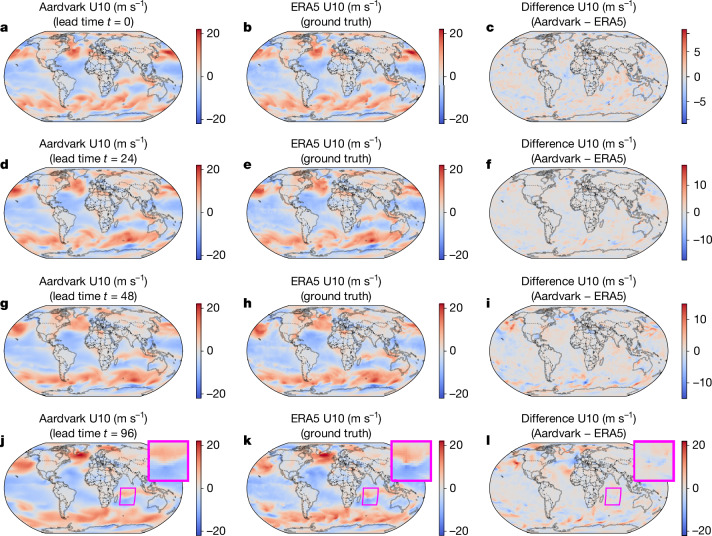
“Aardvark successfully captured the large-scale features of the atmospheric state, both in the mid-latitudes and the tropics.”
§ End-to-end data-driven weather prediction > Evaluation of global forecasting
plain- Asserted: passes — The authors put it forward as true.
- Checkable: passes — It can be checked against evidence.
- Load-bearing: passes — The paper’s conclusions depend on it.
- Based: passes — The paper gives a reason why it holds.
A result the paper states — it cites no source for it, so there is none to check. The quote shows it is in the paper.
In the paper
“Overall, Aardvark’s errors were larger at higher atmospheric levels and shorter lead times than those of the operational baselines.”
§ End-to-end data-driven weather prediction > Evaluation of global forecasting
plainstates an association- Asserted: passes — The authors put it forward as true.
- Checkable: passes — It can be checked against evidence.
- Load-bearing: unclear — It is unclear whether the paper’s conclusions depend on it.
- Based: passes — The paper gives a reason why it holds.
35 more claims
Create a free account to see all 74 claims and to verify the 19 references still open.
- It may state two separate claims as one. 22
- Probably not a substantial claim. 19
- The quote only partly states this claim. 1
Citations
Cites
U-Net: Convolutional Networks for Biomedical Image Segmentation
Ronneberger, O., Fischer, P., & Brox, T. (2015) · Lecture notes in computer science · doi:10.1007/978-3-319-24574-4_28 · Cited by 99,404
An Image is Worth 16x16 Words: Transformers for Image Recognition at Scale
Dosovitskiy, A., Beyer, L., Kolesnikov, A., Weissenborn, D., Zhai, X., Unterthiner, T., Dehghani, M., Minderer, M., Heigold, G., Gelly, S., et al. (2020) · arXiv · doi:10.48550/arxiv.2010.11929 · Cited by 47,472 · cited 2×
“Embeddings for each patch use a multi-layer perceptron following a previous study 27 .”
Matplotlib: a 2D graphics environment
Hunter, J. D. (2007) · Computing in Science & Engineering · doi:10.1109/mcse.2007.55 · Cited by 39,249
Hersbach, H., Bell, B., Berrisford, P., Hirahara, S., Horányi, A., Muñoz‐Sabater, J., Nicolas, J., Peubey, C., Radu, R., Schepers, D., et al. (2020) · Quarterly Journal of the Royal Meteorological Society · doi:10.1002/qj.3803 · Cited by 31,882 · cited 4×
“34), which remained operational until 2017.”
InfluentialOn the difficulty of training recurrent neural networks
Pascanu, R., Mikolov, T., & Bengio, Y. (2012) · arXiv · doi:10.48550/arxiv.1211.5063 · Cited by 4,310 · cited 1×
“Owing to the complexities of training recurrent neural networks, including the need for a spin-up period and gradient instabilities 26 , we opted for a non-recurrent approach.”
5th International Conference on Learning Representations (ICLR 17)
Havrylov, S., & Titov, I. (2017) · Cited by 3,503
International Conference on Learning Representations (ICLR 2013)
松尾, 豊. (2013) · 人工知能学会誌 = Journal of Japanese Society for Artificial Intelligence · Cited by 2,932
Accurate medium-range global weather forecasting with 3D neural networks
Bi, K., Xie, L., Zhang, H., Chen, X., Gu, X., & Tian, Q. (2023) · Nature · doi:10.1038/s41586-023-06185-3 · Cited by 1,670 · cited 3×
“…to a processor module, which produces a gridded forecast at a lead time of 24 h. Forecasts at subsequent lead times are produced by autoregressively feeding the predictions of the processor module back to it as an input, similar to the existing approaches in data-driven weather forecasting 1,6 .”
Learning skillful medium-range global weather forecasting
Lam, R., Sanchez-Gonzalez, A., Willson, M., Wirnsberger, P., Fortunato, M., Alet, F., Ravuri, S., Ewalds, T., Eaton-Rosen, Z., Hu, W., et al. (2023) · Science · doi:10.1126/science.adi2336 · Cited by 1,466 · cited 7×
“This phenomenon is commonly observed in data-driven weather forecasting systems 1,6,35 .”
InfluentialFirst- and Second-Order Conservative Remapping Schemes for Grids in Spherical Coordinates
Jones, P. W. (1999) · Monthly Weather Review · doi:10.1175/1520-0493(1999)127<2204:fasocr>2.0.co;2 · Cited by 842 · cited 1×
“33), in which both datasets were coarsened to 1.50° resolution using first-order conservative re-gridding 61 .”
Influential
Research works printed but not linked: 3
- Gelsthorpe, R., Schied, E. & Wilson, J. ASCAT-Metop’s advanced scatterometer. ESA Bull. 102, 19–27 (2000).
- Vaughan, A., Lane, N. D. & Herzog, M. Multivariate climate downscaling with latent neural processes. In Tackling Climate Change with Machine Learning ICML Workshop (2021).
- Nguyen, T., Brandstetter, J., Kapoor, A., Gupta, J. K. & Grover, A. In Proceedings of the 40th International Conference on Machine Learning, 25904–25938 (PMLR, 2023).
Cited by
Items 101–200 of 310
Global reanalysis from observations alone with machine learningPreprint
Lean, P., Pinnington, E., Laloyaux, P., Alexe, M., Boucher, E., Lang, S. T. K., Kráľ, T., Poli, P., Hersbach, H., Bormann, N., et al. (2026) · arXiv · doi:10.48550/arxiv.2607.07879 · Cited by 4
Self-citationTowards a Foundation Model for the Martian AtmospherePreprint
Roy, S., Nair, U., Wu, Y., Priftis, G., Wang, L., Georgiou, A., Jones, A., Lütjens, B., Schmude, J., Watson, C., et al. (2026) · arXiv · doi:10.48550/arxiv.2605.28851 · Cited by 4
Designing probabilistic AI monsoon forecasts to inform agricultural decision-makingPreprint
Aitken, C., Masiwal, R., Marchakitus, A., Kowal, K. M., Gupta, M., Yang, T., Jina, A., Hassanzadeh, P., Boos, W. R., & Kremer, M. R. (2026) · arXiv · doi:10.48550/arxiv.2603.07893 · Cited by 4
“Recent advances in artificial intelligence weather prediction (AIWP) offer an opportunity to close this gap, with AIWP models matching or exceeding the skill of state-of-the-art numerical weather prediction (NWP) models 24–30 at a fraction of the computational cost.”
MoTiF: a self-supervised model for multi-source forecasting with application to tropical cyclones
Dauvilliers, C., & Monteleoni, C. (2025) · Environmental Data Science · doi:10.1017/eds.2025.10014 · Cited by 3
Time-series modeling with neural flow mapsPreprint
Xu, B., Ho, Z. E., & Huang, Y. (2025) · bioRxiv (Cold Spring Harbor Laboratory) · doi:10.1101/2025.06.18.660388 · Cited by 3
“Data-driven modeling for complex systems holds great promise for accelerating scientific discoveries, ranging from uncovering new equations for atmospheric dynamics [1, 2] to predicting tumor growth [3, 4, 5].”
Brum, D., Teylo, L., da Silva, F. P., Vasconcellos, F. C., Breder, G. B., de Azevedo, L., Bezerra, E. A. D., Porto, F. A. M., & Ferro, M. (2026) · Scientific Reports · doi:10.1038/s41598-026-43029-2 · Cited by 3
Takeshima, A., SHIRAISHI, K., Okazaki, A., Tsuyuki, T., & Kotsuki, S. (2026) · Atmospheric Science Letters · doi:10.1002/asl2.70062 · Cited by 3
From Numerical Models to AI: Evolution of Surface Drifter Trajectory Prediction
Kim, T., Kwon, S., & Kim, Y.-H. (2025) · Journal of Marine Science and Engineering · doi:10.3390/jmse13101928 · Cited by 3
Mixture of Low Rank Adaptation with Partial Parameter Sharing for Time Series ForecastingPreprint
Pan, L., Chen, Z., Li, H., Liu, G., Xu, Z., Liu, Z., Wang, H., & Wei, Y. (2025) · arXiv · doi:10.48550/arxiv.2505.17872 · Cited by 3
“Time-series forecasting (TSF) involves predicting future sequences based on observed ones and is widely applied in domains such as finance ( e . g ., stock price prediction [22]), meteorology ( e . g ., weather forecasting [51, 1]), and manufacturing ( e . g ., process monitoring [12]).”
AIFS-COMPO: A Global Data-Driven Atmospheric Composition Forecasting SystemPreprint
Harder, P., Flemming, J., Alexe, M., Mertes, G., Raoult, B., & Chantry, M. (2026) · arXiv · doi:10.48550/arxiv.2604.03300 · Cited by 3
“…relatively large initial condition errors in atmospheric composition, learning directly from observations [Alexe et al., 2024], or jointly learning from model data and observational constraints [Allen et al., 2025], could significantly improve forecast accuracy, particularly at short lead times.”
Self-citationThe promising potential of vision language models for the generation of textual weather forecastsPreprint
Steele, E. C. C., Mane, D., Monti, E., Orus, L., Chantrill-Cheyette, R., Couch, M., Dale, K. I., Eaton, S. D., Rangarajan, G., Majlesi, A., et al. (2025) · arXiv · doi:10.48550/arxiv.2512.03623 · Cited by 3
“…pioneering developments in machine learning weather prediction (MLWP) models demonstrating skill comparable to physics-based numerical weather prediction (NWP) models across a range of attributes at substantially lower computational cost [Lam et al., 2023, Allen et al., 2025, Bodnar et al., 2025].”
Gholoubi, A., McLaren, R., Ko, M.-C., Jin, X., Esposito, N., Collard, A., Martin, C., Treadon, R. E., Holdaway, D., & Kleist, D. T. (2026) · arXiv · doi:10.48550/arxiv.2607.14196 · Cited by 3
Field-Space Attention for Structure-Preserving Earth System TransformersPreprint
Witte, M., Meuer, J., Plésiat, É., & Kadow, C. (2025) · arXiv · doi:10.48550/arxiv.2512.20350 · Cited by 3
“In particular, data-driven models have achieved strong results on core geophysical tasks such as statistical downscaling (super-resolution) [1, 2], spatiotemporal infilling [3–5], and short-to medium-range prediction [6–12].”
Scalable Spatiotemporal Inference with Biased Scan Attention Transformer Neural Processes
Jenson, D., Navott, J., Grynfelder, P., Zhang, M., Sharma, M., Semenova, E., & Flaxman, S. R. (2026) · International Conference on Artificial Intelligence and Statistics · doi:10.48550/arxiv.2506.09163 · Cited by 3
Discovering Physical Directions in Weight Space: Composing Neural PDE ExpertsPreprint
Wang, P., Liu, P., Wang, Y., Chen, G., Ren, X., Li, X., Hao, Z., Kong, Y., Zhang, Q., & Ni, D. (2026) · arXiv · doi:10.48550/arxiv.2605.14546 · Cited by 3
“Parallel advances in weather and climate modeling demonstrate that learned physical surrogates can serve as large-scale, long-range forecasting systems [11, 12, 20, 21, 49, 50].”
Gong, J., Xu, J., Fei, B., Ling, F., Zhang, W., Chen, K., Xu, W., Yang, W., Yang, X., & Bai, L. (2025) · neural information processing systems · doi:10.52202/085713-4972 · Cited by 3
Li, T., Liu, Q., li, H., Chen, L., Cheng, W., Zheng, F., Xia, X., Wang, Y., Huang, G., Wang, W. (. R. N. )., et al. (2026) · arXiv · doi:10.48550/arxiv.2601.09467 · Cited by 3
“Swin Transformer has been extensively adopted in recent global medium-range weather forecasting models [6], [9], [10], [11].”
Gancio, J., Tirabassi, G., Masoller, C., & Barreiro, M. (2026) · Earth System Dynamics · doi:10.5194/esd-17-533-2026 · Cited by 3
Forecasting the evolution of three-dimensional turbulent recirculating flows from sparse sensor data
Lu, S., & Papadakis, G. (2026) · Journal of Fluid Mechanics · doi:10.1017/jfm.2026.11251 · Cited by 3
EPT-2 Technical ReportPreprint
Molinaro, R., Siegenheim, N., Poulsen, N., Daubinet, J. D., Martin, H., Frey, M., Thiart, K., Dautel, A. J., Schlueter, A., Grigoryev, A., et al. (2025) · arXiv · doi:10.48550/arxiv.2507.09703 · Cited by 3
Bridging the weather and climate divide with artificial intelligence
Camps‐Valls, G., Carrassi, A., Viríssimo, F. D. M., Debeire, K., Fernández‐Torres, M., Hess, P., Heuer, H., Mankovich, N., Montero, D., Bonet, E. R., et al. (2026) · Nature Communications · doi:10.1038/s41467-026-75787-y · Cited by 2
“ML can also fully emulate the DA process 132 – 136 , with end-to-end systems learning the full DA – forecasting cycle directly from data 137,138 (Fig.”
Ma, J., Fu, H., Liu, Y., Shang, C., Dai, Y., & Jin, Y. Q. (2026) · The Innovation Informatics · doi:10.59717/j.xinn-inform.2026.100037 · Cited by 2
Wang, W., Ni, W., Yuan, T., Huang, L., Han, T., Duan, B., Li, X., Zhao, Y., Fei, B., Bai, L., et al. (2026) · Science China Earth Sciences · doi:10.1007/s11430-025-1807-8 · Cited by 2
Conditional Diffusion Models for Global Precipitation Map Inpainting
Kishikawa, D., Muto, Y., & Kotsuki, S. (2026) · Earth and Space Science · doi:10.1029/2025ea004666 · Cited by 2
“Allen et al. applied diffusion models to global weather prediction in an end‐to‐end framework, demonstrating performance comparable to existing methods that have been carefully designed and tuned by human experts (Allen et al., 2025).”
Ensemble‐Based Assimilation of Sounding Observations With AI Weather Models
Huang, H., Lei, L., & Tan, Z.-M. (2026) · Geophysical Research Letters · doi:10.1029/2026gl122153 · Cited by 2
“To bypass the traditional NWP paradigm that uses DA cycles, fully AI‐driven DA and forecasting methods have been developed (Alexe et al., 2024; Allen et al., 2025; Sun et al., 2025).”
From quantum computing to mRNA therapeutics: seven technologies to watch in 2026
Eisenstein, M. S. (2026) · Nature · doi:10.1038/d41586-026-00188-6 · Cited by 2
Land surface information from satellites boost near-surface temperature forecast skill
Ruiz‐Vásquez, M., Sungmin, O., Brenning, A., Reichstein, M., Balsamo, G., & Orth, R. (2026) · Communications Earth & Environment · doi:10.1038/s43247-026-03298-1 · Cited by 2
Steele, E. C. C., Juniper, M. C. R., Pillai, A. C., Ashton, I. G. C., Chen, J., Jaramillo, S., & Zarate, L. (2025) · Offshore Technology Conference · doi:10.4043/35733-ms · Cited by 2
Ardid, A., Power, A., Valencia, A., Pearce, H. G., Gross, S. E., Dempsey, D. E., & Boer, M. (2026) · International Journal of Wildland Fire · doi:10.1071/wf25221 · Cited by 2
MAESTRO: large language model-enabled cross-agency coordination for natural disaster early warning
Wang, J., Wang, N., Shen, Y., Lu, W., Lin, P., Ouyang, M., Wang, Y., Wang, J., Huang, X., Liang, W., et al. (2026) · npj Artificial Intelligence · doi:10.1038/s44387-026-00124-z · Cited by 2
How Usable Are Geospatial Foundation Models? A Systematic Evaluation of 89 ModelsPreprint
Young, R., Gabtraupov, A., Soror, K., & Keshav, S. (2026) · arXiv · doi:10.48550/arxiv.2608.03804 · Cited by 2
EnsAI: an emulator for atmospheric ammonia ensembles
Sitwell, M. (2026) · Geoscientific model development · doi:10.5194/gmd-19-10283-2026 · Cited by 2
Chobtham, K., Sarinnapakorn, K., Torsri, K., Deeprasertkul, P., & Kamma, J. (2026) · Array · doi:10.1016/j.array.2026.101364 · Cited by 2
Bridging short- and medium-range weather forecasting with machine learningPreprint
Smith, T. A., Pope, M., Frolov, S., Basarab, B., Abdi, D., Madden, P., & Jankov, I. (2026) · arXiv · doi:10.48550/arxiv.2608.26822 · Cited by 2
“Recent advancements in “end-to-end” ML forecasting (Pinnington et al., 2026; Pathak et al., 2026a; Zhao et al., 2026; Allen et al., 2025; Wang et al., 2025; Sun et al., 2025) and ML state estimation (Gupta et al., 2026) offer promise in this direction.”
Modernizing CNN-based Weather Forecast Model towards Higher Computational EfficiencyPreprint
Cheon, M., Goo, E., Shin, S.-H., Ahmed, M. T., & Kim, H. (2025) · arXiv · doi:10.48550/arxiv.2507.10893 · Cited by 2
Enhancing a high resolution data-driven weather prediction model with surface descriptorsPreprint
Bakketun, Å., Haugen, H. H., Blyverket, J., Nipen, T. N., & Müller, M. (2026) · arXiv · doi:10.48550/arxiv.2607.02824 · Cited by 2
“A different branch of data-driven weather prediction models base their training solely on observational datasets (Allen et al., 2025).”
A Data-Driven Approach to Offshore Wind Forecasting in the Celtic Sea
Pillai, A. C., Jenkin, P., Ashton, I. G. C., Steele, E. C. C., Juniper, M. C. R., & Chen, J. (2025) · International Conference on Offshore Mechanics and Arctic Engineering (OMAE) · doi:10.1115/omae2025-154981 · Cited by 2
Evaluation of radar-based precipitation estimates during a flood event using rain gauge validation
Dzwonkowski, K., Winnicki, I. A., Pietrek, S., & Kroszczyński, K. (2026) · Scientific Reports · doi:10.1038/s41598-026-40456-z · Cited by 2
Skillful high-resolution weather forecasting independent of physical modelsPreprint
Zhao, P., Xiang, S., Jin, W., Ni, Z., Bian, J., Fang, Z., Sun, H., Zhang, B., Turner, R. E., Weyn, J. A., et al. (2026) · arXiv · doi:10.48550/arxiv.2605.28153 · Cited by 2
“Furthermore, they are implemented at relatively coarse spatial resolutions, typically around 100 km 16,17 .”
Self-citationMu, B., Chen, Y., Yuan, S., Qin, B., & Guo, H. (2026) · npj Climate and Atmospheric Science · doi:10.1038/s41612-026-01572-9 · Cited by 2
Lagrangian–Eulerian learning of flow field and trajectories with TrajectoryFlowNet
Wan, J., Wang, H., Liu, B., Yang, X., Hu, X., Cai, S., He, G., & Liu, Y. (2026) · Nature Machine Intelligence · doi:10.1038/s42256-026-01316-7 · Cited by 2
“The revolutionary development of artificial intelligence (AI) has led to an exceptionally powerful tool for constructing data-driven models 29–32 .”
Neural Stochastic Processes for Satellite Precipitation RefinementPreprint
Nagashima, S., Bannai, T., Koyama, S., Mitsui, T., & Suzuki, S. (2026) · arXiv · doi:10.48550/arxiv.2604.10414 · Cited by 2
“NPs have been applied to climate downscaling [64] and weather forecasting [2], though the NP variants most relevant to this task still treat each time step independently.”
VFEM: Visual Feature Empowered Multivariate Time Series Forecasting with Cross-Modal Fusion
Wang, Y., Yu, H., Xu, J., Ma, F., Zhang, H., Feng, T., Zhang, Z., Huang, S., Sun, D., & Zhang, X.-P. (2026) · Transactions on machine learning research · doi:10.48550/arxiv.2510.03244 · Cited by 2
“Time series forecasting has been widely applied in diverse settings such as weather, power systems, transportation, and finance (Allen et al., 2025; Wu et al., 2021b; Liu et al., 2023; Yi et al., 2023).”
Sousa, P., Tebbutt, W., Jaffer, S., Young, R., Madhavapeddy, A., & Turner, R. E. (2026) · arXiv · doi:10.48550/arxiv.2608.12271 · Cited by 2
Self-citationPazola, A., Shamsudduha, M., Taylor, R. G., & Tucker, A. (2026) · Lecture notes in computer science · doi:10.1007/978-3-032-23833-7_30 · Cited by 2
Elucidating the performance of data assimilation neural networks for chaotic dynamics
Bocquet, M., Finn, T. S., Cheng, S. L., & Farchi, A. (2026) · Nonlinear processes in geophysics · doi:10.5194/npg-33-401-2026 · Cited by 2
“The test RM-SEs of this specific DAN scheme, which mirrors Eq.”
TimeAPN: Adaptive Amplitude-Phase Non-Stationarity Normalization for Time Series ForecastingPreprint
Hu, Y., Tang, J., Yu, S., Yu, B., Zhang, J. J., & Tao, D. (2026) · arXiv · doi:10.48550/arxiv.2603.17436 · Cited by 2
“T IME series forecasting (TSF) aims to predict future temporal dynamics using historical observations, which is a critical task for practical applications ranging from financial forecasting [1], [2] and energy management [3], [4] to traffic control [5], [6] and weather prediction [7]–[9].”
Formulation and Learning Of The Forecasting ProblemPreprint
Calvello, E., Carlson, E., Kovachki, N., Manta, M. N., & Stuart, A. M. (2026) · arXiv · doi:10.48550/arxiv.2603.20359 · Cited by 2
Pfreundschuh, S., Kummerow, C. D., Schmude, J., Roy, S., Ramachandran, R., Lee, T. J., Anantharaj, V., & Breen, K. H. (2026) · arXiv · doi:10.48550/arxiv.2608.03959 · Cited by 2
The interface of data assimilation and machine learningPreprint
Bach, E. (2026) · arXiv · doi:10.48550/arxiv.2610.07496 · Cited by 2
AI and nuclear energy feature strongly in agenda-setting technologies for 2026
(2026) · Nature · doi:10.1038/d41586-026-00185-9 · Cited by 1
Machine Learning-Based Weather Classification over Morocco Using Multi-Station METAR Observations
Saadane, S., Hassine, L., Aroussi, H. K., & Saadane, R. (2026) · Earth · doi:10.3390/earth7030104 · Cited by 1
Physics-Informed spatiotemporal deep learning for multivariate atmospheric forecasting
Yu, H., Lin, L., Zhang, Z., Gao, S., Wang, J., & Zhao, H. (2026) · Expert Systems with Applications · doi:10.1016/j.eswa.2026.131721 · Cited by 1
FengYuan: An End-to-End Global Weather Forecasting Model Driven by Multi-Source Observational Data
Liang, Z., Li, Y., Wang, Y., Shi, Y., Chen, J., Ling, F., Zhu, E., Wang, H., Bai, L., Ke, H., et al. (2026) · 气象学报:英文版 · doi:10.1007/s13351-026-6042-4 · Cited by 1
Hydra: Dual Exponentiated Memory for Multivariate Time Series AnalysisPreprint
Meskin, A., Mirrokni, A., Najar, A., & Behrouz, A. (2025) · arXiv · doi:10.48550/arxiv.2511.00989 · Cited by 1
“…in a wide range of domains such as healthcare (Behrouz, Delavari, and Hashemi 2024; Ivanov et al. 1999), finance (Gajamannage, Park, and Jayathilake 2023; Pincus and Kalman 2004), energy (Zhou et al. 2021), transportation (Durango-Cohen 2007), and weather (Allen et al. 2025; Price et al. 2025).”
Dong, P., Zhang, S., Kan, W., & Zhang, X. (2025) · IEEE International Geoscience and Remote Sensing Symposium (IGARSS) · doi:10.1109/igarss55030.2025.11242424 · Cited by 1
Chen, Z., Li, J., Li, Y., Gao, Y., Wu, H., Lu, Z., Du, J., Wang, K., & An, B. A. B. (2026) · arXiv · doi:10.48550/arxiv.2608.09286 · Cited by 1
“Although physically grounded, high-resolution integration and ensemble forecasting are computationally demanding, while errors from finite resolution, unresolved-process parameterizations, numerical discretization, and imperfect initial conditions accumulate with lead time Allen et al. (2025).”
Chen, H., Constantinescu, E. M., Rao, V., & Stan, C. (2025) · Journal of Advances in Modeling Earth Systems · doi:10.1029/2023ms004188 · Cited by 1
Beyond traditional models: Foundation models for accurate particulate matter prediction
Rollo, F., Angelinelli, M., Casari, M., Po, L., Pedrazzi, G., & Turra, R. (2026) · Expert Systems with Applications · doi:10.1016/j.eswa.2026.133099 · Cited by 1
Wu, J., Wang, Z., Yu, H., & Song, S. (2026) · Journal of Geophysical Research Machine Learning and Computation · doi:10.1029/2025jh000998 · Cited by 1
Deep learning-based precipitation nowcasting integrating radar echoes and rain gauge data
Li, L., Li, J., Wang, Y., Chongju, S., Li, Z., & Liu, J. (2026) · Journal of Hydrology · doi:10.1016/j.jhydrol.2026.136210 · Cited by 1
Almeida, R., Otero, N., Arndt, J., Baur, S., Samek, W., & Ma, J. (2026) · arXiv · doi:10.48550/arxiv.2608.30795 · Cited by 1
“The deterministic Aardvark system 10 is the composition of three learned stages, θ ◦ E θ : the encoder E θ maps the heterogeneous observations x of an assimilation window to an initial state z 0 (internalizing data assimilation; 30 .”
InfluentialPolhavet / Arctic Ocean 2050 Science Plan
Olsen, A., Årthun, M., Dodd, P. A., Jentoft, S., Renaud, P. E., Müller, M., Dankel, D. J., Bertino, L., Bluhm, B. A., Lucia, V. D., et al. (2026) · Polhavet Arctic Ocean 2050 Report Series · doi:10.7557/ph.8956 · Cited by 1
Regimes of Scale in AI MeteorologyPreprint
Martin, A., & Lin, C. (2026) · arXiv · doi:10.48550/arxiv.2604.06000 · Cited by 1
“To accomplish this goal of prediction from "raw observations," academic work like Allen et. al [1] has made extensive use of satellite data/observations, which are already "global" in a way which bypasses conventional reanalysis practices.”
Amortising Inference and Meta-Learning Priors in Neural Networks
Rochussen, T., & Fortuin, V. (2026) · International Conference on Learning Representations · doi:10.48550/arxiv.2602.08782 · Cited by 1
“…to endow representation learners with uncertainty quantification to great success across a range of domains including weather and climate applications (Allen et al., 2025; Ashman et al., 2024b; Andersson et al., 2023), causal machine learning (Dhir 2 T HE B AYESIAN N EURAL N ETWORK P ROCESS”
Why we should condition denoising diffusion generative models on windows of past observationsPreprint
Morzfeld, M., & Hodyss, D. (2026) · arXiv · doi:10.48550/arxiv.2609.10924 · Cited by 1
Strategic Governance of AI Models in Earth SciencePreprint
Kelp, M., Arzani, A., Castellanos, P., Griffiths, P. T., Higuera-Mendieta, I. G., Pérez-Carrasco, M., Shah, V., Sturm, P. O., & Weber, J. (2026) · arXiv · doi:10.48550/arxiv.2610.10560 · Cited by 1
Validity in machine learning for extreme event attributionPreprint
Chou, C. C., Zeger, S. L., & Huynh, B. Q. (2025) · arXiv · doi:10.48550/arxiv.2511.19039 · Cited by 1
Wu, Y., Wang, Z., & Wang, N. (2026) · Advanced Engineering Informatics · doi:10.1016/j.aei.2026.105316 · Cited by 1
“Emerging AIWP models such as GraphCast, Pangu-Weather, Fuxi, Aardvark, and GenCast (Lam et al., 2023; Bi et al., 2023; Chen et al., 2023; Allen et al., 2025; Price et al., 2025) deliver orders-of-magnitude faster inference and competitive medium-range skill.”
Trentini, L., Lehmann, F., Crocetti, L., & Soja, B. S. (2026) · arXiv · doi:10.48550/arxiv.2607.05658 · Cited by 1
“…either by extending model encoders to heterogeneous observational data (Ozdemir et al., 2026) or by learning end-to-end from raw observations rather than reanalysis (Vaughan et al., 2025), underscoring the value of bringing observational streams directly into machine learning weather pipelines.”
Butterfly Effects and Finite Predictability in AI-Based Weather PredictionPreprint
Shen, B., Pielke, R. A., & Zeng, X. (2025) · ESS Open Archive · doi:10.22541/essoar.175308863.35440307/v1 · Cited by 1
Revisiting Neural Processes via Fourier Transform and Volterra Series
Mohseni, P., Duffield, N. G., & Wong, R. K. W. (2026) · International Conference on Machine Learning · doi:10.48550/arxiv.2606.01172 · Cited by 1
“A parallel line of work equips NPs with structural inductive biases that capture symmetries common in scientific and physical data (Gordon et al., 2019; Kawano et al., 2021; Holderrieth et al., 2021; Wang et al., 2021; Huang et al., 2023; Ashman et al., 2024a;b; Allen et al., 2025).”
Shi, C., Hou, J., Wei, Y.-L., Wang, J., Zhang, Y., Dong, Y., Ren, W., Deng, L.-J., & Niu, D. (2026) · Information Fusion · doi:10.48550/arxiv.2606.09486 · Cited by 1
“for public safety and disaster mitigation, with significant implications for fields such as weather forecasting, flood early-warning systems, and agricultural risk management [1, 2, 3, 4, 5].”
Qin, K., Wang, L., Sun, X., Jia, J., Wang, Y., Wang, Y., & Duan, Y. (2026) · Journal of Computational Physics · doi:10.1016/j.jcp.2026.115421 · Cited by 1
From global AI predictions to city-scale extreme winds
Hu, F., Yang, M., Zhang, X., Wang, F., Zhang, Y., Xu, K., Niu, Z., Tang, S., He, J., Chan, P., et al. (2026) · npj natural hazards. · doi:10.1038/s44304-026-00273-w · Cited by 1
FlowDA: Accurate, Low-Latency Weather Data Assimilation via Flow MatchingPreprint
Cheng, R., & Zhu, L. (2026) · arXiv · doi:10.48550/arxiv.2602.06800 · Cited by 1
“Notably, SetConv as adopted in Aardvark (Allen et al., 2025) is particularly suitable for DA because it effectively lifts irregularly located discrete measurements into a continuous, gridded representation.”
Chen, M., Xu, Y., Sun, Q., Zhang, H., Lai, J., Zhou, Z., Zheng, J., Meng, H., Wei, N., Zhang, J., et al. (2026) · arXiv · doi:10.48550/arxiv.2605.24896 · Cited by 1
“AI-basedfore-castingoffersacomplementaryopportunitybecauseitcanlearn frommulti-source,multi-scaledataandgenerateforecastsamples atmuchlowermarginalcost[1,3,7,20,26].”
van der Voort, J., Verlaan, M., & Kekkonen, H. (2026) · Quarterly Journal of the Royal Meteorological Society · doi:10.1002/qj.70339 · Cited by 1
“A particularly interesting application area would be the field of numerical weather prediction (NWP), since there are already several well-developed ML surrogates available in this field (e.g., [21]; [19]; [17]; [16]; [20]; [18]).”
Wang, X., Zhao, H., & Bonilla, E. V. (2025) · International Conference on Machine Learning · doi:10.48550/arxiv.2405.15991 · Cited by 1
“Since their introduction, Neural Processes have seen widespread adoption in various fields, including continuous learning (Jha et al., 2024), spatial temporal forecasting (Wang et al., 2021) and weather prediction (Allen et al., 2025).”
LoPhyDA: Low-Rank Tensor and Physics Gradient Guided Diffusion for Atmospheric Data Assimilation
Peng, D., Chen, Y., Zhou, Y., & Yuan, X. (2026) · International Conference on Machine Learning · Cited by 1
Shi, J., Cornelissen, A., & Mehrkanoon, S. (2026) · Lecture notes in computer science · doi:10.1007/978-3-032-38404-1_51 · Cited by 1
Can we create a `race to the top' for weather forecasts to inform smallholder farmer decisions?Preprint
Aitken, C., Tippett, M. K., Hassanzadeh, P., Kowal, K. M., Mbuvha, R., Marsham, J. H., Nath, S., Ndiaye, O., Parker, D. J., Wainwright, C. M., et al. (2026) · arXiv · doi:10.48550/arxiv.2610.00782 · Cited by 1
“Open-source AIWP models meet or exceed the skill of leading numerical weather prediction (NWP) models on many metrics while requiring a fraction of the computational resources [7–13].”
An interdisciplinary agenda to assess risks of climate extremes to nature’s contributions to people
Hülsen, S., do Amaral, C. H., Bresch, D. N., Hayden, M. T., Kropf, C. M., LoPresti, A., Manley, K., McDonald, R. I., McIntosh, T. L., Nomura, K. J., et al. (2026) · Environmental Research Climate · doi:10.1088/2752-5295/ae861e
Perspective on measurements and modeling of Earth’s climate
Coppa, G., & Massano, L. T. T. (2026) · Measurement Science and Technology · doi:10.1088/1361-6501/ae5c28
“The perspective for the foreseeable future focuses on the realization of fully differentiable, end-to-end ESM [238].”
Deep Learning for Satellite‐Based Forest Disturbance Monitoring: Recent Advances and Challenges
de Moura, C. N., Molnar, C., Dalagnol, R., & Nowack, P. J. (2026) · Wiley Interdisciplinary Reviews Data Mining and Knowledge Discovery · doi:10.1002/widm.70096
Global warming amplifies atmospheric formaldehyde exposure and widens spatial inequality
Xue, J., Hu, Q., Li, T., Li, Q., Su, W., Hou, H., Liu, T., Zhu, Y., Xu, Y., Wang, X., et al. (2026) · Eco-Environment & Health · doi:10.1016/j.eehl.2026.100280
“AI-based weather and climate models such as Pangu, GraphCast, and Spherical Fourier Neural Operator (SFNO) have provided new opportunities to learn global atmospheric dynamics efficiently from observations [42,46,53,54].”
Dai, G., Li, H., Mu, M., Wang, G., Qin, B., Zhong, X., Zhang, F., & Liang, X. S. (2026) · Advances in Atmospheric Sciences · doi:10.1007/s00376-026-6149-7
“The Aardvark model developed at the University of Cambridge represents an early example of this paradigm, in which machine learning is used to directly map multi-source observations to future atmospheric fields (Allen et al., 2025).”
Foundation Models of Ocean and Atmosphere in 2025: Milestones and Perspectives
Krinitskiy, M. (2025) · Moscow University Physics Bulletin · doi:10.3103/s0027134925703084
Matlani, P., & Shukla, B. (2025) · SSRN Electronic Journal · doi:10.2139/ssrn.5658908
王, 悟., 倪, 维., 袁, 太., 黄, 丽., 韩, 滔., 段博恒, 李, 小., 赵延来, 费, 奔., 白, 磊., et al. (2026) · SCIENTIA SINICA Terrae · doi:10.1360/n072025-0199
Li, H., Zhao, Q., Yao, Y., Liang, H., Zeng, Z., Guo, H., Wu, A., Liu, M., Bai, J., Zhao, Y., et al. (2026) · Advances in Space Research · doi:10.1016/j.asr.2026.03.089
Machine learning is revolutionizing weather forecasting - the next step is a change in how we work
Dueben, P. D., Bauer, P., Fuhrer, O., Koldunov, N., & Kristiansen, J. (2026) · Journal of the European Meteorological Society. · doi:10.1016/j.jemets.2026.100050
Su, Y., Ma, T., Rong, H., Yin, Y., Tian, Y., & Xiang, S. (2026) · Information Sciences · doi:10.1016/j.ins.2026.124173
GÖKALP, S., & YEŞİLYURT, C. (2026) · Current Opinion in Environmental Sustainability · doi:10.1016/j.cosust.2026.101734
The Privilege of First Draft: Technical and Ethical Aspects of Using AI to Draft Scripture
Heath, J., Heath, J., & Kuipers, E. (2026) · The Bible Translator · doi:10.1177/20516770261458250
Kim, M., Son, Y., & Choi, S. (2026) · Journal of Electrical Engineering and Technology · doi:10.1007/s42835-026-02974-8
Using a large language model to automate harmful algal bloom prediction
Li, M. H., Zavala, J. V., Wang, X., Costa, P. R., & Glibert, P. M. (2026) · Limnology and Oceanography Letters · doi:10.1002/lol2.70177
“Machine learning (ML) can transform aquatic science and environmental research by enabling the analysis of large datasets, pattern recognition, time series prediction, and decision support (Sadaiappan and Balakrishnan 2023; Konya and Nematzadeh 2024; Gorski et al. 2024; Allen et al. 2025).”
Dou, J., Yu, H., Wang, C., Zhang, Z. W., Wei, Z., Qi, X., & Wang, Z. (2026) · Ocean Modelling · doi:10.1016/j.ocemod.2026.102810
TerraNova: A Foundation Model for the AnthropocenePreprint
Rodriguez-Pardo, C., & Tavoni, M. (2026) · arXiv · doi:10.48550/arxiv.2607.29527
“GenCast adds probabilistic ensemble forecasting (Price et al., 2025), and Aardvark learns an end-to-end observation-to-forecast pipeline (Allen et al., 2025).”
A chemistry-informed deep learning network for mitigating the stratospheric OH data gap
Yin, W., Zhou, C., Feng, W., Dhomse, S. S., Pope, R. J., Millan, L. F., & Chipperfield, M. P. (2026) · Science Advances · doi:10.1126/sciadv.aee2319
Metadata
- Authors
- Allen, A., Markou, S., Tebbutt, W., Requeima, J., Bruinsma, W. P., Andersson, T. R., Herzog, M., Lane, N. D., Chantry, M., Hosking, J. S., & Turner, R. E.
- Affiliations
- University of Cambridge (GB)
- University of Toronto (CA)
- Microsoft Research (United Kingdom) (GB)
- British Antarctic Survey (GB)
- European Centre for Medium-Range Weather Forecasts (GB)
- Corresponding author
- Markou, Stratis
- Turner, Richard E.
- ORCID
- Venue
- Nature
- Published
- 2025-03-20
- Volume
- 641
- Issue
- 8065
- Pages
- 1172-1179
- ISSN
- 0028-0836 (ISSN-L)
- 1476-4687
- PMC
- PMC12119340
- OpenAlex
- W4408657432
- Cited by
- 312
- References
- 80
- Citations by year
- 2026: 221 · 2025: 77
- FWCI
- 77.98
- Type
- journal article
- Language
- en
- Open access
- hybrid
- doi.org
- Licence
- cc-by
- creativecommons.org/licenses/by/4.0 (tdm)
- creativecommons.org/licenses/by/4.0 (vor)
- Locations
- Nature (publishedVersion, cc-by)
- PubMed Central (publishedVersion, cc-by)
- PubMed (publishedVersion)
- arXiv (submittedVersion, cc-by)
- NERC Open Research Archive (Natural Environment Research Council) (submittedVersion, cc-by)
- RePEc: Research Papers in Economics (submittedVersion)
- Apollo (University of Cambridge) (submittedVersion, cc-by)
- Zenodo (CERN European Organization for Nuclear Research) (submittedVersion)
- Apollo (cc-by)
- Funders
- National Science Foundation
- Alan Turing Institute (Y028880/1)
- UK Research and Innovation (AI4ER, EP/S022961/1)
- DeepMind
- University of Cambridge
- Met Office
- Cambridge Trust
- University of Toronto
- European Centre for Medium-Range Weather Forecasts
- National Oceanic and Atmospheric Administration
- Engineering and Physical Sciences Research Council (EP/S022961/1, EP/Y028880/1, EP/T005386/1, EP/W002965/1)
- National Environmental Satellite, Data, and Information Service
- British Antarctic Survey
- Topics
- Physical Sciences › Earth and Planetary Sciences › Atmospheric Science › Meteorological Phenomena and Simulations
- Physical Sciences › Environmental Science › Environmental Engineering › Hydrological Forecasting Using AI
- Social Sciences › Transportation › Traffic Prediction and Management Techniques
- Keywords
- numerical weather prediction, forecast skill, computational complexity reduction, meteorological observations
About these checks
Registry, retraction, Cites and statistics results are computed, not judged, with one exception: a printed reference that no index lists is read once by a model before it counts as a citation error. Claims are extracted by a model and kept only when their quote appears verbatim in the text; each cited source is then checked, with a model’s help, for whether it says what the claim relies on. Those verdicts can be wrong — read the claim’s quote and the cited source before relying on one.
A language model drew the claims from the paper on 2026-11-28, under version 3 of the claim definition (model deepseek-v4.1-flash, prompt extract-v3).
A second model labelled each claim on 2026-11-28 (model jev-1.13-20260917, definition revision gold-guideline-v0.2).
Statistics and arithmetic are recomputed, not judged.
Confidence bands are shown only for fields calibrated on our annotated test set. None is calibrated yet, so no band is shown.
What counts as a claim ›How we measure confidence ›How we check this ›
Are you an author, or do you see a problem with this page? Request a review
Data sources
Bibliographic data: Semantic Scholar, OpenAlex, Crossref.
Contains information from the Semantic Scholar Academic Graph Datasets, made available under the ODC Attribution License (ODC-BY 1.0).
Semantic Scholar’s data is described in: Kinney, R., et al. (2023). The Semantic Scholar Open Data Platform. arXiv:2301.10140.
