

Towards end-to-end automation of AI research
Open accessThe DOI matches its Crossref record; 54 of the 54 references it cites were found in a registry or an index; 3 of the 16 sources its claims cite were checked for support.
Abstract
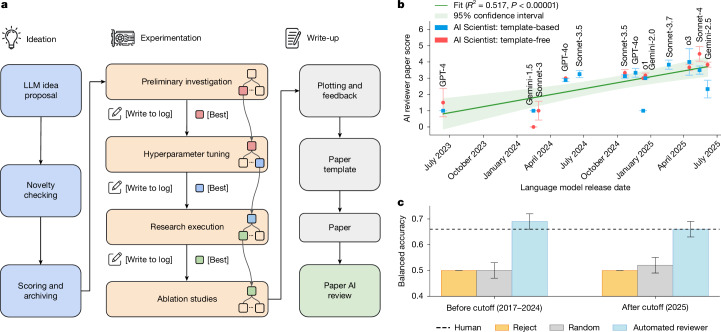
The automation of science is a long-standing ambition in artificial intelligence (AI) research 1,2 . Although the community has made substantial progress in automating individual components of the scientific process, a system that autonomously navigates the entire research life cycle—from conception to publication—has remained out of reach. Here we present a pipeline for automating the entire scientific process end to end. We present The AI Scientist, which creates research ideas, writes code, runs experiments, plots and analyses data, writes the entire scientific manuscript, and performs its own peer review. Its ideas, execution and presentation are of sufficient quality that the manuscript generated by this AI system passed the first round of peer review for a workshop of a top-tier machine learning conference. The workshop had an acceptance rate of 70%. Our system leverages modern foundation models 3–5 within a complex agentic system. We evaluate The AI Scientist in two settings: a focused mode using human-provided code templates as an initial scaffold for conducting research on a specific topic and a template-free, open-ended mode that leverages agentic search for wider scientific exploration 6,7 . Both settings produce diverse ideas and automatically test, report on and evaluate them. This achievement demonstrates the growing capacity of AI for making scientific contributions and signifies a potential paradigm shift in how research is conducted. As with any impactful new technology, there could be important risks, including taxing overwhelmed review systems and adding noise to the scientific literature. However, if developed responsibly, such autonomous systems could greatly accelerate scientific discovery.
Overview
CoChat Summary
TL;DR
The paper presents The AI Scientist, an agentic pipeline that autonomously generates machine-learning research ideas, code, experiments, plots, manuscripts, and peer reviews. One fully AI-generated manuscript received an average score of 6.33 (6, 7, 6) at an ICLR 2025 workshop, above the workshop’s average acceptance threshold, though it was withdrawn per protocol.
Key findings
- The AI Scientist completed an end-to-end research workflow; one of three submissions to the ICLR 2025 ICBINB workshop received an average score of 6.33 (individual scores 6, 7, 6), above the average acceptance threshold. The organizers said it would likely have been accepted if not withdrawn; the workshop acceptance rate was 70% versus 32% for the ICLR 2025 main conference.
- The Automated Reviewer performed comparably to human reviewers: balanced accuracy 69% versus 66%, and F1 score 0.62 versus 0.49 for inter-human agreement. On contamination checks, balanced accuracy decreased from 69% before the knowledge cutoff to 66% in the clean 2025 dataset, remaining comparable to human reviewers.
- Paper quality increased with better base models and more test-time compute; recent model generations produced papers approaching borderline acceptability for machine-learning conference workshops.
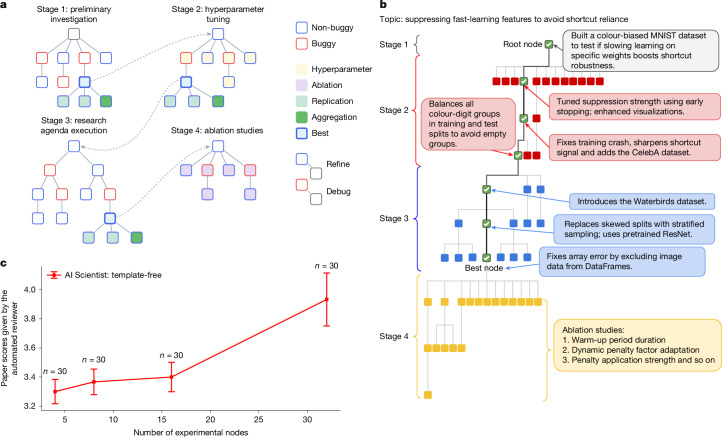
- The template-free system can generate its own starting code, uses agentic tree search, and typically takes from several hours to over 15 h depending on problem complexity.
Methods
- Two AI Scientist modes: template-based (human-provided code template, Aider, sequential plan with up to five experiments, 7,200 s timeout per experiment, up to four debug reattempts) and template-free (open-ended, parallelized agentic tree search, four experiment stages, VLM critique, HuggingFace dataset access, direct LaTeX generation). It uses foundation models including o3, Claude Sonnet 4, GPT-4o, o4-mini, and o1.
- The Automated Reviewer uses o4-mini, follows NeurIPS reviewer guidelines, produces structured scores and accept/reject decisions, and ensembles five reviews plus a meta-review acting as area chair. It was validated on ICLR OpenReview data, including 1,000 papers from 2017–2024 and a clean 2025 dataset.
- Human evaluation submitted three generated manuscripts to the ICLR 2025 ICBINB workshop with IRB approval and organizer cooperation; reviewers were blind to which submissions were AI-generated, and all AI-generated submissions were withdrawn after review regardless of outcome.
Limitations
- Stated: only one of three submissions was accepted, and workshops have much higher acceptance rates than main conferences (70% versus 32%). The AI Scientist cannot yet meet top-tier publication standards nor consistently meet workshop standards; failure modes include naive or underdeveloped ideas, incorrect implementations, lack of deep methodological rigour, experimental errors, duplicated figures, and hallucinations such as inaccurate citations.
- Stated: it currently conducts computational experiments only. Ethical and societal concerns include overwhelming peer review, artificially inflating research credentials, repurposing others’ ideas without credit, eliminating scientist jobs, and conducting unethical or dangerous experiments; more research is needed for safe, aligned open-ended exploratory AI.
- Evident from the text: human filtering selected the most promising outputs at each stage before submission, so the submitted set was not fully unfiltered autonomous output; the paper notes that without filtering, final papers would still be produced but along with other papers at greater total cost. The paper also states that the comparison between Automated Reviewer and human reviewers is not exact because ICLR and NeurIPS paper pools differ, creating a distribution shift.
Model-written summary. Check it against the paper before relying on it.
Integrity signals
Registry
Cites
Statistics
Figures
Verification
Claims the paper makes
2 Valid · 2 Not valid · 9 Not checked · 50 Own results and interpretations
A result the paper reports from its own data — it cites no other source for it, so there is none to check. The quote shows it is in the paper.
In the paper
“Furthermore, The Automated Reviewer shows that improvements to the base models significantly improve the quality of the generated papers”
§ Towards end-to-end automation of AI research > Main
boostedstates a cause- Asserted: passes — The authors put it forward as true.
- Checkable: passes — It can be checked against evidence.
- Load-bearing: passes — The paper’s conclusions depend on it.
- Based: passes — The paper gives a reason why it holds.
A result the paper reports from its own data — it cites no other source for it, so there is none to check. The quote shows it is in the paper.
In the paper
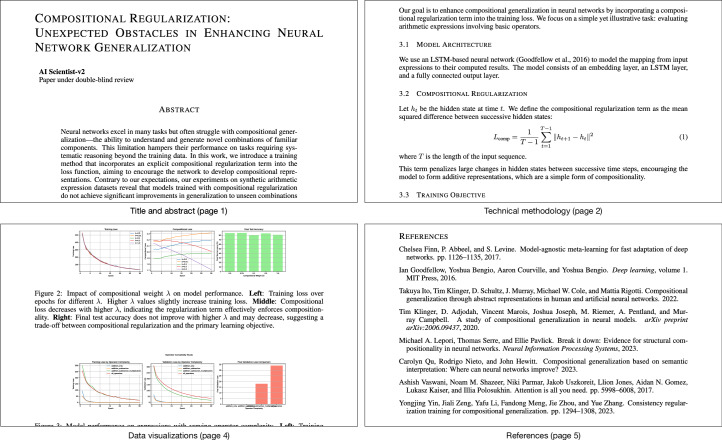
“One of the three AI-generated manuscripts received an average score of 6.33 from the reviewers (individual scores were 6, 7 and 6), placing it above the average acceptance threshold for the workshop (Fig. 2).”
§ Towards end-to-end automation of AI research > Human evaluation results
plainSingle case- Asserted: passes — The authors put it forward as true.
- Checkable: passes — It can be checked against evidence.
- Load-bearing: passes — The paper’s conclusions depend on it.
- Based: passes — The paper gives a reason why it holds.
- Rests on an assumption not shown here.
A result the paper reports from its own data — it cites no other source for it, so there is none to check. The quote shows it is in the paper.
In the paper
“Its ideas, execution and presentation are of sufficient quality that the manuscript generated by this AI system passed the first round of peer review for a workshop of a top-tier machine learning conference.”
- Also stated in: § Main · plain
“One of The AI Scientist’s manuscripts achieved high enough scores to exceed the average human acceptance threshold at a workshop, providing an example of a fully AI-generated paper successfully navigating a peer-review process, albeit one with a lower bar.”
§ Towards end-to-end automation of AI research > Abstract
plainSingle case- Asserted: passes — The authors put it forward as true.
- Checkable: passes — It can be checked against evidence.
- Load-bearing: passes — The paper’s conclusions depend on it.
- Based: passes — The paper gives a reason why it holds.
- Also stated in: § Main · plain
A result the paper reports from its own data — it cites no other source for it, so there is none to check. The quote shows it is in the paper.
In the paper
“The other two papers did not meet the bar for acceptance (Supplementary Table D9).”
§ Towards end-to-end automation of AI research > Human evaluation results
plain- Asserted: passes — The authors put it forward as true.
- Checkable: passes — It can be checked against evidence.
- Load-bearing: passes — The paper’s conclusions depend on it.
- Based: passes — The paper gives a reason why it holds.
None of the sources cited for this claim have been checked yet.
In the paper
“These results are statistically significant (non-parametric bootstrap test35 and two-sample z-test36; Supplementary Information section A.3).”
§ Towards end-to-end automation of AI research > Automated evaluation of generated papers
What the sources say
- Not checked — no full text of the sourcecites [35] Efron, B. & Tibshirani, R. J. An Introduction to the Bootstrap (Chapman & Hall CRC, 1993). source
- Not matchedcites [36] Lehmann, E. L. Testing Statistical Hypotheses 1st edn (Wiley, 1959).
Its entry has no title and year that we can search by.
plainstates an association- Asserted: passes — The authors put it forward as true.
- Checkable: passes — It can be checked against evidence.
- Load-bearing: passes — The paper’s conclusions depend on it.
- Based: passes — The paper gives a reason why it holds.
23 more claims
Create a free account to see all 63 claims and to verify the 3 references still open.
- It may state two separate claims as one. 20
- Probably not a substantial claim. 24
- The quote only partly states this claim. 1
Citations
Cites
Deep Residual Learning for Image Recognition
He, K., Zhang, X., Ren, S., & Sun, J. (2016) · 2016 IEEE Conference on Computer Vision and Pattern Recognition (CVPR) · doi:10.1109/cvpr.2016.90 · Cited by 235,474
Highly accurate protein structure prediction with AlphaFold
Jumper, J., Evans, R., Pritzel, A., Green, T., Figurnov, M., Ronneberger, O., Tunyasuvunakool, K., Bates, R., Žídek, A., Potapenko, A., et al. (2021) · Nature · doi:10.1038/s41586-021-03819-2 · Cited by 43,764
An Introduction to the Bootstrap
Efron, B., & Tibshirani, R. J. (1994) · doi:10.1201/9780429246593 · Cited by 40,500
An Introduction to the Bootstrap
Efron, B., & Tibshirani, R. J. (1993) · doi:10.1007/978-1-4899-4541-9 · Cited by 21,230
Neural Machine Translation by Jointly Learning to Align and Translate
Bahdanau, D., Cho, K., & Bengio, Y. (2014) · arXiv · doi:10.48550/arxiv.1409.0473 · Cited by 16,213
Decoupled Weight Decay Regularization
Loshchilov, I., & Hutter, F. (2017) · arXiv · doi:10.48550/arxiv.1711.05101 · Cited by 12,522
Transformers: State-of-the-Art Natural Language Processing
Wolf, T., Debut, L., Sanh, V., Chaumond, J., Delangue, C., Moi, A., Cistac, P., Rault, T., Louf, R., Funtowicz, M., et al. (2020) · Proceedings of the 2020 Conference on Empirical Methods in Natural Language Processing: System Demonstrations · doi:10.18653/v1/2020.emnlp-demos.6 · Cited by 8,741
Deep Learning Face Attributes in the Wild
Liu, Z., Luo, P., Wang, X., & Tang, X. (2015) · 2015 IEEE International Conference on Computer Vision (ICCV) · doi:10.1109/iccv.2015.425 · Cited by 7,747
Huang, L., Yu, W., Ma, W., Zhong, W., Feng, Z., Wang, H., Chen, Q., Peng, W., Feng, X., Qin, B., et al. (2025) · ACM Transactions on Information Systems · doi:10.1145/3703155 · Cited by 4,688 · cited 1×
“However, some AI weaknesses have proved surprisingly difficult to solve, such as AI being easily fooled 41,42 and overconfidently wrong (hallucinations) 43 , although progress has been made 44,45 .”
Deep neural networks are easily fooled: High confidence predictions for unrecognizable images
Nguyen, A., Yosinski, J., & Clune, J. (2015) · 2015 IEEE Conference on Computer Vision and Pattern Recognition (CVPR) · doi:10.1109/cvpr.2015.7298640 · Cited by 3,258 · cited 1×
“However, some AI weaknesses have proved surprisingly difficult to solve, such as AI being easily fooled 41,42 and overconfidently wrong (hallucinations) 43 , although progress has been made 44,45 .”
Self-citation
Research works printed but not linked: 16
- Lenat, D. B. Automated theory formation in mathematics. In Proc. 5th International Joint Conference on Artificial Intelligence 833–842 (ed. Reddy, R.) (William Kaufmann, 1977).
- The Claude 3 Model Family: Opus, Sonnet, Haiku https://api.semanticscholar.org/CorpusID:268232499 (Anthropic, 2024).
- Chan, J. S. et al. MLE-bench: evaluating machine learning agents on machine learning engineering. In Proc. 13th International Conference on Learning Representation (ed. Yue, Y. et al.) (ICLR, 2025).
- Faldor, M., Zhang, J., Cully, A. & Clune, J. OMNI-EPIC: open-endedness via models of human notions of interestingness with environments programmed in code. In Proc. 13th International Conference on Learning Representations (eds Yue, Y. et al.) (ICLR, 2025).
- Hu, S., Lu, C. & Clune, J. Automated design of agentic systems. In Proc.13th International Conference on Learning Representations (eds Yue, Y. et al.) (ICLR, 2025).
- Huang, Q., Vora, J., Liang, P. & Leskovec, J. MLAgentBench: evaluating language agents on machine learning experimentation. In Proc. 41st International Conference on Machine Learning Vol. 235 (eds Salakhutdinov, R. et al.) 20271–20309 (PMLR, 2024).
- Ma, Y. J. et al. Eureka: human-level reward design via coding large language models. In Proc. 12th International Conference on Learning Representations (eds Kim, B. et al.) (ICLR, 2024).
- González-Márquez, R. & Kobak, D. Learning representations of learning representations. In Proc. Data-centric Machine Learning Research (DMLR) Workshop at ICLR (ICLR, 2024).
- Beygelzimer, A., Dauphin, Y., Liang, P. & Vaughan, J. W. The NeurIPS 2021 consistency experiment. NeurIPSBlog https://blog.neurips.cc/2021/12/08/the-neurips-2021-consistency-experiment (2021).
- Lehmann, E. L. Testing Statistical Hypotheses 1st edn (Wiley, 1959).
- I Can’t Believe it’s Not Better: Challenges in Applied Deep Learning. ICLR Workshop at ICLR 2025 http://openreview.net/group?id=ICLR.cc/2025/Workshop/ICBINB (OpenReview, 2025).
- 13th Annual International Conference on Learning Representations (ICLR) 2025 Fact Sheet https://media.iclr.cc/Conferences/ICLR2025/ICLR2025_Fact_Sheet.pdf (ICLR, 2025).
- Szegedy, C. et al. Intriguing properties of neural networks. In Proc. 2nd International Conference on Learning Representations (eds Bengio, Y. & LeCun, Y.) (ICLR, 2014).
- Brown, T. et al. Language models are few-shot learners. In Proc. Advances in Neural Information Processing Systems Vol. 33 (eds Larochelle, H. et al.) 1877–1901 (Curran Associates, 2020).
- Vaswani, A. et al. Attention is all you need. In Advances in Neural Information Processing Systems (eds Guyon, I. et al.) Vol. 30, 5998–6008 (Curran Associates, 2017).
- El-Kishky, A. OpenAI o1 System Card https://api.semanticscholar.org/CorpusID:272648256 (OpenAI, 2024).
Cited by
Bellodi, P., Casavecchia, P., Paparella, A., Sciavicco, G., & Stan, I. E. (2025) · Leibniz international proceedings in informatics · doi:10.4230/lipics.time.2025.4 · Cited by 117
A multi-agent system for automating scientific discovery
Ghareeb, A. E., Chang, B., Mitchener, L., Yiu, A., Szostkiewicz, C. J., Shved, D., Gyimesi, G. J., Laurent, J. M., Wright, S. M., Razzak, M. T., et al. (2026) · Nature · doi:10.1038/s41586-026-10652-y · Cited by 128
Kim, S., Yoon, D., Gashteovski, K., Suk, J., Baek, J., Aggarwal, P., Wu, I., Zaverkin, V., Petkoski, S., Schrider, D. R., et al. (2026) · arXiv · doi:10.48550/arxiv.2605.20668 · Cited by 15
Why AI cannot do good science without humans
(2026) · Nature · doi:10.1038/d41586-026-01551-3 · Cited by 10
The uncritical adoption of AI in science is alarming — we urgently need guard rails
Messeri, L., & Crockett, M. J. (2026) · Nature · doi:10.1038/d41586-026-01557-x · Cited by 7
Enhancing soil science research with multi-agent artificial intelligence systems
Minasny, B., McBratney, A., Demattê, J. A. M., Dobarco, M. R., & Smith, P. (2026) · Frontiers in Science · doi:10.3389/fsci.2026.1721295 · Cited by 7
“The concept of an “ AI scientist ” or “ co-scientist ”— an AI system capable of skeptical learning, reasoning, and collaboration — has been proposed as a framework for generating novel scienti fi c hypotheses aligned with researcher objectives (8, 37, 38).”
AI and the Future of Publishing: Not Detection, but Answerability
Floridi, L. (2026) · Philosophy & Technology · doi:10.1007/s13347-026-01148-8 · Cited by 8
“…that generates research ideas, runs experiments, drafts papers, and reviews them; one fully AI-generated manuscript received reviewer scores of 6.33 out of 10 at an ICLR 2025 workshop, above the venue average, though the workshop accepted roughly 70 per cent of submissions (Lu et al., 2026).”
InfluentialReimagining research papers as interactive and reliable AI agents
Miao, J., Davis, J. R., Zhang, Y., Pritchard, J. K., & Zou, J. (2026) · Nature · doi:10.1038/s41586-026-11044-y · Cited by 88
Decoding complexity through machine learning is redefining scientific discovery
Vinuesa, R., Cinnella, P., Rabault, J., Azizpour, H., Bauer, S., Brunton, B. W., Elofsson, A., Jarlebring, E., Kjellström, H., Markidis, S., et al. (2026) · Communications Physics · doi:10.1038/s42005-026-02676-7 · Cited by 21
“Early demonstrations include “ The AI Scientist ” 134 , which auto-generates ideas, runs experiments and drafts papers, and an AI co-scientist that proposes and iteratively improves hypotheses with multi-agent debate and different validations in biomedicine 48 .”
AI scientists are changing research — institutions, funders and publishers must respond
(2026) · Nature · doi:10.1038/d41586-026-00934-w · Cited by 13
AI can help scientists publish less
Bertone, G. (2026) · Nature Astronomy · doi:10.1038/s41550-026-02900-y · Cited by 5
Gaikwad, A. S., B.Pawar, S., & Rajguru, M. K. (2026) · Journal of Pharmaceutical Innovation · doi:10.1007/s12247-026-10841-2 · Cited by 2
“By automating these processes, AI not only reduces manual effort but also improves consistency and reproducibility across analyses [ 145, 146].”
Zhehao, D. O. N. G., Shanghai, D. U., Lu, Z., & Yue, Y. A. N. G. (2026) · Chinese Journal of Aeronautics · doi:10.1016/j.cja.2026.104321 · Cited by 11
Ding, H., Shen, Y., Chen, J., & Wang, P. (2026) · Information Processing & Management · doi:10.1016/j.ipm.2026.105046 · Cited by 6
Risk of AI-Generated Results in Energy Research
Sivula, K. (2026) · ACS Energy Letters · doi:10.1021/acsenergylett.6c01145 · Cited by 1
(2026) · Nature Methods · doi:10.1038/s41592-026-03104-y · Cited by 2
Tech-oligarchic visions of automated science: lessons from Franz Neumann’s Behemoth
Söderberg, J. A. (2026) · Science as Culture · doi:10.1080/09505431.2026.2671978 · Cited by 1
Puché, A. C., & Sultan, A. S. (2026) · Head and Neck Pathology · doi:10.1007/s12105-026-01924-0 · Cited by 1
Meng, T., Liang, H., & LiXing, K. A. N. G. (2026) · Chinese Science Bulletin (Chinese Version) · doi:10.1360/csb-2026-0605 · Cited by 1
Artificial intelligence in drug development: From molecular discovery to precision medicine
Xie, T., Zhang, Z.-H., Wang, Y.-S., Wang, H., Chen, X., Han, F., & Shao, F. (2026) · Genes & Diseases · doi:10.1016/j.gendis.2026.102402 · Cited by 1
Liu, J., Cai, A., Zhang, H., Zhang, Y., & Pang, Q. (2026) · Chemometrics and Intelligent Laboratory Systems · doi:10.1016/j.chemolab.2026.105873 · Cited by 1
How to build an AI scientist: first peer-reviewed paper spills the secrets
Castelvecchi, D. (2026) · Nature · doi:10.1038/d41586-026-00899-w · Cited by 1
Krammer, S. M. S. (2026) · SSRN Electronic Journal · doi:10.2139/ssrn.6717418 · Cited by 1
“As reported in Nature (Lu et al., 2026) , this represents something genuinely new: an autonomous system passing what amounts to a Turing test 1 , albeit a milder version, for scientific quality.”
New ‘AI scientists’ are improving – but reveal their fundamental limits
Verspoor, K. M. (2026) · The Conversation · doi:10.64628/aa.994m56a9e · Cited by 1
Baker, C., Ren, T., Rafferty, K., Wang, H., & McDade, S. S. (2026) · bioRxiv (Cold Spring Harbor Laboratory) · doi:10.64898/2026.07.05.736565 · Cited by 1
“Seminal agentic platforms heavily rely on proprietary cloud APIs to execute their reasoning loops 6,9 .”
The Red Queen Gödel Machine: Co-Evolving Agents and Their Evaluators
Iacob, A., Jovanović, A., Shen, W. F., Burkhardt, D., Kurmanji, M., Tastan, N., Sani, L., Venanzi, N. A. E., Nie, J., Odonnat, A., et al. (2026) · arXiv · doi:10.48550/arxiv.2606.26294 · Cited by 32
“We use the Sakana prompt reviewer [14] for paper writing, ProofAutoGrader [7] for proof grading, and the IMO25 prover [52].”
InfluentialTakahashi, K. (2026) · Zenodo (CERN European Organization for Nuclear Research) · doi:10.5281/zenodo.19447443
Research Automation in Healthcare: Scoping Review with ☸️SAIMSARA
SAIMSARA (2026) · SAIMSARA Journal · doi:10.62487/saimsaraed91d2be
Ιn the Era of Aι: We Will All Be Happy if Everyone Chooses What Purpose They Are Intended ForPreprint
Gioannis, P. (2026) · SSRN Electronic Journal · doi:10.2139/ssrn.6290658
Machine learning in ecology: Current status and future directions in the big data era
WU, J., Luo, Y., Liu, F., Liao, C., Wang, Y., He, H., Tong, D., Liu, Z., Zhao, Y., Meng, X., et al. (2026) · Geography and sustainability · doi:10.1016/j.geosus.2026.100533 · Cited by 1
Artificial intelligence agents for the life sciences and drug discovery
Bajorath, J. (2026) · Artificial Intelligence in the Life Sciences · doi:10.1016/j.ailsci.2026.100172 · Cited by 2
Guo, H., Liang, Y., Cheng, X., Ellington, C. N., Xie, P., Song, L., & Xing, E. P. (2026) · bioRxiv (Cold Spring Harbor Laboratory) · doi:10.64898/2026.04.20.719735 · Cited by 1
“First, the efficacy of the agentic system is fundamentally restricted by the reasoning, planning, and coding capabilities of the underlying large language model [32].”
InfluentialLayered Online Service and Replay Control for Verified AI R and D AccelerationPreprint
Takahashi, K. (2026) · Zenodo (CERN European Organization for Nuclear Research) · doi:10.5281/zenodo.19836224
Transforming the cytokine literature into a resource for experimental analysis and discoveryPreprint
Oesinghaus, L., Park, M., Shao, R., Koh, P. W., & Seelig, G. (2026) · bioRxiv (Cold Spring Harbor Laboratory) · doi:10.64898/2026.05.04.722753
“They can retrieve scientific knowledge 12 , produce encyclopedia-like summaries 13 , propose novel scientific hypotheses 14,15 , assist in experimental data evaluation 16 , and even perform end-to-end scientific workflows 17 .”
Robotic perturbation proteomics and AI agents enable scalable drug mechanism discoveryPreprint
Jiang, Y., Movassaghi, C. S., Muñoz‐Estrada, J., Sundararaman, N., Momenzadeh, A., & Meyer, J. G. (2026) · bioRxiv (Cold Spring Harbor Laboratory) · doi:10.64898/2026.05.04.722718
“20,21 .”
Kazemeini, A., Prieto, J., Kuttae, S. B., Siokis, A., Gallagher, C., Klabunde, T., Singh, G., Andreani, T., & Passban, P. (2026) · bioRxiv (Cold Spring Harbor Laboratory) · doi:10.64898/2026.05.06.723244
“Agentic systems such as Talk2BioModels (Wehling et al., 2025), Talk2KnowledgeGraph (Singh et al., 2025), Biomni-A1 (Huang et al., 2025), MEDEA (Sui et al., 2026), BioMedAgent (Bu et al., 2026), and The AI Scientist (Lu et al., 2026) demonstrate capabilities including mechanistic model interrogation, hypothesis generat…”
Constraint Generative Theory: Typed Constraint Effects and Scientific AvailabilityPreprint
Takahashi, K. (2026) · Zenodo (CERN European Organization for Nuclear Research) · doi:10.5281/zenodo.20199440
AI for battery-accelerated discovery of high-voltage electrolytes for advanced lithium batteries
Zhan, Y. Z., Chen, N., Li, L., Wu, F., & Chen, R. (2026) · Chemical Society Reviews · doi:10.1039/d4cs01250j · Cited by 1
Wie billige Künstliche Intelligenz die Arbeitsplätze von Geistesarbeitern vernichtet
Spitzer, M. (2026) · Nervenheilkunde · doi:10.1055/a-2836-3442
An AI-powered trisomy 21 Research Assistant
Nandi, S., Sundararajan, Z., Subirana-Granés, M., Espinosa, J. M., Pividori, M., Sullivan, K. D., Galbraith, M. D., & Costello, J. C. (2026) · Scientific Reports · doi:10.64898/2026.06.08.730893
“…gene-set analysis using curated biological databases (Wang et al. 2025), LLM-derived embeddings for single-cell biology (Chen and Zou 2024), automated conversion of research papers into interactive AI agents (Miao et al. 2025), and end-to-end autonomous AI research pipelines (Lu et al. 2026).”
GALILEO: Embodied AI scientist for autonomous therapeutic discovery in dynamic membrane systemsPreprint
Jiang, N., Wei, R., Xiao, H., Yin, Z., Wang, X., Cui, T., Shao, K., Zhou, J., Fan, J., Torr, P. H. S., et al. (2026) · bioRxiv (Cold Spring Harbor Laboratory) · doi:10.64898/2026.06.10.731360 · Cited by 1
“10 There is an urgent need to address this missing physical axis by asking whether agentic autonomy can close a therapeutic-68 intervention loop in living biological systems.”
From AI Agents to AI Scientists in Health: Emerging Landscape, Challenges, and the Path ForwardPreprint
Chen, Q., Wang, X., Zhou, R., Kim, H., Wang, S., Zhao, W., Liu, T., Riaz, I., He, L., Zhao, Y., et al. (2026) · SSRN Electronic Journal · doi:10.2139/ssrn.6889798 · Cited by 3
Dhahbi, W., Briki, W., & Chamari, K. (2026) · SSRN Electronic Journal · doi:10.2139/ssrn.6956772
Academic Publishing in the Age of Generative AI
Hanneke, B., Hering, F., Pfeiffer, J., Reijers, H. A., & Hinz, O. (2026) · Business & Information Systems Engineering · doi:10.1007/s12599-026-01013-0 · Cited by 3
“Researchers design and operate end-to-end agentic pipelines that generate, test, refine, and document scientific outputs (Lu et al. 2026).”
Practical Use of Advanced AI Frameworks on Real-Life Scientific Problems: Three Case StudiesPreprint
Gulluoglu, H. S. A., Baby, J., Bagul, K. M., Basangari, B. R., Bathini, S. A., Chalamalla, N. K. R., Dcunha, J., Gupta, O., Huang, L., Jiang, X., et al. (2026) · bioRxiv (Cold Spring Harbor Laboratory) · doi:10.64898/2026.06.23.734132 · Cited by 2
IA para los datos, Ciencia para el criterio: un modelo de trabajo para la investigación científica
Rodríguez, A. M., & Reyes, C. E. Y. (2026) · Anales de química · doi:10.62534/rseq.aq.2123
Artificial Intelligence for Discovery in Life Sciences
Chanda, S., Rizzoli, S. O., & Shaib, A. (2026) · Bioconjugate Chemistry · doi:10.1021/acs.bioconjchem.6c00230 · Cited by 1
Messy Research, Certification and the Monetization of SciencePreprint
Fourie, J. (2026) · SSRN Electronic Journal · doi:10.2139/ssrn.7045002
Verifier Ecology Theory: Packetized Self-Verification Under Residual AccountabilityPreprint
Takahashi, K. (2026) · Zenodo (CERN European Organization for Nuclear Research) · doi:10.5281/zenodo.21147093 · Cited by 1
Bajorath, J. (2026) · Journal of Computer-Aided Molecular Design · doi:10.1007/s10822-026-00870-x
The creeping normality of AI in the life sciences
Jarić, I., Pipek, P., Canavan, S., Firth, J. A., & Bertram, M. G. (2026) · Frontiers in Ecology and the Environment · doi:10.1002/fee.70059 · Cited by 1
Consensus on future research directions in the phylum Rotifera
Macêdo, R. L., Udina, C. S., Borup, M. D., Jiménez‐Santos, M. A., Arenas‐Sánchez, C., Branco, C. W. C., Costa, K., Kozlowsky‐Suzuki, B., Bonecker, C. C., Walsh, E. J., et al. (2026) · Limnology and Oceanography · doi:10.1002/lno.70430 · Cited by 2
Mehta, N., Benjamin, J. C., Mehta, S., Valanci, S., MacNeill, H., & Masters, K. (2026) · Medical Teacher · doi:10.1080/0142159x.2026.2681971
Rosenkrantz, A. B. (2026) · American Journal of Roentgenology · doi:10.2214/ajr.26.35529 · Cited by 1
Surfacing the Invisible: AI and the IS Discipline
Agarwal, R., Padmanabhan, B., & Liu, Y. (2026) · ACM Transactions on Management Information Systems · doi:10.1145/3828556
“…hope, optimism and enthusiasm that marvels at the efficiency, productivity, and creativity benefits of this remarkable technology [Si et al. 2025; Lu et al. 2026], to deep concerns about whether the infusion of AI is destroying the core foundations of what research and discovery means [Messeri…”
Aithal, P. S. (2026) · Poornaprajna International Journal of Management Education & Social Science (PIJMESS) · doi:10.64818/pijmess.3107.4626.0056
Evolution and Future of Mission-Oriented Innovation PolicyPreprint
Ho, M., & O’Sullivan, E. (2026) · SSRN Electronic Journal · doi:10.2139/ssrn.7056359
The Next Fifty Years: Drug Discovery in the Age of the Computational Self
Gramatikoff, K., Judge, E., & Brusgaard, K. (2026) · The EuroBiotech Journal · doi:10.2478/ebtj-2026-0018
How experience moderates the impact of AI suggestions on researchers' perceptions of their ideas
Troebinger, M., Doshi, A. R., & Chai, S. (2026) · Research Policy · doi:10.1016/j.respol.2026.105575 · Cited by 1
Editorial: Publishing Physical Sciences in the Era of AI
Ceriotti, M., Krenn, M., Lee, A. B., Marzari, N., Nachman, B. P., Pettee, M., & von Lilienfeld, O. A. (2026) · PRX Intelligence · doi:10.1103/prxintell.1.010001 · Cited by 2
“Potentially, scaling data and models could eventually render expert intuition obsolete, reducing scientists to mere users who prompt machines to execute research autonomously in black-box fashion [7–9].”
Vibe researching: can AI agents with skills replace or augment social scientists?
Zhang, Y. (2026) · Chinese Sociological Review · doi:10.1080/21620555.2026.2707167 · Cited by 8
Reaction: Navigating the path to reasoning laboratories
Sin, J. W., Segura, D. M., Winkler, R., & Schwaller, P. (2026) · Chem · doi:10.1016/j.chempr.2026.103147
Scholarly Publications in an Era of Artificial Intelligence
Taylor, E. (2026) · HERD Health Environments Research & Design Journal · doi:10.1177/19375867261471760
“To be clear, in this case, the AI-generated end-to-end research and paper was an experiment and was both approved by an Institutional Review Board and submitted with the consent of the organizers of a top-tier machine learning conference in early 2025 (Lu et al., 2026).”
Differentiated memory and scientific cognition in AI research agents
Cuadros, D. F., Maiga, A.-A., Thatham, S., Ortiz, A., Powers‐Fletcher, M. V., & Tang, M. (2026) · Frontiers in Big Data · doi:10.3389/fdata.2026.1916523
AI isn’t ready to research itself
Hutson, M. (2026) · Nature · doi:10.1038/d41586-026-02494-5
The AI scientist arrives: a new epoch in autonomous discovery
Ying, G. (2026) · Artificial Intelligence & Environment · doi:10.66178/aie-0026-0017
The black-box future of ecology and conservation
Jarić, I., Pipek, P., Anderson, K., Baktoft, H., Bertram, M. G., Canavan, S., Elliott, L. R., Říha, M., & Gaston, K. J. (2026) · BioScience · doi:10.1093/biosci/biag119
AI-driven Acceleration and the Evaluation Bottleneck in Science: A Conceptual FrameworkPreprint
Rana, P., Varshney, L. R., & Varshney, K. R. (2026) · SSRN Electronic Journal · doi:10.2139/ssrn.7318643
Beyond Fixed Information: Endogenous Construction of Inquiry InterfacesPreprint
Akhtar, M. A. K. (2026) · SSRN Electronic Journal · doi:10.2139/ssrn.7345322
He, T., Zhang, S., Chen, J., Zheng, X., Zhao, J., Li, H., Mao, J., Luo, J., Zheng, J., Ma, D., et al. (2026) · iMetaOmics. · doi:10.1002/imo2.70133 · Cited by 1
The future of AI-assisted science is both fast and slow
Moriguchi, Y., & Kanakogi, Y. (2026) · Nature Human Behaviour · doi:10.1038/s41562-026-02574-6 · Cited by 1
How generative AI is transforming agri-food systems research
Verdouw, C., Vlek, R. J., Tummers, J., van Rooijen, L., Ge, L., & Wolfert, J. (2026) · Trends in Food Science & Technology · doi:10.1016/j.tifs.2026.106052
Vidhani, D. V., Sautie, T., Vidhani, D., Marquez, D., Casanueva, M., Vyas, P. A., & Mariappan, M. (2026) · Chemistry · doi:10.3390/chemistry8090121 · Cited by 1
Reimagining biomedical science workflows in the age of large language models
Roberts, K. F., Koutarapu, S., Melendez, J., Landsness, E. C., Reese, J. T., Elbert, D. L., & Bateman, R. J. (2026) · npj Dementia · doi:10.1038/s44400-026-00126-3
Reproducibility in the Era of AI Agents
Lin, J. (2026) · SIGIR Forum · doi:10.1145/3841298.3841310 · Cited by 1
“It is inevitable in the near future that agents will drive all these efforts and propose novel ideas on the path to recursive self-improvement [Si et al., 2024; Tao, 2025; Bubeck et al., 2025; Lyu et al., 2026; Lu et al., 2026; Ghareeb et al., 2026; Gottweis et al., 2026].”
Zheng, Q., Li, Y., Zhang, Y., Zhao, Y., Koh, H. Y., Wan, Z., Ren, H., Huang, C., Shi, Y., Wu, Z., et al. (2026) · bioRxiv (Cold Spring Harbor Laboratory) · doi:10.64898/2026.09.02.748775
Wu, Y.-L., Fu, D. J., Zhou, Y., Wagner, S. K., & Keane, P. A. (2026) · Journal of Medical Internet Research · doi:10.2196/99597 · Cited by 2
“Our findings indicate that analysis plans or numerical outputs alone cannot be assumed to confirm analytical correctness [26-28] and propose a concrete oversight framework that mandates expert verification of specific components of the code before AI-assisted research can be safely interpreted for…”
AI subsidies as a tool for redistribution
Parmentier, L. (2026) · Economic Modelling · doi:10.1016/j.econmod.2026.107817
Investigación científica en la era de la inteligencia artificial
Pluas, R. E. M., Fernández-Loor, A. O., Mendizábal, V. L. L., Sánchez-Vivanco, J. P., Urbano, A. P. M., & Angulo, R. M. M. (2026) · doi:10.70577/pd8w9r97
Lindebaum, D. (2026) · Academy of Management Learning and Education · doi:10.5465/amle.2026.0628 · Cited by 1
Molinaro, G., Collins, A. G. E., Oudeyer, P., & Colas, C. (2026) · Current Opinion in Behavioral Sciences · doi:10.1016/j.cobeha.2026.101684 · Cited by 1
Guellec, B. L., Bentegeac, R., Boyer, L., Celi, L. A., Boussat, B., & Hamroun, A. (2026) · Journal of Epidemiology and Population Health · doi:10.1016/j.jeph.2026.203798 · Cited by 1
AI co-scientists are revolutionizing how research is done
Dolgin, E. (2026) · Nature · doi:10.1038/d41586-026-02931-5
Agentic campaign control for high-throughput de novo binder designPreprint
Jeon, M., Song, J., Kim, J., & Zhong, E. D. (2026) · bioRxiv (Cold Spring Harbor Laboratory) · doi:10.64898/2026.09.22.753604 · Cited by 3
Zhang, C., Geng, Y., Zhang, J., Wang, F., & Chen, Q. (2026) · Energy Use · doi:10.59717/ipj.energy-use.2026.100063
Han, D., Guo, J., Zhang, Y., et al. (2026) · Environmental Fluid Mechanics · doi:10.1007/s10652-026-10110-3
Scientific Writing, Peer Review, and Artificial Intelligence
BaHammam, A. S. (2026) · Sleep Medicine Clinics · doi:10.1016/j.jsmc.2026.08.004
Xie, M., Dong, Y., Guo, J., He, J., Wang, R., Martinez, J. A., & Zhu, R. (2026) · Journal of Nutrition · doi:10.1016/j.tjnut.2026.101852
AI-Directed Research and the Loss of Scientific Direction
Kim, J. W. (2026) · International Neurourology Journal · doi:10.5213/inj.2626edi03
“Systems incorporating this loop have already been described by Lu et al. [10] in Nature , where The AI Scientist connects idea generation and literature search to computational experimentation, manuscript writing, and automated review.”
Jeon, J. (2026) · The Plant Pathology Journal · doi:10.5423/ppj.oc.07.2026.0091
An AI-powered cloud biofoundry for autonomous biological researchPreprint
Chen, J., Volk, M. J., Shafaei, S., Tan, S., Upadhyay, V., Singh, N., Zhong, X., Arneson, K., He, W., Wang, C., et al. (2026) · bioRxiv (Cold Spring Harbor Laboratory) · doi:10.64898/2026.09.30.750244 · Cited by 2
Predicting the long-term impact of AI assistants on collective intelligencePreprint
Kim, J., & Park, S. W. (2026) · bioRxiv (Cold Spring Harbor Laboratory) · doi:10.64898/2026.09.29.755292
Artificial Intelligence in Research and Academic Publication
Zhang, Y., & Xie, Q. (2026) · IEEE Intelligent Systems · doi:10.1109/mis.2026.3726702
“40 From a societal point of view, safety and ethics are important issues in conducting automated research.”
Nam, Y., Jeong, J., & Kim, N. (2026) · arXiv · doi:10.48550/arxiv.2606.09500 · Cited by 4
MLEvolve: A Self-Evolving Framework for Automated Machine Learning Algorithm Discovery
Du, S., Yan, X., Shi, J., Cao, Z., Feng, S., Liang, Z., Sun, B., Guo, X., Peng, T., Zhou, Y., et al. (2026) · arXiv · doi:10.48550/arxiv.2606.06473 · Cited by 31
Life After Benchmark Saturation: A Case Study of CORE-Bench
Nadgir, N., Kapoor, S., Liu, K., Kirgis, P., Orona, M., Rabanser, S., Bayer, T., Shetty, A., Ling, Y., Chan-Sew, D., et al. (2026) · arXiv · doi:10.48550/arxiv.2606.26158
“AI agents are increasingly deployed across a wide range of domains, including customer service [56], software engineering [3], legal services [25], financial analysis [17], and scientific discovery [37].”
TRACES: A Benchmark for Epistemic Reliability in Scientific Reasoning by LLMs
Rodionov, V., & Assylbekov, S. (2026) · arXiv · doi:10.48550/arxiv.2608.11415 · Cited by 2
Recursive self-improvement of AI research agents
Srikanth, D., Zhao, B., Xu, D., Wu, Y., & Jiang, Z. (2026) · arXiv · doi:10.48550/arxiv.2609.26457
Structured Scaling of AI Discovery Across Diverse Scientific Domains
Ye, H., Lin, H., Tang, J., Luo, Y., Thapa, R., Yang, C., Su, C., Yang, R., Liu, R., Li, R., et al. (2026) · arXiv · doi:10.48550/arxiv.2604.19341
Metadata
- Authors
- Lu, C., Lu, C., Lange, R. T., Yamada, Y., Hu, S., Foerster, J., Ha, D., & Clune, J.
- Affiliations
- University of British Columbia (CA)
- Sakana AI (Japan) (JP)
- University of Oxford (GB)
- Corresponding author
- Yamada, Yutaro
- Ha, David
- Clune, Jeff
- Venue
- Nature
- Published
- 2026-03-25
- Volume
- 651
- Issue
- 8107
- Pages
- 914-919
- ISSN
- 0028-0836 (ISSN-L)
- 1476-4687
- PMC
- PMC13017497
- OpenAlex
- W7140287209
- Semantic Scholar
- b73e2b7ffbb00b03b795dc8b5e732a8859470249
- Cited by
- 116
- References
- 41
- Citations by year
- 2026: 115
- FWCI
- 387.07
- Type
- journal article
- Language
- en
- Open access
- hybrid
- doi.org
- Licence
- cc-by
- creativecommons.org/licenses/by/4.0 (tdm)
- creativecommons.org/licenses/by/4.0 (vor)
- Locations
- Nature (publishedVersion, cc-by)
- PubMed Central (publishedVersion, cc-by)
- PubMed (publishedVersion)
- Funders
- Canadian Institute for Advanced Research
- Natural Sciences and Engineering Research Council of Canada
- Topics
- Physical Sciences › Computer Science › Artificial Intelligence › Artificial Intelligence Applications
- Social Sciences › Decision Sciences › Information Systems and Management › Scientific Computing and Data Management
- Social Sciences › Library and Information Sciences › Academic Writing and Publishing
- Keywords
- research idea generation, code generation, manuscript preparation, peer review, foundation models, agentic systems, agentic search, research lifecycle, machine learning conferences
- MeSH terms
- Machine Learning, Artificial Intelligence, Automation, Humans, Research, Research Personnel, Peer Review, Research
About these checks
Registry, retraction, Cites and statistics results are computed, not judged, with one exception: a printed reference that no index lists is read once by a model before it counts as a citation error. Claims are extracted by a model and kept only when their quote appears verbatim in the text; each cited source is then checked, with a model’s help, for whether it says what the claim relies on. Those verdicts can be wrong — read the claim’s quote and the cited source before relying on one.
The claim verdicts this report counts are experimental: their accuracy is not yet measured.
A language model drew the claims from the paper on 2026-09-28, under version 3 of the claim definition (model deepseek-v4.1-flash, prompt extract-v3).
A second model labelled each claim on 2026-09-28 (model jev-1.13-20260917, definition revision gold-guideline-v0.2).
Statistics and arithmetic are recomputed, not judged.
Confidence bands are shown only for fields calibrated on our annotated test set. None is calibrated yet, so no band is shown.
What counts as a claim ›How we measure confidence ›How we check this ›
Are you an author, or do you see a problem with this page? Request a review
Data sources
Bibliographic data: Semantic Scholar, OpenAlex, Crossref.
Contains information from the Semantic Scholar Academic Graph Datasets, made available under the ODC Attribution License (ODC-BY 1.0).
Semantic Scholar’s data is described in: Kinney, R., et al. (2023). The Semantic Scholar Open Data Platform. arXiv:2301.10140.
