

The DOI matches its Crossref record; 55 of the 57 references it cites were found in a registry or an index.
Modular cytokine receptor-targeting chimeras for targeted degradation of cell surface and extracellular proteins
Open accessAbstract
Targeted degradation of cell surface and extracellular proteins via lysosomal delivery is an important means to modulate extracellular biology. However, these approaches have limitations due to lack of modularity, ease of development, restricted tissue targeting and applicability to both cell surface and extracellular proteins. We describe a lysosomal degradation strategy, termed cytokine receptor-targeting chimeras (KineTACs), that addresses these limitations. KineTACs are fully genetically encoded bispecific antibodies consisting of a cytokine arm, which binds its cognate cytokine receptor, and a target-binding arm for the protein of interest. We show that KineTACs containing the cytokine CXCL12 can use the decoy recycling receptor, CXCR7, to target a variety of target proteins to the lysosome for degradation. Additional KineTACs were designed to harness other CXCR7-targeting cytokines, CXCL11 and vMIPII, and the interleukin-2 (IL-2) receptor-targeting cytokine IL-2. Thus, KineTACs represent a general, modular, selective and simple genetically encoded strategy for inducing lysosomal delivery of extracellular and cell surface targets with broad or tissue-specific distribution.
Overview
The claims and statistics of this paper haven’t been checked yet.
Run the check — free, no account needed. It reads the open-access text and checks the sources it cites.
Integrity signals
Registry
Cites
Statistics
Figures
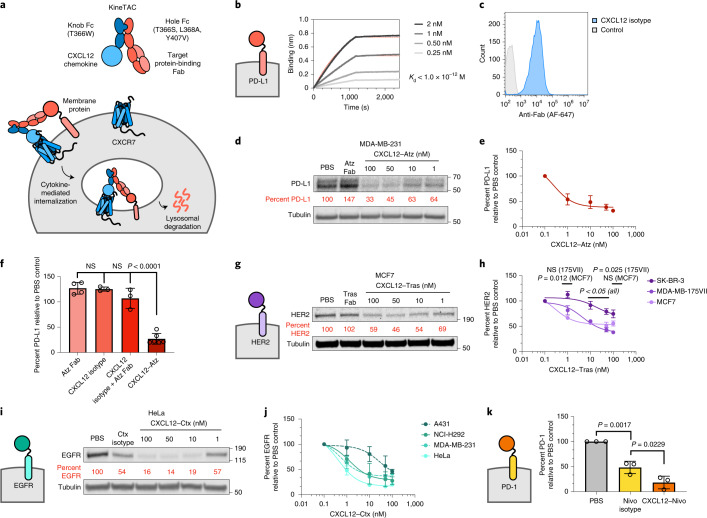
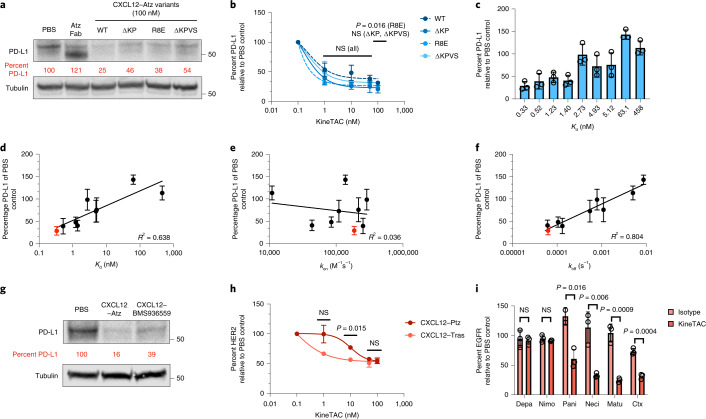
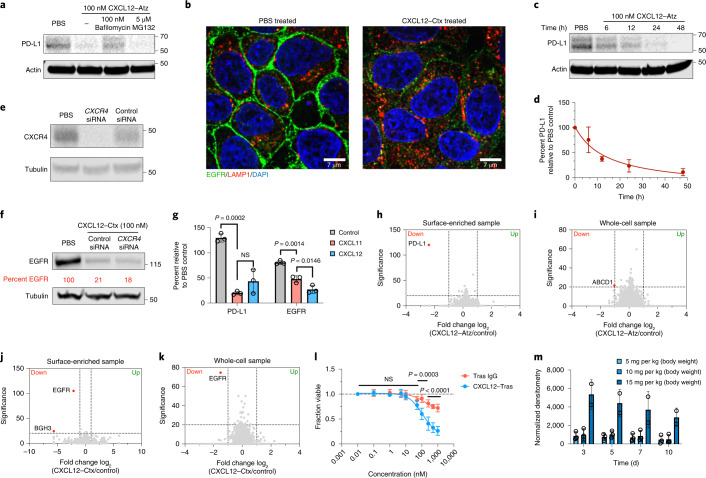
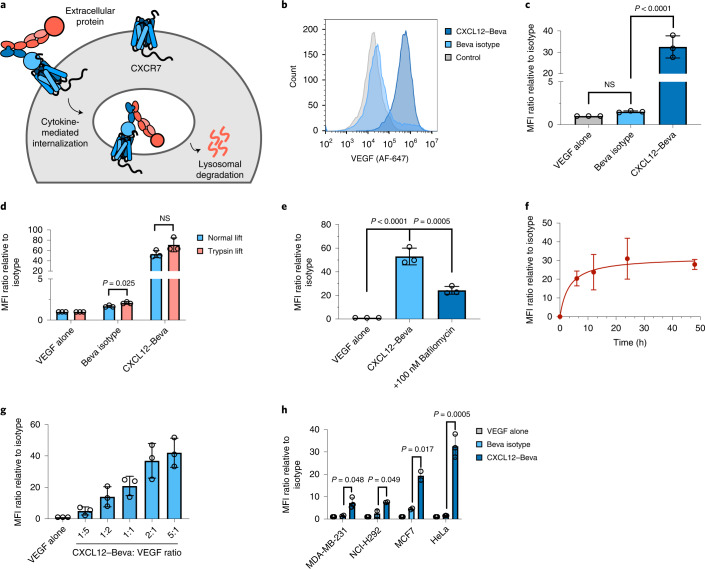
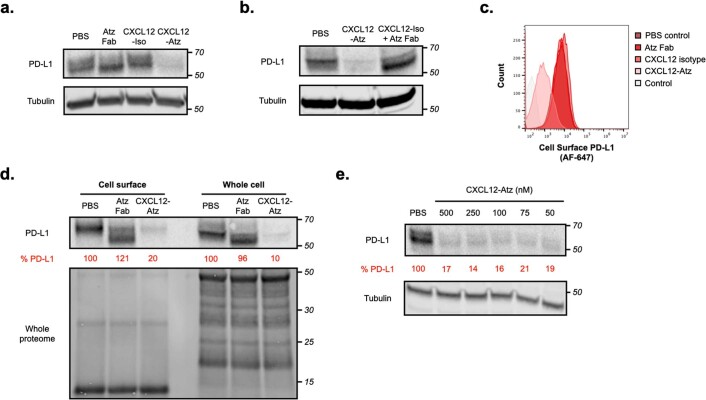
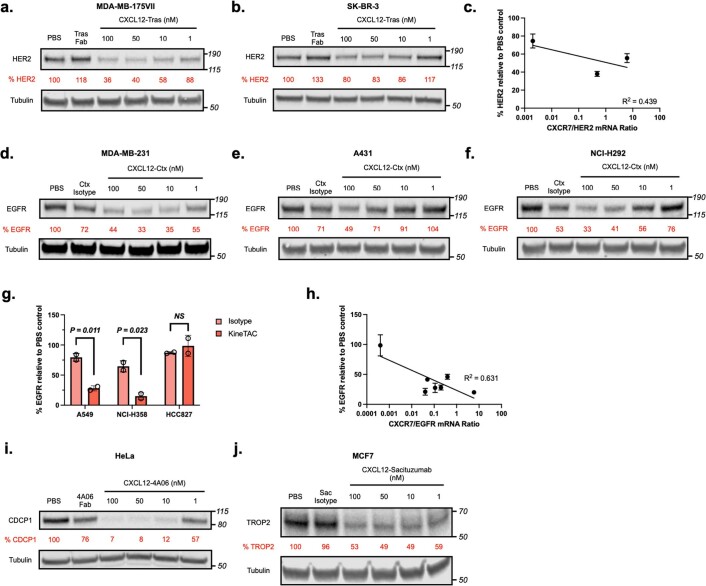
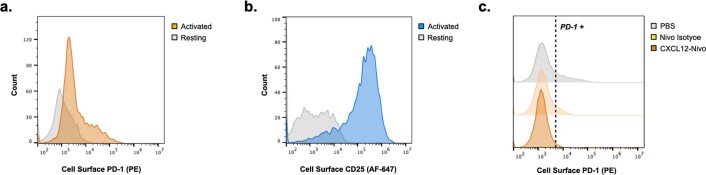
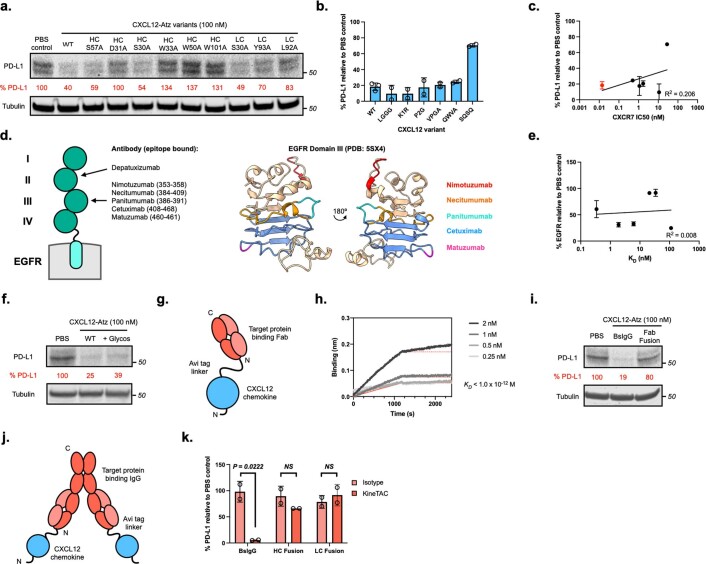
Verification
Claims the paper makes
The claims and statistics of this paper haven’t been checked yet.
Run the check — free, no account needed. It reads the open-access text and checks the sources it cites.
Claims other papers make about this one
Each is checked against this paper’s own text: does it say what the citing paper says it does?
In the citing paper
“To address the challenge of targeting soluble proteins outside cells, James A. Wells’ team developed cytokine receptor-targeting chimeras (KineTACs), a modular cytokine receptor targeting chimera for the targeted degradation of cell surface and extracellular proteins. KineTAC is a fully recombinant bispecific antibody based on a human scaffold that employs the internalization of homologous”
From Recent advances in targeting the “undruggable” proteins: from drug discovery to clinical trials (2023) · cites this paper as [546]
Self-check
Percentages, sums and reported differences re-computed from the paper’s own numbers.
The self-check needs the paper’s full text.
Citations
Cites
The Cancer Cell Line Encyclopedia enables predictive modelling of anticancer drug sensitivity
Barretina, J., Caponigro, G., Stransky, N., Venkatesan, K., Margolin, A. A., Kim, S., Wilson, C. J., Lehár, J., Kryukov, G. V., Sonkin, D., et al. (2012) · Nature · doi:10.1038/nature11003 · Cited by 7,950
Freeman, G. J., Long, A. J., Iwai, Y., Bourque, K., Chernova, T., Nishimura, H., Fitz, L. J., Malenkovich, N., Okazaki, T., Byrne, M. C., et al. (2000) · The Journal of Experimental Medicine · doi:10.1084/jem.192.7.1027 · Cited by 5,294
Epidermal growth factor receptor mutations in lung cancer
Sharma, S. V., Bell, D. W., Settleman, J., & Haber, D. A. (2007) · Nature Reviews Cancer · doi:10.1038/nrc2088 · Cited by 3,170
Sakamoto, K. M., Kim, K. B., Kumagai, A., Mercurio, F., Crews, C. M., & Deshaies, R. J. (2001) · Proceedings of the National Academy of Sciences · doi:10.1073/pnas.141230798 · Cited by 2,609
Lenalidomide Causes Selective Degradation of IKZF1 and IKZF3 in Multiple Myeloma Cells
Krönke, J., Udeshi, N. D., Narla, A., Grauman, P., Hurst, S. N., McConkey, M., Svinkina, T., Heckl, D., Comer, E., Li, X., et al. (2014) · Science · doi:10.1126/science.1244851 · Cited by 1,879
Lysosome-targeting chimaeras for degradation of extracellular proteins
Banik, S. M., Pedram, K., Wisnovsky, S., Ahn, G., Riley, N. M., & Bertozzi, C. R. (2020) · Nature · doi:10.1038/s41586-020-2545-9 · Cited by 1,199
Reprogramming human T cell function and specificity with non-viral genome targeting
Roth, T. L., Puig-Saus, C., Yu, R., Shifrut, E., Carnevale, J., Li, P. J., Hiatt, J., Saco, J., Krystofinski, P., Li, H., et al. (2018) · Nature · doi:10.1038/s41586-018-0326-5 · Cited by 839
PROteolysis TArgeting Chimeras (PROTACs) — Past, present and future
Pettersson, M., & Crews, C. M. (2019) · Drug Discovery Today Technologies · doi:10.1016/j.ddtec.2019.01.002 · Cited by 830
Glycosylation as a strategy to improve antibody-based therapeutics
Jefferis, R. (2009) · Nature Reviews Drug Discovery · doi:10.1038/nrd2804 · Cited by 829
‘Knobs-into-holes’ engineering of antibody C H 3 domains for heavy chain heterodimerization
Ridgway, J. B., Presta, L. G., & Carter, P. M. (1996) · Protein Engineering Design and Selection · doi:10.1093/protein/9.7.617 · Cited by 816
Cited by
Sorted by citations
The present and future of bispecific antibodies for cancer therapy
Klein, C., Brinkmann, U., Reichert, J. M., & Kontermann, R. E. (2024) · Nature Reviews Drug Discovery · doi:10.1038/s41573-024-00896-6 · Cited by 528
Recent advances in targeting the “undruggable” proteins: from drug discovery to clinical trials
Xie, X., Yu, T., Li, X., Zhang, N., Foster, L. J., Peng, C., Huang, W., & He, G. (2023) · Signal Transduction and Targeted Therapy · doi:10.1038/s41392-023-01589-z · Cited by 396
Targeted protein degradation for cancer therapy
Hinterndorfer, M., Spiteri, V. A., Ciulli, A., & Winter, G. E. (2025) · Nature reviews. Cancer · doi:10.1038/s41568-025-00817-8 · Cited by 263
Proximity-Based Modalities for Biology and Medicine
Liu, X., & Ciulli, A. (2023) · ACS Central Science · doi:10.1021/acscentsci.3c00395 · Cited by 206
Ahn, G., Riley, N. M., Kamber, R. A., Wisnovsky, S., von Hase, S. M., Bassik, M. C., Banik, S. M., & Bertozzi, C. R. (2023) · Science · doi:10.1126/science.adf6249 · Cited by 199
Metadata
- Authors
- Pance, K., Gramespacher, J. A., Byrnes, J. R., Salangsang, F., Serrano, J.-A. C., Cotton, A. D., Steri, V., & Wells, J. A.
- Affiliations
- University of California, San Francisco (US)
- Corresponding author
- Wells, James A.
- ORCID
- Venue
- Nature Biotechnology
- Published
- 2022-09-22
- Volume
- 41
- Issue
- 2
- Pages
- 273-281
- ISSN
- 0733-222X (ISSN-L)
- 1087-0156
- 1546-1696
- PMC
- PMC9931583
- OpenAlex
- W4296691508
- Cited by
- 265
- References
- 57
- Citations by year
- 2026: 68 · 2025: 97 · 2024: 58 · 2023: 41 · 2022: 1
- FWCI
- 16.08
- Type
- journal article
- Language
- en
- Open access
- hybrid
- doi.org
- Locations
- Nature Biotechnology (publishedVersion, cc-by)
- PubMed Central (publishedVersion, cc-by)
- PubMed (publishedVersion)
- eScholarship (California Digital Library) (submittedVersion, cc-by)
- Funders
- U.S. Department of Health & Human Services | NIH | National Cancer Institute (1F31CA265080-01, 5F32CA239417, R01CA248323)
- U.S. Department of Health & Human Services | National Institutes of Health (R35GM122451)
- Topics
- Life Sciences › Biochemistry, Genetics and Molecular Biology › Molecular Biology › Protein Degradation and Inhibitors
- Life Sciences › Immunology and Microbiology › Immunology › Monoclonal and Polyclonal Antibodies Research
- Life Sciences › Biochemistry, Genetics and Molecular Biology › Molecular Biology › CRISPR and Genetic Engineering
- Keywords
- targeted protein degradation, lysosomal degradation, bispecific antibodies, CXCL12, CXCR7, decoy receptor, CXCL11, interleukin-2 receptor, interleukin-2, cell surface proteins, extracellular proteins, tissue-specific targeting
- MeSH terms
- Proteolysis Targeting Chimera, Cell Membrane, Interleukin-2, Signal Transduction, Receptors, Cytokine, Chemokine CXCL12, Proteolysis
About these checks
Registry, retraction, Cites and statistics results are computed, not judged, with one exception: a printed reference that no index lists is read once by a model before it counts as a citation error. Claims are extracted by a model and kept only when their quote appears verbatim in the text; each cited source is then checked, with a model’s help, for whether it says what the claim relies on. Those verdicts can be wrong — read the claim’s quote and the cited source before relying on one.
Statistics and arithmetic are recomputed, not judged.
Confidence bands are shown only for fields calibrated on our annotated test set. None is calibrated yet, so no band is shown.
What counts as a claim ›How we measure confidence ›How we check this ›
Are you an author, or do you see a problem with this page? Request a review
