

The DOI matches its Crossref record; 21 of the 21 references it cites were found in a registry or an index.
Neutralizing antibodies against the SARS-CoV-2 Delta and Omicron variants following heterologous CoronaVac plus BNT162b2 booster vaccination
Open accessPublished version of a preprint
Abstract
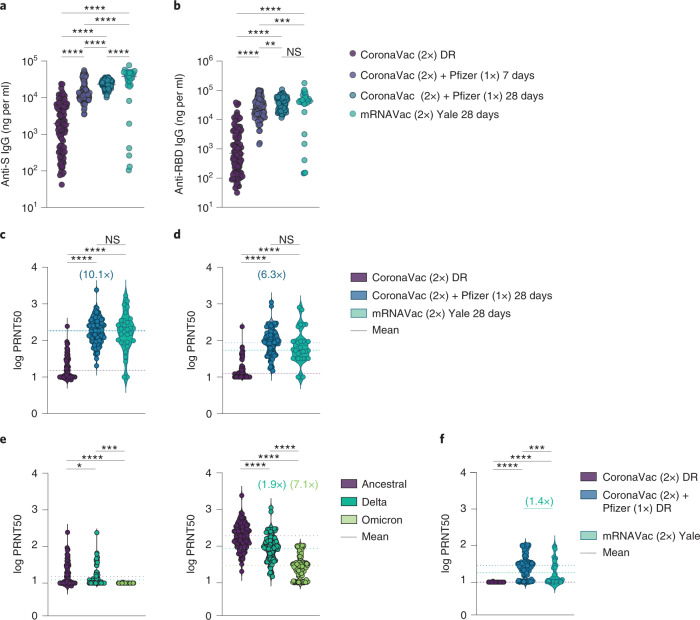
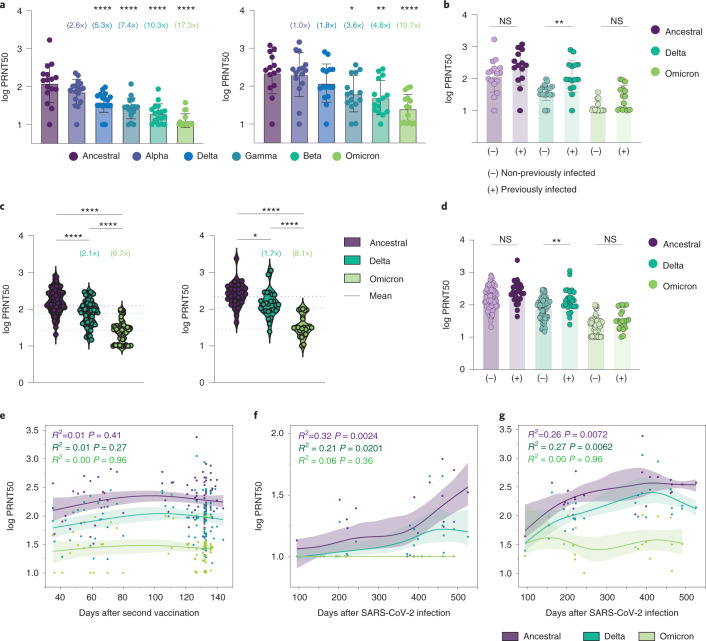
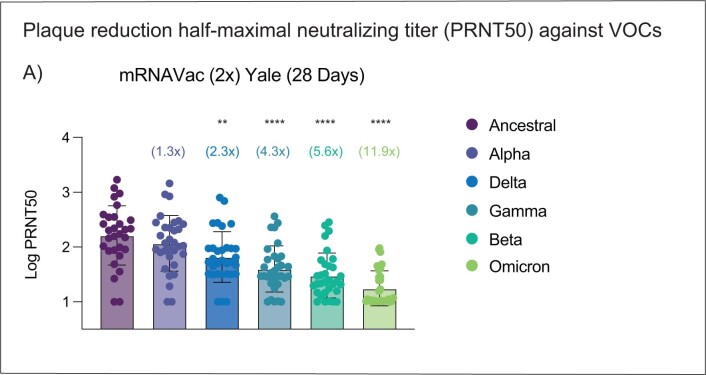
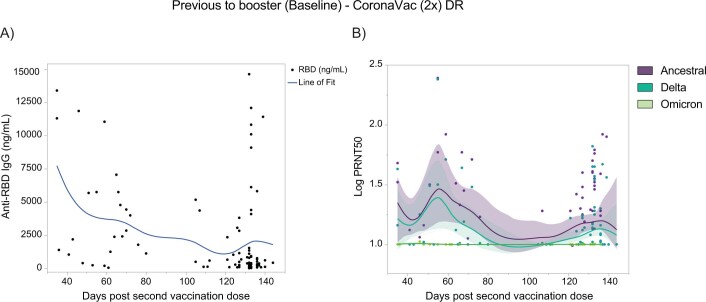
Abstract The recent emergence of the SARS-CoV-2 Omicron variant is raising concerns because of its increased transmissibility and by its numerous spike mutations with potential to evade neutralizing antibodies elicited by COVID-19 vaccines. The Dominican Republic was among the first countries in recommending the administration of a third dose COVID-19 vaccine to address potential waning immunity and reduced effectiveness against variants. Here, we evaluated the effects of a heterologous BNT162b2 mRNA vaccine booster on the humoral immunity of participants that had received a two-dose regimen of CoronaVac, an inactivated vaccine used globally. We found that heterologous CoronaVac prime followed by BNT162b2 booster regimen induces elevated virus-specific antibody levels and potent neutralization activity against the ancestral virus and Delta variant, resembling the titers obtained after two doses of mRNA vaccines. While neutralization of Omicron was undetectable in participants that had received a two-dose regimen of CoronaVac vaccine, BNT162b2 booster resulted in a 1.4-fold increase in neutralization activity against Omicron, compared to two-dose mRNA vaccine. Despite this increase, neutralizing antibody titers were reduced by 6.3-fold and 2.7-fold for Omicron compared to ancestral and Delta variant, respectively. Surprisingly, previous SARS-CoV-2 infection did not affect the neutralizing titers for Omicron in participants that received the heterologous regimen. Our findings have immediate implications for multiples countries that previously used a two-dose regimen of CoronaVac and reinforce the notion that the Omicron variant is associated with immune escape from vaccines or infection-induced immunity, highlighting the global need for vaccine boosters to combat the impact of emerging variants.
Overview
The claims and statistics of this paper haven’t been checked yet.
Run the check — free, no account needed. It reads the open-access text and checks the sources it cites.
Integrity signals
Registry
Cites
Statistics
Figures
Verification
Claims the paper makes
The claims and statistics of this paper haven’t been checked yet.
Run the check — free, no account needed. It reads the open-access text and checks the sources it cites.
Claims other papers make about this one
Each is checked against this paper’s own text: does it say what the citing paper says it does?
In the citing paper
“In all cases, neutralizing antibody titers after the second dose of mRNA-based vaccines were highly reduced for omicron (B.1.1.529) compared with delta (B.1.617.2) and especially compared with the wild-type variant, while the third dose significantly improved antibody neutralization titers.110,112,113”
From COVID-19 mRNA vaccines: Platforms and current developments (2022) · cites this paper as [112]
Self-check
Percentages, sums and reported differences re-computed from the paper’s own numbers.
The self-check needs the paper’s full text.
Citations
Cites
Effectiveness of COVID-19 vaccines against the Omicron (B.1.1.529) variant of concern
Andrews, N., Stowe, J., Kirsebom, F., Toffa, S., Rickeard, T., Gallagher, E., Gower, C., Kall, M., Groves, N., O’Connell, A.-M., et al. (2021) · doi:10.1101/2021.12.14.21267615 · Cited by 2,420
Cele, S., Jackson, L., Khoury, D. S., Khan, K., Moyo-Gwete, T., Tegally, H., San, J. E., Cromer, D., Scheepers, C., Amoako, D., et al. (2021) · doi:10.1101/2021.12.08.21267417 · Cited by 1,333
mRNA-based COVID-19 vaccine boosters induce neutralizing immunity against SARS-CoV-2 Omicron variant
Garcia-Beltran, W. F., St. Denis, K. J., Hoelzemer, A., Lam, E. C., Nitido, A. D., Sheehan, M. L., Berrios, C., Ofoman, O., Chang, C. C., Hauser, B. M., et al. (2022) · Cell · doi:10.1016/j.cell.2021.12.033 · Cited by 1,045
Increased risk of SARS-CoV-2 reinfection associated with emergence of Omicron in South Africa
Pulliam, J. R. C., van Schalkwyk, C., Govender, N., Gottberg, A. V., Cohen, C., Groome, M. J., Dushoff, J., Mlisana, K., & Moultrie, H. (2021) · doi:10.1101/2021.11.11.21266068 · Cited by 1,037
Waning Immunity after the BNT162b2 Vaccine in Israel
Goldberg, Y., Mandel, M., Bar-On, Y. M., Bodenheimer, O., Freedman, L., Haas, E. J., Milo, R., Alroy-Preis, S., Ash, N., & Huppert, A. (2021) · New England Journal of Medicine · doi:10.1056/nejmoa2114228 · Cited by 1,034
Effectiveness of an Inactivated SARS-CoV-2 Vaccine in Chile
Jara, A., Undurraga, E. A., González, C., Paredes, F., Fontecilla, T., Jara, G., Pizarro, A., Acevedo, J., Leo, K., Leon, F., et al. (2021) · New England Journal of Medicine · doi:10.1056/nejmoa2107715 · Cited by 863
Dynamics of antibody response to BNT162b2 vaccine after six months: a longitudinal prospective study
Naaber, P., Tserel, L., Kangro, K., Sepp, E., Jürjenson, V., Adamson, A., Haljasmägi, L., Rumm, A. P., Maruste, R., Kärner, J., et al. (2021) · The Lancet Regional Health - Europe · doi:10.1016/j.lanepe.2021.100208 · Cited by 637
Effectiveness of BNT162b2 Vaccine against Omicron Variant in South Africa
Collie, S., Champion, J., Moultrie, H., Bekker, L.-G., & Gray, G. (2022) · New England Journal of Medicine · doi:10.1056/nejmc2119270 · Cited by 600
Durability of mRNA-1273 vaccine–induced antibodies against SARS-CoV-2 variants
Pegu, A., O’Connell, S. E., Schmidt, S. D., O’Dell, S., Talana, C. A., Lai, L., Albert, J., Anderson, E., Bennett, H., Corbett, K. S., et al. (2021) · Science · doi:10.1126/science.abj4176 · Cited by 527
Self-citationSARS-CoV-2 Omicron Variant Neutralization after mRNA-1273 Booster Vaccination
Pajon, R., Doria-Rose, N. A., Shen, X., Schmidt, S. D., O'Dell, S. J., McDanal, C., Feng, W., Tong, J., Eaton, A., Maglinao, M., et al. (2022) · New England Journal of Medicine · doi:10.1056/nejmc2119912 · Cited by 447
Research works printed but not linked: 1
- Cele, S. et al. Omicron extensively but incompletely escapes Pfizer BNT162b2 neutralization. Nature https://doi.org/10.1038/s41586-021-04387-1 (2021). · DOI · Paper page
Cited by
Sorted by citations
Clemens, S. A. C., Weckx, L. Y., Clemens, R. L., Mendes, A. V. A., Souza, A. R., Silveira, M. B. V., da Guarda, S. N. F., de Nobrega, M. M., Pinto, M. I. D. M., Gonzalez, I. G. S., et al. (2022) · The Lancet · doi:10.1016/s0140-6736(22)00094-0 · Cited by 421
COVID-19 vaccine development: milestones, lessons and prospects
Li, M., Wang, H., Tian, L., Pang, Z., Yang, Q., Huang, T., Fan, J., Song, L., Tong, Y., & Fan, H. (2022) · Signal Transduction and Targeted Therapy · doi:10.1038/s41392-022-00996-y · Cited by 478
Chenchula, S., Karunakaran, P., Sharma, S., & Chavan, M. (2022) · Journal of Medical Virology · doi:10.1002/jmv.27697 · Cited by 342
COVID-19 mRNA vaccines: Platforms and current developments
Szabó, G. T., Mahiny, A. J., & Vlatkovic, I. (2022) · Molecular Therapy · doi:10.1016/j.ymthe.2022.02.016 · Cited by 308
Khandia, R., Singhal, S., Alqahtani, T., Kamal, M. A., El-Shall, N. A., Nainu, F., Desingu, P. A., & Dhama, K. (2022) · Environmental Research · doi:10.1016/j.envres.2022.112816 · Cited by 308
Metadata
- Authors
- Pérez-Then, E., Lucas, C., Monteiro, V. S., Miric, M., Brache, V., Cochon, L., Vogels, C. B. F., Malik, A. A., De la Cruz, E., Jorge, A., De los Santos, M., Leon, P., Breban, M. I., Billig, K., Yildirim, I., Pearson, C., Downing, R., Gagnon, E., Muyombwe, A., Razeq, J., Campbell, M., Ko, A. I., Omer, S. B., Grubaugh, N. D., Vermund, S. H., & Iwasaki, A.
- Affiliations
- Yale University (US)
- Profamilia (DO)
- Connecticut Department of Public Health (US)
- Howard Hughes Medical Institute (US)
- Corresponding author
- Lucas, Carolina
- Iwasaki, Akiko
- ORCID
- Venue
- Nature Medicine
- Published
- 2022-01-20
- Volume
- 28
- Issue
- 3
- Pages
- 481-485
- ISSN
- 1078-8956 (ISSN-L)
- 1546-170X
- PMC
- PMC8938264
- OpenAlex
- W4206675538
- Cited by
- 401
- References
- 20
- Citations by year
- 2026: 10 · 2025: 22 · 2024: 47 · 2023: 114 · 2022: 207
- FWCI
- 47.60
- Type
- journal article
- Language
- en
- Open access
- hybrid
- doi.org
- Locations
- Nature Medicine (publishedVersion, cc-by)
- medRxiv (acceptedVersion)
- PubMed Central (publishedVersion, cc-by)
- PubMed (publishedVersion)
- Funders
- Howard Hughes Medical Institute (N/A)
- Pew Charitable Trusts (N/A)
- Topics
- Health Sciences › Medicine › Infectious Diseases › SARS-CoV-2 and COVID-19 Research
- Life Sciences › Agricultural and Biological Sciences › Animal Science and Zoology › Animal Virus Infections Studies
- Life Sciences › Biochemistry, Genetics and Molecular Biology › Molecular Biology › vaccines and immunoinformatics approaches
- Keywords
- Omicron variant, Delta variant, neutralizing antibodies, CoronaVac, BNT162b2 mRNA vaccine, inactivated vaccine, spike protein mutations, immune evasion, humoral immunity, booster vaccination
- MeSH terms
- COVID-19, SARS-CoV-2, COVID-19 Vaccines, mRNA Vaccines, BNT162 Vaccine, Antibodies, Viral, Humans, Vaccination, Vaccines, Synthetic, Antibodies, Neutralizing
About these checks
Registry, retraction, Cites and statistics results are computed, not judged, with one exception: a printed reference that no index lists is read once by a model before it counts as a citation error. Claims are extracted by a model and kept only when their quote appears verbatim in the text; each cited source is then checked, with a model’s help, for whether it says what the claim relies on. Those verdicts can be wrong — read the claim’s quote and the cited source before relying on one.
Statistics and arithmetic are recomputed, not judged.
Confidence bands are shown only for fields calibrated on our annotated test set. None is calibrated yet, so no band is shown.
What counts as a claim ›How we measure confidence ›How we check this ›
Are you an author, or do you see a problem with this page? Request a review
