

Tirzepatide cardiovascular event risk assessment: a pre-specified meta-analysis
Open accessThe DOI matches its Crossref record; 39 of the 39 references it cites were found in a registry or an index.
Abstract
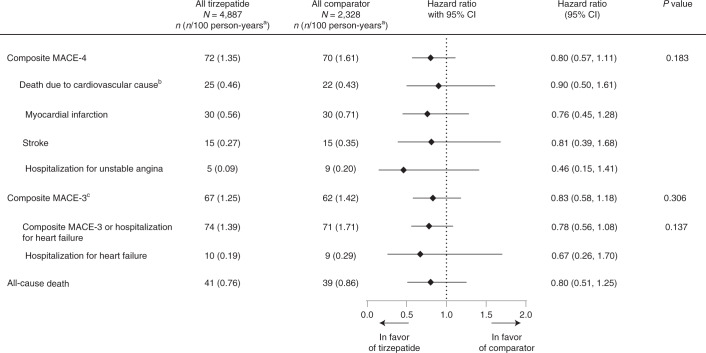
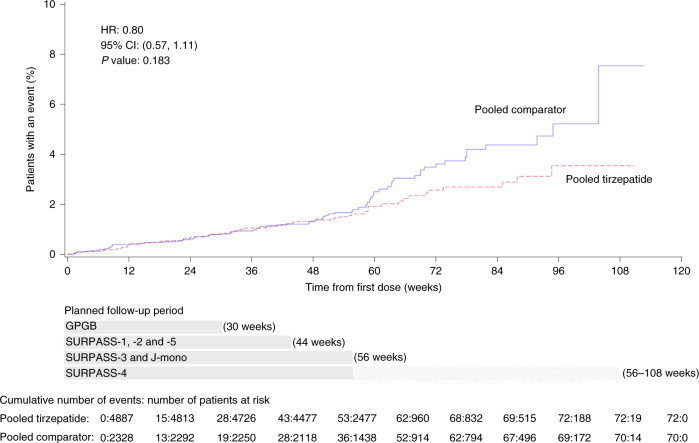
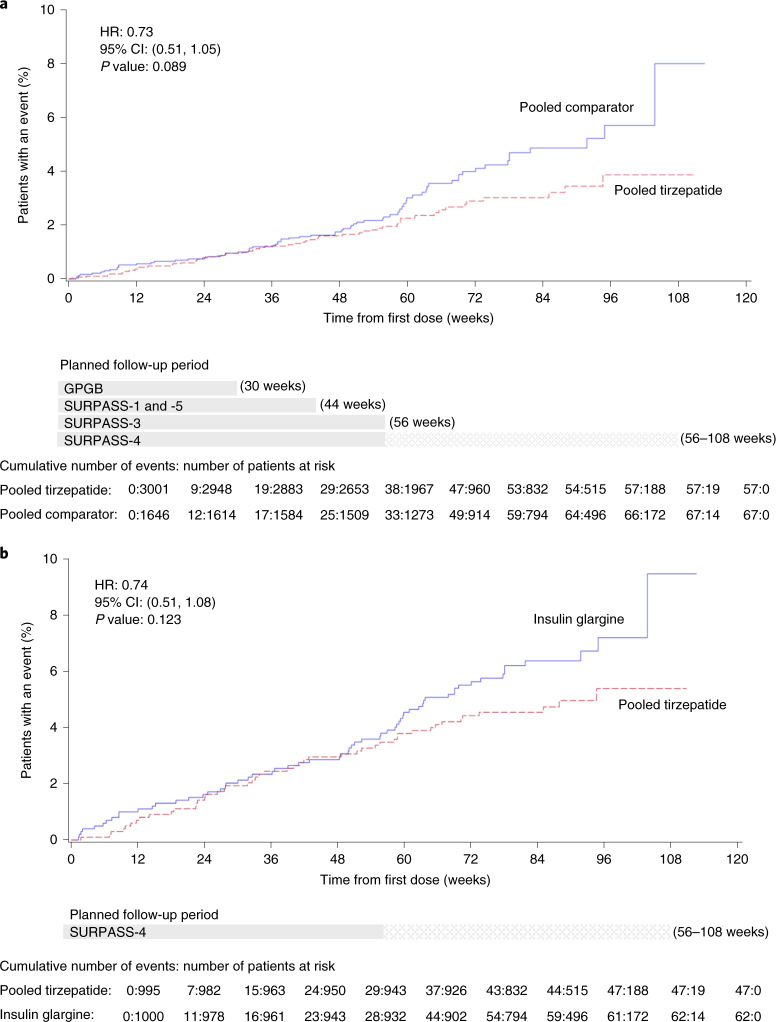
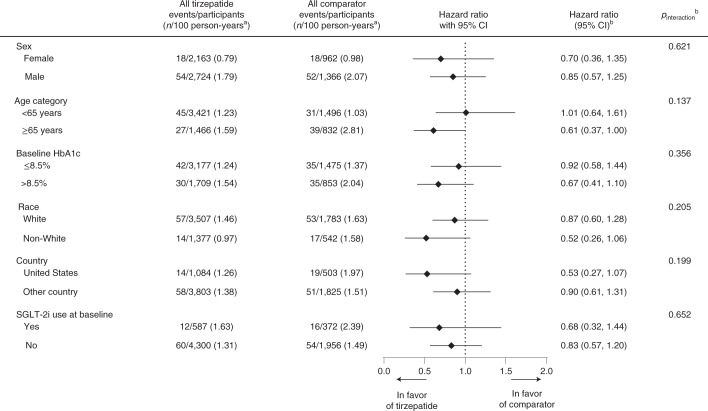
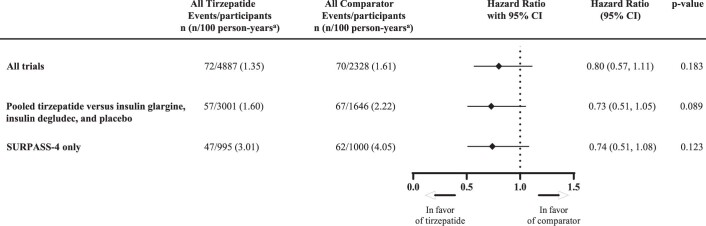
Tirzepatide is a novel, once weekly, dual GIP/GLP-1 receptor agonist and is under development for the treatment of type 2 diabetes (T2D) and obesity. Its association with cardiovascular outcomes requires evaluation. This pre-specified cardiovascular meta-analysis included all seven randomized controlled trials with a duration of at least 26 weeks from the tirzepatide T2D clinical development program, SURPASS. The pre-specified primary objective of this meta-analysis was the comparison of the time to first occurrence of confirmed four-component major adverse cardiovascular events (MACE-4; cardiovascular death, myocardial infarction, stroke and hospitalized unstable angina) between pooled tirzepatide groups and control groups. A stratified Cox proportional hazards model, with treatment as a fixed effect and trial-level cardiovascular risk as the stratification factor, was used for the estimation of hazard ratios (HRs) and confidence intervals (CIs) comparing tirzepatide to control. Data from 4,887 participants treated with tirzepatide and 2,328 control participants were analyzed. Overall, 142 participants, 109 from the trial with high cardiovascular risk and 33 from the six trials with lower cardiovascular risk, had at least one MACE-4 event. The HRs comparing tirzepatide versus controls were 0.80 (95% CI, 0.57–1.11) for MACE-4; 0.90 (95% CI, 0.50–1.61) for cardiovascular death; and 0.80 (95% CI, 0.51–1.25) for all-cause death. No evidence of effect modifications was observed for any subgroups, although the evidence was stronger for participants with high cardiovascular risk. Tirzepatide did not increase the risk of major cardiovascular events in participants with T2D versus controls.
Overview
The claims and statistics of this paper haven’t been checked yet.
Free: it reads the open-access text and checks the first 5 claims that cite a source we can check. Create a free account to check every claim.
Integrity signals
Registry
Cites
Statistics
Figures
Verification
Claims the paper makes
The claims and statistics of this paper haven’t been checked yet.
Free: it reads the open-access text and checks the first 5 claims that cite a source we can check. Create a free account to check every claim.
Claims other papers make about this one
Each is checked against this paper’s own text: does it say what the citing paper says it does?
The source backs part of the claim, not all of it — or backs it for a different population, condition or comparison.
In the citing paper
“Furthermore, in a meta-analysis, which included five phase 3 tirzepatide trials conducted in patients with T2D, tirzepatide did not increase the risk of major cardiovascular events in participants compared with controls (hazard ratio 0.80, 95% CI 0.57-1.11).26”
From Tirzepatide reduces the predicted risk of atherosclerotic cardiovascular disease and improves cardiometabolic risk factors in adults with obesity or overweight: SURMOUNT-1 post hoc analysis (2024) · cites this paper as [26]
Experimental — accuracy not yet measuredThe cited source says what the claim attributes to it.
In the citing paper
“Additionally, current short-term data from RCTs suggest that tirzepatide does not increase the risk of MACE versus comparators; however, robust data on its long-term cardiovascular pro fi le will be”
The cited source says what the claim attributes to it.
In the citing paper
“The ongoing SURPASS trials evaluating tirzepatide also evidenced a trend towards cardiovascular safety with decreased incidence of MACEs (hazard ratio 0.80; 95% CI, 0.57–1.11).62”
From GLP-1 single, dual, and triple receptor agonists for treating type 2 diabetes and obesity: a narrative review (2024) · cites this paper as [62]
The cited source says what the claim attributes to it.
In the citing paper
“Recent results from RCTs with tirzepatide suggest superior effects on glycemic control and weight loss compared to semaglutide [105,116] and a first cardiovascular risk assessment importantly also indicated no increased risk of MACE [123].”
From Obesity and MASLD: Is weight loss the (only) key to treat metabolic liver disease? (2024) · cites this paper as [123]
The cited source says what the claim attributes to it.
In the citing paper
“pooled data from the SURPASS clinical trial programme indicate that tirzepatide does not increase the risk of major cardiovascular events [61]”
3 more claims about this paper
Create a free account to see every claim other papers make about this one.
Self-check
Percentages, sums and reported differences re-computed from the paper’s own numbers.
The self-check needs the paper’s full text.
Citations
Cites
Heart Disease and Stroke Statistics—2017 Update: A Report From the American Heart Association
Benjamin, E. J., Blaha, M. J., Chiuve, S. E., Cushman, M., Das, S. R., Deo, R., de Ferranti, S. D., Floyd, J., Fornage, M., Gillespie, C., et al. (2017) · Circulation · doi:10.1161/cir.0000000000000485 · Cited by 12,591
Empagliflozin, Cardiovascular Outcomes, and Mortality in Type 2 Diabetes
Zinman, B., Wanner, C., Lachin, J. M., Fitchett, D., Bluhmki, E., Hantel, S., Mattheus, M., Devins, T., Johansen, O. E., Woerle, H. J., et al. (2015) · New England Journal of Medicine · doi:10.1056/nejmoa1504720 · Cited by 12,315
Liraglutide and Cardiovascular Outcomes in Type 2 Diabetes
Marso, S. P., Daniels, G. H., Brown-Frandsen, K., Kristensen, P., Mann, J. F. E., Nauck, M. A., Nissen, S. E., Pocock, S., Poulter, N. R., Ravn, L. S., et al. (2016) · New England Journal of Medicine · doi:10.1056/nejmoa1603827 · Cited by 7,629
Heart disease and stroke statistics-2018 update: a report from the american heart association
Benjamin, E. J., Virani, S. S., Callaway, C. W., Chamberlain, A. M., Chang, A. R., Cheng, S., Chiuve, S. E., Cushman, M., Delling, F. N., Deo, R., et al. (2018) · Circulation · doi:10.1161/cir.0000000000000558 · Cited by 7,146
Semaglutide and Cardiovascular Outcomes in Patients with Type 2 Diabetes
Marso, S. P., Bain, S. C., Consoli, A., Eliaschewitz, F. G., Jódar, E., Leiter, L. A., Lingvay, I., Rosenstock, J., Seufert, J., Warren, M. L., et al. (2016) · New England Journal of Medicine · doi:10.1056/nejmoa1607141 · Cited by 6,900
A generalization of sampling without replacement from a finite universe
Horvitz, D. G., & Thompson, D. J. (1952) · Journal of the American Statistical Association · doi:10.1080/01621459.1952.10483446 · Cited by 4,293
Gerstein, H. C., Colhoun, H. M., Dagenais, G. R., Diaz, R., Lakshmanan, M., Pais, P., Probstfield, J., Riesmeyer, J. S., Riddle, M. C., Rydén, L., et al. (2019) · The Lancet · doi:10.1016/s0140-6736(19)31149-3 · Cited by 3,163
Tirzepatide versus Semaglutide Once Weekly in Patients with Type 2 Diabetes
Frías, J. P., Davies, M. J., Rosenstock, J., Pérez Manghi, F. C., Fernández Landó, L., Bergman, B. K., Liu, B., Cui, X., & Brown, K. (2021) · New England Journal of Medicine · doi:10.1056/nejmoa2107519 · Cited by 2,096
Oral Semaglutide and Cardiovascular Outcomes in Patients with Type 2 Diabetes
Husain, M., Birkenfeld, A. L., Donsmark, M., Dungan, K., Eliaschewitz, F. G., Franco, D. R., Jeppesen, O. K., Lingvay, I., Mosenzon, O., Pedersen, S. D., et al. (2019) · New England Journal of Medicine · doi:10.1056/nejmoa1901118 · Cited by 1,997
Meta-analysis of individual participant data: rationale, conduct, and reporting
Riley, R. D., Lambert, P. C., & Abo-Zaid, G. (2010) · BMJ · doi:10.1136/bmj.c221 · Cited by 1,701
Cited by
Items 101–200 of 346
Goldenberg, R. M., Gilbert, J. D., Manjoo, P., Pedersen, S. D., Woo, V. C., & Lovshin, J. A. (2024) · Obesity Reviews · doi:10.1111/obr.13663 · Cited by 27
“132 In a substudy of SURPASS-3, tirzepatide treatment resulted in up to a 47% reduction in liver fat content as measured by MRI-PDFF, and up to 81% of the participants exhibited at least a 30% relative decrease in liver fat content (Table 3C).”
BackgroundUpdated Meta-Analysis Assessing the Cardiovascular Efficacy of Tirzepatide
Patoulias, D., Papadopoulos, C. E., Fragakis, N., & Doumas, M. N. (2022) · The American Journal of Cardiology · doi:10.1016/j.amjcard.2022.07.003 · Cited by 28
Tirzepatide: A Promising Drug for Type 2 Diabetes and Beyond
Dutta, P., Kumar, Y., Babu, A. T., Ravindran, S. G., Salam, A., Rai, B., Baskar, A., Dhawan, A., & Jomy, M. (2023) · Cureus · doi:10.7759/cureus.38379 · Cited by 46
“Tirzepatide shows positive effects on a variety of cardiovascular risk factors, but until now, the findings of just one study, SURPASS-4, have been used to report on the drug's cardiovascular safety [39].”
BackgroundTobaiqy, M. (2024) · Pharmacological Reports · doi:10.1007/s43440-024-00629-x · Cited by 25
“At the same time, liraglutide also decreased the occurrence of similar outcomes in this population [ 3, 27, 28].”
Female obesity: clinical and psychological assessment toward the best treatment
Guglielmi, V., Grave, R. D., Leonetti, F., & Solini, A. (2024) · Frontiers in Endocrinology · doi:10.3389/fendo.2024.1349794 · Cited by 45
Ostrominski, J. W., Ortega-Montiel, J., Tesfaye, H., ALIX, C., DiCesare, E., CROMER, S. J., Wexler, D. J., Paik, J. M., & Patorno, E. (2025) · Annals of Internal Medicine · doi:10.7326/annals-24-02870 · Cited by 29
Guan, R., Yang, Q., Yang, X., Du, W., Li, X., & Ma, G. (2022) · Frontiers in Pharmacology · doi:10.3389/fphar.2022.998816 · Cited by 27
“There were several published meta-analyses of tirzepatide (Bhagavathula et al., 2021; Dutta et al., 2021; Karagiannis et al., 2022; Sattar et al., 2022), which only included six or seven RCTs.”
Billings, L. K., Winne, L., Sharma, P., Valderas, E. G., Chivukula, K. K., & Kwan, A. Y. M. (2025) · Annals of Internal Medicine · doi:10.7326/annals-24-03849 · Cited by 28
Popovic, D. S., Patoulias, D., POPOVIC, L. S., Karakasis, P., Παπάνας, Ν., & Mantzoros, C. S. (2024) · Diabetes Research and Clinical Practice · doi:10.1016/j.diabres.2024.111758 · Cited by 23
Baker, D. E., Walley, K., & Levien, T. L. (2023) · Hospital Pharmacy · doi:10.1177/00185787221125724 · Cited by 21
Chrysavgis, L., Kazanas, S., Bafa, K., Rozani, S., Koloutsou, M. E., & Cholongitas, Ε. (2024) · International Journal of Molecular Sciences · doi:10.3390/ijms25073832 · Cited by 27
“…program showed that treatment once weekly with tirzepatide at any dose (5 mg, 10 mg, and 15 mg) for up to 104 weeks was not associated with higher risk for major CVD events, including cardiovascular death, myocardial infarction, stroke, and hospitalized unstable angina in patients with T2DM [125].”
BackgroundHenney, A. E., Riley, D. R. J., Anson, M., Heague, M., Hernandez, G., Alam, U., Craig, S., & Cuthbertson, D. J. (2025) · Annals of the American Thoracic Society · doi:10.1513/annalsats.202409-923oc · Cited by 29
Research Progress on the GIP/GLP-1 Receptor Coagonist Tirzepatide, a Rising Star in Type 2 Diabetes
Ma, Z., Jin, K., Yue, M., Chen, X., & Chen, J. (2023) · Journal of Diabetes Research · doi:10.1155/2023/5891532 · Cited by 30
Multimodal knowledge graph construction for risk identification in water diversion projects
Wang, L., Liu, X., Liu, Y., Li, H., Liu, J., & Yang, L. (2024) · Journal of Hydrology · doi:10.1016/j.jhydrol.2024.131155 · Cited by 25
Recent achievements and future directions of anti-obesity medications
Grandl, G., Novikoff, A., Liu, X., & Müller, T. D. (2024) · The Lancet Regional Health - Europe · doi:10.1016/j.lanepe.2024.101100 · Cited by 33
Tirzepatide and cardiometabolic parameters in obesity: Summary of current evidence
Sattar, N. A., García‐Pérez, L., Rodríguez, Á., Kapoor, R., Stefański, A., & Hankosky, E. R. (2025) · Diabetes Obesity and Metabolism · doi:10.1111/dom.16549 · Cited by 28
“38 The overall hazard ratios comparing tirzepatide (at an estimated average dose of 9 mg per week) with a range of different controls (placebo, insulin degludec, insulin glargine, semaglutide 1 mg) for MACE-4, cardiovascular death and all-cause death were 0.80 (95% CI: 0.57 to 1.11; p = 0.183),…”
InfluentialSelf-citationTirzepatide-Induced Gastrointestinal Manifestations: A Systematic Review and Meta-Analysis
Karrar, H. R., Nouh, M. I., Nouh, Y. I., Nooh, M. I., Alhindi, A. S. K., Hemeq, Y. H., Aljameeli, A. M. S., Aljuaid, J. A., Alzahrani, S. J., Alsatami, A. A., et al. (2023) · Cureus · doi:10.7759/cureus.46091 · Cited by 32
“However, it is assumed that it is connected to its impacts on weight loss and blood sugar regulation, as well as its capacity to lower inflammation and enhance lipid metabolism [14,15].”
BackgroundThe role of incretin receptor agonists in the treatment of obesity
Forst, T. M., Block, C. E. M. D., Prato, S. D., Armani, S., Frías, J. P., Lautenbach, A., Ludvik, B. H., Marinez, M., Mathieu, C., Müller, T. D., et al. (2024) · Diabetes Obesity and Metabolism · doi:10.1111/dom.15796 · Cited by 22
Song, Y., Yin, C., & Kong, N. (2024) · International Journal of Nanomedicine · doi:10.2147/ijn.s475234 · Cited by 21
Therapeutic Targets and Approaches to Manage Inflammation of NAFLD
Geng, W., Liao, W., Cao, X., & Yang, Y. (2025) · Biomedicines · doi:10.3390/biomedicines13020393 · Cited by 20
“Tirzepatide, a GLP1R and GIP receptor (GIPR) dual agonist, reduced NASH biomarkers like ALT and AST in a phase II trial (NCT03131687) [154], with further studies ongoing (NCT04166773).”
GLP-1-based therapeutics for cardiorenal protection in metabolic diseases
Apperloo, E. M., Heerspink, H. J. L., van Raalte, D. H., & Muskiet, M. H. A. (2025) · Nephrology Dialysis Transplantation · doi:10.1093/ndt/gfaf110 · Cited by 25
“A prespecified meta-analysis of CV events in 7215 T2D patients from the SURPASS trials showed CV safety, with an HR of 0.80 (95% CI 0.57–1.11) for 4-point MACE and 0.80 (95% CI 0.51–1.25) for all-cause mortality [57 ].”
InfluentialBouchi, R., Kondo, T., Ohta, Y., Goto, A., Tanaka, D., Satoh, H., Yabe, D., Nishimura, R., Harada, N., Kamiya, H., et al. (2024) · Journal of Diabetes Investigation · doi:10.1111/jdi.14202 · Cited by 22
“According to a meta-analysis of recently approved tirzepatide, which assessed the safety of cardiovascular outcomes, tirzepatide did not increase the risk of major cardiovascular disease, all-cause mortality and cardiovascular death 67 .”
Bouchi, R., Kondo, T., Ohta, Y., Goto, A., Tanaka, D., Satoh, H., Yabe, D., Nishimura, R., Harada, N., Kamiya, H., et al. (2024) · Diabetology International · doi:10.1007/s13340-024-00723-8 · Cited by 21
“According to a meta-analysis of recently approved tirzepa-tide, which assessed the safety of cardiovascular outcomes, tirzepatide did not increase the risk of major cardiovascular disease, all-cause mortality, and cardiovascular death [67].”
Sallam, M., Snygg, J., Ghandour, S. E., & Sallam, M. (2025) · Obesities · doi:10.3390/obesities5020026 · Cited by 21
Linetzky, B., Sattar, N., Verma, S., Krumholz, H. M., Xie, C. C., Hoffmann, H. T., Zimner-Rapuch, S., Torcello-Gómez, A., & Stefanski, A. (2025) · Annals of Internal Medicine · doi:10.7326/annals-24-02623 · Cited by 17
Self-citationPatoulias, D., Doumas, M. N., & Papadopoulos, C. E. (2022) · The American Journal of Cardiology · doi:10.1016/j.amjcard.2022.03.042 · Cited by 18
Yu, Y., Hu, G., Yin, S., Yang, X., Zhou, M., & Jian, W. (2022) · Frontiers in Cardiovascular Medicine · doi:10.3389/fcvm.2022.990182 · Cited by 17
Pharmacotherapy for obesity: recent evolution and implications for cardiovascular risk reduction
Maki, K. C., Kirkpatrick, C. F., Allison, D. B., & Gadde, K. M. (2023) · Expert Review of Endocrinology & Metabolism · doi:10.1080/17446651.2023.2209176 · Cited by 19
Unraveling Chronic Cardiovascular and Kidney Disorder through the Butterfly Effect
Bedo, D., Beaudrey, T., & Florens, N. (2024) · Diagnostics · doi:10.3390/diagnostics14050463 · Cited by 25
The current landscape for diabetes treatment: Preventing diabetes-associated CV risk
Dardano, A., Bianchi, C., Garofolo, M., & Prato, S. D. (2024) · Atherosclerosis · doi:10.1016/j.atherosclerosis.2024.117560 · Cited by 18
Bucheit, J. D., Ayers, J., Pamulapati, L. G., Browning, A., & Sisson, E. M. (2022) · Journal of Cardiovascular Pharmacology · doi:10.1097/fjc.0000000000001299 · Cited by 20
Okazaki, R. A., Rizvi, S. H. M., Lyons, R., Behrooz, L., & Hamburg, N. M. (2025) · American Journal of Physiology-Heart and Circulatory Physiology · doi:10.1152/ajpheart.00793.2024 · Cited by 19
Król, M., Kupnicka, P., Żychowska, J., Kapczuk, P., Szućko-Kociuba, I., Prajwos, E., & Chlubek, D. (2025) · International Journal of Molecular Sciences · doi:10.3390/ijms26146777 · Cited by 19
“In cardiovascular research, the acronym MACE (major adverse cardiovascular events) is commonly used to describe combined endpoints that include myocardial infarction, stroke, and cardiovascular death (3P-MACE), or additionally, angina pectoris (4P-MACE) [5–7].”
Frías, J. P. (2023) · Expert Review of Endocrinology & Metabolism · doi:10.1080/17446651.2023.2184796 · Cited by 19
“The prespecified meta-analysis, which included the SURAPSS-4 trial, assessed the same MACE-4 CV endpoint [30].”
MethodInfluentialPerspectives on weight control in diabetes – Tirzepatide
Várkonyi, T. T., Pósa, A., Pávó, N., & Pavo, I. J. (2023) · Diabetes Research and Clinical Practice · doi:10.1016/j.diabres.2023.110770 · Cited by 23
Self-citationPopovic, D. S., Patoulias, D., Koufakis, T., Stavropoulos, K., Karakasis, P., Ruža, I., Παπάνας, Ν., Rizzo, M., & Doumas, M. N. (2024) · Journal of Diabetes and its Complications · doi:10.1016/j.jdiacomp.2024.108800 · Cited by 17
Weight Loss Blockbuster Development: A Role for Unimolecular Polypharmacology
Zhou, Q., Li, G., Hang, K., Li, J., Yang, D., & Wang, M. (2024) · The Annual Review of Pharmacology and Toxicology · doi:10.1146/annurev-pharmtox-061324-011832 · Cited by 16
Mechanisms and treatment of obesity-related hypertension—Part 2: Treatments
Parvanova, A. I., Abbate, M., Reseghetti, E., & Ruggenenti, P. L. (2025) · Clinical Kidney Journal · doi:10.1093/ckj/sfaf035 · Cited by 23
“However, pre-specified cardiovascular meta-analysis from the SUR-PASS program reported that tirzepatide treatment for up to 104 weeks does not decrease MACE risk versus controls [170 ].”
Betensky, D. J., Smith, K. C., Katz, J. N., Yang, C. J., Hunter, D. J., Collins, J. E., Feldman, C. H., Messier, S. P., Kim, J., Selzer, F., et al. (2025) · Annals of Internal Medicine · doi:10.7326/annals-24-03609 · Cited by 20
Instituting a successful discharge plan for patients with type 2 diabetes: challenges and solutions
Demidowich, A. P., Batty, K., & Zilbermint, M. (2022) · Diabetes Spectrum · doi:10.2337/dsi22-0013 · Cited by 15
Tirzepatide and potential use for metabolically healthy obesity
Çöpür, S., Tanrıöver, C., Yavuz, F., Tuttle, K. R., & Kanbay, M. (2023) · European Journal of Internal Medicine · doi:10.1016/j.ejim.2023.05.012 · Cited by 18
Challenging Clinical Perspectives in Type 2 Diabetes with Tirzepatide, a First-in-Class Twincretin
MacIsaac, R. J., Deed, G., dʼEmden, M. C., Ekinci, E. I., HOCKING, S. L., Sumithran, P., & Rasalam, R. R. (2023) · Diabetes Therapy · doi:10.1007/s13300-023-01475-5 · Cited by 17
“S4, Supplementary Appendix) [23].”
BackgroundInfluentialChakhtoura, M., & Mantzoros, C. S. (2023) · Metabolism · doi:10.1016/j.metabol.2023.155531 · Cited by 16
Razzaki, T. S., Weiner, A., & Shukla, A. P. (2022) · Therapeutics and Clinical Risk Management · doi:10.2147/tcrm.s328056 · Cited by 16
“32 Another brief meta-analysis evaluated the mean difference in systolic and diastolic blood pressure (SBP and DBP) with dual GIPR and GLP-1R agonists compared to placebo or active comparators (insulin degludec, insulin glargine, liraglutide, or dulaglutide) in 5060 subjects with T2DM, finding a…”
Kushner, P., Anderson, J. E., Simon, J., Boye, K. S., Ranta, K., Torcello-Gómez, A., & Levine, J. A. (2023) · Clinical Diabetes · doi:10.2337/cd22-0029 · Cited by 14
Li, X., Cai, Z., Yang, F., Wang, Y., Pang, X., Sun, J. Y., Li, X., & Lu, Y. (2024) · Foods · doi:10.3390/foods13020273 · Cited by 16
“However, long-term medication will lead to a series of side effects [7], so adopting a natural, safe, mild and non-toxic diet is of great significance in the early prevention and subsequent adjuvant treatment of diabete [8].”
BackgroundMin, K.-D., Matsumoto, Y., Asakura, M., & Ishihara, M. (2024) · ESC Heart Failure · doi:10.1002/ehf2.14811 · Cited by 16
GLP1-GIP receptor co-agonists: a promising evolution in the treatment of type 2 diabetes
Ciardullo, S., Morieri, M. L., DANIELE, G., Fiorentino, T. V., Mezza, T., Tricò, D., Consoli, A., Prato, S. D., Giorgino, F., Piro, S., et al. (2024) · Acta Diabetologica · doi:10.1007/s00592-024-02300-6 · Cited by 19
Yang, Y., He, L., Liu, P., Wang, J., Yang, N., Li, Z., Ping, F., Xu, L., Li, W., Zhang, H., et al. (2024) · Diabetes, Obesity and Metabolism · doi:10.1111/dom.15342 · Cited by 12
“…with the use of TZP and attention should be paid to the outcome of raised heart rate, especially in those with CVD. Current evidence indicates that TZP is not associated with an increase in cardiovascular events, 21,38 and ongoing trials such as SURPASS-CVOT (NCT04255433) will further explore this.”
BackgroundBradley, C. L., McMillin, S. M., Hwang, A. Y., & Sherrill, C. H. (2023) · Annals of Pharmacotherapy · doi:10.1177/10600280221134127 · Cited by 13
McGuire, D. K., D’Alessio, D., Nicholls, S. J., Nissen, S. E., Riesmeyer, J. S., Pavo, I., Sethuraman, S., Heilmann, C. R., Kaiser, J. J., & Weerakkody, G. J. (2022) · Cardiovascular Diabetology · doi:10.1186/s12933-022-01601-w · Cited by 14
“Tirzepatide is a novel, once-weekly, injectable, dual glucose-dependent insulinotropic polypeptide (GIP) and GLP-1 RA, is being developed for the treatment of type 2 diabetes (T2D) and obesity [26] with CV safety demonstrated in the late phase clinical program [27, 28].”
BackgroundSelf-citationTong, K., Yin, S., Yu, Y., Yang, X., Hu, G., Zhang, F., & Liu, Z. (2023) · Medicine · doi:10.1097/md.0000000000035488 · Cited by 18
“[13,14] There is also evidence that TZP has additional benefits in reducing cardiovascular risk and blood lipid levels, [15,16] which means that TZP may have broad application prospects.”
BackgroundMetabolic dysfunction-associated fatty liver disease: bridging cardiology and hepatology
Zhou, X., Targher, G., Byrne, C. D., Shapiro, M. D., Chen, L.-L., & Zheng, M. (2024) · Cardiology Plus · doi:10.1097/cp9.0000000000000106 · Cited by 15
“…agonists, which improve insulin resistance and reduce body weight (on average 3–5 kg) [77–79] , are not currently indicated for MASH treatment, but they have demonstrated benefits in patients with type 2 diabetes by lowering the risk of cardiovascular mortality and hospitalizations [80–82] .”
Pharmacologic Treatment of Obesity in Adults: Standards of Care in Overweight and Obesity
Gudzune, K. A., Apovian, C. M., Aroda, V. R., Aronne, L. J., Balapattabi, K., Bennett, A. K., ChallaSivaKanaka, S., ElSayed, N. A., Fitch, A., Fitzpatrick, S. L., et al. (2026) · Diabetes Obesity and Cardiometabolic CARE · doi:10.2337/doci25-0008 · Cited by 27
“Moreover, in a prespecified participant-level pooled analysis of the SURPASS program, tirzepatide did not increase the risk of major adverse cardiovascular events in people with T2D versus pooled comparators (HR 0.80; 95% CI 0.57–1.11) (109).”
InfluentialLiarakos, A. L., & Koliaki, C. C. (2023) · Biomedicines · doi:10.3390/biomedicines11071875 · Cited by 18
“The cardiovascular safety of tirzepatide was assessed in the SURPASS-4 trial as well as in a pre-specified meta-analysis of seven randomized controlled trials of greater than 26 weeks in duration [58,74].”
MethodCardio‐renal‐metabolic disease in primary care setting
Ibrahim, M. A., Ba-Essa, E. M., Baker, J. C., Cahn, A., Ceriello, A., Cosentino, F., Davies, M. J., Eckel, R. H., Gaal, L. V., Gæde, P., et al. (2023) · Diabetes/Metabolism Research and Reviews · doi:10.1002/dmrr.3755 · Cited by 14
Nicholls, S. J., Tofé, S., le Roux, C. W., D’Alessio, D. A., Wiese, R. J., Pavo, I., Brown, K., Weerakkody, G. J., Zeytinoglu, M., & Romera, I. C. (2024) · Cardiovascular Diabetology · doi:10.1186/s12933-024-02147-9 · Cited by 11
“…as monotherapy and compared to dulaglutide 1.5 mg and semaglutide 1 mg [29–31] and demonstrated cardiovascular safety when compared with pooled comparators for MACE-4, including death due to cardiovascular cause, myocardial infarction, stroke and hospitalization for unstable angina [32].”
BackgroundInfluentialSelf-citationHamidi, H., Bagheri, M., Benzing, T., Krishnan, S., Kianoush, S., Ichikawa, K., Ghanem, A. K., Javier, D., Iskander, B., Aldana-Bitar, J., et al. (2024) · American Heart Journal · doi:10.1016/j.ahj.2024.08.015 · Cited by 14
Shah, M. U., Roebuck, A., Srinivasan, B., Ward, J. K., Squires, P. E., Hills, C. E., & Lee, K. (2025) · Frontiers in Endocrinology · doi:10.3389/fendo.2024.1499681 · Cited by 24
Goldenberg, R., Teoh, H., & Verma, S. (2023) · Current Opinion in Cardiology · doi:10.1097/hco.0000000000001084 · Cited by 11
Tirzepatide and glucagon-like peptide-1 receptor agonists: safety always comes first!
Patoulias, D., Caprio, M., Stoian, A. P., & Rizzo, M. (2023) · Expert Opinion on Drug Safety · doi:10.1080/14740338.2023.2247984 · Cited by 12
“baseline glycated hemoglobin levels, race, country of origin and SGLT-2 inhibitor baseline use [15].”
BackgroundMethodInfluentialThe evolving landscape of obesity pharmacotherapy
Petersen, J., Finan, B., Johansen, V. B. I., Müller, T. D., & Clemmensen, C. (2026) · Nature Reviews Drug Discovery · doi:10.1038/s41573-026-01427-1 · Cited by 21
Harrington, J., Felker, G. M., Januzzi, J. L., Lam, C. S. P., Lingvay, I., Pagidipati, N. J., Sattar, N. A., Spall, H. G. C. V., Verma, S., & McGuire, D. K. (2024) · Current Cardiology Reports · doi:10.1007/s11886-023-02016-z · Cited by 12
“Given the potency of the novel therapeutics, some of which have demonstrated CV safety and efficacy in trials of persons with type 2 diabetes mellitus (T2DM), these agents are now poised for evaluation of their impact on CV outcomes in individuals with obesity [17–20].”
Self-citationUtilization and cost of non‐insulin glucose‐lowering drugs in Australia from 2013 to 2023
Hamblin, P. S., Earnest, A., Russell, A. W., Talic, S., Zomer, E., & Zoungas, S. (2024) · Diabetes Obesity and Metabolism · doi:10.1111/dom.15893 · Cited by 13
“30 On the horizon, new drugs including GLP-1/GIP/glucagon combinations may also be more effective than current GLDs. 31 It is likely that GLD utilization will remain very dynamic over the next decade.”
Self-citationMoreira, R. O., Valério, C. M., Hohl, A., Moulin, C., Moura, F., Trujilho, F. R., Gerchman, F., Corrêa, L. L., Mancini, M. C., de Melo, M. E., et al. (2024) · Archives of Endocrinology and Metabolism · doi:10.20945/2359-4292-2024-0422 · Cited by 29
Characteristics and Dosing Patterns of Tirzepatide Users with Type 2 Diabetes in the United States
Mody, R., Desai, K. R., Teng, C., Reznor, G., Stockbower, G. E., Grabner, M., & Benneyworth, B. D. (2025) · Diabetes Therapy · doi:10.1007/s13300-024-01684-6 · Cited by 15
Insights into the Mechanism of Action of Tirzepatide: A Narrative Review
Galindo, R. J., CHENG, A. Y. Y., Longuet, C., Ai, M., Coşkun, T., Malik, R., Peleshok, J. C., Levine, J. A., & Dunn, J. P. (2025) · Diabetes Therapy · doi:10.1007/s13300-025-01804-w · Cited by 32
“…that tirzepatide treatment is not associated with an increased risk of MACE-4, a composite outcome comprising the four outcomes cardiovascular death, nonfatal myocardial infarction, nonfatal stroke, and hospitalization due to unstable angina (HR = 0.80; [95% CI 0.57–1.11]; P = 0.183) [87].”
InfluentialRyan, D. H., Deanfield, J. E., & Jacob, S. (2023) · Cardiovascular Endocrinology & Metabolism · doi:10.1097/xce.0000000000000279 · Cited by 12
Yu, D., Shen, S., Zhang, J., & Wang, Q. (2023) · Clinical Therapeutics · doi:10.1016/j.clinthera.2023.06.008 · Cited by 12
Stumpf, M. A. M., Cercato, C., de Melo, M. E., Santos, R. D., & Mancini, M. C. (2023) · European Journal of Preventive Cardiology · doi:10.1093/eurjpc/zwad280 · Cited by 12
Management of type 2 diabetes in the new era
Liakos, A., Karagiannis, T., Avgerinos, I., Malandris, K., Τσάπας, Α., & Bekiari, E. (2023) · HORMONES · doi:10.1007/s42000-023-00488-w · Cited by 13
“Initial meta-analytic findings from the SURPASS clinical development program are encouraging [27].”
MethodBumps and humps in the success of Tirzepatide as the first GLP1 and GIP receptor agonist
Ali, R., Virendra, S. A., & Chawla, P. A. (2022) · Health Sciences Review · doi:10.1016/j.hsr.2022.100032 · Cited by 17
Pharmacologic treatment of obesity in adults: Standards of care in overweight and obesity
C, K. A. C. M. V. R. L. J. K. A. G. A. A. A. B. B. (2025) · BMJ Open Diabetes Research & Care · doi:10.1136/bmjdrc-2025-005729 · Cited by 37
Xie, J., & Wang, Y. (2024) · International Journal of Surgery · doi:10.1097/js9.0000000000001320 · Cited by 12
Reese‐Petersen, A. L., Nielsen, S. H., Sand, J. M. B., Schattenberg, J. M., Bugianesi, E., & Karsdal, M. A. (2024) · Diabetes Obesity and Metabolism · doi:10.1111/dom.15615 · Cited by 12
Tran, D. T., Yeung, E. S. H., Hong, L. Y. Q., Kaur, H., Advani, S. L., Liu, Y., Syeda, M. Z., Batchu, S. N., & Advani, A. (2024) · Diabetology & Metabolic Syndrome · doi:10.1186/s13098-024-01525-3 · Cited by 13
Glucagon-like peptide-1 receptor agonists: a review from a cardiovascular perspective
Turkistani, Y. (2025) · Frontiers in Cardiovascular Medicine · doi:10.3389/fcvm.2025.1535134 · Cited by 10
Alhomoud, I. S., Wheeler, S. E., & Dixon, D. L. (2025) · Canadian Journal of Physiology and Pharmacology · doi:10.1139/cjpp-2025-0038 · Cited by 14
Novel Approaches to the Management of Diabetes Mellitus in Patients with Coronary Artery Disease
Oikonomou, E. K., Xenou, M., Zakynthinos, G. Ε., Tsaplaris, P., Lampsas, S., Bletsa, E., Gialamas, I., Kalogeras, K. I., Goliopoulou, A., Gounaridi, M. I., et al. (2023) · Current Pharmaceutical Design · doi:10.2174/1381612829666230703161058 · Cited by 12
Hsu, C., Hsuan, C., Liao, D., Chang, J. K.-J., Chang, A. J.-W., Hee, S., Lee, H.-L., & Teng, S. I. F. (2023) · Life · doi:10.3390/life13041024 · Cited by 15
“program, suggesting that tirzepatide does not increase the risk of HHF [53].”
BackgroundShould tirzepatide be considered for early management in type 2 diabetes? Pros and cons
Koufakis, T., Popovic, D. S., & Παπάνας, Ν. (2023) · Expert Opinion on Pharmacotherapy · doi:10.1080/14656566.2023.2237414 · Cited by 10
“There is pre-liminary evidence that tirzepatide has positive effects on several risk factors for CV disease, such as lipid profile, IR, and overweight/obesity [15].”
BackgroundMody, R., Valentine, W. J., Hoog, M. M., Sharland, H., & Belger, M. A. (2024) · Journal of Managed Care & Specialty Pharmacy · doi:10.18553/jmcp.2024.30.2.153 · Cited by 13
Tirzepatide a novel anti diabetic molecule unfold dual action
Sweta, Gupta, S., Bansal, S., Devi, S., Sharma, S., Laxmi, L., & Deepa (2024) · Discover Public Health · doi:10.1186/s12982-024-00200-2 · Cited by 14
“Tirzepatide has demonstrated effects beyond glycemic control, showing reductions in appetite and food intake, resulting in weight loss [44, 70].”
Multi‐Omic Insight Into the Molecular Networks in the Pathogenesis of Coronary Artery Disease
Fang, Q., Fan, H.-D., Li, Q., Zhang, M., Zhou, Z., Du, J., & Huang, J. (2025) · Journal of the American Heart Association · doi:10.1161/jaha.124.037203 · Cited by 14
“40,41 Despite these findings, our research provides new evidence that GIP may increase the risk of CAD, but its specific effects and mechanisms require further investigation.”
From Current Therapeutics to Multitarget Ligands: A Review of Diabetes Pharmacological Treatments
Cabré, F., Centelles, J. J., & Cascante, M. (2025) · Pharmaceutics · doi:10.3390/pharmaceutics17091125 · Cited by 16
“Moreover, clinical trial data indicate that tirzepatide does not elevate the risk of major cardiovascular events [117].”
Interdisciplinary advances reshape the delivery tools for effective NASH treatment
Chen, L., & Wang, Y. (2023) · Molecular Metabolism · doi:10.1016/j.molmet.2023.101730 · Cited by 10
“tirzepatide [103], NNC0090-2746 [189] normalize the glucose metabolism in type II diabetes patients, without increasing the risk of major cardiovascular events [190].”
BackgroundPolyagonists in Type 2 Diabetes Management
Dissanayake, H. A., & Somasundaram, N. P. (2024) · Current Diabetes Reports · doi:10.1007/s11892-023-01530-2 · Cited by 8
Cimellaro, A., Cavallo, M., Mungo, M., Suraci, E., Spagnolo, F., Addesi, D., Pintaudi, M., & Pintaudi, C. (2024) · Medicina · doi:10.3390/medicina60091542 · Cited by 12
“In the meantime, Sattar and coworkers conducted a meta-analysis in which tirzepatide did not increase the risk of MACE, showing a neutral effect [147].”
BackgroundTang, M., Shi, L., Guan, D., Winberg, D., Tang, T., Shao, H., & Fonseca, V. A. (2025) · Diabetes Obesity and Metabolism · doi:10.1111/dom.16466 · Cited by 8
Nunns, M., Febrey, S., Buckland, J., Abbott, R. A., Whear, R., Bethel, A. C., Boddy, K., Shaw, L., Coon, J. T., & Meléndez‐Torres, G. J. (2025) · Health Technology Assessment · doi:10.3310/skht8119 · Cited by 10
Angelopoulos, N., Livadas, S., Androulakis, I., Petkova, V., Rizoulis, A. A., Boniakos, A., Paparodis, R. D., Tzoulis, P., Mentzelopoulou, V., Florakis, D., et al. (2025) · Journal of Diabetes and its Complications · doi:10.1016/j.jdiacomp.2025.109181 · Cited by 11
Tirzepatide modulates gut microbiota homeostasis to protect against diabetic kidney disease
Ma, J., Tao, M., Zhang, W., Zhou, L., Zhang, H., Li, F., Zhang, H., Yao, D., Lu, W., & Wang, M. (2025) · Frontiers in Molecular Biosciences · doi:10.3389/fmolb.2025.1715024 · Cited by 13
Guan, R., Li, X., & Ma, G. (2023) · Frontiers in Pharmacology · doi:10.3389/fphar.2023.1326373 · Cited by 8
Obesity, cardiovascular and cerebrovascular disease: the role of GLP-1 receptor agonists
Tirandi, A., Montecucco, F., Carbone, F., & Liberale, L. (2024) · Polish Archives of Internal Medicine · doi:10.20452/pamw.16658 · Cited by 8
Chee, Y. J., & Dalan, R. (2024) · Biomedicines · doi:10.3390/biomedicines12071386 · Cited by 10
“Another phase II trial to characterize the dose range and escalation involved 411 patients with T2DM and compared to semaglutide 1 mg weekly found that a dose-dependent absolute reduction in HbA1c up to nearly 1.7% after 16 weeks, as compared to approximately 1.5% for semaglutide [178].”
BackgroundInfluentialGuo, L., Dong, X., Ma, J., Liu, M., Lu, Y., Wang, H., Li, Q., Li, L., Deng, Y., & Xu, J. (2025) · The Lancet Diabetes & Endocrinology · doi:10.1016/s2213-8587(25)00248-7 · Cited by 11
Is Tirzepatide the New Game Changer in Type 2 Diabetes?
Lisco, G., Disoteo, O., Geronimo, V. D., Tullio, A. D., Giagulli, V. A., Guastamacchia, E., Pergola, G. D., Jirillo, E., & Triggiani, V. (2024) · Endocrines · doi:10.3390/endocrines5010005 · Cited by 8
“Sattar meta-analyzed CV data from the SURPASS program, finding that TZP, compared to placebo, had a neutral effect on cardiovascular and all-cause death and composite CV outcome [40].”
MethodCardiovascular effects of tirzepatide
Sumithran, P., Russell, A. W., & Zoungas, S. (2025) · Journal of Endocrinology · doi:10.1530/joe-24-0259 · Cited by 12
Self-citationTirzepatide for diabetes: on track to SURPASS current therapy
Moura, F. A., Scirica, B. M., & Ruff, C. T. (2022) · Nature Medicine · doi:10.1038/s41591-022-01733-2 · Cited by 10
Brodosi, L., Petroni, M. L., & Marchesini, G. (2023) · Expert Opinion on Pharmacotherapy · doi:10.1080/14656566.2023.2208746 · Cited by 7
“active compounds, but reassured on drug safety [22].”
Background
Metadata
- Authors
- Sattar, N., McGuire, D. K., Pavo, I., Weerakkody, G. J., Nishiyama, H., Wiese, R. J., & Zoungas, S.
- Affiliations
- University of Glasgow (GB)
- Parkland Health & Hospital System (US)
- Eli Lilly (United States) (US)
- Monash University (AU)
- Corresponding author
- Sattar, Naveed
- Zoungas, Sophia
- ORCID
- Venue
- Nature Medicine
- Published
- 2022-02-24
- Volume
- 28
- Issue
- 3
- Pages
- 591-598
- ISSN
- 1078-8956 (ISSN-L)
- 1546-170X
- PMC
- PMC8938269
- OpenAlex
- W4213427170
- Cited by
- 346
- References
- 39
- Citations by year
- 2026: 43 · 2025: 72 · 2024: 93 · 2023: 94 · 2022: 44
- FWCI
- 10.78
- Type
- journal article
- Language
- en
- Open access
- hybrid
- doi.org
- Licence
- cc-by
- creativecommons.org/licenses/by/4.0 (tdm)
- creativecommons.org/licenses/by/4.0 (vor)
- Locations
- Nature Medicine (publishedVersion, cc-by)
- PubMed Central (publishedVersion, cc-by)
- PubMed (publishedVersion)
- ENLIGHTEN (Jurnal Bimbingan dan Konseling Islam) (acceptedVersion, cc-by-sa)
- Funders
- British Heart Foundation (RE/18/6/34217)
- Topics
- Health Sciences › Medicine › Endocrinology, Diabetes and Metabolism › Diabetes Treatment and Management
- Health Sciences › Medicine › Pharmacology (medical) › Pharmacology and Obesity Treatment
- Health Sciences › Medicine › Endocrinology, Diabetes and Metabolism › Diabetes, Cardiovascular Risks, and Lipoproteins
- Keywords
- tirzepatide, major adverse cardiovascular events, cardiovascular safety, type 2 diabetes, obesity, GIP/GLP-1 receptor agonist, cardiovascular mortality, myocardial infarction, stroke, unstable angina, SURPASS trials, effect modification
- MeSH terms
- Glucagon-Like Peptide-1 Receptor Agonists, Tirzepatide, Cardiovascular Diseases, Diabetes Mellitus, Type 2, Gastric Inhibitory Polypeptide, Humans, Hypoglycemic Agents
About these checks
Registry, retraction, Cites and statistics results are computed, not judged, with one exception: a printed reference that no index lists is read once by a model before it counts as a citation error. Claims are extracted by a model and kept only when their quote appears verbatim in the text; each cited source is then checked, with a model’s help, for whether it says what the claim relies on. Those verdicts can be wrong — read the claim’s quote and the cited source before relying on one.
Statistics and arithmetic are recomputed, not judged.
Confidence bands are shown only for fields calibrated on our annotated test set. None is calibrated yet, so no band is shown.
What counts as a claim ›How we measure confidence ›How we check this ›
Are you an author, or do you see a problem with this page? Request a review
Data sources
Bibliographic data: Semantic Scholar, OpenAlex, Crossref.
Contains information from the Semantic Scholar Academic Graph Datasets, made available under the ODC Attribution License (ODC-BY 1.0).
Semantic Scholar’s data is described in: Kinney, R., et al. (2023). The Semantic Scholar Open Data Platform. arXiv:2301.10140.
