

Tirzepatide cardiovascular event risk assessment: a pre-specified meta-analysis
Open accessThe DOI matches its Crossref record; 39 of the 39 references it cites were found in a registry or an index.
Abstract
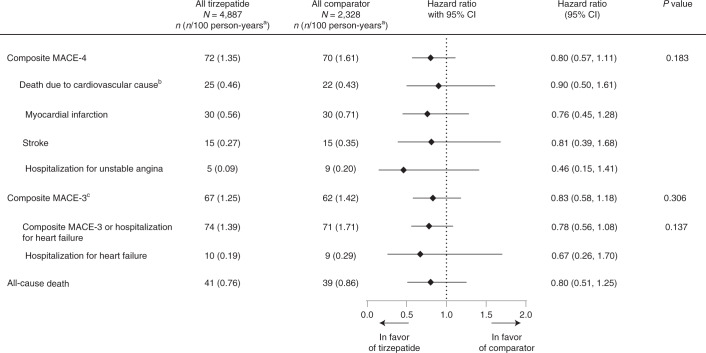
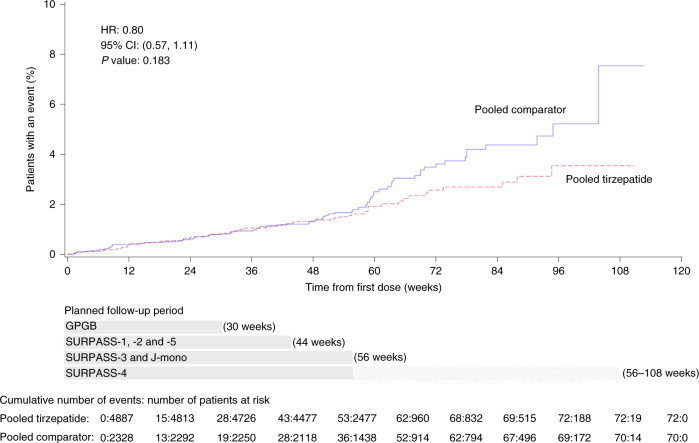
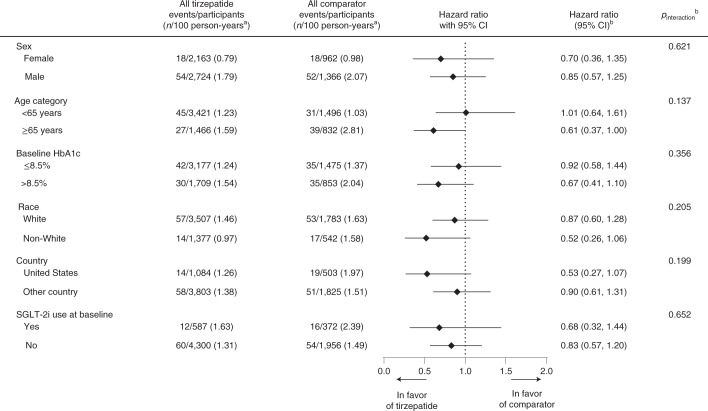
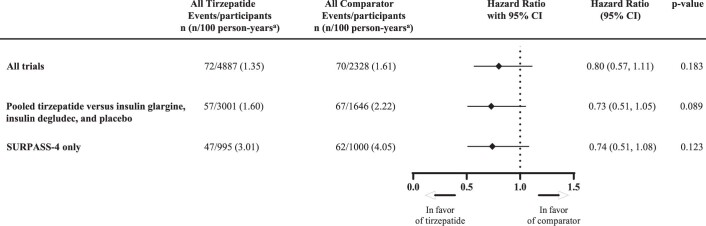
Tirzepatide is a novel, once weekly, dual GIP/GLP-1 receptor agonist and is under development for the treatment of type 2 diabetes (T2D) and obesity. Its association with cardiovascular outcomes requires evaluation. This pre-specified cardiovascular meta-analysis included all seven randomized controlled trials with a duration of at least 26 weeks from the tirzepatide T2D clinical development program, SURPASS. The pre-specified primary objective of this meta-analysis was the comparison of the time to first occurrence of confirmed four-component major adverse cardiovascular events (MACE-4; cardiovascular death, myocardial infarction, stroke and hospitalized unstable angina) between pooled tirzepatide groups and control groups. A stratified Cox proportional hazards model, with treatment as a fixed effect and trial-level cardiovascular risk as the stratification factor, was used for the estimation of hazard ratios (HRs) and confidence intervals (CIs) comparing tirzepatide to control. Data from 4,887 participants treated with tirzepatide and 2,328 control participants were analyzed. Overall, 142 participants, 109 from the trial with high cardiovascular risk and 33 from the six trials with lower cardiovascular risk, had at least one MACE-4 event. The HRs comparing tirzepatide versus controls were 0.80 (95% CI, 0.57–1.11) for MACE-4; 0.90 (95% CI, 0.50–1.61) for cardiovascular death; and 0.80 (95% CI, 0.51–1.25) for all-cause death. No evidence of effect modifications was observed for any subgroups, although the evidence was stronger for participants with high cardiovascular risk. Tirzepatide did not increase the risk of major cardiovascular events in participants with T2D versus controls.
Overview
The claims and statistics of this paper haven’t been checked yet.
Free: it reads the open-access text and checks the first 5 claims that cite a source we can check. Create a free account to check every claim.
Integrity signals
Registry
Cites
Statistics
Figures
Verification
Claims the paper makes
The claims and statistics of this paper haven’t been checked yet.
Free: it reads the open-access text and checks the first 5 claims that cite a source we can check. Create a free account to check every claim.
Claims other papers make about this one
Each is checked against this paper’s own text: does it say what the citing paper says it does?
The source backs part of the claim, not all of it — or backs it for a different population, condition or comparison.
In the citing paper
“Furthermore, in a meta-analysis, which included five phase 3 tirzepatide trials conducted in patients with T2D, tirzepatide did not increase the risk of major cardiovascular events in participants compared with controls (hazard ratio 0.80, 95% CI 0.57-1.11).26”
From Tirzepatide reduces the predicted risk of atherosclerotic cardiovascular disease and improves cardiometabolic risk factors in adults with obesity or overweight: SURMOUNT-1 post hoc analysis (2024) · cites this paper as [26]
Experimental — accuracy not yet measuredThe cited source says what the claim attributes to it.
In the citing paper
“Additionally, current short-term data from RCTs suggest that tirzepatide does not increase the risk of MACE versus comparators; however, robust data on its long-term cardiovascular pro fi le will be”
The cited source says what the claim attributes to it.
In the citing paper
“The ongoing SURPASS trials evaluating tirzepatide also evidenced a trend towards cardiovascular safety with decreased incidence of MACEs (hazard ratio 0.80; 95% CI, 0.57–1.11).62”
From GLP-1 single, dual, and triple receptor agonists for treating type 2 diabetes and obesity: a narrative review (2024) · cites this paper as [62]
The cited source says what the claim attributes to it.
In the citing paper
“Recent results from RCTs with tirzepatide suggest superior effects on glycemic control and weight loss compared to semaglutide [105,116] and a first cardiovascular risk assessment importantly also indicated no increased risk of MACE [123].”
From Obesity and MASLD: Is weight loss the (only) key to treat metabolic liver disease? (2024) · cites this paper as [123]
The cited source says what the claim attributes to it.
In the citing paper
“pooled data from the SURPASS clinical trial programme indicate that tirzepatide does not increase the risk of major cardiovascular events [61]”
3 more claims about this paper
Create a free account to see every claim other papers make about this one.
Self-check
Percentages, sums and reported differences re-computed from the paper’s own numbers.
The self-check needs the paper’s full text.
Citations
Cites
Heart Disease and Stroke Statistics—2017 Update: A Report From the American Heart Association
Benjamin, E. J., Blaha, M. J., Chiuve, S. E., Cushman, M., Das, S. R., Deo, R., de Ferranti, S. D., Floyd, J., Fornage, M., Gillespie, C., et al. (2017) · Circulation · doi:10.1161/cir.0000000000000485 · Cited by 12,591
Empagliflozin, Cardiovascular Outcomes, and Mortality in Type 2 Diabetes
Zinman, B., Wanner, C., Lachin, J. M., Fitchett, D., Bluhmki, E., Hantel, S., Mattheus, M., Devins, T., Johansen, O. E., Woerle, H. J., et al. (2015) · New England Journal of Medicine · doi:10.1056/nejmoa1504720 · Cited by 12,315
Liraglutide and Cardiovascular Outcomes in Type 2 Diabetes
Marso, S. P., Daniels, G. H., Brown-Frandsen, K., Kristensen, P., Mann, J. F. E., Nauck, M. A., Nissen, S. E., Pocock, S., Poulter, N. R., Ravn, L. S., et al. (2016) · New England Journal of Medicine · doi:10.1056/nejmoa1603827 · Cited by 7,629
Heart disease and stroke statistics-2018 update: a report from the american heart association
Benjamin, E. J., Virani, S. S., Callaway, C. W., Chamberlain, A. M., Chang, A. R., Cheng, S., Chiuve, S. E., Cushman, M., Delling, F. N., Deo, R., et al. (2018) · Circulation · doi:10.1161/cir.0000000000000558 · Cited by 7,146
Semaglutide and Cardiovascular Outcomes in Patients with Type 2 Diabetes
Marso, S. P., Bain, S. C., Consoli, A., Eliaschewitz, F. G., Jódar, E., Leiter, L. A., Lingvay, I., Rosenstock, J., Seufert, J., Warren, M. L., et al. (2016) · New England Journal of Medicine · doi:10.1056/nejmoa1607141 · Cited by 6,900
A generalization of sampling without replacement from a finite universe
Horvitz, D. G., & Thompson, D. J. (1952) · Journal of the American Statistical Association · doi:10.1080/01621459.1952.10483446 · Cited by 4,293
Gerstein, H. C., Colhoun, H. M., Dagenais, G. R., Diaz, R., Lakshmanan, M., Pais, P., Probstfield, J., Riesmeyer, J. S., Riddle, M. C., Rydén, L., et al. (2019) · The Lancet · doi:10.1016/s0140-6736(19)31149-3 · Cited by 3,163
Tirzepatide versus Semaglutide Once Weekly in Patients with Type 2 Diabetes
Frías, J. P., Davies, M. J., Rosenstock, J., Pérez Manghi, F. C., Fernández Landó, L., Bergman, B. K., Liu, B., Cui, X., & Brown, K. (2021) · New England Journal of Medicine · doi:10.1056/nejmoa2107519 · Cited by 2,096
Oral Semaglutide and Cardiovascular Outcomes in Patients with Type 2 Diabetes
Husain, M., Birkenfeld, A. L., Donsmark, M., Dungan, K., Eliaschewitz, F. G., Franco, D. R., Jeppesen, O. K., Lingvay, I., Mosenzon, O., Pedersen, S. D., et al. (2019) · New England Journal of Medicine · doi:10.1056/nejmoa1901118 · Cited by 1,997
Meta-analysis of individual participant data: rationale, conduct, and reporting
Riley, R. D., Lambert, P. C., & Abo-Zaid, G. (2010) · BMJ · doi:10.1136/bmj.c221 · Cited by 1,701
Cited by
Items 301–346 of 346
Tirzepatide cardiovascular benefits and adverse events assessment: a Bayesian network meta-analysisPreprint
gong, X., cheng, P., han, Y., li, Q., Song, C., & Zhao, Y. (2024) · Research Square · doi:10.21203/rs.3.rs-4159026/v1
Cardiovascular Disease Risk and Risk Reduction Strategies in Diabetes Mellitus
Wilson, D. P., Hamilton, L., & Maki, K. C. (2024) · Contemporary cardiology · doi:10.1007/978-3-031-54960-1_14
Pharmacotherapy for Obesity: Recent Evolution and Implications for Cardiovascular Risk Reduction
Maki, K. C., Kirkpatrick, C. F., Allison, D. B., & Gadde, K. M. (2024) · Contemporary cardiology · doi:10.1007/978-3-031-54960-1_13
Mendoza‐Marí, Y., Wilson, V. E. D., Wilson, D. R., & Agrawal, D. K. (2024) · Advances in biochemistry in health and disease · doi:10.1007/978-3-031-62806-1_23
Schmidt, S., Busch, M., & Wolf, G. (2024) · Nephrologie aktuell · doi:10.1055/a-2308-4674
Incretin-Related Drugs and Nutrition
Arai, A., Kobayashi, S., & Okajima, F. (2024) · Nippon Eiyo Shokuryo Gakkaishi · doi:10.4327/jsnfs.77.333
당뇨병 치료의 진화: 관해를 향해가는 혁신적 약물치료와 첨단 관리기기의 결합
Choi, J. H., & Moon, M. K. (2024) · Public Health Weekly Report · doi:10.56786/phwr.2024.17.44.4
Liuzzo, G., & Patrono, C. (2025) · European Heart Journal · doi:10.1093/eurheartj/ehaf013
Sind GLP-1-Rezeptor-Agonisten und SGLT2-Inhibitoren auch im höheren Lebensalter geeignet?
Stüdemann, S., & Engeli, S. (2025) · Adipositas - Ursachen Folgeerkrankungen Therapie · doi:10.1055/a-2492-9440
Recent advances in the pharmacological treatment of obesity
Nam, G. E. (2025) · Journal of Korean Medical Association · doi:10.5124/jkma.25.0058 · Cited by 1
Sind GLP-1-Rezeptor-Agonisten und SGLT2-Inhibitoren auch im höheren Lebensalter geeignet?
Stüdemann, S., & Engeli, S. (2025) · Diabetes aktuell · doi:10.1055/a-2588-6338
Advances in peptide-based drug discovery
Khatri, B., Velloso, J. P. L., Shambhawi, Kan, M., & Craik, D. J. (2025) · Elsevier eBooks · doi:10.1016/b978-0-443-29808-0.00041-8
Effect of Tirzepatide on Cardiovascular Outcomes
Huston, J., Orey, D., Ashchi, A., Lachapelle, A. A., Genovese, A., Jackson, J., Ashchi, R., Ashchi, T., Ashchi, M., Sutton, D., et al. (2025) · American Journal of Cardiovascular Drugs · doi:10.1007/s40256-025-00767-4 · Cited by 1
“A pre-specified meta-analysis of all seven phase III SURPASS studies (≥ 26 weeks in duration) found no significant difference in major adverse cardiovascular events (MACE) between tirzepatide and the combined control groups [15].”
Kempf, K., Röhling, M., & Martin, S. (2025) · Frontiers in Endocrinology · doi:10.3389/fendo.2025.1644442 · Cited by 1
TIRZEPATIDE FOR CARDIOVASCULAR RISK REDUCTION: A LITERATURE REVIEW
Settaf-Cherif, E., Settaf-Cherif, L., Malinowska, K., Barwacz, J., Gładysz, D., & Adamik, M. (2025) · International Journal of Innovative Technologies in Social Science · doi:10.31435/ijitss.3(47).2025.3989
“Tirzepatide lowers cardiovascular risk by inducing substantial weight loss-up to 15% in participants with T2DM and 21% in those without, despite similar baseline body weight (Jensen et al., 2024).”
InfluentialQuinaglia, T., Silva, G., Matos‐Souza, J. R., Coelho‐Filho, O. R., Nadruz, W., & Sposito, A. C. (2025) · Current Atherosclerosis Reports · doi:10.1007/s11883-025-01368-x
“Emerging evidence from studies with dual gastric inhibitory polypeptide (GIP) and GLP-1 receptor agonists suggests even more pronounced effects on cardiovascular biomarkers, including greater reduc - tions in inflammatory markers and improved cardiac met - abolic indices [9, 10 ].”
McGuire, D. K., D’Alessio, D., Nicholls, S. J., Nissen, S. E., Riesmeyer, J. S., Pavo, I., Sethuraman, S., Heilmann, C. R., Kaiser, J. J., & Weerakkody, G. J. (2022) · Figshare · doi:10.6084/m9.figshare.20625103
Self-citationLingvay, I., Mosenzon, O., Brown, K. E., Cui, X., O’Neill, C., Landó, L. F., & Patel, H. (2024) · Figshare · doi:10.6084/m9.figshare.26577536
Nicholls, S. J., Tofé, S., le Roux, C. W., D’Alessio, D. A., Wiese, R. J., Pavo, I. J., Brown, K. E., Weerakkody, G. J., Zeytinoglu, M., & Romera, I. (2024) · Figshare · doi:10.6084/m9.figshare.25201920
Self-citationLingvay, I., Mosenzon, O., Brown, K. E., Cui, X., O’Neill, C., Landó, L. F., & Patel, H. (2024) · Figshare · doi:10.6084/m9.figshare.26577542
Lingvay, I., Mosenzon, O., Brown, K. E., Cui, X., O’Neill, C., Landó, L. F., & Patel, H. (2024) · Figshare · doi:10.6084/m9.figshare.26577539
Figueroa, N. C., Mendoza, M. J. L., Ulloa, A., Vindas, J. J., Estrada, M. A. S., & Mena, M. J. V. (2026) · Cureus · doi:10.7759/cureus.104567
“These findings suggest that tirzepatide does not confer additional cardiovascular harm and may be considered a safe therapeutic option for patients with type 2 diabetes mellitus from a cardiovascular standpoint [20].”
Cardiovascular and Kidney Effects of Glucagon-Like Peptide 1 Receptor Agonists
Sattar, N. A. (2026) · Elsevier eBooks · doi:10.1016/b978-0-323-87862-3.00013-6
Self-citationWas ist neu in der Therapie des Typ-2-Diabetes?
Gallwitz, B. (2026) · CME · doi:10.1007/s11298-025-4487-x
Thirugnanam, A. M., Chandrakanth, & Pruthvi (2026) · Cardiovascular revascularization medicine · doi:10.1016/j.carrev.2026.03.011
Chashchin, M. G., Velichko, A. M., Glechyan, A. M., Emelyanov, A. V., Gorshkov, A. Y., & Drapkina, O. M. (2026) · Rational Pharmacotherapy in Cardiology · doi:10.20996/1819-6446-2026-3246
Navas, A., NOONE, J., Laney, N., SHETH, S. T., Tan, X., Liang, Y. M., Munoz, P., & Swift, C. (2026) · Diabetes Therapy · doi:10.1007/s13300-026-01875-3 · Cited by 1
“Potential pathways include improvements in endothelial function, reductions in blood pressure, anti-inflammatory effects, and direct myocardial protection, all of which have been described with GLP-1RA therapy independent of weight change [12–14].”
Yakushevskaya, O. V. (2026) · Meditsinskiy sovet = Medical Council · doi:10.21518/ms2026-075
Terui, S., Minami, T., Nakamura, K., & Terauchi, Y. (2026) · Journal of Lipid and Atherosclerosis · doi:10.12997/jla.2026.15.2.249 · Cited by 1
“22 Although these studies suggested some degree of cardiovascular benefit, the sample sizes and study durations were not large or long enough to establish definitive cardiovascular outcomes for tirzepatide.”
Tirzepatide data: safety first is safety always!
Janić, M., Rabbani, S. A., El‐Tanani, M., Rangraze, I. R., Janež, A., Maggio, V., & Rizzo, M. (2026) · Expert Opinion on Drug Safety · doi:10.1080/14740338.2026.2681511
Tirzepatide for weight and behavior management in a patient with Smith-Magenis syndrome
Liao, X. C., Huang, T., Hong, D. S., & Luo, L. (2026) · JCEM Case Reports · doi:10.1210/jcemcr/luag152
“These weight and metabolic improvements are clinically significant and may reduce future risk of type 2 diabetes and cardiovascular disease [15, 16].”
Effect of emerging antiobesity and antidiabetic drugs on atherosclerosis
Armentaro, G., Severini, G., Pastura, C. A., Scarcelli, M. R., Cassano, V., & Sciacqua, A. (2026) · Internal and Emergency Medicine · doi:10.1007/s11739-026-04438-3
“Like other GLP-1 analogues, Tirzepatide is administered subcutaneously once a week, given its half-life of five days [37].”
Xiao-yu, Z., Wu, Q., Lu, H.-L., Xie, J.-J., Zhang, Y., Xu, Y., Guo, M., & Teng, F. (2026) · Diabetology & Metabolic Syndrome · doi:10.1186/s13098-026-02163-7 · Cited by 2
“By contrast, cardiovascular outcome evidence for tirz-epatide remains more limited, and firmer conclusions will require additional dedicated cardiovascular outcome studies and adequately powered direct comparative trials [60, 75].”
Tocci, G., Nardoianni, G., Pala, B., Zuppini, E., Gualtieri, P., Renzo, L. D., Valenti, V., Basolo, A., Salvetti, G., Santini, F., et al. (2026) · Nutrition Metabolism and Cardiovascular Diseases · doi:10.1016/j.numecd.2026.104857
Spiazzi, B. F., Zingano, C. P., Colpani, V., & Gerchman, F. (2026) · Diabetes Research and Clinical Practice · doi:10.1016/j.diabres.2026.113431 · Cited by 3
Kang, X., Liang, X., Cui, W., Song, Y., Wang, X., Hai, X., Wu, P., Hao, Y., Ma, X., & Yan, N. (2026) · Research Square · doi:10.21203/rs.3.rs-10330033/v1
Singla, A., Kaur, G., Singh, G., Luthra, S., Lodha, C., Alneser, O., Alo, M. S., Ali, S. K. S., & Zulqarnain, M. A. (2026) · Cureus · doi:10.7759/cureus.113371
“…after adjustment, tirzepatide does generate a clinically meaningful palpitation/tachycardia burden that is broadly attributable to GIP receptor-mediated cardiac chronotropy, consistent with the 1-2 bpm heart rate increase observed with tirzepatide versus semaglutide in head-to-head trials [21].”
Bruno, A., Schirosi, M., & Foti, R. (2026) · Aesthetic Plastic Surgery · doi:10.1007/s00266-026-06176-5
“These biomarkers have been extensively validated as indicators of inflammatory activation, endothelial dysfunction, and thrombotic risk in both metabolic and cardiovascular research [3, 4].”
Li, M. (2026) · Frontiers in Cardiovascular Medicine · doi:10.3389/fcvm.2026.1926629
“STEP-HFpEF and SUMMIT identified obesity-related heart failure with preserved ejection fraction (HFpEF) as an incretin-responsive phenotype (10 – 18), while SOUL and SURPASS-CVOT updated the evidence for oral semaglutide and tirzepatide in high-risk type 2 diabetes (19 – 23).”
Segurança Cardiovascular da Tirzepatida- Uma Revisão Integrativa
Nascimento, E. N., Peres, A. C. F., Petrillo, B. A., Naves, B. P. P., Santos, G. S. E. O., da Silva, M. E. A., Peixoto, N. L. D. Á., & Oliveira, R. D. C. (2026) · Revista Master Ensino Pesquisa e Extensão · doi:10.47224/revistamaster.v11i21.859
Argano, C., Maggio, D., Pollicino, C., Cangialosi, V., Manno, S. B., Orlando, V., Monti, M. L., Grutta, A., Torres, A., & Corrao, S. (2026) · Frontiers in Pharmacology · doi:10.3389/fphar.2026.1784959
“…loss, tirzepatide treatment is associated with significant improvements in obesity-related metabolic abnormalities (enhanced insulin sensitivity, favorable changes in lipid profiles, and reductions in markers of metabolic inflammation) and comorbidities (Sattar et al., 2022; Wang et al., 2025).”
Zhan, S., Deng, Y., Chen, P., Lv, T., Song, Y., Liu, J., & Kong, C. (2026) · Cells · doi:10.3390/cells15201900
“By dual-targeting GLP-1 and GIP receptors throughout the body, TZP confers profound whole-body metabolic benefits, including the improvement of peripheral insulin sensitivity, suppression of circulating pro-inflammatory cytokines, and optimization of cardiovascular hemodynamics [38–41].”
Stüdemann, S., Gollasch, M., & Engeli, S. (2026) · Frontiers in Pharmacology · doi:10.3389/fphar.2026.1786211
Carruthers, J. E., Ooi, X. Y., Goodall, D., Reed, J., Bedi, R., McGrath, A. K., Willicombe, M. K., Avari, P., & Frankel, A. (2026) · Diabetic Medicine · doi:10.1111/dme.70500
Füchtenbusch, M., Kraus, M., Heitmann, E., Wilhelm, S., Schwarz, L., Bendel, J., & Hennies, N. (2026) · Advances in Therapy · doi:10.1007/s12325-026-03767-1
Metadata
- Authors
- Sattar, N., McGuire, D. K., Pavo, I., Weerakkody, G. J., Nishiyama, H., Wiese, R. J., & Zoungas, S.
- Affiliations
- University of Glasgow (GB)
- Parkland Health & Hospital System (US)
- Eli Lilly (United States) (US)
- Monash University (AU)
- Corresponding author
- Sattar, Naveed
- Zoungas, Sophia
- ORCID
- Venue
- Nature Medicine
- Published
- 2022-02-24
- Volume
- 28
- Issue
- 3
- Pages
- 591-598
- ISSN
- 1078-8956 (ISSN-L)
- 1546-170X
- PMC
- PMC8938269
- OpenAlex
- W4213427170
- Cited by
- 346
- References
- 39
- Citations by year
- 2026: 43 · 2025: 72 · 2024: 93 · 2023: 94 · 2022: 44
- FWCI
- 10.78
- Type
- journal article
- Language
- en
- Open access
- hybrid
- doi.org
- Licence
- cc-by
- creativecommons.org/licenses/by/4.0 (tdm)
- creativecommons.org/licenses/by/4.0 (vor)
- Locations
- Nature Medicine (publishedVersion, cc-by)
- PubMed Central (publishedVersion, cc-by)
- PubMed (publishedVersion)
- ENLIGHTEN (Jurnal Bimbingan dan Konseling Islam) (acceptedVersion, cc-by-sa)
- Funders
- British Heart Foundation (RE/18/6/34217)
- Topics
- Health Sciences › Medicine › Endocrinology, Diabetes and Metabolism › Diabetes Treatment and Management
- Health Sciences › Medicine › Pharmacology (medical) › Pharmacology and Obesity Treatment
- Health Sciences › Medicine › Endocrinology, Diabetes and Metabolism › Diabetes, Cardiovascular Risks, and Lipoproteins
- Keywords
- tirzepatide, major adverse cardiovascular events, cardiovascular safety, type 2 diabetes, obesity, GIP/GLP-1 receptor agonist, cardiovascular mortality, myocardial infarction, stroke, unstable angina, SURPASS trials, effect modification
- MeSH terms
- Glucagon-Like Peptide-1 Receptor Agonists, Tirzepatide, Cardiovascular Diseases, Diabetes Mellitus, Type 2, Gastric Inhibitory Polypeptide, Humans, Hypoglycemic Agents
About these checks
Registry, retraction, Cites and statistics results are computed, not judged, with one exception: a printed reference that no index lists is read once by a model before it counts as a citation error. Claims are extracted by a model and kept only when their quote appears verbatim in the text; each cited source is then checked, with a model’s help, for whether it says what the claim relies on. Those verdicts can be wrong — read the claim’s quote and the cited source before relying on one.
Statistics and arithmetic are recomputed, not judged.
Confidence bands are shown only for fields calibrated on our annotated test set. None is calibrated yet, so no band is shown.
What counts as a claim ›How we measure confidence ›How we check this ›
Are you an author, or do you see a problem with this page? Request a review
Data sources
Bibliographic data: Semantic Scholar, OpenAlex, Crossref.
Contains information from the Semantic Scholar Academic Graph Datasets, made available under the ODC Attribution License (ODC-BY 1.0).
Semantic Scholar’s data is described in: Kinney, R., et al. (2023). The Semantic Scholar Open Data Platform. arXiv:2301.10140.
