

Drivers and determinants of strain dynamics following fecal microbiota transplantation
Open accessPublished version of a preprint
The DOI matches its Crossref record; 109 of the 109 references it cites were found in a registry or an index.
Abstract
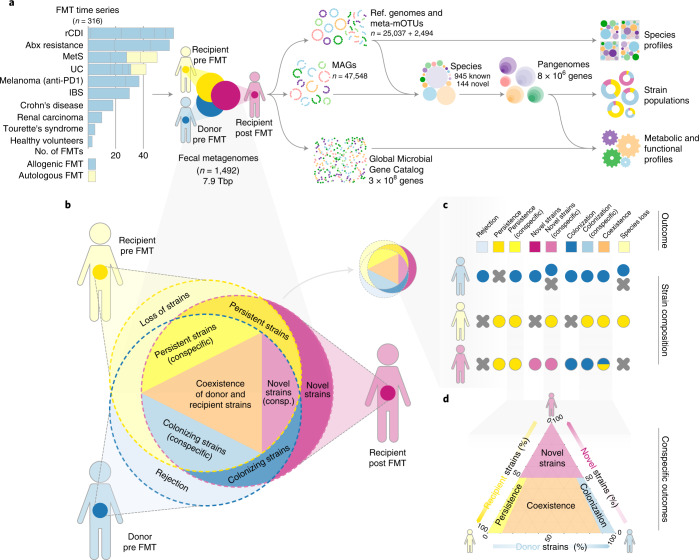
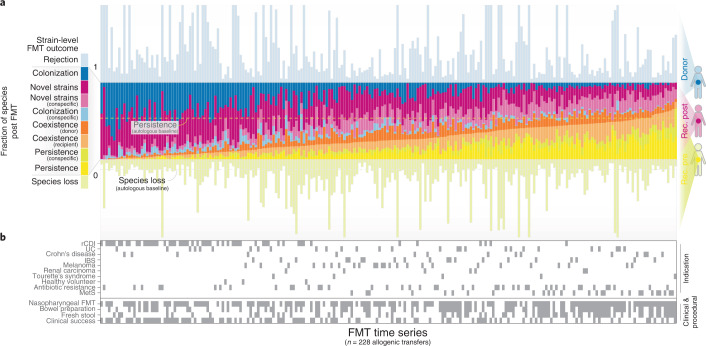
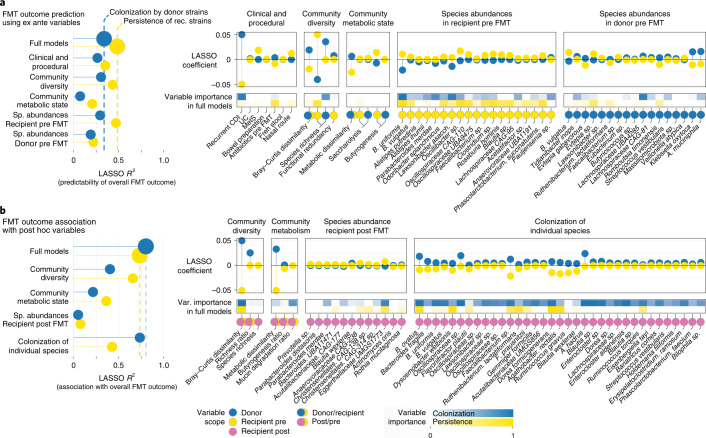
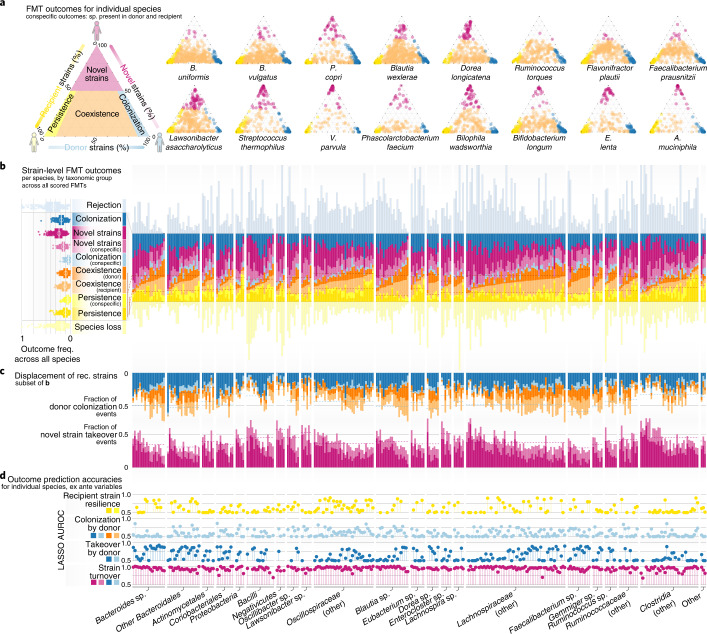
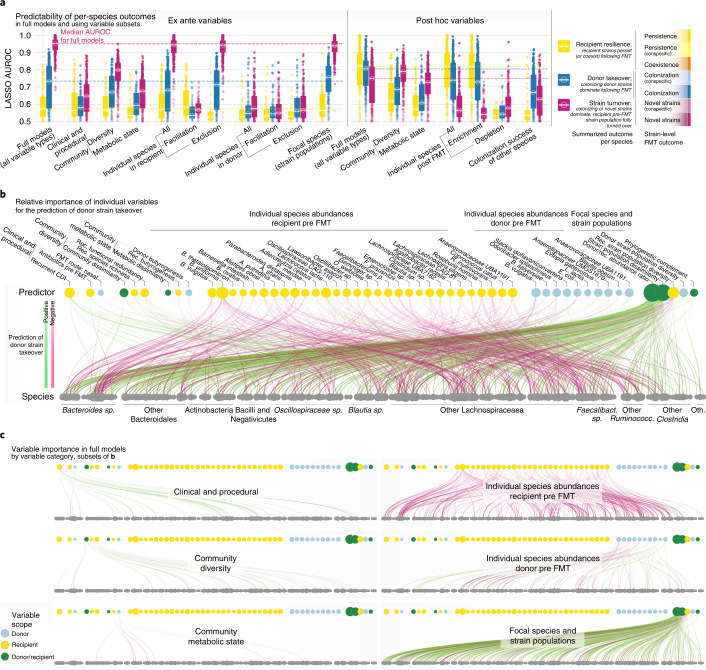
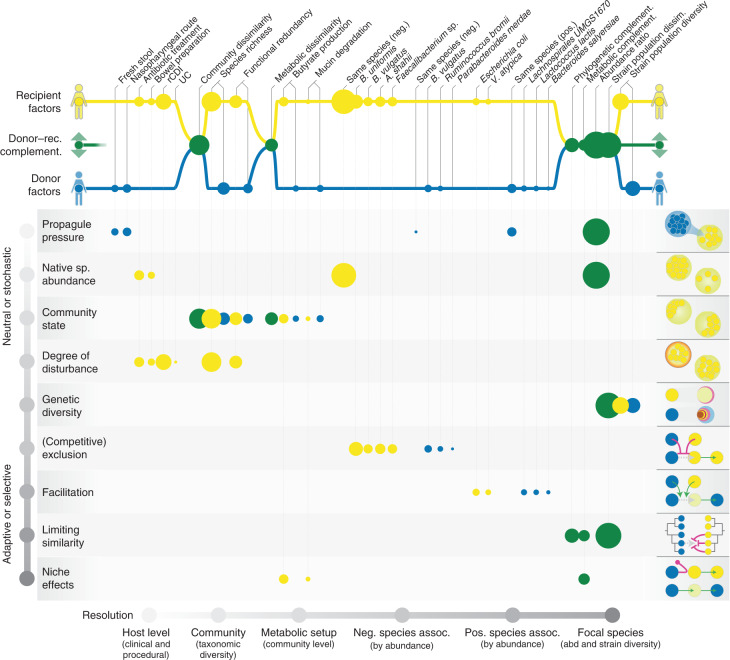
Fecal microbiota transplantation (FMT) is a therapeutic intervention for inflammatory diseases of the gastrointestinal tract, but its clinical mode of action and subsequent microbiome dynamics remain poorly understood. Here we analyzed metagenomes from 316 FMTs, sampled pre and post intervention, for the treatment of ten different disease indications. We quantified strain-level dynamics of 1,089 microbial species, complemented by 47,548 newly constructed metagenome-assembled genomes. Donor strain colonization and recipient strain resilience were mostly independent of clinical outcomes, but accurately predictable using LASSO-regularized regression models that accounted for host, microbiome and procedural variables. Recipient factors and donor–recipient complementarity, encompassing entire microbial communities to individual strains, were the main determinants of strain population dynamics, providing insights into the underlying processes that shape the post-FMT gut microbiome. Applying an ecology-based framework to our findings indicated parameters that may inform the development of more effective, targeted microbiome therapies in the future, and suggested how patient stratification can be used to enhance donor microbiota colonization or the displacement of recipient microbes in clinical practice.
Overview
The claims and statistics of this paper haven’t been checked yet.
Free: it reads the open-access text and checks the first 5 claims that cite a source we can check. Create a free account to check every claim.
Integrity signals
Registry
Cites
Statistics
Figures
Verification
Claims the paper makes
The claims and statistics of this paper haven’t been checked yet.
Free: it reads the open-access text and checks the first 5 claims that cite a source we can check. Create a free account to check every claim.
Claims other papers make about this one
Each is checked against this paper’s own text: does it say what the citing paper says it does?
The cited source doesn’t support the claim as written.
In the citing paper
“In this context, metabolic independence — the capacity to synthesize essential cofactors, amino acids, and nucleotides — has emerged as a key ecological trait that promotes enteric health.228,230”
From Gut dysbiosis in oncology: a risk factor for immunoresistance (2026) · doi:10.1038/s41422-025-01212-6 · cites this paper as [230]
Checked by a reasoning model — may be wrong.
Experimental — accuracy not yet measuredThe source backs part of the claim, not all of it — or backs it for a different population, condition or comparison.
In the citing paper
“In fact, a metagenomics analysis of 316 FMTs indicated that clinical success does not rely on successful colonization, microbial displacement, or bacterial reinstatement.230”
From Gut dysbiosis in oncology: a risk factor for immunoresistance (2026) · doi:10.1038/s41422-025-01212-6 · cites this paper as [230]
Experimental — accuracy not yet measuredIn the citing paper
“based on two recent meta-analyses that reported a higher degree of donor microbiome engraftment in recipients with a precarious microbial community.746–748”
From Microbiota–gut–brain axis and its therapeutic applications in neurodegenerative diseases (2024) · cites this paper as [748]
In the citing paper
“This finding, however, was not replicated in another similar study, probably due to the heterogeneity of cohorts, diseases, FMTworkingprotocols, and differences in microbiome analytical methods. 90”
From Key determinants of success in fecal microbiota transplantation: From microbiome to clinic (2023) · cites this paper as [90]
Self-check
Percentages, sums and reported differences re-computed from the paper’s own numbers.
The self-check needs the paper’s full text.
Citations
Cites
The Sequence Alignment/Map format and SAMtools
Li, H., Handsaker, B., Wysoker, A., Fennell, T., Ruan, J., Homer, N., Marth, G., Abecasis, G., Durbin, R., & 1000 Genome Project Data Processing Subgroup (2009) · Bioinformatics · doi:10.1093/bioinformatics/btp352 · Cited by 62,041
BEDTools: a flexible suite of utilities for comparing genomic features
Quinlan, A. R., & Hall, I. M. (2010) · Bioinformatics · doi:10.1093/bioinformatics/btq033 · Cited by 27,437
Regularization and Variable Selection Via the Elastic Net
Zou, H., & Hastie, T. (2005) · Journal of the Royal Statistical Society Series B: Statistical Methodology · doi:10.1111/j.1467-9868.2005.00503.x · Cited by 20,957
Regularization Paths for Generalized Linear Models via Coordinate Descent
Friedman, J., Hastie, T., & Tibshirani, R. (2010) · Journal of Statistical Software · doi:10.18637/jss.v033.i01 · Cited by 19,927
Prokka: rapid prokaryotic genome annotation
Seemann, T. (2014) · Bioinformatics · doi:10.1093/bioinformatics/btu153 · Cited by 18,818
FastTree 2 – Approximately Maximum-Likelihood Trees for Large Alignments
Price, M. N., Dehal, P. S., & Arkin, A. P. (2010) · PLoS ONE · doi:10.1371/journal.pone.0009490 · Cited by 14,894
Prodigal: prokaryotic gene recognition and translation initiation site identification
Hyatt, D., Chen, G.-L., LoCascio, P. F., Land, M. L., Larimer, F. W., & Hauser, L. J. (2010) · BMC Bioinformatics · doi:10.1186/1471-2105-11-119 · Cited by 12,587
Parks, D. H., Imelfort, M., Skennerton, C. T., Hugenholtz, P., & Tyson, G. W. (2015) · Genome Research · doi:10.1101/gr.186072.114 · Cited by 12,496
Li, D., Liu, C.-M., Luo, R., Sadakane, K., & Lam, T.-W. (2015) · Bioinformatics · doi:10.1093/bioinformatics/btv033 · Cited by 9,893
MUSCLE: a multiple sequence alignment method with reduced time and space complexity
Edgar, R. C. (2004) · BMC Bioinformatics · doi:10.1186/1471-2105-5-113 · Cited by 8,970
Research works printed but not linked: 1
- Mende, D. R., Sunagawa, S., Zeller, G. & Bork, P. Accurate and universal delineation of prokaryotic species. Nat. Publ. Group 10, 881-884 (2013).
Cited by
Items 101–200 of 233
Rook, G. A. W. (2024) · Neuroscience & Biobehavioral Reviews · doi:10.1016/j.neubiorev.2024.105653 · Cited by 12
Spatiotemporal dynamics during niche remodeling by super-colonizing microbiota in the mammalian gut
Urtecho, G., Moody, T. U., Huang, Y., Sheth, R. U., Richardson, M., Descamps, H. C., Kaufman, A., Lekan, O., Zhang, Z., Velez‐Cortes, F., et al. (2024) · Cell Systems · doi:10.1016/j.cels.2024.10.007 · Cited by 16
Wang, L., Xu, Y., Li, L., Bo, Y., Zhao, D., Ye, C., Lin, Z., Cui, J., Liu, Y., Zhu, W., et al. (2024) · mBio · doi:10.1128/mbio.02023-24 · Cited by 13
Shekarriz, S., Szamosi, J. C., Whelan, F., Lau, J. T., Libertucci, J., Rossi, L., Fontes, M. E., Wolfe, M., Lee, C., Moayyedi, P., et al. (2025) · Nature Communications · doi:10.1038/s41467-025-58673-x · Cited by 14
“Even larger studies, which applied their bioinformatic work fl ows to multiple publicly available datasets and disease types 20 – 22 , reported disparate outcomes.”
Long-read metagenomics for strain tracking after faecal microbiota transplant
Fan, Y., Ni, M., Aggarwala, V., Mead, E. A., Ksiezarek, M., Cao, L., Kamm, M. A., Borody, T. J., Paramsothy, S., Kaakoush, N. O., et al. (2025) · Nature Microbiology · doi:10.1038/s41564-025-02164-8 · Cited by 16
“High-throughput metagenomic shotgun sequencing studies have provided valuable insights into FMT strain engraftment in various diseases 14,15,17–20 primarily through short-read sequencing to detect single-nucleotide polymorphisms (SNPs) and/or gene clusters that track strains in the recipient after…”
Self-citationPerspective: on the future of fecal microbiota transplantation
Larsen, O. F. A., & Brummer, R. J. (2024) · Frontiers in Microbiology · doi:10.3389/fmicb.2024.1449133 · Cited by 12
Precision microbial regulation: Strategies for modulating GIT microbiota for host health
Pei, Z., Li, Q., Zhang, Y., Guo, C., Abdelsattar, M. M., & Bi, Y. (2025) · iMetaOmics. · doi:10.1002/imo2.54 · Cited by 12
Wang, F., Chen, W., Jia, Y., He, T., Wu, S., Xiang, J., Chen, R., Jiang, Q., Yu, T., Lan, Y., et al. (2025) · Cancer Medicine · doi:10.1002/cam4.70994 · Cited by 17
Self-citationClaypool, J., Lindved, G., Myers, P. N., Ward, T., Nielsen, H. B., & Blount, K. (2025) · Gut Microbes · doi:10.1080/19490976.2025.2520412 · Cited by 12
“…whether or how the engrafted species affected the rest of the restored microbiome composition (e.g. non-engrafted Clostridia), or whether specific engraf-ters helped eliminate Gammaproteobacteria and Bacilli, as has been proposed for FMT. 58 These hypotheses will be explored in future studies.”
Qin, P., Kragsnæs, M. S., Holm, D. K., Horn, H. C., Nilsson, A. C., Kjeldsen, J., Kristiansen, K., & Ellingsen, T. (2025) · Arthritis & Rheumatology · doi:10.1002/art.43359 · Cited by 11
“…donor – recipient complementarity encompassing entire microbial communities to individual strains may be determinants of strain population dynamics, 22 whereas differential strain engraftment likelihoods seem to be associated with microbial taxonomy and phenotypic properties across various…”
Host origin of microbiota drives functional recovery and Clostridioides difficile clearance in mice
Millard, S., Vendrov, K. C., Young, V. B., & Seekatz, A. M. (2025) · mBio · doi:10.1128/mbio.01108-25 · Cited by 11
Fecal microbiota transplantation: A promising treatment strategy for chronic liver disease
Ma, L., Zhang, M., Xu, Y., Hao, Y.-X., Niu, X.-X., Li, Y., & Xing, H. (2025) · World Journal of Gastroenterology · doi:10.3748/wjg.v31.i28.105089 · Cited by 13
Elendu, C., Omeludike, E., Aregbesola, E. T., Mordi, P., Blewusi, G. S., Ogidan, A. O., Okeke, N. S., Obidigbo, B. T., Asini, A. O., Ubi, E. S., et al. (2025) · Annals of Medicine and Surgery · doi:10.1097/ms9.0000000000003649 · Cited by 11
“Key risk factors influencing the epidemiology of rCDI include prior antibiotic exposure, advanced age, hospitalization, immunosuppression, and comorbidities such as chronic kidney disease and inflammatory bowel disease [ 8–11 , 17– 19 ] .”
InfluentialReygner, J., Delannoy, J., Barba-Goudiaby, M.-T., Gasc, C., Levast, B., Gaschet, E., Ferraris, L., Paul, S., Kapel, N., Waligora‐Dupriet, A., et al. (2024) · Applied and Environmental Microbiology · doi:10.1128/aem.00016-24 · Cited by 12
Oral Anaerobutyricum soehngenii augments glycemic control in type 2 diabetes
Attaye, I., Witjes, J. J., Koopen, A. M., van der Vossen, E. W. J., Zwirs, D., Wortelboer, K., Collard, D., Kemper, E. M., Winkelmeijer, M., Holst, J. J., et al. (2024) · iScience · doi:10.1016/j.isci.2024.110455 · Cited by 11
Self-citationBryson, S., Sisson, Z., Nelson, B., Grove, J., Reister, E., Liachko, I., Auch, B., Graiziger, C. T., & Khoruts, A. (2025) · Gut Microbes · doi:10.1080/19490976.2025.2559019 · Cited by 9
“17,18 The recovery of antibiotic-depleted bacteria restores secondary bile acid metabolism and certain short-chain fatty acids, which enhance colonization resistance against C. difficile bacteria.”
Metalog: curated and harmonised contextual data for global metagenomics samples
Kuhn, M., Schmidt, T., Ferretti, P., Glazek, A. M., Robbani, S. M., Akanni, W. A., Fullam, A., Schudoma, C., Cetin, E., Hassan, M., et al. (2025) · Nucleic Acids Research · doi:10.1093/nar/gkaf1118 · Cited by 17
“…panel for pancreatic duct carcinoma [ 50 ], to investigate the associations between fecal microbial load and various host-associated features [ 47 ], to trace strain dynamics after FMT [ 51 ], and to investigate the prevalence of C. difficile across different age groups and environments [ 52 ].”
Self-citationLi, H., Li, Y., & Qian, J. (2023) · Chinese Medical Journal · doi:10.1097/cm9.0000000000002704 · Cited by 9
“A recent bioinformatics study demonstrated that factors related to recipients, not donors, are more predictive of FMT success.[17] Zou et al[18] constructed a predictive model of gut microbiota composition in post-FMT patients, in which no donorrelated factor contributed to the predictive accuracy.”
BackgroundCurrent and future microbiome-based therapies in inflammatory bowel disease
Montrose, J. A., Kurada, S. V., & Fischer, M. (2024) · Current Opinion in Gastroenterology · doi:10.1097/mog.0000000000001027 · Cited by 9
Pucci, N., Ujčič-Voortman, J. K., Verhoeff, A. P., & Mende, D. R. (2025) · PeerJ · doi:10.7717/peerj.18602 · Cited by 11
Xu, Z., Mak, J. W. Y., Lin, Y., Yang, K., Liu, Q., Zhang, F., Lau, L. H. S., Tang, W., Ching, J. Y. L., Tun, H. M., et al. (2023) · Gut · doi:10.1136/gutjnl-2022-328993 · Cited by 9
Fecal microbiota transplantation in pigs: current status and future perspective
Rahman, R., Marcolla, C. S., & Willing, B. P. (2025) · Animal Microbiome · doi:10.1186/s42523-025-00440-w · Cited by 10
“…the success of cross-species FMT relies on phenotype transfer, which involves the colonization of specific strains and highlights the important role of microbial communities in influencing and altering disease states, metabolic functions, and physiological traits in different host organisms [277].”
de Groen, P., Snethlage, C. M. F., Wortelboer, K., Tokgöz, S., Davids, M., Verdoes, X., Westerbeke, F. H. M., Meijer, R. I., Gotthardt, M., de Vos, W. M., et al. (2025) · Gut Microbes · doi:10.1080/19490976.2025.2563155 · Cited by 10
Self-citationSingle-cell nanocapsules of gut microbiota facilitate fecal microbiota transplantation
Hou, W., Cao, Y., Wang, J., Yin, F., Wang, J., Guo, N., Wang, Z., Lv, X., Ma, C., Chen, Q., et al. (2025) · Theranostics · doi:10.7150/thno.104852 · Cited by 8
“Initially, microbiota slurries are prepared by homogenization and filtration of fecal material under sterile conditions, and then administered by invasive nasogastric feeding tubes or colonoscopy [8-10], which are not suitable for children and the elderly.”
Correlating the Gut Microbiome to Health and Disease
Marques, T. M., Mall, J. G., Forsgård, R. A., Wall, R., Brummer, R. J., & de Vos, W. M. (2024) · Elsevier eBooks · doi:10.1016/b978-0-323-99971-7.00010-2 · Cited by 13
Ronkainen, A., Khan, I., & Satokari, R. M. (2024) · Microbiome Research Reports · doi:10.20517/mrr.2024.43 · Cited by 9
de Groen, P., Blok, L. C. H. M., Snethlage, C. M. F., Hanssen, N. M. J., Rampanelli, E., & Nieuwdorp, M. (2025) · International Journal of Molecular Sciences · doi:10.3390/ijms262110788 · Cited by 6
“Although numerous studies have investigated the microbial signatures associated with type 1 diabetes, there is currently no consensus on specific microbial species that consistently drive or predict disease onset [81,82].”
Self-citationThe human gut microbiome in enteric infections: from association to translation
Yin, Q., Gupta, S., Muller, E., & Almeida, A. (2026) · Gut Microbes · doi:10.1080/19490976.2026.2612836 · Cited by 8
The gut as a central hub for multi-organ crosstalk in aging
Zhang, X., Li, R., Gao, Y., Zhang, W., Ni, T., & Liu, Y. (2026) · Cellular and Molecular Life Sciences · doi:10.1007/s00018-026-06129-w · Cited by 9
Fecal microbiota transplantation: from empirical remedy to precision medicine
Zhao, J., 樊翌明, Yang, K., & Gao, H. (2026) · Frontiers in Microbiomes · doi:10.3389/frmbi.2026.1863308 · Cited by 6
Behling, A. H., Portlock, T., Ho, D., Wilson, B. C., Paramsothy, S., Kamm, M. A., Cutfield, W. S., Kaakoush, N. O., O'Sullivan, J. M., & Vatanen, T. (2025) · Gut Microbes · doi:10.1080/19490976.2025.2597628 · Cited by 9
“28 Typically, published clinical FMT trial datasets will provide metagenomic sequencing data for donors and recipients (pre-and post-treatment), in addition to details of the donor-recipient pairings (for multi-donor FMT trials).”
InfluentialA trait-based framework to identify microbial keystone taxa for microbiome engineering
Espíndola‐Hernández, P., Banerjee, S., Abdulmalik, A. O., Andrade‐Linares, D. R., Baldi, G., Berg, G., Brearley, F. Q., Flocco, C. G., Galgani, L., Gegeckienė, L., et al. (2026) · Cell Reports Sustainability · doi:10.1016/j.crsus.2025.100615 · Cited by 10
Németh, K., Tóth, I., Lányi, K., Schilling-Tóth, B. M., Csorba, S., Žaja, I. Ž., & Sterczer, Á. (2026) · Veterinary Sciences · doi:10.3390/vetsci13020182 · Cited by 7
van der Vossen, E. W. J., Davids, M., Voermans, B., Wortelboer, K., Hartstra, A. V., Koopen, A. M., de Groot, P. F., Levin, E., & Nieuwdorp, M. (2024) · Gut Microbes · doi:10.1080/19490976.2024.2388295 · Cited by 7
Self-citationDiet shapes and maintains the personalized native gut microbiomes in mice
Yang, Z., Zhang, Z., Jiang, S., Li, A., Song, H., & Zhang, J. (2024) · Journal of the Science of Food and Agriculture · doi:10.1002/jsfa.14073 · Cited by 5
Straining to define a healthy microbiome
Seekatz, A. M. (2025) · mSphere · doi:10.1128/msphere.00797-24 · Cited by 4
Microbiota Transplant Therapy Is Safe and Feasible in Pulmonary Arterial Hypertension
Moutsoglou, D., Blake, M., Belhasan, D. C., Peichel, G. A., Vang, B. M., Weir, Ε. K., Lopez, S., Prins, K. W., Kabage, A. J., Prisco, S. Z., et al. (2025) · JACC Basic to Translational Science · doi:10.1016/j.jacbts.2025.101347 · Cited by 9
Ebadi, M., Reddi, S., Senyshyn, L., Minot, S. S., Gooley, T. A., Kabage, A. J., Lee, S. J., Hill, G. R., Khoruts, A., & Rashidi, A. (2025) · Gut Microbes · doi:10.1080/19490976.2025.2551882 · Cited by 6
Human-microbes symbiosis in health and disease, on earth and beyond planetary boundaries
Dore, J. M., & Ugalde, S. O. (2023) · Frontiers in Astronomy and Space Sciences · doi:10.3389/fspas.2023.1180522 · Cited by 5
Assessing live microbial therapeutic transmission
Faith, J. J. (2025) · Gut Microbes · doi:10.1080/19490976.2024.2447836 · Cited by 4
Validation methods for encapsulated faecal microbiota transplantation: a scoping review
Rågård, N., Baunwall, S. M. D., Paaske, S. E., Hansen, M. M., Høyer, K. L., Mikkelsen, S., Erikstrup, C., Dahlerup, J. F., & Hvas, C. L. (2025) · Therapeutic Advances in Gastroenterology · doi:10.1177/17562848251314820 · Cited by 5
“85,86 The present study identified discrepancies in the validation methods used, highlighting the complexity of obtaining standardised microbiota preparations for human applications.”
mbDriver: identifying driver microbes in microbial communities based on time-series microbiome data
Tan, X., Xue, F., Zhang, C., & Wang, T. (2024) · Briefings in Bioinformatics · doi:10.1093/bib/bbae580 · Cited by 4
Pathobionts in the microbiome: Drivers of disease and targets for treatment
Bharathi, S., Rajan, Y. A. P. A. S., Prakash, S., Immanuel, G., & Ramasubburayan, R. (2025) · Microbial Pathogenesis · doi:10.1016/j.micpath.2025.108268 · Cited by 7
Su, Q., Chen, S., Lau, L. H., Lui, R. N.-S., Wang, Y., Xu, Z., Cheung, C. P., Ching, J. Y. L., Shen, X., Peng, Y., et al. (2026) · Cell Reports · doi:10.1016/j.celrep.2026.117301 · Cited by 7
Li, J., Wang, Y., Li, R., Huang, H., Zhu, X., Li, X., Sun, Z., Zhang, L., Zheng, P., He, Y., et al. (2026) · Cell Host & Microbe · doi:10.1016/j.chom.2026.05.017 · Cited by 12
Metagenomic source tracking after microbiota transplant therapy
Hoops, S., Moutsoglou, D., Vaughn, B. P., Khoruts, A., & Knights, D. (2025) · Gut Microbes · doi:10.1080/19490976.2025.2487840 · Cited by 6
Algavi, Y. M., & Borenstein, E. (2024) · Nature Communications · doi:10.1038/s41467-024-48717-z · Cited by 4
“Following a previous study that categorized classi fi ed taxa into different post-FMT classes 21 when multiple recipient post-FMT samples were available, they were treated as participating in multiple FMT experiments.”
Zou, B., Huo, Q., Zhou, X., Lv, Y., Li, G., Fu, G., Shen, H., & Shu, S. (2025) · Current Research in Microbial Sciences · doi:10.1016/j.crmicr.2025.100512 · Cited by 6
Exploring gut microbiota and spinal cord injury: pathogenesis, treatment strategies and prospects
Chen, Q., Zhong, M., & Ye, L. (2025) · Frontiers in Immunology · doi:10.3389/fimmu.2025.1693883 · Cited by 3
“Some patients may experience poor outcomes or even adverse reactions following FMT (263).”
Gut microbiome modulates breast cancer risk in socially isolated mice
Andrade, F. D. O., Staley, C. M., Jin, L., Ozgul-Onal, M., McDermott, M., Kenanoğlu, S., de Oliveira, K. A., Verma, V., & Hilakivi-Clarke, L. A. (2026) · Breast Cancer Research · doi:10.1186/s13058-026-02292-x · Cited by 3
“It is important to note that although FMT is successfully employed to treat many gut inflammatory and other diseases, such as type 2 diabetes, and improves response to cancer immunotherapies, its clinical success is not determined by engraftment rate [35].”
Advances and challenges in microbiome transplantation
Sen, P., Kaulmann, D., Youngster, I., Abdeen, S. K., & Elinav, E. (2026) · Cell Host & Microbe · doi:10.1016/j.chom.2026.06.006 · Cited by 5
Ninkov, M., & Vareki, S. M. (2026) · Nature Communications · doi:10.1038/s41467-026-76051-z · Cited by 6
Ebrahimi, R., Nejad, S. S., Fekri, M., & Nejadghaderi, S. A. (2025) · Current Research in Microbial Sciences · doi:10.1016/j.crmicr.2025.100420 · Cited by 12
Metaproteomics Reveals Community Coalescence Outcomes in Co‐Cultured Human Gut Microbiota
Sun, B., Yuan, J., Zhang, X., Ma, X., Hao, Z., Wang, L., Li, Y., Zhang, L., & Li, L. (2025) · PROTEOMICS · doi:10.1002/pmic.70009 · Cited by 3
Fecal microbiota transplantation for glaucoma; a potential emerging treatment strategy
Ebrahimi, R., Farsi, Y., & Nejadghaderi, S. A. (2024) · Current Research in Microbial Sciences · doi:10.1016/j.crmicr.2024.100314 · Cited by 8
Phages modulate bacterial communities in the human gut following fecal microbiota transplantationPreprint
Zuppi, M., Vatanen, T., Wilson, B. C., Golovina, E., Cutfield, W. S., Vickers, M. H., & O'Sullivan, J. M. (2024) · Research Square · doi:10.21203/rs.3.rs-3883935/v1 · Cited by 3
Towards a Generative Paradigm for Large-scale Microbiome Analysis by Generative Language ModelPreprint
Zhang, H., Kang, Z., Zhang, Y., Yang, R., & Ning, K. (2025) · bioRxiv (Cold Spring Harbor Laboratory) · doi:10.1101/2025.01.15.633278 · Cited by 4
Syed, S. A., Moayyedi, P., Kao, D. H., Patel, J., Marshall, J. K., Surette, M. G., & Narula, N. (2025) · Inflammatory Bowel Diseases · doi:10.1093/ibd/izaf284 · Cited by 2
Drew, G., Kraft, C. S., & Mehta, N. (2025) · Clinical Chemistry · doi:10.1093/clinchem/hvaf156 · Cited by 2
Su, Y., Su, X., Chen, Z., Wang, L., & Chen, J. (2026) · Frontiers in Medicine · doi:10.3389/fmed.2026.1735121 · Cited by 3
“The primary goal of this procedure is to suppress pathogenic bacteria, restore microbial balance, and achieve therapeutic benefits (70).”
Ma, Z., Shi, H., Bai, X., Wang, Z. P., Cao, J., Dong, Y., & Chen, Y. (2026) · Gut Microbes · doi:10.1080/19490976.2026.2667735 · Cited by 3
Integration of donor microbiota following FMT correlates with anti-PD-1 response in melanoma
Fessler, J. L., Olm, M. R., Engleman, E. G., & Sonnenburg, J. L. (2026) · Nature Communications · doi:10.1038/s41467-026-73465-7 · Cited by 7
“While certain bacterial families were more readily transmitted, as has been previously reported 37 – 39 (Supplementary Fig.”
Garneau, J. R., Altenried, A., Teo, Y., Xiaobing, W. U., McHugh, S. C., Taschner, M. J., Hernández‐Cabanyero, C., Mignolet, J., Gomes, P., de la Noue, H. D. V., et al. (2026) · npj Biofilms and Microbiomes · doi:10.1038/s41522-026-01087-4 · Cited by 2
Koo, H., & Morrow, C. D. (2023) · Scientific Reports · doi:10.1038/s41598-023-41128-y · Cited by 2
“The degree of recipient strain microbial community depletion, because of the several rounds of suppressive antibiotics, was also an important consideration for donor colonization 10 .”
BackgroundInterspecies interaction controls Escherichia coli growth in human gut microbiome samples
Boumasmoud, M., León‐Sampedro, R., Beusch, V., Benz, F., Arnoldini, M., & Hall, A. R. (2026) · Proceedings of the National Academy of Sciences · doi:10.1073/pnas.2527793123 · Cited by 3
“This aspect is relevant in the context of potential microbiome-based therapies, such as probiotics and fecal microbiota transplantation [28,29].”
Gut microbiota bacterial strain richness is species specific and limits therapeutic engraftmentPreprint
Chen-Liaw, A., Aggarwala, V., Mogno, I., Haifer, C., Li, Z., Eggers, J., Helmus, D. S., Hart, A. B., Wehkamp, J., Lamousé-Smith, E. S. N., et al. (2022) · bioRxiv (Cold Spring Harbor Laboratory) · doi:10.1101/2022.11.01.514782 · Cited by 2
Self-citationAssessing Engraftment Following Fecal Microbiota TransplantPreprint
Herman, C., Barker, B. M., Bartelli, T. F., Chandra, V., Krajmalnik‐Brown, R., Jewell, M., Li, L., Liao, C., McAllister, F. M., Nirmalkar, K., et al. (2024) · PubMed · doi:10.48550/arxiv.2404.07325 · Cited by 2
Fecal Microbiota Transplantation (FMT) in Ulcerative Colitis: Holding Out for a Superdonor?
Claytor, J. D., & Faith, J. J. (2024) · Clinical Gastroenterology and Hepatology · doi:10.1016/j.cgh.2024.07.047 · Cited by 4
“Gut” to grips with the science of the microbiome – a symposium report
Finnegan, Y. E., Neill, H. R., Prpa, E. J., & Pot, B. (2024) · Gut Microbiome · doi:10.1017/gmb.2024.8 · Cited by 3
Pinto, S., Benincà, E., Nooij, S., Terveer, E. M., Keller, J. J., Jong, A. E. V. D. M., Steyerberg, E. W., & Bogaards, J. A. (2025) · ISME Communications · doi:10.1093/ismeco/ycaf119 · Cited by 2
“Similarly, a meta-analysis conducted by Schmidt et al. [12] involving 316 FMT procedures across various disease indications, including IBD, highlighted the importance of donor-recipient microbiome complementarity in shaping treatment outcomes [12].”
InfluentialZhang, T., Feng, J. Q., Qian, M., Gao, X., Chen, X., Xiao, R., Peng, H., Fan, X., Meng, X., Yin, M., et al. (2025) · Advanced Chinese Medicine · doi:10.1002/acm4.35 · Cited by 1
Wilson, B. C., Tweedie‐Cullen, R. Y., Albert, B. B., Derraik, J. G. B., Ho, D., Depczynski, M., Creagh, C., Edwards, T., Gali, S., Thabrew, H., et al. (2025) · Nature Communications · doi:10.1038/s41467-025-67267-6 · Cited by 1
“Our fi ndings are consistent with microbiome restoration trials in other conditions 29 – 31 , demonstrating that FMT successfully altered the gut microbiome in individuals with AN, with participants acquiring an averageof38newspecies.”
Tuft Cells in the Gut Limit Cognitive Disorders by Regulating Gut Homeostasis
Chen, L., Yang, Y., Zhang, Y., Yang, X., Zhang, X., Chen, L., Li, W., Zhang, S. L., Xiong, R., Wang, J., et al. (2026) · Cellular and Molecular Gastroenterology and Hepatology · doi:10.1016/j.jcmgh.2026.101747 · Cited by 2
“47 Within this reconstituted ecosystem, post-FMT colonization dynamics and abundance shifts of Firmicutes and Bacteroidota frequently deviate from those of the donor.”
Live biotherapeutics and nutraceuticals: Exploring the differences and synergies
Jyoti, Padhi, S., & Rai, A. K. (2026) · Progress in molecular biology and translational science · doi:10.1016/bs.pmbts.2026.01.031 · Cited by 1
Gut dysbiosis in kidney injury: therapeutic potential of fecal microbiota transplantation
Liu, J., Ning, X., Yuan, J., Yu, Z., Qin, Y., Xing, Y., Zhao, J., & Sun, S. (2026) · European journal of medical research · doi:10.1186/s40001-026-04100-w · Cited by 4
Baseline Gut Microbiome-Dependent Responses to Probiotic Treatments for IBD in Mice
Zhang, Z., Yang, Z., Jiang, S., Sun, Y., Jiang, Y., Huang, S., & Zhang, J. (2026) · Engineering · doi:10.1016/j.eng.2025.02.025 · Cited by 2
Rethinking microbiome health through functional dynamics
Potiron, A., Francken, J. C., & Aidy, S. E. (2026) · Cell Host & Microbe · doi:10.1016/j.chom.2026.03.005 · Cited by 1
How the social lives of bacteria affect their pangenome
Whelan, F. (2026) · Essays in Biochemistry · doi:10.1042/ebc20250039 · Cited by 1
Neutralizing gut-derived lipopolysaccharide as a novel therapeutic strategy for severe leptospirosis
Xie, X., Chen, X., Zhang, S., Liu, J., Zhang, W., & Cao, Y. (2024) · eLife · doi:10.7554/elife.96065 · Cited by 9
Oladele, P. O., Dong, W., Richert, B. T., & Johnson, T. A. (2025) · Animal Microbiome · doi:10.1186/s42523-025-00495-9 · Cited by 1
“The amplicons were then sequenced with an Illumina MiSeq Sequencer (2 × 250 paired end) at the Purdue University Genomics Core Facility.”
ELECTRON RAY SCANNING SYSTEM FOR MEASUREMENT OF PHOTOGRAPHS FROM BUBBLE CHAMBERS.
Berlin, N. I., Vertlib, I. L., Gorelov, A. A., Кац, Б. М., Markovich, M. G., Ovchinnikov, E. K., Rubchinskii, S. M., Uvarov, V., & Tsukkerman, I. I. (1973) · OSTI OAI (U.S. Department of Energy Office of Scientific and Technical Information)
Geerlings, S. Y. (2023) · doi:10.18174/581871 · Cited by 3
Microbial dispersion in the human gut through the lens of fecal transplantPreprint
Algavi, Y. M., & Borenstein, E. (2023) · bioRxiv (Cold Spring Harbor Laboratory) · doi:10.1101/2023.08.29.555267
Kousgaard, S. J. (2023) · VBN Forskningsportal (Aalborg Universitet) · doi:10.54337/aau561823572 · Cited by 1
Liu, X., & Wu, S. (2023) · World Chinese Journal of Digestology · doi:10.11569/wcjd.v31.i22.922
Neutralizing gut-derived lipopolysaccharide as a novel therapeutic strategy for severe leptospirosisPreprint
Xie, X., Chen, X., Zhang, S., Liu, J., Zhang, W., & Cao, Y. (2024) · bioRxiv (Cold Spring Harbor Laboratory) · doi:10.1101/2024.01.17.576119
Neutralizing gut-derived lipopolysaccharide as a novel therapeutic strategy for severe leptospirosisPreprint
Xie, X., Chen, X., Zhang, S., Liu, J., Zhang, W., & Cao, Y. (2024) · eLife · doi:10.7554/elife.96065.1 · Cited by 2
Shtossel, O., Turjeman, S., Riumin, A., Goldberg, M. R., Elizur, A., Bekor, Y., Mor, H., Koren, O., & Louzoun, Y. (2023) · Figshare · doi:10.6084/m9.figshare.23949883
Colonisation of the gut microbiome by Escherichia coli during international travel
Davies, M. A. (2024) · Research Publications (Maastricht University) · doi:10.26481/dis.20240417md · Cited by 1
Neutralizing gut-derived lipopolysaccharide as a novel therapeutic strategy for severe leptospirosisPreprint
Xie, X., Chen, X., Zhang, S., Liu, J., Zhang, W., & Cao, Y. (2024) · eLife · doi:10.7554/elife.96065.2
Montenegro-Borbolla, E., El‐Khoury, J. W., Bertelli, C., Schoepfer, A. M., Guery, B. P., & Galpérine, T. (2025) · Gut Microbes Reports · doi:10.1080/29933935.2025.2487905
Gut Microbiota in Health and Disease: A Path to Personalized Medicine
Pulipati, S., Puttagunta, S. B., Aswini, S., Nandini, Y., & Lavanya, K. (2025) · Archives of Case Reports · doi:10.29328/journal.acr.1001152
Kragsnæs, M. S., Kjeldsen, J., Ellingsen, T., Qin, P., & Kristiansen, K. (2025) · Arthritis & Rheumatology · doi:10.1002/art.43394
Lucarini, E., D’Amato, A., Pilato, V. D., Morecchiato, F., Gall, G. L., Vauzour, D., Micheli, L., Toti, A., Ciampi, C., Nicoletti, C., et al. (2025) · SSRN Electronic Journal · doi:10.21203/rs.3.rs-6025304/v1
Microbiome Modulation: Translating Function into Clinical Practice
Zurowska, A. M. (2025) · EMJ Gastroenterology · doi:10.33590/emjgastroenterol/lolr2998
Qassadi, F. I., Johnson, C., Robinson, K., Griffin, R., Polytarchou, C., Kao, D. H., Kim, D., Griffiths, R. L., Zhu, Z., & Monaghan, T. M. (2025) · International Journal of Molecular Sciences · doi:10.3390/ijms262211221
“This likely reflects differences in the baseline metabolic states of rCDI patients and healthy donors, as well as individual-specific factors including residual microbiota composition, diet, and host metabolic responses [20,21].”
Living therapeutics: Colorectal related diseases precision therapy with engineered organisms
Huang, J., Lan, Y., Chen, L., Guan, X., Liang, R., Liang, J., Gao, M., Gan, J., Guo, Y., & Zhang, S. (2025) · Chinese Chemical Letters · doi:10.1016/j.cclet.2025.112151
Zuppi, M., Vatanen, T., Wilson, B. C., Golovina, E., Portlock, T., Cutfield, W. S., Vickers, M. H., & O’Sullivan, J. M. (2024) · Figshare · doi:10.6084/m9.figshare.26195789
Zuppi, M., Vatanen, T., Wilson, B. C., Golovina, E., Portlock, T., Cutfield, W. S., Vickers, M. H., & O’Sullivan, J. M. (2024) · Figshare · doi:10.6084/m9.figshare.26195886
Zuppi, M., Vatanen, T., Wilson, B. C., Golovina, E., Portlock, T., Cutfield, W. S., Vickers, M. H., & O’Sullivan, J. M. (2024) · Figshare · doi:10.6084/m9.figshare.26744621
Metadata
- Authors
- Schmidt, T. S. B., Li, S. S., Maistrenko, O. M., Akanni, W., Coelho, L. P., Dolai, S., Fullam, A., Glazek, A. M., Hercog, R., Herrema, H., Jung, F., Kandels, S., Orakov, A., Thielemann, R., von Stetten, M., Van Rossum, T., Benes, V., Borody, T. J., de Vos, W. M., Ponsioen, C. Y., Nieuwdorp, M., & Bork, P.
- Affiliations
- European Molecular Biology Laboratory (DE)
- The University of Queensland (AU)
- Royal Netherlands Institute for Sea Research (NL)
- Fudan University (CN)
- Centre For Digestive Diseases (AU)
- Amsterdam University Medical Centers (NL)
- Amsterdam UMC Location University of Amsterdam (NL)
- ORCID
- Venue
- Nature Medicine
- Published
- 2022-09
- Volume
- 28
- Issue
- 9
- Pages
- 1902-1912
- ISSN
- 1078-8956 (ISSN-L)
- 1546-170X
- PMC
- PMC9499871
- OpenAlex
- W4295929883
- Semantic Scholar
- 31ce244f5415b2717b4f2f9b6a0ac4e68b13465a
- Cited by
- 233
- References
- 103
- Citations by year
- 2026: 56 · 2025: 63 · 2024: 70 · 2023: 37 · 2022: 5
- FWCI
- 14.36
- Type
- journal article
- Language
- en
- Open access
- hybrid
- doi.org
- Licence
- cc-by
- creativecommons.org/licenses/by/4.0 (tdm)
- creativecommons.org/licenses/by/4.0 (vor, 14 d)
- Locations
- Nature Medicine (publishedVersion, cc-by)
- PubMed Central (publishedVersion, cc-by)
- PubMed (publishedVersion)
- Pure Amsterdam UMC (publishedVersion, cc-by)
- Amsterdam UMC (VU Amsterdam) - Institutional Repository (publishedVersion, other-oa)
- MDC Repository (Max-Delbrueck-Center for Molecular Medicine) (acceptedVersion)
- Socio-Environmental Systems Modeling (acceptedVersion, cc-by)
- Data Archiving and Networked Services (DANS) (submittedVersion, other-oa)
- Työväentutkimus Vuosikirja (submittedVersion)
- Technical University of Denmark, DTU Orbit (Technical University of Denmark, DTU) (submittedVersion, cc-by)
- Data Archiving and Networked Services (DANS) (submittedVersion, cc-by)
- Funders
- Harvard University
- Universitetet i Tromsø
- Universität Hohenheim
- European Molecular Biology Laboratory (ALTF 137-2018)
- European Commission (669830, 686070)
- ZonMw ([09150182010020], 2019.82.004)
- Bundesministerium für Bildung und Forschung (031L0181A)
- Diabetes Fonds (2019.82.004)
- Nederlandse Organisatie voor Wetenschappelijk Onderzoek (024.002.002)
- Université de Genève
- Medical Research Council
- National Health and Medical Research Council (1166180)
- Topics
- Life Sciences › Biochemistry, Genetics and Molecular Biology › Molecular Biology › Gut microbiota and health
- Health Sciences › Medicine › Infectious Diseases › Clostridium difficile and Clostridium perfringens research
- Health Sciences › Medicine › Gastroenterology › Inflammatory Bowel Disease
- Keywords
- fecal microbiota transplantation, gut microbiota, metagenome-assembled genomes, microbiome ecology, patient stratification, microbiota-based therapy, inflammatory bowel disease
- MeSH terms
- Gastrointestinal Microbiome, Fecal Microbiota Transplantation, Clostridium Infections, Feces, Humans, Gastrointestinal Tract, Microbiota
About these checks
Registry, retraction, Cites and statistics results are computed, not judged, with one exception: a printed reference that no index lists is read once by a model before it counts as a citation error. Claims are extracted by a model and kept only when their quote appears verbatim in the text; each cited source is then checked, with a model’s help, for whether it says what the claim relies on. Those verdicts can be wrong — read the claim’s quote and the cited source before relying on one.
Statistics and arithmetic are recomputed, not judged.
Confidence bands are shown only for fields calibrated on our annotated test set. None is calibrated yet, so no band is shown.
What counts as a claim ›How we measure confidence ›How we check this ›
Are you an author, or do you see a problem with this page? Request a review
Data sources
Bibliographic data: Semantic Scholar, OpenAlex, Crossref.
Contains information from the Semantic Scholar Academic Graph Datasets, made available under the ODC Attribution License (ODC-BY 1.0).
Semantic Scholar’s data is described in: Kinney, R., et al. (2023). The Semantic Scholar Open Data Platform. arXiv:2301.10140.
