

The DOI matches its Crossref record; 69 of the 71 references it cites were found in a registry or an index.
Evidence for a role of Anopheles stephensi in the spread of drug- and diagnosis-resistant malaria in Africa
Open accessPublished version of a preprint
Abstract
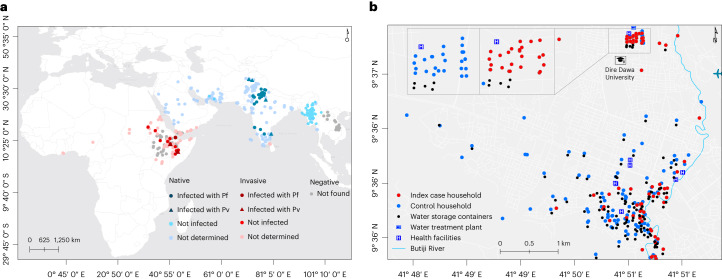
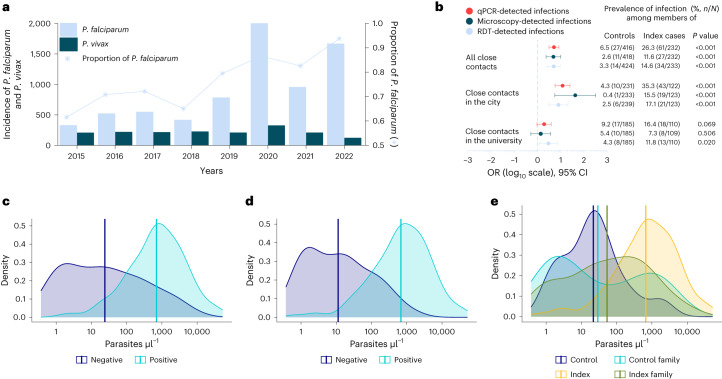
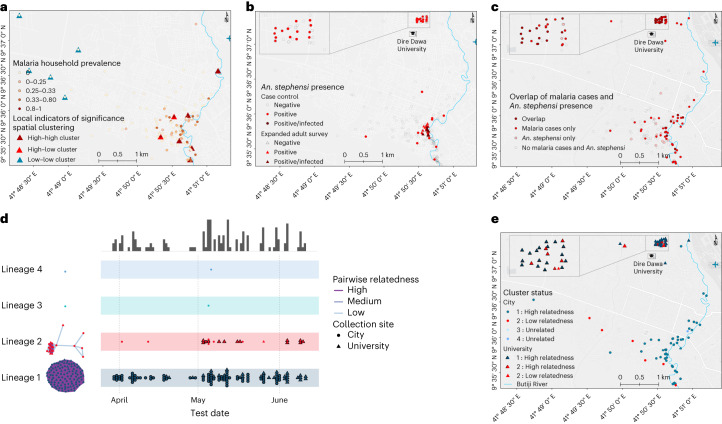
Anopheles stephensi , an Asian malaria vector, continues to expand across Africa. The vector is now firmly established in urban settings in the Horn of Africa. Its presence in areas where malaria resurged suggested a possible role in causing malaria outbreaks. Here, using a prospective case–control design, we investigated the role of An. stephensi in transmission following a malaria outbreak in Dire Dawa, Ethiopia in April–July 2022. Screening contacts of patients with malaria and febrile controls revealed spatial clustering of Plasmodium falciparum infections around patients with malaria in strong association with the presence of An. stephensi in the household vicinity . Plasmodium sporozoites were detected in these mosquitoes. This outbreak involved clonal propagation of parasites with molecular signatures of artemisinin and diagnostic resistance. To our knowledge, this study provides the strongest evidence so far for a role of An. stephensi in driving an urban malaria outbreak in Africa, highlighting the major public health threat posed by this fast-spreading mosquito.
Overview
The claims and statistics of this paper haven’t been checked yet.
Run the check — free, no account needed. It reads the open-access text and checks the sources it cites.
Integrity signals
Registry
Cites
Statistics
Figures
Verification
Claims the paper makes
The claims and statistics of this paper haven’t been checked yet.
Run the check — free, no account needed. It reads the open-access text and checks the sources it cites.
Claims other papers make about this one
Each is checked against this paper’s own text: does it say what the citing paper says it does?
The cited source says what the claim attributes to it.
In the citing paper
“Due to its potential to drive malaria outbreaks [67, 70], An. stephensi surveillance has received increased attention in areas of potential invasion.”
From Sibling species of the major malaria vector Anopheles gambiae display divergent preferences for aquatic breeding sites in southern Nigeria (2024) · cites this paper as [70]
The cited source says what the claim attributes to it.
In the citing paper
“The connection between the presence of An. stephensi and malaria outbreaks in Djibouti City, Djibouti [4] and Dire Dawa, Ethiopia [5] heightens the need to track the spread of this invasive species.”
From Sequencing confirms Anopheles stephensi distribution across southern Yemen (2024) · cites this paper as [5]
Self-check
Percentages, sums and reported differences re-computed from the paper’s own numbers.
The self-check needs the paper’s full text.
Citations
Cites
Epidemiology and burden of malaria in pregnancy
Desai, M., ter Kuile, F. O., Nosten, F., McGready, R., Asamoa, K., Brabin, B., & Newman, R. D. (2007) · The Lancet Infectious Diseases · doi:10.1016/s1473-3099(07)70021-x · Cited by 1,432
Evidence of Artemisinin-Resistant Malaria in Africa
Balikagala, B., Fukuda, N., Ikeda, M., Katuro, O. T., Tachibana, S., Yamauchi, M., Opio, W., Emoto, S., Anywar, D. A., Kimura, E., et al. (2021) · New England Journal of Medicine · doi:10.1056/nejmoa2101746 · Cited by 883
Uwimana, A., Legrand, E., Stokes, B. H., Mangala, J.-L. N., Warsame, M., Umulisa, N., Ngamije, D., Munyaneza, T., Mazarati, J.-B., Munguti, K., et al. (2020) · Nature Medicine · doi:10.1038/s41591-020-1005-2 · Cited by 852
Okell, L., Bousema, T., Griffin, J. T., Ouédraogo, A. L., Ghani, A. C., & DRAKELEY, C. J. (2012) · Nature Communications · doi:10.1038/ncomms2241 · Cited by 659
Self-citationSinka, M. E., Bangs, M. J., Manguin, S., Chareonviriyaphap, T., Patil, A. P., Temperley, W. H., Gething, P. W., Elyazar, I. R., Kabaria, C. W., Harbach, R. E., et al. (2011) · Parasites & Vectors · doi:10.1186/1756-3305-4-89 · Cited by 550
Gamboa, D., Ho, M., Bendezú, J., Torres, K., Chiodini, P. L., Barnwell, J. W., Incardona, S., Perkins, M. D., Bell, D., McCarthy, J. S., et al. (2010) · PLoS ONE · doi:10.1371/journal.pone.0008091 · Cited by 547
The entomological inoculation rate and Plasmodium falciparum infection in African children
Smith, D. L., Dushoff, J., Snow, R. W., & Hay, S. I. (2005) · Nature · doi:10.1038/nature04024 · Cited by 369
Kent, R. J., & Norris, D. E. (2005) · American Journal of Tropical Medicine and Hygiene · doi:10.4269/ajtmh.2005.73.336 · Cited by 368
The Design of Case-Control Studies: The Influence of Confounding and Interaction Effects
Smith, P. G., & Day, N. (1984) · International Journal of Epidemiology · doi:10.1093/ije/13.3.356 · Cited by 295
Detection of Plasmodium falciparum malaria parasites in vivo by real-time quantitative PCR
Hermsen, C. C., Telgt, D. S. C., Linders, E. H. P., van de Locht, L. A. T. F., Eling, W. M. C., Mensink, E. J. B. M., & Sauerwein, R. W. (2001) · Molecular and Biochemical Parasitology · doi:10.1016/s0166-6851(01)00379-6 · Cited by 263
Strategies for Detection of Plasmodium species Gametocytes
Wampfler, R., Mwingira, F., Javati, S., Robinson, L., Betuela, I., Siba, P., Beck, H.-P., Mueller, I., & Felger, I. (2013) · PLoS ONE · doi:10.1371/journal.pone.0076316 · Cited by 252
Faulde, M. K., Rueda, L. M., & Khaireh, B. A. (2014) · Acta Tropica · doi:10.1016/j.actatropica.2014.06.016 · Cited by 245
Berhane, A., Anderson, K. A., Mihreteab, S., Gresty, K. J., Rogier, E. W., Mohamed, S., Hagos, F., Embaye, G., Chinorumba, A., Zehaie, A., et al. (2018) · Emerging infectious diseases · doi:10.3201/eid2403.171723 · Cited by 218
Increasing Prevalence of Artemisinin-Resistant HRP2-Negative Malaria in Eritrea
Mihreteab, S., Platon, L., Berhane, A., Stokes, B. H., Warsame, M., Campagne, P., Criscuolo, A., Ma, L., Petiot, N., Doderer-Lang, C., et al. (2023) · New England Journal of Medicine · doi:10.1056/nejmoa2210956 · Cited by 199
Tadesse, F. G., Slater, H., Chali, W., Teelen, K., Lanke, K. H. W., Belachew, M., Menberu, T., Shumie, G., Shitaye, G., Okell, L., et al. (2018) · Clinical Infectious Diseases · doi:10.1093/cid/cix1123 · Cited by 198
Self-citationPlasmodium falciparum resistant to artemisinin and diagnostics have emerged in Ethiopia
Fola, A. A., Feleke, S. M., Mohammed, H., Brhane, B. G., Hennelly, C. M., Assefa, A., Crudale, R., Reichert, E. N., Juliano, J. J., Cunningham, J. A., et al. (2023) · Nature Microbiology · doi:10.1038/s41564-023-01461-4 · Cited by 196
Carter, T. E., Yared, S., Gebresilassie, A., Bonnell, V., Damodaran, L., Lopez, K., Ibrahim, M., Mohammed, S., & Janies, D. (2018) · Acta Tropica · doi:10.1016/j.actatropica.2018.09.001 · Cited by 192
Andolina, C., Rek, J. C., Briggs, J. J., Okoth, J., Musiime, A. K., Ramjith, J., Teyssier, N., Conrad, M. D., Nankabirwa, J. I., Lanke, K. H. W., et al. (2021) · The Lancet Infectious Diseases · doi:10.1016/s1473-3099(21)00072-4 · Cited by 191
Self-citationPlasmodium falciparum is evolving to escape malaria rapid diagnostic tests in Ethiopia
Feleke, S. M., Reichert, E. N., Mohammed, H., Brhane, B. G., Mekete, K., Mamo, H., Petros, B., Solomon, H., Abate, E., Hennelly, C. M., et al. (2021) · Nature Microbiology · doi:10.1038/s41564-021-00962-4 · Cited by 188
Breeding Sites ofAedes aegypti: Potential Dengue Vectors in Dire Dawa, East Ethiopia
Getachew, D., Tekie, H., Gebre-Michael, T., Balkew, M., & Mesfin, A. (2015) · Interdisciplinary Perspectives on Infectious Diseases · doi:10.1155/2015/706276 · Cited by 160
Self-citationDurnez, L., Bortel, W. V., Denis, L., Roelants, P., Veracx, A., Trung, H. D., Sochantha, T., & Coosemans, M. (2011) · Malaria Journal · doi:10.1186/1475-2875-10-195 · Cited by 157
Geographical distribution of Anopheles stephensi in eastern Ethiopia
Balkew, M., Mumba, P. P., Dengela, D. O., Yohannes, G., Getachew, D., Yared, S., Chibsa, S., Murphy, M. W., George, K., López, K., et al. (2020) · Parasites & Vectors · doi:10.1186/s13071-020-3904-y · Cited by 148
Self-citationAn Introduction to Multilevel Regression Models
Austin, P. C., Goel, V., & van Walraven, C. (2001) · Canadian Journal of Public Health · doi:10.1007/bf03404950 · Cited by 146
Wilson, M. L., Krogstad, D. J., Arinaitwe, E., Arévalo‐Herrera, M., Chery, L., Ferreira, M. U., Ndiaye, D., Mathanga, D. P., & Eapen, A. K. (2015) · American Journal of Tropical Medicine and Hygiene · doi:10.4269/ajtmh.14-0834 · Cited by 144
Anopheles stephensi Mosquitoes as Vectors of Plasmodiumvivax and falciparum, Horn of Africa, 2019
Tadesse, F. G., Ashine, T., Teka, H., Esayas, E., Messenger, L. A., Chali, W., Meerstein‐Kessel, L., Walker, T., Behaksra, S. W., Lanke, K. H. W., et al. (2021) · Emerging infectious diseases · doi:10.3201/eid2702.200019 · Cited by 136
Self-citationSeyfarth, M., Khaireh, B. A., Abdi, A. A., Bouh, S. M., & Faulde, M. K. (2019) · Parasitology Research · doi:10.1007/s00436-019-06213-0 · Cited by 126
Camargo, L. M. A., Colletto, G. M. D. D., Ferreira, M. U., Gurgel, S. D. M., Escobar, A. L., Marques, A., Krieger, H., Camargo, E. P., & da Silva, L. P. (1996) · American Journal of Tropical Medicine and Hygiene · doi:10.4269/ajtmh.1996.55.32 · Cited by 116
Haile, D., & Lakew, Y. (2015) · PLoS ONE · doi:10.1371/journal.pone.0130460 · Cited by 114
Balkew, M., Mumba, P. P., Yohannes, G., Abiy, E., Getachew, D., Yared, S., Worku, A., Gebresilassie, A., Tadesse, F. G., Gadisa, E., et al. (2021) · Malaria Journal · doi:10.1186/s12936-021-03801-3 · Cited by 113
Self-citationKibret, S., Wilson, G. G., Tekie, H., & Petros, B. (2014) · Malaria Journal · doi:10.1186/1475-2875-13-360 · Cited by 111
Insecticide resistance in Anopheles stephensi in Somali Region, eastern Ethiopia
Yared, S., Gebressielasie, A., Damodaran, L., Bonnell, V., Lopez, K., Janies, D., & Carter, T. E. (2020) · Malaria Journal · doi:10.1186/s12936-020-03252-2 · Cited by 111
Sex-based differences in clearance of chronic Plasmodium falciparum infection
Briggs, J. J., Teyssier, N., Nankabirwa, J. I., Rek, J. C., Jagannathan, P., Arinaitwe, E., Bousema, T., DRAKELEY, C. J., Murray, M., Crawford, E. D., et al. (2020) · eLife · doi:10.7554/elife.59872 · Cited by 109
Self-citationKiattibutr, K., Roobsoong, W., Sriwichai, P., Saeseu, T., Rachaphaew, N., Suansomjit, C., Buates, S., Obadia, T., Müeller, I., Cui, L., et al. (2016) · International Journal for Parasitology · doi:10.1016/j.ijpara.2016.10.006 · Cited by 97
A Unique Plasmodium falciparum K13 Gene Mutation in Northwest Ethiopia
Bayih, A. G., Getnet, G., Alemu, A., Getie, S., Mohon, A. N., & Pillai, D. R. (2015) · American Journal of Tropical Medicine and Hygiene · doi:10.4269/ajtmh.15-0477 · Cited by 88
Resting and feeding preferences of Anopheles stephensi in an urban setting, perennial for malaria
Thomas, S., Ravishankaran, S., Justin, N. A. J. A., Asokan, A., Mathai, M. T., Valecha, N., Montgomery, J. L., Thomas, M. B., & Eapen, A. K. (2017) · Malaria Journal · doi:10.1186/s12936-017-1764-5 · Cited by 88
Clonal Outbreak ofPlasmodium falciparumInfection in Eastern Panama
Obaldía, N., Baro, N. K., Calzada, J. E., Santamaría, A. M., Daniels, R. F., Wong, W., Chang, H., Hamilton, E. J., Arévalo‐Herrera, M., Herrera, S. V., et al. (2014) · The Journal of Infectious Diseases · doi:10.1093/infdis/jiu575 · Cited by 80
Whittaker, C., Slater, H., Nash, R. K., Bousema, T., DRAKELEY, C. J., Ghani, A. C., & Okell, L. (2021) · The Lancet Microbe · doi:10.1016/s2666-5247(21)00055-0 · Cited by 79
Self-citationTessema, S. K., Hathaway, N. J., Teyssier, N., Murphy, M., Chen, A., Aydemir, Ö., Duarte, E. M., Simone, W., Colborn, J. M., Saúte, F., et al. (2020) · The Journal of Infectious Diseases · doi:10.1093/infdis/jiaa527 · Cited by 74
Self-citationInvasive Malaria Vector Anopheles stephensi Mosquitoes in Sudan, 2016–2018
Ahmed, A., Pignatelli, P. M., Elaagip, A. H., Hamid, M. M. A., Alrahman, O. F., & Weetman, D. (2021) · Emerging infectious diseases · doi:10.3201/eid2711.210040 · Cited by 73
Ten years' study (1955-64) of host selection by anopheline mosquitos.
Bruce-Chwatt, L. J., Garrett-Jones, C., & Weitz, B. (1966) · PubMed · Cited by 67
Azrag, R. S., & Mohammed, B. H. (2018) · Malaria Journal · doi:10.1186/s12936-018-2350-1 · Cited by 61
Forest Goers and Multidrug-Resistant Malaria in Cambodia: An Ethnographic Study
Bannister-Tyrrell, M., Gryseels, C., Sokha, S., Dara, L., Sereiboth, N., James, N. J., Thavrin, B., Ly, P., Kheang, S. T., Grietens, K. P., et al. (2019) · American Journal of Tropical Medicine and Hygiene · doi:10.4269/ajtmh.18-0662 · Cited by 57
Dcifer: an IBD-based method to calculate genetic distance between polyclonal infections
Gerlovina, I., Gerlovin, B., Rodríguez-Barraquer, I., & Greenhouse, B. (2022) · Genetics · doi:10.1093/genetics/iyac126 · Cited by 57
Self-citationEcheverry, D. F., Deason, N. A., Makuru, V., Davidson, J. R., Xiao, H., Niedbalski, J., Yu, X., Stevenson, J. C., Bugoro, H., Aparaimo, A., et al. (2017) · Malaria Journal · doi:10.1186/s12936-017-1881-1 · Cited by 55
Allan, R., Weetman, D., Sauskojus, H., Budge, S., Hawail, T. B., & Baheshm, Y. (2023) · Malaria Journal · doi:10.1186/s12936-022-04427-9 · Cited by 54
Morphological identification and genetic characterization of Anopheles stephensi in Somaliland
Ali, S. M., Samake, J. N., Spear, J., & Carter, T. E. (2022) · Parasites & Vectors · doi:10.1186/s13071-022-05339-y · Cited by 52
Prosser, C., Gresty, K. J., Ellis, J., Meyer, W., Anderson, K. A., Lee, R. P., & Cheng, Q. (2021) · Emerging infectious diseases · doi:10.3201/eid2702.191410 · Cited by 51
Landgraf, B., Kollaritsch, H., Wiedermann, G., & Wernsdorfer, W. H. (1994) · Transactions of the Royal Society of Tropical Medicine and Hygiene · doi:10.1016/0035-9203(94)90505-3 · Cited by 50
Loha, E., & Lindtjørn, B. (2012) · American Journal of Tropical Medicine and Hygiene · doi:10.4269/ajtmh.2012.12-0155 · Cited by 50
Molina-Gómez, K., Caicedo, M. A., Gaitán, A., Herrera-Varela, M., Arce, M. I., Vallejo, A. F., Padilla, J. C., Chaparro, P., Pacheco, M. A., Escalante, A. A., et al. (2017) · PLoS neglected tropical diseases · doi:10.1371/journal.pntd.0005780 · Cited by 49
Iriart, X., Ménard, S., Chauvin, P., Mohamed, H. S., Charpentier, É., Mohamed, M. A., Berry, A., & Aboubaker, M. H. (2020) · Emerging Microbes & Infections · doi:10.1080/22221751.2020.1815590 · Cited by 47
Whittaker, C., Hamlet, A., Sherrard-Smith, E., Winskill, P., Cuomo-Dannenburg, G., Walker, P. G. T., Sinka, M., Pironon, S., Kumar, A., Ghani, A., et al. (2023) · Proceedings of the National Academy of Sciences · doi:10.1073/pnas.2216142120 · Cited by 43
Mosquito bisection as a variable in estimates of PCR-derived malaria sporozoite rates
Foley, D. H., Harrison, G. F., Murphy, J., Dowler, M. G., Rueda, L. M., & Wilkerson, R. C. (2012) · Malaria Journal · doi:10.1186/1475-2875-11-145 · Cited by 42
Wang, X., Ruan, W., Zhou, S., Huang, F. J., Lu, Q., Feng, X., & Yan, H. (2020) · Malaria Journal · doi:10.1186/s12936-020-3140-0 · Cited by 35
Molecular Tools for Early Detection of Invasive Malaria Vector Anopheles stephensi Mosquitoes
Singh, O. P., Kaur, T., Sharma, G., Kona, M. P., Mishra, S., Kapoor, N., & Mallick, P. K. (2023) · Emerging infectious diseases · doi:10.3201/eid2901.220786 · Cited by 32
Hendershot, A. L., Esayas, E., Sutcliffe, A. C., Irish, S. R., Gadisa, E., Tadesse, F. G., & Lobo, N. F. (2021) · Parasites & Vectors · doi:10.1186/s13071-021-04976-z · Cited by 31
Self-citationFalse positivity of circumsporozoite protein (CSP)–ELISA in zoophilic anophelines in Bangladesh
Bashar, K., Tuno, N., Ahmed, T. U., & Howlader, A. J. (2012) · Acta Tropica · doi:10.1016/j.actatropica.2012.10.004 · Cited by 29
Graumans, W., Tadesse, F. G., Andolina, C., van Gemert, G., Teelen, K., Lanke, K. H. W., Gadisa, E., Yewhalaw, D., van de Vegte‐Bolmer, M., Siebelink‐Stoter, R., et al. (2017) · Malaria Journal · doi:10.1186/s12936-017-2011-9 · Cited by 26
Self-citationBaseline malaria prevalence at the targeted pre-elimination districts in Ethiopia
Nega, D., Abera, A., Gidey, B., Feleke, S. M., Abebe, A., Dillu, D., Mehari, D., Assefa, G., Hailu, S., Haile, M., et al. (2021) · BMC Public Health · doi:10.1186/s12889-021-12036-5 · Cited by 20
Self-citationExpansion of the Plasmodium falciparum Kelch13 R622I Mutation in Northwest Ethiopia
Abere, A., Castañeda-Mogollón, D., Getie, S., Tesfa, H., Mohon, A. N., Balasingam, N., Bayih, A. G., Ashraf, S., & Pillai, D. R. (2025) · Open Forum Infectious Diseases · doi:10.1093/ofid/ofaf279 · Cited by 20
Sutcliffe, A. C., Irish, S. R., Rogier, E. W., Finney, M., Zohdy, S., & Dotson, E. M. (2021) · Malaria Journal · doi:10.1186/s12936-021-03910-z · Cited by 17
Self-citationLl, R., Schneider, I., & Wirtz, R. A. (1991) · PubMed · Cited by 15
Plasmodium falciparum outbreak in native communities of Condorcanqui, Amazonas, Perú
Montenegro, C. C., Bustamante, P., Pajuelo-Reyes, C., Bernal, M., Gonzales-Cornejo, L., Tapia‐Limonchi, R., Tejedo, J. R., & Chenet, S. M. (2021) · Malaria Journal · doi:10.1186/s12936-021-03608-2 · Cited by 15
Expansion of the Plasmodium falciparum Kelch 13 R622I mutation in Northwest EthiopiaPreprint
Abere, A., Castañeda-Mogollón, D., Tesfa, H., et al. (2021) · Research Square · doi:10.21203/rs.3.rs-171038/v1 · Cited by 15
Lynch, E., Jensen, T. Ø., Assao, B., Chihana, M. L., Turuho, T., Nyehangane, D., Manyok, J. B., Pasquale, H. A., Khim, N., Witkowski, B., et al. (2022) · Malaria Journal · doi:10.1186/s12936-022-04280-w · Cited by 15
Molecular surveillance leads to the first detection of Anopheles stephensi in Kenya.Preprint
Ochomo, E., Milanoi, S., Abong’o, B., Onyango, B., Muchoki, M., Omoke, D., Olanga, E. A., Njoroge, L., Juma, E. O., Otieno, J. D., et al. (2023) · Research Square · doi:10.21203/rs.3.rs-2498485/v2 · Cited by 8
Invasive Malaria Vector Anopheles stephensi Mosquitoes in Sudan, 2016–2018
Ahmed, A., Pignatelli, P., Elaagip, A., et al. (2021) · Greater South Information System · doi:10.60692/at0ka-ty660 · Cited by 5
MAD4HatTeR v2Preprint
Aranda-Díaz, A. (2022) · doi:10.17504/protocols.io.14egn779mv5d/v3 · Cited by 4
Self-citationMoin-Vaziri, V., Djadid, N. D., Hoosh-Deghati, H., Atta, H., Raz, A. A., Seyyedtabaei, S. J., Maleki‐Ravasan, N., & Zakeri, S. (2022) · Ethiopian Journal of Health Sciences · doi:10.4314/ejhs.v32i2.7 · Cited by 3
Research works printed but not linked: 2
- Goldstein, H. & Browne, W. in Contemporary Psychometrics (eds Maydeu-Olivares, A. & McArdle, J. J.) Ch. 14 (Taylor & Francis Group, 2005).
- Burnham, K. P. & Anderson, D. R. (eds) Model Selection and Multimodel Inference: A Practical Information-Theoretic Approach 2nd edn (Springer, 2002).
Cited by
Sorted by citations
Rosenthal, P. J., Asua, V., & Conrad, M. D. (2024) · Nature Reviews Microbiology · doi:10.1038/s41579-024-01008-2 · Cited by 172
Assefa, A., Fola, A. A., & Tasew, G. (2024) · Malaria Journal · doi:10.1186/s12936-024-04848-8 · Cited by 70
Invasive Anopheles stephensi in Africa: insights from Asia
Taylor, R., Messenger, L. A., Abeku, T. A., Clarke, S. E., Yadav, R. S., & Lines, J. (2024) · Trends in Parasitology · doi:10.1016/j.pt.2024.06.008 · Cited by 66
Aranda-Díaz, A., Vickers, E. N., Murie, K., Palmer, B., Hathaway, N. J., Gerlovina, I., Boene, S. S., García-Ulloa, M. I., Cisteró, P., Katairo, T., et al. (2025) · Scientific Reports · doi:10.1038/s41598-025-94716-5 · Cited by 51
Self-citationGlobal Fight against Malaria: Goals and Achievements 1900–2022
Théllier, M., Gemegah, A., & Tantaoui, I. (2024) · Journal of Clinical Medicine · doi:10.3390/jcm13195680 · Cited by 52
Metadata
- Authors
- Emiru, T., Getachew, D., Murphy, M., Sedda, L., Ejigu, L. A., Bulto, M. G., Byrne, I., Demisse, M., Abdo, M., Chali, W., Elliott, A., Vickers, E. N., Aranda-Díaz, A., Alemayehu, L., Behaksera, S. W., Jebessa, G., Dinka, H., Tsegaye, T., Teka, H., Chibsa, S., Mumba, P., Girma, S., Hwang, J., Yoshimizu, M., Sutcliffe, A., Taffese, H. S., Bayissa, G. A., Zohdy, S., Tongren, J. E., Drakeley, C., Greenhouse, B., Bousema, T., & Tadesse, F. G.
- Affiliations
- Armauer Hansen Research Institute (ET)
- Adama Science and Technology University (ET)
- University of California, San Francisco (US)
- Lancaster University (GB)
- London School of Hygiene & Tropical Medicine (GB)
- Radboud University Medical Center (NL)
- United States Agency for International Development (US)
- Centers for Disease Control and Prevention (US)
- Federal Ministry of Health (ET)
- Radboud University Nijmegen (NL)
- Corresponding author
- Tadesse, Fitsum G.
- ORCID
- Emiru, Tadele
- Getachew, Dejene
- Murphy, Maxwell
- Sedda, Luigi
- Ejigu, Legesse Alamerie
- Bulto, Mikiyas Gebremichael
- Byrne, Isabel
- Demisse, Mulugeta
- Chali, Wakweya
- Elliott, Aaron
- Vickers, Eric Neubauer
- Aranda-Díaz, Andrés
- Alemayehu, Lina
- Dinka, Hunduma
- Teka, Hiwot
- Mumba, Peter
- Girma, Samuel
- Hwang, Jimee
- Sutcliffe, Alice
- Taffese, Hiwot Solomon
- Zohdy, Sarah
- Tongren, Jon Eric
- Drakeley, Chris
- Greenhouse, Bryan
- Bousema, Teun
- Tadesse, Fitsum G.
- Venue
- Nature Medicine
- Published
- 2023-10-26
- Volume
- 29
- Issue
- 12
- Pages
- 3203-3211
- ISSN
- 1078-8956 (ISSN-L)
- 1546-170X
- PMC
- PMC10719088
- OpenAlex
- W4387956265
- Cited by
- 162
- References
- 71
- Citations by year
- 2026: 39 · 2025: 57 · 2024: 59 · 2023: 7
- FWCI
- 41.47
- Type
- journal article
- Language
- en
- Open access
- hybrid
- doi.org
- Locations
- Nature Medicine (publishedVersion, cc-by)
- Research Square (acceptedVersion, cc-by)
- PubMed Central (publishedVersion, cc-by)
- PubMed (publishedVersion)
- Lancaster EPrints (Lancaster University) (acceptedVersion)
- eScholarship (California Digital Library) (submittedVersion, cc-by)
- Radboud Repository (Radboud University) (submittedVersion)
- LSHTM Research Online (London School of Hygiene and Tropical Medicine) (submittedVersion)
- Greater South Information System
- Funders
- Bill and Melinda Gates Foundation (INV-005898, 005898, INV-035257)
- Wellcome Trust (102348, 220870/Z/20/Z, 226350)
- National Institute for Health and Care Research (220870/Z/20/Z)
- Nederlandse Organisatie voor Wetenschappelijk Onderzoek (09150182210039)
- National Institutes of Health
- Centers for Disease Control and Prevention
- National Institute of Allergy and Infectious Diseases (K24AI144048)
- H2020 European Research Council (864180)
- Topics
- Health Sciences › Medicine › Public Health, Environmental and Occupational Health › Malaria Research and Control
- Life Sciences › Immunology and Microbiology › Parasitology › Bird parasitology and diseases
- Health Sciences › Medicine › Public Health, Environmental and Occupational Health › Mosquito-borne diseases and control
- Keywords
- Anopheles stephensi, malaria transmission, Plasmodium falciparum, artemisinin resistance, malaria outbreak, urban malaria, vector range expansion, sporozoites, Dire Dawa
- MeSH terms
- Mosquito Vectors, Animals, Anopheles, Ethiopia, Humans, Malaria, Malaria, Falciparum
About these checks
Registry, retraction, Cites and statistics results are computed, not judged, with one exception: a printed reference that no index lists is read once by a model before it counts as a citation error. Claims are extracted by a model and kept only when their quote appears verbatim in the text; each cited source is then checked, with a model’s help, for whether it says what the claim relies on. Those verdicts can be wrong — read the claim’s quote and the cited source before relying on one.
Statistics and arithmetic are recomputed, not judged.
Confidence bands are shown only for fields calibrated on our annotated test set. None is calibrated yet, so no band is shown.
What counts as a claim ›How we measure confidence ›How we check this ›
Are you an author, or do you see a problem with this page? Request a review
