

Connectivity-guided intermittent theta burst versus repetitive transcranial magnetic stimulation for treatment-resistant depression: a randomized controlled trial
Open accessThe DOI matches its Crossref record; 66 of the 66 references it cites were found in a registry or an index.
Abstract
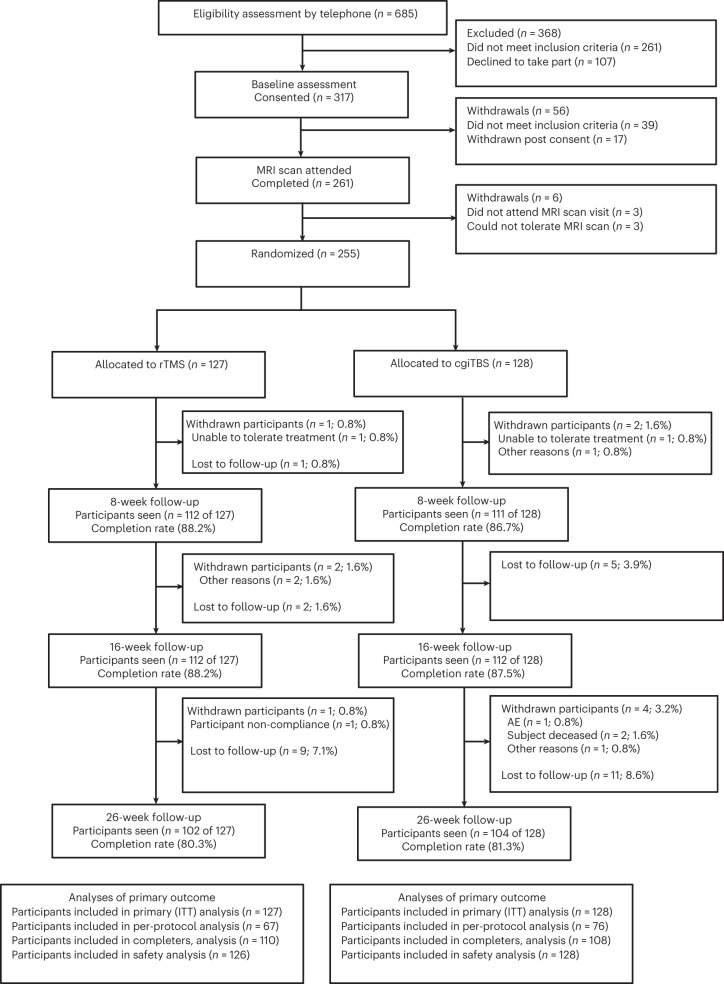
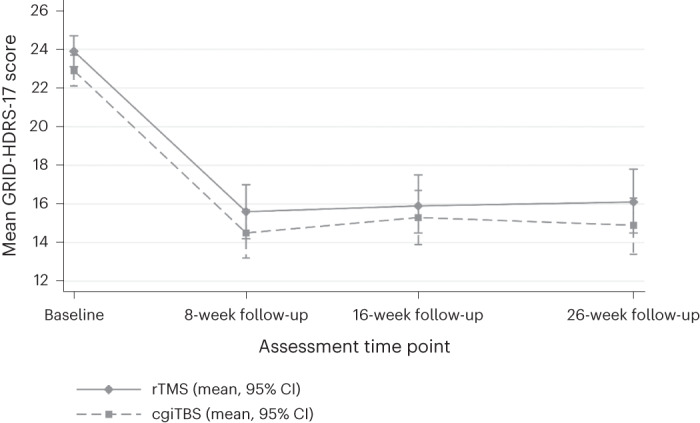
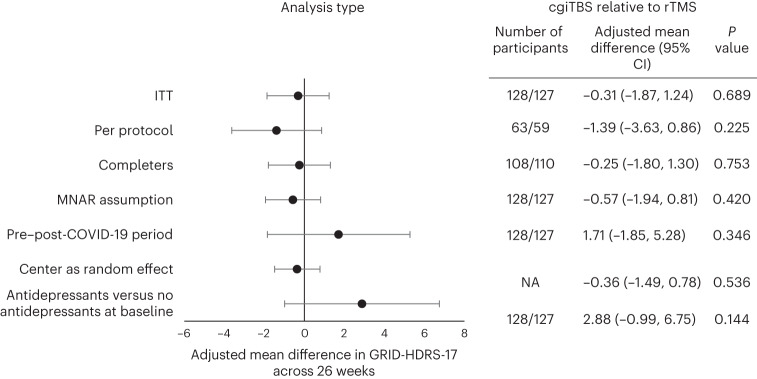
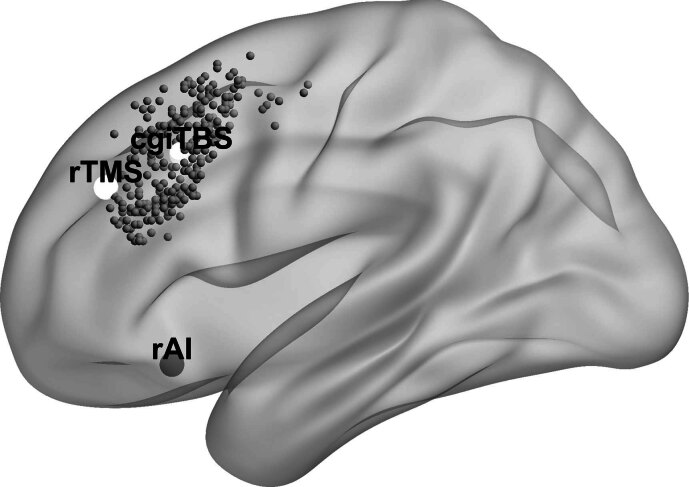
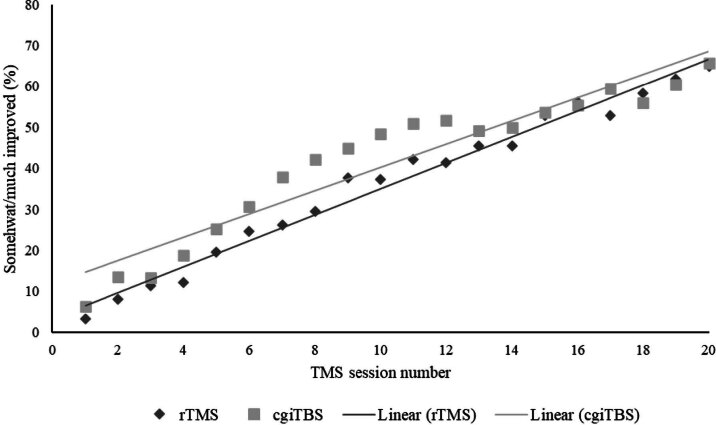
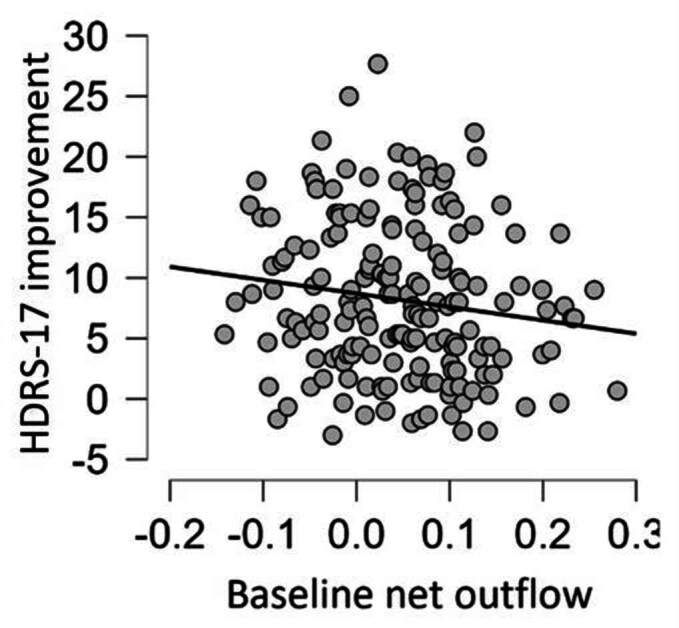
Disruption in reciprocal connectivity between the right anterior insula and the left dorsolateral prefrontal cortex is associated with depression and may be a target for neuromodulation. In a five-center, parallel, double-blind, randomized controlled trial we personalized resting-state functional magnetic resonance imaging neuronavigated connectivity-guided intermittent theta burst stimulation (cgiTBS) at a site based on effective connectivity from the right anterior insula to the left dorsolateral prefrontal cortex. We tested its efficacy in reducing the primary outcome depression symptoms measured by the GRID Hamilton Depression Rating Scale 17-item over 8, 16 and 26 weeks, compared with structural magnetic resonance imaging (MRI) neuronavigated repetitive transcranial magnetic stimulation (rTMS) delivered at the standard stimulation site (F3) in patients with ‘treatment-resistant depression’. Participants were randomly assigned to 20 sessions over 4–6 weeks of either cgiTBS ( n = 128) or rTMS ( n = 127) with resting-state functional MRI at baseline and 16 weeks. Persistent decreases in depressive symptoms were seen over 26 weeks, with no differences between arms on the primary outcome GRID Hamilton Depression Rating Scale 17-item score (intention-to-treat adjusted mean, −0.31, 95% confidence interval (CI) −1.87, 1.24, P = 0.689). Two serious adverse events were possibly related to TMS (mania and psychosis). MRI-neuronavigated cgiTBS and rTMS were equally effective in patients with treatment-resistant depression over 26 weeks (trial registration no. ISRCTN19674644).
Overview
The claims and statistics of this paper haven’t been checked yet.
Free: it reads the open-access text and checks the first 5 claims that cite a source we can check. Create a free account to check every claim.
Integrity signals
Registry
Cites
Statistics
Figures
Verification
Claims the paper makes
The claims and statistics of this paper haven’t been checked yet.
Free: it reads the open-access text and checks the first 5 claims that cite a source we can check. Create a free account to check every claim.
Self-check
Percentages, sums and reported differences re-computed from the paper’s own numbers.
The self-check needs the paper’s full text.
Citations
Cites
Diagnostic and Statistical Manual of Mental Disorders
American Psychiatric Association (2013) · doi:10.1176/appi.books.9780890425596 · Cited by 116,369
The PHQ-9: Validity of a brief depression severity measure
Kroenke, K., Spitzer, R. L., & Williams, J. B. W. (2001) · Journal of General Internal Medicine · doi:10.1046/j.1525-1497.2001.016009606.x · Cited by 44,910
A Brief Measure for Assessing Generalized Anxiety Disorder: The GAD-7
Spitzer, R. L., Kroenke, K., Williams, J. B. W., & Löwe, B. (2006) · Archives of Internal Medicine · doi:10.1001/archinte.166.10.1092 · Cited by 31,765
Beck, A. T., Steer, R. A., & Brown, G. (2011) · PsycTESTS Dataset · doi:10.1037/t00742-000 · Cited by 7,535
Development and validation of a brief screening version of the Childhood Trauma Questionnaire
Bernstein, D. P., Stein, J. A., Newcomb, M. D., Walker, E., Pogge, D., Ahluvalia, T., Stokes, J., Handelsman, L., Medrano, M., Desmond, D., et al. (2003) · Child Abuse & Neglect · doi:10.1016/s0145-2134(02)00541-0 · Cited by 6,419
Rush, A. J., Trivedi, M. H., Wisniewski, S. R., Nierenberg, A. A., Stewart, J. W., Warden, D., Niederehe, G., Thase, M. E., Lavori, P. W., Lebowitz, B. D., et al. (2006) · American Journal of Psychiatry · doi:10.1176/ajp.2006.163.11.1905 · Cited by 5,643
BrainNet Viewer: A Network Visualization Tool for Human Brain Connectomics
Xia, M., Wang, J., & He, Y. (2013) · PLoS ONE · doi:10.1371/journal.pone.0068910 · Cited by 4,106
The National Institute for Clinical Excellence
(2001) · Nursing Management · doi:10.7748/nm.8.2.39.s15 · Cited by 3,876
Rush, A. J., Trivedi, M. H., Ibrahim, H. M., Carmody, T. J., Arnow, B., Klein, D. N., Markowitz, J. C., Ninan, P. T., Kornstein, S., Manber, R., et al. (2003) · Biological Psychiatry · doi:10.1016/s0006-3223(02)01866-8 · Cited by 3,829 · cited 1×
“Participants recruited later in the study completed the Quick Inventory of Depressive Symp-tomatology Self-Rated version 67 at baseline and 8, 16 and 26 weeks for the purposes of a substudy on cognition and fMRI (Supplementary Information 48 ).”
The Work and Social Adjustment Scale: a simple measure of impairment in functioning
Mundt, J. C., Marks, I. M., Shear, M. K., & Greist, J. M. (2002) · British Journal of Psychiatry · doi:10.1192/bjp.180.5.461 · Cited by 2,515 · cited 1×
“…greater than minimum clinically important improvements in Generalized Anxiety Disorder Assessment (GAD-7) 31 (≥3.3 points 32 ), Work and Social Adjustment Scale (WSAS 33 , >3.7 points 34 ) and the Euroqol-5D-5L visual analog scale of overall perceived health (EQ-5D-5L VAS 35 , ≥8.0 points 36 ).”
Influential
Research works printed but not linked: 1
- National Institute for Health and Care Excellence. Depression in Adults: Treatment and Management. NICE Guidelines(NG222) (NICE, 2022). 35977056
Cited by
Items 101–125 of 125
Zhang, Y., Meng, J., Liu, X., Tang, H., Zhong, D., Li, Y., Li, J., Li, J. R., Cui, Y., Zhang, A., et al. (2026) · Journal of Evidence-Based Medicine · doi:10.1111/jebm.70155
Ou, L., Zhou, C., wang, X., Shi, L., Ou, P., Xiang, C., Chen, H., Chen, X., Wang, B., Chen, W., et al. (2026) · CNS Neuroscience & Therapeutics · doi:10.1002/cns.71016
Teng, Y.-L., Gu, Z., Ding, L., Shi, H., Gao, Z. Z., & Xu, H. Y. (2026) · Frontiers in Psychiatry · doi:10.3389/fpsyt.2026.1860185
dDual-target rTMS treatment for adolescent depression with headache: a case report
Sun, G., Yin, Y., & Yuan, Y. (2026) · BMC Psychiatry · doi:10.1186/s12888-026-08106-w
Briley, P. M., Webster, L., Hall, B., Davison, L., Gallagher, P., Pszczółkowski, S., Lankappa, S. T., Auer, D. P., Liddle, P. F., McAllister-Williams, H., et al. (2026) · Psychological Medicine · doi:10.1017/s0033291726104899
“The BRIGhTMIND trial itself found that connectivity between the (typically ECN) DLPFC target and the anterior insula (SN) predicted treatment outcomes (Morriss et al., 2024).”
Self-citationAutomated Meta-Analysis of Transcranial Magnetic Stimulation Based on GraphRAG: A Methodology StudyPreprint
Zhong, Y., Jin, J., Wang, X., He, W., & Yin, T. (2026) · Research Square · doi:10.21203/rs.3.rs-10200494/v1
Yu, L., Li, X. Q., Roberts, N., Huang, X., & Xing, H. (2026) · Psychoradiology · doi:10.1093/psyrad/kkag024
Apostol, M., Valles, T. E., Corlier, J., Leuchter, M. K., Young, A. I., Artin, H., Koek, R. J., Einstein, E. H., Wilke, S. A., Oughli, H. A., et al. (2026) · medRxiv · doi:10.64898/2026.08.03.26359627
Personalized Medicine for the Treatment of Depression
Roh, D., & Kim, M.-D. (2026) · Springer eBooks · doi:10.1007/978-981-92-1331-3_14
Zhong, X., Zhang, B., Yuan, Y., Li, Q., Fang, S., Lv, Q., Wang, X., & Wang, X. (2026) · Neuroscience & Biobehavioral Reviews · doi:10.1016/j.neubiorev.2026.106907
Luo, Z., Li, W., Liu, G., Wang, C., Lan, X., Zhang, M., Chen, Z., Shen, J., Liu, X., Hou, Z., et al. (2026) · Biological Psychiatry · doi:10.1016/j.biopsych.2026.07.025
Transcranial Magnetic Stimulation (TMS)
Leite, J., & Carvalho, S. (2026) · Neuromethods · doi:10.1007/978-1-0716-5340-1_16
Demchenko, I., Soma, P., Alhasani, H., Krishnathas, U., Hunter, M., Tailor, I., Nezhad, F. G., Schweizer, T. A., Kennedy, S. H., Jha, M. K., et al. (2026) · Biological Psychiatry Global Open Science · doi:10.1016/j.bpsgos.2026.100823
Hou, Y., Zhang, J., Wang, S., 刘琨亚, Zhang, B., Deng, H., Wang, R., Xu, Y., Wang, D., Wang, C., et al. (2026) · CNS Neuroscience & Therapeutics · doi:10.1002/cns.71166
Appelbaum, L. G., Stolz, L. A., Sun, Y., Kohn, J. N., Poorganji, M., Hadas, I., Bacio, B., Rodriguez, K., Boyd, E. C., Wiener, E., et al. (2026) · Journal of Affective Disorders · doi:10.1016/j.jad.2026.122515
Qiu, N., Xu, D., Sahakian, B., Langley, C., Eils, R., Marciano, L., Montag, C., Halpern, J., Yeo, B. T. T., Yip, P. S. F., et al. (2026) · Psychotherapy and Psychosomatics · doi:10.1159/pps/aemag015
Wass, C., Geiger, F., Aiff, H., Hieronymus, F., & Hagsäter, M. (2026) · Journal of Affective Disorders Reports · doi:10.1016/j.jadr.2026.101175
Abdelnaim, M. A., Reißmann, A., Kerkel, K., Aamer, M., Hüebner, J., Poeppl, T. B., Schoisswohl, S., & Langguth, B. (2026) · European Archives of Psychiatry and Clinical Neuroscience · doi:10.1007/s00406-026-02384-x
Deng, J., Shao, Y., Jiang, L., Wu, B., Roberts, N., Wang, Q., & Jia, Z. (2026) · Molecular Psychiatry · doi:10.1038/s41380-026-03930-8
Naffaa, M. M. (2026) · Exploratory Research and Hypothesis in Medicine · doi:10.14218/erhm.2026.00045
Yang, Y., Zhang, X., Duan, Y., Wu, J., Zhang, M., Niu, R., & Bao, T. (2026) · Frontiers in Psychiatry · doi:10.3389/fpsyt.2026.1938107
“Finally, personalized continuous gamma-rhythm inhibitory TMS based on effective connectivity from the right anterior insula to the left DLPFC showed ef fi cacy comparable to that of conventional rTMS in patients with depression (8).”
Saxena, A. (2026) · International Journal For Multidisciplinary Research · doi:10.36948/ijfmr.2026.v08i05.90184
Coomans, A. C., de Roij, L. V., Oostra, E., Hoogendoorn, A. W., van der Werf, Y. D., van den Heuvel, O. A., & van Exel, E. R. (2026) · Transcranial magnetic stimulation . · doi:10.1016/j.transm.2026.100337
Recent Advances in Clinical Neuromodulation for Brain Disorders
刘秀云, Du, Y., Guo, Q., Li, S., Wang, W., Peng, R., Zhao, Z., Song, X., Zhi, H., Li, H., et al. (2026) · Engineering · doi:10.1016/j.eng.2026.10.011
Reddy, M. S., Mudunuru, A. K., Roth, Y., Brink, E., Davis, M., DeBrocco, D., Ellis, S., Jones, L., Khan, A., MACMILLAN, C. M., et al. (2026) · Brain stimulation · doi:10.1016/j.brs.2026.103247
Metadata
- Authors
- Morriss, R., Briley, P. M., Webster, L., Abdelghani, M., Barber, S., Bates, P., Brookes, C., Hall, B., Ingram, L., Kurkar, M., Lankappa, S., Liddle, P. F., McAllister-Williams, R. H., O’Neil-Kerr, A., Pszczolkowski, S., Suazo Di Paola, A., Walters, Y., & Auer, D. P.
- Affiliations
- University of Nottingham (GB)
- Nottinghamshire Healthcare NHS Foundation Trust (GB)
- Camden and Islington NHS Foundation Trust (GB)
- University of Leicester (GB)
- Cumbria Northumberland Tyne and Wear NHS Foundation Trust (GB)
- Pennine Care NHS Foundation Trust (GB)
- Corresponding author
- Morriss, Richard
- ORCID
- Venue
- Nature Medicine
- Published
- 2024-01-16
- Volume
- 30
- Issue
- 2
- Pages
- 403-413
- ISSN
- 1078-8956 (ISSN-L)
- 1546-170X
- PMC
- PMC10878976
- OpenAlex
- W4390912825
- Semantic Scholar
- cdd0789adcb97c30b2aedbf242e5a4c8917f4b15
- Cited by
- 122
- References
- 65
- Citations by year
- 2026: 56 · 2025: 48 · 2024: 18
- FWCI
- 18.92
- Type
- journal article
- Language
- en
- Open access
- hybrid
- doi.org
- Licence
- cc-by
- creativecommons.org/licenses/by/4.0 (tdm)
- creativecommons.org/licenses/by/4.0 (vor)
- Locations
- Nature Medicine (publishedVersion, cc-by)
- PubMed Central (publishedVersion, cc-by)
- PubMed (publishedVersion)
- Repository@Nottingham (University of Nottingham) (publishedVersion, other-oa)
- Figshare (submittedVersion, cc-by)
- Newcastle University ePrints (Newcastle Univesity) (cc-by)
- Funders
- DH | National Institute for Health Research (16/44/22)
- Topics
- Life Sciences › Neuroscience › Neurology › Transcranial Magnetic Stimulation Studies
- Health Sciences › Medicine › Pharmacology (medical) › Treatment of Major Depression
- Health Sciences › Medicine › Psychiatry and Mental health › Electroconvulsive Therapy Studies
- Keywords
- treatment-resistant depression, intermittent theta burst stimulation, repetitive transcranial magnetic stimulation, anterior insula, dorsolateral prefrontal cortex, effective connectivity, resting-state functional connectivity, neuronavigation, personalized neuromodulation, Hamilton Depression Rating Scale, adverse events, mania, psychosis
- MeSH terms
- Double-Blind Method, Humans, Magnetic Resonance Imaging, Treatment Outcome, Prefrontal Cortex, Transcranial Magnetic Stimulation, Depressive Disorder, Treatment-Resistant
About these checks
Registry, retraction, Cites and statistics results are computed, not judged, with one exception: a printed reference that no index lists is read once by a model before it counts as a citation error. Claims are extracted by a model and kept only when their quote appears verbatim in the text; each cited source is then checked, with a model’s help, for whether it says what the claim relies on. Those verdicts can be wrong — read the claim’s quote and the cited source before relying on one.
Statistics and arithmetic are recomputed, not judged.
Confidence bands are shown only for fields calibrated on our annotated test set. None is calibrated yet, so no band is shown.
What counts as a claim ›How we measure confidence ›How we check this ›
Are you an author, or do you see a problem with this page? Request a review
Data sources
Bibliographic data: Semantic Scholar, OpenAlex, Crossref.
Contains information from the Semantic Scholar Academic Graph Datasets, made available under the ODC Attribution License (ODC-BY 1.0).
Semantic Scholar’s data is described in: Kinney, R., et al. (2023). The Semantic Scholar Open Data Platform. arXiv:2301.10140.
