

Connectivity-guided intermittent theta burst versus repetitive transcranial magnetic stimulation for treatment-resistant depression: a randomized controlled trial
Open accessThe DOI matches its Crossref record; 66 of the 66 references it cites were found in a registry or an index.
Abstract
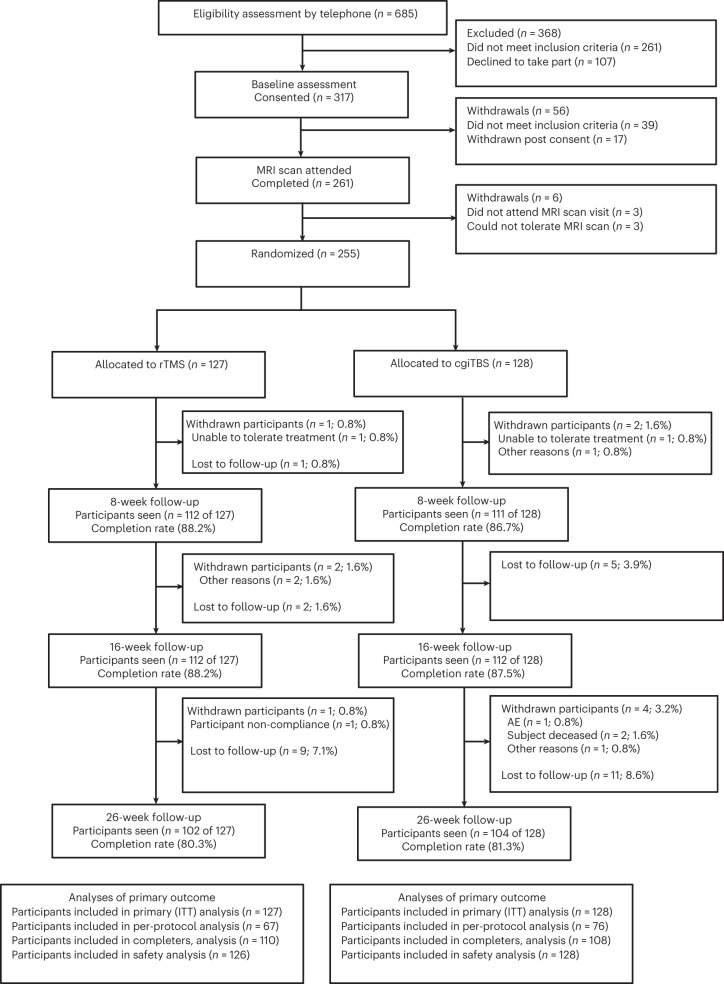
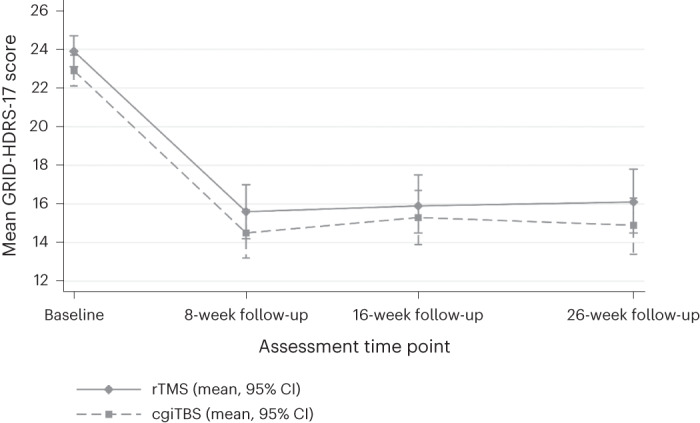
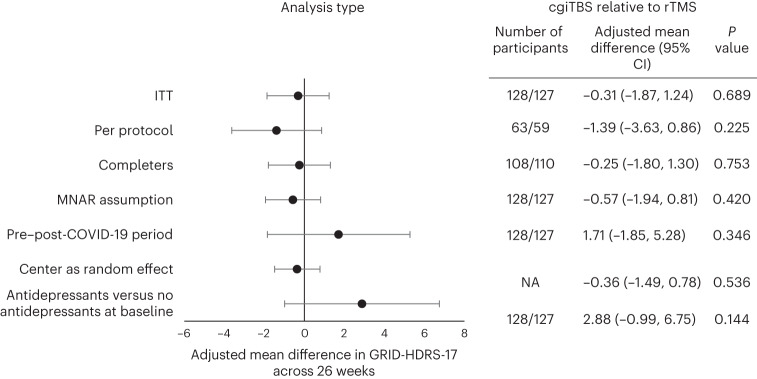
Disruption in reciprocal connectivity between the right anterior insula and the left dorsolateral prefrontal cortex is associated with depression and may be a target for neuromodulation. In a five-center, parallel, double-blind, randomized controlled trial we personalized resting-state functional magnetic resonance imaging neuronavigated connectivity-guided intermittent theta burst stimulation (cgiTBS) at a site based on effective connectivity from the right anterior insula to the left dorsolateral prefrontal cortex. We tested its efficacy in reducing the primary outcome depression symptoms measured by the GRID Hamilton Depression Rating Scale 17-item over 8, 16 and 26 weeks, compared with structural magnetic resonance imaging (MRI) neuronavigated repetitive transcranial magnetic stimulation (rTMS) delivered at the standard stimulation site (F3) in patients with ‘treatment-resistant depression’. Participants were randomly assigned to 20 sessions over 4–6 weeks of either cgiTBS ( n = 128) or rTMS ( n = 127) with resting-state functional MRI at baseline and 16 weeks. Persistent decreases in depressive symptoms were seen over 26 weeks, with no differences between arms on the primary outcome GRID Hamilton Depression Rating Scale 17-item score (intention-to-treat adjusted mean, −0.31, 95% confidence interval (CI) −1.87, 1.24, P = 0.689). Two serious adverse events were possibly related to TMS (mania and psychosis). MRI-neuronavigated cgiTBS and rTMS were equally effective in patients with treatment-resistant depression over 26 weeks (trial registration no. ISRCTN19674644).
Overview
The claims and statistics of this paper haven’t been checked yet.
Free: it reads the open-access text and checks the first 5 claims that cite a source we can check. Create a free account to check every claim.
Integrity signals
Registry
Cites
Statistics
Figures
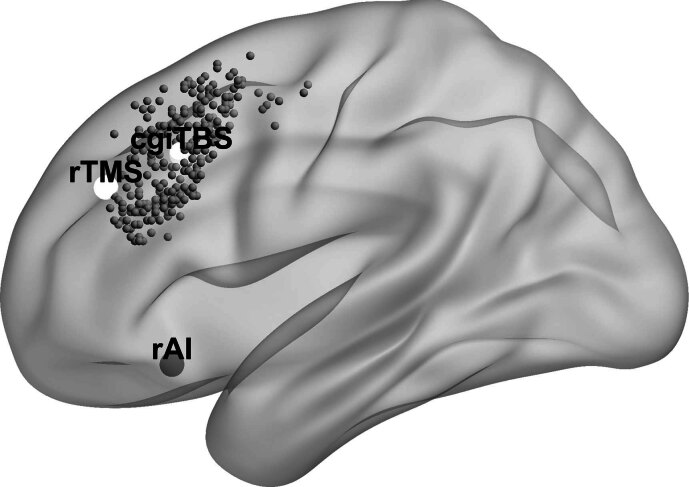
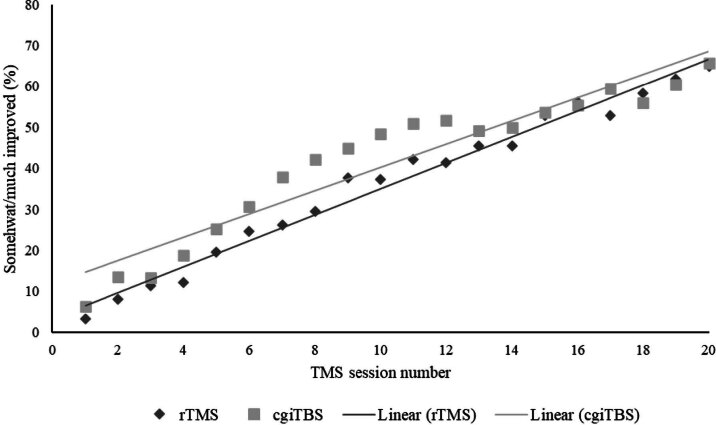
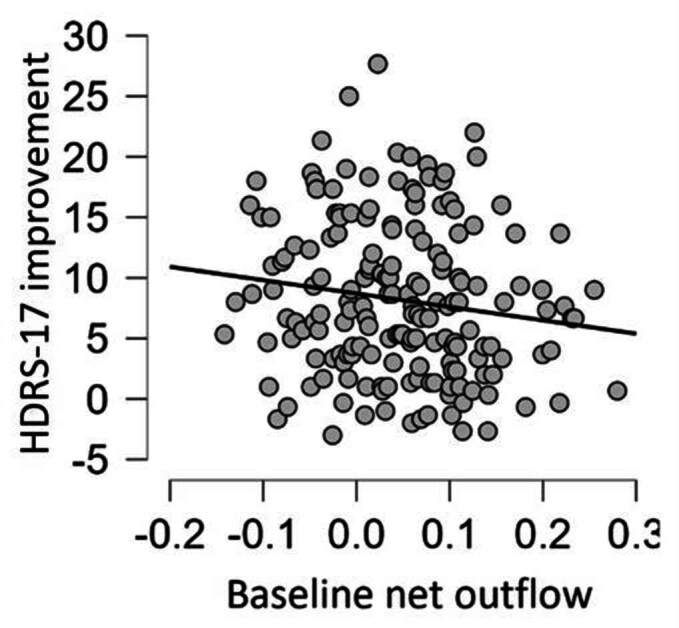
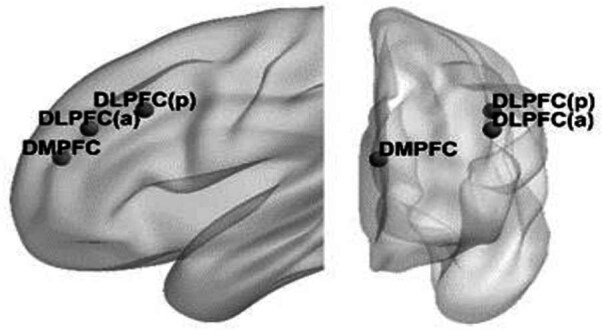
Verification
Claims the paper makes
The claims and statistics of this paper haven’t been checked yet.
Free: it reads the open-access text and checks the first 5 claims that cite a source we can check. Create a free account to check every claim.
Self-check
Percentages, sums and reported differences re-computed from the paper’s own numbers.
The self-check needs the paper’s full text.
Citations
Cites
Diagnostic and Statistical Manual of Mental Disorders
American Psychiatric Association (2013) · doi:10.1176/appi.books.9780890425596 · Cited by 116,369
The PHQ-9: Validity of a brief depression severity measure
Kroenke, K., Spitzer, R. L., & Williams, J. B. W. (2001) · Journal of General Internal Medicine · doi:10.1046/j.1525-1497.2001.016009606.x · Cited by 44,910
A Brief Measure for Assessing Generalized Anxiety Disorder: The GAD-7
Spitzer, R. L., Kroenke, K., Williams, J. B. W., & Löwe, B. (2006) · Archives of Internal Medicine · doi:10.1001/archinte.166.10.1092 · Cited by 31,765
Beck, A. T., Steer, R. A., & Brown, G. (2011) · PsycTESTS Dataset · doi:10.1037/t00742-000 · Cited by 7,535
Development and validation of a brief screening version of the Childhood Trauma Questionnaire
Bernstein, D. P., Stein, J. A., Newcomb, M. D., Walker, E., Pogge, D., Ahluvalia, T., Stokes, J., Handelsman, L., Medrano, M., Desmond, D., et al. (2003) · Child Abuse & Neglect · doi:10.1016/s0145-2134(02)00541-0 · Cited by 6,419
Rush, A. J., Trivedi, M. H., Wisniewski, S. R., Nierenberg, A. A., Stewart, J. W., Warden, D., Niederehe, G., Thase, M. E., Lavori, P. W., Lebowitz, B. D., et al. (2006) · American Journal of Psychiatry · doi:10.1176/ajp.2006.163.11.1905 · Cited by 5,643
BrainNet Viewer: A Network Visualization Tool for Human Brain Connectomics
Xia, M., Wang, J., & He, Y. (2013) · PLoS ONE · doi:10.1371/journal.pone.0068910 · Cited by 4,106
The National Institute for Clinical Excellence
(2001) · Nursing Management · doi:10.7748/nm.8.2.39.s15 · Cited by 3,876
Rush, A. J., Trivedi, M. H., Ibrahim, H. M., Carmody, T. J., Arnow, B., Klein, D. N., Markowitz, J. C., Ninan, P. T., Kornstein, S., Manber, R., et al. (2003) · Biological Psychiatry · doi:10.1016/s0006-3223(02)01866-8 · Cited by 3,829 · cited 1×
“Participants recruited later in the study completed the Quick Inventory of Depressive Symp-tomatology Self-Rated version 67 at baseline and 8, 16 and 26 weeks for the purposes of a substudy on cognition and fMRI (Supplementary Information 48 ).”
The Work and Social Adjustment Scale: a simple measure of impairment in functioning
Mundt, J. C., Marks, I. M., Shear, M. K., & Greist, J. M. (2002) · British Journal of Psychiatry · doi:10.1192/bjp.180.5.461 · Cited by 2,515 · cited 1×
“…greater than minimum clinically important improvements in Generalized Anxiety Disorder Assessment (GAD-7) 31 (≥3.3 points 32 ), Work and Social Adjustment Scale (WSAS 33 , >3.7 points 34 ) and the Euroqol-5D-5L visual analog scale of overall perceived health (EQ-5D-5L VAS 35 , ≥8.0 points 36 ).”
InfluentialKaiser, R. H., Andrews-Hanna, J. R., Wager, T. D., & Pizzagalli, D. A. (2015) · JAMA Psychiatry · doi:10.1001/jamapsychiatry.2015.0071 · Cited by 2,281
O’Reardon, J. P., Solvason, H. B., Janicak, P. G., Sampson, S., Isenberg, K. E., Nahas, Z., McDonald, W. M., Avery, D., Fitzgerald, P. B., Loo, C., et al. (2007) · Biological Psychiatry · doi:10.1016/j.biopsych.2007.01.018 · Cited by 1,910 · cited 1×
“The Federal Drug Administration in the United States approved rTMS for depression in 2008 following confirmation of its effectiveness in a worldwide, 23-site, randomized clinical trial (RCT) 10 .”
Diagnosis and definition of treatment-resistant depression
Fava, M. (2003) · Biological Psychiatry · doi:10.1016/s0006-3223(03)00231-2 · Cited by 1,380
Blumberger, D. M., Vila-Rodriguez, F., Thorpe, K. E., Feffer, K., Noda, Y., Giacobbe, P., Knyahnytska, Y., Kennedy, S. H., Lam, R. W., Daskalakis, Z. J., et al. (2018) · The Lancet · doi:10.1016/s0140-6736(18)30295-2 · Cited by 1,363 · cited 19×
“For clinical and ethical reasons in this severe TRD group, changes in antidepressant or other medication were allowed and were made in 19% of the sample by 16 weeks.”
InfluentialIndividual Variability in Functional Connectivity Architecture of the Human Brain
Mueller, S., Wang, D., Fox, M. D., Yeo, B. T. T., Sepulcre, J., Sabuncu, M. R., Shafee, R., Lu, J., & Liu, H. (2013) · Neuron · doi:10.1016/j.neuron.2012.12.028 · Cited by 1,141 · cited 1×
“However, there is individual variation in the functional connectivity of the lDLPFC to these nodes 14 , suggesting that a personalized approach to targeting the site of delivery of TMS might improve either response rates or the duration of response compared with a single, standardized site of…”
Mapping directed influence over the brain using Granger causality and fMRI
Roebroeck, A., Formisano, E., & Goebel, R. (2005) · NeuroImage · doi:10.1016/j.neuroimage.2004.11.017 · Cited by 1,016 · cited 1×
“…stimulation was personalized using effective connectivity (a type of functional connectivity in which directionality is inferred from time-shift analysis of the regional time series 20 ), the balance of influence between rAI and lDLPFC was predictive of improvement following a course of TMS 19 .”
Stanford Neuromodulation Therapy (SNT): A Double-Blind Randomized Controlled Trial
Cole, E. J., Phillips, A. L., Bentzley, B. S., Stimpson, K. H., Nejad, R., Barmak, F., Veerapal, C., Khan, N., Cherian, K., Felber, E., et al. (2022) · American Journal of Psychiatry · doi:10.1176/appi.ajp.2021.20101429 · Cited by 795 · cited 3×
“The reduction in intensity of stimulation was important because the number of treatment sessions moderated the mean reduction in depression symptoms over 8, 16 and 26 weeks in both the current RCT and THREE-D RCT 50 .”
InfluentialDefault mode network mechanisms of transcranial magnetic stimulation in depression
Liston, C., Chen, A. C., Zebley, B. D., Drysdale, A. T., Gordon, R., Leuchter, B., Voss, H. U., Casey, B. J., Etkin, A., & Dubin, M. J. (2014) · Biological Psychiatry · doi:10.1016/j.biopsych.2014.01.023 · Cited by 763 · cited 1×
“Despite the different proximities of the targets to the posterior lDLPFC (close for cgiTBS, distant for rTMS), the findings were similar between the two treatment arms, replicating our unpub-lished pilot work and a previous study 21 —although only in self-rated measures of depression.”
Berlim, M. T., van den Eynde, F., Tovar-Perdomo, S., & Daskalakis, Z. J. (2014) · Psychological Medicine · doi:10.1017/s0033291713000512 · Cited by 620 · cited 1×
“Thus, while previous evidence suggests that the beneficial effects of rTMS on mood in TRD may be relatively short lived, lasting only 1–3 months 5,9 , both MRI-neuronavigated TMS protocols in our study and THETA-DEP led to sustained responses maintained for >6 months post treatment in one in five…”
Brunoni, A. R., Chaimani, A., Moffa, A. H., Razza, L. B., Gattaz, W. F., Daskalakis, Z. J., & Carvalho, A. F. (2017) · JAMA Psychiatry · doi:10.1001/jamapsychiatry.2016.3644 · Cited by 520
The Hamilton Depression Scale: EVALUATION OF OBJECTIVITY USING LOGISTIC MODELS
Bech, P., Allerup, P., Gram, L. F., Reisby, N., Rosenberg, R., Jacobsen, O., & Nagy, A. (1981) · Acta Psychiatrica Scandinavica · doi:10.1111/j.1600-0447.1981.tb00676.x · Cited by 425
Fitzgerald, P. B., Hoy, K., McQueen, S., Maller, J. J., Herring, S., Segrave, R., Bailey, M., Been, G., Kulkarni, J., & Daskalakis, Z. J. (2009) · Neuropsychopharmacology · doi:10.1038/npp.2008.233 · Cited by 417 · cited 1×
“Although one previous MDD study reported greater clinical efficacy for MRI-guided neu-ronavigated TMS versus scalp-based targeting methods 42 , others found no difference in clinical efficacy 43,44 .”
Fox, M. D., Liu, H., & Pascual-Leone, A. (2013) · NeuroImage · doi:10.1016/j.neuroimage.2012.10.082 · Cited by 377 · cited 7×
“Both treatments were associated with improvements over time for sustained attention, executive functioning and working memory, consistent with the conclusion of a recent meta-analysis that rTMS has modest cognitive-enhancing effects in MDD 45 .”
InfluentialLisanby, S. H., Husain, M. M., Rosenquist, P. B., Maixner, D., Gutierrez, R., Krystal, A., Gilmer, W., Marangell, L. B., Aaronson, S., Daskalakis, Z. J., et al. (2009) · Neuropsychopharmacology · doi:10.1038/npp.2008.118 · Cited by 333
The GRID-HAMD: standardization of the Hamilton Depression Rating Scale
Williams, J. B. W., Kobak, K. A., Bech, P., Engelhardt, N., Evans, K., Lipsitz, J., Olin, J., Pearson, J., & Kalali, A. (2008) · International Clinical Psychopharmacology · doi:10.1097/yic.0b013e3282f948f5 · Cited by 295 · cited 1×
“HDRS-17 is the most frequently used observer-rated measure of depression for RCTs of treatments for depression 68 , and the GRID form was utilized given evidence of improved inter-rater reliability 24 .”
Cash, R. F. H., Cocchi, L., Lv, J., Fitzgerald, P. B., & Zalesky, A. (2021) · JAMA Psychiatry · doi:10.1001/jamapsychiatry.2020.3794 · Cited by 291 · cited 1×
“Two small RCTs of personalized and accelerated rTMS or iTBS, based on functional connectivity between the subgenual anterior cingulate cortex and lDLPFC, resulted in greater responses in depression over 3–4 weeks versus standardized or sham TBS 15,16 .”
Larson, J., & Munkácsy, E. (2015) · Brain Research · doi:10.1016/j.brainres.2014.10.034 · Cited by 285
Nettekoven, C., Volz, L. J., Kutscha, M., Pool, E.-M., Rehme, A. K., Eickhoff, S. B., Fink, G. R., & Grefkes, C. (2014) · The Journal of Neuroscience · doi:10.1523/jneurosci.4993-13.2014 · Cited by 264 · cited 1×
“Dosage and time intervals between TBS protocols could affect meta-plasticity, either by reducing or reversing the effect of synaptic plasticity or by increasing the effect of synaptic plasticity 51–53 .”
Everitt, H. A., Landau, S., O’Reilly, G., Sibelli, A., Hughes, S., Windgassen, S., Holland, R., Little, P., McCrone, P., Bishop, F., et al. (2019) · Gut · doi:10.1136/gutjnl-2018-317805 · Cited by 198 · cited 1×
“…greater than minimum clinically important improvements in Generalized Anxiety Disorder Assessment (GAD-7) 31 (≥3.3 points 32 ), Work and Social Adjustment Scale (WSAS 33 , >3.7 points 34 ) and the Euroqol-5D-5L visual analog scale of overall perceived health (EQ-5D-5L VAS 35 , ≥8.0 points 36 ).”
InfluentialHiroe, T., Kojima, M., Yamamoto, I., Nojima, S., Kinoshita, Y., Hashimoto, N., Watanabe, N., Maeda, T., & Furukawa, T. A. (2005) · Psychiatry Research · doi:10.1016/j.psychres.2004.03.014 · Cited by 176 · cited 1×
“27), ≥6.0 points 28 ) and the Beck Depression Inventory-II (BDI-II 29 , ≥10.0 points 30 ), with greater than minimum clinically important improvements in Generalized Anxiety Disorder Assessment (GAD-7) 31 (≥3.3 points 32 ), Work and Social Adjustment Scale (WSAS 33 , >3.7 points 34 ) and the…”
InfluentialMcIntyre, R. S., Best, M. W., Bowie, C. R., Carmona, N. E., Cha, D. S., Lee, Y., Subramaniapillai, M., Mansur, R. B., Barry, H., Baune, B. T., et al. (2017) · The Journal of Clinical Psychiatry · doi:10.4088/jcp.16m11329 · Cited by 172 · cited 1×
“The cognition analysis showed improvements over time on the Trans-forming Health with Integrated Care–integrated tool (THINC-it) cognitive battery 37 for sustained attention (Choice Response Task) ( F (1, 155.49) = 11.28, P = 0.001), executive functioning (Trail-making Task) ( F (1, 152.45) = 5.50,…”
InfluentialRazza, L. B., Moffa, A. H., Moreno, M. L., Carvalho, A. F., Padberg, F., Fregni, F., & Brunoni, A. R. (2018) · Progress in Neuro-Psychopharmacology and Biological Psychiatry · doi:10.1016/j.pnpbp.2017.10.016 · Cited by 172 · cited 1×
“A high degree of treatment resistance (all failed two treatments, the majority four) and long duration of current illness (median 6 years) are associated with lower placebo responses with treatments for depression, including TMS 55–58 .”
Martin, D. M., McClintock, S. M., Forster, J. J., Lo, T. Y., & Loo, C. K. (2017) · Depression and Anxiety · doi:10.1002/da.22658 · Cited by 162 · cited 7×
“Both treatments were associated with improvements over time for sustained attention, executive functioning and working memory, consistent with the conclusion of a recent meta-analysis that rTMS has modest cognitive-enhancing effects in MDD 45 .”
InfluentialZanini, A., Aiello, M., Adamo, D., Casale, S., Cherubino, F., Della Patrona, S., Raimondi, E., Zampogna, E., Chetta, A., & Spanevello, A. (2015) · Respiratory Care · doi:10.4187/respcare.03272 · Cited by 145 · cited 1×
“…greater than minimum clinically important improvements in Generalized Anxiety Disorder Assessment (GAD-7) 31 (≥3.3 points 32 ), Work and Social Adjustment Scale (WSAS 33 , >3.7 points 34 ) and the Euroqol-5D-5L visual analog scale of overall perceived health (EQ-5D-5L VAS 35 , ≥8.0 points 36 ).”
InfluentialCaulfield, K. A., Fleischmann, H. H., Cox, C. E., Wolf, J. P., George, M. S., & McTeague, L. M. (2022) · Brain Stimulation · doi:10.1016/j.brs.2022.08.013 · Cited by 145
Treatment-Resistant Depression in Primary Care across Canada
Rizvi, S. J., Grima, E., Tan, M., Rotzinger, S., Lin, P., McIntyre, R. S., & Kennedy, S. H. (2014) · The Canadian Journal of Psychiatry · doi:10.1177/070674371405900702 · Cited by 144
Impact of repetitive theta burst stimulation on motor cortex excitability
Gamboa, O. L., Antal, A., Laczo, B., Moliadze, V., Nitsche, M. A., & Paulus, W. (2011) · Brain Stimulation · doi:10.1016/j.brs.2010.09.008 · Cited by 123 · cited 1×
“In some individuals, 5-min intervals between iTBS runs might increase short-term cortical inhibition, reducing the effectiveness of the whole iTBS session 52 and thereby making a group difference between cgiTBS and rTMS more difficult to demonstrate.”
Jones, B. D. M., Razza, L. B., Weissman, C. R., Karbi, J., Vine, T., Mulsant, L. S., Brunoni, A. R., Husain, M. I., Mulsant, B. H., Blumberger, D. M., et al. (2021) · JAMA Network Open · doi:10.1001/jamanetworkopen.2021.25531 · Cited by 121
Li, C.-T., Cheng, C.-M., Chen, M.-H., Juan, C.-H., Tu, P.-C., Bai, Y.-M., Jeng, J.-S., Lin, W.-C., Tsai, S.-J., & Su, T.-P. (2020) · Biological Psychiatry · doi:10.1016/j.biopsych.2019.07.031 · Cited by 119 · cited 1×
“Although one previous MDD study reported greater clinical efficacy for MRI-guided neu-ronavigated TMS versus scalp-based targeting methods 42 , others found no difference in clinical efficacy 43,44 .”
Salagre, E., Fernandes, B. S., Dodd, S., Brownstein, D. J., & Berk, M. (2016) · Journal of Affective Disorders · doi:10.1016/j.jad.2016.04.047 · Cited by 117 · cited 1×
“HDRS-17 is the most frequently used observer-rated measure of depression for RCTs of treatments for depression 68 , and the GRID form was utilized given evidence of improved inter-rater reliability 24 .”
Targeted transcranial theta-burst stimulation alters fronto-insular network and prefrontal GABA
Iwabuchi, S. J., Raschke, F., Auer, D. P., Liddle, P. F., Lankappa, S. T., & Palaniyappan, L. K. (2016) · NeuroImage · doi:10.1016/j.neuroimage.2016.09.043 · Cited by 115 · cited 1×
“A RCT in 27 healthy volunteers found that iTBS delivered to a connectivity-guided target in the lDLPFC with maximum negative influence from the right anterior insula (rAI) improved frontal–insula connectivity 18 .”
Self-citationTse, N. Y., Goldsworthy, M. R., Ridding, M. C., Coxon, J. P., Fitzgerald, P. B., Fornito, A., & Rogasch, N. C. (2018) · Scientific Reports · doi:10.1038/s41598-018-26791-w · Cited by 114 · cited 1×
“Dosage and time intervals between TBS protocols could affect meta-plasticity, either by reducing or reversing the effect of synaptic plasticity or by increasing the effect of synaptic plasticity 51–53 .”
Anderson, R. J., Hoy, K. E., Daskalakis, Z. J., & Fitzgerald, P. B. (2016) · Clinical Neurophysiology · doi:10.1016/j.clinph.2016.08.015 · Cited by 107 · cited 1×
“…key nodes within the salience network and default mode network (DMN), leading to rebalancing of abnormal functional connectivity (calculated by correlation of blood oxygenation level-dependent time courses using rsfMRI from different regions of the brain) between and within these networks 13 .”
Turkoz, I., Alphs, L., Singh, J., Jamieson, C., Daly, E., Shawi, M., Sheehan, J. J., Trivedi, M. H., & Rush, A. J. (2021) · Acta Psychiatrica Scandinavica · doi:10.1111/acps.13260 · Cited by 104
Bauer-Staeb, C., Kounali, D.-Z., Welton, N. J., Griffith, E., Wiles, N. J., Lewis, G., Faraway, J. J., & Button, K. S. (2021) · Journal of Clinical Epidemiology · doi:10.1016/j.jclinepi.2021.04.002 · Cited by 99 · cited 1×
“…, ≥10.0 points 30 ), with greater than minimum clinically important improvements in Generalized Anxiety Disorder Assessment (GAD-7) 31 (≥3.3 points 32 ), Work and Social Adjustment Scale (WSAS 33 , >3.7 points 34 ) and the Euroqol-5D-5L visual analog scale of overall perceived health (EQ-5D-5L…”
InfluentialBurke, M. J., Romanella, S. M., Mencarelli, L., Greben, R., Fox, M., Kaptchuk, T. J., Pascual‐Leone, Á., & Santarnecchi, E. (2021) · Molecular Psychiatry · doi:10.1038/s41380-021-01397-3 · Cited by 99 · cited 1×
“The occurrence of fMRI changes associated with treatment in the study does not exclude a placebo response, especially given the finding of an overlap between brain regional activity modified by placebo and TMS for targets including lDLPFC 60 .”
Bulteau, S., Laurin, A., Pere, M., Fayet, G., Thomas-Ollivier, V., Deschamps, T., Auffray-Calvier, E., Bukowski, N., Vanelle, J.-M., Sébille, V., et al. (2022) · Brain Stimulation · doi:10.1016/j.brs.2022.05.011 · Cited by 97 · cited 4×
“Previous RCTs suggest that iTBS and rTMS may be equivalent in efficacy in TRD 9,40 .”
InfluentialIwabuchi, S. J., Auer, D. P., Lankappa, S. T., & Palaniyappan, L. (2019) · European Neuropsychopharmacology · doi:10.1016/j.euroneuro.2019.02.012 · Cited by 73 · cited 3×
“Assuming a standard deviation of 8 in the mean difference between groups, as informed by our pilot work 19 and a previous randomized controlled trial in chronic persistent depressive disorder 59 , a sample size of 266 participants would provide 89.3% power to detect a mean difference of three…”
InfluentialSelf-citationTrevizol, A. P., Downar, J., Vila-Rodriguez, F., Thorpe, K. E., Daskalakis, Z. J., & Blumberger, D. M. (2020) · EClinicalMedicine · doi:10.1016/j.eclinm.2020.100349 · Cited by 70 · cited 1×
“The reduction in intensity of stimulation was important because the number of treatment sessions moderated the mean reduction in depression symptoms over 8, 16 and 26 weeks in both the current RCT and THREE-D RCT 50 .”
Alterations in effective connectivity anchored on the insula in major depressive disorder
Iwabuchi, S. J., Peng, D., Fang, Y., Jiang, K., Liddle, E. B., Liddle, P. F., & Palaniyappan, L. (2014) · European Neuropsychopharmacology · doi:10.1016/j.euroneuro.2014.08.005 · Cited by 67 · cited 2×
“A disruption of the reciprocal loop between the DLPFC and insula (a key node of the salience network) has been found in depression 17 , so the insula may represent another target for personalized neuro-modulation.”
Self-citationRush, A. J., South, C. C., Jain, S. B., Agha, R. S., Zhang, M., Shrestha, S., Khan, Z., Hassan, M., & Trivedi, M. H. (2021) · Neuropsychiatric Disease and Treatment · doi:10.2147/ndt.s305331 · Cited by 66
Gallagher, P., Nilsson, J., Finkelmeyer, A. E., Goshawk, M., Macritchie, K., Lloyd, A. J., Thompson, J., Porter, R., Young, A. H., Ferrier, I. N., et al. (2015) · Psychological Medicine · doi:10.1017/s0033291715000926 · Cited by 64
Hebel, T., Göllnitz, A., Schoisswohl, S., Weber, F. C., Abdelnaim, M., Wetter, T. C., Rupprecht, R., Langguth, B., & Schecklmann, M. (2021) · Brain Stimulation · doi:10.1016/j.brs.2021.01.013 · Cited by 59 · cited 1×
“Although one previous MDD study reported greater clinical efficacy for MRI-guided neu-ronavigated TMS versus scalp-based targeting methods 42 , others found no difference in clinical efficacy 43,44 .”
Zhao, K., Xie, H., Fonzo, G. A., Tong, X., Carlisle, N. B., Chidharom, M., Etkin, A., & Zhang, Y. (2023) · Molecular Psychiatry · doi:10.1038/s41380-023-01958-8 · Cited by 50
Morriss, R. K., Garland, A., Nixon, N. L., Guo, B., James, M., Kaylor‐Hughes, C., Moore, R., Ramana, R., Sampson, C., Sweeney, T., et al. (2016) · The Lancet Psychiatry · doi:10.1016/s2215-0366(16)30143-2 · Cited by 46 · cited 2×
“…difference between groups, as informed by our pilot work 19 and a previous randomized controlled trial in chronic persistent depressive disorder 59 , a sample size of 266 participants would provide 89.3% power to detect a mean difference of three points in GRID-HDRS-17 over 26 weeks between…”
InfluentialSelf-citationNixon, N. L., Guo, B., Garland, A., Kaylor‐Hughes, C., Nixon, E., & Morriss, R. K. (2020) · PLoS ONE · doi:10.1371/journal.pone.0241370 · Cited by 40 · cited 3×
“38) which, unlike GRID-HDRS-17, is a unidimensional measure of depression over time 39 , to further understand the effects of baseline net rAI to lDLPFC outflow results in relation to depression symptoms over 26 weeks.”
Self-citationDemyttenaere, K., Desaiah, D., Petit, C., Croenlein, J., & Brecht, S. (2009) · The Primary Care Companion to The Journal of Clinical Psychiatry · doi:10.4088/pcc.08m00670 · Cited by 33 · cited 1×
“…and based on the advice of our patient and public involvement (PPI) representatives, we adapted the seven-point patient global impression of change measure 66 to a shortened, five-point Likert scale (1–5, much worse to much better, with as many rating points for worse and improved mental state).”
Nelson, J. C., Zhang, Q., Deberdt, W. G., Marangell, L. B., Karamustafalıoğlu, O., & Lipkovich, I. A. (2012) · Current Medical Research and Opinion · doi:10.1185/03007995.2011.654010 · Cited by 32
Hsu, J. H., Downar, J., Vila-Rodriguez, F., Daskalakis, Z. J., & Blumberger, D. M. (2019) · Brain Stimulation · doi:10.1016/j.brs.2019.07.011 · Cited by 31
Repetitive transcranial magnetic stimulation for depression
Cooke, R. G. (2003) · Journal of Psychiatry and Neuroscience · doi:10.1139/jpn.0349 · Cited by 22
Morriss, R. K., Webster, L., Abdelghani, M., Auer, D. P., Barber, S. R., Bates, P., Blamire, A. M., Briley, P. M., Brookes, C. L., Iwabuchi, S. J., et al. (2020) · BMJ Open · doi:10.1136/bmjopen-2020-038430 · Cited by 19 · cited 2×
“Participants recruited later in the study completed the Quick Inventory of Depressive Symp-tomatology Self-Rated version 67 at baseline and 8, 16 and 26 weeks for the purposes of a substudy on cognition and fMRI (Supplementary Information 48 ).”
Self-citationPszczółkowski, S., Cottam, W. J., Briley, P. M., Iwabuchi, S. J., Kaylor‐Hughes, C., Shalabi, A., Babourina‐Brooks, B., Berrington, A., Barber, S. R., Paola, A. S. D., et al. (2021) · JMIR Research Protocols · doi:10.2196/31925 · Cited by 15 · cited 1×
“…Committee, we made a number of substantial changes to the protocol including (1) a change in primary outcome from response at 16 weeks to average change over 8, 16 and 26 weeks, (2) a revised power calculation and (3) a move from face-to-face to remote assessment of outcome where possible 48,49 .”
Self-citationZhao, K., Xie, H. L., Fonzo, G. A., et al. (2022) · medRxiv · doi:10.1101/2022.09.12.22279659 · Cited by 11
Batail, J.-M. V., Gaillard, R., Haffen, É., Poulet, E., Sauvaget, A., Szekely, D., Brunelin, J., Bulteau, S., Bubrovszky, M., Smadja, J., et al. (2023) · Brain stimulation · doi:10.1016/j.brs.2023.05.015 · Cited by 9 · cited 1×
“In England, TMS is available in only one in seven mental health services and has not been recommended for use in some countries such as France, albeit based on a questionable review of the evidence 11 .”
BRIGhTMIND trial-motivating mechanism of action analysis plan: resting-state fMRI
Briley, P. M. (2022) · Nottingham ePrints (University of Nottingham) · doi:10.17639/nott.7251 · Cited by 2
Self-citation
Research works printed but not linked: 1
- National Institute for Health and Care Excellence. Depression in Adults: Treatment and Management. NICE Guidelines(NG222) (NICE, 2022). 35977056
Cited by
Trapp, N. T., Purgianto, A., Taylor, J. J., Singh, M. K., Oberman, L. M., Mickey, B. J., Youssef, N. A., Solzbacher, D., Zebley, B., Cabrera, L. Y., et al. (2025) · Clinical Neurophysiology · doi:10.1016/j.clinph.2024.12.015 · Cited by 89
Accelerated Theta-Burst Stimulation for Treatment-Resistant Depression: A Randomized Clinical Trial
Ramos, M. R. F., Goerigk, S. A., da Silva, V. A., Cavendish, B. A., Pinto, B. S., Papa, C. H. G., de Resende, J. C. F., Klein, I., Carneiro, A. M., de Sousa, J. P., et al. (2025) · JAMA Psychiatry · doi:10.1001/jamapsychiatry.2025.0013 · Cited by 53
Ren, J., Su, W., Zhou, Y. C., Han, K., Pan, R., Duan, X., Liu, J., Lu, H., Zhang, P., Zhang, W., et al. (2025) · Brain stimulation · doi:10.1016/j.brs.2025.02.009 · Cited by 29
Soleimani, G., Nitsche, M. A., Hanlon, C. A., Lim, K. O., Opitz, A., & Ekhtiari, H. (2025) · Neuropsychopharmacology · doi:10.1038/s41386-025-02094-3 · Cited by 32
Briley, P. M., Webster, L., Lankappa, S. T., Pszczółkowski, S., McAllister-Williams, H., Liddle, P. F., Auer, D. P., & Morriss, R. K. (2024) · npj Mental Health Research · doi:10.1038/s44184-024-00077-8 · Cited by 29
“To determine whether there are baseline clinical or demographic fac-torsthatpredictresponsetrajectory,wecomparedtrajectoryclassesonthose variablesthatwereexaminedasmoderatorsoftheprimaryoutcomeinthe mainBRIGhTMINDreport 12 .”
BackgroundSelf-citation
Metadata
- Authors
- Morriss, R., Briley, P. M., Webster, L., Abdelghani, M., Barber, S., Bates, P., Brookes, C., Hall, B., Ingram, L., Kurkar, M., Lankappa, S., Liddle, P. F., McAllister-Williams, R. H., O’Neil-Kerr, A., Pszczolkowski, S., Suazo Di Paola, A., Walters, Y., & Auer, D. P.
- Affiliations
- University of Nottingham (GB)
- Nottinghamshire Healthcare NHS Foundation Trust (GB)
- Camden and Islington NHS Foundation Trust (GB)
- University of Leicester (GB)
- Cumbria Northumberland Tyne and Wear NHS Foundation Trust (GB)
- Pennine Care NHS Foundation Trust (GB)
- Corresponding author
- Morriss, Richard
- ORCID
- Venue
- Nature Medicine
- Published
- 2024-01-16
- Volume
- 30
- Issue
- 2
- Pages
- 403-413
- ISSN
- 1078-8956 (ISSN-L)
- 1546-170X
- PMC
- PMC10878976
- OpenAlex
- W4390912825
- Semantic Scholar
- cdd0789adcb97c30b2aedbf242e5a4c8917f4b15
- Cited by
- 122
- References
- 65
- Citations by year
- 2026: 56 · 2025: 48 · 2024: 18
- FWCI
- 18.92
- Type
- journal article
- Language
- en
- Open access
- hybrid
- doi.org
- Licence
- cc-by
- creativecommons.org/licenses/by/4.0 (tdm)
- creativecommons.org/licenses/by/4.0 (vor)
- Locations
- Nature Medicine (publishedVersion, cc-by)
- PubMed Central (publishedVersion, cc-by)
- PubMed (publishedVersion)
- Repository@Nottingham (University of Nottingham) (publishedVersion, other-oa)
- Figshare (submittedVersion, cc-by)
- Newcastle University ePrints (Newcastle Univesity) (cc-by)
- Funders
- DH | National Institute for Health Research (16/44/22)
- Topics
- Life Sciences › Neuroscience › Neurology › Transcranial Magnetic Stimulation Studies
- Health Sciences › Medicine › Pharmacology (medical) › Treatment of Major Depression
- Health Sciences › Medicine › Psychiatry and Mental health › Electroconvulsive Therapy Studies
- Keywords
- treatment-resistant depression, intermittent theta burst stimulation, repetitive transcranial magnetic stimulation, anterior insula, dorsolateral prefrontal cortex, effective connectivity, resting-state functional connectivity, neuronavigation, personalized neuromodulation, Hamilton Depression Rating Scale, adverse events, mania, psychosis
- MeSH terms
- Double-Blind Method, Humans, Magnetic Resonance Imaging, Treatment Outcome, Prefrontal Cortex, Transcranial Magnetic Stimulation, Depressive Disorder, Treatment-Resistant
About these checks
Registry, retraction, Cites and statistics results are computed, not judged, with one exception: a printed reference that no index lists is read once by a model before it counts as a citation error. Claims are extracted by a model and kept only when their quote appears verbatim in the text; each cited source is then checked, with a model’s help, for whether it says what the claim relies on. Those verdicts can be wrong — read the claim’s quote and the cited source before relying on one.
Statistics and arithmetic are recomputed, not judged.
Confidence bands are shown only for fields calibrated on our annotated test set. None is calibrated yet, so no band is shown.
What counts as a claim ›How we measure confidence ›How we check this ›
Are you an author, or do you see a problem with this page? Request a review
Data sources
Bibliographic data: Semantic Scholar, OpenAlex, Crossref.
Contains information from the Semantic Scholar Academic Graph Datasets, made available under the ODC Attribution License (ODC-BY 1.0).
Semantic Scholar’s data is described in: Kinney, R., et al. (2023). The Semantic Scholar Open Data Platform. arXiv:2301.10140.
