

Analysis of the Human Protein Atlas Image Classification competition
Open accessThe DOI matches its Crossref record; 52 of the 52 references it cites were found in a registry or an index.
Abstract
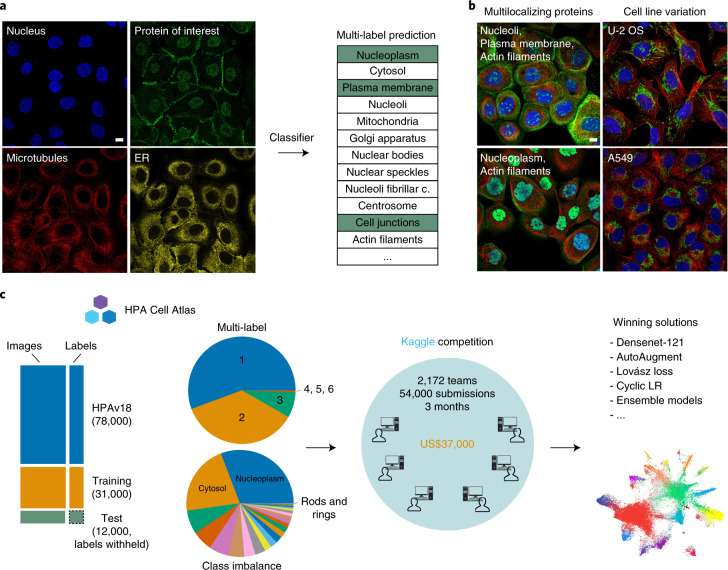
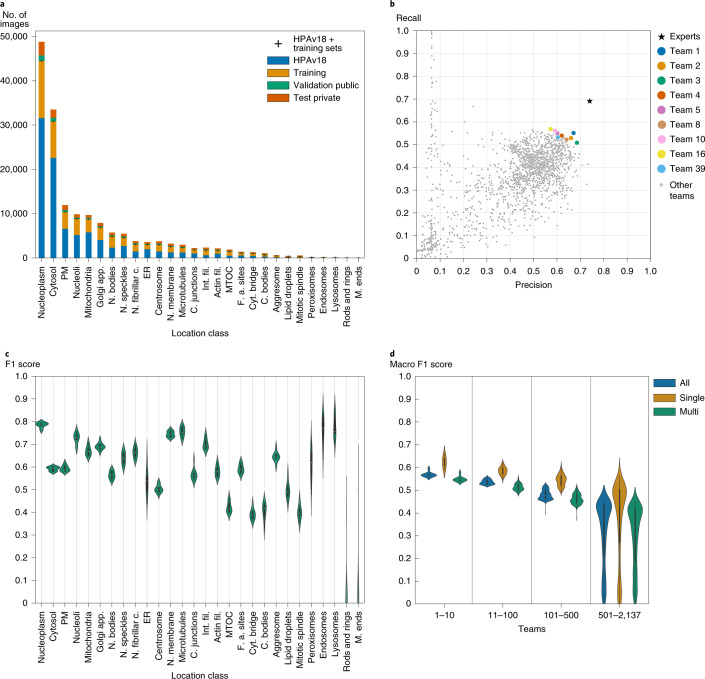
Pinpointing subcellular protein localizations from microscopy images is easy to the trained eye, but challenging to automate. Based on the Human Protein Atlas image collection, we held a competition to identify deep learning solutions to solve this task. Challenges included training on highly imbalanced classes and predicting multiple labels per image. Over 3 months, 2,172 teams participated. Despite convergence on popular networks and training techniques, there was considerable variety among the solutions. Participants applied strategies for modifying neural networks and loss functions, augmenting data and using pretrained networks. The winning models far outperformed our previous effort at multi-label classification of protein localization patterns by ~20%. These models can be used as classifiers to annotate new images, feature extractors to measure pattern similarity or pretrained networks for a wide range of biological applications.
Overview
The claims and statistics of this paper haven’t been checked yet.
Free: it reads the open-access text and checks the first 5 claims that cite a source we can check. Create a free account to check every claim.
Integrity signals
Registry
Cites
Statistics
Figures
Verification
Claims the paper makes
The claims and statistics of this paper haven’t been checked yet.
Free: it reads the open-access text and checks the first 5 claims that cite a source we can check. Create a free account to check every claim.
Self-check
Percentages, sums and reported differences re-computed from the paper’s own numbers.
The self-check needs the paper’s full text.
Citations
Cites
Deep Residual Learning for Image Recognition
He, K., Zhang, X., Ren, S., & Sun, J. (2016) · 2016 IEEE Conference on Computer Vision and Pattern Recognition (CVPR) · doi:10.1109/cvpr.2016.90 · Cited by 235,474 · cited 3×
“Both Team 1 and 5 found DenseNet 20 to be more effective than Resnet 19 in terms of neural network architecture.”
BackgroundMethodVery Deep Convolutional Networks for Large-Scale Image Recognition
Simonyan, K., & Zisserman, A. (2014) · arXiv · doi:10.48550/arxiv.1409.1556 · Cited by 114,148 · cited 2×
“3–11).”
MethodU-Net: Convolutional Networks for Biomedical Image Segmentation
Ronneberger, O., Fischer, P., & Brox, T. (2015) · Lecture notes in computer science · doi:10.1007/978-3-319-24574-4_28 · Cited by 99,404
LeCun, Y., Bengio, Y., & Hinton, G. (2015) · Nature · doi:10.1038/nature14539 · Cited by 84,126
ImageNet: A large-scale hierarchical image database
Deng, J., Dong, W., Socher, R., Li, L.-J., Li, K., & Fei-Fei, L. (2009) · 2009 IEEE Conference on Computer Vision and Pattern Recognition · doi:10.1109/cvpr.2009.5206848 · Cited by 65,333
Gradient-based learning applied to document recognition
Lecun, Y., Bottou, L., Bengio, Y., & Haffner, P. (1998) · Proceedings of the IEEE · doi:10.1109/5.726791 · Cited by 58,805 · cited 2×
“Deep neural networks, particularly convolutional neural networks (CNNs) 8 , have been widely applied to perform computer vision tasks such as image classification 11,12 and segmentation 13 .”
BackgroundMethodDensely Connected Convolutional Networks
Huang, G., Liu, Z., Van Der Maaten, L., & Weinberger, K. Q. (2017) · 2017 IEEE Conference on Computer Vision and Pattern Recognition (CVPR) · doi:10.1109/cvpr.2017.243 · Cited by 48,566
ImageNet Large Scale Visual Recognition Challenge
Russakovsky, O., Deng, J., Su, H., Krause, J., Satheesh, S., Ma, S., Huang, Z., Karpathy, A., Khosla, A., Bernstein, M., et al. (2015) · International Journal of Computer Vision · doi:10.1007/s11263-015-0816-y · Cited by 39,380
(2014) · Cited by 33,419
Rethinking the Inception Architecture for Computer Vision
Szegedy, C., Vanhoucke, V., Ioffe, S., Shlens, J., & Wojna, Z. (2016) · 2016 IEEE Conference on Computer Vision and Pattern Recognition (CVPR) · doi:10.1109/cvpr.2016.308 · Cited by 32,138
Focal Loss for Dense Object Detection
Lin, T.-Y., Goyal, P., Girshick, R., He, K., & Dollar, P. (2017) · 2017 IEEE International Conference on Computer Vision (ICCV) · doi:10.1109/iccv.2017.324 · Cited by 30,581 · cited 2×
“Over recent years, a collection of successful neural network architectures, such as Resnet 19 , Inception 12 and Densenet 20 , and different training techniques, such as Dropout 21 , Batch Normalization 22 , Focal Loss 23 , Cyclical learning rates 24 and AutoAugment 25 , have been developed.”
BackgroundMethodBatch Normalization: Accelerating Deep Network Training by Reducing Internal Covariate Shift
Ioffe, S., & Szegedy, C. (2015) · arXiv · doi:10.48550/arxiv.1502.03167 · Cited by 27,818 · cited 1×
“Over recent years, a collection of successful neural network architectures, such as Resnet 19 , Inception 12 and Densenet 20 , and different training techniques, such as Dropout 21 , Batch Normalization 22 , Focal Loss 23 , Cyclical learning rates 24 and AutoAugment 25 , have been developed.”
BackgroundGrad-CAM: Visual Explanations from Deep Networks via Gradient-Based Localization
Selvaraju, R. R., Cogswell, M., Das, A., Vedantam, R., Parikh, D., & Batra, D. (2017) · 2017 IEEE International Conference on Computer Vision (ICCV) · doi:10.1109/iccv.2017.74 · Cited by 24,513
Tissue-based map of the human proteome
Uhlén, M., Fagerberg, L., Hallström, B. M., Lindskog, C., Oksvold, P., Mardinoglu, A., Sivertsson, Å., Kampf, C., Sjöstedt, E., Asplund, A., et al. (2015) · Science · doi:10.1126/science.1260419 · Cited by 15,286
Self-citation(2017) · Cited by 11,625
UMAP: Uniform Manifold Approximation and Projection
McInnes, L., Healy, J., Saul, N., & Großberger, L. (2018) · Journal of Open Source Software · doi:10.21105/joss.00861 · Cited by 9,826
TensorFlow: Large-Scale Machine Learning on Heterogeneous Distributed Systems
Abadi, M., Agarwal, A., Barham, P., Brevdo, E., Chen, Z., Citro, C., Corrado, G. S., Davis, A., Dean, J., Devin, M., et al. (2016) · arXiv · doi:10.48550/arxiv.1603.04467 · Cited by 9,408 · cited 1×
“Software libraries, such as PyTorch 26 and Tensorflow 27 , can be easily implemented and applied to a wide range of applications.”
BackgroundMastering the game of Go without human knowledge
Silver, D., Schrittwieser, J., Simonyan, K., Antonoglou, I., Huang, A., Guez, A., Hubert, T., Baker, L., Lai, M., Bolton, A., et al. (2017) · Nature · doi:10.1038/nature24270 · Cited by 9,084
ArcFace: Additive Angular Margin Loss for Deep Face Recognition
Deng, J., Guo, J., Xue, N., & Zafeiriou, S. (2019) · 2019 IEEE/CVF Conference on Computer Vision and Pattern Recognition (CVPR) · doi:10.1109/cvpr.2019.00482 · Cited by 7,781 · cited 1×
“3): a classification model and a metric learning model 41 that was trained with antibody identifiers from HPAv18 (Supplementary Notes, Supplementary Fig.”
BackgroundUMAP: Uniform Manifold Approximation and Projection for Dimension Reduction
McInnes, L., Healy, J., & Melville, J. (2018) · arXiv · doi:10.48550/arxiv.1802.03426 · Cited by 7,101 · cited 3×
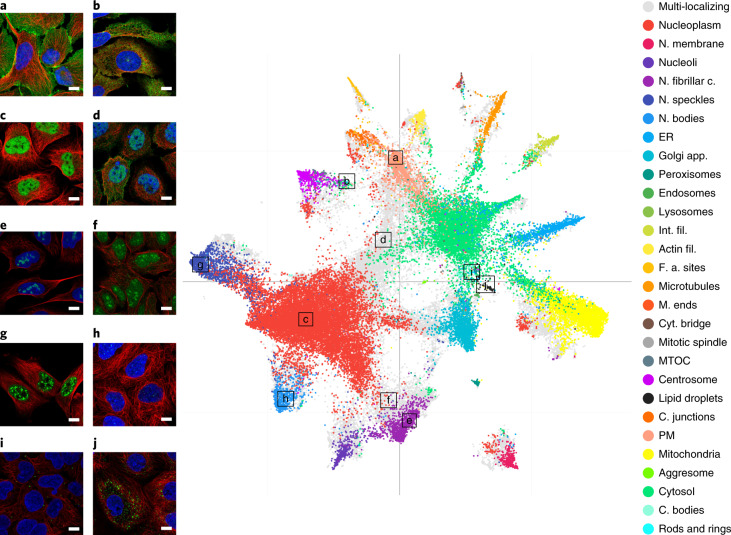
“Figure 4 shows a uniform manifold approximation and projection for dimension reduction (UMAP) 42 projection of these features.”
Backgroundscikit-image: image processing in Python
van der Walt, S., Schönberger, J. L., Nunez-Iglesias, J., Boulogne, F., Warner, J. D., Yager, N., Gouillart, E., & Yu, T. (2014) · PeerJ · doi:10.7717/peerj.453 · Cited by 6,794
End to End Learning for Self-Driving Cars
Bojarski, M., Del Testa, D., Dworakowski, D., Firner, B., Flepp, B., Goyal, P., Jackel, L. D., Monfort, M., Muller, U., Zhang, J., et al. (2016) · arXiv · doi:10.48550/arxiv.1604.07316 · Cited by 3,198 · cited 1×
“The emerging field of deep learning 7 has powered many successful real-life applications, including image recognition 8 , gaming 9 and autonomous cars 10 .”
BackgroundSurvey on deep learning with class imbalance
Johnson, J. M., & Khoshgoftaar, T. M. (2019) · Journal of Big Data · doi:10.1186/s40537-019-0192-5 · Cited by 3,032
A subcellular map of the human proteome
Thul, P. J., Åkesson, L., Wiking, M., Mahdessian, D., Geladaki, A., Ait Blal, H., Alm, T., Asplund, A., Björk, L., Breckels, L. M., et al. (2017) · Science · doi:10.1126/science.aal3321 · Cited by 2,813
Self-citationAutoAugment: Learning Augmentation Strategies From Data
Cubuk, E. D., Zoph, B., Mané, D., Vasudevan, V., & Le, Q. V. (2019) · 2019 IEEE/CVF Conference on Computer Vision and Pattern Recognition (CVPR) · doi:10.1109/cvpr.2019.00020 · Cited by 2,733
Cyclical Learning Rates for Training Neural Networks
Smith, L. N. (2017) · 2017 IEEE Winter Conference on Applications of Computer Vision (WACV) · doi:10.1109/wacv.2017.58 · Cited by 2,670 · cited 1×
“Over recent years, a collection of successful neural network architectures, such as Resnet 19 , Inception 12 and Densenet 20 , and different training techniques, such as Dropout 21 , Batch Normalization 22 , Focal Loss 23 , Cyclical learning rates 24 and AutoAugment 25 , have been developed.”
BackgroundMulti-Label Classification: An Overview
Tsoumakas, G., & Katakis, I. (2007) · International Journal of Data Warehousing and Mining · doi:10.4018/jdwm.2007070101 · Cited by 2,508
Neural Architecture Search: A Survey
Elsken, T., Metzen, J. H., & Hutter, F. (2018) · arXiv · doi:10.48550/arxiv.1808.05377 · Cited by 1,763
Zech, J. R., Badgeley, M. A., Liu, M., Costa, A. B., Titano, J. J., & Oermann, E. K. (2018) · PLOS Medicine · doi:10.1371/journal.pmed.1002683 · Cited by 1,719
Automated Machine Learning: Methods, Systems, Challenges
(2019) · The Springer Series on Challenges in Machine Learning · doi:10.1007/978-3-030-05318-5 · Cited by 1,485
Do Better ImageNet Models Transfer Better?
Kornblith, S., Shlens, J., & Le, Q. V. (2019) · 2019 IEEE/CVF Conference on Computer Vision and Pattern Recognition (CVPR) · doi:10.1109/cvpr.2019.00277 · Cited by 1,325 · cited 1×
“However, it has also been shown that the generalization of the ImageNet features is questionable, especially for fine-grained classification tasks 48 .”
BackgroundDeep learning for cellular image analysis
Moen, E., Bannon, D., Kudo, T., Graf, W., Covert, M., & Van Valen, D. (2019) · Nature Methods · doi:10.1038/s41592-019-0403-1 · Cited by 1,225 · cited 1×
“CNNs are increasingly used for biological image analysis 15–17 including multi-label classification for yeast protein localization 18 .”
MethodAutoAugment: Learning Augmentation Policies from Data
Cubuk, E. D., Zoph, B., Mane, D., Vasudevan, V., & Le, Q. V. (2018) · arXiv · doi:10.48550/arxiv.1805.09501 · Cited by 1,106 · cited 2×
“Over recent years, a collection of successful neural network architectures, such as Resnet 19 , Inception 12 and Densenet 20 , and different training techniques, such as Dropout 21 , Batch Normalization 22 , Focal Loss 23 , Cyclical learning rates 24 and AutoAugment 25 , have been developed.”
BackgroundMethodInfluentialBerman, M., Triki, A. R., & Blaschko, M. B. (2018) · 2018 IEEE/CVF Conference on Computer Vision and Pattern Recognition · doi:10.1109/cvpr.2018.00464 · Cited by 1,027 · cited 1×
“For example, Team 1 used an optimized single neural network and a combined loss function with a Lovász loss 38 term, Team 2 focused on data preprocessing, Team 3 used automatic data augmentation and Team 4 ensembled a large number of models.”
MethodAn objective comparison of cell-tracking algorithms
Ulman, V., Maška, M., Magnusson, K. E. G., Ronneberger, O., Haubold, C., Harder, N., Matula, P., Matula, P., Svoboda, D., Radojevic, M., et al. (2017) · Nature Methods · doi:10.1038/nmeth.4473 · Cited by 565
BOHB: Robust and Efficient Hyperparameter Optimization at Scale
Falkner, S., Klein, A., & Hutter, F. (2018) · arXiv · doi:10.48550/arxiv.1807.01774 · Cited by 551
Applications, promises, and pitfalls of deep learning for fluorescence image reconstruction
Belthangady, C., & Royer, L. A. (2019) · Nature Methods · doi:10.1038/s41592-019-0458-z · Cited by 510 · cited 1×
“Despite the superior performance of deep learning methods, there are limitations including hallucination and generalization problems 44 .”
BackgroundOn the Stratification of Multi-label Data
Sechidis, K., Tsoumakas, G., & Vlahavas, I. (2011) · Lecture Notes in Computer Science · doi:10.1007/978-3-642-23808-6_10 · Cited by 432 · cited 1×
“Many teams handled class imbalance by applying class weights or by using focal loss 23 to train the models, and employed multi-label stratification 37 to generate validation datasets.”
MethodDeep Learning Scaling is Predictable, Empirically
Hestness, J., Narang, S., Ardalani, N., Diamos, G., Jun, H., Kianinejad, H., Patwary, M. M. A., Yang, Y., & Zhou, Y. (2017) · arXiv · doi:10.48550/arxiv.1712.00409 · Cited by 427 · cited 1×
“This allows the model to better abstract cellular localization patterns and scale efficiently with data size 14 .”
MethodClassifying and segmenting microscopy images with deep multiple instance learning
Kraus, O. Z., Ba, J. L., & Frey, B. J. (2016) · Bioinformatics · doi:10.1093/bioinformatics/btw252 · Cited by 411
Benchmarking HEp-2 Cells Classification Methods
Foggia, P., Percannella, G., Soda, P., & Vento, M. (2013) · IEEE Transactions on Medical Imaging · doi:10.1109/tmi.2013.2268163 · Cited by 232
Spatiotemporal dissection of the cell cycle with single-cell proteogenomics
Mahdessian, D., Cesnik, A. J., Gnann, C., Danielsson, F., Stenström, L., Arif, M., Zhang, C., Le, T., Johansson, F., Schutten, R., et al. (2021) · Nature · doi:10.1038/s41586-021-03232-9 · Cited by 198
Self-citationA multi-scale convolutional neural network for phenotyping high-content cellular images
Godinez, W. J., Hossain, I., Lazic, S. E., Davies, J. W., & Zhang, X. (2017) · Bioinformatics · doi:10.1093/bioinformatics/btx069 · Cited by 183
Sullivan, D. P., Winsnes, C. F., Åkesson, L., Hjelmare, M., Wiking, M., Schutten, R., Campbell, L., Leifsson, H., Rhodes, S., Nordgren, A., et al. (2018) · Nature Biotechnology · doi:10.1038/nbt.4225 · Cited by 177
Self-citationVanschoren, J. (2018) · arXiv (Cornell University) · doi:10.48550/arxiv.1810.03548 · Cited by 169
Three pitfalls to avoid in machine learning.
Riley, P. (2019) · Nature · doi:10.1038/d41586-019-02307-y · Cited by 142
ImJoy: an open-source computational platform for the deep learning era
Ouyang, W., Mueller, F., Hjelmare, M., Lundberg, E., & Zimmer, C. (2019) · Nature Methods · doi:10.1038/s41592-019-0627-0 · Cited by 137 · cited 1×
“A web application was developed and deployed with the ImJoy platform 43 , where users can interact with the UMAP and the images with associated metadata (https://tinyurl.com/y6nhf5bo).”
MethodSelf-citationHofmarcher, M., Rumetshofer, E., Clevert, D.-A., Hochreiter, S., & Klambauer, G. (2019) · Journal of Chemical Information and Modeling · doi:10.1021/acs.jcim.8b00670 · Cited by 109
A single fixation protocol for proteome-wide immunofluorescence localization studies
Stadler, C., Skogs, M., Brismar, H., Uhlén, M., & Lundberg, E. K. (2009) · Journal of Proteomics · doi:10.1016/j.jprot.2009.10.012 · Cited by 107
Self-citationOei, R. W., Hou, G., Liu, F., Zhong, J., Zhang, J., An, Z., Xu, L., & Yang, Y. (2019) · PLOS ONE · doi:10.1371/journal.pone.0213626 · Cited by 69
The imaging tsunami: Computational opportunities and challenges
Ouyang, W., & Zimmer, C. (2017) · Current Opinion in Systems Biology · doi:10.1016/j.coisb.2017.07.011 · Cited by 47
Self-citationSpatiotemporal dissection of the cell cycle with single-cell proteogenomicsPreprint
Mahdessian, D., Cesnik, A. J., Gnann, C., et al. (2019) · bioRxiv (Cold Spring Harbor Laboratory) · doi:10.1101/543231 · Cited by 24
Self-citation
Research works printed but not linked: 1
- Yosinski, J., Clune, J., Bengio, Y. & Lipson, H. How transferable are features in deep neural networks? in Advances in Neural Information ProcessingSystems Vol. 27 (eds Ghahramani, Z. et al.) 3320–3328 (Curran Associates, Inc., 2014).
Cited by
OpenCell: Endogenous tagging for the cartography of human cellular organization
Cho, N. H., Cheveralls, K. C., Brunner, A.-D., Kim, K., Michaelis, A. C., Raghavan, P., Kobayashi, H., Savy, L., Li, J. Y., Canaj, H., et al. (2022) · Science · doi:10.1126/science.abi6983 · Cited by 567
“Although expert annotation remains the best-performing strategy to curate protein localization ( 49 , 50 ), the low-dimensional description it allows is not well suited for quantitative comparisons.”
BackgroundMethodSegment Anything for Microscopy
Archit, A., Freckmann, L., Nair, S., Khalid, N., Hilt, P., Rajashekar, V., Freitag, M., Teuber, C., Spitzner, M., Tapia Contreras, C., et al. (2025) · Nature Methods · doi:10.1038/s41592-024-02580-4 · Cited by 307
“Figure 2a shows the mean segmentation accuracy 27 (higher is better; see the Methods for details) for the default and LIVECell specialist model, using a separate test set for evaluation.”
The Human Protein Atlas—Spatial localization of the human proteome in health and disease
Digre, A., & Lindskog, C. (2021) · Protein Science · doi:10.1002/pro.3987 · Cited by 244
A high-stringency blueprint of the human proteome
Adhikari, S., Nice, E. C., Deutsch, E. W., Lane, L., Omenn, G. S., Pennington, S. R., Paik, Y.-K., Overall, C. M., Corrales, F. J., Cristea, I. M., et al. (2020) · Nature Communications · doi:10.1038/s41467-020-19045-9 · Cited by 210
Self-citationMacromolecular condensation organizes nucleolar sub-phases to set up a pH gradient
King, M. R., Ruff, K. M., Lin, A. Z., Pant, A., Farag, M., Lalmansingh, J. M., Wu, T., Fossat, M. J., Ouyang, W., Lew, M. D., et al. (2024) · Cell · doi:10.1016/j.cell.2024.02.029 · Cited by 198
“80 For subcellular location, the human protein atlas field category Subcellular location (ICC) was used to extract the accessions of nuclear speckles IDRs, Nuclear bodies IDRs, FC/DFC (Nucleoli fibrillar center) IDRs, and GC (Nucleoli) IDRs.”
MethodSelf-citation
Metadata
- Authors
- Ouyang, W., Winsnes, C. F., Hjelmare, M., Cesnik, A. J., Åkesson, L., Xu, H., Sullivan, D. P., Dai, S., Lan, J., Jinmo, P., Galib, S. M., Henkel, C., Hwang, K., Poplavskiy, D., Tunguz, B., Wolfinger, R. D., Gu, Y., Li, C., Xie, J., Buslov, D., Fironov, S., Kiselev, A., Panchenko, D., Cao, X., Wei, R., Wu, Y., Zhu, X., Tseng, K.-L., Gao, Z., Ju, C., Yi, X., Zheng, H., Kappel, C., & Lundberg, E.
- Affiliations
- Science for Life Laboratory (SE)
- Chan Zuckerberg Biohub San Francisco (US)
- Winning Health Technology Group (China) (CN)
- Missouri University of Science and Technology (US)
- Qualcomm (United States) (US)
- SAS Institute (United States) (US)
- Jilian Technology Group (China) (CN)
- BDO Unicon (Russia) (RU)
- Kharkiv National University of Radio Electronics (UA)
- The University of Texas MD Anderson Cancer Center (US)
- University of Hawaii Cancer Center (US)
- Microsoft Research Asia (China) (CN)
- University of California, Berkeley (US)
- Peking University (CN)
- Leica Microsystems (Germany) (DE)
- Corresponding author
- Lundberg, Emma
- ORCID
- Venue
- Nature Methods
- Published
- 2019-11-28
- Volume
- 16
- Issue
- 12
- Pages
- 1254-1261
- ISSN
- 1548-7091 (ISSN-L)
- 1548-7105
- PMC
- PMC6976526
- OpenAlex
- W2991083105
- Semantic Scholar
- 972d5fd56d8fc554a9a1c01077dd2eb68c51532d
- Cited by
- 131
- References
- 49
- Citations by year
- 2026: 10 · 2025: 21 · 2024: 21 · 2023: 14 · 2022: 29 · 2021: 23 · 2020: 12
- FWCI
- 7.75
- Type
- journal article
- Language
- en
- Open access
- hybrid
- doi.org
- Licence
- cc-by
- creativecommons.org/licenses/by/4.0 (tdm)
- creativecommons.org/licenses/by/4.0 (vor)
- Locations
- Nature Methods (publishedVersion, cc-by)
- PubMed Central (publishedVersion, cc-by)
- PubMed (publishedVersion)
- Funders
- Knut och Alice Wallenbergs Stiftelse (2016.0204)
- Familjen Erling-Perssons Stiftelse (2017-05327)
- Topics
- Life Sciences › Biochemistry, Genetics and Molecular Biology › Biophysics › Cell Image Analysis Techniques
- Life Sciences › Biochemistry, Genetics and Molecular Biology › Molecular Biology › Machine Learning in Bioinformatics
- Physical Sciences › Computer Science › Computer Vision and Pattern Recognition › Advanced Neural Network Applications
- Keywords
- subcellular protein localization, microscopy image classification, Human Protein Atlas, multi-label classification, class imbalance, data augmentation, pre-trained neural networks, loss functions
- MeSH terms
- Deep Learning, Humans, Image Processing, Computer-Assisted, Microscopy, Fluorescence, Proteins
About these checks
Registry, retraction, Cites and statistics results are computed, not judged, with one exception: a printed reference that no index lists is read once by a model before it counts as a citation error. Claims are extracted by a model and kept only when their quote appears verbatim in the text; each cited source is then checked, with a model’s help, for whether it says what the claim relies on. Those verdicts can be wrong — read the claim’s quote and the cited source before relying on one.
Statistics and arithmetic are recomputed, not judged.
Confidence bands are shown only for fields calibrated on our annotated test set. None is calibrated yet, so no band is shown.
What counts as a claim ›How we measure confidence ›How we check this ›
Are you an author, or do you see a problem with this page? Request a review
Data sources
Bibliographic data: Semantic Scholar, OpenAlex, Crossref.
Contains information from the Semantic Scholar Academic Graph Datasets, made available under the ODC Attribution License (ODC-BY 1.0).
Semantic Scholar’s data is described in: Kinney, R., et al. (2023). The Semantic Scholar Open Data Platform. arXiv:2301.10140.
