CoChat

Shared computational principles for language processing in humans and deep language models

Open access

The DOI matches its Crossref record; 65 of the 65 references it cites were found in a registry or an index.

Abstract

Departing from traditional linguistic models, advances in deep learning have resulted in a new type of predictive (autoregressive) deep language models (DLMs). Using a self-supervised next-word prediction task, these models generate appropriate linguistic responses in a given context. In the current study, nine participants listened to a 30-min podcast while their brain responses were recorded using electrocorticography (ECoG). We provide empirical evidence that the human brain and autoregressive DLMs share three fundamental computational principles as they process the same natural narrative: (1) both are engaged in continuous next-word prediction before word onset; (2) both match their pre-onset predictions to the incoming word to calculate post-onset surprise; (3) both rely on contextual embeddings to represent words in natural contexts. Together, our findings suggest that autoregressive DLMs provide a new and biologically feasible computational framework for studying the neural basis of language.

Overview

The claims and statistics of this paper haven’t been checked yet.

Free: it reads the open-access text and checks the first 5 claims that cite a source we can check. Create a free account to check every claim.

A few free checks a day · papers already verified open instantly · results are public

Integrity signals

Registry

Crossref · 10.1038/s41593-022-01026-4

Cites

65 of 65 references verified0 citation errors · 0 not checkable

Statistics

Figures

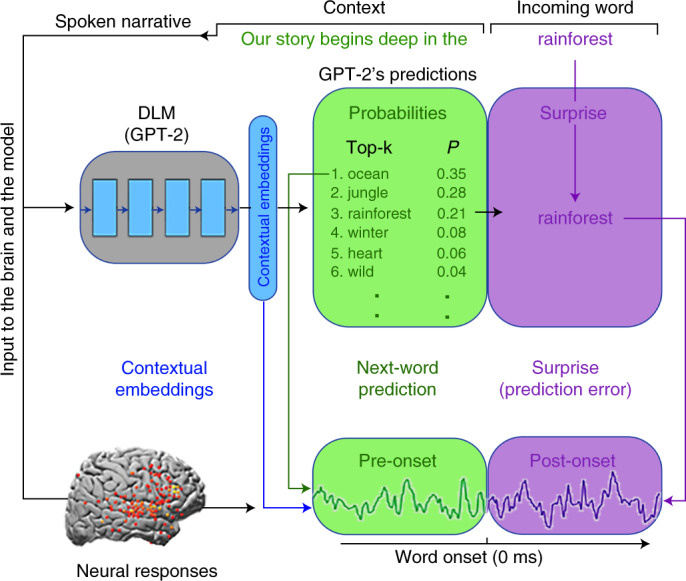
Fig. 1 Shared computational principles between the brain and autoregressive deep language models in processing natural language. For each sequence of words in the text, GPT-2 generates a contextual embedding (blue), which is used to assign probabilities to the identity of the next word (green box). Next, GPT-2 uses its pre-onset predictions to calculate its surprise level (that is, error signal) when the next word is revealed (purple box). The minimization of the surprise is the mechanism by which GPT-2 is trained to generate well-formed outputs. Each colored box and arrow represents the relationship between a given computational principle of the autoregressive DLM and the neural responses. The green boxes represent that both the brain and autoregressive DLMs are engaged in context-dependent prediction of the upcoming word before word onset. The green arrow indicates that we take the actual predictions from GPT-2 (for example, the top-one prediction ‘ocean’ for the example sentence ‘our story begins deep in the…’) to model the neural responses before word onset (Fig. 4). The purple boxes represent that both the brain and autoregressive DLMs are engaged in the assessment of their predictions after word onset. The purple arrow indicates that we take the actual perceived next word (‘rainforest’ in our example), as well as GPT-2’s surprise level for the perceived word (cross-entropy) to model the neural responses after word onset (Figs. 4b and 5b). The blue boxes represent that both the brain and autoregressive DLMs use contextual embeddings to represent words. The blue arrow indicates that we take the contextual embeddings from GPT-2 to model the neural responses (Figs. 6 and 8). We argue here that, although the internal word-processing mechanisms are not the same for the brain and DLMs, they do share three core computational principles: (1) continuous context-dependent next-word prediction before word onset; (2) reliance on the pre-onset prediction to calculate post-word-onset surprise; and finally, (3) context-specific representation of meaning.
Fig. 1 Shared computational principles between the brain and autoregressive deep language models in processing natural language. For each sequence of words in the text, GPT-2 generates a contextual embedding (blue), which is used to assign probabilities to the identity of the next word (green box). Next, GPT-2 uses its pre-onset predictions to calculate its surprise level (that is, error signal) when the next word is revealed (purple box). The minimization of the surprise is the mechanism by which GPT-2 is trained to generate well-formed outputs. Each colored box and arrow represents the relationship between a given computational principle of the autoregressive DLM and the neural responses. The green boxes represent that both the brain and autoregressive DLMs are engaged in context-dependent prediction of the upcoming word before word onset. The green arrow indicates that we take the actual predictions from GPT-2 (for example, the top-one prediction ‘ocean’ for the example sentence ‘our story begins deep in the…’) to model the neural responses before word onset (Fig. 4). The purple boxes represent that both the brain and autoregressive DLMs are engaged in the assessment of their predictions after word onset. The purple arrow indicates that we take the actual perceived next word (‘rainforest’ in our example), as well as GPT-2’s surprise level for the perceived word (cross-entropy) to model the neural responses after word onset (Figs. 4b and 5b). The blue boxes represent that both the brain and autoregressive DLMs use contextual embeddings to represent words. The blue arrow indicates that we take the contextual embeddings from GPT-2 to model the neural responses (Figs. 6 and 8). We argue here that, although the internal word-processing mechanisms are not the same for the brain and DLMs, they do share three core computational principles: (1) continuous context-dependent next-word prediction before word onset; (2) reliance on the pre-onset prediction to calculate post-word-onset surprise; and finally, (3) context-specific representation of meaning.CC BY · PubMed Central
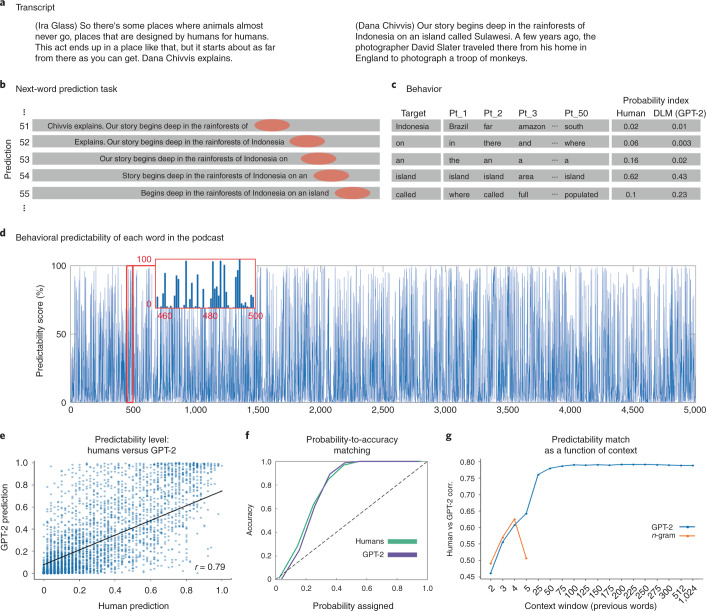
Fig. 2 Behavioral assessment of the human ability to predict forthcoming words in a natural context. a, The stimulus was transcribed for the behavioral experiment. b, A ten-word sliding window was presented in each trial, and participants were asked to type their prediction of the next word. Once entered, the correct word is presented, and the window slides forward by one word. c, For each word, we calculated the proportion of participants that predicted the forthcoming word correctly. d, Human predictability scores across words. e, Human predictability scores versus GPT-2’s predictability scores for each upcoming word in the podcast. f, Match between assigned probability for humans and GPT-2 and the actual accuracy for their top-one predictions. g, Correlation between human predictions and GPT-2 predictions (as reported in d) for different context window lengths ranging from 2 to 1,024 preceding tokens (blue). Correlation between human predictions and 2- to 5-gram model predictions (orange).
Fig. 2 Behavioral assessment of the human ability to predict forthcoming words in a natural context. a, The stimulus was transcribed for the behavioral experiment. b, A ten-word sliding window was presented in each trial, and participants were asked to type their prediction of the next word. Once entered, the correct word is presented, and the window slides forward by one word. c, For each word, we calculated the proportion of participants that predicted the forthcoming word correctly. d, Human predictability scores across words. e, Human predictability scores versus GPT-2’s predictability scores for each upcoming word in the podcast. f, Match between assigned probability for humans and GPT-2 and the actual accuracy for their top-one predictions. g, Correlation between human predictions and GPT-2 predictions (as reported in d) for different context window lengths ranging from 2 to 1,024 preceding tokens (blue). Correlation between human predictions and 2- to 5-gram model predictions (orange).CC BY · PubMed Central
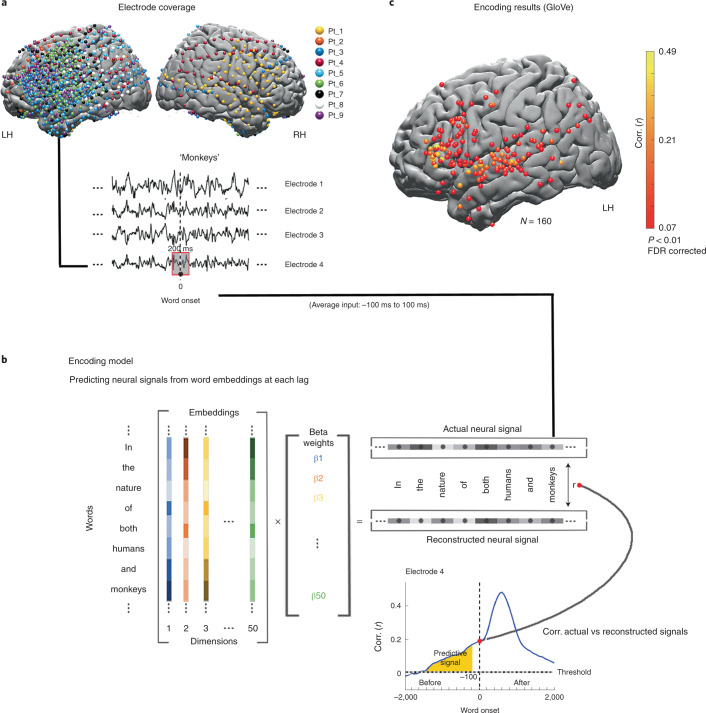
Fig. 3 Linear encoding model used to predict the neural responses to each word in the narrative before and after word-onset. a, Brain coverage consisted of 1,339 electrodes (across nine participants). The words are aligned with the neural signal; each word’s onset (moment of articulation) is designated at lag 0. Responses are averaged over a window of 200 ms and provided as input to the encoding model. b, A series of 50 coefficients corresponding to the features of the word embeddings is learned using linear regression to predict the neural signal across words from the assigned embeddings. The model was evaluated by computing the correlation between the reconstructed signal and the actual signal for a held-out test word. This procedure was repeated for each lag and each electrode, using a 25-ms sliding window. The dashed horizontal line indicates the statistical threshold (q < 0.01, FDR corrected). Lags of −100 ms or more preceding word onset contained only neural information sampled before the word was perceived (yellow). c, Electrodes with significant correlation at the peaked lag between predicted and actual word responses for semantic embeddings (GloVe). LH, left hemisphere; RH, right hemisphere.
Fig. 3 Linear encoding model used to predict the neural responses to each word in the narrative before and after word-onset. a, Brain coverage consisted of 1,339 electrodes (across nine participants). The words are aligned with the neural signal; each word’s onset (moment of articulation) is designated at lag 0. Responses are averaged over a window of 200 ms and provided as input to the encoding model. b, A series of 50 coefficients corresponding to the features of the word embeddings is learned using linear regression to predict the neural signal across words from the assigned embeddings. The model was evaluated by computing the correlation between the reconstructed signal and the actual signal for a held-out test word. This procedure was repeated for each lag and each electrode, using a 25-ms sliding window. The dashed horizontal line indicates the statistical threshold (q < 0.01, FDR corrected). Lags of −100 ms or more preceding word onset contained only neural information sampled before the word was perceived (yellow). c, Electrodes with significant correlation at the peaked lag between predicted and actual word responses for semantic embeddings (GloVe). LH, left hemisphere; RH, right hemisphere.CC BY · PubMed Central
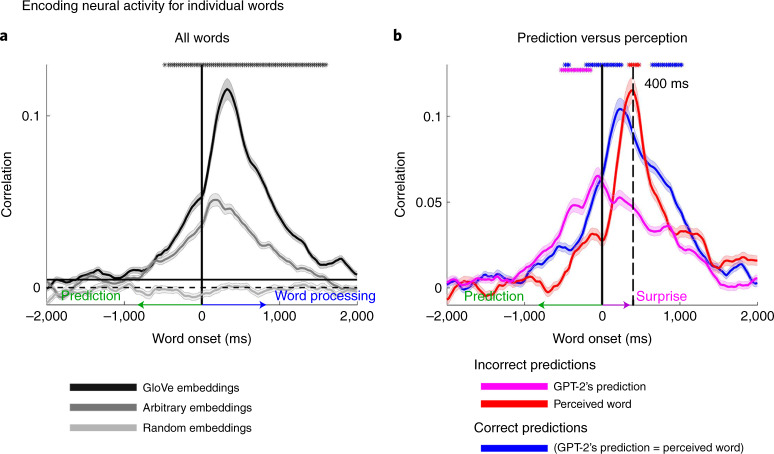
Fig. 4 Modeling of neural signals before and after word onset for predictable, unpredictable and incorrectly predicted words. a, Estimating neural signals for all individual words from word embeddings (encodings). The encoding analysis was performed in each electrode with significant encoding for GloVe embeddings (n = 160), and then averaged across electrodes (see map of electrodes in Fig. 3c). The shaded regions indicate the s.e. of the encoding models across electrodes. Using arbitrary embeddings, we managed to encode information as to the identity of the incoming word before and after word onset. Using word embeddings (GloVe), which contain contextual information as to the relation among words in natural language, further improves the encoding models before and after word onset. Furthermore, we observed a robust encoding to upcoming words starting −1,000 ms before word onset. The horizontal continuous black line specifies the statistical threshold. Black asterisks indicate lags for which the encoding based on GloVe embeddings significantly outperformed the encoding based on arbitrary embeddings. b, Estimating neural signals for correctly predicted words (blue), incorrectly predicted words (magenta) and the actual unexpected perceived word (red). Note that encoding before word onset was aligned with the content of the predicted words, whereas the encoding after word onset was aligned with the content of the perceived words. Moreover, we observed an increase in encoding performance for surprising words compared to predicted words 400 ms after word onset. Magenta asterisks represent significant differences between incorrect GPT-2 predictions (magenta line) and correct predictions (blue line). Red asterisks represent significantly higher values for incorrectly predicted words (red line) than correctly predicted words (blue line). Blue asterisks represent significantly higher values for correctly predicted words (blue line) than incorrectly predicted words (red line). The shaded regions indicate the s.e. of the encoding models across electrodes.
Fig. 4 Modeling of neural signals before and after word onset for predictable, unpredictable and incorrectly predicted words. a, Estimating neural signals for all individual words from word embeddings (encodings). The encoding analysis was performed in each electrode with significant encoding for GloVe embeddings (n = 160), and then averaged across electrodes (see map of electrodes in Fig. 3c). The shaded regions indicate the s.e. of the encoding models across electrodes. Using arbitrary embeddings, we managed to encode information as to the identity of the incoming word before and after word onset. Using word embeddings (GloVe), which contain contextual information as to the relation among words in natural language, further improves the encoding models before and after word onset. Furthermore, we observed a robust encoding to upcoming words starting −1,000 ms before word onset. The horizontal continuous black line specifies the statistical threshold. Black asterisks indicate lags for which the encoding based on GloVe embeddings significantly outperformed the encoding based on arbitrary embeddings. b, Estimating neural signals for correctly predicted words (blue), incorrectly predicted words (magenta) and the actual unexpected perceived word (red). Note that encoding before word onset was aligned with the content of the predicted words, whereas the encoding after word onset was aligned with the content of the perceived words. Moreover, we observed an increase in encoding performance for surprising words compared to predicted words 400 ms after word onset. Magenta asterisks represent significant differences between incorrect GPT-2 predictions (magenta line) and correct predictions (blue line). Red asterisks represent significantly higher values for incorrectly predicted words (red line) than correctly predicted words (blue line). Blue asterisks represent significantly higher values for correctly predicted words (blue line) than incorrectly predicted words (red line). The shaded regions indicate the s.e. of the encoding models across electrodes.CC BY · PubMed Central
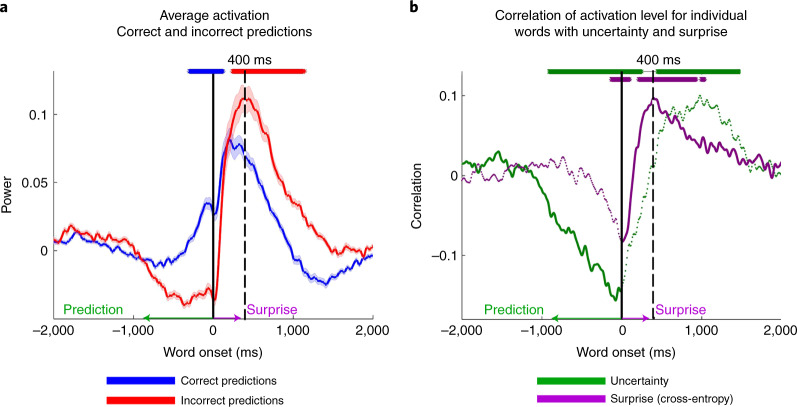
Fig. 5 Uncertainty and surprise levels computed by GPT-2 correlate with pre-onset and post-onset neural activity respectively. a, Trigger-averaged activity (and s.e.) across 160 electrodes with significant GloVe encoding for words (Fig. 3c). Averaging was performed separately for words correctly predicted and incorrectly predicted. Note the increase in signal activity for predictable words before onset and for unpredictable words 400 ms after word onset. b, Partial correlations between uncertainty (entropy) and signal power controlling for cross-entropy (green line). Partial correlations between surprise (cross-entropy) and neural signals controlling for correlation with entropy (red and purple lines). Asterisks indicate correlation significance (FDR corrected, q < 0.01).
Fig. 5 Uncertainty and surprise levels computed by GPT-2 correlate with pre-onset and post-onset neural activity respectively. a, Trigger-averaged activity (and s.e.) across 160 electrodes with significant GloVe encoding for words (Fig. 3c). Averaging was performed separately for words correctly predicted and incorrectly predicted. Note the increase in signal activity for predictable words before onset and for unpredictable words 400 ms after word onset. b, Partial correlations between uncertainty (entropy) and signal power controlling for cross-entropy (green line). Partial correlations between surprise (cross-entropy) and neural signals controlling for correlation with entropy (red and purple lines). Asterisks indicate correlation significance (FDR corrected, q < 0.01).CC BY · PubMed Central
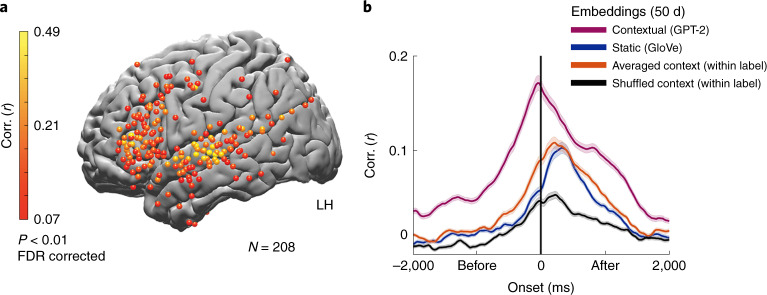
Fig. 6 Contextual (GPT-2) embeddings improve the modeling of neural responses before word onset. a, Peak correlation between predicted and actual word responses for the contextual (GPT-2) embeddings. Using contextual embeddings significantly improved the encoding model’s ability to predict the neural signals for unseen words across many electrodes. b, Encoding model performance for contextual embeddings (GPT-2) aggregated across 160 electrodes with significant encoding for GloVe (Fig. 3c): contextual embeddings (purple), static embeddings (GloVe, blue), contextual embeddings averaged across all occurrences of a given word (orange), contextual embeddings shuffled across context-specific occurrence of a given word (black). The shaded regions indicate the s.e. of the encoding models across electrodes.
Fig. 6 Contextual (GPT-2) embeddings improve the modeling of neural responses before word onset. a, Peak correlation between predicted and actual word responses for the contextual (GPT-2) embeddings. Using contextual embeddings significantly improved the encoding model’s ability to predict the neural signals for unseen words across many electrodes. b, Encoding model performance for contextual embeddings (GPT-2) aggregated across 160 electrodes with significant encoding for GloVe (Fig. 3c): contextual embeddings (purple), static embeddings (GloVe, blue), contextual embeddings averaged across all occurrences of a given word (orange), contextual embeddings shuffled across context-specific occurrence of a given word (black). The shaded regions indicate the s.e. of the encoding models across electrodes.CC BY · PubMed Central
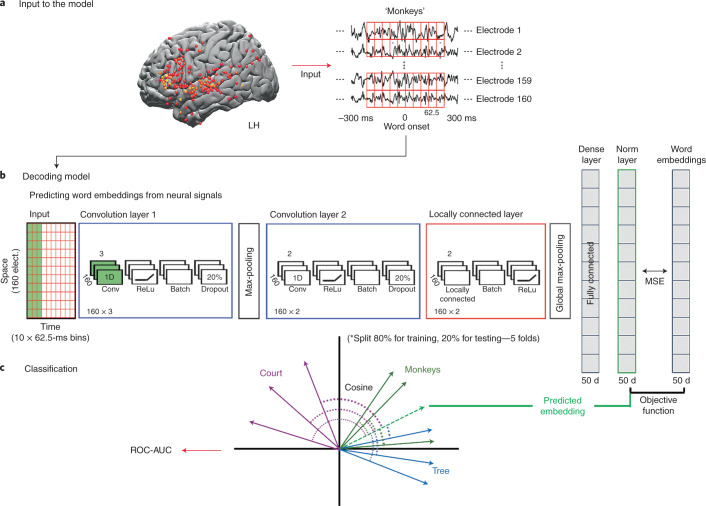
Fig. 7 Deep nonlinear decoding model used to predict words from neural responses before and after word onset. a, Neural data from left-hemisphere electrodes with significant encoding model performance using GloVe embeddings were used as input to the decoding model. For each fold, electrode selection was performed on 80% of the data that were not used for testing the model. The stimulus was segmented into individual words and aligned to the brain signal at each lag. b, Schematic of the feed-forward deep neural network model that learns to project the neural signals for the words into the arbitrary embedding, static semantic embedding (GloVe) or contextual embedding (GPT-2) space (Appendix I). The input (currently represented as a 160 × 10 matrix) changes its dimensions for each of the five folds based on the number of significant electrodes for each fold. The model was trained to minimize the mean squared error (MSE) when mapping the neural signals into the embedding space. c, The decoding model was evaluated using a word classification task. The quality of word classification is based on the embedding space used to construct ROC-AUC scores. This enabled us to assess how much information about specific words is extractible from the neural activity via the linguistic embedding space.
Fig. 7 Deep nonlinear decoding model used to predict words from neural responses before and after word onset. a, Neural data from left-hemisphere electrodes with significant encoding model performance using GloVe embeddings were used as input to the decoding model. For each fold, electrode selection was performed on 80% of the data that were not used for testing the model. The stimulus was segmented into individual words and aligned to the brain signal at each lag. b, Schematic of the feed-forward deep neural network model that learns to project the neural signals for the words into the arbitrary embedding, static semantic embedding (GloVe) or contextual embedding (GPT-2) space (Appendix I). The input (currently represented as a 160 × 10 matrix) changes its dimensions for each of the five folds based on the number of significant electrodes for each fold. The model was trained to minimize the mean squared error (MSE) when mapping the neural signals into the embedding space. c, The decoding model was evaluated using a word classification task. The quality of word classification is based on the embedding space used to construct ROC-AUC scores. This enabled us to assess how much information about specific words is extractible from the neural activity via the linguistic embedding space.CC BY · PubMed Central
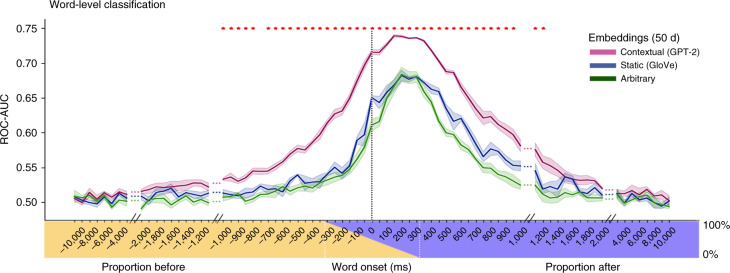
Fig. 8 Using a decoding model for classification of words before and after word onset. Word-level classification. Classification performance for contextual (GPT-2), static (GloVe) and arbitrary (green) embeddings. The averaged values were weighted by the frequency of the words in the test set. The x-axis labels indicate the center of each 625-ms window used for decoding at each lag (between −10 and 10 s). The colored stripe indicates the proportion of pre-word onset (yellow) and post-word onset (blue) time points in each lag. Shaded regions denote the s.e. across five test folds. Note that contextual embeddings improved classification performance over GloVe both before and after word onset. Significance was assessed using a paired-sample t-test of the AUCs for each unique word, comparing the AUCs of the GloVe-based decoding and GPT-2-based decoding. The comparison was performed for each leg separately and results were FDR corrected (q < .01).
Fig. 8 Using a decoding model for classification of words before and after word onset. Word-level classification. Classification performance for contextual (GPT-2), static (GloVe) and arbitrary (green) embeddings. The averaged values were weighted by the frequency of the words in the test set. The x-axis labels indicate the center of each 625-ms window used for decoding at each lag (between −10 and 10 s). The colored stripe indicates the proportion of pre-word onset (yellow) and post-word onset (blue) time points in each lag. Shaded regions denote the s.e. across five test folds. Note that contextual embeddings improved classification performance over GloVe both before and after word onset. Significance was assessed using a paired-sample t-test of the AUCs for each unique word, comparing the AUCs of the GloVe-based decoding and GPT-2-based decoding. The comparison was performed for each leg separately and results were FDR corrected (q < .01).CC BY · PubMed Central
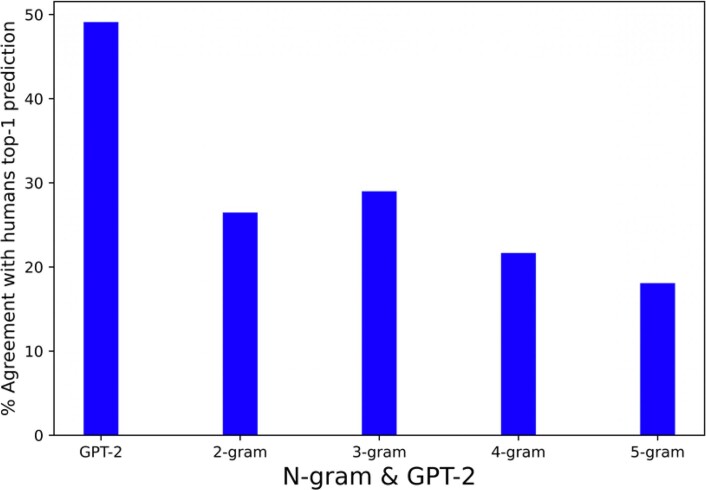
Extended Data Fig. 1 Figure S1. Comparing agreement with human prediction between most probable predictions based on n-grams or GPT-2. The plots show higher agreement between human predictions and GPT-2’s top-1 predictions than all the n-gram model predictions we trained.
Extended Data Fig. 1 Figure S1. Comparing agreement with human prediction between most probable predictions based on n-grams or GPT-2. The plots show higher agreement between human predictions and GPT-2’s top-1 predictions than all the n-gram model predictions we trained.CC BY · PubMed Central
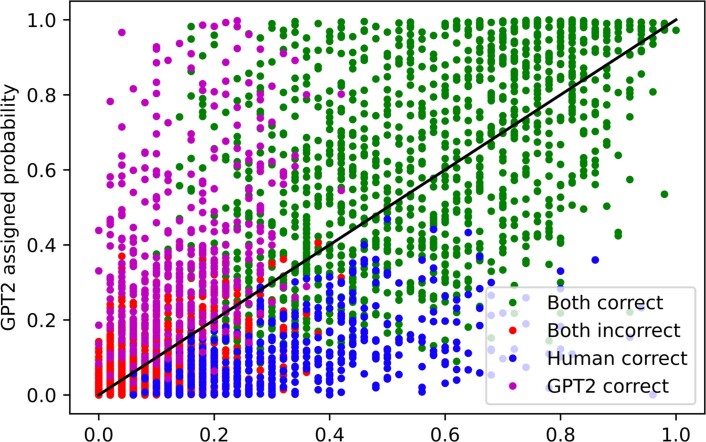
Extended Data Fig. 2 Figure S2. Comparing GPT-2 predictions and human predictions. Coloring the scatter plot according to GPT-2/human accuracy. GPT-2 and humans jointly predicted correctly 27.6% of the words (green). GPT-2 and humans jointly predicted incorrectly and disagreed on the next word for 48.8% of the words (red). GPT-2 and humans jointly predicted incorrectly and agreed on the next word for 5.9% of the words (black) 9.2% of the words humans predicted correctly were not correctly predicted by GPT-2 (blue). 8.4% of the words correctly predicted by GPT-2 were not correctly predicted by humans.
Extended Data Fig. 2 Figure S2. Comparing GPT-2 predictions and human predictions. Coloring the scatter plot according to GPT-2/human accuracy. GPT-2 and humans jointly predicted correctly 27.6% of the words (green). GPT-2 and humans jointly predicted incorrectly and disagreed on the next word for 48.8% of the words (red). GPT-2 and humans jointly predicted incorrectly and agreed on the next word for 5.9% of the words (black) 9.2% of the words humans predicted correctly were not correctly predicted by GPT-2 (blue). 8.4% of the words correctly predicted by GPT-2 were not correctly predicted by humans.CC BY · PubMed Central
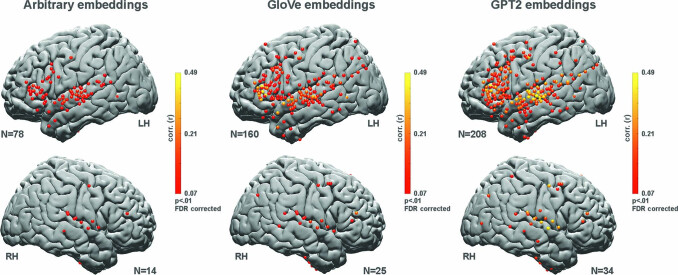
Extended Data Fig. 3 Figure S3. Left and right hemisphere encoding results show an advantage for contextual (GPT-2) embeddings over static (GloVe) and arbitrary embeddings. Right Hemisphere maps for correlation between. A. Predicted and actual word responses for the arbitrary embeddings (nonparametric permutation test; q < .01, FDR corrected). B. Correlation between predicted and actual word responses for the static (GloVe) embeddings. C. Correlation between predicted and actual word responses for the contextual (GPT-2) embeddings. Using contextual embeddings significantly improved the encoding model’s ability to predict the neural signals for unseen words across many electrodes. Given that we had fewer electrodes in the right hemisphere relative to the left hemisphere, this study is not set up to test differences in language lateralization across hemispheres.
Extended Data Fig. 3 Figure S3. Left and right hemisphere encoding results show an advantage for contextual (GPT-2) embeddings over static (GloVe) and arbitrary embeddings. Right Hemisphere maps for correlation between. A. Predicted and actual word responses for the arbitrary embeddings (nonparametric permutation test; q < .01, FDR corrected). B. Correlation between predicted and actual word responses for the static (GloVe) embeddings. C. Correlation between predicted and actual word responses for the contextual (GPT-2) embeddings. Using contextual embeddings significantly improved the encoding model’s ability to predict the neural signals for unseen words across many electrodes. Given that we had fewer electrodes in the right hemisphere relative to the left hemisphere, this study is not set up to test differences in language lateralization across hemispheres.CC BY · PubMed Central
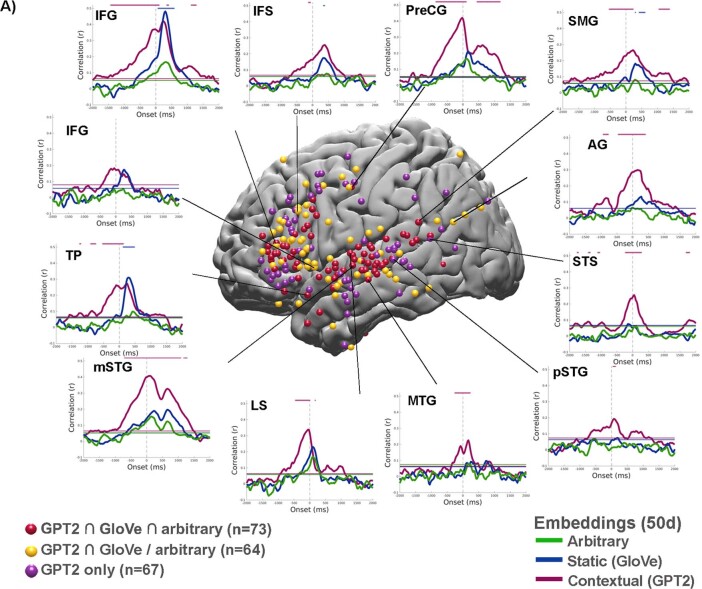
Extended Data Fig. 4 Figure S4. Contextual embedding significantly improves the modeling of neural signals. Map of the electrodes in the left hemisphere with significant encoding for 1) all three types of embeddings (GPT-2 ∩ GloVe ∩ arbitrary, red); 2) for static and contextual embeddings (GPT-2 ∩ GloVe, but not arbitrary, yellow); 3) and contextual only (GPT-2, purple) embeddings. Note the three groups do not overlap. A sampling of encoding performance for selected individual electrodes across different brain areas: inferior frontal gyrus (IFG), temporal pole (TP), middle superior central gyrus (mSTG), superior temporal sulcus (STS), lateral sulcus (LS), middle temporal gyrus (MTG), posterior superior temporal gyrus (pSTG), angular gyrus (AG), post central gyrus (postCG), precentral gyrus (PreCG), and middle frontal sulcus (MFS). (Green - encoding for the arbitrary embeddings, blue - encoding for static (GloVe) embeddings; purple - encoding for contextual (GPT-2) embeddings).
Extended Data Fig. 4 Figure S4. Contextual embedding significantly improves the modeling of neural signals. Map of the electrodes in the left hemisphere with significant encoding for 1) all three types of embeddings (GPT-2 ∩ GloVe ∩ arbitrary, red); 2) for static and contextual embeddings (GPT-2 ∩ GloVe, but not arbitrary, yellow); 3) and contextual only (GPT-2, purple) embeddings. Note the three groups do not overlap. A sampling of encoding performance for selected individual electrodes across different brain areas: inferior frontal gyrus (IFG), temporal pole (TP), middle superior central gyrus (mSTG), superior temporal sulcus (STS), lateral sulcus (LS), middle temporal gyrus (MTG), posterior superior temporal gyrus (pSTG), angular gyrus (AG), post central gyrus (postCG), precentral gyrus (PreCG), and middle frontal sulcus (MFS). (Green - encoding for the arbitrary embeddings, blue - encoding for static (GloVe) embeddings; purple - encoding for contextual (GPT-2) embeddings).CC BY · PubMed Central
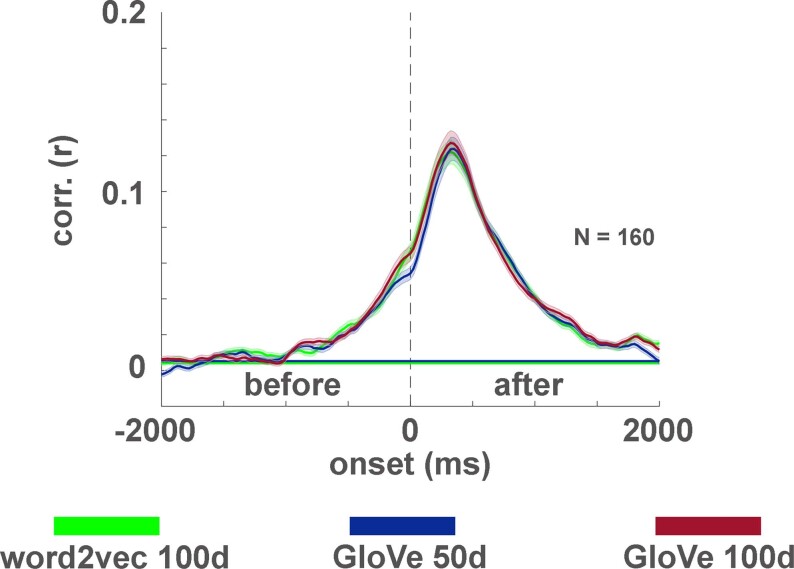
Extended Data Fig. 5 Figure S5. Comparison of GloVe and word2vec-based static embeddings. The encoding procedure was repeated for two additional static embeddings using the electrodes that were found significant for GloVe-50 encoding on the left hemisphere (Fig. 3B). Each line indicates the encoding model performance averaged across electrodes for a given type of static embedding at lags from -2000 to 2000 ms relative to word onset. The error bars indicate the standard error of the mean across the electrodes at each lag. 100-dimensional word2vec and GloVe embeddings resulted in similar encoding results to the initial 50-dimensional GloVe embeddings. This suggests that results obtained with static embeddings are robust to the specific type of static embeddings used.
Extended Data Fig. 5 Figure S5. Comparison of GloVe and word2vec-based static embeddings. The encoding procedure was repeated for two additional static embeddings using the electrodes that were found significant for GloVe-50 encoding on the left hemisphere (Fig. 3B). Each line indicates the encoding model performance averaged across electrodes for a given type of static embedding at lags from -2000 to 2000 ms relative to word onset. The error bars indicate the standard error of the mean across the electrodes at each lag. 100-dimensional word2vec and GloVe embeddings resulted in similar encoding results to the initial 50-dimensional GloVe embeddings. This suggests that results obtained with static embeddings are robust to the specific type of static embeddings used.CC BY · PubMed Central
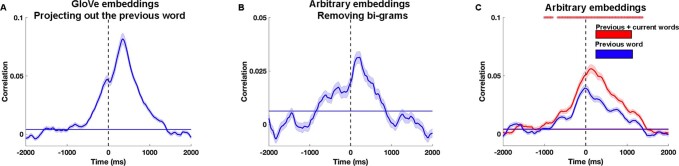
Extended Data Fig. 6 Figure S6. Controlling for correlations among adjacent GloVe embeddings. To ensure that the signal predicted before word-onset is not a result of a correlation among adjacent GloVe embeddings we ran the following additional control analyses: A. We projected (by inner product) and then subtracted the GloVe embedding of the previous word from each word and re-ran the encoding analysis. The analysis demonstrates that the significant encoding before word onset holds even after removing local contextual dependencies in the GloVe embedding of consecutive words. The error bars indicate the standard error of the encoding models across electrodes. The horizontal line indicates the significance threshold calculated using a permutation test and FDR corrected for multiple comparisons (q < .01). B. We trained an encoding model using arbitrary embeddings on our dataset after removing all bi-grams that repeated more than once. The encoding before word onset remained significant after the removal of the bi-grams. The error bars indicate the standard error of the encoding models across electrodes. The horizontal line indicates the significance threshold calculated using a permutation test and FDR corrected for multiple comparisons (q < .01). C. We compared an encoding model based on arbitrary embeddings using the previous word embedding (blue line), to an encoding model where we concatenated previous and current word embeddings (red line). The error bars indicate the standard error of the encoding models across electrodes. Red asterisks mark significant differences using a permutation test and FDR correction (q < .01). The significant difference between these two models before word onset is another evidence that there is predictive information in the neural activity as to the upcoming word, above and beyond the contextual information embedded in the previous word. The horizontal line indicates the significance threshold calculated using permutation test and FDR corrected for multiple comparisons (q < .01).
Extended Data Fig. 6 Figure S6. Controlling for correlations among adjacent GloVe embeddings. To ensure that the signal predicted before word-onset is not a result of a correlation among adjacent GloVe embeddings we ran the following additional control analyses: A. We projected (by inner product) and then subtracted the GloVe embedding of the previous word from each word and re-ran the encoding analysis. The analysis demonstrates that the significant encoding before word onset holds even after removing local contextual dependencies in the GloVe embedding of consecutive words. The error bars indicate the standard error of the encoding models across electrodes. The horizontal line indicates the significance threshold calculated using a permutation test and FDR corrected for multiple comparisons (q < .01). B. We trained an encoding model using arbitrary embeddings on our dataset after removing all bi-grams that repeated more than once. The encoding before word onset remained significant after the removal of the bi-grams. The error bars indicate the standard error of the encoding models across electrodes. The horizontal line indicates the significance threshold calculated using a permutation test and FDR corrected for multiple comparisons (q < .01). C. We compared an encoding model based on arbitrary embeddings using the previous word embedding (blue line), to an encoding model where we concatenated previous and current word embeddings (red line). The error bars indicate the standard error of the encoding models across electrodes. Red asterisks mark significant differences using a permutation test and FDR correction (q < .01). The significant difference between these two models before word onset is another evidence that there is predictive information in the neural activity as to the upcoming word, above and beyond the contextual information embedded in the previous word. The horizontal line indicates the significance threshold calculated using permutation test and FDR corrected for multiple comparisons (q < .01).CC BY · PubMed Central
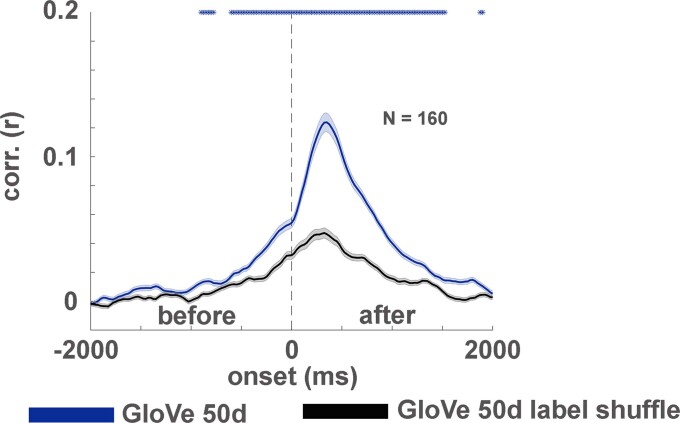
Extended Data Fig. 7 Figure S7. GloVe’s space embedding attributes. It can be argued that GloVe based encoding outperforms arbitrary-based encoding due to a general property of the space that GloVe embeddings induce (for example, they are closer / further away from each other). To control for this possible confound, we consistently mismatched the labels of the embeddings of GloVe and used the mismatched version for encoding. This means that each unique word was consistently matched with a specific vector that is actually an embedding of a different label (for example, matching each instance of the word ‘David’ with the embedding of the word ‘court’). This manipulation uses the same embedding space that GloVe uses and also induces a consistent mapping of words to embeddings (as in the arbitrary-based encoding). The matched GloVe (blue) outperformed the mismatched GloVe (black), supporting the claim that GloVe embedding carries information about word statistics that is useful for predicting the brain signal.. The error bars indicate the standard error of the encoding models across electrodes.
Extended Data Fig. 7 Figure S7. GloVe’s space embedding attributes. It can be argued that GloVe based encoding outperforms arbitrary-based encoding due to a general property of the space that GloVe embeddings induce (for example, they are closer / further away from each other). To control for this possible confound, we consistently mismatched the labels of the embeddings of GloVe and used the mismatched version for encoding. This means that each unique word was consistently matched with a specific vector that is actually an embedding of a different label (for example, matching each instance of the word ‘David’ with the embedding of the word ‘court’). This manipulation uses the same embedding space that GloVe uses and also induces a consistent mapping of words to embeddings (as in the arbitrary-based encoding). The matched GloVe (blue) outperformed the mismatched GloVe (black), supporting the claim that GloVe embedding carries information about word statistics that is useful for predicting the brain signal.. The error bars indicate the standard error of the encoding models across electrodes.CC BY · PubMed Central
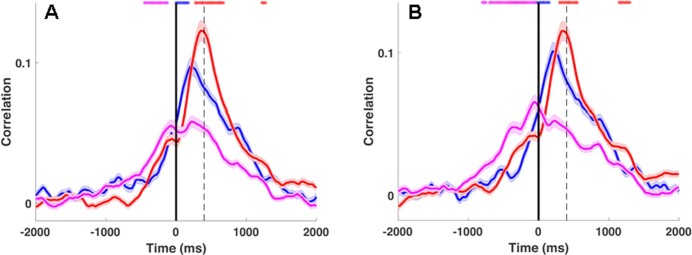
Extended Data Fig. 8 Figure S8. Encoding for correct / incorrect predictions. This is a variation of Fig. 4B where: A. We classify words as correctly predicted if they are the most predictable words by humans’ ratings. The error bars indicate the standard error of the encoding models across electrodes. B. We classify words as correctly predicted if they are the most predictable by GPT-2 (instead of top-5). The error bars indicate the standard error of the encoding models across electrodes.
Extended Data Fig. 8 Figure S8. Encoding for correct / incorrect predictions. This is a variation of Fig. 4B where: A. We classify words as correctly predicted if they are the most predictable words by humans’ ratings. The error bars indicate the standard error of the encoding models across electrodes. B. We classify words as correctly predicted if they are the most predictable by GPT-2 (instead of top-5). The error bars indicate the standard error of the encoding models across electrodes.CC BY · PubMed Central
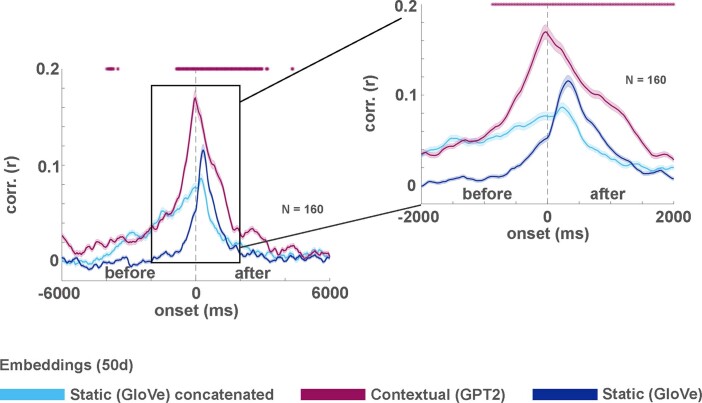
Extended Data Fig. 9 Figure S9. Comparison of GPT-2 and concatenation of static embeddings. The increased performance of GPT-2 based contextual embeddings encoding may be attributed to the fact that it consists of information about the previous words’ identity. To examine this possibility, we concatenated the GloVe embeddings of the 10 previous words and current word, and reduced their dimensionality to 50 features. GPT-2 based encoding outperformed mere concatenation before word onset, suggesting that GPT-2’s ability to compress the contextual information improves the ability to model the neural signals before word onset. The error bars indicate the standard error of the encoding models across electrodes.
Extended Data Fig. 9 Figure S9. Comparison of GPT-2 and concatenation of static embeddings. The increased performance of GPT-2 based contextual embeddings encoding may be attributed to the fact that it consists of information about the previous words’ identity. To examine this possibility, we concatenated the GloVe embeddings of the 10 previous words and current word, and reduced their dimensionality to 50 features. GPT-2 based encoding outperformed mere concatenation before word onset, suggesting that GPT-2’s ability to compress the contextual information improves the ability to model the neural signals before word onset. The error bars indicate the standard error of the encoding models across electrodes.CC BY · PubMed Central
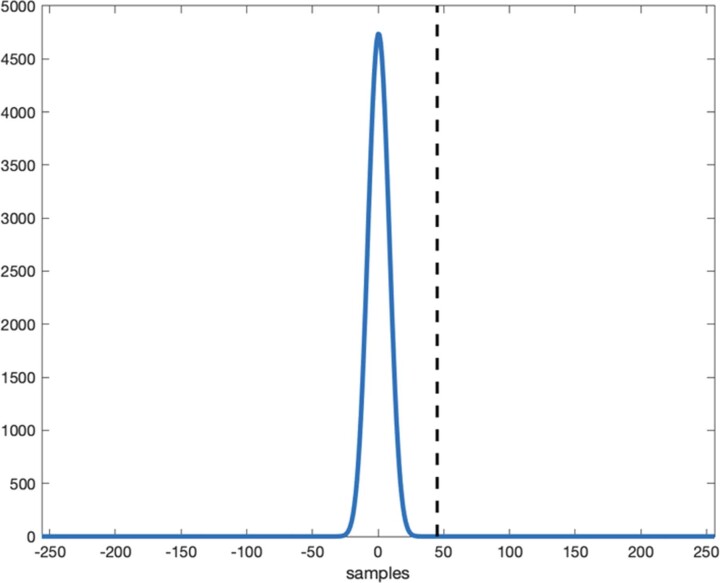
Extended Data Fig. 10 Figure S10. Preprocessing procedure applied to an impulse response. The plot demonstrates the temporal uncertainty introduced by the preprocessing procedure (especially by the wavelet and smoothing procedures). At sample 45 after onset (dashed line) the value is back to zero, considering the 512 HZ sampling rate this means that the leak from the future is bounded by 93 ms.
Extended Data Fig. 10 Figure S10. Preprocessing procedure applied to an impulse response. The plot demonstrates the temporal uncertainty introduced by the preprocessing procedure (especially by the wavelet and smoothing procedures). At sample 45 after onset (dashed line) the value is back to zero, considering the 512 HZ sampling rate this means that the leak from the future is bounded by 93 ms.CC BY · PubMed Central

Verification

Claims the paper makes

The claims and statistics of this paper haven’t been checked yet.

Free: it reads the open-access text and checks the first 5 claims that cite a source we can check. Create a free account to check every claim.

A few free checks a day · papers already verified open instantly · results are public

Claims other papers make about this one

Each is checked against this paper’s own text: does it say what the citing paper says it does?

Self-check

Percentages, sums and reported differences re-computed from the paper’s own numbers.

The self-check needs the paper’s full text.

Citations

Cites

Show all 65 references

Research works printed but not linked: 9

  1. Yang, Z. et al. XLNet: generalized autoregressive pretraining for language understanding. in Advances in Neural Information Processing Systems (eds. Wallach, H. et al.) 5753–5763 (Curran Associates, 2019).
  2. Schwartz, D. et al. Inducing brain-relevant bias in natural language processing models. in Advances in Neural Information Processing Systems (eds. Wallach, H. et al.) 14123–14133 (Curran Associates, 2019).
  3. Athanasiou, N., Iosif, E. & Potamianos, A. Neural activation semantic models: computational lexical semantic models of localized neural activations. in Proceedings of the 27th International Conference on Computational Linguistics 2867–2878 (Association for Computational Linguistics, 2018).
  4. Caucheteux, C., Gramfort, A. & King, J.-R. GPT-2’s activations predict the degree of semantic comprehension in the human brain. Preprint at bioRxiv https://doi.org/10.1101/2021.04.20.440622 (2021). · DOI
  5. Mikolov, T., Sutskever, I., Chen, K., Corrado, G. S. & Dean, J. Distributed Representations of Words and Phrases and their Compositionality. in Advances in Neural Information Processing Systems (eds. Burges et al.) 3111–3119 (Curran Associates, 2013).
  6. Toneva, M. & Wehbe, L. Interpreting and improving natural-language processing (in machines) with natural language-processing (in the brain). in 33rd Conference on Neural Information Processing Systems (2019).
  7. Khandelwal, U., Levy, O., Jurafsky, D., Zettlemoyer, L. & Lewis, M. Generalization through memorization: nearest neighbor language models. in International Conference on Learning Representations (2020).
  8. Goldberg, A. E. Explain me This: Creativity, Competition, and the Partial Productivity of Constructions (Princeton University Press, 2019). · DOI · Paper page
  9. Marcus, G. F. The Algebraic Mind: Integrating Connectionism and Cognitive Science (MIT Press, 2019).

Cited by

See all 706

Metadata

Authors
Goldstein, A., Zada, Z., Buchnik, E., Schain, M., Price, A., Aubrey, B., Nastase, S. A., Feder, A., Emanuel, D., Cohen, A., Jansen, A., Gazula, H., Choe, G., Rao, A., Kim, C., Casto, C., Fanda, L., Doyle, W., Friedman, D., Dugan, P., Melloni, L., Reichart, R., Devore, S., Flinker, A., Hasenfratz, L., Levy, O., Hassidim, A., Brenner, M., Matias, Y., Norman, K. A., Devinsky, O., & Hasson, U.
Affiliations
  • Google (United States) (US)
  • Princeton University (US)
  • New York University (US)
  • Technion – Israel Institute of Technology (IL)
  • Tel Aviv University (IL)
Corresponding author
Goldstein, Ariel
Venue
Nature Neuroscience
Published
2022-03
Volume
25
Issue
3
Pages
369-380
ISSN
  • 1097-6256 (ISSN-L)
  • 1546-1726
OpenAlex
W4220949944
Cited by
447
References
62
Citations by year
2026: 97 · 2025: 123 · 2024: 111 · 2023: 94 · 2022: 21
FWCI
44.98
Type
journal article
Language
en
Open access
Licence
Locations
  • Nature Neuroscience (publishedVersion, cc-by)
  • PubMed Central (publishedVersion, cc-by)
  • PubMed (publishedVersion)
Funders
  • Finding A Cure for Epilepsy and Seizures
  • National Institutes of Health
  • National Institute of Mental Health (R01MH112566)
  • National Institute of Neurological Disorders and Stroke (R01NS109367)
  • Eunice Kennedy Shriver National Institute of Child Health and Human Development (DP1HD091948)
Topics
  • Life Sciences › Neuroscience › Cognitive Neuroscience › Neurobiology of Language and Bilingualism
  • Social Sciences › Psychology › Developmental and Educational Psychology › Reading and Literacy Development
  • Social Sciences › Psychology › Developmental and Educational Psychology › Language Development and Disorders
Keywords
deep language models, autoregressive language models, language processing, next-word prediction, contextual embeddings, neural basis of language, electrocorticography, narrative comprehension
MeSH terms
Brain, Humans, Language, Linguistics

About these checks

Registry, retraction, Cites and statistics results are computed, not judged, with one exception: a printed reference that no index lists is read once by a model before it counts as a citation error. Claims are extracted by a model and kept only when their quote appears verbatim in the text; each cited source is then checked, with a model’s help, for whether it says what the claim relies on. Those verdicts can be wrong — read the claim’s quote and the cited source before relying on one.

Statistics and arithmetic are recomputed, not judged.

Confidence bands are shown only for fields calibrated on our annotated test set. None is calibrated yet, so no band is shown.

What counts as a claim ›How we measure confidence ›How we check this ›

Are you an author, or do you see a problem with this page? Request a review

How to cite

Cite CoChat for the checks on this page, and the paper for its own findings.

This page
CoChat. (2026). Citation check: Shared computational principles for language processing in humans and deep language models. https://app.cochat.ai/papers/10.1038/s41593-022-01026-4
The paper
Goldstein, A., Zada, Z., Buchnik, E., Schain, M., Price, A., Aubrey, B., Nastase, S. A., Feder, A., Emanuel, D., Cohen, A., Jansen, A., Gazula, H., Choe, G., Rao, A., Kim, C., Casto, C., Fanda, L., Doyle, W., Friedman, D., . . . Hasson, U. (2022). Shared computational principles for language processing in humans and deep language models. Nature Neuroscience. https://doi.org/10.1038/s41593-022-01026-4

Data sources

Bibliographic data: Semantic Scholar, OpenAlex, Crossref.

Contains information from the Semantic Scholar Academic Graph Datasets, made available under the ODC Attribution License (ODC-BY 1.0).

Semantic Scholar’s data is described in: Kinney, R., et al. (2023). The Semantic Scholar Open Data Platform. arXiv:2301.10140.