

Shared computational principles for language processing in humans and deep language models
Open accessThe DOI matches its Crossref record; 65 of the 65 references it cites were found in a registry or an index.
Abstract
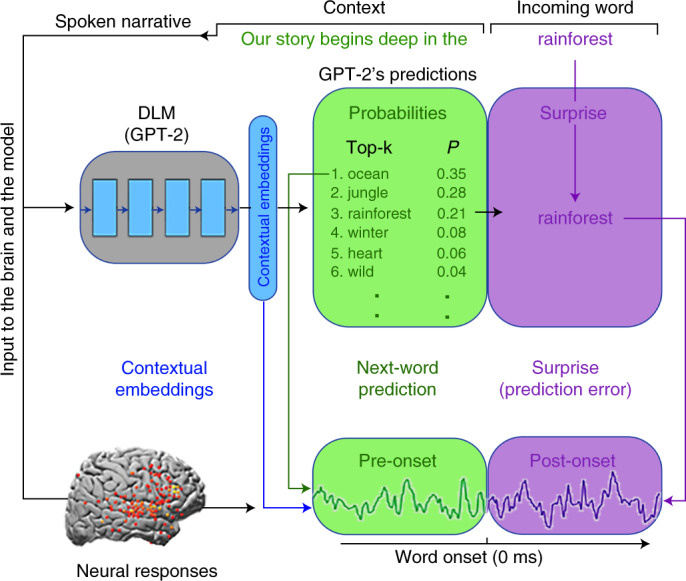
Departing from traditional linguistic models, advances in deep learning have resulted in a new type of predictive (autoregressive) deep language models (DLMs). Using a self-supervised next-word prediction task, these models generate appropriate linguistic responses in a given context. In the current study, nine participants listened to a 30-min podcast while their brain responses were recorded using electrocorticography (ECoG). We provide empirical evidence that the human brain and autoregressive DLMs share three fundamental computational principles as they process the same natural narrative: (1) both are engaged in continuous next-word prediction before word onset; (2) both match their pre-onset predictions to the incoming word to calculate post-onset surprise; (3) both rely on contextual embeddings to represent words in natural contexts. Together, our findings suggest that autoregressive DLMs provide a new and biologically feasible computational framework for studying the neural basis of language.
Overview
The claims and statistics of this paper haven’t been checked yet.
Free: it reads the open-access text and checks the first 5 claims that cite a source we can check. Create a free account to check every claim.
Integrity signals
Registry
Cites
Statistics
Figures
Verification
Claims the paper makes
The claims and statistics of this paper haven’t been checked yet.
Free: it reads the open-access text and checks the first 5 claims that cite a source we can check. Create a free account to check every claim.
Claims other papers make about this one
Each is checked against this paper’s own text: does it say what the citing paper says it does?
The cited source doesn’t support the claim as written.
In the citing paper
“Previous studies in the neural encoding literature all used LLMs that were only aware of the short-term context, i.e., where the context window size was as large as several tens of words1–10.”
From Incremental accumulation of linguistic context in artificial and biological neural networks (2025) · cites this paper as [10]
Checked by a reasoning model — may be wrong.
Experimental — accuracy not yet measuredThe cited source says what the claim attributes to it.
In the citing paper
“Studying AI can also advance psychological science (80–82).”
From Evaluating large language models in theory of mind tasks (2024) · cites this paper as [82]
The cited source says what the claim attributes to it.
In the citing paper
“Large Language Models (LLMs) have shown success in predicting neural signals associated with narrative processing”
From Incremental accumulation of linguistic context in artificial and biological neural networks (2025) · cites this paper as [10]
The cited source says what the claim attributes to it.
In the citing paper
“This was the case even though the participants in these studies were exposed to language stimuli that encompassed hundreds and even thousands of words.”
From Incremental accumulation of linguistic context in artificial and biological neural networks (2025) · cites this paper as [10]
Self-check
Percentages, sums and reported differences re-computed from the paper’s own numbers.
The self-check needs the paper’s full text.
Citations
Cites
Controlling the False Discovery Rate: A Practical and Powerful Approach to Multiple Testing
Benjamini, Y., & Hochberg, Y. (1995) · Journal of the Royal Statistical Society Series B: Statistical Methodology · doi:10.1111/j.2517-6161.1995.tb02031.x · Cited by 109,482
Glove: Global Vectors for Word Representation
Pennington, J., Socher, R., & Manning, C. (2014) · Proceedings of the 2014 Conference on Empirical Methods in Natural Language Processing (EMNLP) · doi:10.3115/v1/d14-1162 · Cited by 34,071
Language Models are Few-Shot Learners
Brown, T. B., Mann, B., Ryder, N., Subbiah, M., Kaplan, J., Dhariwal, P., Neelakantan, A., Shyam, P., Sastry, G., Askell, A., et al. (2020) · arXiv · doi:10.48550/arxiv.2005.14165 · Cited by 23,372
ASPECTS OF THE THEORY OF SYNTAX
Chomsky, N. (1964) · doi:10.21236/ad0616323 · Cited by 13,587
Oostenveld, R., Fries, P., Maris, E., & Schoffelen, J.-M. (2011) · Computational Intelligence and Neuroscience · doi:10.1155/2011/156869 · Cited by 10,323
Lewis, M., Liu, Y., Goyal, N., Ghazvininejad, M., Mohamed, A., Levy, O., Stoyanov, V., & Zettlemoyer, L. (2020) · Proceedings of the 58th Annual Meeting of the Association for Computational Linguistics · doi:10.18653/v1/2020.acl-main.703 · Cited by 8,821
Self-citationLewis, M., Liu, Y., Goyal, N., Ghazvininejad, M., Mohamed, A., Levy, O., Stoyanov, V., & Zettlemoyer, L. (2019) · arXiv · doi:10.48550/arxiv.1910.13461 · Cited by 8,816
Self-citationChomsky, N. (1957) · doi:10.1515/9783112316009 · Cited by 7,885
Whatever next? Predictive brains, situated agents, and the future of cognitive science
Clark, A. (2013) · Behavioral and Brain Sciences · doi:10.1017/s0140525x12000477 · Cited by 5,924
Reading Senseless Sentences: Brain Potentials Reflect Semantic Incongruity
Kutas, M., & Hillyard, S. A. (1980) · Science · doi:10.1126/science.7350657 · Cited by 4,888
Receiver Operating Characteristic Curve in Diagnostic Test Assessment
Mandrekar, J. N. (2010) · Journal of Thoracic Oncology · doi:10.1097/jto.0b013e3181ec173d · Cited by 4,506
Kutas, M., & Federmeier, K. D. (2011) · Annual Review of Psychology · doi:10.1146/annurev.psych.093008.131123 · Cited by 4,377 · cited 2×
“Detecting increased neural activity 400 ms after word onset for unpredictable words, documented across many studies 34,35 , has traditionally been used as indirect evidence for pre-onset predictions.”
BackgroundStatistical Modeling: The Two Cultures (with comments and a rejoinder by the author)
Breiman, L. (2001) · Statistical Science · doi:10.1214/ss/1009213726 · Cited by 4,340 · cited 1×
“DLMs, in contrast, are performance oriented and are focused on learning how to generate formed linguistic outputs as a function of context while de-emphasizing interpretability 60 .”
Background“Cloze Procedure”: A New Tool for Measuring Readability
Taylor, W. L. (1953) · Journalism Quarterly · doi:10.1177/107769905303000401 · Cited by 2,332
Manuscripts Accepted for Publication
(2005) · Child Development · doi:10.1111/j.1467-8624.2005.00876.x · Cited by 2,047
Talking to Children Matters: Early Language Experience Strengthens Processing and Builds Vocabulary
Weisleder, A., & Fernald, A. (2013) · Psychological Science · doi:10.1177/0956797613488145 · Cited by 1,273 · cited 1×
“Observational work in developmental psychology suggests that children are exposed to tens of thousands of words in contextualized speech each day, creating a large data volume available for learning 65,66 .”
A deep learning framework for neuroscience
Richards, B. A., Lillicrap, T. P., Beaudoin, P., Bengio, Y., Bogacz, R., Christensen, A., Clopath, C., Costa, R. P., de Berker, A., Ganguli, S., et al. (2019) · Nature Neuroscience · doi:10.1038/s41593-019-0520-2 · Cited by 1,027 · cited 1×
“To the extent that the brain relies on a next-word prediction objective to learn how to use language in context, it likely uses a different implementation 54 .”
BackgroundNaselaris, T., Kay, K. N., Nishimoto, S., & Gallant, J. L. (2011) · NeuroImage · doi:10.1016/j.neuroimage.2010.07.073 · Cited by 905
A hierarchy of temporal receptive windows in human cortex
Hasson, U., Yang, E., Vallines, I., Heeger, D. J., & Rubin, N. (2008) · The Journal of Neuroscience · doi:10.1523/jneurosci.5487-07.2008 · Cited by 874
Self-citationAmbati, B. R., Deoskar, T., Johnson, M., & Steedman, M. J. (2015) · The Association for Computational Linguistics · Cited by 860
Ethayarajh, K. (2019) · Proceedings of the 2019 Conference on Empirical Methods in Natural Language Processing and the 9th International Joint Conference on Natural Language Processing (EMNLP-IJCNLP) · doi:10.18653/v1/d19-1006 · Cited by 841
Hierarchical process memory: memory as an integral component of information processing
Hasson, U., Chen, J., & Honey, C. J. (2015) · Trends in Cognitive Sciences · doi:10.1016/j.tics.2015.04.006 · Cited by 749
Self-citationKliegl, R., Nuthmann, A., & Engbert, R. (2006) · Journal of Experimental Psychology: General · doi:10.1037/0096-3445.135.1.12 · Cited by 605
Speaker identification on the SCOTUS corpus
Yuan, J., & Liberman, M. (2008) · The Journal of the Acoustical Society of America · doi:10.1121/1.2935783 · Cited by 594
Two Guidelines for Bootstrap Hypothesis Testing
Hall, P., & Wilson, S. R. (1991) · Biometrics · doi:10.2307/2532163 · Cited by 471 · cited 2×
“6 and 7), we used a bootstrapping method 77 .”
MethodHuang, Y., & Rao, R. P. N. (2011) · WIREs Cognitive Science · doi:10.1002/wcs.142 · Cited by 470
Direct Fit to Nature: An Evolutionary Perspective on Biological and Artificial Neural Networks
Hasson, U., Nastase, S. A., & Goldstein, A. (2020) · Neuron · doi:10.1016/j.neuron.2019.12.002 · Cited by 387
Self-citationThe ERP response to the amount of information conveyed by words in sentences
Frank, S. L., Otten, L. J., Galli, G., & Vigliocco, G. (2015) · Brain and Language · doi:10.1016/j.bandl.2014.10.006 · Cited by 381
Words and the World: Predictive Coding and the Language-Perception-Cognition Interface
Lupyan, G., & Clark, A. (2015) · Current Directions in Psychological Science · doi:10.1177/0963721415570732 · Cited by 380
Bybee, J., & McClelland, J. L. (2005) · The Linguistic Review · doi:10.1515/tlir.2005.22.2-4.381 · Cited by 362
A hierarchy of linguistic predictions during natural language comprehension
Heilbron, M., Armeni, K., Schoffelen, J.-M., Hagoort, P., & de Lange, F. P. (2022) · Proceedings of the National Academy of Sciences · doi:10.1073/pnas.2201968119 · Cited by 343
Emergent linguistic structure in artificial neural networks trained by self-supervision
Manning, C. D., Clark, K., Hewitt, J., Khandelwal, U., & Levy, O. (2020) · Proceedings of the National Academy of Sciences · doi:10.1073/pnas.1907367117 · Cited by 339
Self-citationIntracranial EEG and human brain mapping
Lachaux, J. P., Rudrauf, D., & Kahane, P. (2003) · Journal of Physiology-Paris · doi:10.1016/j.jphysparis.2004.01.018 · Cited by 331
Toward a universal decoder of linguistic meaning from brain activation
Pereira, F., Lou, B., Pritchett, B., Ritter, S., Gershman, S. J., Kanwisher, N., Botvinick, M., & Fedorenko, E. (2018) · Nature Communications · doi:10.1038/s41467-018-03068-4 · Cited by 324
Machine translation of cortical activity to text with an encoder–decoder framework
Makin, J. G., Moses, D. A., & Chang, E. F. (2020) · Nature Neuroscience · doi:10.1038/s41593-020-0608-8 · Cited by 321
Same Story, Different Story: The Neural Representation of Interpretive Frameworks
Yeshurun, Y., Swanson, S., Simony, E., Chen, J., Lazaridi, C., Honey, C. J., & Hasson, U. (2017) · Psychological Science · doi:10.1177/0956797616682029 · Cited by 300 · cited 1×
“Even a single change to one word or one sentence at the beginning of a story can alter the neural responses to all subsequent sentences 43,52 .”
BackgroundSelf-citationPrediction during natural language comprehension
Willems, R. M., Frank, S. L., Nijhof, A. D., Hagoort, P., & van den Bosch, A. (2016) · Cerebral Cortex · doi:10.1093/cercor/bhv075 · Cited by 288 · cited 1×
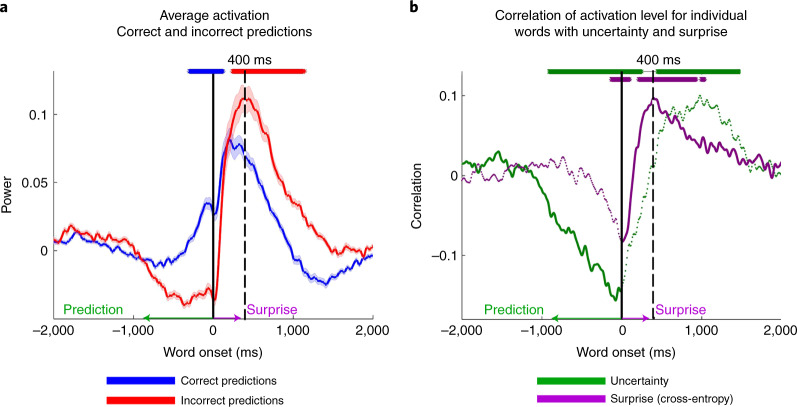
“It was already shown that the activation level after onset is correlated with the surprise level 14,21–23 , 41 .”
BackgroundFilters: When, Why, and How (Not) to Use Them
de Cheveigné, A., & Nelken, I. (2019) · Neuron · doi:10.1016/j.neuron.2019.02.039 · Cited by 243
Prediction and memory: A predictive coding account
Barron, H. C., Auksztulewicz, R., & Friston, K. (2020) · Progress in Neurobiology · doi:10.1016/j.pneurobio.2020.101821 · Cited by 220
Syntactic Structure from Deep Learning
Linzen, T., & Baroni, M. (2021) · Annual Review of Linguistics · doi:10.1146/annurev-linguistics-032020-051035 · Cited by 202
Explain Me This: Creativity, Competition, and the Partial Productivity of Constructions
Goldberg, A. E. (2019) · Princeton University Press eBooks · doi:10.2307/j.ctvc772nn · Cited by 201
Two Distinct Neural Timescales for Predictive Speech Processing
Donhauser, P. W., & Baillet, S. (2020) · Neuron · doi:10.1016/j.neuron.2019.10.019 · Cited by 189
Gamma and the Coordination of Spiking Activity in Early Visual Cortex
Jia, X., Tanabe, S., & Kohn, A. (2013) · Neuron · doi:10.1016/j.neuron.2012.12.036 · Cited by 183
Hasson, U., Egidi, G., Marelli, M., & Willems, R. M. (2018) · Cognition · doi:10.1016/j.cognition.2018.06.018 · Cited by 157
Self-citationIncorporating Context into Language Encoding Models for fMRI
Jain, S., & Huth, A. G. (2018) · doi:10.1101/327601 · Cited by 155 · cited 1×
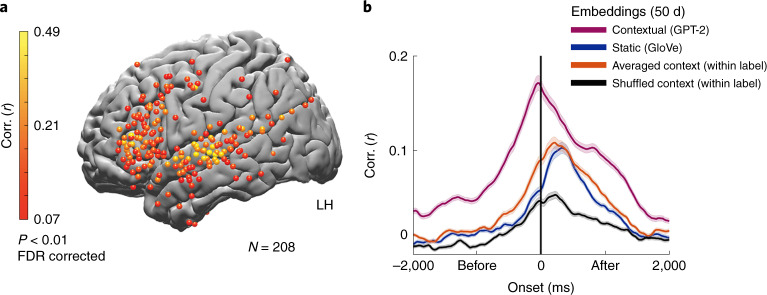
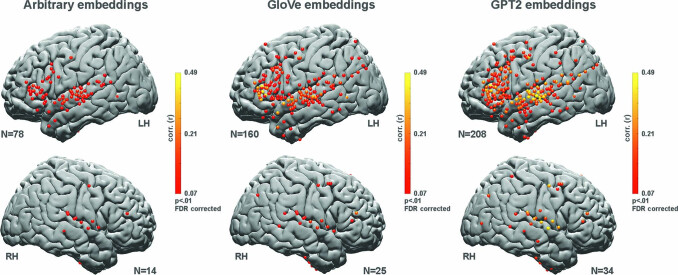
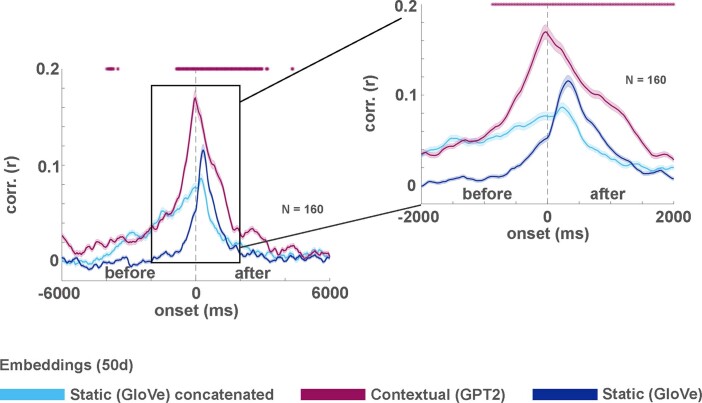
“These results agree with concurrent studies demonstrating that contextual embeddings model neural responses to words better than static semantic embeddings 15,16,45,46 .”
ResultLocalization of dense intracranial electrode arrays using magnetic resonance imaging
Yang, A. I., Wang, X., Doyle, W. K., Halgren, E., Carlson, C., Belcher, T. L., Cash, S. S., Devinsky, O., & Thesen, T. (2012) · NeuroImage · doi:10.1016/j.neuroimage.2012.06.039 · Cited by 140
Self-citationThe neural architecture of language: Integrative modeling converges on predictive processing
(2020) · doi:10.1101/2020.06.26.174482 · Cited by 129
Cortical Tracking of Surprisal during Continuous Speech Comprehension
Weissbart, H., Kandylaki, K. D., & Reichenbach, T. (2020) · Journal of Cognitive Neuroscience · doi:10.1162/jocn_a_01467 · Cited by 126
Russian Sentence Corpus: Benchmark measures of eye movements in reading in Russian
Laurinavichyute, A., Алексеевна, С. И., Alexeeva, S., Bagdasaryan, K., & Kliegl, R. M. (2018) · Behavior Research Methods · doi:10.3758/s13428-018-1051-6 · Cited by 117
Aligning context-based statistical models of language with brain activity during reading
Wehbe, L., Vaswani, A., Knight, K., & Mitchell, T. (2014) · Proceedings of the 2014 Conference on Empirical Methods in Natural Language Processing (EMNLP) · doi:10.3115/v1/d14-1030 · Cited by 95 · cited 1×
“These results agree with concurrent studies demonstrating that contextual embeddings model neural responses to words better than static semantic embeddings 15,16,45,46 .”
ResultAmplification of local changes along the timescale processing hierarchy
Yeshurun, Y., Nguyen, M., & Hasson, U. (2017) · Proceedings of the National Academy of Sciences · doi:10.1073/pnas.1701652114 · Cited by 94 · cited 1×
“Even a single change to one word or one sentence at the beginning of a story can alter the neural responses to all subsequent sentences 43,52 .”
BackgroundSelf-citationMcClelland, J. L., Hill, F., Rudolph, M., Baldridge, J., & Schütze, H. (2020) · Proceedings of the National Academy of Sciences · doi:10.1073/pnas.1910416117 · Cited by 91 · cited 1×
“Furthermore, DLMs avoid the circularity built into many psycholinguistic language models that rely on linguistic terms to explain how language is encoded in neural substrates 19,62 .”
BackgroundDeep language algorithms predict semantic comprehension from brain activity
Caucheteux, C., Gramfort, A., & King, J.-R. (2022) · Scientific Reports · doi:10.1038/s41598-022-20460-9 · Cited by 91
Processing Timescales as an Organizing Principle for Primate Cortex
Chen, J., Hasson, U., & Honey, C. J. (2015) · Neuron · doi:10.1016/j.neuron.2015.10.010 · Cited by 85
Self-citationVokenization: Improving Language Understanding with Contextualized, Visual-Grounded Supervision
Tan, H., & Bansal, M. (2020) · Proceedings of the 2020 Conference on Empirical Methods in Natural Language Processing (EMNLP) · doi:10.18653/v1/2020.emnlp-main.162 · Cited by 75
A primer on encoding models in sensory neuroscience
van Gerven, M. A. J. (2016) · Journal of Mathematical Psychology · doi:10.1016/j.jmp.2016.06.009 · Cited by 73
Linking artificial and human neural representations of language
Gauthier, J., & Levy, R. (2019) · Proceedings of the 2019 Conference on Empirical Methods in Natural Language Processing and the 9th International Joint Conference on Natural Language Processing (EMNLP-IJCNLP) · doi:10.18653/v1/d19-1050 · Cited by 70
Data-driven re-referencing of intracranial EEG based on independent component analysis (ICA)
Michelmann, S., Treder, M. S., Griffiths, B., Kerrén, C., Roux, F., Wimber, M., Rollings, D. T., Sawlani, V., Chelvarajah, R., Gollwitzer, S., et al. (2018) · Journal of Neuroscience Methods · doi:10.1016/j.jneumeth.2018.06.021 · Cited by 67
A hierarchy of linguistic predictions during natural language comprehension
(2020) · doi:10.1101/2020.12.03.410399 · Cited by 63
Emergence of Separable Manifolds in Deep Language RepresentationsPreprint
Mamou, J., Le, H., Rio, M. D., Stephenson, C., Tang, H., Kim, Y., & Chung, S. (2020) · arXiv (Cornell University) · doi:10.48550/arxiv.2006.01095 · Cited by 49
GPT-2’s activations predict the degree of semantic comprehension in the human brainPreprint
Caucheteux, C., Gramfort, A., & King, J.-R. (2021) · bioRxiv (Cold Spring Harbor Laboratory) · doi:10.1101/2021.04.20.440622 · Cited by 46
Towards Coherent and Cohesive Long-form Text Generation
Cho, W. S., Zhang, P., Zhang, Y., Li, X., Galley, M., Brockett, C., Wang, M., & Gao, J. (2019) · Proceedings of the First Workshop on Narrative Understanding · doi:10.18653/v1/w19-2401 · Cited by 23
Predictions from masked motion with and without obstacles
Goldstein, A., Rivlin, I., Goldstein, A., Pertzov, Y., & Hassin, R. R. (2020) · PLoS ONE · doi:10.1371/journal.pone.0239839 · Cited by 14
Self-citationten Hacken, P. (2001) · Natural Language Engineering · doi:10.1017/s1351324901212613 · Cited by 3
de Boer, B. (2003) · Artificial Life · doi:10.1162/106454603321489545 · Cited by 2
Research works printed but not linked: 9
- Yang, Z. et al. XLNet: generalized autoregressive pretraining for language understanding. in Advances in Neural Information Processing Systems (eds. Wallach, H. et al.) 5753–5763 (Curran Associates, 2019).
- Schwartz, D. et al. Inducing brain-relevant bias in natural language processing models. in Advances in Neural Information Processing Systems (eds. Wallach, H. et al.) 14123–14133 (Curran Associates, 2019).
- Athanasiou, N., Iosif, E. & Potamianos, A. Neural activation semantic models: computational lexical semantic models of localized neural activations. in Proceedings of the 27th International Conference on Computational Linguistics 2867–2878 (Association for Computational Linguistics, 2018).
- Caucheteux, C., Gramfort, A. & King, J.-R. GPT-2’s activations predict the degree of semantic comprehension in the human brain. Preprint at bioRxiv https://doi.org/10.1101/2021.04.20.440622 (2021). · DOI
- Mikolov, T., Sutskever, I., Chen, K., Corrado, G. S. & Dean, J. Distributed Representations of Words and Phrases and their Compositionality. in Advances in Neural Information Processing Systems (eds. Burges et al.) 3111–3119 (Curran Associates, 2013).
- Toneva, M. & Wehbe, L. Interpreting and improving natural-language processing (in machines) with natural language-processing (in the brain). in 33rd Conference on Neural Information Processing Systems (2019).
- Khandelwal, U., Levy, O., Jurafsky, D., Zettlemoyer, L. & Lewis, M. Generalization through memorization: nearest neighbor language models. in International Conference on Learning Representations (2020).
- Goldberg, A. E. Explain me This: Creativity, Competition, and the Partial Productivity of Constructions (Princeton University Press, 2019). · DOI · Paper page
- Marcus, G. F. The Algebraic Mind: Integrating Connectionism and Cognitive Science (MIT Press, 2019).
Cited by
Dissociating language and thought in large language models
Mahowald, K., Ivanova, A. A., Blank, I. A., Kanwisher, N., Tenenbaum, J. B., & Fedorenko, E. (2024) · Trends in Cognitive Sciences · doi:10.1016/j.tics.2024.01.011 · Cited by 345
A hierarchy of linguistic predictions during natural language comprehension
Heilbron, M., Armeni, K., Schoffelen, J.-M., Hagoort, P., & de Lange, F. P. (2022) · Proceedings of the National Academy of Sciences · doi:10.1073/pnas.2201968119 · Cited by 343
Evaluating large language models in theory of mind tasks
Kosinski, M. (2024) · Proceedings of the National Academy of Sciences · doi:10.1073/pnas.2405460121 · Cited by 339
“Studying AI can also advance psychological science ( 80 – 82 ).”
BackgroundHow Close is ChatGPT to Human Experts? Comparison Corpus, Evaluation, and Detection
Guo, B., Zhang, X., Wang, Z., Jiang, M., Nie, J., Ding, Y., Yue, J., & Wu, Y. (2023) · arXiv · doi:10.48550/arxiv.2301.07597 · Cited by 318
Evidence of a predictive coding hierarchy in the human brain listening to speech
Caucheteux, C., Gramfort, A., & King, J.-R. (2023) · Nature Human Behaviour · doi:10.1038/s41562-022-01516-2 · Cited by 308
Metadata
- Authors
- Goldstein, A., Zada, Z., Buchnik, E., Schain, M., Price, A., Aubrey, B., Nastase, S. A., Feder, A., Emanuel, D., Cohen, A., Jansen, A., Gazula, H., Choe, G., Rao, A., Kim, C., Casto, C., Fanda, L., Doyle, W., Friedman, D., Dugan, P., Melloni, L., Reichart, R., Devore, S., Flinker, A., Hasenfratz, L., Levy, O., Hassidim, A., Brenner, M., Matias, Y., Norman, K. A., Devinsky, O., & Hasson, U.
- Affiliations
- Google (United States) (US)
- Princeton University (US)
- New York University (US)
- Technion – Israel Institute of Technology (IL)
- Tel Aviv University (IL)
- Corresponding author
- Goldstein, Ariel
- ORCID
- Goldstein, Ariel
- Zada, Zaid
- Price, Amy
- Nastase, Samuel A.
- Feder, Amir
- Cohen, Alon
- Gazula, Harshvardhan
- Choe, Gina
- Kim, Catherine
- Casto, Colton
- Fanda, Lora
- Doyle, Werner
- Friedman, Daniel
- Dugan, Patricia
- Melloni, Lucia
- Reichart, Roi
- Devore, Sasha
- Flinker, Adeen
- Hasenfratz, Liat
- Levy, Omer
- Hassidim, Avinatan
- Brenner, Michael
- Matias, Yossi
- Norman, Kenneth A.
- Devinsky, Orrin
- Hasson, Uri
- Venue
- Nature Neuroscience
- Published
- 2022-03
- Volume
- 25
- Issue
- 3
- Pages
- 369-380
- ISSN
- 1097-6256 (ISSN-L)
- 1546-1726
- PMC
- PMC8904253
- OpenAlex
- W4220949944
- Cited by
- 447
- References
- 62
- Citations by year
- 2026: 97 · 2025: 123 · 2024: 111 · 2023: 94 · 2022: 21
- FWCI
- 44.98
- Type
- journal article
- Language
- en
- Open access
- hybrid
- doi.org
- Licence
- cc-by
- creativecommons.org/licenses/by/4.0 (tdm)
- creativecommons.org/licenses/by/4.0 (vor, 6 d)
- Locations
- Nature Neuroscience (publishedVersion, cc-by)
- PubMed Central (publishedVersion, cc-by)
- PubMed (publishedVersion)
- Funders
- Finding A Cure for Epilepsy and Seizures
- National Institutes of Health
- National Institute of Mental Health (R01MH112566)
- National Institute of Neurological Disorders and Stroke (R01NS109367)
- Eunice Kennedy Shriver National Institute of Child Health and Human Development (DP1HD091948)
- Topics
- Life Sciences › Neuroscience › Cognitive Neuroscience › Neurobiology of Language and Bilingualism
- Social Sciences › Psychology › Developmental and Educational Psychology › Reading and Literacy Development
- Social Sciences › Psychology › Developmental and Educational Psychology › Language Development and Disorders
- Keywords
- deep language models, autoregressive language models, language processing, next-word prediction, contextual embeddings, neural basis of language, electrocorticography, narrative comprehension
- MeSH terms
- Brain, Humans, Language, Linguistics
About these checks
Registry, retraction, Cites and statistics results are computed, not judged, with one exception: a printed reference that no index lists is read once by a model before it counts as a citation error. Claims are extracted by a model and kept only when their quote appears verbatim in the text; each cited source is then checked, with a model’s help, for whether it says what the claim relies on. Those verdicts can be wrong — read the claim’s quote and the cited source before relying on one.
Statistics and arithmetic are recomputed, not judged.
Confidence bands are shown only for fields calibrated on our annotated test set. None is calibrated yet, so no band is shown.
What counts as a claim ›How we measure confidence ›How we check this ›
Are you an author, or do you see a problem with this page? Request a review
Data sources
Bibliographic data: Semantic Scholar, OpenAlex, Crossref.
Contains information from the Semantic Scholar Academic Graph Datasets, made available under the ODC Attribution License (ODC-BY 1.0).
Semantic Scholar’s data is described in: Kinney, R., et al. (2023). The Semantic Scholar Open Data Platform. arXiv:2301.10140.
