

Shared computational principles for language processing in humans and deep language models
Open accessThe DOI matches its Crossref record; 65 of the 65 references it cites were found in a registry or an index.
Abstract
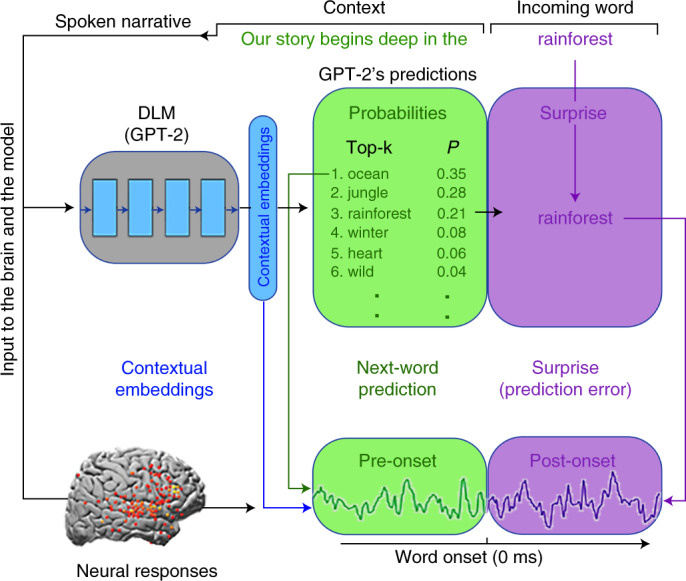
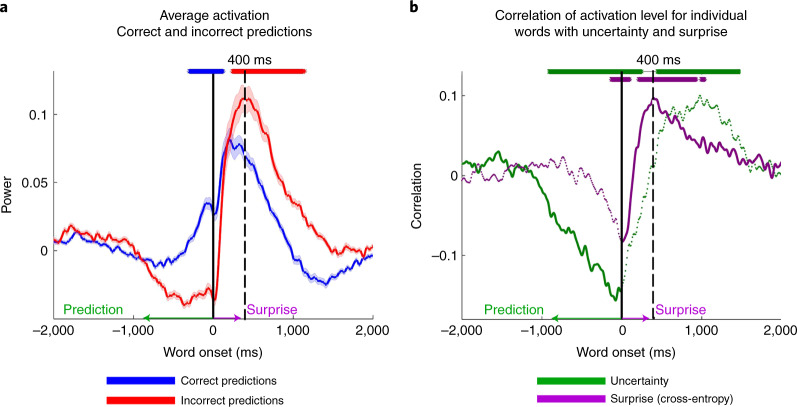
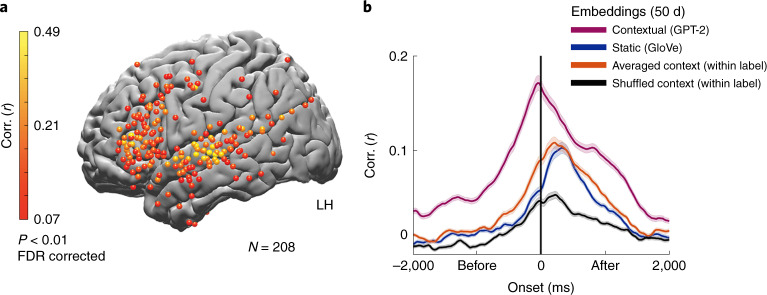
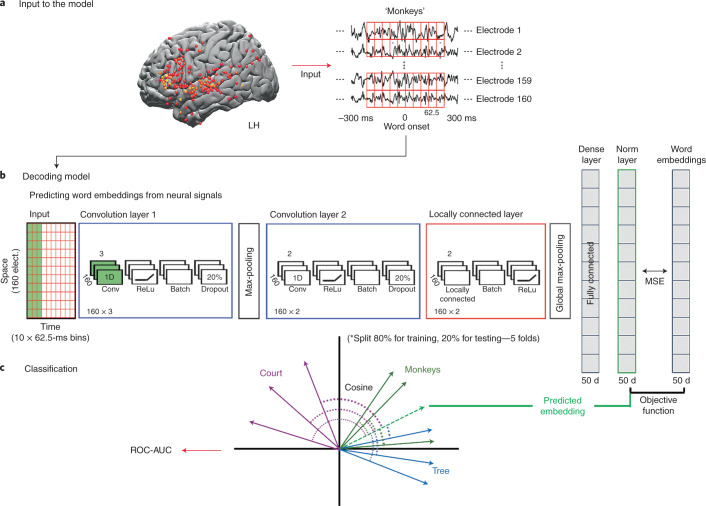
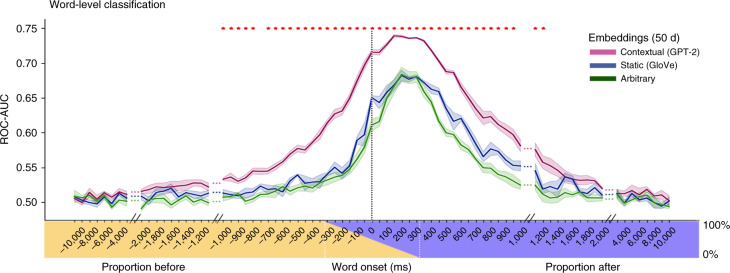
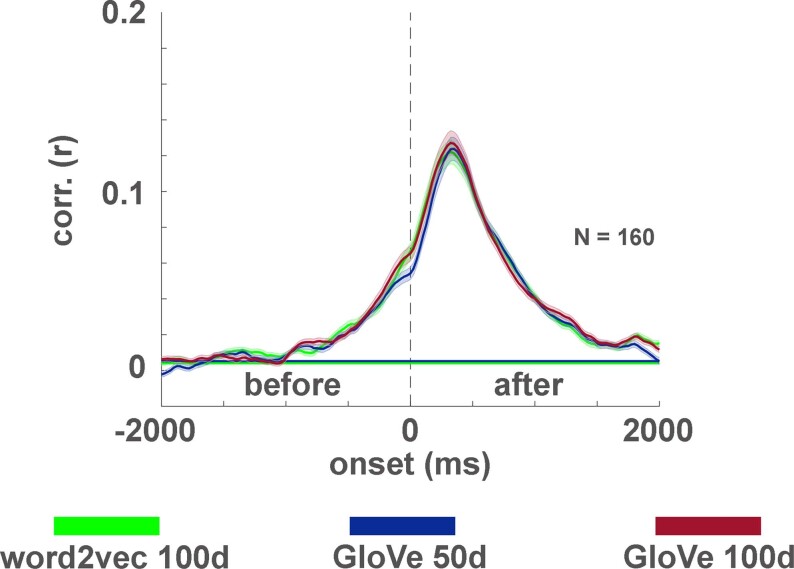
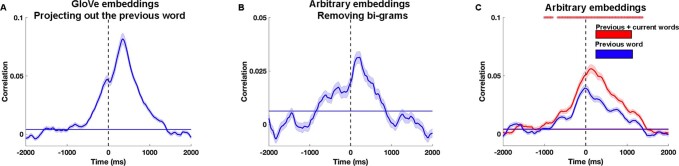
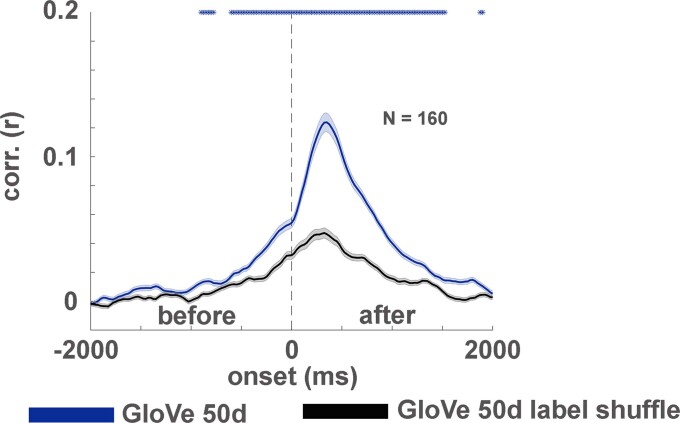
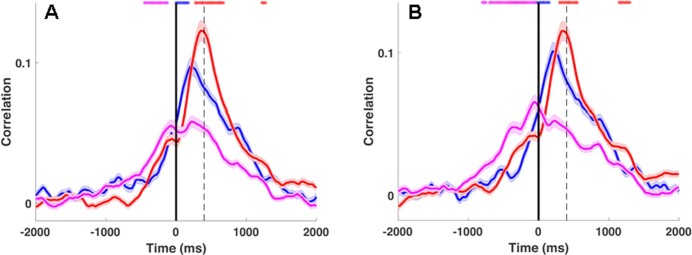
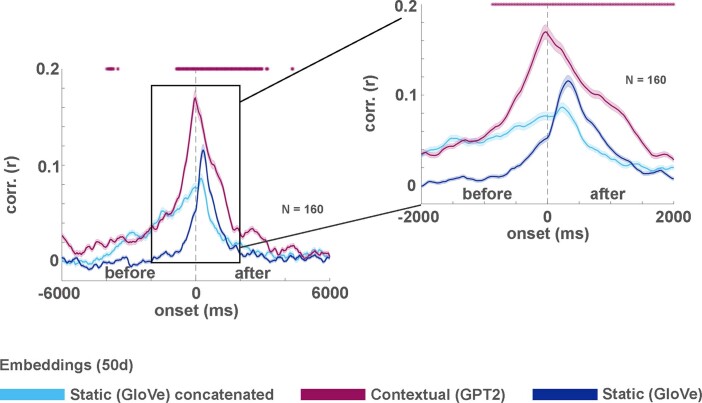
Departing from traditional linguistic models, advances in deep learning have resulted in a new type of predictive (autoregressive) deep language models (DLMs). Using a self-supervised next-word prediction task, these models generate appropriate linguistic responses in a given context. In the current study, nine participants listened to a 30-min podcast while their brain responses were recorded using electrocorticography (ECoG). We provide empirical evidence that the human brain and autoregressive DLMs share three fundamental computational principles as they process the same natural narrative: (1) both are engaged in continuous next-word prediction before word onset; (2) both match their pre-onset predictions to the incoming word to calculate post-onset surprise; (3) both rely on contextual embeddings to represent words in natural contexts. Together, our findings suggest that autoregressive DLMs provide a new and biologically feasible computational framework for studying the neural basis of language.
Overview
The claims and statistics of this paper haven’t been checked yet.
Free: it reads the open-access text and checks the first 5 claims that cite a source we can check. Create a free account to check every claim.
Integrity signals
Registry
Cites
Statistics
Figures
Verification
Claims the paper makes
The claims and statistics of this paper haven’t been checked yet.
Free: it reads the open-access text and checks the first 5 claims that cite a source we can check. Create a free account to check every claim.
Claims other papers make about this one
Each is checked against this paper’s own text: does it say what the citing paper says it does?
The cited source doesn’t support the claim as written.
In the citing paper
“Previous studies in the neural encoding literature all used LLMs that were only aware of the short-term context, i.e., where the context window size was as large as several tens of words1–10.”
From Incremental accumulation of linguistic context in artificial and biological neural networks (2025) · cites this paper as [10]
Checked by a reasoning model — may be wrong.
Experimental — accuracy not yet measuredThe cited source says what the claim attributes to it.
In the citing paper
“Studying AI can also advance psychological science (80–82).”
From Evaluating large language models in theory of mind tasks (2024) · cites this paper as [82]
The cited source says what the claim attributes to it.
In the citing paper
“Large Language Models (LLMs) have shown success in predicting neural signals associated with narrative processing”
From Incremental accumulation of linguistic context in artificial and biological neural networks (2025) · cites this paper as [10]
The cited source says what the claim attributes to it.
In the citing paper
“This was the case even though the participants in these studies were exposed to language stimuli that encompassed hundreds and even thousands of words.”
From Incremental accumulation of linguistic context in artificial and biological neural networks (2025) · cites this paper as [10]
Self-check
Percentages, sums and reported differences re-computed from the paper’s own numbers.
The self-check needs the paper’s full text.
Citations
Cites
Controlling the False Discovery Rate: A Practical and Powerful Approach to Multiple Testing
Benjamini, Y., & Hochberg, Y. (1995) · Journal of the Royal Statistical Society Series B: Statistical Methodology · doi:10.1111/j.2517-6161.1995.tb02031.x · Cited by 109,482
Glove: Global Vectors for Word Representation
Pennington, J., Socher, R., & Manning, C. (2014) · Proceedings of the 2014 Conference on Empirical Methods in Natural Language Processing (EMNLP) · doi:10.3115/v1/d14-1162 · Cited by 34,071
Language Models are Few-Shot Learners
Brown, T. B., Mann, B., Ryder, N., Subbiah, M., Kaplan, J., Dhariwal, P., Neelakantan, A., Shyam, P., Sastry, G., Askell, A., et al. (2020) · arXiv · doi:10.48550/arxiv.2005.14165 · Cited by 23,372
ASPECTS OF THE THEORY OF SYNTAX
Chomsky, N. (1964) · doi:10.21236/ad0616323 · Cited by 13,587
Oostenveld, R., Fries, P., Maris, E., & Schoffelen, J.-M. (2011) · Computational Intelligence and Neuroscience · doi:10.1155/2011/156869 · Cited by 10,323
Lewis, M., Liu, Y., Goyal, N., Ghazvininejad, M., Mohamed, A., Levy, O., Stoyanov, V., & Zettlemoyer, L. (2020) · Proceedings of the 58th Annual Meeting of the Association for Computational Linguistics · doi:10.18653/v1/2020.acl-main.703 · Cited by 8,821
Self-citationLewis, M., Liu, Y., Goyal, N., Ghazvininejad, M., Mohamed, A., Levy, O., Stoyanov, V., & Zettlemoyer, L. (2019) · arXiv · doi:10.48550/arxiv.1910.13461 · Cited by 8,816
Self-citationChomsky, N. (1957) · doi:10.1515/9783112316009 · Cited by 7,885
Whatever next? Predictive brains, situated agents, and the future of cognitive science
Clark, A. (2013) · Behavioral and Brain Sciences · doi:10.1017/s0140525x12000477 · Cited by 5,924
Reading Senseless Sentences: Brain Potentials Reflect Semantic Incongruity
Kutas, M., & Hillyard, S. A. (1980) · Science · doi:10.1126/science.7350657 · Cited by 4,888
Research works printed but not linked: 9
- Yang, Z. et al. XLNet: generalized autoregressive pretraining for language understanding. in Advances in Neural Information Processing Systems (eds. Wallach, H. et al.) 5753–5763 (Curran Associates, 2019).
- Schwartz, D. et al. Inducing brain-relevant bias in natural language processing models. in Advances in Neural Information Processing Systems (eds. Wallach, H. et al.) 14123–14133 (Curran Associates, 2019).
- Athanasiou, N., Iosif, E. & Potamianos, A. Neural activation semantic models: computational lexical semantic models of localized neural activations. in Proceedings of the 27th International Conference on Computational Linguistics 2867–2878 (Association for Computational Linguistics, 2018).
- Caucheteux, C., Gramfort, A. & King, J.-R. GPT-2’s activations predict the degree of semantic comprehension in the human brain. Preprint at bioRxiv https://doi.org/10.1101/2021.04.20.440622 (2021). · DOI
- Mikolov, T., Sutskever, I., Chen, K., Corrado, G. S. & Dean, J. Distributed Representations of Words and Phrases and their Compositionality. in Advances in Neural Information Processing Systems (eds. Burges et al.) 3111–3119 (Curran Associates, 2013).
- Toneva, M. & Wehbe, L. Interpreting and improving natural-language processing (in machines) with natural language-processing (in the brain). in 33rd Conference on Neural Information Processing Systems (2019).
- Khandelwal, U., Levy, O., Jurafsky, D., Zettlemoyer, L. & Lewis, M. Generalization through memorization: nearest neighbor language models. in International Conference on Learning Representations (2020).
- Goldberg, A. E. Explain me This: Creativity, Competition, and the Partial Productivity of Constructions (Princeton University Press, 2019). · DOI · Paper page
- Marcus, G. F. The Algebraic Mind: Integrating Connectionism and Cognitive Science (MIT Press, 2019).
Cited by
Dissociating language and thought in large language models
Mahowald, K., Ivanova, A. A., Blank, I. A., Kanwisher, N., Tenenbaum, J. B., & Fedorenko, E. (2024) · Trends in Cognitive Sciences · doi:10.1016/j.tics.2024.01.011 · Cited by 345
A hierarchy of linguistic predictions during natural language comprehension
Heilbron, M., Armeni, K., Schoffelen, J.-M., Hagoort, P., & de Lange, F. P. (2022) · Proceedings of the National Academy of Sciences · doi:10.1073/pnas.2201968119 · Cited by 343
Evaluating large language models in theory of mind tasks
Kosinski, M. (2024) · Proceedings of the National Academy of Sciences · doi:10.1073/pnas.2405460121 · Cited by 339
“Studying AI can also advance psychological science ( 80 – 82 ).”
BackgroundHow Close is ChatGPT to Human Experts? Comparison Corpus, Evaluation, and Detection
Guo, B., Zhang, X., Wang, Z., Jiang, M., Nie, J., Ding, Y., Yue, J., & Wu, Y. (2023) · arXiv · doi:10.48550/arxiv.2301.07597 · Cited by 318
Evidence of a predictive coding hierarchy in the human brain listening to speech
Caucheteux, C., Gramfort, A., & King, J.-R. (2023) · Nature Human Behaviour · doi:10.1038/s41562-022-01516-2 · Cited by 308
High-resolution image reconstruction with latent diffusion models from human brain activity
Takagi, Y., & Nishimoto, S. (2023) · 2023 IEEE/CVF Conference on Computer Vision and Pattern Recognition (CVPR) · doi:10.1109/cvpr52729.2023.01389 · Cited by 297
The language network as a natural kind within the broader landscape of the human brain
Fedorenko, E., Ivanova, A. A., & Regev, T. I. (2024) · Nature Reviews Neuroscience · doi:10.1038/s41583-024-00802-4 · Cited by 293
Large-scale evidence for logarithmic effects of word predictability on reading time
Shain, C., Meister, C., Pimentel, T., Cotterell, R., & Lévy, R. (2024) · Proceedings of the National Academy of Sciences · doi:10.1073/pnas.2307876121 · Cited by 289
Meaning without reference in large language models
Piantadosi, S. T., & Hill, F. (2022) · arXiv (Cornell University) · doi:10.48550/arxiv.2208.02957 · Cited by 65
Toward a Realistic Model of Speech Processing in the Brain with Self-Supervised Learning
Millet, J., Caucheteux, C., Orhan, P., Boubenec, Y., Gramfort, A., Dunbar, E., Pallier, C., & King, J.-R. (2022) · neural information processing systems · doi:10.52202/068431-2422 · Cited by 194
Language is primarily a tool for communication rather than thought
Fedorenko, E., Piantadosi, S. T., & Gibson, E. A. F. (2024) · Nature · doi:10.1038/s41586-024-07522-w · Cited by 190
“Recent advances in artificial intelligence—the development of neural network models that excel at language 201 —have provided language researchers with a suite of powerful tools to probe the neural codes of linguistic processing 48,202–205 (reviewed in ref.”
BackgroundProbabilistic atlas for the language network based on precision fMRI data from >800 individuals
Lipkin, B., Tuckute, G., Affourtit, J., Small, H., Mineroff, Z., Kean, H., Jouravlev, O., Rakocevic, L., Pritchett, B., Siegelman, M., et al. (2022) · Scientific Data · doi:10.1038/s41597-022-01645-3 · Cited by 141
Using artificial neural networks to ask ‘why’ questions of minds and brains
Kanwisher, N., Khosla, M., & Dobs, K. (2023) · Trends in Neurosciences · doi:10.1016/j.tins.2022.12.008 · Cited by 182
Driving and suppressing the human language network using large language models
Tuckute, G., Sathe, A., Srikant, S., Taliaferro, M., Wang, M., Schrimpf, M., Kay, K., & Fedorenko, E. (2024) · Nature Human Behaviour · doi:10.1038/s41562-023-01783-7 · Cited by 69
Prediction during language comprehension: what is next?
Ryskin, R., & Nieuwland, M. S. (2023) · Trends in Cognitive Sciences · doi:10.1016/j.tics.2023.08.003 · Cited by 165
Can language models learn from explanations in context?
Lampinen, A. K., Dasgupta, I., Chan, S. C. Y., Matthewson, K., Tessler, M. H., Creswell, A., McClelland, J. L., Wang, J. X., & Hill, F. (2022) · arXiv · doi:10.48550/arxiv.2204.02329 · Cited by 163
Dissecting neural computations in the human auditory pathway using deep neural networks for speech
Li, Y., Anumanchipalli, G. K., Mohamed, A., Chen, P., Carney, L. H., Lu, J., Wu, J., & Chang, E. F. (2023) · Nature Neuroscience · doi:10.1038/s41593-023-01468-4 · Cited by 158
Shared functional specialization in transformer-based language models and the human brain
Kumar, S., Sumers, T. R., Yamakoshi, T., Goldstein, A., Hasson, U., Norman, K. A., Griffiths, T. L., Hawkins, R. D., & Nastase, S. A. (2024) · Nature Communications · doi:10.1038/s41467-024-49173-5 · Cited by 86
Self-citationCan language models learn from explanations in context?
Lampinen, A., Dasgupta, I., Chan, S., Mathewson, K., Tessler, M., Creswell, A., McClelland, J., Wang, J., & Hill, F. (2022) · Findings of the Association for Computational Linguistics: EMNLP 2022 · doi:10.18653/v1/2022.findings-emnlp.38 · Cited by 142
Huang, K., Arehalli, S., Kugemoto, M., Muxica, C., Prasad, G., Dillon, B., & Linzen, T. (2023) · PsyArXiv (OSF Preprints) · doi:10.1016/j.jml.2024.104510 · Cited by 131
Large language models demonstrate the potential of statistical learning in language
Contreras Kallens, P., Kristensen‐McLachlan, R. D., & Christiansen, M. H. (2023) · Cognitive Science · doi:10.1111/cogs.13256 · Cited by 130
Evaluating Large Language Models in Theory of Mind Tasks
Kosinski, M. (2023) · arXiv · doi:10.48550/arxiv.2302.02083 · Cited by 339
Machine learning and artificial intelligence in neuroscience: A primer for researchers
Badrulhisham, F., Pogatzki-Zahn, E. M., Segelcke, D., Spisák, T., & Vollert, J. (2023) · Brain Behavior and Immunity · doi:10.1016/j.bbi.2023.11.005 · Cited by 126
Niu, Q., Liu, J., Bi, Z., Feng, P., Peng, B., Chen, K., Li, M., Yan, L. K. Q., Zhang, Y., Yin, C. H., et al. (2026) · BIO Integration · doi:10.15212/bioi-2025-0199 · Cited by 121
Event Knowledge in Large Language Models: The Gap Between the Impossible and the Unlikely
Kauf, C., Ivanova, A. A., Rambelli, G., Chersoni, E., She, J. S., Chowdhury, Z., Fedorenko, E., & Lenci, A. (2023) · Cognitive Science · doi:10.1111/cogs.13386 · Cited by 53
Language in Brains, Minds, and Machines
Tuckute, G., Kanwisher, N., & Fedorenko, E. G. (2024) · Annual Review of Neuroscience · doi:10.1146/annurev-neuro-120623-101142 · Cited by 115
Beyond simple laboratory studies: Developing sophisticated models to study rich behavior
Maselli, A., Gordon, J. R., Eluchans, M., Lancia, G. L., Thiery, T., Moretti, R., Cisek, P., & Pezzulo, G. (2023) · Physics of Life Reviews · doi:10.1016/j.plrev.2023.07.006 · Cited by 112
Contextual feature extraction hierarchies converge in large language models and the brain
Mischler, G., Li, Y. A., Bickel, S., Mehta, A. D., & Mesgarani, N. (2024) · Nature Machine Intelligence · doi:10.1038/s42256-024-00925-4 · Cited by 111
Functional neuroimaging as a catalyst for integrated neuroscience
Finn, E. S., Poldrack, R. A., & Shine, J. M. (2023) · Nature · doi:10.1038/s41586-023-06670-9 · Cited by 110
How linguistics learned to stop worrying and love the language models
Futrell, R., & Mahowald, K. (2025) · Behavioral and Brain Sciences · doi:10.1017/s0140525x2510112x · Cited by 102
Zada, Z., Goldstein, A., Michelmann, S., Simony, E., Price, A. R., Hasenfratz, L., Barham, E., Zadbood, A., Doyle, W., Friedman, D. J., et al. (2024) · Neuron · doi:10.1016/j.neuron.2024.06.025 · Cited by 100
Self-citationCombining computational controls with natural text reveals aspects of meaning composition
Toneva, M., Mitchell, T. M., & Wehbe, L. (2022) · Nature Computational Science · doi:10.1038/s43588-022-00354-6 · Cited by 97
Goldstein, A., Wang, H., Niekerken, L., Schain, M., Zada, Z., Aubrey, B., Sheffer, T., Nastase, S. A., Gazula, H., Singh, A., et al. (2025) · Nature Human Behaviour · doi:10.1038/s41562-025-02105-9 · Cited by 94
Self-citationTowards Voice Reconstruction from EEG during Imagined Speech
Lee, Y.-E., Lee, S., Kim, S., & Lee, S. (2023) · Proceedings of the AAAI Conference on Artificial Intelligence · doi:10.1609/aaai.v37i5.25745 · Cited by 93
Scaling laws for language encoding models in fMRI
Antonello, R., Vaidya, A. R., & Huth, A. G. (2023) · PubMed · doi:10.48550/arxiv.2305.11863 · Cited by 87
Shain, C., Blank, I. A., Fedorenko, E., Gibson, E., & Schuler, W. (2022) · The Journal of Neuroscience · doi:10.1523/jneurosci.1894-21.2022 · Cited by 82
Explaining black box text modules in natural language with language modelsPreprint
Singh, C., Hsu, A. R., Antonello, R., Jain, S., Huth, A. G., Yu, B., & Gao, J. (2023) · arXiv (Cornell University) · doi:10.48550/arxiv.2305.09863 · Cited by 82
Human-like object concept representations emerge naturally in multimodal large language models
Du, C., Fu, K., Wen, B., Sun, Y., Peng, J., Wei, W., Gao, Y., Wang, S., Zhang, C., Li, J., et al. (2025) · Nature Machine Intelligence · doi:10.1038/s42256-025-01049-z · Cited by 81
Generating meaning: active inference and the scope and limits of passive AI
Pezzulo, G., Parr, T., Cisek, P., Clark, A., & Friston, K. (2024) · Trends in Cognitive Sciences · doi:10.1016/j.tics.2023.10.002 · Cited by 80
“…predictive training – the latent variables of generative AI likewise come to re fl ect deep regularities (e.g., emergent linguistic structure in LLMs [42,43]) that might extend beyond the training domain (e.g., non-linguistic regularities for LLMs, such as the relations between looks and tastes).”
Kauf, C., Tuckute, G., Lévy, R., Andreas, J., & Fedorenko, E. G. (2024) · Neurobiology of Language · doi:10.1162/nol_a_00116 · Cited by 78
Large Linguistic Models: Investigating LLMs’ Metalinguistic Abilities
Beguš, G., Dąbkowski, M. M., & Rhodes, R. E. (2025) · IEEE Transactions on Artificial Intelligence · doi:10.1109/tai.2025.3575745 · Cited by 78
Goldstein, A., Ham, E., Schain, M., Nastase, S. A., Aubrey, B., Zada, Z., Grinstein-Dabush, A., Gazula, H., Feder, A., Doyle, W., et al. (2025) · Nature Communications · doi:10.1038/s41467-025-65518-0 · Cited by 75
Self-citationLarge language models predict human sensory judgments across six modalities
Marjieh, R., Sucholutsky, I., van Rijn, P., Jacoby, N., & Griffiths, T. L. (2024) · Scientific Reports · doi:10.1038/s41598-024-72071-1 · Cited by 73
Natural language instructions induce compositional generalization in networks of neurons
Riveland, R., & Pouget, A. (2024) · Nature Neuroscience · doi:10.1038/s41593-024-01607-5 · Cited by 73
Data science opportunities of large language models for neuroscience and biomedicine
Bzdok, D., Thieme, A., Levkovskyy, O., Wren, P. B., Ray, T. S., & Reddy, S. (2024) · Neuron · doi:10.1016/j.neuron.2024.01.016 · Cited by 72
Kozlowski, A. C., & Evans, J. A. (2025) · Sociological Methods & Research · doi:10.1177/00491241251337316 · Cited by 71
Language models, like humans, show content effects on reasoning tasks
Lampinen, A. K., Dasgupta, I., Chan, S. C. Y., Sheahan, H. R., Creswell, A., Kumaran, D., McClelland, J. L., & Hill, F. (2024) · PNAS Nexus · doi:10.1093/pnasnexus/pgae233 · Cited by 69
ROSE: A neurocomputational architecture for syntax
Murphy, E. (2023) · Journal of Neurolinguistics · doi:10.1016/j.jneuroling.2023.101180 · Cited by 68
Gwilliams, L., Flick, G., Marantz, A. P., Pylkkänen, L., Poeppel, D., & King, J.-R. (2023) · Scientific Data · doi:10.1038/s41597-023-02752-5 · Cited by 68
Goldstein, A., Grinstein-Dabush, A., Schain, M., Wang, H., Hong, Z., Aubrey, B., Nastase, S. A., Zada, Z., Ham, E., Feder, A., et al. (2024) · Nature Communications · doi:10.1038/s41467-024-46631-y · Cited by 64
Self-citationHosseini, E. A., Schrimpf, M., Zhang, Y., Bowman, S., Zaslavsky, N., & Fedorenko, E. (2024) · Neurobiology of Language · doi:10.1162/nol_a_00137 · Cited by 63
“…et al., 2018), magnetoencephalography (Brodbeck et al., 2022; Heilbron et al., 2022), fMRI (Brennan et al., 2016; Heilbron et al., 2022; Henderson et al., 2016; Lopopolo et al., 2017; Shain et al., 2020; Willems et al., 2016), or intracranially (Goldstein et al., 2022) during language processing.”
BackgroundBayesian Surprise Predicts Human Event Segmentation in Story Listening
Kumar, M., Goldstein, A., Michelmann, S., Zacks, J. M., Hasson, U., & Norman, K. A. (2023) · Cognitive Science · doi:10.1111/cogs.13343 · Cited by 63
Self-citationNatural language processing models reveal neural dynamics of human conversation
Cai, J., Hadjinicolaou, A. E., Paulk, A. C., Soper, D. J., Xia, T., Wang, A. F., Rolston, J. D., Richardson, R. M., Williams, Z. M., & Cash, S. S. (2025) · Nature Communications · doi:10.1038/s41467-025-58620-w · Cited by 63
Modeling Structure‐Building in the Brain With CCG Parsing and Large Language Models
Stanojević, M., Brennan, J., Dunagan, D. G., Steedman, M. J., & Hale, J. (2023) · Cognitive Science · doi:10.1111/cogs.13312 · Cited by 62
On the Effect of Anticipation on Reading Times
Pimentel, T., Meister, C., Wilcox, E., Lévy, R., & Cotterell, R. (2023) · Transactions of the Association for Computational Linguistics · doi:10.1162/tacl_a_00603 · Cited by 62
Large language models can segment narrative events similarly to humans
Michelmann, S., Kumar, M., Norman, K. A., & Toneva, M. (2025) · Behavior Research Methods · doi:10.3758/s13428-024-02569-z · Cited by 60
Self-citationSemantic Representations during Language Comprehension Are Affected by Context
Deniz, F., Tseng, C., Wehbe, L., la Tour, T. D., & Gallant, J. L. (2023) · Journal of Neuroscience · doi:10.1523/jneurosci.2459-21.2023 · Cited by 60
Task-driven neural network models predict neural dynamics of proprioception
Vargas, A. M., Bisi, A., Chiappa, A. S., Versteeg, C., Miller, L. E., & Mathis, A. (2024) · Cell · doi:10.1016/j.cell.2024.02.036 · Cited by 59
Mind the gap: challenges of deep learning approaches to Theory of Mind
Aru, J., Labash, A., Corcoll, O., & Vicente, R. (2023) · Artificial Intelligence Review · doi:10.1007/s10462-023-10401-x · Cited by 57
Adversarial attacks and defenses for large language models (LLMs): methods, frameworks & challenges
Rai, P. K. (2024) · International Journal of Multimedia Information Retrieval · doi:10.1007/s13735-024-00334-8 · Cited by 57
Trajectories through semantic spaces in schizophrenia and the relationship to ripple bursts
Nour, M. M., McNamee, D., Liu, Y., & Dolan, R. J. (2023) · Proceedings of the National Academy of Sciences · doi:10.1073/pnas.2305290120 · Cited by 55
The LLM Language Network: A Neuroscientific Approach for Identifying Causally Task-Relevant Units
AlKhamissi, B., Tuckute, G., Bosselut, A., & Schrimpf, M. (2025) · Conference of the North American Chapter of the Association for Computational Linguistics: Human Language Technologies (NAACL-HLT) · doi:10.18653/v1/2025.naacl-long.544 · Cited by 55
Instruction-tuning Aligns LLMs to the Human BrainPreprint
Aw, K. L., Montariol, S., AlKhamissi, B., Schrimpf, M., & Bosselut, A. (2023) · arXiv (Cornell University) · doi:10.48550/arxiv.2312.00575 · Cited by 55
On Behalf of the Stakeholders: Trends in NLP Model Interpretability in the Era of LLMs
Calderon, N., & Reichart, R. (2025) · Conference of the North American Chapter of the Association for Computational Linguistics: Human Language Technologies (NAACL-HLT) · doi:10.18653/v1/2025.naacl-long.29 · Cited by 52
Self-citationIncreasing alignment of large language models with language processing in the human brain
Gao, C., Ma, Z., Chen, J., Li, P., Huang, S., & Li, J. (2025) · Nature Computational Science · doi:10.1038/s43588-025-00863-0 · Cited by 51
The default network dominates neural responses to evolving movie stories
Yang, E., Milisav, F., Kopál, J., Holmes, A. J., Mitsis, G. D., Mišić, B., Finn, E. S., & Bzdok, D. (2023) · Nature Communications · doi:10.1038/s41467-023-39862-y · Cited by 47
Vishne, G., Gerber, E. M., Knight, R. T., & Deouell, L. Y. (2023) · Cell Reports · doi:10.1016/j.celrep.2023.112752 · Cited by 46
Neural populations in the language network differ in the size of their temporal receptive windows
Regev, T. I., Casto, C., Hosseini, E. A., Adamek, M., Ritaccio, A. L., Willie, J. T., Brunner, P., & Fedorenko, E. G. (2024) · Nature Human Behaviour · doi:10.1038/s41562-024-01944-2 · Cited by 46
Self-citationNatural Neuroscience: Toward a Systems Neuroscience of Natural Behaviors
Ulanovsky, N. (2025) · The MIT Press eBooks · doi:10.7551/mitpress/10813.001.0001 · Cited by 46
Takagi, Y., & Nishimoto, S. (2023) · arXiv (Cornell University) · doi:10.48550/arxiv.2306.11536 · Cited by 45
Stick to your role! Stability of personal values expressed in large language models
Kovač, G., Portelas, R., Sawayama, M., Dominey, P. F., & Oudeyer, P. (2024) · PLoS ONE · doi:10.1371/journal.pone.0309114 · Cited by 44
Speech language models lack important brain-relevant semantics
Oota, S. R., Çelik, E., Deniz, F., & Toneva, M. (2024) · Proceedings of the conference - Association for Computational Linguistics. Meeting · doi:10.18653/v1/2024.acl-long.462 · Cited by 44
From Language to Cognition: How LLMs Outgrow the Human Language Network
AlKhamissi, B., Tuckute, G., Tang, Y., Binhuraib, T. O. A., Bosselut, A., & Schrimpf, M. (2025) · Conference on Empirical Methods in Natural Language Processing (EMNLP) · doi:10.18653/v1/2025.emnlp-main.1237 · Cited by 44
Language models and brains align due to more than next-word prediction and word-level information
Merlin, G., & Toneva, M. (2024) · Conference on Empirical Methods in Natural Language Processing (EMNLP) · doi:10.18653/v1/2024.emnlp-main.1024 · Cited by 44
Deep Neural Networks and Brain Alignment: Brain Encoding and Decoding (Survey)
Oota, S. R., Chen, Z., Gupta, M., Bapi, R. S., Jobard, G., Alexandre, F., & Hinaut, X. (2025) · Transactions on machine learning research · doi:10.48550/arxiv.2307.10246 · Cited by 43
Desbordes, T., Lakretz, Y., Chanoine, V., Oquab, M., Badier, J., Trébuchon, A., Carron, R., Bénar, C., Dehaene, S., & King, J.-R. (2023) · Journal of Neuroscience · doi:10.1523/jneurosci.1163-22.2023 · Cited by 40
Yu, S., Gu, C., Huang, K., & Li, P. (2024) · Science Advances · doi:10.1126/sciadv.adn7744 · Cited by 39
He, L., Chen, P., Nie, E., Li, Y., & Brennan, J. (2024) · Language Resources and Evaluation Conference (LREC) · doi:10.63317/2pgxvkynikmx · Cited by 39
Generative language reconstruction from brain recordings
Ye, Z., Ai, Q., Liu, Y., de Rijke, M., Zhang, M., Lioma, C., & Ruotsalo, T. (2025) · Communications Biology · doi:10.1038/s42003-025-07731-7 · Cited by 38
Oyekan, J. O., Turner, C. J., Bax, M., & Graf, E. W. (2025) · Computers in Industry · doi:10.1016/j.compind.2025.104329 · Cited by 38
Intonation Units in Spontaneous Speech Evoke a Neural Response
Inbar, M., Genzer, S., Perry, A., Grossman, E., & Landau, A. N. (2023) · Journal of Neuroscience · doi:10.1523/jneurosci.0235-23.2023 · Cited by 37
Top-down information shapes lexical processing when listening to continuous speech
Gwilliams, L., Marantz, A. P., Poeppel, D., & King, J.-R. (2023) · Language Cognition and Neuroscience · doi:10.1080/23273798.2023.2171072 · Cited by 37
Deep learning models to study sentence comprehension in the human brain
Arana, S., Lerousseau, J. P., & Hagoort, P. (2023) · Language Cognition and Neuroscience · doi:10.1080/23273798.2023.2198245 · Cited by 37
Getting aligned on representational alignment
Sucholutsky, I., Muttenthaler, L., Weller, A., Peng, A., Bobu, A., Kim, B., Love, B. C., Cueva, C. J., Grant, E., Groen, I., et al. (2023) · arXiv · doi:10.48550/arxiv.2310.13018 · Cited by 36
Wong, L., Grand, G., Lew, A. K., Goodman, N. D., Mansinghka, V. K., Andreas, J., & Tenenbaum, J. B. (2023) · arXiv · doi:10.48550/arxiv.2306.12672 · Cited by 36
Neural evidence for attentional capture by salient distractors
Lin, R., Meng, X., Chen, F., Li, X., Jensen, O. B., Theeuwes, J., & Wang, B. (2024) · Nature Human Behaviour · doi:10.1038/s41562-024-01852-5 · Cited by 35
What’s the next word in large language models?
(2023) · Nature Machine Intelligence · doi:10.1038/s42256-023-00655-z · Cited by 35
The “Podcast” ECoG dataset for modeling neural activity during natural language comprehension
Zada, Z., Nastase, S. A., Aubrey, B., Jalon, I., Michelmann, S., Wang, H., Hasenfratz, L., Doyle, W., Friedman, D. J., Dugan, P. C., et al. (2025) · Scientific Data · doi:10.1038/s41597-025-05462-2 · Cited by 35
Self-citationHuber, E., Sauppe, S., Isasi-Isasmendi, A., Bornkessel‐Schlesewsky, I., Merlo, P., & Bickel, B. (2023) · Neurobiology of Language · doi:10.1162/nol_a_00121 · Cited by 34
Testing the limits of natural language models for predicting human language judgements
Golan, T., Siegelman, M., Kriegeskorte, N., & Baldassano, C. A. (2023) · Nature Machine Intelligence · doi:10.1038/s42256-023-00718-1 · Cited by 34
Large-scale foundation models and generative AI for BigData neuroscience
Wang, R., & Chen, Z. S. (2024) · Neuroscience Research · doi:10.1016/j.neures.2024.06.003 · Cited by 34
A Whole-Brain Topographic Ontology
Arcaro, M. J., & Livingstone, M. S. (2024) · Annual Review of Neuroscience · doi:10.1146/annurev-neuro-082823-073701 · Cited by 33
Language models outperform cloze predictability in a cognitive model of reading
Rego, A. T. L., Snell, J., & Meeter, M. (2024) · PLoS Computational Biology · doi:10.1371/journal.pcbi.1012117 · Cited by 33
Saddler, M. R., & McDermott, J. H. (2024) · Nature Communications · doi:10.1038/s41467-024-54700-5 · Cited by 33
Understanding Natural Language Understanding Systems. A Critical AnalysisPreprint
Alessandro, L. (2023) · arXiv (Cornell University) · doi:10.48550/arxiv.2303.04229 · Cited by 33
Maintenance and transformation of representational formats during working memory prioritization
Pacheco, D., Fellner, M.-C., Kunz, L., Zhang, H., Reinacher, P. C., Roy, C., Brandt, A., Schulze‐Bonhage, A., Yang, L., Wang, S., et al. (2024) · Nature Communications · doi:10.1038/s41467-024-52541-w · Cited by 32
Brain encoding models based on multimodal transformers can transfer across language and vision
Tang, J., Du, M., Vo, V. A., Lal, V., & Huth, A. G. (2023) · PubMed · doi:10.48550/arxiv.2305.12248 · Cited by 31
Demystifying large language models in second language development research
Cong, Y. (2024) · Computer Speech & Language · doi:10.1016/j.csl.2024.101700 · Cited by 31
Are Vision Transformers More Data Hungry Than Newborn Visual Systems?
Pandey, L., Wood, S. M. W., & Wood, J. N. (2023) · neural information processing systems · doi:10.52202/075280-3196 · Cited by 31
Language-specific representation of emotion-concept knowledge causally supports emotion inference
Li, M., Su, Y.-S., Huang, H.-Y., Cheng, J., Hu, X., Zhang, X., Wang, H., Qin, Y., Wang, X., Lindquist, K. A., et al. (2024) · iScience · doi:10.1016/j.isci.2024.111401 · Cited by 30
Metadata
- Authors
- Goldstein, A., Zada, Z., Buchnik, E., Schain, M., Price, A., Aubrey, B., Nastase, S. A., Feder, A., Emanuel, D., Cohen, A., Jansen, A., Gazula, H., Choe, G., Rao, A., Kim, C., Casto, C., Fanda, L., Doyle, W., Friedman, D., Dugan, P., Melloni, L., Reichart, R., Devore, S., Flinker, A., Hasenfratz, L., Levy, O., Hassidim, A., Brenner, M., Matias, Y., Norman, K. A., Devinsky, O., & Hasson, U.
- Affiliations
- Google (United States) (US)
- Princeton University (US)
- New York University (US)
- Technion – Israel Institute of Technology (IL)
- Tel Aviv University (IL)
- Corresponding author
- Goldstein, Ariel
- ORCID
- Goldstein, Ariel
- Zada, Zaid
- Price, Amy
- Nastase, Samuel A.
- Feder, Amir
- Cohen, Alon
- Gazula, Harshvardhan
- Choe, Gina
- Kim, Catherine
- Casto, Colton
- Fanda, Lora
- Doyle, Werner
- Friedman, Daniel
- Dugan, Patricia
- Melloni, Lucia
- Reichart, Roi
- Devore, Sasha
- Flinker, Adeen
- Hasenfratz, Liat
- Levy, Omer
- Hassidim, Avinatan
- Brenner, Michael
- Matias, Yossi
- Norman, Kenneth A.
- Devinsky, Orrin
- Hasson, Uri
- Venue
- Nature Neuroscience
- Published
- 2022-03
- Volume
- 25
- Issue
- 3
- Pages
- 369-380
- ISSN
- 1097-6256 (ISSN-L)
- 1546-1726
- PMC
- PMC8904253
- OpenAlex
- W4220949944
- Cited by
- 447
- References
- 62
- Citations by year
- 2026: 97 · 2025: 123 · 2024: 111 · 2023: 94 · 2022: 21
- FWCI
- 44.98
- Type
- journal article
- Language
- en
- Open access
- hybrid
- doi.org
- Licence
- cc-by
- creativecommons.org/licenses/by/4.0 (tdm)
- creativecommons.org/licenses/by/4.0 (vor, 6 d)
- Locations
- Nature Neuroscience (publishedVersion, cc-by)
- PubMed Central (publishedVersion, cc-by)
- PubMed (publishedVersion)
- Funders
- Finding A Cure for Epilepsy and Seizures
- National Institutes of Health
- National Institute of Mental Health (R01MH112566)
- National Institute of Neurological Disorders and Stroke (R01NS109367)
- Eunice Kennedy Shriver National Institute of Child Health and Human Development (DP1HD091948)
- Topics
- Life Sciences › Neuroscience › Cognitive Neuroscience › Neurobiology of Language and Bilingualism
- Social Sciences › Psychology › Developmental and Educational Psychology › Reading and Literacy Development
- Social Sciences › Psychology › Developmental and Educational Psychology › Language Development and Disorders
- Keywords
- deep language models, autoregressive language models, language processing, next-word prediction, contextual embeddings, neural basis of language, electrocorticography, narrative comprehension
- MeSH terms
- Brain, Humans, Language, Linguistics
About these checks
Registry, retraction, Cites and statistics results are computed, not judged, with one exception: a printed reference that no index lists is read once by a model before it counts as a citation error. Claims are extracted by a model and kept only when their quote appears verbatim in the text; each cited source is then checked, with a model’s help, for whether it says what the claim relies on. Those verdicts can be wrong — read the claim’s quote and the cited source before relying on one.
Statistics and arithmetic are recomputed, not judged.
Confidence bands are shown only for fields calibrated on our annotated test set. None is calibrated yet, so no band is shown.
What counts as a claim ›How we measure confidence ›How we check this ›
Are you an author, or do you see a problem with this page? Request a review
Data sources
Bibliographic data: Semantic Scholar, OpenAlex, Crossref.
Contains information from the Semantic Scholar Academic Graph Datasets, made available under the ODC Attribution License (ODC-BY 1.0).
Semantic Scholar’s data is described in: Kinney, R., et al. (2023). The Semantic Scholar Open Data Platform. arXiv:2301.10140.
