

CRISPR/Cas9-mediated PD-1 disruption enhances anti-tumor efficacy of human chimeric antigen receptor T cells
Open accessThe DOI matches its Crossref record; 38 of the 39 references it cites were found in a registry or an index.
Abstract
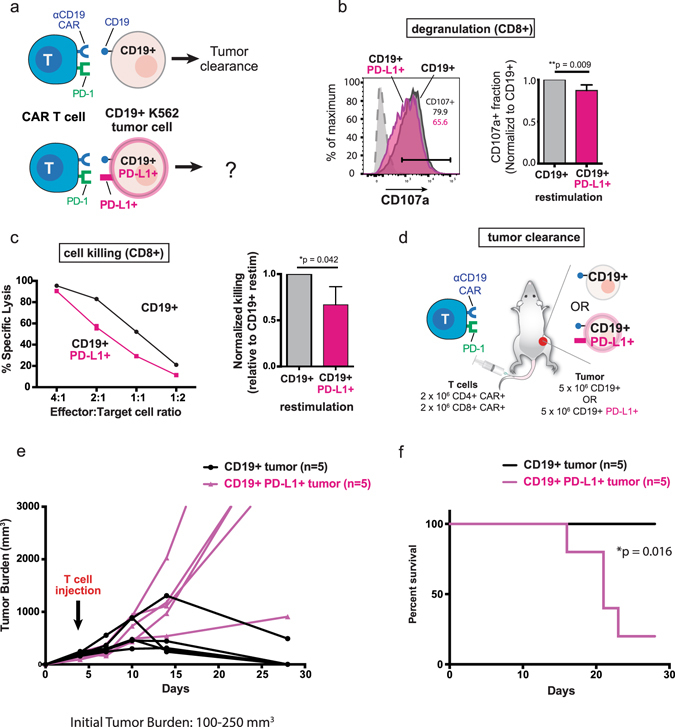
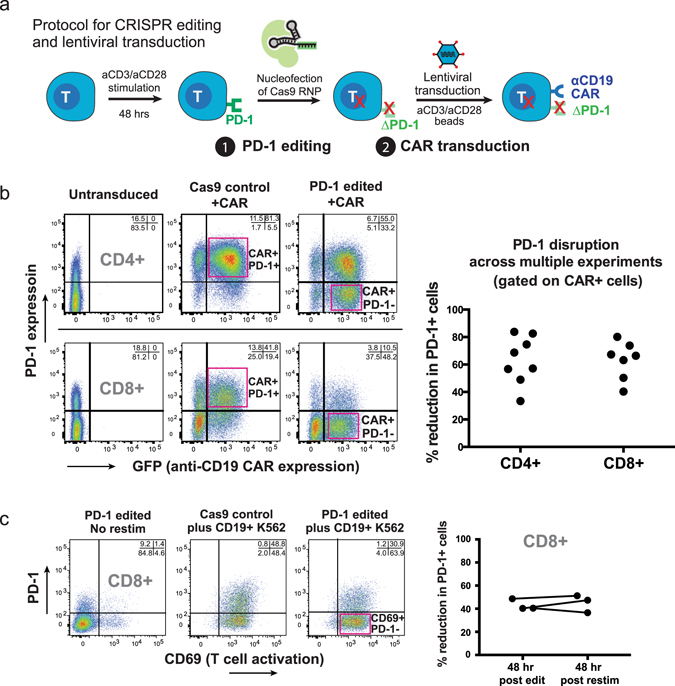
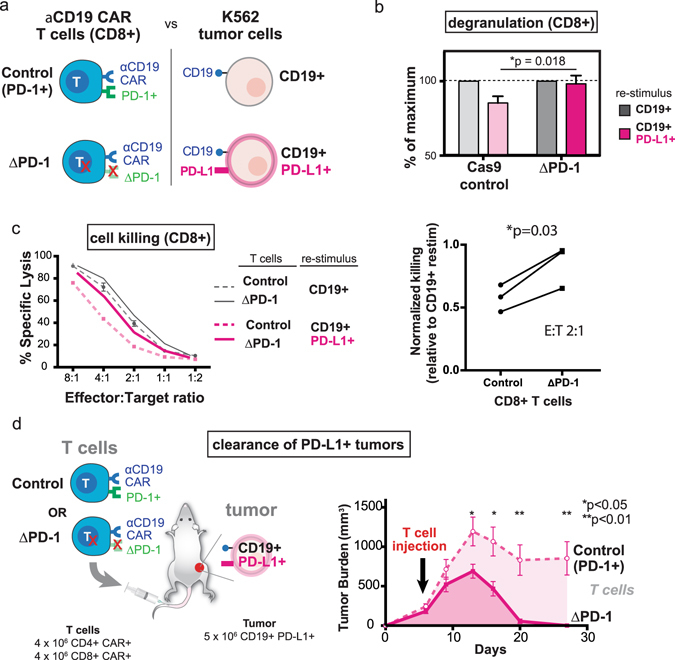
Immunotherapies with chimeric antigen receptor (CAR) T cells and checkpoint inhibitors (including antibodies that antagonize programmed cell death protein 1 [PD-1]) have both opened new avenues for cancer treatment, but the clinical potential of combined disruption of inhibitory checkpoints and CAR T cell therapy remains incompletely explored. Here we show that programmed death ligand 1 (PD-L1) expression on tumor cells can render human CAR T cells (anti-CD19 4-1BBζ) hypo-functional, resulting in impaired tumor clearance in a sub-cutaneous xenograft model. To overcome this suppressed anti-tumor response, we developed a protocol for combined Cas9 ribonucleoprotein (Cas9 RNP)-mediated gene editing and lentiviral transduction to generate PD-1 deficient anti-CD19 CAR T cells. Pdcd1 (PD-1) disruption augmented CAR T cell mediated killing of tumor cells in vitro and enhanced clearance of PD-L1+ tumor xenografts in vivo. This study demonstrates improved therapeutic efficacy of Cas9-edited CAR T cells and highlights the potential of precision genome engineering to enhance next-generation cell therapies.
Overview
The claims and statistics of this paper haven’t been checked yet.
Free: it reads the open-access text and checks the first 5 claims that cite a source we can check. Create a free account to check every claim.
Integrity signals
Registry
Cites
Statistics
Figures
Verification
Claims the paper makes
The claims and statistics of this paper haven’t been checked yet.
Free: it reads the open-access text and checks the first 5 claims that cite a source we can check. Create a free account to check every claim.
Claims other papers make about this one
Each is checked against this paper’s own text: does it say what the citing paper says it does?
The check wasn’t confident either way, so it gives no verdict — never disputed.
In the citing paper
“Mouse cells lacking p53 are unable to effectively arrest cell cycle progression after DNA damage, leading to genomic instability [16].”
From A Review of Research on CRISPR/Cas9 Gene Editing Technology in Disease Treatment (2024) · cites this paper as [16]
Experimental — accuracy not yet measuredThe check wasn’t confident either way, so it gives no verdict — never disputed.
In the citing paper
“Donehower, L.A. and his team found that mice with the P53 gene knocked out exhibit a high frequency of spontaneous tumorigenesis, including lymphomas, osteosarcomas, and other types of tumors.”
From A Review of Research on CRISPR/Cas9 Gene Editing Technology in Disease Treatment (2024) · cites this paper as [16]
Experimental — accuracy not yet measuredThe check wasn’t confident either way, so it gives no verdict — never disputed.
In the citing paper
“This observation suggests that p53 plays a crucial role in tumor suppression.”
From A Review of Research on CRISPR/Cas9 Gene Editing Technology in Disease Treatment (2024) · cites this paper as [16]
Experimental — accuracy not yet measuredIn the citing paper
“CRISPR-Cas9 genetic ablation of checkpoint targets such as PD-1 in adoptive T cell therapies has also shown increased functionality in certain models and is being persued clinically (Ren et al., 2017; Rupp et al., 2017; Stadtmauer et al., 2020; Su et al., 2016).”
From Pooled Knockin Targeting for Genome Engineering of Cellular Immunotherapies (2020) · cites this paper as Rupp et al., 2017
Self-check
Percentages, sums and reported differences re-computed from the paper’s own numbers.
The self-check needs the paper’s full text.
Citations
Cites
PD-1 and PD-L1 Immune Checkpoint Blockade to Treat Breast Cancer
Hartkopf, A. D., Taran, F.-A., Wallwiener, M., Walter, C. B., Krämer, B., Grischke, E.-M., & Brucker, S. Y. (2016) · Breast Care · doi:10.1159/000453569 · Cited by 30,845
Safety, activity, and immune correlates of anti–PD-1 antibody in cancer
Topalian, S. L., Hodi, F. S., Brahmer, J. R., Gettinger, S. N., Smith, D. C., McDermott, D. F., Powderly, J. D., Carvajal, R. D., Sosman, J. A., Atkins, M. B., et al. (2012) · New England Journal of Medicine · doi:10.1056/nejmoa1200690 · Cited by 12,628
Safety and activity of anti-PD-L1 antibody in patients with advanced cancer
Brahmer, J. R., Tykodi, S. S., Chow, L. Q. M., Hwu, W.-J., Topalian, S. L., Hwu, P., Drake, C. G., Camacho, L. H., Kauh, J., Odunsi, K., et al. (2012) · New England Journal of Medicine · doi:10.1056/nejmoa1200694 · Cited by 7,945
Chimeric Antigen Receptor T Cells for Sustained Remissions in Leukemia
Maude, S. L., Frey, N., Shaw, P. A., Aplenc, R., Barrett, D. M., Bunin, N. J., Chew, A., Gonzalez, V. E., Zheng, Z., Lacey, S. F., et al. (2014) · New England Journal of Medicine · doi:10.1056/nejmoa1407222 · Cited by 5,413
PD-1 and Its Ligands in Tolerance and Immunity
Keir, M. E., Butte, M. J., Freeman, G. J., & Sharpe, A. H. (2008) · Annual Review of Immunology · doi:10.1146/annurev.immunol.26.021607.090331 · Cited by 5,378
Restoring function in exhausted CD8 T cells during chronic viral infection
Barber, D. L., Wherry, E. J., Masopust, D., Zhu, B., Allison, J. P., Sharpe, A. H., Freeman, G. J., & Ahmed, R. (2006) · Nature · doi:10.1038/nature04444 · Cited by 3,986
PD-1 Blockade with Nivolumab in Relapsed or Refractory Hodgkin's Lymphoma
Ansell, S. M., Lesokhin, A. M., Borrello, I., Halwani, A., Scott, E. C., Gutierrez, M., Schuster, S. J., Millenson, M. M., Cattry, D., Freeman, G. J., et al. (2015) · New England Journal of Medicine · doi:10.1056/nejmoa1411087 · Cited by 3,560
Wang, H., Yang, H., Shivalila, C. S., Dawlaty, M. M., Cheng, A. W., Zhang, F., & Jaenisch, R. (2013) · Cell · doi:10.1016/j.cell.2013.04.025 · Cited by 3,495
Metabolic Competition in the Tumor Microenvironment Is a Driver of Cancer Progression
Chang, C.-H., Qiu, J., O’Sullivan, D., Buck, M. D., Noguchi, T., Curtis, J. D., Chen, Q., Gindin, M., Gubin, M. M., van der Windt, G. J. W., et al. (2015) · Cell · doi:10.1016/j.cell.2015.08.016 · Cited by 3,331
High-fidelity CRISPR-Cas9 nucleases with no detectable genome-wide off-target effects
Kleinstiver, B. P., Pattanayak, V., Prew, M. S., Tsai, S. Q., Nguyen, N. T., Zheng, Z., & Joung, J. K. (2016) · Nature · doi:10.1038/nature16526 · Cited by 2,673
Adoptive cell transfer as personalized immunotherapy for human cancer
Rosenberg, S. A., & Restifo, N. P. (2015) · Science · doi:10.1126/science.aaa4967 · Cited by 2,506
T cell exclusion, immune privilege, and the tumor microenvironment
Joyce, J. A., & Fearon, D. T. (2015) · Science · doi:10.1126/science.aaa6204 · Cited by 2,473
Rationally engineered Cas9 nucleases with improved specificity
Slaymaker, I. M., Gao, L., Zetsche, B., Scott, D. A., Yan, W. X., & Zhang, F. (2016) · Science · doi:10.1126/science.aad5227 · Cited by 2,414
PD-L1 expression as a predictive biomarker in cancer immunotherapy
Patel, S. P., & Kurzrock, R. (2015) · Molecular Cancer Therapeutics · doi:10.1158/1535-7163.mct-14-0983 · Cited by 2,291
GUIDE-seq enables genome-wide profiling of off-target cleavage by CRISPR-Cas nucleases
Tsai, S. Q., Zheng, Z., Nguyen, N. T., Liebers, M., Topkar, V. V., Thapar, V., Wyvekens, N., Khayter, C., Iafrate, A. J., Le, L. P., et al. (2015) · Nature Biotechnology · doi:10.1038/nbt.3117 · Cited by 2,268
CTLA-4 and PD-1 Receptors Inhibit T-Cell Activation by Distinct Mechanisms
Parry, R. V., Chemnitz, J. M., Frauwirth, K. A., Lanfranco, A. R., Braunstein, I., Kobayashi, S. V., Linsley, P. S., Thompson, C. B., & Riley, J. L. (2005) · Molecular and Cellular Biology · doi:10.1128/mcb.25.21.9543-9553.2005 · Cited by 1,931
Overcoming T cell exhaustion in infection and cancer
Pauken, K. E., & Wherry, E. J. (2015) · Trends in Immunology · doi:10.1016/j.it.2015.02.008 · Cited by 1,171
Chemically modified guide RNAs enhance CRISPR-Cas genome editing in human primary cells
Hendel, A., Bak, R. O., Clark, J. T., Kennedy, A. B., Ryan, D. E., Roy, S., Steinfeld, I., Lunstad, B. D., Kaiser, R. J., Wilkens, A. B., et al. (2015) · Nature Biotechnology · doi:10.1038/nbt.3290 · Cited by 1,090
Carpenito, C., Milone, M. C., Hassan, R., Simonet, J. C., Lakhal, M., Suhoski, M. M., Varela-Rohena, A., Haines, K. M., Heitjan, D. F., Albelda, S. M., et al. (2009) · Proceedings of the National Academy of Sciences · doi:10.1073/pnas.0813101106 · Cited by 888
Zhao, Z., Condomines, M., van der Stegen, S. J. C., Perna, F., Kloss, C. C., Gunset, G., Plotkin, J., & Sadelain, M. (2015) · Cancer Cell · doi:10.1016/j.ccell.2015.09.004 · Cited by 843
Fedorov, V. D., Themeli, M., & Sadelain, M. (2013) · Science Translational Medicine · doi:10.1126/scitranslmed.3006597 · Cited by 735
Generation of knock-in primary human T cells using Cas9 ribonucleoproteins
Schumann, K., Lin, S., Boyer, E., Simeonov, D. R., Subramaniam, M., Gate, R. E., Haliburton, G. E., Ye, C. J., Bluestone, J. A., Doudna, J. A., et al. (2015) · Proceedings of the National Academy of Sciences · doi:10.1073/pnas.1512503112 · Cited by 702
Self-citationJohn, L. B., Devaud, C., Duong, C. P. M., Yong, C. S., Beavis, P. A., Haynes, N. M., Chow, M. T., Smyth, M. J., Kershaw, M. H., & Darcy, P. K. (2013) · Clinical Cancer Research · doi:10.1158/1078-0432.ccr-13-0458 · Cited by 694
Remote control of therapeutic T cells through a small molecule–gated chimeric receptor
Wu, C.-Y., Roybal, K. T., Puchner, E. M., Onuffer, J., & Lim, W. A. (2015) · Science · doi:10.1126/science.aab4077 · Cited by 687
Self-citationMelanoma Cell-Intrinsic PD-1 Receptor Functions Promote Tumor Growth
Kleffel, S., Posch, C., Barthel, S. R., Mueller, H., Schlapbach, C., Guenova, E., Elco, C. P., Lee, N., Juneja, V. R., Zhan, Q., et al. (2015) · Cell · doi:10.1016/j.cell.2015.08.052 · Cited by 639
Poirot, L., Philip, B., Schiffer-Mannioui, C., Le Clerre, D., Chion-Sotinel, I., Derniame, S., Potrel, P., Bas, C., Lemaire, L., Galetto, R., et al. (2015) · Cancer Research · doi:10.1158/0008-5472.can-14-3321 · Cited by 605
Torikai, H., Reik, A., Liu, P.-Q., Zhou, Y., Zhang, L., Maiti, S., Huls, H., Miller, J. C., Kebriaei, P., Rabinovitch, B., et al. (2012) · Blood · doi:10.1182/blood-2012-01-405365 · Cited by 528
Efficient ablation of genes in human hematopoietic stem and effector cells using CRISPR/Cas9
Mandal, P. K., Ferreira, L. M. R., Collins, R., Meissner, T. B., Boutwell, C. L., Friesen, M., Vrbanac, V., Garrison, B. S., Stortchevoi, A., Bryder, D., et al. (2014) · Cell stem cell · doi:10.1016/j.stem.2014.10.004 · Cited by 475
Genetic absence of PD-1 promotes accumulation of terminally differentiated exhausted CD8+ T cells
Odorizzi, P. M., Pauken, K. E., Paley, M. A., Sharpe, A., & Wherry, E. J. (2015) · Journal of Experimental Medicine · doi:10.1084/jem.20142237 · Cited by 467
The PDL1-PD1 Axis Converts Human T H 1 Cells into Regulatory T Cells
Amarnath, S., Mangus, C. W., Wang, J. C. M., Wei, F., He, A., Kapoor, V., Foley, J. E., Massey, P. R., Felizardo, T. C., Riley, J. L., et al. (2011) · Science Translational Medicine · doi:10.1126/scitranslmed.3003130 · Cited by 446
A Genome-wide CRISPR Screen in Primary Immune Cells to Dissect Regulatory Networks
Parnas, O., Jovanovic, M., Eisenhaure, T. M., Herbst, R. H., Dixit, A., Ye, C. J., Przybylski, D., Platt, R. J., Tirosh, I., Sanjana, N. E., et al. (2015) · Cell · doi:10.1016/j.cell.2015.06.059 · Cited by 440
Self-citationICOS-based chimeric antigen receptors program bipolar TH17/TH1 cells
Guedan, S., Chen, X., Madar, A., Carpenito, C., McGettigan, S. E., Frigault, M. J., Lee, J., Posey, A. D., Scholler, J., Scholler, N., et al. (2014) · Blood · doi:10.1182/blood-2013-10-535245 · Cited by 353
Early memory phenotypes drive T cell proliferation in patients with pediatric malignancies
Singh, N., Perazzelli, J., Grupp, S. A., & Barrett, D. M. (2016) · Science Translational Medicine · doi:10.1126/scitranslmed.aad5222 · Cited by 303
Adoptive Immunotherapy for Cancer or Viruses
Maus, M. V., Fraietta, J. A., Levine, B. L., Kalos, M., Zhao, Y., & June, C. H. (2014) · Annual Review of Immunology · doi:10.1146/annurev-immunol-032713-120136 · Cited by 264
Berdien, B., Mock, U., Atanackovic, D., & Fehse, B. (2014) · Gene Therapy · doi:10.1038/gt.2014.26 · Cited by 160
Anders, C., & Jinek, M. (2014) · Methods in Enzymology · doi:10.1016/b978-0-12-801185-0.00001-5 · Cited by 62
Synthetic biology approaches to engineer T cells
Wu, C., Rupp, L. J., Roybal, K. T., & Lim, W. A. (2015) · Current Opinion in Immunology · doi:10.1016/j.coi.2015.06.015 · Cited by 42
Self-citationReleasing the Brake on the Immune System: The PD-1 Strategy for Hematologic Malignancies.
Bryan, L. J., & Gordon, L. I. (2015) · PubMed · Cited by 18
Cited by
Cancer immunoediting and resistance to T cell-based immunotherapy
O’Donnell, J. S., Teng, M. W. L., & Smyth, M. J. (2019) · Nature Reviews Clinical Oncology · doi:10.1038/s41571-018-0142-8 · Cited by 1,759
Engineering strategies to overcome the current roadblocks in CAR T cell therapy
Rafiq, S., Hackett, C. S., & Brentjens, R. J. (2020) · Nature Reviews Clinical Oncology · doi:10.1038/s41571-019-0297-y · Cited by 1,472
“169 ) have been used to delete the gene encoding PD-1 ( PD1 ) in CAR T cells.”
MethodCRISPR-engineered T cells in patients with refractory cancer
Stadtmauer, E. A., Fraietta, J. A., Davis, M. M., Cohen, A. D., Weber, K. L., Lancaster, E., Mangan, P. A., Kulikovskaya, I., Gupta, M., Chen, F., et al. (2020) · Science · doi:10.1126/science.aba7365 · Cited by 1,478
CRISPR-Cas guides the future of genetic engineering
Knott, G. J., & Doudna, J. A. (2018) · Science · doi:10.1126/science.aat5011 · Cited by 1,410
Clinical implications of T cell exhaustion for cancer immunotherapy
Chow, A., Perica, K., Klebanoff, C. A., & Wolchok, J. D. (2022) · Nature Reviews Clinical Oncology · doi:10.1038/s41571-022-00689-z · Cited by 1,044
Metadata
- Authors
- Rupp, L. J., Schumann, K., Roybal, K. T., Gate, R. E., Ye, C. J., Lim, W. A., & Marson, A.
- Affiliations
- Howard Hughes Medical Institute (US)
- University of California, San Francisco (US)
- Corresponding author
- Lim, Wendell A.
- Venue
- Scientific Reports
- Published
- 2017-04-07
- Volume
- 7
- Issue
- 1
- Pages
- 737-737
- ISSN
- 2045-2322 (ISSN-L)
- PMC
- PMC5428439
- OpenAlex
- W2604982880
- Cited by
- 757
- References
- 39
- Citations by year
- 2026: 58 · 2025: 72 · 2024: 70 · 2023: 72 · 2022: 94 · 2021: 107 · 2020: 122 · 2019: 85 · 2018: 67 · 2017: 10
- FWCI
- 34.37
- Type
- journal article
- Language
- en
- Open access
- gold
- doi.org
- Licence
- cc-by
- creativecommons.org/licenses/by/4.0 (tdm)
- creativecommons.org/licenses/by/4.0 (vor)
- Locations
- Scientific Reports (publishedVersion, cc-by)
- PubMed Central (publishedVersion, cc-by)
- PubMed (publishedVersion)
- eScholarship (California Digital Library) (submittedVersion)
- DOAJ (DOAJ: Directory of Open Access Journals) (submittedVersion, cc-by-sa)
- KOPS (University of Konstanz) (submittedVersion, cc-by)
- Funders
- Howard Hughes Medical Institute (R01 CA196277)
- Burroughs Wellcome Fund
- Deutsche Forschungsgemeinschaft
- National Institutes of Health (EY016546)
- University of California, San Francisco
- National Eye Institute (PN2EY016546)
- National Cancer Institute (R01CA196277)
- National Institute of General Medical Sciences (T32GM067547, R01GM055040)
- National Institute of Allergy and Infectious Diseases (F32AI120352)
- Topics
- Health Sciences › Medicine › Oncology › CAR-T cell therapy research
- Health Sciences › Medicine › Oncology › Cancer Immunotherapy and Biomarkers
- Life Sciences › Biochemistry, Genetics and Molecular Biology › Molecular Biology › CRISPR and Genetic Engineering
- Keywords
- CRISPR/Cas9 genome editing, PD-1, PD-L1, chimeric antigen receptor T cells, CD19 CAR T cells, 4-1BB, lentiviral transduction, Cas9 ribonucleoprotein, cancer immunotherapy, antitumor efficacy, anti-PD-1 therapy
- MeSH terms
- Animals, Antigens, Neoplasm, Female, Humans, Neoplasms, Receptors, Antigen, T-Cell, T-Lymphocytes, Biomarkers, Gene Expression, Immunophenotyping, Mice, Knockout, Gene Targeting, Antigens, CD19, Cell Line, Tumor, Mice, Gene Knockdown Techniques, B7-H1 Antigen, Programmed Cell Death 1 Receptor, CRISPR-Cas Systems
About these checks
Registry, retraction, Cites and statistics results are computed, not judged, with one exception: a printed reference that no index lists is read once by a model before it counts as a citation error. Claims are extracted by a model and kept only when their quote appears verbatim in the text; each cited source is then checked, with a model’s help, for whether it says what the claim relies on. Those verdicts can be wrong — read the claim’s quote and the cited source before relying on one.
Statistics and arithmetic are recomputed, not judged.
Confidence bands are shown only for fields calibrated on our annotated test set. None is calibrated yet, so no band is shown.
What counts as a claim ›How we measure confidence ›How we check this ›
Are you an author, or do you see a problem with this page? Request a review
Data sources
Bibliographic data: Semantic Scholar, OpenAlex, Crossref.
Contains information from the Semantic Scholar Academic Graph Datasets, made available under the ODC Attribution License (ODC-BY 1.0).
Semantic Scholar’s data is described in: Kinney, R., et al. (2023). The Semantic Scholar Open Data Platform. arXiv:2301.10140.
