

CRISPR/Cas9-mediated PD-1 disruption enhances anti-tumor efficacy of human chimeric antigen receptor T cells
Open accessThe DOI matches its Crossref record; 38 of the 39 references it cites were found in a registry or an index.
Abstract
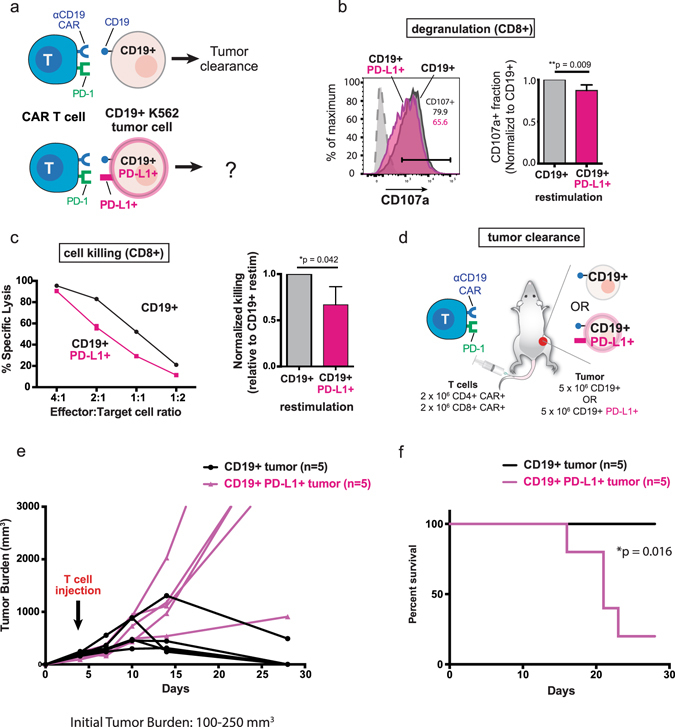
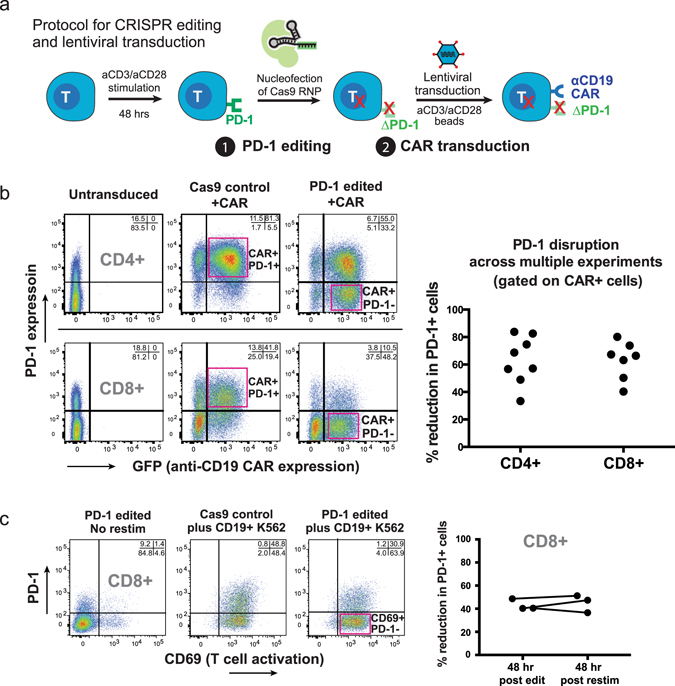
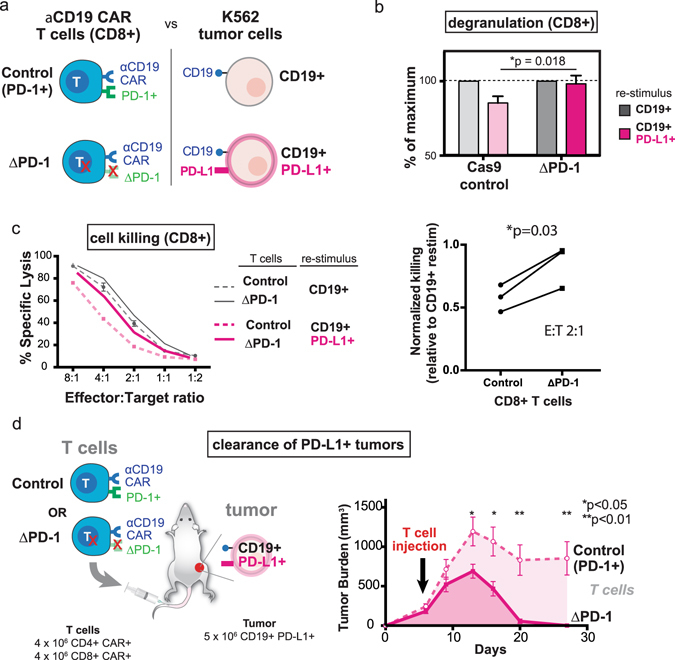
Immunotherapies with chimeric antigen receptor (CAR) T cells and checkpoint inhibitors (including antibodies that antagonize programmed cell death protein 1 [PD-1]) have both opened new avenues for cancer treatment, but the clinical potential of combined disruption of inhibitory checkpoints and CAR T cell therapy remains incompletely explored. Here we show that programmed death ligand 1 (PD-L1) expression on tumor cells can render human CAR T cells (anti-CD19 4-1BBζ) hypo-functional, resulting in impaired tumor clearance in a sub-cutaneous xenograft model. To overcome this suppressed anti-tumor response, we developed a protocol for combined Cas9 ribonucleoprotein (Cas9 RNP)-mediated gene editing and lentiviral transduction to generate PD-1 deficient anti-CD19 CAR T cells. Pdcd1 (PD-1) disruption augmented CAR T cell mediated killing of tumor cells in vitro and enhanced clearance of PD-L1+ tumor xenografts in vivo. This study demonstrates improved therapeutic efficacy of Cas9-edited CAR T cells and highlights the potential of precision genome engineering to enhance next-generation cell therapies.
Overview
The claims and statistics of this paper haven’t been checked yet.
Free: it reads the open-access text and checks the first 5 claims that cite a source we can check. Create a free account to check every claim.
Integrity signals
Registry
Cites
Statistics
Figures
Verification
Claims the paper makes
The claims and statistics of this paper haven’t been checked yet.
Free: it reads the open-access text and checks the first 5 claims that cite a source we can check. Create a free account to check every claim.
Claims other papers make about this one
Each is checked against this paper’s own text: does it say what the citing paper says it does?
The check wasn’t confident either way, so it gives no verdict — never disputed.
In the citing paper
“Mouse cells lacking p53 are unable to effectively arrest cell cycle progression after DNA damage, leading to genomic instability [16].”
From A Review of Research on CRISPR/Cas9 Gene Editing Technology in Disease Treatment (2024) · cites this paper as [16]
Experimental — accuracy not yet measuredThe check wasn’t confident either way, so it gives no verdict — never disputed.
In the citing paper
“Donehower, L.A. and his team found that mice with the P53 gene knocked out exhibit a high frequency of spontaneous tumorigenesis, including lymphomas, osteosarcomas, and other types of tumors.”
From A Review of Research on CRISPR/Cas9 Gene Editing Technology in Disease Treatment (2024) · cites this paper as [16]
Experimental — accuracy not yet measuredThe check wasn’t confident either way, so it gives no verdict — never disputed.
In the citing paper
“This observation suggests that p53 plays a crucial role in tumor suppression.”
From A Review of Research on CRISPR/Cas9 Gene Editing Technology in Disease Treatment (2024) · cites this paper as [16]
Experimental — accuracy not yet measuredIn the citing paper
“CRISPR-Cas9 genetic ablation of checkpoint targets such as PD-1 in adoptive T cell therapies has also shown increased functionality in certain models and is being persued clinically (Ren et al., 2017; Rupp et al., 2017; Stadtmauer et al., 2020; Su et al., 2016).”
From Pooled Knockin Targeting for Genome Engineering of Cellular Immunotherapies (2020) · cites this paper as Rupp et al., 2017
Self-check
Percentages, sums and reported differences re-computed from the paper’s own numbers.
The self-check needs the paper’s full text.
Citations
Cites
PD-1 and PD-L1 Immune Checkpoint Blockade to Treat Breast Cancer
Hartkopf, A. D., Taran, F.-A., Wallwiener, M., Walter, C. B., Krämer, B., Grischke, E.-M., & Brucker, S. Y. (2016) · Breast Care · doi:10.1159/000453569 · Cited by 30,845
Safety, activity, and immune correlates of anti–PD-1 antibody in cancer
Topalian, S. L., Hodi, F. S., Brahmer, J. R., Gettinger, S. N., Smith, D. C., McDermott, D. F., Powderly, J. D., Carvajal, R. D., Sosman, J. A., Atkins, M. B., et al. (2012) · New England Journal of Medicine · doi:10.1056/nejmoa1200690 · Cited by 12,628
Safety and activity of anti-PD-L1 antibody in patients with advanced cancer
Brahmer, J. R., Tykodi, S. S., Chow, L. Q. M., Hwu, W.-J., Topalian, S. L., Hwu, P., Drake, C. G., Camacho, L. H., Kauh, J., Odunsi, K., et al. (2012) · New England Journal of Medicine · doi:10.1056/nejmoa1200694 · Cited by 7,945
Chimeric Antigen Receptor T Cells for Sustained Remissions in Leukemia
Maude, S. L., Frey, N., Shaw, P. A., Aplenc, R., Barrett, D. M., Bunin, N. J., Chew, A., Gonzalez, V. E., Zheng, Z., Lacey, S. F., et al. (2014) · New England Journal of Medicine · doi:10.1056/nejmoa1407222 · Cited by 5,413
PD-1 and Its Ligands in Tolerance and Immunity
Keir, M. E., Butte, M. J., Freeman, G. J., & Sharpe, A. H. (2008) · Annual Review of Immunology · doi:10.1146/annurev.immunol.26.021607.090331 · Cited by 5,378
Restoring function in exhausted CD8 T cells during chronic viral infection
Barber, D. L., Wherry, E. J., Masopust, D., Zhu, B., Allison, J. P., Sharpe, A. H., Freeman, G. J., & Ahmed, R. (2006) · Nature · doi:10.1038/nature04444 · Cited by 3,986
PD-1 Blockade with Nivolumab in Relapsed or Refractory Hodgkin's Lymphoma
Ansell, S. M., Lesokhin, A. M., Borrello, I., Halwani, A., Scott, E. C., Gutierrez, M., Schuster, S. J., Millenson, M. M., Cattry, D., Freeman, G. J., et al. (2015) · New England Journal of Medicine · doi:10.1056/nejmoa1411087 · Cited by 3,560
Wang, H., Yang, H., Shivalila, C. S., Dawlaty, M. M., Cheng, A. W., Zhang, F., & Jaenisch, R. (2013) · Cell · doi:10.1016/j.cell.2013.04.025 · Cited by 3,495
Metabolic Competition in the Tumor Microenvironment Is a Driver of Cancer Progression
Chang, C.-H., Qiu, J., O’Sullivan, D., Buck, M. D., Noguchi, T., Curtis, J. D., Chen, Q., Gindin, M., Gubin, M. M., van der Windt, G. J. W., et al. (2015) · Cell · doi:10.1016/j.cell.2015.08.016 · Cited by 3,331
High-fidelity CRISPR-Cas9 nucleases with no detectable genome-wide off-target effects
Kleinstiver, B. P., Pattanayak, V., Prew, M. S., Tsai, S. Q., Nguyen, N. T., Zheng, Z., & Joung, J. K. (2016) · Nature · doi:10.1038/nature16526 · Cited by 2,673
Cited by
Cancer immunoediting and resistance to T cell-based immunotherapy
O’Donnell, J. S., Teng, M. W. L., & Smyth, M. J. (2019) · Nature Reviews Clinical Oncology · doi:10.1038/s41571-018-0142-8 · Cited by 1,759
Engineering strategies to overcome the current roadblocks in CAR T cell therapy
Rafiq, S., Hackett, C. S., & Brentjens, R. J. (2020) · Nature Reviews Clinical Oncology · doi:10.1038/s41571-019-0297-y · Cited by 1,472
“169 ) have been used to delete the gene encoding PD-1 ( PD1 ) in CAR T cells.”
MethodCRISPR-engineered T cells in patients with refractory cancer
Stadtmauer, E. A., Fraietta, J. A., Davis, M. M., Cohen, A. D., Weber, K. L., Lancaster, E., Mangan, P. A., Kulikovskaya, I., Gupta, M., Chen, F., et al. (2020) · Science · doi:10.1126/science.aba7365 · Cited by 1,478
CRISPR-Cas guides the future of genetic engineering
Knott, G. J., & Doudna, J. A. (2018) · Science · doi:10.1126/science.aat5011 · Cited by 1,410
Clinical implications of T cell exhaustion for cancer immunotherapy
Chow, A., Perica, K., Klebanoff, C. A., & Wolchok, J. D. (2022) · Nature Reviews Clinical Oncology · doi:10.1038/s41571-022-00689-z · Cited by 1,044
Cholesterol Induces CD8+ T Cell Exhaustion in the Tumor Microenvironment
Ma, X., Bi, E., Lu, Y., Su, P., Huang, C., Liu, L., Wang, Q., Yang, M., Kalady, M. F., Qian, J., et al. (2019) · Cell Metabolism · doi:10.1016/j.cmet.2019.04.002 · Cited by 1,033
Martinez, M., & Moon, E. K. (2019) · Frontiers in Immunology · doi:10.3389/fimmu.2019.00128 · Cited by 851
“In both cases, tumors were eradicated in mouse xenograft models using the IR knockout CAR T cells (138, 139).”
MethodRecent advances and discoveries in the mechanisms and functions of CAR T cells
Larson, R. C., & Maus, M. V. (2021) · Nature Reviews Cancer · doi:10.1038/s41568-020-00323-z · Cited by 852
“This improves antitumour immunity in vitro and within in vivo models in the presence of PDL1 + tumours 123 .”
CAR-NK cells: A promising cellular immunotherapy for cancer
Xie, G., Dong, H., Liang, Y., Ham, J. D., Rizwan, R., & Chen, J. (2020) · eBioMedicine · doi:10.1016/j.ebiom.2020.102975 · Cited by 800
“[109] Like T cells, activated NK cells also expressed some T cell immune checkpoint molecules (e.”
BackgroundTools for translation: non-viral materials for therapeutic mRNA delivery
Hajj, K. A., & Whitehead, K. A. (2017) · Nature Reviews Materials · doi:10.1038/natrevmats.2017.56 · Cited by 799
Immunotherapy for glioma: Current management and future application
Xu, S., Tang, L., Li, X., Fan, F., & Liu, Z. (2020) · Cancer Letters · doi:10.1016/j.canlet.2020.02.002 · Cited by 746
Domingues, B., Lopes, J., Soares, P., & Populo, H. (2018) · ImmunoTargets and Therapy · doi:10.2147/itt.s134842 · Cited by 701
“A recent study reported that Cas9-based gene editing technique can enhance CAR-T cells efficacy.(110) The selection of the target antigen must have as criterion the maximal effect in tumor cells and the minimal effect in normal cells.”
BackgroundTargeting the epigenetic regulation of antitumour immunity
Hogg, S. J., Beavis, P. A., Dawson, M. A., & Johnstone, R. W. (2020) · Nature Reviews Drug Discovery · doi:10.1038/s41573-020-0077-5 · Cited by 630
Engineering CAR-T Cells for Next-Generation Cancer Therapy
Hong, M., Clubb, J. D., & Chen, Y. Y. (2020) · Cancer Cell · doi:10.1016/j.ccell.2020.07.005 · Cited by 639
Maalej, K. M., Merhi, M., Inchakalody, V. P., Mestiri, S., Alam, M., Maccalli, C., Cherif, H., Uddin, S., Steinhoff, M., Marincola, F. M., et al. (2023) · Molecular Cancer · doi:10.1186/s12943-023-01723-z · Cited by 618
Combination Immunotherapy with CAR T Cells and Checkpoint Blockade for the Treatment of Solid Tumors
Grosser, R., Cherkassky, L., Chintala, N., & Adusumilli, P. S. (2019) · Cancer Cell · doi:10.1016/j.ccell.2019.09.006 · Cited by 603
CAR T cells in solid tumors: challenges and opportunities
Marofi, F., Motavalli, R., Safonov, V. A., Thangavelu, L., Yumashev, A. V., Alexander, M., Shomali, N., Chartrand, M. S., Pathak, Y., Jarahian, M., et al. (2021) · Stem Cell Research & Therapy · doi:10.1186/s13287-020-02128-1 · Cited by 582
Genome-wide CRISPR Screens in Primary Human T Cells Reveal Key Regulators of Immune Function
Shifrut, E., Carnevale, J., Tobin, V., Roth, T. L., Woo, J. M., Bui, C. T., Li, P. J., Diolaiti, M. E., Ashworth, A., & Marson, A. (2018) · Cell · doi:10.1016/j.cell.2018.10.024 · Cited by 573
Self-citationThe cancer–natural killer cell immunity cycle
Huntington, N. D., Cursons, J., & Rautela, J. (2020) · Nature Reviews Cancer · doi:10.1038/s41568-020-0272-z · Cited by 566
Killing Mechanisms of Chimeric Antigen Receptor (CAR) T Cells
Benmebarek, M.-R., Karches, C. H., Cadilha, B. L., Lesch, S., Endres, S., & Kobold, S. (2019) · International Journal of Molecular Sciences · doi:10.3390/ijms20061283 · Cited by 531
Current Progress in CAR-T Cell Therapy for Solid Tumors
Ma, S., Li, X., Wang, X., Cheng, L., Li, Z., Zhang, C., Ye, Z., & Qian, Q. (2019) · International Journal of Biological Sciences · doi:10.7150/ijbs.34213 · Cited by 496
“Many strategies and approaches have been tried to overcome these obstacles, including arming CAR-T cells with knock-out of PD-1 expression or secretion of cytokines/chemokines and using CAR-T cells in combination with other treatments [3-5].”
BackgroundNext-generation regulatory T cell therapy
Ferreira, L. M. R., Muller, Y. D., Bluestone, J. A., & Tang, Q. (2019) · Nature Reviews Drug Discovery · doi:10.1038/s41573-019-0041-4 · Cited by 476
Current applications and future perspective of CRISPR/Cas9 gene editing in cancer
Wang, S.-W., Gao, C., Zheng, Y.-M., Yi, L., Lu, J.-C., Huang, X.-Y., Cai, J.-B., Zhang, P.-F., Cui, Y.-H., & Ke, A.-W. (2022) · Molecular Cancer · doi:10.1186/s12943-022-01518-8 · Cited by 478
“PD-1 deletion enhances enhanced the antitumor activity of CAR-T cells in vitro and enhances clearance of PD-L1+ tumor xenografts in animal models [194].”
BackgroundFrom bench to bedside: the history and progress of CAR T cell therapy
Mitra, A., Barua, A., Huang, L., Ganguly, S., Feng, Q., & He, B. (2023) · Frontiers in Immunology · doi:10.3389/fimmu.2023.1188049 · Cited by 466
“In addition to co-express a stimulatory factor, negative regulators of T cell function are being deleted from CAR T cells by CRISPR/Cas9 technology to achieve an enhanced anticancer activity, including PD-1 (114, 115), Tet2 (116), NR4A (117), and regnase-1 (118, 119).”
BackgroundInfluentialBeyond immune checkpoint blockade: emerging immunological strategies
Kubli, S. P., Berger, T., Araujo, D. V., Siu, L. L., & Mak, T. W. (2021) · Nature Reviews Drug Discovery · doi:10.1038/s41573-021-00155-y · Cited by 461
Teaching an old dog new tricks: next-generation CAR T cells
Tokarew, N., Ogonek, J., Endres, S., von Bergwelt-Baildon, M., & Kobold, S. (2019) · British Journal of Cancer · doi:10.1038/s41416-018-0325-1 · Cited by 440
Enhancing anti-tumour efficacy with immunotherapy combinations
Meric-Bernstam, F., Larkin, J., Tabernero, J., & Bonini, C. (2021) · The Lancet · doi:10.1016/s0140-6736(20)32598-8 · Cited by 409
Recent advances in CAR-T cell engineering
Huang, R., Li, X., He, Y., Zhu, W., Gao, L., Liu, Y., Gao, L., Wen, Q., Zhong, J. F., Zhang, C., et al. (2020) · Journal of Hematology & Oncology · doi:10.1186/s13045-020-00910-5 · Cited by 402
“Although disrupting the PD-1 receptor using the clustered regularly interspaced short palindromic repeats (CRISPR)/CAS9 system enables CAR-T cells to resist the TME and increases the tumorkilling efficiency [90], the secreted PD-1 blocker rescues the “bystander” T cells and reconstructs the immune system in patients […”
BackgroundImproving CAR-T immunotherapy: Overcoming the challenges of T cell exhaustion
Gumber, D., & Wang, L. D. (2022) · eBioMedicine · doi:10.1016/j.ebiom.2022.103941 · Cited by 396
PD-1 expression on tumor-specific T cells: Friend or foe for immunotherapy?
Simon, S., & Labarriere, N. (2018) · OncoImmunology · doi:10.1080/2162402x.2017.1364828 · Cited by 394
CAR T Cell Therapy for Solid Tumors: Bright Future or Dark Reality?
Wagner, J., Wickman, E., DeRenzo, C., & Gottschalk, S. (2020) · Molecular Therapy · doi:10.1016/j.ymthe.2020.09.015 · Cited by 380
Chimeric antigen receptor natural killer (CAR-NK) cell design and engineering for cancer therapy
Gong, Y., Klein Wolterink, R. G. J., Wang, J., Bos, G. M. J., & Germeraad, W. T. V. (2021) · Journal of Hematology & Oncology · doi:10.1186/s13045-021-01083-5 · Cited by 379
Non-viral, specifically targeted CAR-T cells achieve high safety and efficacy in B-NHL
Zhang, J., Hu, Y., Yang, J., Li, W., Zhang, M., Wang, Q., Zhang, L., Wei, G., Tian, Y., Zhao, K., et al. (2022) · Nature · doi:10.1038/s41586-022-05140-y · Cited by 371
Seki, A., & Rutz, S. (2018) · Journal of Experimental Medicine · doi:10.1084/jem.20171626 · Cited by 372
“…or synthetic single guide RNA (sgRNA), to transfect activated human T cells resulted in 50% to 90% efficiency across different targets, including CXCR4, CCR5, PD-1, and CD7 (Hendel et al., 2015; Schumann et al., 2015; Gomes-Silva et al., 2017; Ren et al., 2017a; Rupp et al., 2017).”
BackgroundXu, X., Sun, Q., Liang, X., Chen, Z., Zhang, X., Zhou, X., Li, M., Tu, H., Liu, Y., Tu, S., et al. (2019) · Frontiers in Immunology · doi:10.3389/fimmu.2019.02664 · Cited by 347
“CRISPR/Cas9 Genome Editing of CAR T-Cell It is found that regulation of the programmed death ligand 1/programmed cell death 1 (PD-L1/PD-1) axis enhances the anti-tumor activity of T-cells (42, 43).”
BackgroundT Cell Dysfunction in Cancer Immunity and Immunotherapy
Xia, A., Zhang, Y., Xu, J., Yin, T., & Lu, X.-J. (2019) · Frontiers in Immunology · doi:10.3389/fimmu.2019.01719 · Cited by 341
“Recently, CRISPR-Cas9 technology has been applied to knock out IR itself, and studies have been conducted on PD1 and LAG-3 in CD19-BBζ CAR-T cells (196, 197).”
BackgroundMethodDevelopment of Immunotherapy Combination Strategies in Cancer
Yap, T. A., Parkes, E. E., Peng, W., Moyers, J. T., Curran, M. A., & Tawbi, H. A. (2021) · Cancer Discovery · doi:10.1158/2159-8290.cd-20-1209 · Cited by 330
“The advantages of this approach include potential reduction in systemic effects of PD-1 inhibition with a highly-specific PD-1 knockdown in tumor-targeted T cells only, as well as avoiding the need for repeated administrations of systemic anti-PD-1 (117).”
BackgroundCAR-T Cells Hit the Tumor Microenvironment: Strategies to Overcome Tumor Escape
Rodriguez-Garcia, A., Palazon, A., Noguera-Ortega, E., Powell, D. J., & Guedan, S. (2020) · Frontiers in Immunology · doi:10.3389/fimmu.2020.01109 · Cited by 312
CAR-T cell therapy for cancer: current challenges and future directions
Zugasti, I., Espinosa-Aroca, L., Fidyt, K., Mulens-Arias, V., Diaz-Beya, M., Juan, M., Urbano-Ispizua, Á., Esteve, J., Velasco-Hernandez, T., & Menéndez, P. (2025) · Signal Transduction and Targeted Therapy · doi:10.1038/s41392-025-02269-w · Cited by 281
Xie, Y. J., Dougan, M., Jailkhani, N., Ingram, J., Fang, T., Kummer, L., Momin, N., Pishesha, N., Rickelt, S., Hynes, R. O., et al. (2019) · Proceedings of the National Academy of Sciences · doi:10.1073/pnas.1817147116 · Cited by 296
“Genetic ablation of PD-L1 using CRISPR-Cas9 in the course of CAR generation would likewise be possible, but involves genetic modifications in addition to provision of the CAR construct (37).”
BackgroundNidhi, S., Anand, U., Oleksak, P., Tripathi, P., Lal, J. A., Thomas, G., Kuca, K., & Tripathi, V. (2021) · International Journal of Molecular Sciences · doi:10.3390/ijms22073327 · Cited by 276
Engineered cellular immunotherapies in cancer and beyond
Finck, A. V., Blanchard, T., Roselle, C. P., Golinelli, G., & June, C. H. (2022) · Nature Medicine · doi:10.1038/s41591-022-01765-8 · Cited by 269
Hu, W., Zi, Z., Jin, Y., Li, G., Shao, K., Cai, Q., Ma, X., & Wei, F. (2019) · Cancer Immunology, Immunotherapy · doi:10.1007/s00262-018-2281-2 · Cited by 265
Challenges and new technologies in adoptive cell therapy
Zhang, P., Zhang, G., & Wan, X. (2023) · Journal of Hematology & Oncology · doi:10.1186/s13045-023-01492-8 · Cited by 259
“Zhao et al. used the CRISPR/Cas9 system to simultaneously disrupt TCR, β-2 microglobulin, and PD-1 genes to construct a universal CAR-T cell that showed a stronger anti-tumor effect in vivo [218].”
BackgroundInfluentialZhang, H., Qin, C., An, C., Zheng, X., Wen, S., Chen, W., Liu, X., Lv, Z., Yang, P., Xu, W., et al. (2021) · Molecular Cancer · doi:10.1186/s12943-021-01431-6 · Cited by 247
RASA2 ablation in T cells boosts antigen sensitivity and long-term function
Carnevale, J., Shifrut, E., Kale, N., Nyberg, W. A., Blaeschke, F., Chen, Y. Y., Li, Z., Bapat, S. P., Diolaiti, M. E., O’Leary, P., et al. (2022) · Nature · doi:10.1038/s41586-022-05126-w · Cited by 239
Self-citationEnhancing CAR-T cell efficacy in solid tumors by targeting the tumor microenvironment
Liu, G., Rui, W., Zhao, X., & Lin, X. (2021) · Cellular & Molecular Immunology · doi:10.1038/s41423-021-00655-2 · Cited by 237
CRISPR/Cas9 mediated deletion of the adenosine A2A receptor enhances CAR T cell efficacy
Giuffrida, L., Sek, K., Henderson, M. A., Lai, J., Chen, A. X. Y., Meyran, D., Todd, K. L., Petley, E. V., Mardiana, S., Mølck, C., et al. (2021) · Nature Communications · doi:10.1038/s41467-021-23331-5 · Cited by 226
CRISPR/Cas9-Mediated Knockout of DGK Improves Antitumor Activities of Human T Cells
Jung, I.-Y., Kim, Y.-Y., Yu, H.-S., Lee, M., Kim, S., & Lee, J. (2018) · Cancer Research · doi:10.1158/0008-5472.can-18-0030 · Cited by 222
The journey of CAR-T therapy in hematological malignancies
Lu, J., & Jiang, G. (2022) · Molecular Cancer · doi:10.1186/s12943-022-01663-0 · Cited by 217
“Additionally, such local secretion of antibodies against immune checkpoints may reduce systemic toxicity [100]; (III) Genetic perturbation of CAR-T cell autoimmune checkpoint genes, including CAR-T cell modification to make them resistant to PD-L1 [101] and knockout of CAR-T cell-encoding PD-1 gene using CRISPR-Cas9,…”
BackgroundChimeric Antigen Receptor T Cell Therapy: Challenges to Bench-to-Bedside Efficacy
Srivastava, S., & Riddell, S. R. (2018) · The Journal of Immunology · doi:10.4049/jimmunol.1701155 · Cited by 220
Yoon, D., Osborn, M., Tolar, J., & Kim, C. (2018) · International Journal of Molecular Sciences · doi:10.3390/ijms19020340 · Cited by 215
Frequent aneuploidy in primary human T cells after CRISPR–Cas9 cleavage
Nahmad, A. D., Reuveni, E., Goldschmidt, E., Tenne, T., Liberman, M., Horovitz-Fried, M., Khosravi, R., Kobo, H., Reinstein, E., Madi, A., et al. (2022) · Nature Biotechnology · doi:10.1038/s41587-022-01377-0 · Cited by 212
Recent advances in overcoming barriers to cell‐based delivery systems for cancer immunotherapy
Ding, Y., Wang, Y., & Hu, Q. (2022) · Exploration · doi:10.1002/exp.20210106 · Cited by 212
Targeted delivery of CRISPR-Cas9 and transgenes enables complex immune cell engineering
Hamilton, J. R., Tsuchida, C. A., Nguyen, D. N., Shy, B. R., McGarrigle, E. R., Sandoval Espinoza, C. R., Carr, D., Blaeschke, F., Marson, A., & Doudna, J. A. (2021) · Cell Reports · doi:10.1016/j.celrep.2021.109207 · Cited by 208
“This is an open access article under the CC BY-N activity of cell therapies (Bailey and Maus, 2019; Hu et al., 2019; Rupp et al., 2017; Tang et al., 2020).”
BackgroundSelf-citationSi, J., Shi, X., Sun, S., Zou, B., Li, Y., An, D., Lin, X., Gao, Y., Long, F., Pang, B., et al. (2020) · Cancer Cell · doi:10.1016/j.ccell.2020.08.001 · Cited by 209
Dagar, G., Gupta, A., Masoodi, T., Nisar, S., Merhi, M., Hashem, S., Chauhan, R., Dagar, M., Mirza, S., Bagga, P., et al. (2023) · Journal of Translational Medicine · doi:10.1186/s12967-023-04292-3 · Cited by 205
“In both cases, tumors were eradicated in mouse xenograft models using the IR knockout CAR-T cells [342, 343].”
BackgroundGuo, X., Jiang, H., Shi, B., Zhou, M., Zhang, H., Shi, Z., Du, G., Luo, H., Wu, X., Wang, Y., et al. (2018) · Frontiers in Pharmacology · doi:10.3389/fphar.2018.01118 · Cited by 206
“Although the previous studies have showed that, in some tumor models, the disruption of PD-1 enhanced the antitumor activity of CAR T cells, those studies mainly focused on the leukemia and pancreatic cancer cells, and most of tumor models in those studies were not derived from the native PD-L1expressing tumor cells (…”
BackgroundResultInfluentialGene editing for immune cell therapies
Bailey, S. R., & Maus, M. V. (2019) · Nature Biotechnology · doi:10.1038/s41587-019-0137-8 · Cited by 203
Sui, H., Ma, N., Wang, Y., Li, H., Liu, X., Su, Y., & Yang, J. (2018) · Journal of Immunology Research · doi:10.1155/2018/6984948 · Cited by 199
In vivo somatic cell base editing and prime editing
Newby, G. A., & Liu, D. R. (2021) · Molecular Therapy · doi:10.1016/j.ymthe.2021.09.002 · Cited by 199
Wallstabe, L., Göttlich, C., Nelke, L. C., Kühnemundt, J., Schwarz, T., Nerreter, T., Einsele, H., Walles, H., Dandekar, G., Nietzer, S. L., et al. (2019) · JCI Insight · doi:10.1172/jci.insight.126345 · Cited by 193
Gene editing and CRISPR in the clinic: current and future perspectives
Hirakawa, M. P., Krishnakumar, R., Timlin, J. A., Carney, J. P., & Butler, K. S. (2020) · Bioscience Reports · doi:10.1042/bsr20200127 · Cited by 192
Agarwal, S., Aznar, M. A., Rech, A. J., Good, C. R., Kuramitsu, S., Da, T., Gohil, M., Chen, L., Hong, S.-J. A., Ravikumar, P., et al. (2023) · Immunity · doi:10.1016/j.immuni.2023.09.001 · Cited by 185
Pooled Knockin Targeting for Genome Engineering of Cellular Immunotherapies
Roth, T. L., Li, P. J., Blaeschke, F., Nies, J. F., Apathy, R., Mowery, C., Yu, R., Nguyen, M. L. T., Lee, Y., Truong, A., et al. (2020) · Cell · doi:10.1016/j.cell.2020.03.039 · Cited by 186
Self-citationImmune Checkpoint LAG3 and Its Ligand FGL1 in Cancer
Shi, A.-P., Tang, X.-Y., Xiong, Y.-L., Zheng, K.-F., Liu, Y.-J., Shi, X.-G., Lv, Y., Jiang, T., Ma, N., & Zhao, J.-B. (2022) · Frontiers in Immunology · doi:10.3389/fimmu.2021.785091 · Cited by 185
“Except for the monotherapies and combination therapies mentioned above, the gene editing technology CRISPR-Cas9 points out a new direction to enhance the efficacy of tumor immunotherapy, as knocking out PD-1 and LAG3 of CAR-T cells can significantly enhance the anti-tumor effect and inhibit the immunosuppressive micro…”
BackgroundCAR T-Cell Therapy in Hematological Malignancies
Haslauer, T., Greil, R., Zaborsky, N., & Geisberger, R. (2021) · International Journal of Molecular Sciences · doi:10.3390/ijms22168996 · Cited by 180
“The CRISPR/Cas9 tool enables one to knockout immune checkpoint molecules such as PD-1, CTLA-4 and LAG3 in CAR T-cells [63].”
MethodNext-Generation CAR T-cell Therapies
Young, R. M., Engel, N. W., Uslu, U., Wellhausen, N., & June, C. H. (2022) · Cancer Discovery · doi:10.1158/2159-8290.cd-21-1683 · Cited by 179
Mechanisms of resistance to chimeric antigen receptor-T cells in haematological malignancies
Ruella, M., Korell, F., Porazzi, P., & Maus, M. V. (2023) · Nature Reviews Drug Discovery · doi:10.1038/s41573-023-00807-1 · Cited by 175
CRISPR–Cas: a tool for cancer research and therapeutics
Yin, H., Xue, W., & Anderson, D. G. (2019) · Nature Reviews Clinical Oncology · doi:10.1038/s41571-019-0166-8 · Cited by 178
Zhang, X., Zhang, C., Qiao, M., Cheng, C., Tang, N., Lu, S., Sun, W., Xu, B., Cao, Y., Wei, X., et al. (2022) · Cancer Cell · doi:10.1016/j.ccell.2022.09.013 · Cited by 172
Gene modification strategies for next-generation CAR T cells against solid cancers
Tian, Y., Li, Y., Shao, Y., & Zhang, Y. (2020) · Journal of Hematology & Oncology · doi:10.1186/s13045-020-00890-6 · Cited by 173
PD-1 disrupted CAR-T cells in the treatment of solid tumors: Promises and challenges
McGowan, E., Lin, Q., Ma, G., Yin, H., Chen, S., & Lin, Y. (2020) · Biomedicine & Pharmacotherapy · doi:10.1016/j.biopha.2019.109625 · Cited by 171
“These ‘TRUCKs’ are aimed to attract and shape a favorable TME effectively by delivering chemokines/cytokines to the cancer tissue.”
BackgroundMethodInfluentialCD70-Targeted Allogeneic CAR T-Cell Therapy for Advanced Clear Cell Renal Cell Carcinoma
Pal, S. K., Tran, B., Haanen, J. B. A. G., Hurwitz, M. E., Sacher, A., Tannir, N. M., Budde, L. E., Harrison, S. J., Klobuch, S., Patel, S. S., et al. (2024) · Cancer Discovery · doi:10.1158/2159-8290.cd-24-0102 · Cited by 168
RNA Nanotechnology-Mediated Cancer Immunotherapy
Lin, Y.-X., Wang, Y., Blake, S., Yu, M., Mei, L., Wang, H., & Shi, J. (2020) · Theranostics · doi:10.7150/thno.35568 · Cited by 169
“Like cancer cells’ highly/over-expressed inhibitory molecules (e.g., PD-L1), some activated T cells also over-express corresponding inhibitory molecules [112, 113], such as programmed cell death protein 1 (PD-1), cytotoxic T-lymphocyte-associated protein 4 (CTLA-4) and mucin-containing protein 3 (TIM-3).”
BackgroundInfluentialCounteracting CAR T cell dysfunction
Poorebrahim, M., Melief, J., Pico de Coaña, Y., L. Wickström, S., Cid-Arregui, A., & Kiessling, R. (2021) · Oncogene · doi:10.1038/s41388-020-01501-x · Cited by 168
CAR-T cell combination therapy: the next revolution in cancer treatment
Al-Haideri, M., Tondok, S. B., Safa, S. H., maleki, A. H., Rostami, S., Jalil, A. T., Al-Gazally, M. E., Alsaikhan, F., Rizaev, J. A., Mohammad, T. A. M., et al. (2022) · Cancer Cell International · doi:10.1186/s12935-022-02778-6 · Cited by 163
Programming CAR T Cell Tumor Recognition: Tuned Antigen Sensing and Logic Gating
Hamieh, M., Mansilla-Soto, J., Rivière, I., & Sadelain, M. (2023) · Cancer Discovery · doi:10.1158/2159-8290.cd-23-0101 · Cited by 163
Current challenges and emerging opportunities of CAR-T cell therapies
Abreu, T. R., Fonseca, N. A., Gonçalves, N., & Moreira, J. N. (2019) · Journal of Controlled Release · doi:10.1016/j.jconrel.2019.12.047 · Cited by 176
Engineered Cytokine Signaling to Improve CAR T Cell Effector Function
Bell, M. R., & Gottschalk, S. M. (2021) · Frontiers in Immunology · doi:10.3389/fimmu.2021.684642 · Cited by 175
“Likewise, additional genetic modification may be required to endow CAR T cells with potent and sustained effector function and to overcome the immunosuppressive tumor microenvironment (TME) to produce lasting benefits for cancer patients (22).”
BackgroundCAR T Cell Therapy for Neuroblastoma
Richards, R. M., Sotillo, E., & Majzner, R. G. (2018) · Frontiers in Immunology · doi:10.3389/fimmu.2018.02380 · Cited by 169
Cao, Y., Lu, W., Sun, R., Jin, X. K., Cheng, L., He, X., Wang, L., Yuan, T., Lyu, C., & Zhao, M. (2019) · Frontiers in Oncology · doi:10.3389/fonc.2019.00767 · Cited by 158
“Other strategies, including CAR-T cells engineered to secrete anti-PD-1/PD-L1 antibodies, the engineering of PD-1, knocking down PD-1 expression, and knocking out PD-1, are also currently being evaluated (5, 21).”
BackgroundMethodClinical investigation of CAR T cells for solid tumors: Lessons learned and future directions
Bagley, S. J., & O’Rourke, D. M. (2020) · Pharmacology & Therapeutics · doi:10.1016/j.pharmthera.2019.107419 · Cited by 145
Stock, S., Schmitt, M. W., & Sellner, L. (2019) · International Journal of Molecular Sciences · doi:10.3390/ijms20246223 · Cited by 152
“Additionally, it was reported that CRISPR/Cas9-mediated genome editing and lentiviral transduction was applied to produce PD-1 deficient CD19-specific CART cells, leading to enhanced anti-tumor and therapeutic efficacy [78].”
BackgroundNanoparticles for nucleic acid delivery: Applications in cancer immunotherapy
Mukalel, A. J., Riley, R. S., Zhang, R., & Mitchell, M. J. (2019) · Cancer Letters · doi:10.1016/j.canlet.2019.04.040 · Cited by 136
“The vast potential of nucleic acids for treating cancer can be demonstrated by the use of CRISPR/Cas9 to inactivate PD-1/PD-L1 interactions between cancer cells and T-cells [8].”
BackgroundSupercharging adoptive T cell therapy to overcome solid tumor–induced immunosuppression
Mardiana, S., Solomon, B., Darcy, P. K., & Beavis, P. A. (2019) · Science Translational Medicine · doi:10.1126/scitranslmed.aaw2293 · Cited by 143
A deep insight into CRISPR/Cas9 application in CAR-T cell-based tumor immunotherapies
Razeghian, E., Nasution, M. K. M., Rahman, H. S., Gardanova, Z. R., Abdelbasset, W. K., Surendar, A., Bokov, D. O., Suksatan, W., Nakhaei, P., Shariatzadeh, S., et al. (2021) · Stem Cell Research & Therapy · doi:10.1186/s13287-021-02510-7 · Cited by 160
“Albeit, it was found that ectopic PD-L1 expression could not significantly modify intrinsic tumor proliferation in K562 cell-bearing mice since there was no alteration in growth kinetics of CD19+ and CD19+ PD-L1+ cells in the experimental model [121].”
BackgroundHossain, M. A., Liu, G., Dai, B., Si, Y., Yang, Q., Wazir, J., Birnbaumer, L., & Yang, Y. (2020) · Medicinal Research Reviews · doi:10.1002/med.21727 · Cited by 154
Tim-3 expression and its role in hepatocellular carcinoma
Liu, F., Liu, Y., & Chen, Z. (2018) · Journal of Hematology & Oncology · doi:10.1186/s13045-018-0667-4 · Cited by 134
Strohl, W. R., & Naso, M. (2019) · Antibodies · doi:10.3390/antib8030041 · Cited by 134
Cytosine base editing enables quadruple-edited allogeneic CART cells for T-ALL
Diorio, C. J., Murray, R. C., Naniong, M., Barrera, L. A., Camblin, A. J., Chukinas, J. A., Coholan, L. J., Edwards, A., Fuller, T. J., Gonzales, C., et al. (2022) · Blood · doi:10.1182/blood.2022015825 · Cited by 145
Oncolytic virus-derived type I interferon restricts CAR T cell therapy
Evgin, L., Huff, A. L., Wongthida, P., Thompson, J., Kottke, T., Tonne, J., Schuelke, M., Ayasoufi, K., Driscoll, C. B., Shim, K. G., et al. (2020) · Nature Communications · doi:10.1038/s41467-020-17011-z · Cited by 128
CRISPR/Cas9 gene-editing: Research technologies, clinical applications and ethical considerations
Memi, F., Ntokou, A., & Papangeli, I. (2018) · Seminars in Perinatology · doi:10.1053/j.semperi.2018.09.003 · Cited by 158
Hu, B., Zou, Y., Zhang, L., Tang, J., Niedermann, G., Firat, E., Huang, X., & Zhu, X. (2019) · Human Gene Therapy · doi:10.1089/hum.2017.234 · Cited by 124
Industrializing Autologous Adoptive Immunotherapies: Manufacturing Advances and Challenges
Iyer, R. K., Bowles, P. A., Kim, H., & Dulgar-Tulloch, A. (2018) · Frontiers in Medicine · doi:10.3389/fmed.2018.00150 · Cited by 122
“applied to gene knockout of TCR and HLA to create allogeneic or universal T-cells (37) or knocking out immune checkpoint inhibitory pathways such as programmed cell death protein 1 (PD1) (38).”
MethodBorn to survive: how cancer cells resist CAR T cell therapy
Lemoine, J., Ruella, M., & Houot, R. (2021) · Journal of Hematology & Oncology · doi:10.1186/s13045-021-01209-9 · Cited by 144
Tieu, V., Sotillo, E., Bjelajac, J. R., Chen, C., Malipatlolla, M. B., Guerrero, J. A., Xu, P., Quinn, P. J., Fisher, C., Klysz, D. D., et al. (2024) · Cell · doi:10.1016/j.cell.2024.01.035 · Cited by 128
Improving CAR T-Cell Persistence
Pietrobon, V., Todd, L. A., Goswami, A., Stefanson, O., Yang, Z., & Marincola, F. M. (2021) · International Journal of Molecular Sciences · doi:10.3390/ijms221910828 · Cited by 133
CRISPR/Cas9 Genome-Editing System in Human Stem Cells: Current Status and Future Prospects
Zhang, Z., Zhang, Y., Gao, F., Han, S., Cheah, K. S., Tse, H.-F., & Lian, Q. (2017) · Molecular Therapy - Nucleic Acids · doi:10.1016/j.omtn.2017.09.009 · Cited by 114
“CRISPR/Cas9 can be used to increase their anti-tumor efficacy by disrupting the programmed death protein 1 (PD-1) in CAR T cells by eliminating PD-L1 (PD-1 ligand) expressed tumor xenografts in vivo.(77) In addition, CRISPR/Cas9 can be utilized to eliminate the risks associated with lentivirus-mediated CAR T cells, su…”
BackgroundTargeting immune checkpoints in hematological malignancies
Salik, B., Smyth, M. J., & Nakamura, K. (2020) · Journal of Hematology & Oncology · doi:10.1186/s13045-020-00947-6 · Cited by 113
Metadata
- Authors
- Rupp, L. J., Schumann, K., Roybal, K. T., Gate, R. E., Ye, C. J., Lim, W. A., & Marson, A.
- Affiliations
- Howard Hughes Medical Institute (US)
- University of California, San Francisco (US)
- Corresponding author
- Lim, Wendell A.
- Venue
- Scientific Reports
- Published
- 2017-04-07
- Volume
- 7
- Issue
- 1
- Pages
- 737-737
- ISSN
- 2045-2322 (ISSN-L)
- PMC
- PMC5428439
- OpenAlex
- W2604982880
- Semantic Scholar
- 27ffac41ff676af9dc298997351e23839515638e
- Cited by
- 757
- References
- 39
- Citations by year
- 2026: 58 · 2025: 72 · 2024: 70 · 2023: 72 · 2022: 94 · 2021: 107 · 2020: 122 · 2019: 85 · 2018: 67 · 2017: 10
- FWCI
- 34.37
- Type
- journal article
- Language
- en
- Open access
- gold
- doi.org
- Licence
- cc-by
- creativecommons.org/licenses/by/4.0 (tdm)
- creativecommons.org/licenses/by/4.0 (vor)
- Locations
- Scientific Reports (publishedVersion, cc-by)
- PubMed Central (publishedVersion, cc-by)
- PubMed (publishedVersion)
- eScholarship (California Digital Library) (submittedVersion)
- DOAJ (DOAJ: Directory of Open Access Journals) (submittedVersion, cc-by-sa)
- KOPS (University of Konstanz) (submittedVersion, cc-by)
- Funders
- Howard Hughes Medical Institute (R01 CA196277)
- Burroughs Wellcome Fund
- Deutsche Forschungsgemeinschaft
- National Institutes of Health (EY016546)
- University of California, San Francisco
- National Eye Institute (PN2EY016546)
- National Cancer Institute (R01CA196277)
- National Institute of General Medical Sciences (T32GM067547, R01GM055040)
- National Institute of Allergy and Infectious Diseases (F32AI120352)
- Topics
- Health Sciences › Medicine › Oncology › CAR-T cell therapy research
- Health Sciences › Medicine › Oncology › Cancer Immunotherapy and Biomarkers
- Life Sciences › Biochemistry, Genetics and Molecular Biology › Molecular Biology › CRISPR and Genetic Engineering
- Keywords
- CRISPR/Cas9 genome editing, PD-1, PD-L1, chimeric antigen receptor T cells, CD19 CAR T cells, 4-1BB, lentiviral transduction, Cas9 ribonucleoprotein, cancer immunotherapy, antitumor efficacy, anti-PD-1 therapy
- MeSH terms
- Animals, Antigens, Neoplasm, Female, Humans, Neoplasms, Receptors, Antigen, T-Cell, T-Lymphocytes, Biomarkers, Gene Expression, Immunophenotyping, Mice, Knockout, Gene Targeting, Antigens, CD19, Cell Line, Tumor, Mice, Gene Knockdown Techniques, B7-H1 Antigen, Programmed Cell Death 1 Receptor, CRISPR-Cas Systems
About these checks
Registry, retraction, Cites and statistics results are computed, not judged, with one exception: a printed reference that no index lists is read once by a model before it counts as a citation error. Claims are extracted by a model and kept only when their quote appears verbatim in the text; each cited source is then checked, with a model’s help, for whether it says what the claim relies on. Those verdicts can be wrong — read the claim’s quote and the cited source before relying on one.
Statistics and arithmetic are recomputed, not judged.
Confidence bands are shown only for fields calibrated on our annotated test set. None is calibrated yet, so no band is shown.
What counts as a claim ›How we measure confidence ›How we check this ›
Are you an author, or do you see a problem with this page? Request a review
Data sources
Bibliographic data: Semantic Scholar, OpenAlex, Crossref.
Contains information from the Semantic Scholar Academic Graph Datasets, made available under the ODC Attribution License (ODC-BY 1.0).
Semantic Scholar’s data is described in: Kinney, R., et al. (2023). The Semantic Scholar Open Data Platform. arXiv:2301.10140.
