

The DOI matches its Crossref record; 52 of the 52 references it cites were found in a registry or an index.
Flexible and Self-Healing Aqueous Supercapacitors for Low Temperature Applications: Polyampholyte Gel Electrolytes with Biochar Electrodes
Open accessAbstract
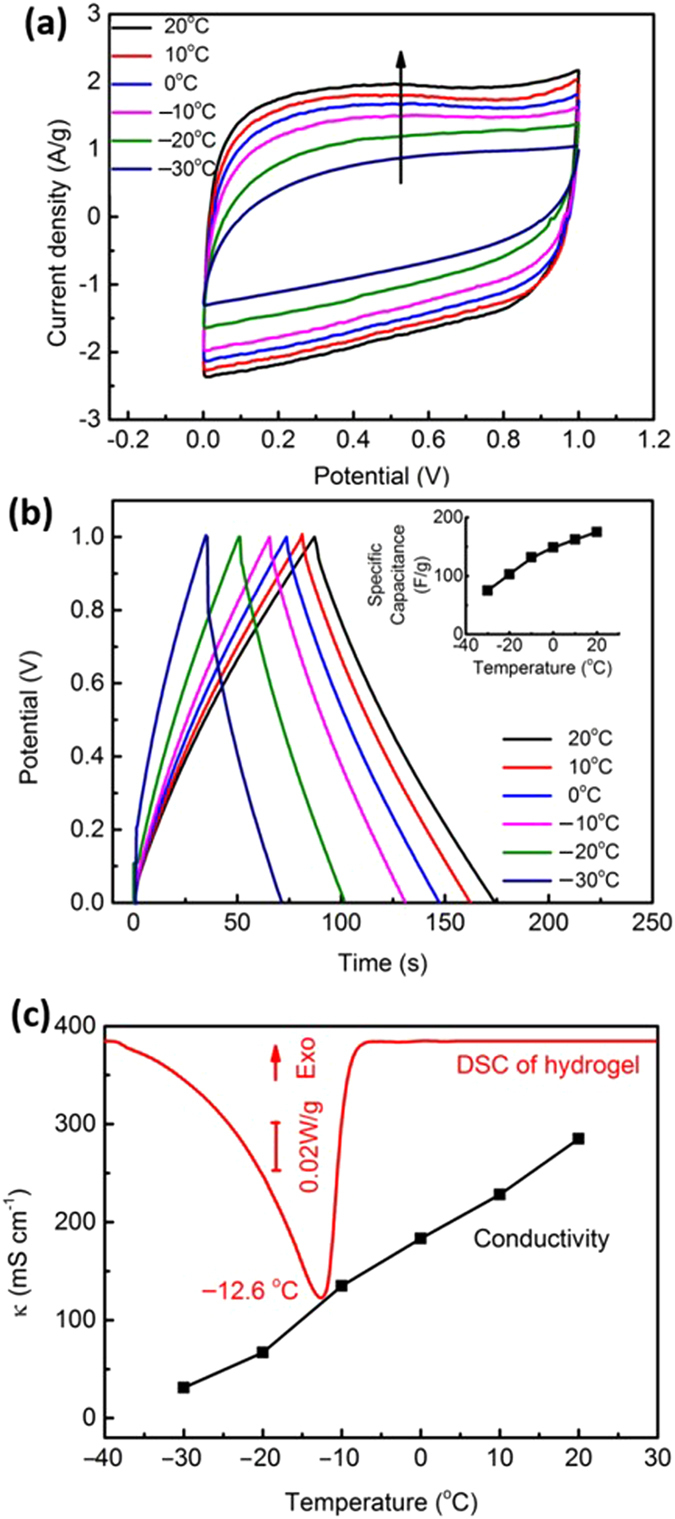
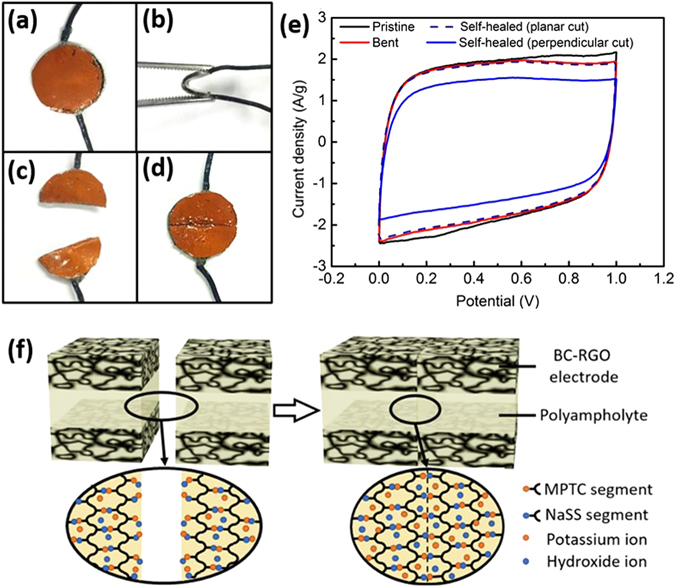
A flexible and self-healing supercapacitor with high energy density in low temperature operation was fabricated using a combination of biochar-based composite electrodes and a polyampholyte hydrogel electrolyte. Polyampholytes, a novel class of tough hydrogel, provide self-healing ability and mechanical flexibility, as well as low temperature operation for the aqueous electrolyte. Biochar is a carbon material produced from the low-temperature pyrolysis of biological wastes; the incorporation of reduced graphene oxide conferred mechanical integrity and electrical conductivity and hence the electrodes are called biochar-reduced-graphene-oxide (BC-RGO) electrodes. The fabricated supercapacitor showed high energy density of 30 Wh/kg with ~90% capacitance retention after 5000 charge–discharge cycles at room temperature at a power density of 50 W/kg. At −30 °C, the supercapacitor exhibited an energy density of 10.5 Wh/kg at a power density of 500 W/kg. The mechanism of the low-temperature performance excellence is likely to be associated with the concept of non-freezable water near the hydrophilic polymer chains, which can motivate future researches on the phase behaviour of water near polyampholyte chains. We conclude that the combination of the BC-RGO electrode and the polyampholyte hydrogel electrolyte is promising for supercapacitors for flexible electronics and for low temperature environments.
Overview
The claims and statistics of this paper haven’t been checked yet.
Run the check — free, no account needed. It reads the open-access text and checks the sources it cites.
Integrity signals
Registry
Cites
Statistics
Figures
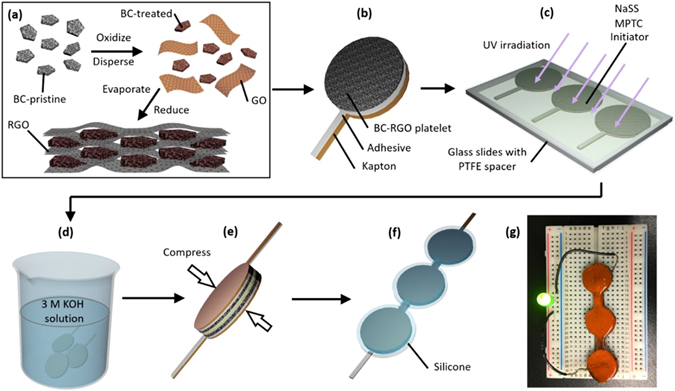
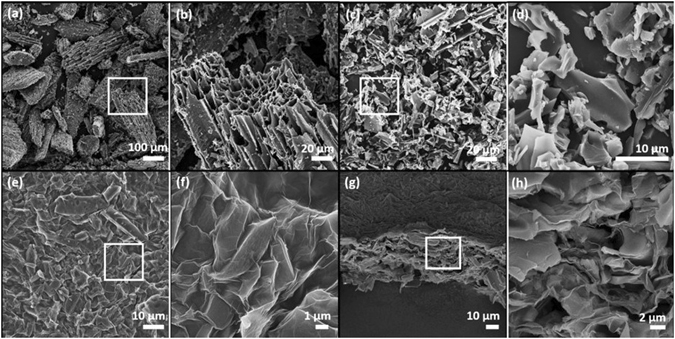
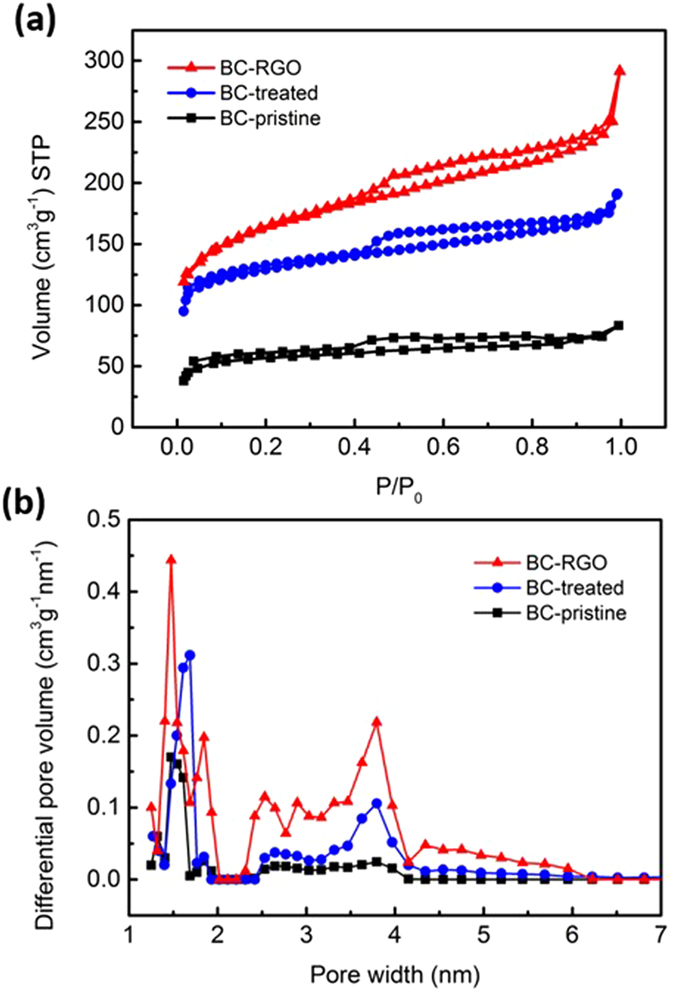
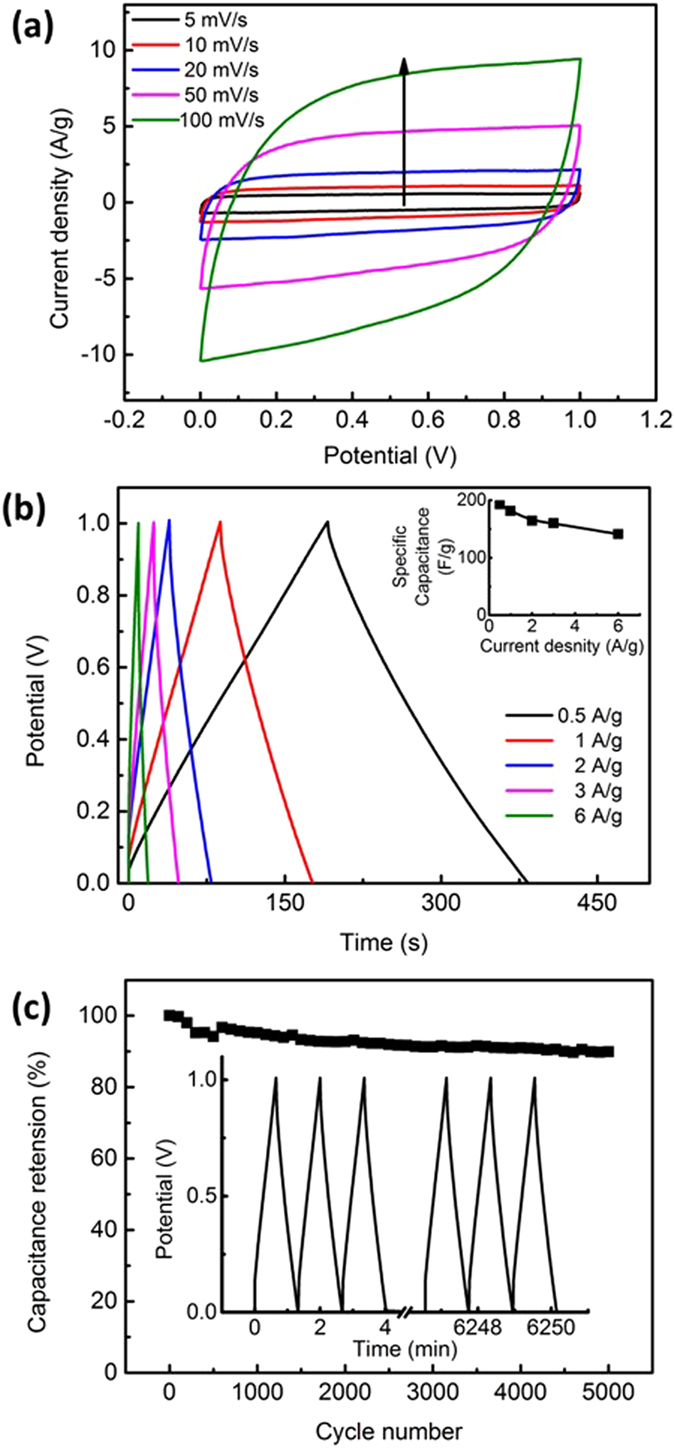
Verification
Claims the paper makes
The claims and statistics of this paper haven’t been checked yet.
Run the check — free, no account needed. It reads the open-access text and checks the sources it cites.
Claims other papers make about this one
Each is checked against this paper’s own text: does it say what the citing paper says it does?
In the citing paper
“Recently, the discovery of 'geobattery' theory (reversible functional interspecies conversion) on natural pyrogenic carbon, whereby phenolic -OH and quinoid C=O can undergo electronmediated transformation, further indicates the electron donating ability of phenolic -OH.105,106”
From Sustainable remediation with an electroactive biochar system: mechanisms and perspectives (2020) · cites this paper as [106]
Self-check
Percentages, sums and reported differences re-computed from the paper’s own numbers.
The self-check needs the paper’s full text.
Citations
Cites
Issues and challenges facing rechargeable lithium batteries
Tarascon, J. ‐., & Armand, M. B. (2001) · Nature · doi:10.1038/35104644 · Cited by 21,450
Ionic-liquid materials for the electrochemical challenges of the future
Armand, M. B., Endres, F., MacFarlane, D. R., Ohno, H., & Scrosati, B. (2009) · Nature Materials · doi:10.1038/nmat2448 · Cited by 4,694
Room-temperature stationary sodium-ion batteries for large-scale electric energy storage
Pan, H., Hu, Y., & Chen, L. (2013) · Energy & Environmental Science · doi:10.1039/c3ee40847g · Cited by 3,326
Carbons and Electrolytes for Advanced Supercapacitors
Béguin, F., Presser, V., Balducci, A., & Frąckowiak, E. (2014) · Advanced Materials · doi:10.1002/adma.201304137 · Cited by 2,690
Lehmann, J. (2007) · Nature · doi:10.1038/447143a · Cited by 2,477
Best practice methods for determining an electrode material's performance for ultracapacitors
Stoller, M. D., & Ruoff, R. S. (2010) · Energy & Environmental Science · doi:10.1039/c0ee00074d · Cited by 2,315
Physical hydrogels composed of polyampholytes demonstrate high toughness and viscoelasticity
Sun, T. L., Kurokawa, T., Kuroda, S., Ihsan, A. B., Akasaki, T., Sato, K., Haque, M. A., Nakajima, T., & Gong, J. P. (2013) · Nature Materials · doi:10.1038/nmat3713 · Cited by 2,089
Electrolytes for solid-state lithium rechargeable batteries: recent advances and perspectives
Quartarone, E., & Mustarelli, P. (2011) · Chemical Society Reviews · doi:10.1039/c0cs00081g · Cited by 1,633
Flexible solid-state supercapacitors: design, fabrication and applications
Lu, X., Yu, M., Wang, G., Tong, Y., & Li, Y. (2014) · Energy & Environmental Science · doi:10.1039/c4ee00960f · Cited by 1,326
Highly Flexible and All-Solid-State Paperlike Polymer Supercapacitors
Meng, C., Liu, C., Chen, L., Hu, C., & Fan, S. (2010) · Nano Letters · doi:10.1021/nl1019672 · Cited by 1,194
Research works printed but not linked: 1
- Khodakovsky, I. L., Mironenko, M. V., Chernysheva, I. V. and Pokrovsky, O. S. Liquid radioactive waste solutions. In Contaminant hydrology: cold regions modelling (eds Grant, S. A. & Iskandar, I. K.) (CRC Press, 2000).
Cited by
Sorted by citations
Review of supercapacitors: Materials and devices
Poonam, Sharma, K., Arora, A., & Tripathi, S. K. (2019) · Journal of Energy Storage · doi:10.1016/j.est.2019.01.010 · Cited by 2,095
An aqueous hybrid electrolyte for low-temperature zinc-based energy storage devices
Chang, N., Li, T., Li, R., Wang, S., Yin, Y., Zhang, H., & Li, X. (2020) · Energy & Environmental Science · doi:10.1039/d0ee01538e · Cited by 806
Self-citationHydrogel Electrolytes for Flexible Aqueous Energy Storage Devices
Wang, Z., Li, H., Tang, Z., Liu, Z., Ruan, Z., Ma, L., Yang, Q., Wang, D., & Zhi, C. (2018) · Advanced Functional Materials · doi:10.1002/adfm.201804560 · Cited by 665
You, S., Ok, Y. S., Chen, S. S., Tsang, D. C. W., Kwon, E. E., Lee, J., & Wang, C. (2017) · Bioresource Technology · doi:10.1016/j.biortech.2017.06.177 · Cited by 441
Self-citationEngineered biochar – A sustainable solution for the removal of antibiotics from water
Krasucka, P., Pan, B., Ok, Y. S., Mohan, D., Sarkar, B., & Oleszczuk, P. (2020) · Chemical Engineering Journal · doi:10.1016/j.cej.2020.126926 · Cited by 407
Self-citation
Metadata
- Authors
- Li, X., Liu, L., Wang, X., Ok, Y. S., Elliott, J. A. W., Chang, S. X., & Chung, H.-J.
- Affiliations
- University of Alberta (CA)
- Kangwon National University (KR)
- Corresponding author
- Chung, Hyun-Joong
- Venue
- Scientific Reports
- Published
- 2017-05-10
- Volume
- 7
- Issue
- 1
- Pages
- 1685-1685
- ISSN
- 2045-2322 (ISSN-L)
- PMC
- PMC5431763
- OpenAlex
- W2610557054
- Cited by
- 132
- References
- 52
- Citations by year
- 2026: 7 · 2025: 8 · 2024: 3 · 2023: 18 · 2022: 17 · 2021: 15 · 2020: 27 · 2019: 18 · 2018: 15 · 2017: 4
- FWCI
- 5.95
- Type
- journal article
- Language
- en
- Open access
- gold
- doi.org
- Locations
- Scientific Reports (publishedVersion, cc-by)
- PubMed Central (publishedVersion, cc-by)
- PubMed (publishedVersion)
- DOAJ (DOAJ: Directory of Open Access Journals) (submittedVersion, cc-by-sa)
- Funders
- University of Alberta
- Canada Research Chairs
- Canadian Institutes of Health Research (140186_1)
- Natural Sciences and Engineering Research Council of Canada (435914, CHRPJ 478519, RGPIN 435914)
- Topics
- Physical Sciences › Materials Science › Electronic, Optical and Magnetic Materials › Supercapacitor Materials and Fabrication
- Physical Sciences › Engineering › Electrical and Electronic Engineering › Aqueous and Flow Batteries
- Physical Sciences › Materials Science › Materials Chemistry › MXene and MAX Phase Materials
- Keywords
- aqueous supercapacitors, self-healing hydrogels, biochar electrodes, reduced graphene oxide, low-temperature performance, flexible energy storage, non-freezable water, energy density, cycling stability, flexible electronics
About these checks
Registry, retraction, Cites and statistics results are computed, not judged, with one exception: a printed reference that no index lists is read once by a model before it counts as a citation error. Claims are extracted by a model and kept only when their quote appears verbatim in the text; each cited source is then checked, with a model’s help, for whether it says what the claim relies on. Those verdicts can be wrong — read the claim’s quote and the cited source before relying on one.
Statistics and arithmetic are recomputed, not judged.
Confidence bands are shown only for fields calibrated on our annotated test set. None is calibrated yet, so no band is shown.
What counts as a claim ›How we measure confidence ›How we check this ›
Are you an author, or do you see a problem with this page? Request a review
