

The DOI matches its Crossref record; 52 of the 52 references it cites were found in a registry or an index.
Flexible and Self-Healing Aqueous Supercapacitors for Low Temperature Applications: Polyampholyte Gel Electrolytes with Biochar Electrodes
Open accessAbstract
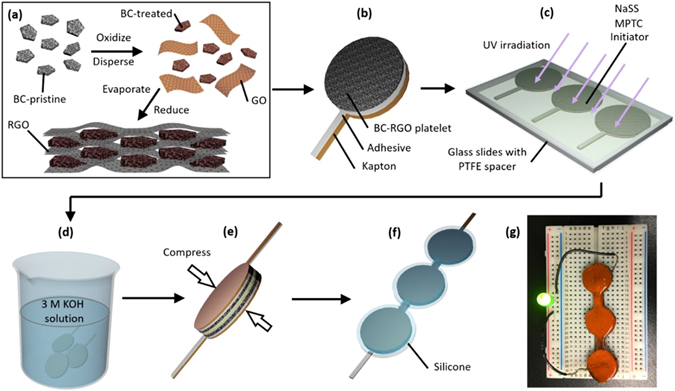
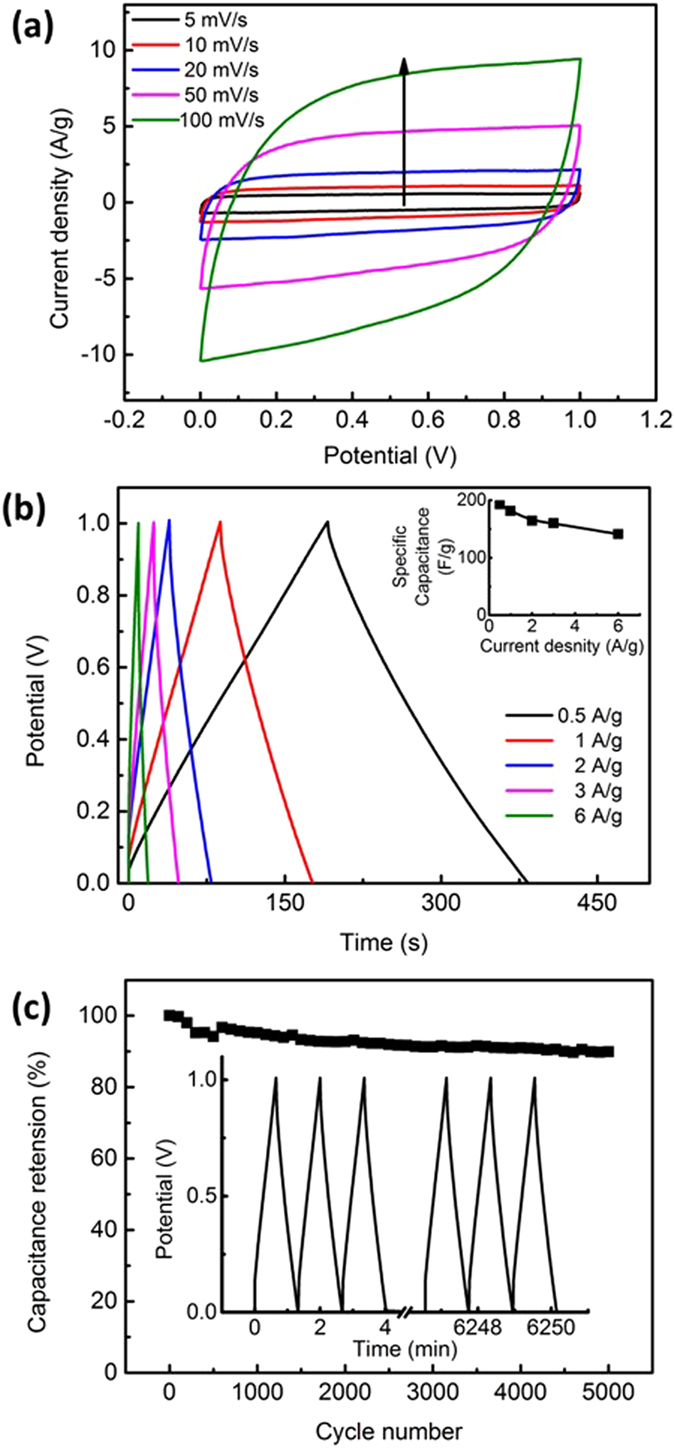
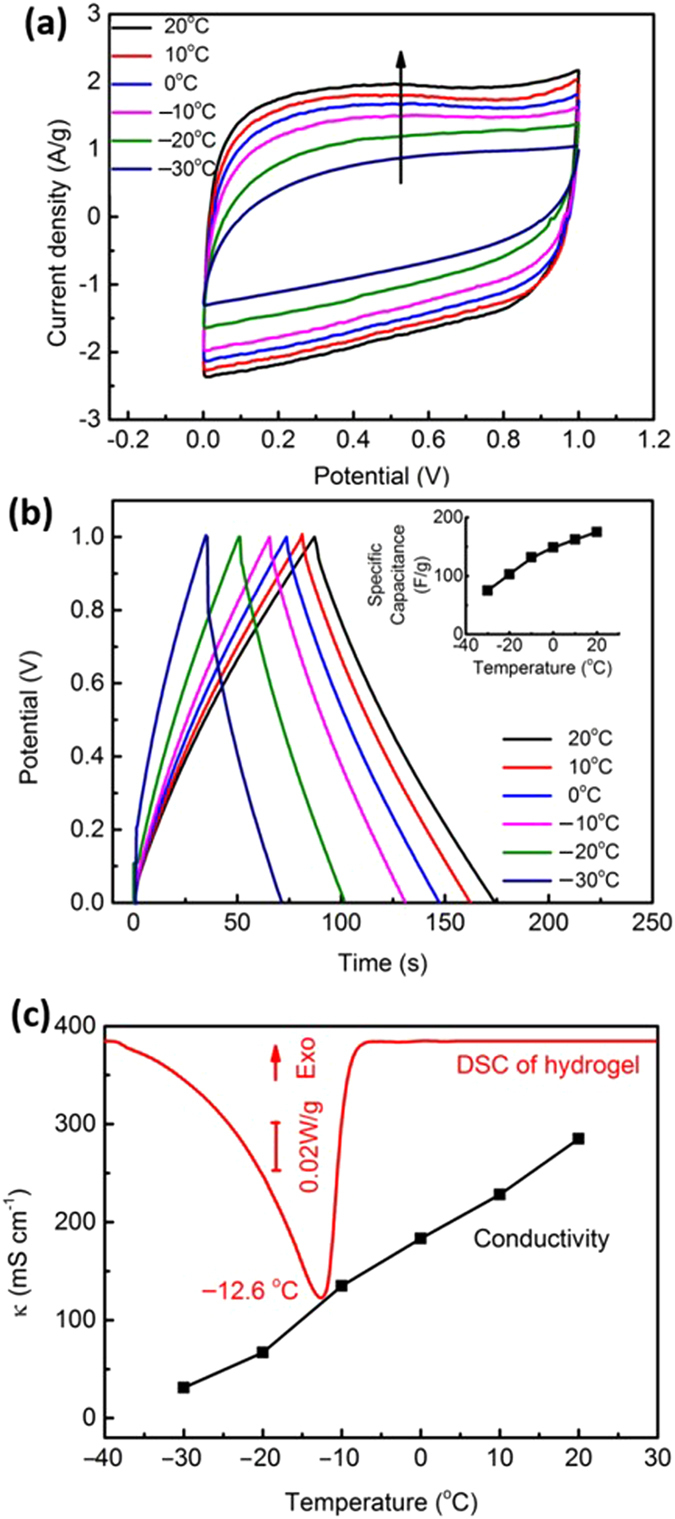
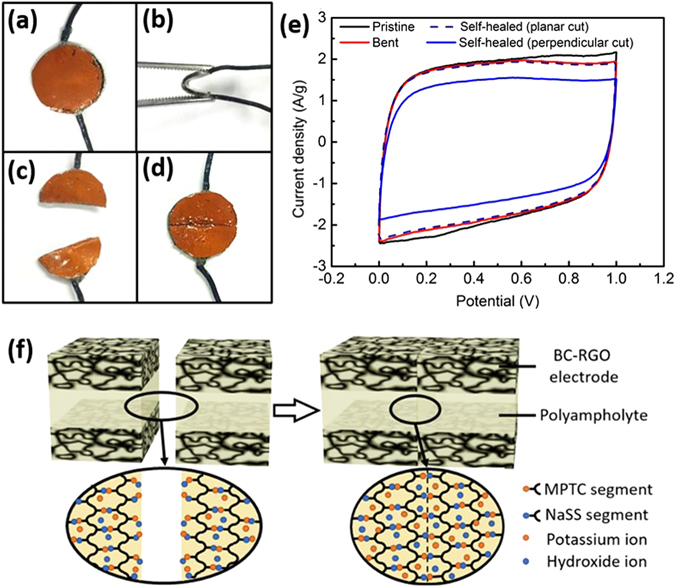
A flexible and self-healing supercapacitor with high energy density in low temperature operation was fabricated using a combination of biochar-based composite electrodes and a polyampholyte hydrogel electrolyte. Polyampholytes, a novel class of tough hydrogel, provide self-healing ability and mechanical flexibility, as well as low temperature operation for the aqueous electrolyte. Biochar is a carbon material produced from the low-temperature pyrolysis of biological wastes; the incorporation of reduced graphene oxide conferred mechanical integrity and electrical conductivity and hence the electrodes are called biochar-reduced-graphene-oxide (BC-RGO) electrodes. The fabricated supercapacitor showed high energy density of 30 Wh/kg with ~90% capacitance retention after 5000 charge–discharge cycles at room temperature at a power density of 50 W/kg. At −30 °C, the supercapacitor exhibited an energy density of 10.5 Wh/kg at a power density of 500 W/kg. The mechanism of the low-temperature performance excellence is likely to be associated with the concept of non-freezable water near the hydrophilic polymer chains, which can motivate future researches on the phase behaviour of water near polyampholyte chains. We conclude that the combination of the BC-RGO electrode and the polyampholyte hydrogel electrolyte is promising for supercapacitors for flexible electronics and for low temperature environments.
Overview
The claims and statistics of this paper haven’t been checked yet.
Run the check — free, no account needed. It reads the open-access text and checks the sources it cites.
Integrity signals
Registry
Cites
Statistics
Figures
Verification
Claims the paper makes
The claims and statistics of this paper haven’t been checked yet.
Run the check — free, no account needed. It reads the open-access text and checks the sources it cites.
Claims other papers make about this one
Each is checked against this paper’s own text: does it say what the citing paper says it does?
In the citing paper
“Recently, the discovery of 'geobattery' theory (reversible functional interspecies conversion) on natural pyrogenic carbon, whereby phenolic -OH and quinoid C=O can undergo electronmediated transformation, further indicates the electron donating ability of phenolic -OH.105,106”
From Sustainable remediation with an electroactive biochar system: mechanisms and perspectives (2020) · cites this paper as [106]
Self-check
Percentages, sums and reported differences re-computed from the paper’s own numbers.
The self-check needs the paper’s full text.
Citations
Cites
Issues and challenges facing rechargeable lithium batteries
Tarascon, J. ‐., & Armand, M. B. (2001) · Nature · doi:10.1038/35104644 · Cited by 21,450
Ionic-liquid materials for the electrochemical challenges of the future
Armand, M. B., Endres, F., MacFarlane, D. R., Ohno, H., & Scrosati, B. (2009) · Nature Materials · doi:10.1038/nmat2448 · Cited by 4,694
Room-temperature stationary sodium-ion batteries for large-scale electric energy storage
Pan, H., Hu, Y., & Chen, L. (2013) · Energy & Environmental Science · doi:10.1039/c3ee40847g · Cited by 3,326
Carbons and Electrolytes for Advanced Supercapacitors
Béguin, F., Presser, V., Balducci, A., & Frąckowiak, E. (2014) · Advanced Materials · doi:10.1002/adma.201304137 · Cited by 2,690
Lehmann, J. (2007) · Nature · doi:10.1038/447143a · Cited by 2,477
Best practice methods for determining an electrode material's performance for ultracapacitors
Stoller, M. D., & Ruoff, R. S. (2010) · Energy & Environmental Science · doi:10.1039/c0ee00074d · Cited by 2,315
Physical hydrogels composed of polyampholytes demonstrate high toughness and viscoelasticity
Sun, T. L., Kurokawa, T., Kuroda, S., Ihsan, A. B., Akasaki, T., Sato, K., Haque, M. A., Nakajima, T., & Gong, J. P. (2013) · Nature Materials · doi:10.1038/nmat3713 · Cited by 2,089
Electrolytes for solid-state lithium rechargeable batteries: recent advances and perspectives
Quartarone, E., & Mustarelli, P. (2011) · Chemical Society Reviews · doi:10.1039/c0cs00081g · Cited by 1,633
Flexible solid-state supercapacitors: design, fabrication and applications
Lu, X., Yu, M., Wang, G., Tong, Y., & Li, Y. (2014) · Energy & Environmental Science · doi:10.1039/c4ee00960f · Cited by 1,326
Highly Flexible and All-Solid-State Paperlike Polymer Supercapacitors
Meng, C., Liu, C., Chen, L., Hu, C., & Fan, S. (2010) · Nano Letters · doi:10.1021/nl1019672 · Cited by 1,194
Research works printed but not linked: 1
- Khodakovsky, I. L., Mironenko, M. V., Chernysheva, I. V. and Pokrovsky, O. S. Liquid radioactive waste solutions. In Contaminant hydrology: cold regions modelling (eds Grant, S. A. & Iskandar, I. K.) (CRC Press, 2000).
Cited by
Sorted by citations
Review of supercapacitors: Materials and devices
Poonam, Sharma, K., Arora, A., & Tripathi, S. K. (2019) · Journal of Energy Storage · doi:10.1016/j.est.2019.01.010 · Cited by 2,095
An aqueous hybrid electrolyte for low-temperature zinc-based energy storage devices
Chang, N., Li, T., Li, R., Wang, S., Yin, Y., Zhang, H., & Li, X. (2020) · Energy & Environmental Science · doi:10.1039/d0ee01538e · Cited by 806
Self-citationHydrogel Electrolytes for Flexible Aqueous Energy Storage Devices
Wang, Z., Li, H., Tang, Z., Liu, Z., Ruan, Z., Ma, L., Yang, Q., Wang, D., & Zhi, C. (2018) · Advanced Functional Materials · doi:10.1002/adfm.201804560 · Cited by 665
You, S., Ok, Y. S., Chen, S. S., Tsang, D. C. W., Kwon, E. E., Lee, J., & Wang, C. (2017) · Bioresource Technology · doi:10.1016/j.biortech.2017.06.177 · Cited by 441
Self-citationEngineered biochar – A sustainable solution for the removal of antibiotics from water
Krasucka, P., Pan, B., Ok, Y. S., Mohan, D., Sarkar, B., & Oleszczuk, P. (2020) · Chemical Engineering Journal · doi:10.1016/j.cej.2020.126926 · Cited by 407
Self-citationCustomised fabrication of nitrogen-doped biochar for environmental and energy applications
Wan, Z., Sun, Y., Tsang, D. C. W., Khan, E., Yip, A. C. K., Ng, Y. H., Rinklebe, J., & Ok, Y. S. (2020) · Chemical Engineering Journal · doi:10.1016/j.cej.2020.126136 · Cited by 324
Self-citationA Flexible Stretchable Hydrogel Electrolyte for Healable All‐in‐One Configured Supercapacitors
Guo, Y., Zheng, K., & Wan, P. (2018) · Small · doi:10.1002/smll.201704497 · Cited by 291
Park, S., Thangavel, G., Parida, K., Li, S., & Lee, P. S. (2018) · Advanced Materials · doi:10.1002/adma.201805536 · Cited by 267
An intuitive review of supercapacitors with recent progress and novel device applications
Raghavendra, K. V. G., Vinoth, R., Zeb, K., Gopi, C. V. V. M., Sangaraju, S., Kummara, M. R., Obaidat, I. M., & Kim, H. (2020) · Journal of Energy Storage · doi:10.1016/j.est.2020.101652 · Cited by 272
Rashidi, S., Karimi, N., Sunden, B. A., Kim, K. C., Olabi, A. G., & Mahian, O. (2021) · Progress in Energy and Combustion Science · doi:10.1016/j.pecs.2021.100966 · Cited by 271
Li, X., Lou, D., Wang, H., Sun, X.-Y., Li, J., & Liu, Y.-N. (2020) · Advanced Functional Materials · doi:10.1002/adfm.202007291 · Cited by 211
Self-citationElectrochemical Supercapacitors: From Mechanism Understanding to Multifunctional Applications
Chen, J.-W., & Lee, P. (2020) · Advanced Energy Materials · doi:10.1002/aenm.202003311 · Cited by 192
Nanostructured graphene-based materials for flexible energy storage
Guo, X., Zheng, S., Zhang, G., Xiao, X., Li, X., Xu, Y., Xue, H., & Pang, H. (2017) · Energy storage materials · doi:10.1016/j.ensm.2017.07.006 · Cited by 234
Self-citationYang, J., Xu, Z., Wang, J., Gai, L., Ji, X., Jiang, H., & Liu, L. (2021) · Advanced Functional Materials · doi:10.1002/adfm.202009438 · Cited by 232
Self-citationQin, C., Wang, H., Yuan, X., Xiong, T., Zhang, J., & Zhang, J. (2020) · Chemical Engineering Journal · doi:10.1016/j.cej.2019.122977 · Cited by 205
Development and application of self-healing materials in smart batteries and supercapacitors
Cheng, Y. L., Xiao, X., Pan, K., & Pang, H. (2019) · Chemical Engineering Journal · doi:10.1016/j.cej.2019.122565 · Cited by 201
Self‐Healing Materials for Energy‐Storage Devices
Mai, W., Yu, Q., Han, C., Kang, F., & Li, B. (2020) · Advanced Functional Materials · doi:10.1002/adfm.201909912 · Cited by 194
Nanobiochar: production, properties, and multifunctional applications
Ramanayaka, S., Vithanage, M. S., Alessi, D. S., Liu, W., Jayasundera, A. C. A., & Ok, Y. S. (2020) · Environmental Science Nano · doi:10.1039/d0en00486c · Cited by 194
Self-citationSustainable remediation with an electroactive biochar system: mechanisms and perspectives
Wan, Z., Sun, Y., Tsang, D. C. W., Hou, D., Cao, X., Zhang, S., Gao, B., & Ok, Y. S. (2020) · Green Chemistry · doi:10.1039/d0gc00717j · Cited by 162
Self-citationLin, Y., Zhang, H., Liao, H., Zhao, Y., & Li, K. (2019) · Chemical Engineering Journal · doi:10.1016/j.cej.2019.02.064 · Cited by 149
Vijayaraghavan, K. (2019) · Environmental Technology Reviews · doi:10.1080/21622515.2019.1631393 · Cited by 146
Atomic Insights into Advances and Issues in Low‐Temperature Electrolytes
Hou, R., Guo, S., & Zhou, H. S. (2023) · Advanced Energy Materials · doi:10.1002/aenm.202300053 · Cited by 145
A self-healing hydrogel electrolyte for flexible solid-state supercapacitors
Zhao, J., Gong, J., Wang, G., Zhu, K., Ye, K., Yan, J., & Cao, D. (2020) · Chemical Engineering Journal · doi:10.1016/j.cej.2020.125456 · Cited by 142
Self-healing polymers with nanomaterials and nanostructures
Zhai, L., Narkar, A. R., & Ahn, B. K. (2019) · Nano Today · doi:10.1016/j.nantod.2019.100826 · Cited by 138
Huang, H., Han, L., Fu, X., Wang, Y., Yang, Z., Pan, L., & Xu, M. H. (2021) · Small · doi:10.1002/smll.202006807 · Cited by 137
Yang, G., Huang, J., Wan, X.-H., Zhu, Y.-C., Liu, B.-B., Wang, J.-W., Hiralal, P., Fontaine, O., Guo, Y.-Z., & Zhou, H. (2021) · Nano Energy · doi:10.1016/j.nanoen.2021.106500 · Cited by 93
Hu, X., Fan, L., Qin, G., Shen, Z., Chen, J., Wang, M., Yang, J., & Chen, Q. K. (2019) · Journal of Power Sources · doi:10.1016/j.jpowsour.2019.01.006 · Cited by 116
Highly Flexible, Multipixelated Thermosensitive Smart Windows Made of Tough Hydrogels
La, T., Li, X., Kumar, A., Fu, Y., Yang, S. M., & Chung, H. (2017) · ACS Applied Materials & Interfaces · doi:10.1021/acsami.7b08907 · Cited by 112
Self-citationJeerapan, I., & Poorahong, S. (2020) · Journal of The Electrochemical Society · doi:10.1149/1945-7111/ab7117 · Cited by 116
Skin-Inspired Surface-Microstructured Tough Hydrogel Electrolytes for Stretchable Supercapacitors
Fang, L., Cai, Z., Ding, Z., Chen, T., Zhang, J., Chen, F., Shen, J., Chen, F., Li, R., Zhou, X., et al. (2019) · ACS Applied Materials & Interfaces · doi:10.1021/acsami.9b03410 · Cited by 108
Recent Achievements of Self-Healing Graphene/Polymer Composites
Du, Y., Li, D., Liu, L., & Gai, G. (2018) · Polymers · doi:10.3390/polym10020114 · Cited by 95
Self-citationPeng, S., Jiang, X., Xiang, X., Chen, K., Chen, G., Jiang, X., & Hou, L. (2019) · Electrochimica Acta · doi:10.1016/j.electacta.2019.134874 · Cited by 94
Wang, R., Yao, M., Huang, S., Tian, J., & Niu, Z. (2022) · Science China Materials · doi:10.1007/s40843-021-1924-2 · Cited by 95
Anti-Freezing multiphase gel materials: Bioinspired design strategies and applications
Xu, Y., Rong, Q., Zhao, T., & Liu, M. (2020) · Giant · doi:10.1016/j.giant.2020.100014 · Cited by 93
Design of Fe3+-Rich, High-Conductivity Lignin Hydrogels for Supercapacitor and Sensor Applications
Mondal, A. K., Xu, D., Wu, S., Zou, Q., Huang, F., & Ni, Y. (2022) · Biomacromolecules · doi:10.1021/acs.biomac.1c01194 · Cited by 92
Salimi, P., Norouzi, O., Pourhosseini, S. E. M., Bartocci, P., Tavasoli, A., Maria, F. D., Pirbazari, S. M., Bidini, G., & Fantozzi, F. (2019) · Renewable Energy · doi:10.1016/j.renene.2019.03.077 · Cited by 90
Rana, H. H., Park, J. H., Ducrot, É., Park, H., Kota, M., Han, T. H., Lee, J. Y., Kim, J., Kim, J., Howlett, P. C., et al. (2018) · Energy storage materials · doi:10.1016/j.ensm.2018.11.008 · Cited by 90
Water‐Deactivated Polyelectrolyte Hydrogel Electrolytes for Flexible High‐Voltage Supercapacitors
Wei, J., Zhou, J., Su, S., Jiang, J., Feng, J., & Wang, Q. (2018) · ChemSusChem · doi:10.1002/cssc.201801277 · Cited by 89
Mondal, A. K., Xu, D., Wu, S., Zou, Q., Lin, W., Huang, F., & Ni, Y. (2022) · International Journal of Biological Macromolecules · doi:10.1016/j.ijbiomac.2022.02.144 · Cited by 86
Mondal, A. K., Wu, S., Xu, D., Zou, Q., Chen, L., Huang, L., Huang, F., & Ni, Y. (2021) · International Journal of Biological Macromolecules · doi:10.1016/j.ijbiomac.2021.07.021 · Cited by 84
Khokhar, S., Anand, H., & Chand, P. (2022) · Journal of Energy Storage · doi:10.1016/j.est.2022.105897 · Cited by 81
Ions Transport in Electrochemical Energy Storage Devices at Low Temperatures
Sun, Y., Liu, B., Liu, L., & Yan, X. (2021) · Advanced Functional Materials · doi:10.1002/adfm.202109568 · Cited by 79
Self-citationYang, C., Wu, H., Cai, M., Zhou, Y., Guo, C., Han, Y. M., & Zhang, L. (2023) · Polymers · doi:10.3390/polym15122741 · Cited by 80
Review on Hydrogel-Based Flexible Supercapacitors for Wearable Applications
Tadesse, M. G., & Lübben, J. F. (2023) · Gels · doi:10.3390/gels9020106 · Cited by 76
Wang, M., Fan, L., Qin, G., Hu, X., Wang, Y., Wang, C., Yang, J., & Chen, Q. (2019) · Journal of Membrane Science · doi:10.1016/j.memsci.2019.117740 · Cited by 73
Liu, J., Khanam, Z., Ahmed, S., Wang, H., Wang, T., & Song, S. (2021) · Journal of Power Sources · doi:10.1016/j.jpowsour.2021.229461 · Cited by 72
Peng, Z., Shi, Y., Chen, N., Li, Y., & Pei, Q. (2020) · Advanced Functional Materials · doi:10.1002/adfm.202008321 · Cited by 71
Self-Healing Materials for Electronics Applications
Mashkoor, F., Lee, S. J., Yi, H., Noh, S. M., & Jeong, C. (2022) · International Journal of Molecular Sciences · doi:10.3390/ijms23020622 · Cited by 75
Le, P., Trưởng, N. V., Sahoo, S. K., Tseng, T., & Wei, K. (2020) · Journal of Materials Science · doi:10.1007/s10853-020-04693-5 · Cited by 69
A Solid-State and Flexible Supercapacitor That Operates across a Wide Temperature Range
Chaichi, A., Venugopalan, G., Devireddy, R. V., Arges, C. G., & Gartia, M. R. (2020) · ACS Applied Energy Materials · doi:10.1021/acsaem.0c00636 · Cited by 69
Recent achievements in self-healing materials based on ionic liquids: a review
Zhang, W., Jiang, H., Chang, Z., Wu, W. H., Wu, G., Wu, R., & Li, J. (2020) · Journal of Materials Science · doi:10.1007/s10853-020-04981-0 · Cited by 69
Recent progress in multifunctional hydrogel-based supercapacitors
Cao, X., Jiang, C., Sun, N., Tan, D., Li, Q., Bi, S., & Song, J. (2021) · Journal of Science Advanced Materials and Devices · doi:10.1016/j.jsamd.2021.06.002 · Cited by 70
Bioinspired Freeze‐Tolerant Soft Materials: Design, Properties, and Applications
Wang, Z., Valenzuela, C., Wu, J., Chen, Y., Wang, L., & Feng, W. (2022) · Small · doi:10.1002/smll.202201597 · Cited by 67
Sun, Z., Zhang, M., Yin, H. Y., Hu, Q. L., Krishnan, S., Huang, Z., Qi, H., & Wang, X. (2023) · Renewable Energy · doi:10.1016/j.renene.2023.119375 · Cited by 67
Self-citationElectrostatically Interactive Injectable Hydrogels for Drug Delivery
Seo, J. Y., Lee, B. H., Kang, T. W., Noh, J. H., Kim, M. J., Ju, H. J., Ju, H. J., Min, B. H., & Kim, M. S. (2018) · Tissue Engineering and Regenerative Medicine · doi:10.1007/s13770-018-0146-6 · Cited by 66
Flexible and Self-Healable Supercapacitor with High Capacitance Restoration
Vu, V., Mai, V., Nguyen, D. C. T., & Lee, S. (2022) · ACS Applied Energy Materials · doi:10.1021/acsaem.1c03758 · Cited by 64
Qin, G., Wang, M., Fan, L., Fang, X., Zhang, D., Liu, J., Qin, J. Y., Shi, J., Yang, J., & Chen, Q. (2020) · Journal of Power Sources · doi:10.1016/j.jpowsour.2020.228602 · Cited by 63
Shuaibu, A. D., Shah, S. S., Alzahrani, A. S., & Aziz, M. A. (2024) · Journal of Energy Storage · doi:10.1016/j.est.2024.114851 · Cited by 63
Self-Healable Antifreeze Hydrogel Based on Dense Quadruple Hydrogen Bonding
Choi, J., Kim, S., Yoo, J. H., Choi, S., & Char, K. (2021) · Macromolecules · doi:10.1021/acs.macromol.1c00295 · Cited by 57
Charaya, H., La, T., Rieger, J., & Chung, H. (2019) · Advanced Materials Technologies · doi:10.1002/admt.201900327 · Cited by 58
Self-citationYe, T., Li, D., Liu, H., She, X., Xia, Y., Zhang, S., Zhang, H., & Yang, D. (2018) · Macromolecules · doi:10.1021/acs.macromol.8b01955 · Cited by 54
Gibbsian Surface Thermodynamics
Elliott, J. A. W. (2020) · The Journal of Physical Chemistry B · doi:10.1021/acs.jpcb.0c05946 · Cited by 54
Self-citationThe role of high-entropy materials and d-band center adjustments in supercapacitor development
Ansari, M. Z., Ansari, S. A., Parveen, N., Alam, M. W., & Kim, S. (2025) · Journal of Energy Storage · doi:10.1016/j.est.2025.117535 · Cited by 54
Low-Temperature Ionic Conductivity Enhanced by Disrupted Ice Formation in Polyampholyte Hydrogels
Li, X., Charaya, H., Bernard, G. M., Elliott, J. A. W., Michaelis, V. K., Lee, B., & Chung, H. (2018) · Macromolecules · doi:10.1021/acs.macromol.7b02498 · Cited by 51
Self-citationXu, X., Liu, J., Ouyang, X., Cui, L., Hong, J.-L., Meng, X., Qin, S., Liu, C., Tang, J., & Chen, D.-Z. (2019) · Electrochimica Acta · doi:10.1016/j.electacta.2019.135551 · Cited by 50
Solar‐Thermal Driven Self‐Heating of Micro‐Supercapacitors at Low Temperatures
Sun, Y., Ma, P., Liu, L., Chen, J., Zhang, X., Lang, J., & Yan, X. (2018) · Solar RRL · doi:10.1002/solr.201800223 · Cited by 48
Self-citationSpecific Ion Effects in Polyampholyte Hydrogels Dialyzed in Aqueous Electrolytic Solutions
Charaya, H., Li, X., Jen, N., & Chung, H. (2018) · Langmuir · doi:10.1021/acs.langmuir.8b02281 · Cited by 47
Self-citationDiao, W., Wu, L., Ma, X., Wang, L., Bu, X., Ni, W., Yang, X., & Fang, Y. Z. (2020) · Journal of Applied Polymer Science · doi:10.1002/app.48995 · Cited by 47
Yang, J., Hu, X., Fang, X., Fan, L., Qin, G., Zhang, Z., Xu, J., Liang, Y. L., & Chen, Q. (2022) · Journal of Membrane Science · doi:10.1016/j.memsci.2022.120386 · Cited by 42
Hassan, H., Iqbal, M. W., Alharthi, S., Amin, M. A., Afzal, A. M., Ryl, J., & Ansari, M. Z. (2023) · Molecules · doi:10.3390/molecules28124737 · Cited by 38
Surface thermodynamics at the nanoscale
Elliott, J. A. W. (2021) · The Journal of Chemical Physics · doi:10.1063/5.0049031 · Cited by 38
Self-citationDesign and application of self-healable polymeric films and coatings for smart food packaging
Lai, W. (2023) · npj Science of Food · doi:10.1038/s41538-023-00185-3 · Cited by 35
Duy, L. T., & Seo, H. (2020) · Applied Surface Science · doi:10.1016/j.apsusc.2020.146467 · Cited by 33
Tough, flexible, and durable all-polyampholyte hydrogel supercapacitor
Li, X., Wang, Y., Li, D., Shen, C., Chen, M., Long, S., & Huang, Y. (2022) · Polymer Testing · doi:10.1016/j.polymertesting.2022.107720 · Cited by 33
Self-citationApplications of Carbon in Rechargeable Electrochemical Power Sources: A Review
Lach, J., Wróbel, K., Wróbel, J., & Czerwiński, A. A. (2021) · Energies · doi:10.3390/en14092649 · Cited by 32
Li, D., Xu, Z., Ji, X., Liu, L., Gai, G., Yang, J., & Wang, J. (2019) · Journal of Materials Chemistry A · doi:10.1039/c9ta01208g · Cited by 31
Self-citationYu, S., Ye, Y., Yang, M. J., Liu, Y., Yang, D., Li, H., & Liu, B. (2023) · Small · doi:10.1002/smll.202306267 · Cited by 30
An aqueous magnesium-ion hybrid supercapacitor operated at -50 °C
Yang, G., Qu, G., Fang, C.-Y., Deng, J., Xu, X., Xie, Y., Sun, T., Zhu, Y.-C., Zheng, J.-X., & Zhou, H. (2022) · Green Energy & Environment · doi:10.1016/j.gee.2022.09.004 · Cited by 23
Synthetic and natural polyampholytes: Structural and behavioral similarity
Kudaibergenov, S. E. (2020) · Polymers for Advanced Technologies · doi:10.1002/pat.5145 · Cited by 27
Feng, L., Mi, G., Wang, Q., Guo, M., Hao, J., Li, Z., Yang, J., Qin, G., Sun, G., & Chen, Q. (2023) · Journal of Power Sources · doi:10.1016/j.jpowsour.2023.233453 · Cited by 22
Biochar Supercapacitors: Recent Developments in the Materials and Methods
Vivekanandhan, S. (2018) · Wiley eBooks · doi:10.1002/9781119528463.ch10 · Cited by 22
Toleutay, G., Dauletbekova, M., Shakhvorostov, A. V., & Kudaibergenov, S. E. (2019) · Macromolecular Symposia · doi:10.1002/masy.201800160 · Cited by 21
Skovroinski, E., de Oliveira, R. J., & Galembeck, A. (2018) · Journal of Colloid and Interface Science · doi:10.1016/j.jcis.2018.08.048 · Cited by 19
Ashok Kumar, S., Yadav, M. S., Karmakar, S., Kundu, A., Etacheri, V., Ratha, S., Pal, V. K., & Sahoo, S. (2026) · Journal of Materials Chemistry A · doi:10.1039/d5ta09101b · Cited by 18
Role of Electrochemical Techniques for Photovoltaic and Supercapacitor Applications
Padha, B., Verma, S., Mahajan, P., Gupta, V., Khosla, A., & Arya, S. K. (2022) · Critical Reviews in Analytical Chemistry · doi:10.1080/10408347.2022.2096401 · Cited by 18
Wang, Y., Zhao, L., Peng, H., Dai, X., Liu, X., Ma, G., & Lei, Z. (2019) · Ionics · doi:10.1007/s11581-019-02966-x · Cited by 18
Behaviors of quenched polyampholytes in solution and gel state
Kudaibergenov, S. E., & Okay, O. (2020) · Polymers for Advanced Technologies · doi:10.1002/pat.5112 · Cited by 17
Bu, X., Wu, L., Ma, X., Diao, W., & Lu, D. (2020) · International Journal of Electrochemical Science · doi:10.20964/2020.03.66 · Cited by 15
Application of polyampholytes in emerging technologies
Kudaibergenov, S. E. (2022) · Materials Today Proceedings · doi:10.1016/j.matpr.2022.07.187 · Cited by 15
Alshoaibi, A. A., Awada, C., Ahmed, F., Obodo, R. M., Mâaza, M., & Ezema, F. I. (2022) · Crystals · doi:10.3390/cryst12060874 · Cited by 14
Kim, H., Kong, S. M., Kim, J. A., Yoon, G., Na, Y. H., & Kim, S. K. (2023) · Chemical Engineering Journal · doi:10.1016/j.cej.2023.147189 · Cited by 14
Ha, M., Lee, J.-H., Cho, Y., Lee, M., Baek, H., Lee, J., Seo, J., Chun, S., Kim, K., Kim, J., et al. (2023) · Advanced Materials Technologies · doi:10.1002/admt.202301404 · Cited by 16
Construct Flexible, Durable Supercapacitors via Antifreezing Polyampholyte Hydrogels
Chen, H., Wang, Y., Li, D., Zhao, Y., Wan, B., Long, S., Huang, Y., & Li, X. (2024) · ACS Applied Polymer Materials · doi:10.1021/acsapm.4c01363 · Cited by 12
Self-citationBidin, M. Z., Ming, N. H., Omar, F. S., Ramesh, K., & Ramesh, S. (2017) · Journal of Applied Polymer Science · doi:10.1002/app.45902 · Cited by 12
Wang, L., Shu, T., Guo, S., Chen, S., Jiang, Y., & Hu, X. (2020) · Journal of Energy Chemistry · doi:10.1016/j.jechem.2020.03.056 · Cited by 12
Sakthivel, P., Krishnamoorthy, A., & Devadoss, I. (2023) · Indian Journal of Physics · doi:10.1007/s12648-023-02870-1 · Cited by 11
Thermal insulating walls based on Ti3C2TX as energy storage panels for future smart house
Vaghasiya, J. V., Mayorga‐Martinez, C. C., & Pumera, M. (2022) · Chemical Engineering Journal · doi:10.1016/j.cej.2022.140114 · Cited by 11
Equimolar Polyampholyte Hydrogel Synthesis Strategies with Adaptable Properties
Toleutay, G., Su, E., & Yelemessova, G. (2023) · Polymers · doi:10.3390/polym15143131 · Cited by 10
Virya, A., Bagchi, R., & Lian, K. K. (2021) · Electrochimica Acta · doi:10.1016/j.electacta.2021.137984 · Cited by 10
Lv, S., Gao, Y., Zhao, M., Jiang, X., Li, X., Yang, J., Chen, S., & Cui, S. (2022) · Journal of Separation Science · doi:10.1002/jssc.202100884 · Cited by 8
Self-citation
Metadata
- Authors
- Li, X., Liu, L., Wang, X., Ok, Y. S., Elliott, J. A. W., Chang, S. X., & Chung, H.-J.
- Affiliations
- University of Alberta (CA)
- Kangwon National University (KR)
- Corresponding author
- Chung, Hyun-Joong
- Venue
- Scientific Reports
- Published
- 2017-05-10
- Volume
- 7
- Issue
- 1
- Pages
- 1685-1685
- ISSN
- 2045-2322 (ISSN-L)
- PMC
- PMC5431763
- OpenAlex
- W2610557054
- Cited by
- 132
- References
- 52
- Citations by year
- 2026: 7 · 2025: 8 · 2024: 3 · 2023: 18 · 2022: 17 · 2021: 15 · 2020: 27 · 2019: 18 · 2018: 15 · 2017: 4
- FWCI
- 5.95
- Type
- journal article
- Language
- en
- Open access
- gold
- doi.org
- Locations
- Scientific Reports (publishedVersion, cc-by)
- PubMed Central (publishedVersion, cc-by)
- PubMed (publishedVersion)
- DOAJ (DOAJ: Directory of Open Access Journals) (submittedVersion, cc-by-sa)
- Funders
- University of Alberta
- Canada Research Chairs
- Canadian Institutes of Health Research (140186_1)
- Natural Sciences and Engineering Research Council of Canada (435914, CHRPJ 478519, RGPIN 435914)
- Topics
- Physical Sciences › Materials Science › Electronic, Optical and Magnetic Materials › Supercapacitor Materials and Fabrication
- Physical Sciences › Engineering › Electrical and Electronic Engineering › Aqueous and Flow Batteries
- Physical Sciences › Materials Science › Materials Chemistry › MXene and MAX Phase Materials
- Keywords
- aqueous supercapacitors, self-healing hydrogels, biochar electrodes, reduced graphene oxide, low-temperature performance, flexible energy storage, non-freezable water, energy density, cycling stability, flexible electronics
About these checks
Registry, retraction, Cites and statistics results are computed, not judged, with one exception: a printed reference that no index lists is read once by a model before it counts as a citation error. Claims are extracted by a model and kept only when their quote appears verbatim in the text; each cited source is then checked, with a model’s help, for whether it says what the claim relies on. Those verdicts can be wrong — read the claim’s quote and the cited source before relying on one.
Statistics and arithmetic are recomputed, not judged.
Confidence bands are shown only for fields calibrated on our annotated test set. None is calibrated yet, so no band is shown.
What counts as a claim ›How we measure confidence ›How we check this ›
Are you an author, or do you see a problem with this page? Request a review
