

The DOI matches its Crossref record; 64 of the 64 references it cites were found in a registry or an index.
Tracking Real-Time Changes in Working Memory Updating and Gating with the Event-Based Eye-Blink Rate
Open accessPublished version of a preprint
Abstract
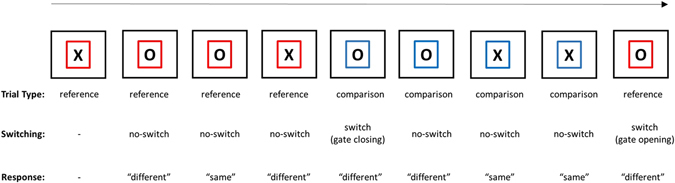
Effective working memory (WM) functioning depends on the gating process that regulates the balance between maintenance and updating of WM. The present study used the event-based eye-blink rate (ebEBR), which presumably reflects phasic striatal dopamine activity, to examine how the cognitive processes of gating and updating separately facilitate flexible updating of WM contents and the potential involvement of dopamine in these processes. Real-time changes in eye blinks were tracked during performance on the reference-back task, in which demands on these two processes were independently manipulated. In all three experiments, trials that required WM updating and trials that required gate switching were both associated with increased ebEBR. These results may support the prefrontal cortex basal ganglia WM model (PBWM) by linking updating and gating to striatal dopaminergic activity. In Experiment 3, the ebEBR was used to determine what triggers gate switching. We found that switching to an updating mode (gate opening) was more stimulus driven and retroactive than switching to a maintenance mode, which was more context driven. Together, these findings show that the ebEBR – an inexpensive, non-invasive, easy-to-use measure – can be used to track changes in WM demands during task performance and, hence, possibly striatal dopamine activity.
Overview
The claims and statistics of this paper haven’t been checked yet.
Free: it reads the open-access text and checks the first 5 claims that cite a source we can check. Create a free account to check every claim.
Integrity signals
Registry
Cites
Statistics
Figures


Verification
Claims the paper makes
The claims and statistics of this paper haven’t been checked yet.
Free: it reads the open-access text and checks the first 5 claims that cite a source we can check. Create a free account to check every claim.
Claims other papers make about this one
Each is checked against this paper’s own text: does it say what the citing paper says it does?
The cited source says what the claim attributes to it.
In the citing paper
“Second, trials requiring WM updating and gate switching elicited an increase in spontaneous eye blink rate (Rac-Lubashevsky, Slagter, & Kessler, 2017)—a presumed marker of dopamine activity in BG (Jongkees & Colzato, 2016), which implements the gating mechanism (Hazy et al., 2006).”
From Baseline-dependent effect of dopamine’s precursor L-tyrosine on working memory gating but not updating (2020) · cites this paper as Rac-Lubashevsky et al., 2017
The cited source says what the claim attributes to it.
In the citing paper
“In summary, the reference-back paradigm is well-suited to disentangle component processes of WM.”
From Baseline-dependent effect of dopamine’s precursor L-tyrosine on working memory gating but not updating (2020) · cites this paper as Rac-Lubashevsky et al., 2017
Self-check
Percentages, sums and reported differences re-computed from the paper’s own numbers.
The self-check needs the paper’s full text.
Citations
Cites
Delorme, A., & Makeig, S. (2004) · Journal of Neuroscience Methods · doi:10.1016/j.jneumeth.2003.10.009 · Cited by 24,371
An Integrative Theory of Prefrontal Cortex Function
Miller, E. K., & Cohen, J. D. (2001) · Annual Review of Neuroscience · doi:10.1146/annurev.neuro.24.1.167 · Cited by 12,803
A JOURNAL OF PHARMACOLOGY AND EXPERIMENTAL THERAPEUTICS
(1909) · Journal of the American Medical Association · doi:10.1001/jama.1909.02550020033007 · Cited by 7,866
The magical number 4 in short-term memory: A reconsideration of mental storage capacity
Cowan, N. (2001) · Behavioral and Brain Sciences · doi:10.1017/s0140525x01003922 · Cited by 6,779
Persistent activity in the prefrontal cortex during working memory
Curtis, C. E., & D'Esposito, M. (2003) · Trends in Cognitive Sciences · doi:10.1016/s1364-6613(03)00197-9 · Cited by 2,001
Temporal dynamics of brain activation during a working memory task
Cohen, J. D., Perlstein, W. M., Braver, T. S., Nystrom, L. E., Noll, D. C., Jonides, J., & Smith, E. E. (1997) · Nature · doi:10.1038/386604a0 · Cited by 1,876
A Parametric Study of Prefrontal Cortex Involvement in Human Working Memory
Braver, T. S., Cohen, J. D., Nystrom, L. E., Jonides, J., Smith, E. E., & Noll, D. C. (1997) · NeuroImage · doi:10.1006/nimg.1996.0247 · Cited by 1,694
Inverted-U–Shaped Dopamine Actions on Human Working Memory and Cognitive Control
Cools, R., & D'Esposito, M. (2011) · Biological Psychiatry · doi:10.1016/j.biopsych.2011.03.028 · Cited by 1,673
The primate basal ganglia: Parallel and integrative networks
Haber, S. N. (2003) · Journal of Chemical Neuroanatomy · doi:10.1016/j.jchemneu.2003.10.003 · Cited by 1,479
Neural measures reveal individual differences in controlling access to working memory
Vogel, E. K., McCollough, A. W., & Machizawa, M. G. (2005) · Nature · doi:10.1038/nature04171 · Cited by 1,299
Cited by
Spontaneous eye blink rate as predictor of dopamine-related cognitive function—A review
Jongkees, B. J., & Colzato, L. S. (2016) · Neuroscience & Biobehavioral Reviews · doi:10.1016/j.neubiorev.2016.08.020 · Cited by 300
Souchet, A. D., Philippe, S., Lourdeaux, D., & Leroy, L. (2022) · International Journal of Human–Computer Interaction · doi:10.1080/10447318.2021.1976509 · Cited by 204
“However, it appears to be a viable metric of central dopamine activity (Eckstein et al., 2017; Jongkees & Colzato, 2016; Rac-Lubashevsky et al., 2017) which is associated with motivation mechanisms (Wise, 2004).”
BackgroundBreathable Electronic Skins for Daily Physiological Signal Monitoring
Yang, Y., Cui, T., Li, D., Ji, S., Chen, Z., Shao, W., Liu, H., & Ren, T.-L. (2022) · Nano-Micro Letters · doi:10.1007/s40820-022-00911-8 · Cited by 176
Spontaneous eye blink rate: An index of dopaminergic component of sustained attention and fatigue
Maffei, A., & Angrilli, A. (2017) · International Journal of Psychophysiology · doi:10.1016/j.ijpsycho.2017.11.009 · Cited by 174
Imperceptible electrooculography graphene sensor system for human–robot interface
Ameri, S. K., Kim, M., Kuang, I. A., Perera, W. K., Alshiekh, M., Jeong, H., Topcu, U., Akinwande, D., & Lu, N. (2018) · npj 2D Materials and Applications · doi:10.1038/s41699-018-0064-4 · Cited by 162
Metadata
- Authors
- Rac-Lubashevsky, R., Slagter, H. A., & Kessler, Y.
- Affiliations
- Ben-Gurion University of the Negev (IL)
- University of Amsterdam (NL)
- Corresponding author
- Rac-Lubashevsky, Rachel
- Venue
- Scientific Reports
- Published
- 2017-05-31
- Volume
- 7
- Issue
- 1
- Pages
- 2547-2547
- ISSN
- 2045-2322 (ISSN-L)
- PMC
- PMC5451427
- OpenAlex
- W2950752434
- Cited by
- 52
- References
- 64
- Citations by year
- 2026: 3 · 2025: 6 · 2024: 7 · 2023: 6 · 2022: 5 · 2021: 4 · 2020: 5 · 2019: 2 · 2018: 10 · 2017: 3
- FWCI
- 3.14
- Type
- journal article
- Language
- en
- Open access
- gold
- doi.org
- Licence
- cc-by
- creativecommons.org/licenses/by/4.0 (tdm)
- creativecommons.org/licenses/by/4.0 (vor)
- Locations
- Scientific Reports (publishedVersion, cc-by)
- Europe PMC (PubMed Central) (publishedVersion, other-oa)
- PubMed Central (publishedVersion, cc-by)
- PubMed (publishedVersion)
- UvA-DARE (University of Amsterdam) (submittedVersion, cc-by)
- DOAJ (DOAJ: Directory of Open Access Journals) (submittedVersion, cc-by-sa)
- Data Archiving and Networked Services (DANS) (submittedVersion, other-oa)
- Funders
- Israel Science Foundation (458/14)
- Topics
- Life Sciences › Neuroscience › Cognitive Neuroscience › Neural and Behavioral Psychology Studies
- Social Sciences › Psychology › Experimental and Cognitive Psychology › Cognitive Abilities and Testing
- Life Sciences › Neuroscience › Cellular and Molecular Neuroscience › Neurotransmitter Receptor Influence on Behavior
- Keywords
- working memory updating, maintenance mode
- MeSH terms
- Adult, Attention, Basal Ganglia, Blinking, Corpus Striatum, Dopamine, Female, Humans, Male, Memory, Short-Term, Pattern Recognition, Visual, Task Performance and Analysis, Prefrontal Cortex
About these checks
Registry, retraction, Cites and statistics results are computed, not judged, with one exception: a printed reference that no index lists is read once by a model before it counts as a citation error. Claims are extracted by a model and kept only when their quote appears verbatim in the text; each cited source is then checked, with a model’s help, for whether it says what the claim relies on. Those verdicts can be wrong — read the claim’s quote and the cited source before relying on one.
Statistics and arithmetic are recomputed, not judged.
Confidence bands are shown only for fields calibrated on our annotated test set. None is calibrated yet, so no band is shown.
What counts as a claim ›How we measure confidence ›How we check this ›
Are you an author, or do you see a problem with this page? Request a review
How to cite
Cite CoChat for the checks on this page, and the paper for its own findings.
- This page
- CoChat. (2026). Citation check: Tracking Real-Time Changes in Working Memory Updating and Gating with the Event-Based Eye-Blink Rate. https://app.cochat.ai/papers/10.1038/s41598-017-02942-3
- The paper
- Rac-Lubashevsky, R., Slagter, H. A., & Kessler, Y. (2017). Tracking Real-Time Changes in Working Memory Updating and Gating with the Event-Based Eye-Blink Rate. Scientific Reports. https://doi.org/10.1038/s41598-017-02942-3
Data sources
Bibliographic data: Semantic Scholar, OpenAlex, Crossref.
Contains information from the Semantic Scholar Academic Graph Datasets, made available under the ODC Attribution License (ODC-BY 1.0).
Semantic Scholar’s data is described in: Kinney, R., et al. (2023). The Semantic Scholar Open Data Platform. arXiv:2301.10140.
