

The DOI matches its Crossref record; 65 of the 65 references it cites were found in a registry or an index.
Imperceptible electrooculography graphene sensor system for human–robot interface
Open accessAbstract
Electrooculography (EOG) is a method to record the electrical potential between the cornea and the retina of human eyes. Despite many applications of EOG in both research and medical diagnosis for many decades, state-of-the-art EOG sensors are still bulky, stiff, and uncomfortable to wear. Since EOG has to be measured around the eye, a prominent area for appearance with delicate skin, mechanically and optically imperceptible EOG sensors are highly desirable. Here, we report an imperceptible EOG sensor system based on noninvasive graphene electronic tattoos (GET), which are ultrathin, ultrasoft, transparent, and breathable. The GET EOG sensors can be easily laminated around the eyes without using any adhesives and they impose no constraint on blinking or facial expressions. High-precision EOG with an angular resolution of 4° of eye movement can be recorded by the GET EOG and eye movement can be accurately interpreted. Imperceptible GET EOG sensors have been successfully applied for human–robot interface (HRI). To demonstrate the functionality of GET EOG sensors for HRI, we connected GET EOG sensors to a wireless transmitter attached to the collar such that we can use eyeball movements to wirelessly control a quadcopter in real time.
Overview
The claims and statistics of this paper haven’t been checked yet.
Free: it reads the open-access text and checks the first 5 claims that cite a source we can check. Create a free account to check every claim.
Integrity signals
Registry
Cites
Statistics
Figures

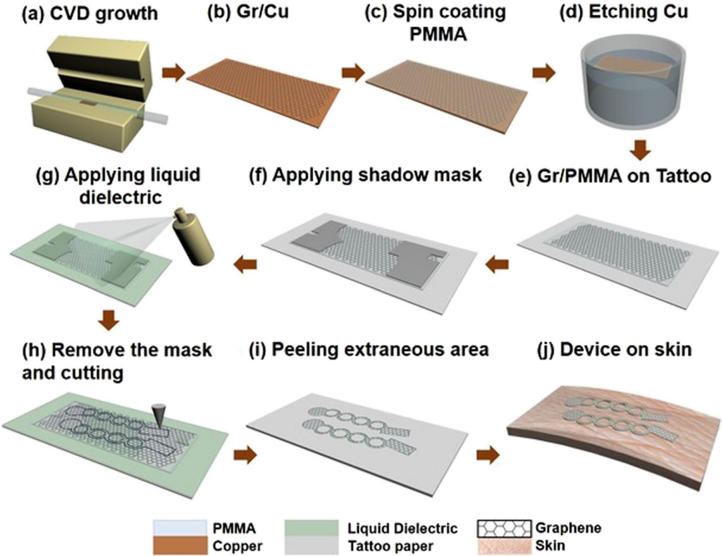
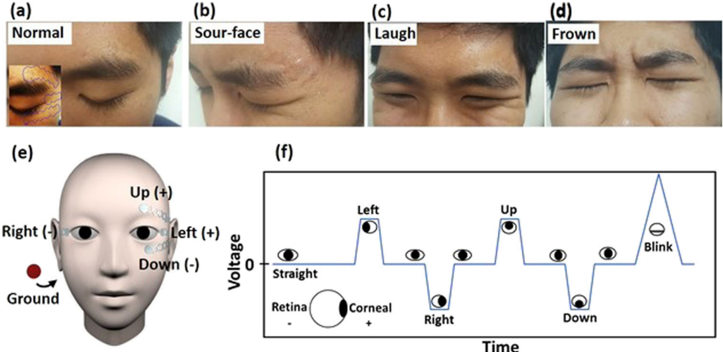
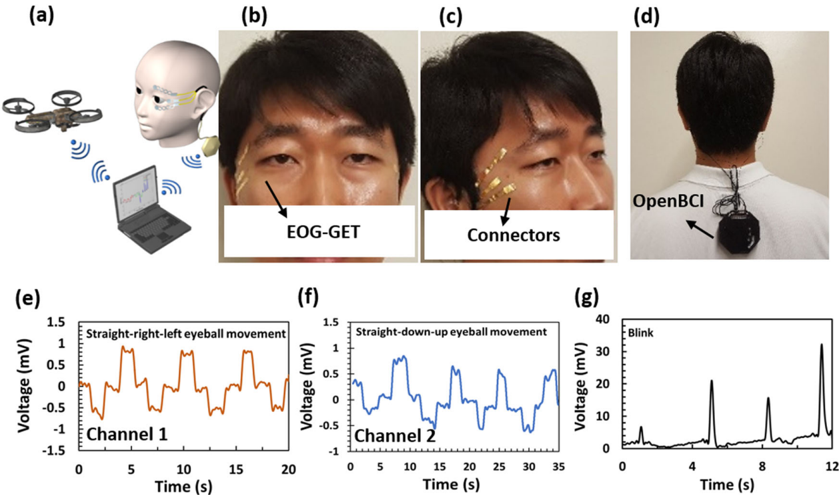
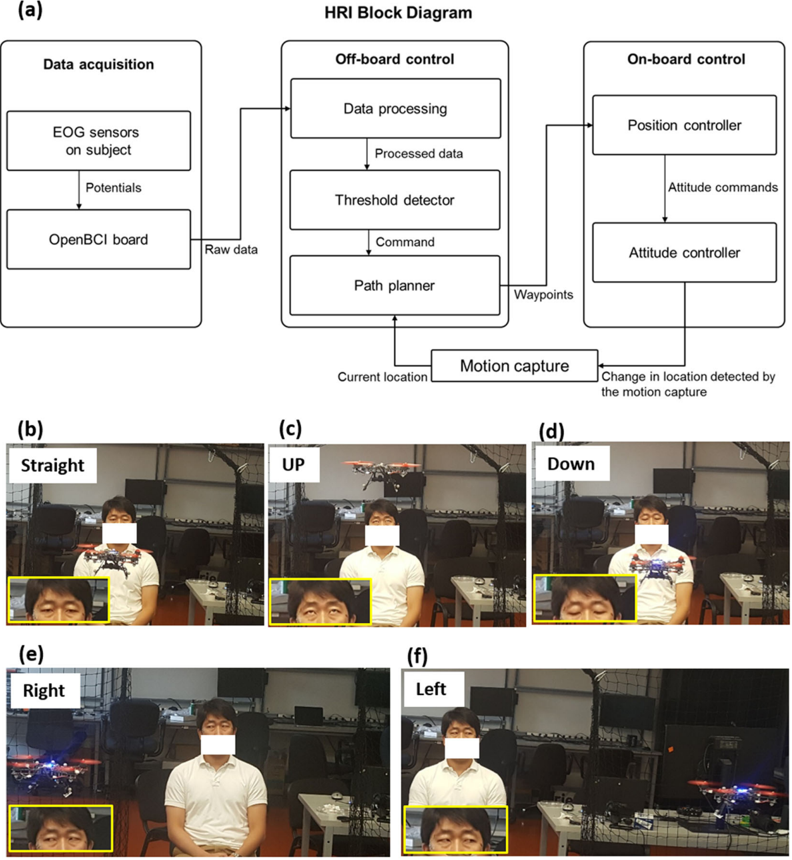
Verification
Claims the paper makes
The claims and statistics of this paper haven’t been checked yet.
Free: it reads the open-access text and checks the first 5 claims that cite a source we can check. Create a free account to check every claim.
Claims other papers make about this one
Each is checked against this paper’s own text: does it say what the citing paper says it does?
The check wasn’t confident either way, so it gives no verdict — never disputed.
In the citing paper
“Surface EMG is therefore, in principle, a low-cost and specific way of detecting what the patient wants the prosthetic to do.[400,401]”
From Flexible Electronics and Devices as Human–Machine Interfaces for Medical Robotics (2022) · cites this paper as [400]
Experimental — accuracy not yet measured
Self-check
Percentages, sums and reported differences re-computed from the paper’s own numbers.
The self-check needs the paper’s full text.
Citations
Cites
Fully integrated wearable sensor arrays for multiplexed in situ perspiration analysis
Gao, W., Emaminejad, S., Nyein, H. Y. Y., Challa, S., Chen, K., Peck, A., Fahad, H. M., Ota, H., Shiraki, H., Kiriya, D., et al. (2016) · Nature · doi:10.1038/nature16521 · Cited by 5,087
Kim, D.-H., Lu, N., Ma, R., Kim, Y.-S., Kim, R.-H., Wang, S., Wu, J., Won, S. M., Tao, H., Islam, A., et al. (2011) · Science · doi:10.1126/science.1206157 · Cited by 4,836
Self-citationAn ultra-lightweight design for imperceptible plastic electronics
Kaltenbrunner, M., Sekitani, T., Reeder, J., Yokota, T., Kuribara, K., Tokuhara, T., Drack, M., Schwödiauer, R., Graz, I., Bauer-Gogonea, S., et al. (2013) · Nature · doi:10.1038/nature12314 · Cited by 2,485
Pursuing prosthetic electronic skin
Chortos, A., Liu, J., & Bao, Z. (2016) · Nature Materials · doi:10.1038/nmat4671 · Cited by 2,396
Hecht, D. S., Hu, L., & Irvin, G. (2011) · Advanced Materials · doi:10.1002/adma.201003188 · Cited by 2,229
Past achievements and future challenges in the development of optically transparent electrodes
Ellmer, K. (2012) · Nature Photonics · doi:10.1038/nphoton.2012.282 · Cited by 2,090
Lee, H., Choi, T. K., Lee, Y. B., Cho, H. R., Ghaffari, R., Wang, L., Choi, H. J., Chung, T. D., Lu, N., Hyeon, T., et al. (2016) · Nature Nanotechnology · doi:10.1038/nnano.2016.38 · Cited by 1,802
Self-citationTransfer printing by kinetic control of adhesion to an elastomeric stamp
Meitl, M. A., Zhu, Z.-T., Kumar, V., Lee, K. J., Feng, X., Huang, Y. Y., Adesida, I., Nuzzo, R. G., & Rogers, J. A. (2006) · Nature Materials · doi:10.1038/nmat1532 · Cited by 1,548
Multifunctional wearable devices for diagnosis and therapy of movement disorders
Son, D., Lee, J., Qiao, S., Ghaffari, R., Kim, J., Lee, J. E., Song, C., Kim, S. J., Lee, D. J., Jun, S. W., et al. (2014) · Nature Nanotechnology · doi:10.1038/nnano.2014.38 · Cited by 1,462
Self-citationA highly stretchable, transparent, and conductive polymer
Wang, Y., Zhu, C., Pfattner, R., Yan, H., Jin, L., Chen, S., Molina-Lopez, F., Lissel, F., Liu, J., Rabiah, N. I., et al. (2017) · Science Advances · doi:10.1126/sciadv.1602076 · Cited by 1,442
Research works printed but not linked: 1
- Siddiqui, U. & Shaikh, A. N. An overview of “electrooculography”. Int. J. Adv. Res. Comput. Commun. Eng. 2, 3 (2013).
Cited by
Bio-Integrated Wearable Systems: A Comprehensive Review
Ray, T. R., Choi, J., Bandodkar, A. J., Krishnan, S., Gutruf, P., Tian, L., Ghaffari, R., & Rogers, J. A. (2019) · Chemical Reviews · doi:10.1021/acs.chemrev.8b00573 · Cited by 1,350
Flexible Hybrid Electronics for Digital Healthcare
Ma, Y., Zhang, Y., Cai, S., Han, Z., Liu, X., Wang, F., Cao, Y., Wang, Z., Li, H., Chen, Y., et al. (2020) · Advanced Materials · doi:10.1002/adma.201902062 · Cited by 620
Flexible Electronics and Devices as Human–Machine Interfaces for Medical Robotics
Heng, W., Solomon, S., & Gao, W. (2022) · Advanced Materials · doi:10.1002/adma.202107902 · Cited by 609
Hong, Y. J., Jeong, H., Cho, K. W., Lu, N., & Kim, D. (2019) · Advanced Functional Materials · doi:10.1002/adfm.201808247 · Cited by 559
Self-citationSang, M., Shin, J., Kim, K., & Yu, K. J. (2019) · Nanomaterials · doi:10.3390/nano9030374 · Cited by 505
Metadata
- Authors
- Ameri, S. K., Kim, M., Kuang, I. A., Perera, W. K., Alshiekh, M., Jeong, H., Topcu, U., Akinwande, D., & Lu, N.
- Affiliations
- The University of Texas at Austin (US)
- Texas Materials Institute (US)
- Corresponding author
- Akinwande, Deji
- Lu, Nanshu
- ORCID
- Venue
- npj 2D Materials and Applications
- Published
- 2018-07-24
- Volume
- 2
- Issue
- 1
- ISSN
- 2397-7132 (ISSN-L)
- OpenAlex
- W2809506543
- Semantic Scholar
- 5ade482a3c84be18790be183dd3dcdc3fd797f54
- Cited by
- 162
- References
- 65
- Citations by year
- 2026: 12 · 2025: 16 · 2024: 20 · 2023: 25 · 2022: 27 · 2021: 24 · 2020: 17 · 2019: 19 · 2018: 1
- FWCI
- 6.10
- Type
- journal article
- Language
- en
- Open access
- gold
- doi.org
- Licence
- cc-by
- creativecommons.org/licenses/by/4.0 (tdm)
- creativecommons.org/licenses/by/4.0 (vor)
- Locations
- npj 2D Materials and Applications (publishedVersion, cc-by)
- DOAJ (DOAJ: Directory of Open Access Journals) (submittedVersion)
- Scholarworks@UNIST (Ulsan National Institute of Science and Technology) (submittedVersion)
- Funders
- DOD | Office of Naval Research (N00014-16-1-2044)
- National Science Foundation (CNS-1738293)
- Topics
- Physical Sciences › Engineering › Biomedical Engineering › Advanced Sensor and Energy Harvesting Materials
- Physical Sciences › Computer Science › Human-Computer Interaction › Gaze Tracking and Assistive Technology
- Life Sciences › Neuroscience › Cellular and Molecular Neuroscience › Neuroscience and Neural Engineering
- Keywords
- electrooculography, human-robot interface, eye movement detection, wearable sensors, wireless control, quadcopter control
About these checks
Registry, retraction, Cites and statistics results are computed, not judged, with one exception: a printed reference that no index lists is read once by a model before it counts as a citation error. Claims are extracted by a model and kept only when their quote appears verbatim in the text; each cited source is then checked, with a model’s help, for whether it says what the claim relies on. Those verdicts can be wrong — read the claim’s quote and the cited source before relying on one.
Statistics and arithmetic are recomputed, not judged.
Confidence bands are shown only for fields calibrated on our annotated test set. None is calibrated yet, so no band is shown.
What counts as a claim ›How we measure confidence ›How we check this ›
Are you an author, or do you see a problem with this page? Request a review
How to cite
Cite CoChat for the checks on this page, and the paper for its own findings.
- This page
- CoChat. (2026). Citation check: Imperceptible electrooculography graphene sensor system for human–robot interface. https://app.cochat.ai/papers/10.1038/s41699-018-0064-4
- The paper
- Ameri, S. K., Kim, M., Kuang, I. A., Perera, W. K., Alshiekh, M., Jeong, H., Topcu, U., Akinwande, D., & Lu, N. (2018). Imperceptible electrooculography graphene sensor system for human–robot interface. npj 2D Materials and Applications. https://doi.org/10.1038/s41699-018-0064-4
Data sources
Bibliographic data: Semantic Scholar, OpenAlex, Crossref.
Contains information from the Semantic Scholar Academic Graph Datasets, made available under the ODC Attribution License (ODC-BY 1.0).
Semantic Scholar’s data is described in: Kinney, R., et al. (2023). The Semantic Scholar Open Data Platform. arXiv:2301.10140.
