

Tracking Real-Time Changes in Working Memory Updating and Gating with the Event-Based Eye-Blink Rate
Open accessPublished version of a preprint
The DOI matches its Crossref record; 64 of the 64 references it cites were found in a registry or an index.
Abstract
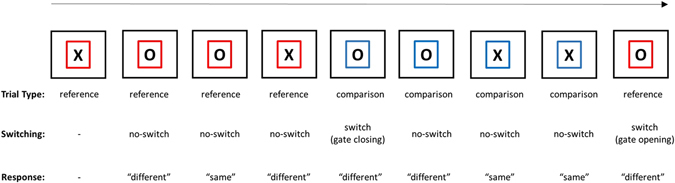
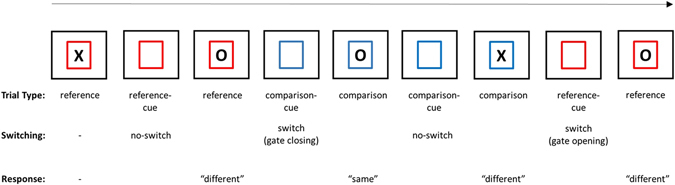
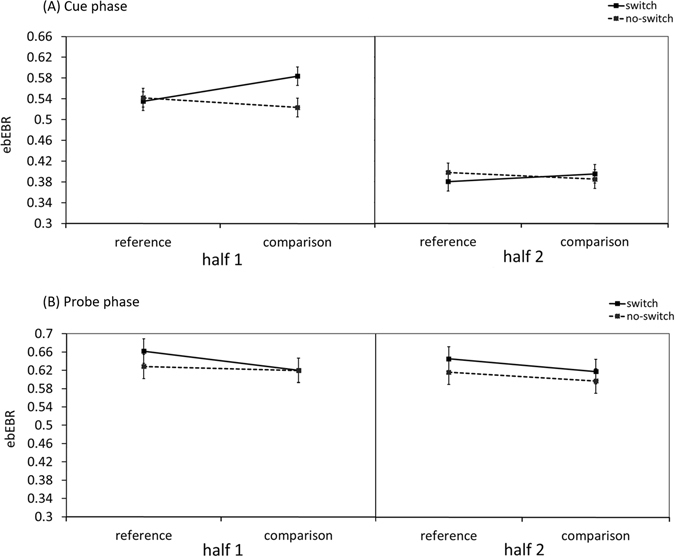
Effective working memory (WM) functioning depends on the gating process that regulates the balance between maintenance and updating of WM. The present study used the event-based eye-blink rate (ebEBR), which presumably reflects phasic striatal dopamine activity, to examine how the cognitive processes of gating and updating separately facilitate flexible updating of WM contents and the potential involvement of dopamine in these processes. Real-time changes in eye blinks were tracked during performance on the reference-back task, in which demands on these two processes were independently manipulated. In all three experiments, trials that required WM updating and trials that required gate switching were both associated with increased ebEBR. These results may support the prefrontal cortex basal ganglia WM model (PBWM) by linking updating and gating to striatal dopaminergic activity. In Experiment 3, the ebEBR was used to determine what triggers gate switching. We found that switching to an updating mode (gate opening) was more stimulus driven and retroactive than switching to a maintenance mode, which was more context driven. Together, these findings show that the ebEBR – an inexpensive, non-invasive, easy-to-use measure – can be used to track changes in WM demands during task performance and, hence, possibly striatal dopamine activity.
Overview
The claims and statistics of this paper haven’t been checked yet.
Free: it reads the open-access text and checks the first 5 claims that cite a source we can check. Create a free account to check every claim.
Integrity signals
Registry
Cites
Statistics
Figures
Verification
Claims the paper makes
The claims and statistics of this paper haven’t been checked yet.
Free: it reads the open-access text and checks the first 5 claims that cite a source we can check. Create a free account to check every claim.
Claims other papers make about this one
Each is checked against this paper’s own text: does it say what the citing paper says it does?
The cited source says what the claim attributes to it.
In the citing paper
“Second, trials requiring WM updating and gate switching elicited an increase in spontaneous eye blink rate (Rac-Lubashevsky, Slagter, & Kessler, 2017)—a presumed marker of dopamine activity in BG (Jongkees & Colzato, 2016), which implements the gating mechanism (Hazy et al., 2006).”
From Baseline-dependent effect of dopamine’s precursor L-tyrosine on working memory gating but not updating (2020) · cites this paper as Rac-Lubashevsky et al., 2017
The cited source says what the claim attributes to it.
In the citing paper
“In summary, the reference-back paradigm is well-suited to disentangle component processes of WM.”
From Baseline-dependent effect of dopamine’s precursor L-tyrosine on working memory gating but not updating (2020) · cites this paper as Rac-Lubashevsky et al., 2017
Self-check
Percentages, sums and reported differences re-computed from the paper’s own numbers.
The self-check needs the paper’s full text.
Citations
Cites
Delorme, A., & Makeig, S. (2004) · Journal of Neuroscience Methods · doi:10.1016/j.jneumeth.2003.10.009 · Cited by 24,371
An Integrative Theory of Prefrontal Cortex Function
Miller, E. K., & Cohen, J. D. (2001) · Annual Review of Neuroscience · doi:10.1146/annurev.neuro.24.1.167 · Cited by 12,803
A JOURNAL OF PHARMACOLOGY AND EXPERIMENTAL THERAPEUTICS
(1909) · Journal of the American Medical Association · doi:10.1001/jama.1909.02550020033007 · Cited by 7,866
The magical number 4 in short-term memory: A reconsideration of mental storage capacity
Cowan, N. (2001) · Behavioral and Brain Sciences · doi:10.1017/s0140525x01003922 · Cited by 6,779
Persistent activity in the prefrontal cortex during working memory
Curtis, C. E., & D'Esposito, M. (2003) · Trends in Cognitive Sciences · doi:10.1016/s1364-6613(03)00197-9 · Cited by 2,001
Temporal dynamics of brain activation during a working memory task
Cohen, J. D., Perlstein, W. M., Braver, T. S., Nystrom, L. E., Noll, D. C., Jonides, J., & Smith, E. E. (1997) · Nature · doi:10.1038/386604a0 · Cited by 1,876
A Parametric Study of Prefrontal Cortex Involvement in Human Working Memory
Braver, T. S., Cohen, J. D., Nystrom, L. E., Jonides, J., Smith, E. E., & Noll, D. C. (1997) · NeuroImage · doi:10.1006/nimg.1996.0247 · Cited by 1,694
Inverted-U–Shaped Dopamine Actions on Human Working Memory and Cognitive Control
Cools, R., & D'Esposito, M. (2011) · Biological Psychiatry · doi:10.1016/j.biopsych.2011.03.028 · Cited by 1,673
The primate basal ganglia: Parallel and integrative networks
Haber, S. N. (2003) · Journal of Chemical Neuroanatomy · doi:10.1016/j.jchemneu.2003.10.003 · Cited by 1,479
Neural measures reveal individual differences in controlling access to working memory
Vogel, E. K., McCollough, A. W., & Machizawa, M. G. (2005) · Nature · doi:10.1038/nature04171 · Cited by 1,299
Reconfiguration of processing mode prior to task performance.
Meiran, N. (1996) · Journal of Experimental Psychology: Learning, Memory, and Cognition · doi:10.1037//0278-7393.22.6.1423 · Cited by 1,153
Functional MRI studies of spatial and nonspatial working memory
D'Esposito, M., Aguirre, G. K., Zarahn, E., Ballard, D., Shin, R. K., & Lease, J. (1998) · Cognitive Brain Research · doi:10.1016/s0926-6410(98)00004-4 · Cited by 1,006
Prefrontal cortex and basal ganglia control access to working memory
McNab, F., & Klingberg, T. (2008) · Nature Neuroscience · doi:10.1038/nn2024 · Cited by 989
Interactions between frontal cortex and basal ganglia in working memory: A computational model
FRANK, M. J., LOUGHRY, B., & O'REILLY, R. C. (2001) · Cognitive, Affective, & Behavioral Neuroscience · doi:10.3758/cabn.1.2.137 · Cited by 879
FRONTO-STRIATAL COGNITIVE DEFICITS AT DIFFERENT STAGES OF PARKINSON'S DISEASE
OWEN, A. M., JAMES, M., LEIGH, P. N., SUMMERS, B. A., MARSDEN, C. D., QUINN, N. P., LANGE, K. W., & ROBBINS, T. W. (1992) · Brain · doi:10.1093/brain/115.6.1727 · Cited by 868
Dreisbach, G., & Goschke, T. (2004) · Journal of Experimental Psychology: Learning, Memory, and Cognition · doi:10.1037/0278-7393.30.2.343 · Cited by 775
Using confidence intervals for graphically based data interpretation.
Masson, M. E. J., & Loftus, G. R. (2003) · Canadian Journal of Experimental Psychology / Revue canadienne de psychologie expérimentale · doi:10.1037/h0087426 · Cited by 730
SPONTANEOUS EYE-BLINK RATES AND DOPAMINERGIC SYSTEMS
KARSON, C. N. (1983) · Brain · doi:10.1093/brain/106.3.643 · Cited by 514
Stern, J. A., Walrath, L. C., & Goldstein, R. (1984) · Psychophysiology · doi:10.1111/j.1469-8986.1984.tb02312.x · Cited by 510
Basal-ganglia 'Projections' to the Prefrontal Cortex of the Primate
Middleton, F. A. (2002) · Cerebral Cortex · doi:10.1093/cercor/12.9.926 · Cited by 451
On the Control of Control: The Role of Dopamine in Regulating Prefrontal Function and Working Memory
(2000) · Control of Cognitive Processes · doi:10.7551/mitpress/1481.003.0044 · Cited by 416
Banishing the homunculus: Making working memory work
Hazy, T. E., Frank, M. J., & O’Reilly, R. C. (2006) · Neuroscience · doi:10.1016/j.neuroscience.2005.04.067 · Cited by 385
Siegle, G. J., Ichikawa, N., & Steinhauer, S. (2008) · Psychophysiology · doi:10.1111/j.1469-8986.2008.00681.x · Cited by 317
Role of prefrontal cortex and the midbrain dopamine system in working memory updating
D’Ardenne, K., Eshel, N., Luka, J., Lenartowicz, A., Nystrom, L. E., & Cohen, J. D. (2012) · Proceedings of the National Academy of Sciences · doi:10.1073/pnas.1116727109 · Cited by 305
Goschke, T., & Bolte, A. (2014) · Neuropsychologia · doi:10.1016/j.neuropsychologia.2014.07.015 · Cited by 288
The anatomical relationships of the prefrontal cortex with limbic structures and the basal ganglia
Groenewegen, H. J., Wright, C. I., & Uylings, H. B. M. (1997) · Journal of Psychopharmacology · doi:10.1177/026988119701100202 · Cited by 268 · cited 7×
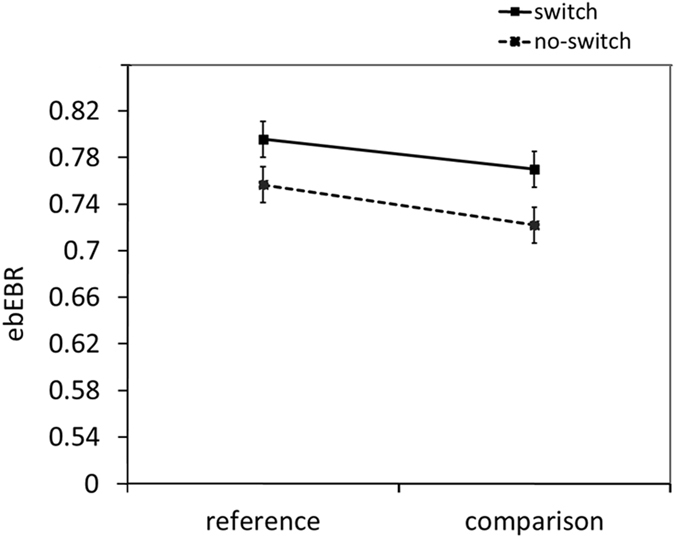
“As before, the ebERB was significantly higher in the reference than in the comparison trials, F(1, 19) = 6.”
BackgroundInfluentialHuman prefrontal lesions increase distractibility to irrelevant sensory inputs
Chao, L. L., & Knight, R. T. (1995) · NeuroReport · doi:10.1097/00001756-199508000-00005 · Cited by 265
Diurnal variation in spontaneous eye-blink rate
Barbato, G., Ficca, G., Muscettola, G., Fichele, M., Beatrice, M., & Rinaldi, F. (2000) · Psychiatry Research · doi:10.1016/s0165-1781(00)00108-6 · Cited by 208
Between Persistence and Flexibility
Hommel, B. (2015) · Advances in Motivation Science · doi:10.1016/bs.adms.2015.04.003 · Cited by 204
Taylor, J. R., Elsworth, J. D., Lawrence, M. S., Sladek, J. R., Roth, R. H., & Redmond, D. E. (1999) · Experimental Neurology · doi:10.1006/exnr.1999.7093 · Cited by 197
Metatheory of storage capacity limits
Cowan, N. (2001) · Behavioral and Brain Sciences · doi:10.1017/s0140525x0161392x · Cited by 196
Dreisbach, G., Müller, J., Goschke, T., Strobel, A., Schulze, K., Lesch, K.-P., & Brocke, B. (2005) · Behavioral Neuroscience · doi:10.1037/0735-7044.119.2.483 · Cited by 194
Dopamine modulation in the basal ganglia locks the gate to working memory
Gruber, A. J., Dayan, P., Gutkin, B. S., & Solla, S. A. (2006) · Journal of Computational Neuroscience · doi:10.1007/s10827-005-5705-x · Cited by 194 · cited 3×
“Indeed, ebERB was significantly higher in the reference than in the comparison trials, F(1, 18) = 13.”
BackgroundInfluentialStereological Approaches to Identifying Neuropathology in Psychosis
Dorph-Petersen, K.-A., & Lewis, D. A. (2011) · Biological Psychiatry · doi:10.1016/j.biopsych.2010.04.030 · Cited by 151
Mesoscopic Structure Conditions the Emergence of Cooperation on Social Networks
Lozano, S., Arenas, A., & Sánchez, A. (2008) · PLoS ONE · doi:10.1371/journal.pone.0001892 · Cited by 150
Groman, S. M., James, A. S., Seu, E., Tran, S., Clark, T. A., Harpster, S. N., Crawford, M., Burtner, J. L., Feiler, K., Roth, R. H., et al. (2014) · The Journal of Neuroscience · doi:10.1523/jneurosci.3037-14.2014 · Cited by 143
Blink rates and disorders of movement
Karson, C. N., Burns, R. S., LeWitt, P. A., Foster, N. L., & Newman, R. P. (1984) · Neurology · doi:10.1212/wnl.34.5.677 · Cited by 138
Kleven, M. S., & Koek, W. (1996) · The Journal of Pharmacology and Experimental Therapeutics · doi:10.1016/s0022-3565(25)21279-4 · Cited by 128
D1 and D2 dopamine receptors independently regulate spontaneous blink rate in the vervet monkey.
Elsworth, J. D., Lawrence, M. S., Roth, R. H., Taylor, J. R., Mailman, R. B., Nichols, D. E., Lewis, M. H., & Redmond, D. E. (1991) · The Journal of Pharmacology and Experimental Therapeutics · doi:10.1016/s0022-3565(25)20364-0 · Cited by 121
Apomorphine‐induced blinking and yawning in healthy volunteers.
Blin, O., Masson, G., Azulay, J., Fondarai, J., & Serratrice, G. (1990) · British Journal of Clinical Pharmacology · doi:10.1111/j.1365-2125.1990.tb03848.x · Cited by 116
van Schouwenburg, M., Aarts, E., & Cools, R. (2010) · Current Pharmaceutical Design · doi:10.2174/138161210791293097 · Cited by 113
Accessory Stimulus Effects on Response Selection: Does Arousal Speed Decision Making?
Hackley, S. A., & Valle‐Inclán, F. (1999) · Journal of Cognitive Neuroscience · doi:10.1162/089892999563427 · Cited by 110
Clinical Psychological Science
Queen's University, Chivers, M. L., Bowie, C., Queen's University, Buchanan, S., Queen's University, Clifford, T., Queen's University, Goodman, J., Queen's University, et al. (2019) · The Canadian Handbook for Careers in Psychological Science · doi:10.24908/008f0328a598/ch5 · Cited by 105
The timing and temporal patterns of eye blinking are dynamically modulated by attention
Oh, J., Jeong, S.-Y., & Jeong, J. (2012) · Human Movement Science · doi:10.1016/j.humov.2012.06.003 · Cited by 100
Blinks of the eye predict blinks of the mind
Colzato, L. S., Slagter, H. A., Spapé, M., & Hommel, B. (2008) · Neuropsychologia · doi:10.1016/j.neuropsychologia.2008.07.006 · Cited by 99
Self-citationDecomposing the n-back task: An individual differences study using the reference-back paradigm
Rac-Lubashevsky, R., & Kessler, Y. (2016) · Neuropsychologia · doi:10.1016/j.neuropsychologia.2016.07.013 · Cited by 96
Self-citationKarson, C. N., Dykman, R. A., & Paige, S. R. (1990) · Schizophrenia Bulletin · doi:10.1093/schbul/16.2.345 · Cited by 90
Dissociating working memory updating and automatic updating: The reference-back paradigm.
Rac-Lubashevsky, R., & Kessler, Y. (2016) · Journal of Experimental Psychology: Learning, Memory, and Cognition · doi:10.1037/xlm0000219 · Cited by 84
Self-citationSpontaneous eye blink rate predicts learning from negative, but not positive, outcomes
Slagter, H. A., Georgopoulou, K., & Frank, M. J. (2015) · Neuropsychologia · doi:10.1016/j.neuropsychologia.2015.03.028 · Cited by 83
Self-citationKessler, Y., & Oberauer, K. (2014) · Journal of Experimental Psychology: Learning, Memory, and Cognition · doi:10.1037/a0035545 · Cited by 78
Self-citationMPTP lesions and dopaminergic drugs alter eye blink rate in African green monkeys
Lawrence, M. S., & Redmond, D. E. (1991) · Pharmacology Biochemistry and Behavior · doi:10.1016/0091-3057(91)90255-z · Cited by 76
Blinking predicts enhanced cognitive control
van Bochove, M. E., der Haegen, L. V., Notebaert, W., & Verguts, T. (2012) · Cognitive Affective & Behavioral Neuroscience · doi:10.3758/s13415-012-0138-2 · Cited by 68
Brain regions activated by endogenous preparatory set shifting as revealed by fMRI
Slagter, H. A., Weissman, D. H., Giesbrecht, B., Kenemans, J. L., Mangun, G. R., Kok, A., & Woldorff, M. G. (2006) · Cognitive Affective & Behavioral Neuroscience · doi:10.3758/cabn.6.3.175 · Cited by 63
Self-citationColzato, L. S., van den Wildenberg, W. P. M., & Hommel, B. (2008) · PLoS ONE · doi:10.1371/journal.pone.0003461 · Cited by 61
Eye-blinks in choice response tasks uncover hidden aspects of information processing
Wascher, E., Heppner, H., Möckel, T., Kobald, S. O., & Getzmann, S. (2015) · EXCLI journal · doi:10.17179/excli2015-696 · Cited by 60
8-Month-Old Infants Spontaneously Learn and Generalize Hierarchical Rules
Werchan, D. M., Collins, A. G. E., Frank, M. J., & Amso, D. (2015) · Psychological Science · doi:10.1177/0956797615571442 · Cited by 59
Doping the Mind: Dopaminergic Modulation of Prefrontal Cortical Cognition
Ranganath, A., & Jacob, S. N. (2016) · The Neuroscientist · doi:10.1177/1073858415602850 · Cited by 50
Forward scanning in verbal working memory updating
Kessler, Y., & Oberauer, K. (2015) · Psychonomic Bulletin & Review · doi:10.3758/s13423-015-0853-0 · Cited by 47
Self-citationEye-blink rate predicts individual differences in pseudoneglect
Slagter, H. A., Davidson, R. J., & Tomer, R. (2009) · Neuropsychologia · doi:10.1016/j.neuropsychologia.2009.12.027 · Cited by 46
Self-citationCortex–basal ganglia interaction and attractor states
Djurfeldt, M., Ekeberg, Ö., & Graybiel, A. M. (2001) · Neurocomputing · doi:10.1016/s0925-2312(01)00413-1 · Cited by 38
Swerdlow, N. R., Wasserman, L. C., Talledo, J., Casas, R. N., Bruins, P., & Stephany, N. (2002) · Biological Psychology · doi:10.1016/s0301-0511(02)00090-x · Cited by 35
Peckham, A., & Johnson, S. L. (2015) · Clinical Psychological Science · doi:10.1177/2167702615594999 · Cited by 34
Tharp, J. A., Wendelken, C., Mathews, C. A., Marco, E. J., Schreier, H. A., & Bunge, S. A. (2015) · Frontiers in Psychiatry · doi:10.3389/fpsyt.2015.00095 · Cited by 28
Bacher, L. F., Retz, S., Lindon, C., & Bell, M. A. (2016) · Infancy · doi:10.1111/infa.12164 · Cited by 15
Cited by
Spontaneous eye blink rate as predictor of dopamine-related cognitive function—A review
Jongkees, B. J., & Colzato, L. S. (2016) · Neuroscience & Biobehavioral Reviews · doi:10.1016/j.neubiorev.2016.08.020 · Cited by 300
Souchet, A. D., Philippe, S., Lourdeaux, D., & Leroy, L. (2022) · International Journal of Human–Computer Interaction · doi:10.1080/10447318.2021.1976509 · Cited by 204
“However, it appears to be a viable metric of central dopamine activity (Eckstein et al., 2017; Jongkees & Colzato, 2016; Rac-Lubashevsky et al., 2017) which is associated with motivation mechanisms (Wise, 2004).”
BackgroundBreathable Electronic Skins for Daily Physiological Signal Monitoring
Yang, Y., Cui, T., Li, D., Ji, S., Chen, Z., Shao, W., Liu, H., & Ren, T.-L. (2022) · Nano-Micro Letters · doi:10.1007/s40820-022-00911-8 · Cited by 176
Spontaneous eye blink rate: An index of dopaminergic component of sustained attention and fatigue
Maffei, A., & Angrilli, A. (2017) · International Journal of Psychophysiology · doi:10.1016/j.ijpsycho.2017.11.009 · Cited by 187
Imperceptible electrooculography graphene sensor system for human–robot interface
Ameri, S. K., Kim, M., Kuang, I. A., Perera, W. K., Alshiekh, M., Jeong, H., Topcu, U., Akinwande, D., & Lu, N. (2018) · npj 2D Materials and Applications · doi:10.1038/s41699-018-0064-4 · Cited by 162
Metadata
- Authors
- Rac-Lubashevsky, R., Slagter, H. A., & Kessler, Y.
- Affiliations
- Ben-Gurion University of the Negev (IL)
- University of Amsterdam (NL)
- Corresponding author
- Rac-Lubashevsky, Rachel
- Venue
- Scientific Reports
- Published
- 2017-05-31
- Volume
- 7
- Issue
- 1
- Pages
- 2547-2547
- ISSN
- 2045-2322 (ISSN-L)
- PMC
- PMC5451427
- OpenAlex
- W2950752434
- Semantic Scholar
- ccc0582b7445f5cf452a5fa9d2d68c14f8086185
- Cited by
- 52
- References
- 64
- Citations by year
- 2026: 3 · 2025: 6 · 2024: 7 · 2023: 6 · 2022: 5 · 2021: 4 · 2020: 5 · 2019: 2 · 2018: 10 · 2017: 3
- FWCI
- 3.14
- Type
- journal article
- Language
- en
- Open access
- gold
- doi.org
- Licence
- cc-by
- creativecommons.org/licenses/by/4.0 (tdm)
- creativecommons.org/licenses/by/4.0 (vor)
- Locations
- Scientific Reports (publishedVersion, cc-by)
- Europe PMC (PubMed Central) (publishedVersion, other-oa)
- PubMed Central (publishedVersion, cc-by)
- PubMed (publishedVersion)
- UvA-DARE (University of Amsterdam) (submittedVersion, cc-by)
- DOAJ (DOAJ: Directory of Open Access Journals) (submittedVersion, cc-by-sa)
- Data Archiving and Networked Services (DANS) (submittedVersion, other-oa)
- Funders
- Israel Science Foundation (458/14)
- Topics
- Life Sciences › Neuroscience › Cognitive Neuroscience › Neural and Behavioral Psychology Studies
- Social Sciences › Psychology › Experimental and Cognitive Psychology › Cognitive Abilities and Testing
- Life Sciences › Neuroscience › Cellular and Molecular Neuroscience › Neurotransmitter Receptor Influence on Behavior
- Keywords
- working memory updating, maintenance mode
- MeSH terms
- Adult, Attention, Basal Ganglia, Blinking, Corpus Striatum, Dopamine, Female, Humans, Male, Memory, Short-Term, Pattern Recognition, Visual, Task Performance and Analysis, Prefrontal Cortex
About these checks
Registry, retraction, Cites and statistics results are computed, not judged, with one exception: a printed reference that no index lists is read once by a model before it counts as a citation error. Claims are extracted by a model and kept only when their quote appears verbatim in the text; each cited source is then checked, with a model’s help, for whether it says what the claim relies on. Those verdicts can be wrong — read the claim’s quote and the cited source before relying on one.
Statistics and arithmetic are recomputed, not judged.
Confidence bands are shown only for fields calibrated on our annotated test set. None is calibrated yet, so no band is shown.
What counts as a claim ›How we measure confidence ›How we check this ›
Are you an author, or do you see a problem with this page? Request a review
Data sources
Bibliographic data: Semantic Scholar, OpenAlex, Crossref.
Contains information from the Semantic Scholar Academic Graph Datasets, made available under the ODC Attribution License (ODC-BY 1.0).
Semantic Scholar’s data is described in: Kinney, R., et al. (2023). The Semantic Scholar Open Data Platform. arXiv:2301.10140.
