

Disturbance and mosquito diversity in the lowland tropical rainforest of central Panama
Open accessThe DOI matches its Crossref record; 75 of the 75 references it cites were found in a registry or an index.
Abstract
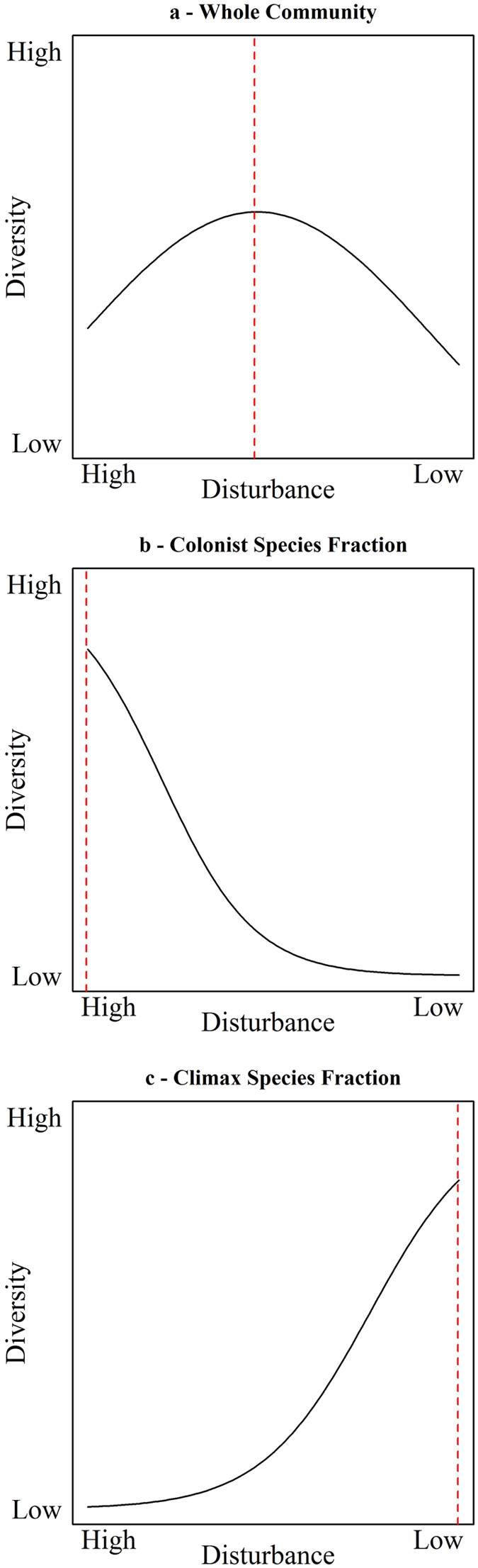
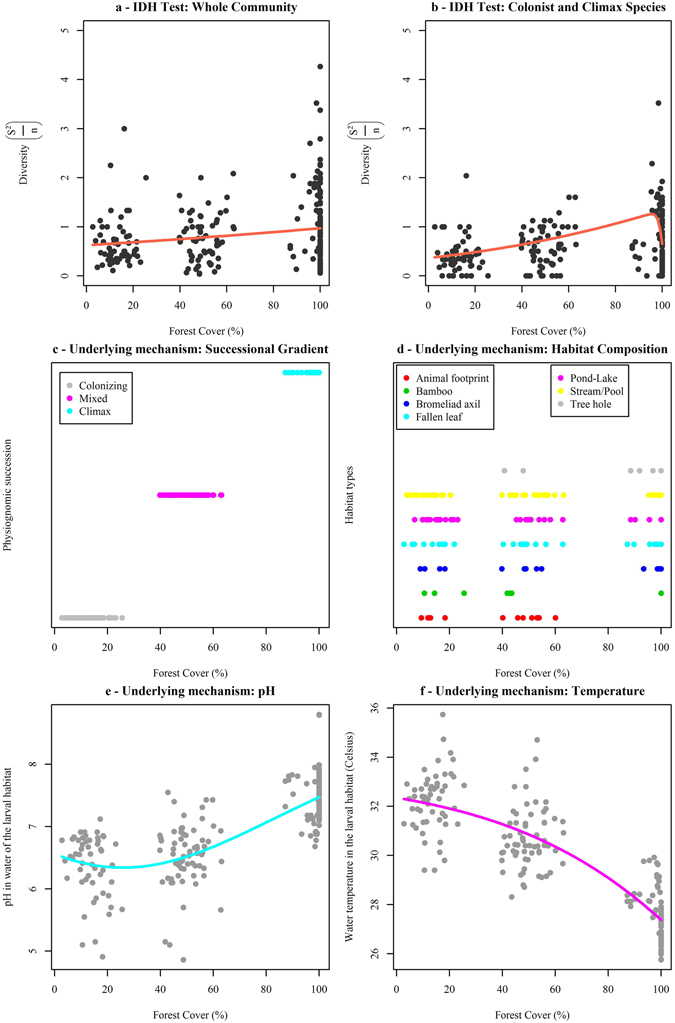
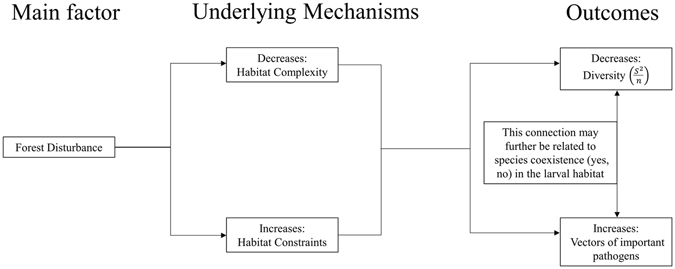
The Intermediate Disturbance Hypothesis (IDH) is well-known in ecology providing an explanation for the role of disturbance in the coexistence of climax and colonist species. Here, we used the IDH as a framework to describe the role of forest disturbance in shaping the mosquito community structure, and to identify the ecological processes that increase the emergence of vector-borne disease. Mosquitoes were collected in central Panama at immature stages along linear transects in colonising, mixed and climax forest habitats, representing different levels of disturbance. Species were identified taxonomically and classified into functional categories (i.e., colonist, climax, disturbance-generalist, and rare). Using the Huisman-Olff-Fresco multi-model selection approach, IDH testing was done. We did not detect a unimodal relationship between species diversity and forest disturbance expected under the IDH; instead diversity peaked in old-growth forests. Habitat complexity and constraints are two mechanisms proposed to explain this alternative postulate. Moreover, colonist mosquito species were more likely to be involved in or capable of pathogen transmission than climax species. Vector species occurrence decreased notably in undisturbed forest settings. Old-growth forest conservation in tropical rainforests is therefore a highly-recommended solution for preventing new outbreaks of arboviral and parasitic diseases in anthropic environments.
Overview
The claims and statistics of this paper haven’t been checked yet.
Free: it reads the open-access text and checks the first 5 claims that cite a source we can check. Create a free account to check every claim.
Integrity signals
Registry
Cites
Statistics
Figures
Verification
Claims the paper makes
The claims and statistics of this paper haven’t been checked yet.
Free: it reads the open-access text and checks the first 5 claims that cite a source we can check. Create a free account to check every claim.
Claims other papers make about this one
Each is checked against this paper’s own text: does it say what the citing paper says it does?
The cited source says what the claim attributes to it.
In the citing paper
“With the intent of preventing malaria epidemics, environmental manipulation has been proposed in Panama and other Latin American countries by increasing forest cover recovery in highly disturbed deforested areas, thus favouring the prevalence of auxiliary over primary vectors [34].”
From Achieving global malaria eradication in changing landscapes (2021) · cites this paper as [34]
Self-check
Percentages, sums and reported differences re-computed from the paper’s own numbers.
The self-check needs the paper’s full text.
Citations
Cites
Tamura, K., Peterson, D., Peterson, N., Stecher, G., Nei, M., & Kumar, S. (2011) · Molecular Biology and Evolution · doi:10.1093/molbev/msr121 · Cited by 39,969
Connell, J. H. (1978) · Science · doi:10.1126/science.199.4335.1302 · Cited by 9,417 · cited 3×
“Ideally, the best study design would match characteristics to cope with these three limitations: (1) The gradient of forest disturbance in this study was not continuous.”
BackgroundMethodThe Unified Neutral Theory of Biodiversity and Biogeography
Jetschke, G. (2002) · Ecology · doi:10.1890/0012-9658(2002)083[1771:tuntob]2.0.co;2 · Cited by 6,993
Gotelli, N. J., & Colwell, R. K. (2001) · Ecology Letters · doi:10.1046/j.1461-0248.2001.00230.x · Cited by 6,420
A General Hypothesis of Species Diversity
Huston, M. (1979) · The American Naturalist · doi:10.1086/283366 · Cited by 3,390
Hutchinson, G. E. (1961) · The American Naturalist · doi:10.1086/282171 · Cited by 3,074
Dayton, P. K. (1971) · Ecological Monographs · doi:10.2307/1948498 · Cited by 2,423
The Role of Disturbance in Natural Communities
Sousa, W. P. (1984) · Annual Review of Ecology and Systematics · doi:10.1146/annurev.es.15.110184.002033 · Cited by 2,305
Primary forests are irreplaceable for sustaining tropical biodiversity
Gibson, L., Lee, T. M., Koh, L. P., Brook, B. W., Gardner, T. A., Barlow, J., Peres, C. A., Bradshaw, C. J. A., Laurance, W. F., Lovejoy, T. E., et al. (2011) · Nature · doi:10.1038/nature10425 · Cited by 2,147
Light-Gap Disturbances, Recruitment Limitation, and Tree Diversity in a Neotropical Forest
Hubbell, S. P., Foster, R. B., O'Brien, S. T., Harms, K. E., Condit, R., Wechsler, B., Wright, S. J., & de Lao, S. L. (1999) · Science · doi:10.1126/science.283.5401.554 · Cited by 1,537
The Unified Neutral Theory of Biodiversity and Biogeography at Age Ten
Rosindell, J., Hubbell, S. P., & Etienne, R. S. (2011) · Trends in Ecology & Evolution · doi:10.1016/j.tree.2011.03.024 · Cited by 1,095
Nobre, C. A., Sampaio, G., Borma, L. S., Castilla-Rubio, J. C., Silva, J. S., & Cardoso, M. (2016) · Proceedings of the National Academy of Sciences · doi:10.1073/pnas.1605516113 · Cited by 1,045
Evolution of Species Diversity in Land Communities
Whittaker, R. H. (1977) · Evolutionary Biology · doi:10.1007/978-1-4615-6953-4_1 · Cited by 843
THE DIVERSITY–DISTURBANCE RELATIONSHIP: IS IT GENERALLY STRONG AND PEAKED?
Mackey, R. L., & Currie, D. J. (2001) · Ecology · doi:10.1890/0012-9658(2001)082[3479:tddrii]2.0.co;2 · Cited by 555
The intermediate disturbance hypothesis, refugia, and biodiversity in streams
Townsend, C. R., Scarsbrook, M. R., & Dolédec, S. (1997) · Limnology and Oceanography · doi:10.4319/lo.1997.42.5.0938 · Cited by 528
The intermediate disturbance hypothesis should be abandoned
Fox, J. W. (2013) · Trends in Ecology & Evolution · doi:10.1016/j.tree.2012.08.014 · Cited by 514
Poveda, G., Waylen, P. R., & Pulwarty, R. S. (2006) · Palaeogeography, Palaeoclimatology, Palaeoecology · doi:10.1016/j.palaeo.2005.10.031 · Cited by 424
Anopheles mosquitoes - New insights into malaria vectors
(2013) · InTech eBooks · doi:10.5772/3392 · Cited by 421
Windsor, D. M. (1990) · Smithsonian Contributions to the Earth Sciences · doi:10.5479/si.00810274.29.1 · Cited by 405
Pangloss revisited: a critique of the dilution effect and the biodiversity-buffers-disease paradigm
RANDOLPH, S. E., & DOBSON, A. D. M. (2012) · Parasitology · doi:10.1017/s0031182012000200 · Cited by 405
Tree Diversity in Tropical Rain Forests: A Validation of the Intermediate Disturbance Hypothesis
Molino, J.-F., & Sabatier, D. (2001) · Science · doi:10.1126/science.1060284 · Cited by 400 · cited 4×
“(2) Our study design was not a follow-up of successional stages in a single landscape.”
BackgroundMethodInfluentialDisturbing hypotheses in tropical forests
Sheil, D., & Burslem, D. F. R. P. (2003) · Trends in Ecology & Evolution · doi:10.1016/s0169-5347(02)00005-8 · Cited by 333
Species Interactions Among Larval Mosquitoes: Context Dependence Across Habitat Gradients
Juliano, S. A. (2009) · Annual Review of Entomology · doi:10.1146/annurev.ento.54.110807.090611 · Cited by 328
Emerging Threats to Human Health from Global Environmental Change
Myers, S. S., & Patz, J. A. (2009) · Annual Review of Environment and Resources · doi:10.1146/annurev.environ.033108.102650 · Cited by 294
Disturbance, productivity, and species diversity: empiricism vs. logic in ecological theory
Huston, M. A. (2014) · Ecology · doi:10.1890/13-1397.1 · Cited by 281
Bongers, F., Poorter, L., Hawthorne, W. D., & Sheil, D. (2009) · Ecology Letters · doi:10.1111/j.1461-0248.2009.01329.x · Cited by 277
Reciprocal relationships and potential feedbacks between biodiversity and disturbance
Randall Hughes, A., Byrnes, J. E., Kimbro, D. L., & Stachowicz, J. J. (2007) · Ecology Letters · doi:10.1111/j.1461-0248.2007.01075.x · Cited by 220
Evolutionary forces on Anopheles: what makes a malaria vector?
Cohuet, A., Harris, C., Robert, V., & Fontenille, D. (2010) · Trends in Parasitology · doi:10.1016/j.pt.2009.12.001 · Cited by 197
How to model species responses along ecological gradients – Huisman–Olff–Fresco models revisited
Jansen, F., & Oksanen, J. (2013) · Journal of Vegetation Science · doi:10.1111/jvs.12050 · Cited by 167
Defining and defending Connell's intermediate disturbance hypothesis: a response to Fox
Sheil, D., & Burslem, D. F. R. P. (2013) · Trends in Ecology & Evolution · doi:10.1016/j.tree.2013.07.006 · Cited by 133
Chikungunya: No Longer a Third World Disease
Enserink, M. (2007) · Science · doi:10.1126/science.318.5858.1860 · Cited by 130
Biodiversity Can Help Prevent Malaria Outbreaks in Tropical Forests
Laporta, G. Z., Prado, P. I. K. L. D., Kraenkel, R. A., Coutinho, R. M., & Sallum, M. A. M. (2013) · PLoS Neglected Tropical Diseases · doi:10.1371/journal.pntd.0002139 · Cited by 108
Self-citationInsight into Global Mosquito Biogeography from Country Species Records
Foley, D. H., Rueda, L. M., & Wilkerson, R. C. (2007) · Journal of Medical Entomology · doi:10.1093/jmedent/44.4.554 · Cited by 96
Self-citationIllustrated key to the female anopheline mosquitoes of Central America and Mexico.
Wilkerson, R. C., Strickman, D., & Litwak, T. R. (1990) · PubMed · Cited by 89
Barros, F. S. M., & Honório, N. A. (2015) · The American Society of Tropical Medicine and Hygiene · doi:10.4269/ajtmh.15-0042 · Cited by 89
Revision of the Spissipes Section of Culex (Melanoconion) (Diptera:Culicidae).
Sallum, M. A. M., & Forattini, O. P. (1996) · PubMed · Cited by 88
Turell, M. J., Jones, J. W., Sardelis, M. R., Dohm, D. J., Coleman, R. E., Watts, D. M., Fernandez, R., Calampa, C., & Klein, T. A. (2000) · Journal of Medical Entomology · doi:10.1603/0022-2585-37.6.835 · Cited by 88
Competition and Disturbance in Communities of Carrion-Breeding Diptera
Kneidel, K. A. (1984) · Journal of Animal Ecology · doi:10.2307/4663 · Cited by 88
Kershaw, H. M., & Mallik, A. U. (2013) · Critical Reviews in Plant Sciences · doi:10.1080/07352689.2013.791501 · Cited by 84
An Ecological Survey for Arboviruses in Almirante, Panama, 1959–1962
Galindo, P., Srihongse, S., de Rodaniche, E., & Grayson, M. A. (1966) · American Journal of Tropical Medicine and Hygiene · doi:10.4269/ajtmh.1966.15.385 · Cited by 83
Experimental Plasmodium vivax infection of key Anopheles species from the Brazilian Amazon
Ríos-Velásquez, C. M., Martins-Campos, K. M., Simões, R. D. C., Izzo, T. J., dos Santos, E. V., Pessoa, F. A. C., Lima, J. B. P., Monteiro, W. M., Secundino, N. F. C., Lacerda, M., et al. (2013) · Malaria Journal · doi:10.1186/1475-2875-12-460 · Cited by 81
Potential for Mosquitoes (Diptera: Culicidae) From Florida to Transmit Rift Valley Fever Virus
Turell, M. J., Britch, S. C., Aldridge, R. L., Kline, D. L., Boohene, C. K., & Linthicum, K. J. (2013) · Journal of Medical Entomology · doi:10.1603/me13049 · Cited by 80
Reproductive Biology and Susceptibility of Florida Culex coronator to Infection with West Nile Virus
Alto, B. W., Connelly, C. R., O’Meara, G. F., Hickman, D., & Karr, N. (2014) · Vector-Borne and Zoonotic Diseases · doi:10.1089/vbz.2013.1501 · Cited by 79
COMPETITIVE DISPLACEMENT AND REDUCTION
Lounibos, L. P. (2007) · Journal of the American Mosquito Control Association · doi:10.2987/8756-971x(2007)23[276:cdar]2.0.co;2 · Cited by 74
New highland distribution records of multiple Anopheles species in the Ecuadorian Andes
Pinault, L. L., & Hunter, F. F. (2011) · Malaria Journal · doi:10.1186/1475-2875-10-236 · Cited by 70
Insight into Global Mosquito Biogeography from Country Species Records
Foley, D. H., Rueda, L. M., & Wilkerson, R. C. (2007) · Journal of Medical Entomology · doi:10.1603/0022-2585(2007)44[554:iigmbf]2.0.co;2 · Cited by 61
Self-citationBarros, F. S. M., Arruda, M. E., Gurgel, H. C., & Honório, N. A. (2011) · Bulletin of Entomological Research · doi:10.1017/s0007485311000265 · Cited by 60
Dillip, A., Mboma, Z. M., Greer, G. R., & Lorenz, L. M. (2018) · Malaria Journal · doi:10.1186/s12936-018-2608-7 · Cited by 60
Mayaro Virus Isolated from a Trinidadian Mosquito, Mansonia venezuelensis
Aitken, T. H. G., Downs, W. G., Anderson, C. R., Spence, L., & Casals, J. (1960) · Science · doi:10.1126/science.131.3405.986 · Cited by 55
Lachniet, M. S., Patterson, W. P., Burns, S., Asmerom, Y., & Polyak, V. J. (2007) · Geophysical Research Letters · doi:10.1029/2006gl028469 · Cited by 54
Ecological studies of enzootic Venezuelan equine encephalitis in north-central Venezuela, 1997-1998.
Salas, R. A., García, C. Z., Liria, J., Barrera, R., Navarro, J. C., Medina, G., Vásquez, C., Fernández, Z., & Weaver, S. C. (2001) · American Journal of Tropical Medicine and Hygiene · doi:10.4269/ajtmh.2001.64.84 · Cited by 52
Frequency of Saint Louis Encephalitis Virus in Humans from Florida, USA: 1990–1999
Day, J. F., & Stark, L. M. (2000) · Journal of Medical Entomology · doi:10.1603/0022-2585-37.4.626 · Cited by 50
Fox, J. W. (2013) · Trends in Ecology & Evolution · doi:10.1016/j.tree.2013.07.008 · Cited by 49
Species Composition and Distribution of Adult Anopheles (Diptera: Culicidae) in Panama
Loaiza, J. R., Bermingham, E., Scott, M. E., Rovira, J. R., & Conn, J. E. (2008) · Journal of Medical Entomology · doi:10.1603/0022-2585(2008)45[841:scadoa]2.0.co;2 · Cited by 47
Self-citationAhumada, M. L., Orjuela, L. I., Pareja, P. X., Conde, M., Cabarcas, D. M., Cubillos, E. F. G., Lopez, J. A., Beier, J. C., Herrera, S. V., & Quiñones, M. L. (2016) · Malaria Journal · doi:10.1186/s12936-016-1421-4 · Cited by 47
Species Composition and Distribution of AdultAnopheles(Diptera: Culicidae) in Panama
Loaiza, J. R., Bermingham, E., Scott, M. E., Rovira, J. R., & Conn, J. E. (2008) · Journal of Medical Entomology · doi:10.1093/jmedent/45.5.841 · Cited by 47
Self-citationSusceptibility of Peruvian Mosquitoes to Eastern Equine Encephalitis Virus
Turell, M. J., O’Guinn, M. L., Dohm, D. J., Zyzak, M., Watts, D. M., Fernández, R., Calampa, C., Klein, T. A., & Jones, J. W. (2008) · Journal of Medical Entomology · doi:10.1603/0022-2585(2008)45[720:sopmte]2.0.co;2 · Cited by 46
Dusfour, I., Issaly, J., Carinci, R., Gaborit, P., & Girod, R. (2012) · Memórias do Instituto Oswaldo Cruz · doi:10.1590/s0074-02762012000300021 · Cited by 44
Alfonzo, D., Grillet, M. E., Liria, J., Navarro, J. C., Weaver, S. C., & Barrera, R. (2005) · Journal of Medical Entomology · doi:10.1093/jmedent/42.3.278 · Cited by 44
Turell, M. J. (1999) · Journal of Medical Entomology · doi:10.1093/jmedent/36.4.407 · Cited by 40
Manrique-Saide, P. C., Escobedo-Ortegón, F. J., Bolio‐González, M. E., Sauri-Arceo, C. H., Dzib-Florez, S., Guillermo-May, G., CEH-PAVÍA, E., & Lenhart, A. E. (2010) · Medical and Veterinary Entomology · doi:10.1111/j.1365-2915.2010.00884.x · Cited by 37
Alencar, J. A. F., Morone, F. C., de Mello, C. F., Dégallier, N., Lúcio, P. S., Serra‐Freire, N. M., & Guimarães, A. É. (2013) · Journal of Medical Entomology · doi:10.1603/me12120 · Cited by 36
Culex (Melanoconion) aikenii : Natural Vector in Panama of Endemic Venezuelan Encephalitis
Galindo, P., & Grayson, M. A. (1971) · Science · doi:10.1126/science.172.3983.594 · Cited by 35
Coexistence mechanisms at multiple scales in mosquito assemblages
Laporta, G. Z., & Sallum, M. A. M. (2014) · BMC Ecology · doi:10.1186/s12898-014-0030-8 · Cited by 34
Self-citationCalzada, J. E., Márquez, R., Rigg, C., Victoria, C., Cruz, M. D. L., Chaves, L. F., & Cáceres, L. (2015) · Malaria Journal · doi:10.1186/s12936-015-0987-6 · Cited by 32
Loaiza, J. R., Scott, M. E., Bermingham, E., Sanjur, O. I., Rovira, J. R., Dutari, L. C., Linton, Y., Bickersmith, S. A., & Conn, J. E. (2013) · Acta Tropica · doi:10.1016/j.actatropica.2013.06.012 · Cited by 31
Self-citationEpidemic and Non-Epidemic Hot Spots of Malaria Transmission Occur in Indigenous Comarcas of Panama
Lainhart, W., Dutari, L. C., Rovira, J. R., Sucupira, I. M. C., Póvoa, M. M., Conn, J. E., & Loaiza, J. R. (2016) · PLoS neglected tropical diseases · doi:10.1371/journal.pntd.0004718 · Cited by 27 · cited 16×
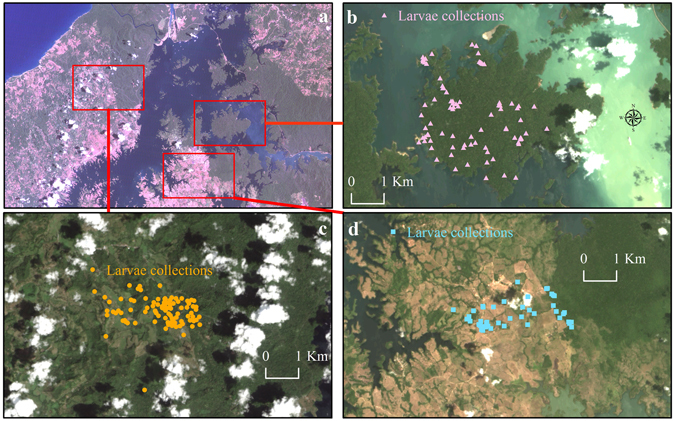
“4c) and Las Pavas - PVAS (9° 09′ N, - 79° 87′ W; Fig.”
MethodInfluentialSelf-citationGalindo, P., Trapido, H., Carpenter, S. J., & Blanton, F. S. (1956) · Annals of the Entomological Society of America · doi:10.1093/aesa/49.6.543 · Cited by 26
Loaiza, J. R., & Miller, M. J. (2013) · Parasitology Research · doi:10.1007/s00436-013-3562-5 · Cited by 22
Self-citationEastwood, G., Loaiza, J. R., Pongsiri, M. J., Sanjur, O. I., Pecor, J. E., Auguste, A. J., & Kramer, L. D. (2016) · American Journal of Tropical Medicine and Hygiene · doi:10.4269/ajtmh.15-0445 · Cited by 17
Self-citationPhylogeography, Vectors and Transmission in Latin America
Conn, J. E., Quiñones, M. L., & Póvoa, M. M. (2013) · InTech eBooks · doi:10.5772/55217 · Cited by 16
Attack on the Vector of Filariasis in British Guiana
Burton, G. J. (1964) · Public Health Reports (1896-1970) · doi:10.2307/4592075 · Cited by 14
The Sabethines of Northern Andean Coffee-Growing Regions of Colombia
Suaza-Vasco, J., López‐Rubio, A., Galeano, J., Uribe, S., Vélez, I. D., & Porter, C. H. (2015) · Journal of the American Mosquito Control Association · doi:10.2987/14-6466r · Cited by 11
Marchi, M. J., Pereira, P. A., de Menezes, R. M. T., & Tubaki, R. M. (2012) · Journal of the American Mosquito Control Association · doi:10.2987/12-6222r.1 · Cited by 10
Anthropophilic Anopheles species composition and malaria in Tierradentro, Córdoba, Colombia
Schiemann, D. J., Pinzón, M. L. Q., & Hankeln, T. (2014) · Memórias do Instituto Oswaldo Cruz · doi:10.1590/0074-0276130483 · Cited by 9
Research works printed but not linked: 5
- Wiens JA On competition and variable environments Am. Sci. 1977 65 590 607
- MacArthur, R. H. & Wilson, E. O. The theory of island biogeography 22-40 (Princeton University Press 1967).
- Tokeshi, M. Species Coexistence: Ecological and Evolutionary Perspectives 146-182 (Wiley-Blackwell 1998).
- Pecor, J. E., Mallampalli, V. L., Harbach, R. E., & Peyton, E. L. Catalog and illustrated review of the subgenus Melanoconion of Culex (Diptera: Culicidae). Contrib. Am. Entomol. Inst. (1992).
- GenBank - The genetic sequence database: collection of all publicly available DNA sequences. Available at: http://www.ncbi.nlm.nih.gov/genbank/. (Accessed: 10th July 2015).
Cited by
The effect of global change on mosquito-borne disease
Franklinos, L. H. V., Jones, K. E., Redding, D. W., & Abubakar, I. (2019) · The Lancet Infectious Diseases · doi:10.1016/s1473-3099(19)30161-6 · Cited by 641
Ortiz, D. I., Piche-Ovares, M., Romero-Vega, L. M., Wagman, J., & Troyo, A. (2021) · Insects · doi:10.3390/insects13010020 · Cited by 162
“In Panama, several rodent and bat reservoirs have been proposed, including the black rat (Rattus rattus [Linnaeus, 1758]), short-tailed cane mouse (Z. brevicauda), long-whiskered rice rat (T. bolivaris), Tome’s spiny rat (P. semispinosus), Seba’s short-tailed bat (Carollia perspicillata [Linnaeus, 1758]), and pale spe…”
BackgroundInfluentialAchieving global malaria eradication in changing landscapes
Fornace, K. M., Diaz, A. V., Lines, J., & Drakeley, C. J. (2021) · Malaria Journal · doi:10.1186/s12936-021-03599-0 · Cited by 112
“Counter-intuitively, the abundance of both colonist (disturbance-tolerant) and climax (disturbance-intolerant) anopheline mosquitoes species increased in disturbed forests in Panama [34].”
BackgroundInfluentialIntermediate Disturbance Hypothesis in Ecology: A Literature Review
Moi, D. A., García-Ríos, R., Hong, Z., Daquila, B. V., & Mormul, R. P. (2020) · Annales Zoologici Fennici · doi:10.5735/086.057.0108 · Cited by 119
“However, several other studies showed that the three mechanisms mentioned above are invalid (Chesson et al. 1994, Roxburgh et al. 2004, Loaiza et al. 2017), and according to Fox (2013), this controversy indicates that the IDH should be abandoned.”
ResultEpidemiology of the zoonotic malaria Plasmodium knowlesi in changing landscapes
Cuenca, P. R., Key, S., Jumail, A., Surendra, H., Ferguson, H. M., DRAKELEY, C. J., & Fornace, K. (2021) · Advances in Parasitology/Advances in parasitology · doi:10.1016/bs.apar.2021.08.006 · Cited by 53
Metadata
- Authors
- Loaiza, J. R., Dutari, L. C., Rovira, J. R., Sanjur, O. I., Laporta, G. Z., Pecor, J., Foley, D. H., Eastwood, G., Kramer, L. D., Radtke, M., & Pongsiri, M.
- Affiliations
- Instituto de Investigaciones Científicas y Servicios de Alta Tecnología (PA)
- Smithsonian Tropical Research Institute (PA)
- Faculdade de Medicina do ABC (BR)
- Smithsonian Institution (US)
- New York State Department of Health (US)
- Environmental Protection Agency (US)
- Corresponding author
- Laporta, Gabriel Z.
- ORCID
- Venue
- Scientific Reports
- Published
- 2017-08-03
- Volume
- 7
- Issue
- 1
- Pages
- 7248-7248
- ISSN
- 2045-2322 (ISSN-L)
- PMC
- PMC5543164
- OpenAlex
- W2741618637
- Cited by
- 68
- References
- 74
- Citations by year
- 2026: 5 · 2025: 6 · 2024: 9 · 2023: 8 · 2022: 4 · 2021: 13 · 2020: 9 · 2019: 10 · 2018: 4
- FWCI
- 5.90
- Type
- journal article
- Language
- en
- Open access
- gold
- doi.org
- Licence
- cc-by
- creativecommons.org/licenses/by/4.0 (tdm)
- creativecommons.org/licenses/by/4.0 (vor)
- Locations
- Scientific Reports (publishedVersion, cc-by)
- Europe PMC (PubMed Central) (publishedVersion, cc-by)
- PubMed Central (publishedVersion, cc-by)
- PubMed (publishedVersion)
- DOAJ (DOAJ: Directory of Open Access Journals) (submittedVersion, cc-by-sa)
- Greater South Information System
- Funders
- Smithsonian Institution
- Fundação de Amparo à Pesquisa do Estado de São Paulo (14/09774-1, 2014/, 2015/, 2015/09669-6)
- Smithsonian Tropical Research Institute
- Topics
- Health Sciences › Medicine › Public Health, Environmental and Occupational Health › Mosquito-borne diseases and control
- Physical Sciences › Environmental Science › Nature and Landscape Conservation › Ecology and Vegetation Dynamics Studies
- Life Sciences › Agricultural and Biological Sciences › Ecology, Evolution, Behavior and Systematics › Diptera species taxonomy and behavior
- Keywords
- intermediate disturbance hypothesis, mosquito diversity, forest disturbance, climax species, old-growth forest, tropical rainforest, vector-borne diseases, arbovirus infection, habitat complexity, species coexistence, functional categories, Panama
- MeSH terms
- Mosquito Vectors, Animals, Humans, Culicidae, Panama, Population Dynamics, Tropical Climate, Ecosystem, Communicable Diseases, Emerging, Biodiversity, Rainforest
About these checks
Registry, retraction, Cites and statistics results are computed, not judged, with one exception: a printed reference that no index lists is read once by a model before it counts as a citation error. Claims are extracted by a model and kept only when their quote appears verbatim in the text; each cited source is then checked, with a model’s help, for whether it says what the claim relies on. Those verdicts can be wrong — read the claim’s quote and the cited source before relying on one.
Statistics and arithmetic are recomputed, not judged.
Confidence bands are shown only for fields calibrated on our annotated test set. None is calibrated yet, so no band is shown.
What counts as a claim ›How we measure confidence ›How we check this ›
Are you an author, or do you see a problem with this page? Request a review
Data sources
Bibliographic data: Semantic Scholar, OpenAlex, Crossref.
Contains information from the Semantic Scholar Academic Graph Datasets, made available under the ODC Attribution License (ODC-BY 1.0).
Semantic Scholar’s data is described in: Kinney, R., et al. (2023). The Semantic Scholar Open Data Platform. arXiv:2301.10140.
