

The Candida albicans HIR histone chaperone regulates the yeast-to-hyphae transition by controlling the sensitivity to morphogenesis signals
Open accessThe DOI matches its Crossref record; 103 of the 103 references it cites were found in a registry or an index.
Abstract
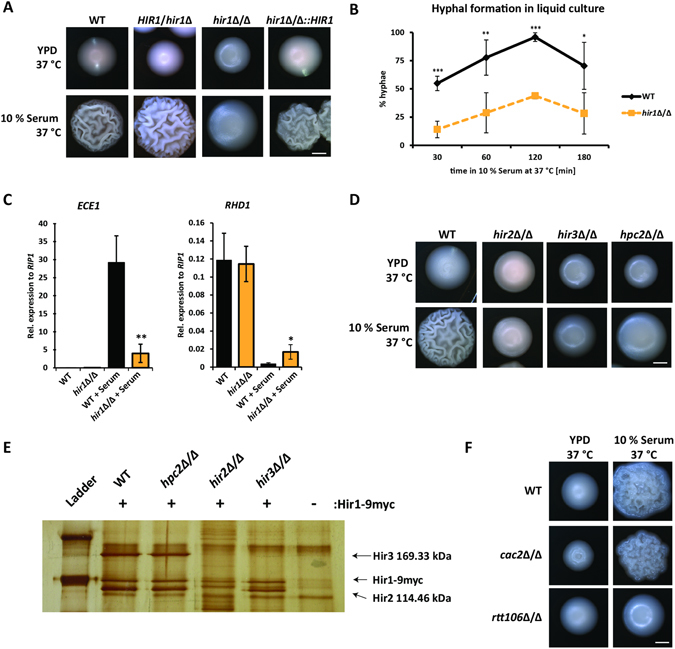
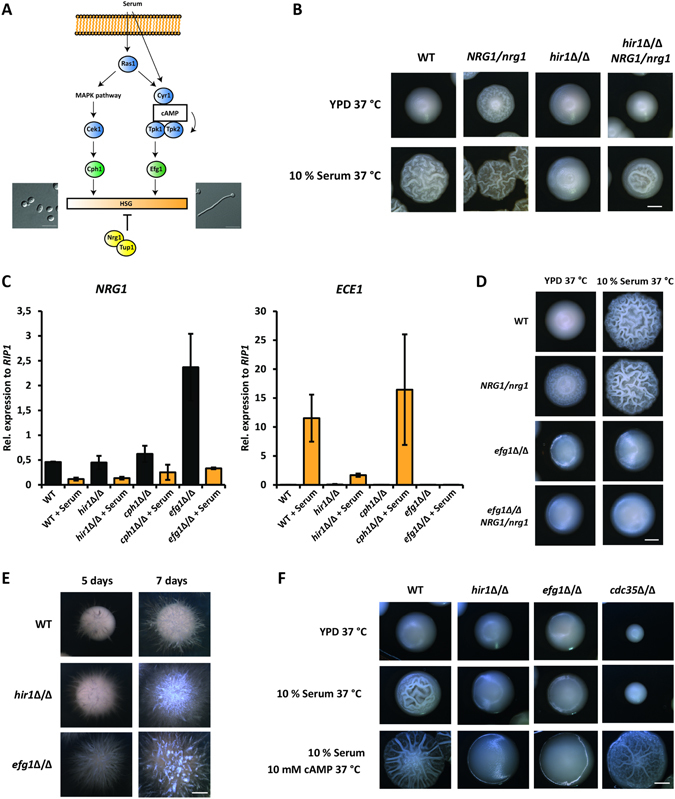
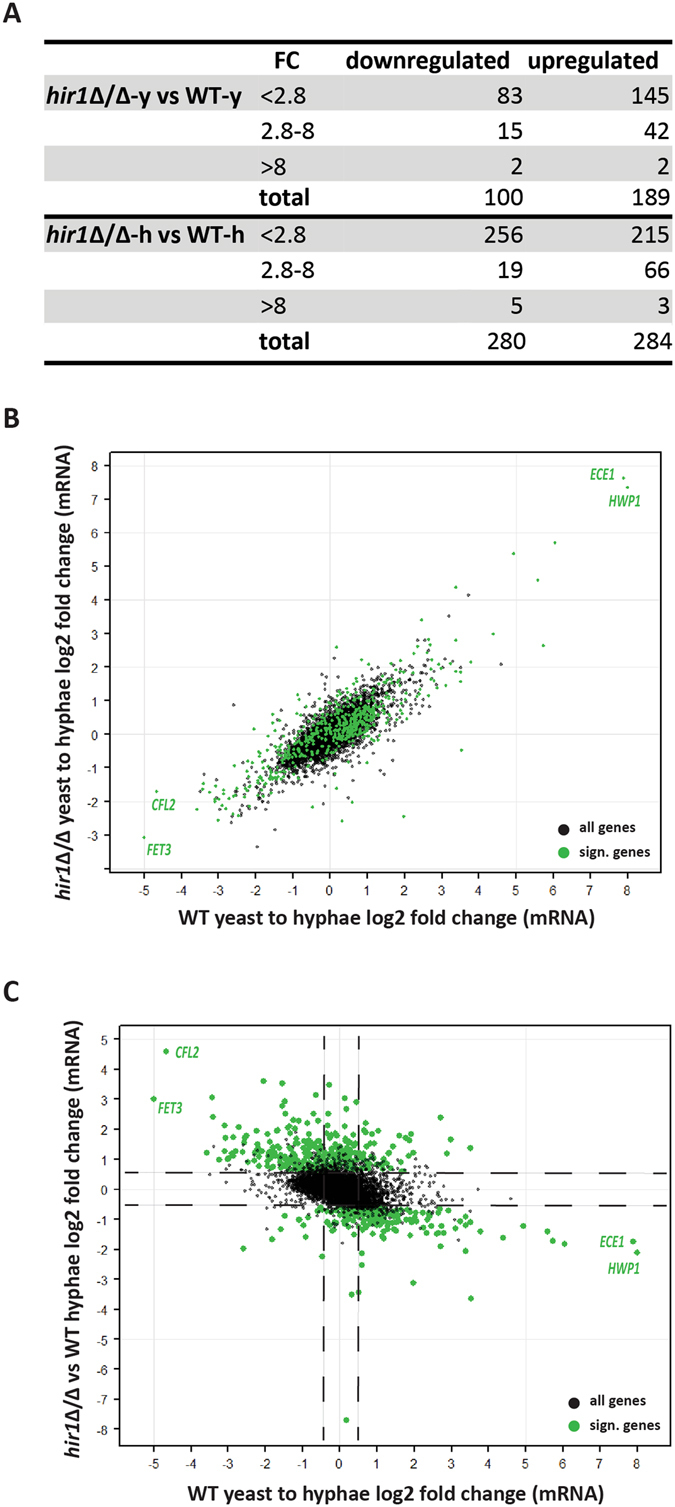
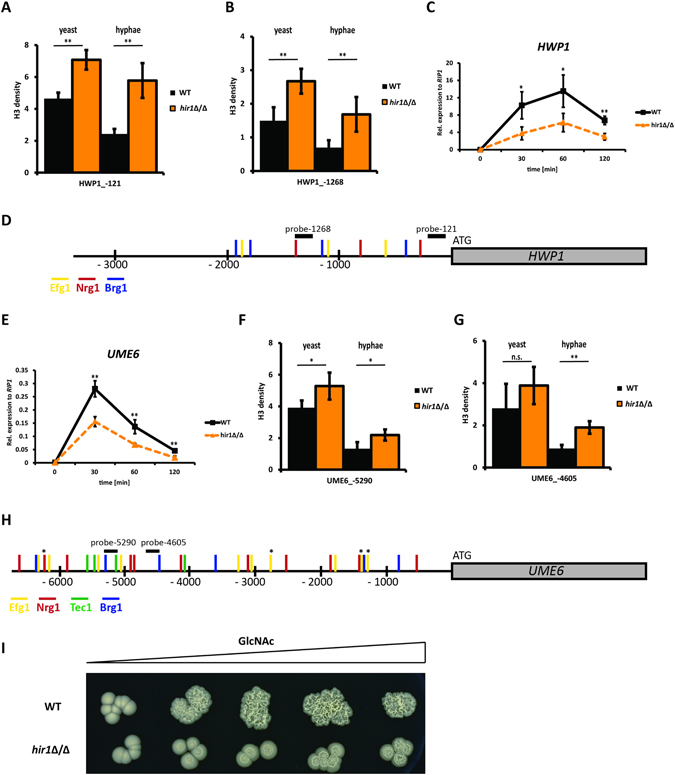
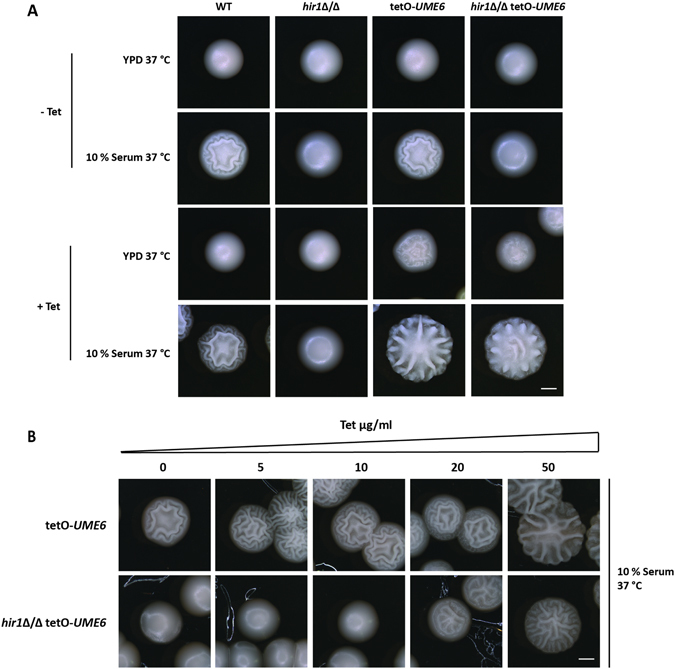
Morphological plasticity such as the yeast-to-hyphae transition is a key virulence factor of the human fungal pathogen Candida albicans. Hyphal formation is controlled by a multilayer regulatory network composed of environmental sensing, signaling, transcriptional modulators as well as chromatin modifications. Here, we demonstrate a novel role for the replication-independent HIR histone chaperone complex in fungal morphogenesis. HIR operates as a crucial modulator of hyphal development, since genetic ablation of the HIR complex subunit Hir1 decreases sensitivity to morphogenetic stimuli. Strikingly, HIR1-deficient cells display altered transcriptional amplitudes upon hyphal initiation, suggesting that Hir1 affects transcription by establishing transcriptional thresholds required for driving morphogenetic cell-fate decisions. Furthermore, ectopic expression of the transcription factor Ume6, which facilitates hyphal maintenance, rescues filamentation defects of hir1 Δ/Δ cells, suggesting that Hir1 impacts the early phase of hyphal initiation. Hence, chromatin chaperone-mediated fine-tuning of transcription is crucial for driving morphogenetic conversions in the fungal pathogen C. albicans.
Overview
The claims and statistics of this paper haven’t been checked yet.
Free: it reads the open-access text and checks the first 5 claims that cite a source we can check. Create a free account to check every claim.
Integrity signals
Registry
Cites
Statistics
Figures
Verification
Claims the paper makes
The claims and statistics of this paper haven’t been checked yet.
Free: it reads the open-access text and checks the first 5 claims that cite a source we can check. Create a free account to check every claim.
Claims other papers make about this one
Each is checked against this paper’s own text: does it say what the citing paper says it does?
In the citing paper
“C. albicans Rtt106 and C. albicans SWI/SNF affect hyphae formation56,57, which indirectly influences drug tolerance and pathogenicity.”
From SWI/SNF and the histone chaperone Rtt106 drive expression of the Pleiotropic Drug Resistance network genes (2022) · cites this paper as [56]
Self-check
Percentages, sums and reported differences re-computed from the paper’s own numbers.
The self-check needs the paper’s full text.
Citations
Cites
Controlling the False Discovery Rate: A Practical and Powerful Approach to Multiple Testing
Benjamini, Y., & Hochberg, Y. (1995) · Journal of the Royal Statistical Society Series B: Statistical Methodology · doi:10.1111/j.2517-6161.1995.tb02031.x · Cited by 109,482
Robinson, M. D., McCarthy, D. J., & Smyth, G. K. (2010) · Bioinformatics · doi:10.1093/bioinformatics/btp616 · Cited by 41,364
A new mathematical model for relative quantification in real-time RT-PCR
Pfaffl, M. W. (2001) · Nucleic Acids Research · doi:10.1093/nar/29.9.e45 · Cited by 34,610
HTSeq—a Python framework to work with high-throughput sequencing data
Anders, S., Pyl, P. T., & Huber, W. (2015) · Bioinformatics · doi:10.1093/bioinformatics/btu638 · Cited by 21,464
TopHat: discovering splice junctions with RNA-Seq
Trapnell, C., Pachter, L., & Salzberg, S. L. (2009) · Bioinformatics · doi:10.1093/bioinformatics/btp120 · Cited by 11,617
Hidden Killers: Human Fungal Infections
Brown, G. D., Denning, D. W., Gow, N. A. R., Levitz, S. M., Netea, M. G., & White, T. C. (2012) · Science Translational Medicine · doi:10.1126/scitranslmed.3004404 · Cited by 4,284
Improved silver staining of plant proteins, RNA and DNA in polyacrylamide gels
Blum, H., Beier, H., & Gross, H. J. (1987) · ELECTROPHORESIS · doi:10.1002/elps.1150080203 · Cited by 4,150
Methods in Yeast Genetics: A Laboratory Course Manual
Rose, M. D., Winston, F., & Hieter, P. (1990) · Medical Entomology and Zoology · Cited by 1,894
Candida albicans pathogenicity mechanisms
Mayer, F. L., Wilson, D., & Hube, B. (2013) · Virulence · doi:10.4161/viru.22913 · Cited by 1,848
Gillum, A. M., Tsay, E. Y. H., & Kirsch, D. R. (1984) · Molecular and General Genetics MGG · doi:10.1007/bf00328721 · Cited by 1,251
Cited by
Antibiofilm Activities of Biogenic Silver Nanoparticles Against Candida albicans
Ahamad, I., Bano, F., Anwer, R., Srivastava, P., Kumar, R., & Fatma, T. (2022) · Frontiers in Microbiology · doi:10.3389/fmicb.2021.741493 · Cited by 94
“HIR genes (regulatory genes) are responsible for the yeast to hyphae transition, according to another study, if this is not expressed then unable to convert from yeast hyphal form (Jenull et al., 2017).”
BackgroundRossi, D. C. P., Gleason, J. E., Sánchez, H., Schatzman, S. S., Culbertson, E. M., Johnson, C. J., McNees, C. A., Coelho, C., Nett, J. E., Andes, D. R., et al. (2017) · PLoS Pathogens · doi:10.1371/journal.ppat.1006763 · Cited by 69
Regulatory mechanisms controlling morphology and pathogenesis in Candida albicans
Kadosh, D. (2019) · Current Opinion in Microbiology · doi:10.1016/j.mib.2019.04.005 · Cited by 79
Frazer, C., Staples, M. I., Kim, Y., Hirakawa, M., Dowell, M. A., Johnson, N. V., Hernday, A. D., Ryan, V. H., Fawzi, N. L., Finkelstein, I. J., et al. (2020) · Nature Microbiology · doi:10.1038/s41564-020-0760-7 · Cited by 56
From Genes to Networks: The Regulatory Circuitry Controlling Candida albicans Morphogenesis
Basso, V., d’Enfert, C., Znaidi, S., & Bachellier‐Bassi, S. (2018) · Current topics in microbiology and immunology · doi:10.1007/82_2018_144 · Cited by 60
Histone Acetylation/Deacetylation in Candida Albicans and their Potential as Antifungal Targets
Su, S., Li, X., Yang, X., Li, Y., Chen, X., Sun, S., & Jia, S. (2020) · Future Microbiology · doi:10.2217/fmb-2019-0343 · Cited by 36
Liu, Z., Basso, P., Hossain, S., Liston, S. D., Robbins, N., Whitesell, L., Noble, S. M., & Cowen, L. E. (2023) · Nature Communications · doi:10.1038/s41467-023-40209-w · Cited by 22
Jenull, S., Mair, T., Tscherner, M., Penninger, P., Zwolanek, F., Silao, F. G. S., Vicente, K. M. D. S., Riedelberger, M., Bandari, N. C., Shivarathri, R., et al. (2021) · Cell Reports · doi:10.1016/j.celrep.2021.109406 · Cited by 20
“Of note, the C. albicans HIR complex exploits related mechanisms during fungal transitions from the unicellular yeast state to hyphal growth, whereby HIR1 deficiency alters the amplitudes of hyphal-specific gene expression (Jenull et al., 2017).”
BackgroundMethodSelf-citationNikolov, V. N., Malavia, D., & Kubota, T. (2022) · Nature Communications · doi:10.1038/s41467-022-29591-z · Cited by 16
Li, G., Liu, S., Wu, L., Wang, X., Cuan, R., Zheng, Y., Liu, D., & Yuan, Y. (2022) · Journal of Fungi · doi:10.3390/jof8070667 · Cited by 13
El-Gazzar, N. S., Elez, R. M. M. A., Attia, A. S. A., Abdel‐Warith, A. A., Darwish, M. M., Younis, E. M., El-Tahlawi, R., Ibraheem, K. I. M., Davies, S. J., & Elsohaby, I. (2024) · Frontiers in Cellular and Infection Microbiology · doi:10.3389/fcimb.2024.1358270 · Cited by 13
Sahoo, B., Goyal, R., Dutta, S., Joshi, P., & Sanyal, K. (2025) · ACS Infectious Diseases · doi:10.1021/acsinfecdis.5c00079 · Cited by 15
Ahamad, I., & Fatma, T. (2025) · BioMetals · doi:10.1007/s10534-025-00680-y · Cited by 9
“Even without the gene expression of these genes, the cell cannot transform from the yeast-hyphal form (Jenull et al. 2017).”
The zinc cluster transcription factor Rha1 is a positive filamentation regulator in Candida albicans
Omran, R. P., Ramírez-Zavala, B., Tebung, W. A., Yao, S., Feng, J., Law, C. O., Dumeaux, V., Morschhäuser, J., & Whiteway, M. S. (2021) · Genetics · doi:10.1093/genetics/iyab155 · Cited by 10
Chen, M., Huang, W.-K., Yao, Y., Wu, S.-M., Yang, Y.-X., Liu, W.-X., Luo, G., Wei, S., Zhang, H., Liu, H., et al. (2024) · Frontiers in Microbiology · doi:10.3389/fmicb.2024.1358752 · Cited by 7
Lim, S. J., Noor, N. D. M., Sabri, S., Ali, M. S. M., Salleh, A. B., & Oslan, S. N. (2023) · Medical Mycology · doi:10.1093/mmy/myad126 · Cited by 6
Jain, B. P. (2018) · The Protein Journal · doi:10.1007/s10930-018-9804-8 · Cited by 6
Sun, M., Lu, T., Chen, P., Wang, X., Yang, H., Zhou, R., Zheng, W., & Zhao, Y. (2023) · Applied and Environmental Microbiology · doi:10.1128/aem.01018-23 · Cited by 5
“the long-term evolution, fungi have developed multiple mechanisms to sense envi ronmental signals via cell membrane-associated receptors, membrane-associated protein kinases, mitogen-activated protein kinase cascades, and downstream regulatory protein complexes that alter gene expression (3–5).”
BackgroundHorianopoulos, L. C., Lee, C. W. J., Schmitt, K., Valerius, O., Hu, G., Caza, M., Braus, G. H., & Kronstad, J. W. (2021) · mBio · doi:10.1128/mbio.03273-21 · Cited by 4
Voutsina, A., Fragiadakis, G. S., Gkouskou, K. K., & Alexandraki, D. (2019) · Current Genetics · doi:10.1007/s00294-019-00935-5 · Cited by 4
Singha, R., Aggarwal, R., & Sanyal, K. (2023) · Molecular Microbiology · doi:10.1111/mmi.15050 · Cited by 3
“The CAF- 1 and HIR histone chaperone complexes have been characterized in C. albicans (Jenull et al., 2017; Stevenson & Liu, 2013).”
BackgroundMethodInfluentialStack-Couture, S., Marsiglio-Librais, G. N., Lung, B., Genereaux, J. L., Halder, V., Dumeaux, V., Shapiro, R. S., & Lajoie, P. (2026) · Journal of Cell Science · doi:10.1242/jcs.264610 · Cited by 2
“…through various mechanisms including serum treatment, elevated temperature, nutrient starvation, chromatin accessibility and pH neutralization (Do et al., 2025; Jenull et al., 2017; Razzaq et al., 2021; Shapiro et al., 2011; Shivarathri et al., 2019; Tebbji et al., 2017; Villa et al., 2020).”
Distinct Ire1-driven transcriptional responses control morphogenesis in Candida albicansPreprint
Stack-Couture, S., Marsiglio-Librais, G. N., Lung, B., Genereaux, J. L., Halder, V., Dumeaux, V., Shapiro, R. S., & Lajoie, P. (2025) · bioRxiv (Cold Spring Harbor Laboratory) · doi:10.1101/2025.11.13.688365
Proteome remodelling in Candida auris during early host adaptation in-vitro and in-vivoPreprint
Mazumdar, R., & Bjelanović, A. (2026) · bioRxiv (Cold Spring Harbor Laboratory) · doi:10.64898/2026.03.09.710370
Environmental adaptation of Candida albicans : the examples of persistence and chlamydosporulation
Denega, I. (2020) · theses.fr (ABES) · doi:10.70675/748584ddzf6f4z4124z9237z56d0535d3352
Assessment of the metabolome in genomically diverse Candida albicans isolates
Alaban, L. R. (2022) · theses.fr (ABES) · doi:10.70675/6127ebd7z2b67z4728z960dzdc64762b4c70
Proteome Remodelling in Candida auris During Early Host Adaptation In Vitro and In Vivo
Mazumdar, R., & Bjelanović, A. (2026) · Journal of Fungi · doi:10.3390/jof12090649
“Hir3 is a component of the HIR complex, which in C. albicans has been implicated in regulating morphological plasticity, from yeast to hyphae, which is a key virulence-associated trait [42].”
Altammar, K. A. (2026) · Microorganisms · doi:10.3390/microorganisms14092010
Metadata
- Authors
- Jenull, S., Tscherner, M., Gulati, M., Nobile, C. J., Chauhan, N., & Kuchler, K.
- Affiliations
- Max Perutz Labs (AT)
- Harvard University (US)
- University of California, Merced (US)
- Rutgers, The State University of New Jersey (US)
- Corresponding author
- Kuchler, Karl
- Venue
- Scientific Reports
- Published
- 2017-08-16
- Volume
- 7
- Issue
- 1
- Pages
- 8308-8308
- ISSN
- 2045-2322 (ISSN-L)
- PMC
- PMC5559454
- OpenAlex
- W2744309050
- Cited by
- 28
- References
- 103
- Citations by year
- 2026: 4 · 2025: 3 · 2024: 2 · 2023: 4 · 2022: 4 · 2021: 3 · 2020: 3 · 2019: 2 · 2018: 2 · 2017: 1
- FWCI
- 0.89
- Type
- journal article
- Language
- en
- Open access
- gold
- doi.org
- Licence
- cc-by
- creativecommons.org/licenses/by/4.0 (tdm)
- creativecommons.org/licenses/by/4.0 (vor)
- Locations
- Scientific Reports (publishedVersion, cc-by)
- PubMed Central (publishedVersion, cc-by)
- PubMed (publishedVersion)
- eScholarship (California Digital Library) (submittedVersion)
- Rutgers University Community Repository (Rutgers University) (submittedVersion)
- Digital Access to Scholarship at Harvard (DASH) (Harvard University) (submittedVersion, cc-by)
- DOAJ (DOAJ: Directory of Open Access Journals) (submittedVersion, cc-by-sa)
- Funders
- Austrian Science Fund (FWF-P25333-B22, P25333)
- National Institutes of Health (NIH-R01)
- National Institute of Allergy and Infectious Diseases (R01AI124499, R00AI100896)
- Topics
- Life Sciences › Biochemistry, Genetics and Molecular Biology › Molecular Biology › Fungal and yeast genetics research
- Life Sciences › Biochemistry, Genetics and Molecular Biology › Molecular Biology › Genomics and Chromatin Dynamics
- Health Sciences › Medicine › Infectious Diseases › Antifungal resistance and susceptibility
- Keywords
- Candida albicans, yeast-to-hypha transition, fungal morphogenesis, Ume6, transcriptional regulation, filamentation, virulence
- MeSH terms
- Ectopic Gene Expression, Candida albicans, Fungal Proteins, Models, Biological, Phenotype, Transcription Factors, Signal Transduction, Gene Deletion, Hyphae, Histone Chaperones
About these checks
Registry, retraction, Cites and statistics results are computed, not judged, with one exception: a printed reference that no index lists is read once by a model before it counts as a citation error. Claims are extracted by a model and kept only when their quote appears verbatim in the text; each cited source is then checked, with a model’s help, for whether it says what the claim relies on. Those verdicts can be wrong — read the claim’s quote and the cited source before relying on one.
Statistics and arithmetic are recomputed, not judged.
Confidence bands are shown only for fields calibrated on our annotated test set. None is calibrated yet, so no band is shown.
What counts as a claim ›How we measure confidence ›How we check this ›
Are you an author, or do you see a problem with this page? Request a review
Data sources
Bibliographic data: Semantic Scholar, OpenAlex, Crossref.
Contains information from the Semantic Scholar Academic Graph Datasets, made available under the ODC Attribution License (ODC-BY 1.0).
Semantic Scholar’s data is described in: Kinney, R., et al. (2023). The Semantic Scholar Open Data Platform. arXiv:2301.10140.
