

The DOI matches its Crossref record; 154 of the 154 references it cites were found in a registry or an index.
Elongation factor Tu is a multifunctional and processed moonlighting protein
Open accessAbstract
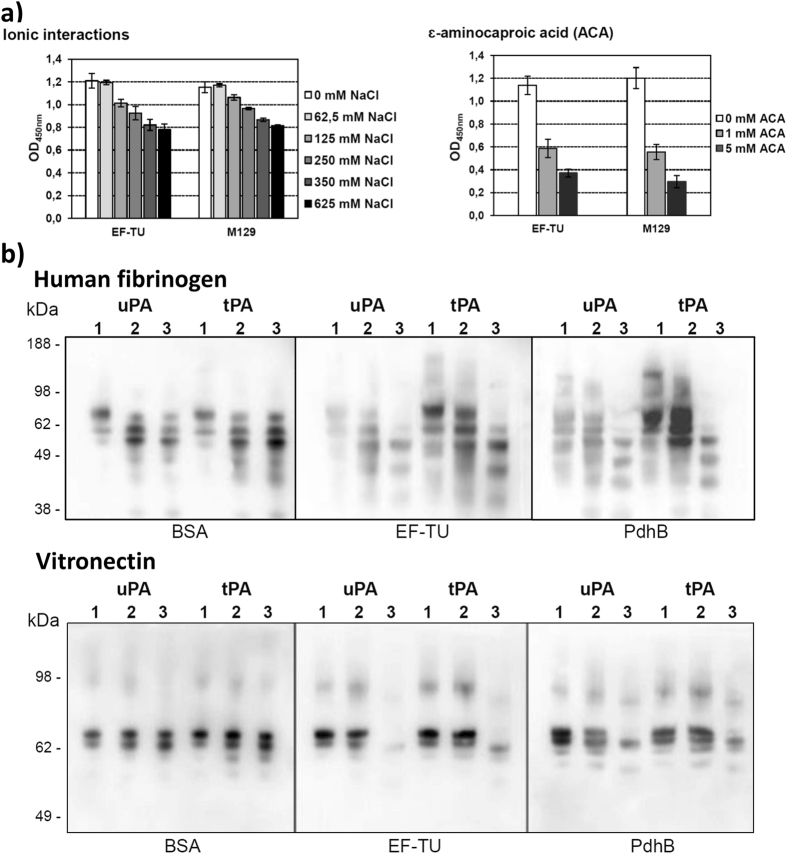
Many bacterial moonlighting proteins were originally described in medically, agriculturally, and commercially important members of the low G + C Firmicutes. We show Elongation factor Tu (Ef-Tu) moonlights on the surface of the human pathogens Staphylococcus aureus (Sa Ef-Tu) and Mycoplasma pneumoniae (Mpn Ef-Tu), and the porcine pathogen Mycoplasma hyopneumoniae (Mhp Ef-Tu). Ef-Tu is also a target of multiple processing events on the cell surface and these were characterised using an N-terminomics pipeline. Recombinant Mpn Ef-Tu bound strongly to a diverse range of host molecules, and when bound to plasminogen, was able to convert plasminogen to plasmin in the presence of plasminogen activators. Fragments of Ef-Tu retain binding capabilities to host proteins. Bioinformatics and structural modelling studies indicate that the accumulation of positively charged amino acids in short linear motifs (SLiMs), and protein processing promote multifunctional behaviour. Codon bias engendered by an A + T rich genome may influence how positively-charged residues accumulate in SLiMs.
Overview
The claims and statistics of this paper haven’t been checked yet.
Run the check — free, no account needed. It reads the open-access text and checks the sources it cites.
Integrity signals
Registry
Cites
Statistics
Figures
Verification
Claims the paper makes
The claims and statistics of this paper haven’t been checked yet.
Run the check — free, no account needed. It reads the open-access text and checks the sources it cites.
Claims other papers make about this one
Each is checked against this paper’s own text: does it say what the citing paper says it does?
The source backs part of the claim, not all of it — or backs it for a different population, condition or comparison.
In the citing paper
“Because of evolutionary pressure to delete nonessential genes, mycoplasmas are known for having such multifunctional proteins.114−117”
From Toward the Complete Functional Characterization of a Minimal Bacterial Proteome (2022) · cites this paper as [117]
Experimental — accuracy not yet measured
Self-check
Percentages, sums and reported differences re-computed from the paper’s own numbers.
The self-check needs the paper’s full text.
Citations
Cites
Fast, scalable generation of high‐quality protein multiple sequence alignments using Clustal Omega
Sievers, F., Wilm, A., Dineen, D. G., Gibson, T. J., Karplus, K. J., Li, W., López, R., McWilliam, H., Remmert, M., Söding, J., et al. (2011) · Molecular Systems Biology · doi:10.1038/msb.2011.75 · Cited by 15,426
SignalP 4.0: discriminating signal peptides from transmembrane regions
Petersen, T. N., Brunak, S., von Heijne, G., & Nielsen, H. (2011) · Nature Methods · doi:10.1038/nmeth.1701 · Cited by 8,847
Protein Identification and Analysis Tools in the ExPASy Server
Wilkins, M. R., Gasteiger, E., Bairoch, A., Sanchez, J., Williams, K. L., Appel, R. D., & Hochstrasser, D. F. (2003) · Humana Press eBooks · doi:10.1385/1-59259-584-7:531 · Cited by 6,244
Comparative Protein Structure Modeling Using Modeller
Eswar, N., Webb, B., Martı́-Renom, M. A., Madhusudhan, M. S., Eramian, D., Shen, M., Pieper, U., & Šali, A. (2006) · Current Protocols in Bioinformatics · doi:10.1002/0471250953.bi0506s15 · Cited by 4,618
Comparative Protein Structure Modeling Using MODELLER
Webb, B., & Šali, A. (2016) · Current Protocols in Bioinformatics · doi:10.1002/cpbi.3 · Cited by 4,404
Predicting coiled coils from protein sequences.
Lupas, A., Van Dyke, M., & Stock, J. (1991) · Science · doi:10.1126/science.252.5009.1162 · Cited by 3,953
Boller, T., & Felix, G. (2009) · Annual Review of Plant Biology · doi:10.1146/annurev.arplant.57.032905.105346 · Cited by 3,514
Phase separation of integral membrane proteins in Triton X-114 solution.
Bordier, C. (1981) · Journal of Biological Chemistry · doi:10.1016/s0021-9258(19)69848-0 · Cited by 3,324
Comparative Protein Structure Modeling Using MODELLER
Eswar, N., Webb, B., Martı́-Renom, M. A., Madhusudhan, M. S., Eramian, D., Shen, M., Pieper, U., & Šali, A. (2007) · Current Protocols in Protein Science · doi:10.1002/0471140864.ps0209s50 · Cited by 2,874
Gómez‐Gómez, L., & Boller, T. (2000) · Molecular Cell · doi:10.1016/s1097-2765(00)80265-8 · Cited by 2,319
Research works printed but not linked: 2
- Tacchi, J. L. et al. Post-translational processing targets functionally diverse proteins in Mycoplasma hyopneumoniae. Open biology 6, 150210, doi:10.1098/rsob.150210 (2016). · DOI · Paper page
- P, H. Diploma thesis, Technische Universität München, (2012).
Cited by
Sorted by citations
Nitrogen-fixing organelle in a marine alga
Coale, T. H., Loconte, V., Turk‐Kubo, K. A., Vanslembrouck, B., Mak, E. W. K., Cheung, S., Ekman, A. A., Chen, J.-H., Hagino, K., Takano, Y., et al. (2024) · Science · doi:10.1126/science.adk1075 · Cited by 249
The Diverse Functional Roles of Elongation Factor Tu (EF-Tu) in Microbial Pathogenesis
Harvey, K. L., Jarocki, V. M., Charles, I. G., & Djordjevic, S. P. (2019) · Frontiers in Microbiology · doi:10.3389/fmicb.2019.02351 · Cited by 218
Self-citationMycoplasma pneumoniae Infections: Pathogenesis and Vaccine Development
Jiang, Z., Li, S., Zhu, C., Zhou, R., & Leung, P. H. M. (2021) · Pathogens · doi:10.3390/pathogens10020119 · Cited by 184
Intracellular proteins moonlighting as bacterial adhesion factors
Jeffery, C. J. (2018) · AIMS Microbiology · doi:10.3934/microbiol.2018.2.362 · Cited by 94
Infection strategies of mycoplasmas: Unraveling the panoply of virulence factors
Yi-wen, C., Wu, Y., Qin, L., Cuiming, Z., & You, X. (2021) · Virulence · doi:10.1080/21505594.2021.1889813 · Cited by 84
Metadata
- Authors
- Widjaja, M., Harvey, K. L., Hagemann, L., Berry, I. J., Jarocki, V. M., Raymond, B. B. A., Tacchi, J. L., Gründel, A., Steele, J. R., Padula, M. P., Charles, I. G., Dumke, R., & Djordjevic, S. P.
- Affiliations
- University of Technology Sydney (AU)
- Technische Universität Dresden (DE)
- Norwich Research Park (GB)
- Corresponding author
- Djordjevic, Steven Philip
- ORCID
- Venue
- Scientific Reports
- Published
- 2017-09-11
- Volume
- 7
- Issue
- 1
- Pages
- 11227-11227
- ISSN
- 2045-2322 (ISSN-L)
- PMC
- PMC5593925
- OpenAlex
- W2750987002
- Cited by
- 131
- References
- 154
- Citations by year
- 2026: 7 · 2025: 17 · 2024: 20 · 2023: 7 · 2022: 16 · 2021: 20 · 2020: 14 · 2019: 13 · 2018: 17
- FWCI
- 4.92
- Type
- journal article
- Language
- en
- Open access
- gold
- doi.org
- Locations
- Scientific Reports (publishedVersion, cc-by)
- PubMed Central (publishedVersion, cc-by)
- PubMed (publishedVersion)
- UEA Digital Repository (University of East Anglia) (acceptedVersion)
- DOAJ (DOAJ: Directory of Open Access Journals) (submittedVersion)
- UTS ePRESS (University of Technology Sydney) (submittedVersion)
- Funders
- Bristol-Myers Squibb Foundation
- Deutsche Forschungsgemeinschaft (1280/1-1, DU 1280/1-1)
- University of Technology Sydney
- NSW Department of Primary Industries
- Australian Research Council (LE130100096)
- Topics
- Life Sciences › Biochemistry, Genetics and Molecular Biology › Molecular Biology › Biochemical and Structural Characterization
- Life Sciences › Immunology and Microbiology › Microbiology › Microbial infections and disease research
- Life Sciences › Biochemistry, Genetics and Molecular Biology › Genetics › Bacterial Genetics and Biotechnology
- Keywords
- elongation factor Tu, moonlighting proteins, protein processing, Staphylococcus aureus, Mycoplasma pneumoniae, Mycoplasma hyopneumoniae, plasmin, short linear motifs, positively charged amino acids, codon usage bias, AT-rich genome, host-pathogen interaction, bacterial cell surface, N-terminomics
- MeSH terms
- Fibrinolysin, Membrane Proteins, Models, Molecular, Mycoplasma pneumoniae, Peptide Elongation Factor Tu, Plasminogen, Protein Binding, Staphylococcus aureus, Computational Biology, Virulence Factors, Mycoplasma hyopneumoniae, Host-Pathogen Interactions
About these checks
Registry, retraction, Cites and statistics results are computed, not judged, with one exception: a printed reference that no index lists is read once by a model before it counts as a citation error. Claims are extracted by a model and kept only when their quote appears verbatim in the text; each cited source is then checked, with a model’s help, for whether it says what the claim relies on. Those verdicts can be wrong — read the claim’s quote and the cited source before relying on one.
Statistics and arithmetic are recomputed, not judged.
Confidence bands are shown only for fields calibrated on our annotated test set. None is calibrated yet, so no band is shown.
What counts as a claim ›How we measure confidence ›How we check this ›
Are you an author, or do you see a problem with this page? Request a review
