

An application of machine learning to haematological diagnosis
Open accessThe DOI matches its Crossref record; 42 of the 42 references it cites were found in a registry or an index.
Abstract
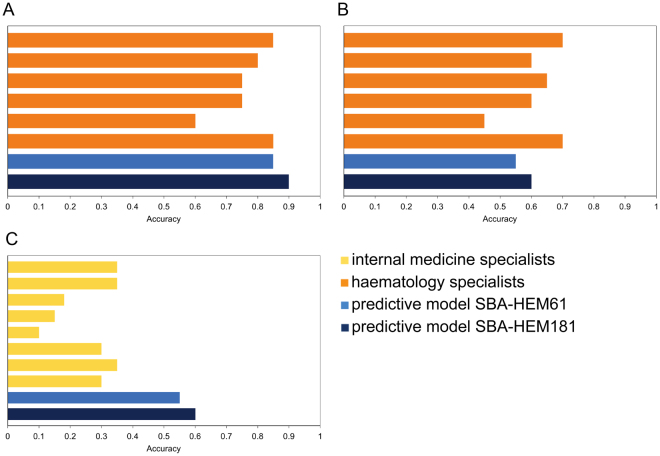
Quick and accurate medical diagnoses are crucial for the successful treatment of diseases. Using machine learning algorithms and based on laboratory blood test results, we have built two models to predict a haematologic disease. One predictive model used all the available blood test parameters and the other used only a reduced set that is usually measured upon patient admittance. Both models produced good results, obtaining prediction accuracies of 0.88 and 0.86 when considering the list of five most likely diseases and 0.59 and 0.57 when considering only the most likely disease. The models did not differ significantly, which indicates that a reduced set of parameters can represent a relevant “fingerprint” of a disease. This knowledge expands the model’s utility for use by general practitioners and indicates that blood test results contain more information than physicians generally recognize. A clinical test showed that the accuracy of our predictive models was on par with that of haematology specialists. Our study is the first to show that a machine learning predictive model based on blood tests alone can be successfully applied to predict haematologic diseases. This result and could open up unprecedented possibilities for medical diagnosis.
Overview
The claims and statistics of this paper haven’t been checked yet.
Free: it reads the open-access text and checks the first 5 claims that cite a source we can check. Create a free account to check every claim.
Integrity signals
Registry
Cites
Statistics
Figures
Verification
Claims the paper makes
The claims and statistics of this paper haven’t been checked yet.
Free: it reads the open-access text and checks the first 5 claims that cite a source we can check. Create a free account to check every claim.
Claims other papers make about this one
Each is checked against this paper’s own text: does it say what the citing paper says it does?
The cited source says what the claim attributes to it.
In the citing paper
“Hematology and serology can benefit from microscope-integrated AIs 42 that diagnose common conditions 43 or count blood cells of various types 44 -repetitive tasks that are easy to augment with CNNs.”
From Deep learning-enabled medical computer vision (2021) · cites this paper as [43]
Self-check
Percentages, sums and reported differences re-computed from the paper’s own numbers.
The self-check needs the paper’s full text.
Citations
Cites
Breiman, L. (2001) · Machine Learning · doi:10.1023/a:1010933404324 · Cited by 133,538
LIBSVM: A library for support vector machines
Chang, C.-C., & Lin, C.-J. (2011) · ACM Transactions on Intelligent Systems and Technology · doi:10.1145/1961189.1961199 · Cited by 40,918
The Nature of Statistical Learning Theory
Vapnik, V. N. (1995) · doi:10.1007/978-1-4757-2440-0 · Cited by 39,138
SMOTE synthetic minority over-sampling technique
Chawla, N. V., Bowyer, K. W., Hall, L. O., & Kegelmeyer, W. P. (2002) · Journal of Artificial Intelligence Research · doi:10.1613/jair.953 · Cited by 32,865
UCI Machine Learning Repository
Asuncion, A. (2007) · Medical Entomology and Zoology · Cited by 25,416
An introduction to ROC analysis
Fawcett, T. (2006) · Pattern Recognition Letters · doi:10.1016/j.patrec.2005.10.010 · Cited by 21,879 · cited 1×
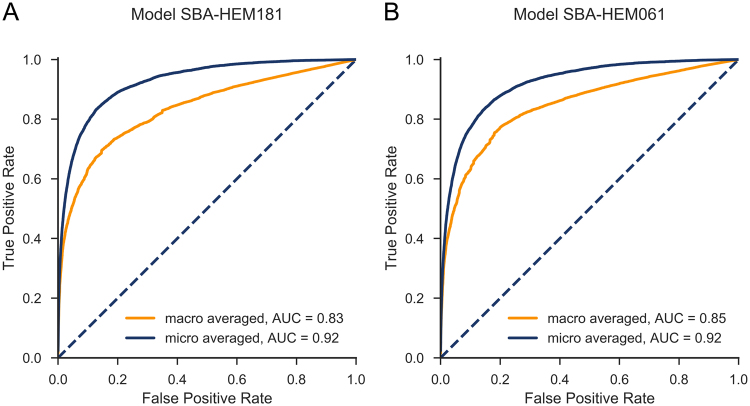
“For two-class problems and scoring classifiers (i.e., a classifier that produces a score for each possible class and predicts the class with the maximum score), ROC curves are produced in a straightforward manner by ordering the maximum scores and varying the decision threshold 25 .”
BackgroundDermatologist-level classification of skin cancer with deep neural networks
Esteva, A., Kuprel, B., Novoa, R. A., Ko, J., Swetter, S. M., Blau, H. M., & Thrun, S. (2017) · Nature · doi:10.1038/nature21056 · Cited by 14,362 · cited 1×
“Recently, a model capable of classifying skin cancers based on images of the skin was presented that achieves a level of competence comparable to that of a dermatologist 7 .”
BackgroundMachine learning: Trends, perspectives, and prospects
Jordan, M. I., & Mitchell, T. M. (2015) · Science · doi:10.1126/science.aaa8415 · Cited by 9,955 · cited 1×
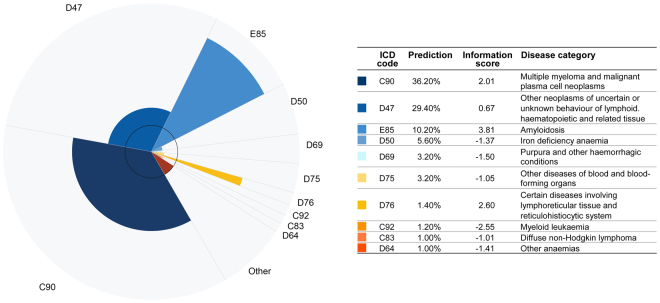
“In these two equations (1, 2), r is the radius (information score) and ø the angle (predicted probability) of disease x.”
BackgroundEnsemble methods in machine learning
Dietterich, T. G. (2000) · Lecture Notes in Computer Science · doi:10.1007/3-540-45014-9_1 · Cited by 8,408
A systematic analysis of performance measures for classification tasks
Sokolova, M., & Lapalme, G. (2009) · Information Processing & Management · doi:10.1016/j.ipm.2009.03.002 · Cited by 7,515 · cited 1×
“We applied two approaches suitable for observing overall classifier performance in multi-class problems: macro-averaging and micro-averaging 26 .”
Method
Research works printed but not linked: 2
- Kononenko, I. In Proc. 4th European Working Session on Learning. 91–98 (1989).
- Conover, W. Statistics of the Kolmogorov-Smirnov type in Practical nonparametric statistics, 428–473 (John Wiley & Sons, 1999).
Cited by
Items 201–246 of 246
Diagnosis of Methylmalonic Acidemia using Machine Learning Methods
Li, X., Yang, X., & Wen, W. (2019) · International Conference on Machine Learning Technologies (ICMLT) · doi:10.1145/3340997.3341000
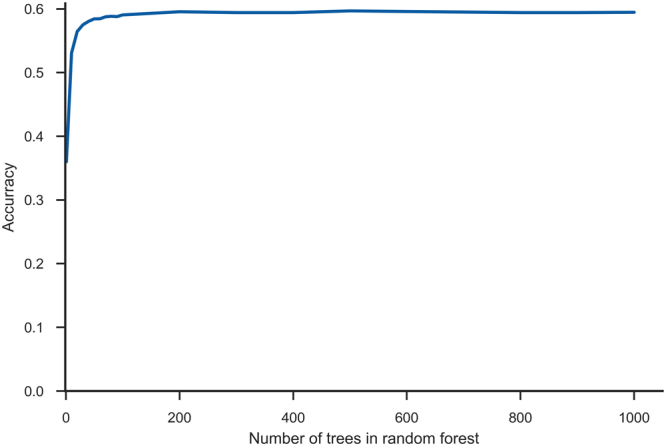
“In order to reduce the variance [14], random forests with 200 trees are used for these data sets in our models.”
BackgroundMethodLidströmer, N., Davids, J., Sood, H. S., & Ashrafian, H. (2021) · Springer eBooks · doi:10.1007/978-3-030-58080-3_340-1 · Cited by 1
Determining Local Hematology Reference Ranges: A Data-driven Approach
Semini, K. A. H., & Caldera, A. (2021) · International Journal of Advanced Computer Science and Applications · doi:10.14569/ijacsa.2021.0120810
“Many kinds of research in the medical sector have already used data mining and machine learning concepts to get efficient outcomes[12]–[14].”
BackgroundNarrative Disruptions in Composition's Culture of Scholarship
Madan, R. S. (2012) · D-Scholarship@Pitt (University of Pittsburgh) · Cited by 1
Developing an Automatic COVID-19 Diagnostic Care System Using Machine Learning
Albargi, J., & Elhag, S. (2021) · International Conference on Future Networks and Distributed Systems (ICFNDS) · doi:10.1145/3508072.3508097
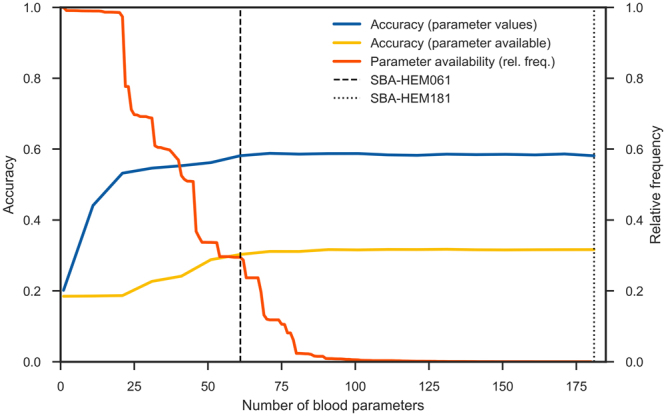
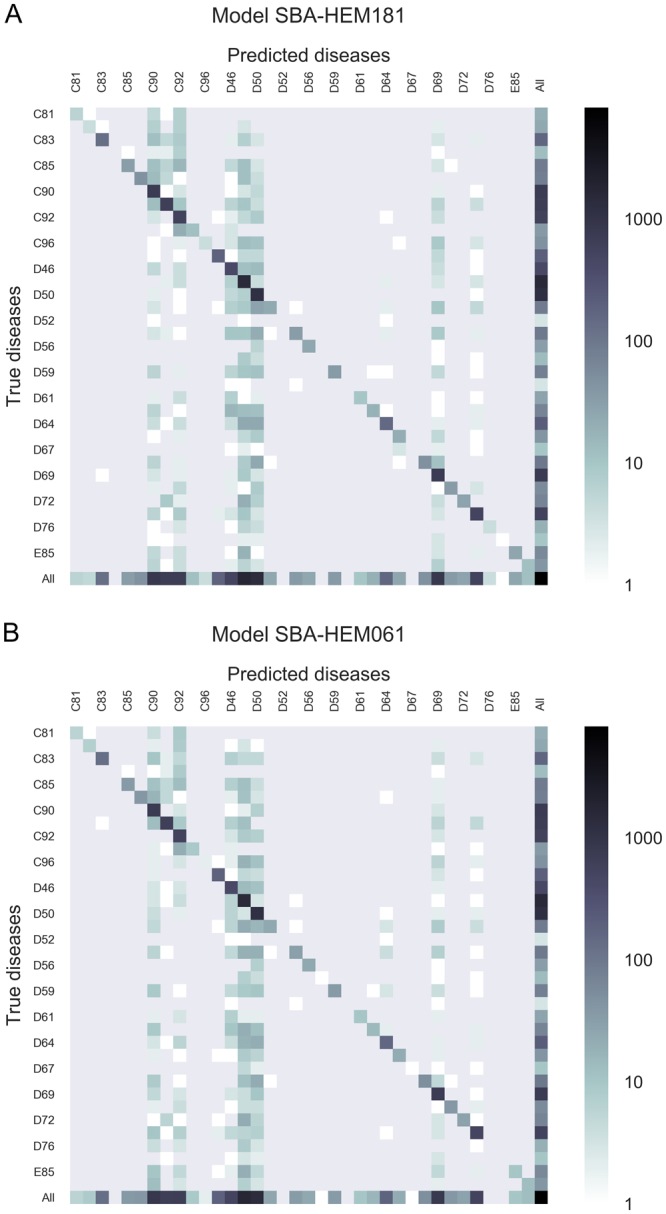
“[1 ] Trained two machine learning models, SBA-HEM181 and SBA-HEM61.”
BackgroundMethodResultInfluentialSedick, Q., & Elyamany, G. (2022) · GLOBAL JOURNAL FOR RESEARCH ANALYSIS · doi:10.36106/gjra/4306231
Multiple Tests and Multivariable Risk Models
Newman, T. B., & Kohn, M. A. (2020) · Cambridge University Press eBooks · doi:10.1017/9781108500111.008
Predicting hepatotoxicity associated with low-dose methotrexate using machine learningPreprint
Hu, Q., Wang, H., & Xu, T. (2022) · Research Square · doi:10.21203/rs.3.rs-1753066/v1
Hussain, S. (2022) · Research Square · doi:10.21203/rs.3.rs-2049616/v1
Predicting hepatotoxicity associated with low-dose methotrexate using machine learningPreprint
Hu, Q., Wang, H., & Xu, T. (2022) · Research Square · doi:10.21203/rs.3.rs-1753066/v2
Machine Learning For Non- Invasive Diagnostics Of Glucose Metabolism Disorder
Dive, S., & Sakarkar, G. (2022) · INTERNATIONAL JOURNAL OF NEXT-GENERATION COMPUTING · doi:10.47164/ijngc.v13i5.968
Sevinç, S., Şişman, A. R., Başok, B. İ., Akşit, M., Bilgi, P. T., Yildirim, O., Yaşar, E., Çolak, A., Duman, C., & Akbulut, G. (2022) · Journal of Artificial Intelligence in Health Sciences · doi:10.52309/jaihs.v2i2.45
Neto, R. B. D. A., Gomes, D. C. D. A. P., & Pinto, L. A. (2023) · Seven Editora eBooks · doi:10.56238/colleinternhealthscienv1-023
Novel Representation Learning Improves Personalizing Blood Test Ranges and Disease Risk PredictionPreprint
Heydari, A. A., Prieto, J. L., Patel, S., & Rezaei, N. (2023) · Research Square · doi:10.21203/rs.3.rs-3054397/v1
Detection of Thrombocytopenia, Anemia and Leukocytosis by Using Ensemble Learning
Ataş, P. K. (2022) · Journal of ENT and Healthcare · doi:10.58489/2837-3367/002
An unexpected association between the blood bilirubin level and eosinophil count
Chung, S. J., Lee, S., Lee, S.-H., & Kim, S.-S. (2023) · Allergy Asthma & Respiratory Disease · doi:10.4168/aard.2023.11.3.151
Hematological Parameters in Patients with Covid-19: Age and Gender Aspects
Hashimova, U., Safikhanova, K., Gaisina, A., Afandiyev, I., Ahmadov, A., & Abdullayeva, M. (2022) · International Journal of Clinical Medicine and Bioengineering · doi:10.35745/ijcmb2022v02.03.0003
เทศสมบูรณ์, ส. (2019) · Chula Digiverse · doi:10.58837/chula.the.2019.1158
Detection of Canine Parvovirus using ELM and Support Vector Machine Algorithm from Blood Tests
Kole, S., & Kuppili, V. (2023) · International Conference on Computer, Electronics & Electrical Engineering & their Applications (IC2E3) · doi:10.1109/ic2e357697.2023.10262676
Machine learning methods applied to COVID-19 patient data
Bezzan, V. P. (2021) · doi:10.47749/t/unicamp.2021.1232336
Enhancing Early Detection of Blood Disorders through A Novel Hybrid Modeling Approach
Ataş, P. K. (2023) · Bitlis Eren Üniversitesi Fen Bilimleri Dergisi · doi:10.17798/bitlisfen.1376817
Translational Deep Learning-Based Diagnostics: Enhancing Pathology With AI
Ashwini, B. P., Sinha, D. K., & Chaudhary, C. (2023) · International Conference on Advances in Computation, Communication and Information Technology (ICAICCIT) · doi:10.1109/icaiccit60255.2023.10465859
“[6] This transformation includes replacing conventional microscope techniques, integrating digital tools with lab IT systems, sending slides digitally to pathology staff members both within as well as outside the organization, reviewing digital slides on-screen, and reporting cases in a fully…”
MethodAnemia Detection and Classification Using Data Analysis of Blood Samples
Bahadure, N. B., Khomane, R. B., Nittala, A., Singh, A., Chadalwada, D., Bonde, O., Nagar, S., & Raju, N. (2023) · International Conference on Artificial Intelligence for Innovations in Healthcare Industries (ICAIIHI) · doi:10.1109/icaiihi57871.2023.10489465
Yu, S., Zhang, S., & Chen, P. (2024) · IEEE International Conference on Electronic Communications, Internet of Things and Big Data (ICEIB) · doi:10.1109/iceib61477.2024.10602575
Deshpande, A. H., Borkar, S. S., & Baheti, J. (2025) · Algorithms for intelligent systems · doi:10.1007/978-981-96-3648-8_3 · Cited by 1
Revolutionizing Healthcare: Integrating AI and ML for Precision Medicine and Operational Efficiency
Nagam, M. R. (2025) · International Conference on Artificial Intelligence and Machine Learning Applications Theme: Healthcare and Internet of Things (AIMLA) · doi:10.1109/aimla63829.2025.11041055
“Later progressions, for example, (9), presented prescient models prepared on far-reaching blood test information.”
High-resolution mapping of anthropogenic impacts on erosion and sediment flux in the Northern Andes
Ott, R. F., Pérez-Consuegra, N., & Restrepo, J. C. (2026) · Global and Planetary Change · doi:10.1016/j.gloplacha.2026.105676
Hafezi, S. G., Hosseini, M., Panahi, M., Yousefabadi, S. A., Mansoori, A., Atighi, I., Ghamsary, M. G., Ferns, G., Esmaily, H., & Ghayour‐Mobarhan, M. (2025) · Journal of Health Population and Nutrition · doi:10.1186/s41043-025-01069-w
Orynbay, S., Akanova, I., Turmakhan, D., Lim, N., Bießmann, F., & Fazli, S. (2025) · Lecture notes in networks and systems · doi:10.1007/978-3-032-07109-5_10
Karoddeo, A., Nirkhi, S. M., Shelke, N. M., Motghare, M., Singh, S., & Balla, R. (2025) · IEEE India Council International Subsections Conference (INDISCON) · doi:10.1109/indiscon66021.2025.11252122
“Convolutional Neural Networks (VGG16, ResNet, and DenseNet) have been performing tremendously well in classifying WBCs, thus automating feature extraction from microphotographs and assisting clinical diagnosis [3][4][5][13].”
Nirkhi, S. M., Gaikwad, R., Joshi, V. K., Guda, S. P., Motghare, M., & Patil, S. (2025) · International Conference on Sustainability, Innovation & Technology (ICSIT) · doi:10.1109/icsit65336.2025.11293923
Multi-Scale Hematological Image Analysis for WBC Classification via GNNs
Nirkhi, S., Sonawane, M., Joshi, V. K., Sonavane, R., Motghare, M., & Patil, S. (2025) · International Conference on Sustainability, Innovation & Technology (ICSIT) · doi:10.1109/icsit65336.2025.11294287
“Graph Neural Networks (Graph Neural Networks) [2,4,6] are predominant in scientific literature involving medical imaging, in terms of interpreting the relationships among data that are three-dimensional and possess internal structure.”
Morang’a, C. M., Amenga-Etego, L. A., Bah, S. Y., Appiah, V., Amuzu, D. S. Y., Amoako, N., Abugri, J., Oduro, A. R., Cunnington, A. J., Awandare, G. A., et al. (2020) · Figshare · doi:10.6084/m9.figshare.13300186
Introduction: The Development of Artificial Intelligence and Drug Design
Li, H. (2025) · Springer eBooks · doi:10.1007/978-981-95-2525-6_1 · Cited by 1
Baran, H. I., Sahinoglu, N., & Cicek, G. (2026) · Springer eBooks · doi:10.1007/978-3-032-07267-2_11
Li, E. (2026) · International Conference on Communication, Information, and Digital Technologies (CIDT) · doi:10.1117/12.3090538 · Cited by 1
Stolbov, L. A., Rudik, A. V., Stolbova, E. A., Рokrovskaya, A. V., Shemshura, A. B., Евгеньевич, К. Д., Лагунин, А. А., Филимонов, Д. А., Poroikov, V., & Tarasova, O. A. (2026) · Computer Methods and Programs in Biomedicine · doi:10.1016/j.cmpb.2026.109268
Developing High-Altitude Acclimatization Metrics from Hematological Signatures
Pathak, S., & Khurana, P. (2026) · SN Comprehensive Clinical Medicine · doi:10.1007/s42399-026-02273-3
Role of Inflammation in Hematological Diseases with Special Emphasis on Leukemia
Kalor, K., Vyavhare, M. D. S., & Mohire, G. (2026) · Vita Scientia · doi:10.65116/vitascientia.v2i4.rev.01
Print2type: Revolutionizing Blood Group Detection Through Fingerprint Analysis and ML
Patil, B. (2026) · i-manager’s Journal on Pattern Recognition · doi:10.26634/jpr.13.1.1103
Yin, P., Tan, J., & Hong, H. (2026) · Diagnostics · doi:10.3390/diagnostics16172815
“Unlike rule-based formulas, ML algorithms leverage the full spectrum of CBC parameters by capturing complex nonlinear relationships among them, rather than relying on pre-defined thresholds or assumptions [21].”
Shuchami, A., Lazebnik, T., Ashkenazi, S., Cohen, A. H., Reichenberg, Y., & Zemer, V. S. (2026) · PLoS ONE · doi:10.1371/journal.pone.0352682
“The application of machine learning in medicine has rapidly evolved, offering new possibilities for improving patient care, optimizing clinical workflows, and enhancing diagnostic accuracy [20,27,29].”
Christensen, M. E., Sachs, M. C., Dunn, W. G., Jonzon, G., Kriegbaum, M., Lind, B., Samuelsson, J., Grønbæk, K., Vassiliou, G. S., & Andersen, C. L. (2026) · British Journal of Haematology · doi:10.1111/bjh.70798
YEŞİL, Y., Medetalibeyoğlu, A., & Ademoğlu, E. (2026) · Laboratory Medicine · doi:10.1093/labmed/lmag074
Metadata
- Authors
- Gunčar, G., Kukar, M., Notar, M., Brvar, M., Černelč, P., Notar, M., & Notar, M.
- Affiliations
- Ljubljana University Medical Centre (SI)
- Venue
- Scientific Reports
- Published
- 2018-01-11
- Volume
- 8
- Issue
- 1
- Pages
- 411-411
- ISSN
- 2045-2322 (ISSN-L)
- PMC
- PMC5765139
- OpenAlex
- W2741016737
- Cited by
- 237
- References
- 41
- Citations by year
- 2026: 11 · 2025: 22 · 2024: 31 · 2023: 41 · 2022: 46 · 2021: 29 · 2020: 32 · 2019: 15 · 2018: 9
- FWCI
- 26.80
- Type
- journal article
- Language
- en
- Open access
- gold
- doi.org
- Licence
- cc-by
- creativecommons.org/licenses/by/4.0 (tdm)
- creativecommons.org/licenses/by/4.0 (vor)
- Locations
- Scientific Reports (publishedVersion, cc-by)
- PubMed Central (publishedVersion, cc-by)
- PubMed (publishedVersion)
- arXiv (Cornell University) (submittedVersion)
- DOAJ (DOAJ: Directory of Open Access Journals) (submittedVersion, cc-by-sa)
- arXiv (Cornell University)
- Topics
- Health Sciences › Health Professions › Health Information Management › Artificial Intelligence in Healthcare
- Physical Sciences › Computer Science › Computer Vision and Pattern Recognition › Digital Imaging for Blood Diseases
- Health Sciences › Medicine › Hematology › Hematological disorders and diagnostics
- Keywords
- laboratory diagnosis, disease classification, clinical decision support, general practitioners, diagnostic accuracy
- MeSH terms
- Machine Learning, Adult, Bayes Theorem, Hematologic Diseases, Humans, Models, Theoretical
About these checks
Registry, retraction, Cites and statistics results are computed, not judged, with one exception: a printed reference that no index lists is read once by a model before it counts as a citation error. Claims are extracted by a model and kept only when their quote appears verbatim in the text; each cited source is then checked, with a model’s help, for whether it says what the claim relies on. Those verdicts can be wrong — read the claim’s quote and the cited source before relying on one.
Statistics and arithmetic are recomputed, not judged.
Confidence bands are shown only for fields calibrated on our annotated test set. None is calibrated yet, so no band is shown.
What counts as a claim ›How we measure confidence ›How we check this ›
Are you an author, or do you see a problem with this page? Request a review
Data sources
Bibliographic data: Semantic Scholar, OpenAlex, Crossref.
Contains information from the Semantic Scholar Academic Graph Datasets, made available under the ODC Attribution License (ODC-BY 1.0).
Semantic Scholar’s data is described in: Kinney, R., et al. (2023). The Semantic Scholar Open Data Platform. arXiv:2301.10140.
