

The DOI matches its Crossref record; 2 of the 2 references it cites were found in a registry or an index.
Europe’s lost forests: a pollen-based synthesis for the last 11,000 years
Abstract
8000 years ago, prior to Neolithic agriculture, Europe was mostly a wooded continent. Since then, its forest cover has been progressively fragmented, so that today it covers less than half of Europe’s land area, in many cases having been cleared to make way for fields and pasture-land. Establishing the origin of Europe’s current, more open land-cover mosaic requires a long-term perspective, for which pollen analysis offers a key tool. In this study we utilise and compare three numerical approaches to transforming pollen data into past forest cover, drawing on >1000 14 C-dated site records. All reconstructions highlight the different histories of the mixed temperate and the northern boreal forests, with the former declining progressively since ~6000 years ago, linked to forest clearance for agriculture in later prehistory (especially in northwest Europe) and early historic times (e.g. in north central Europe). In contrast, extensive human impact on the needle-leaf forests of northern Europe only becomes detectable in the last two millennia and has left a larger area of forest in place. Forest loss has been a dominant feature of Europe’s landscape ecology in the second half of the current interglacial, with consequences for carbon cycling, ecosystem functioning and biodiversity.
Overview
The claims and statistics of this paper haven’t been checked yet.
Run the check — free, no account needed. It reads the open-access text and checks the sources it cites.
Integrity signals
Registry
Cites
Statistics
Figures
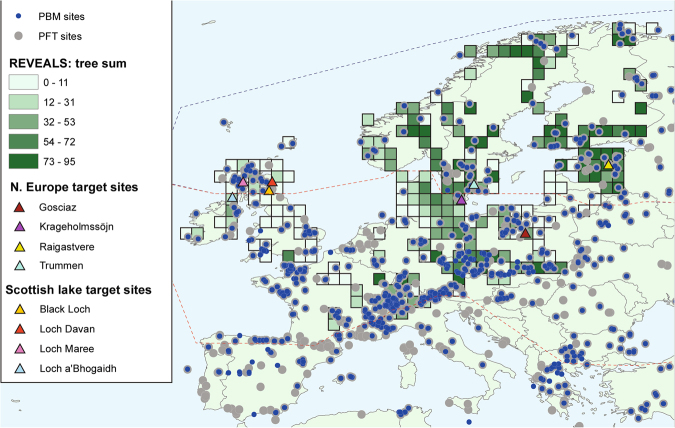
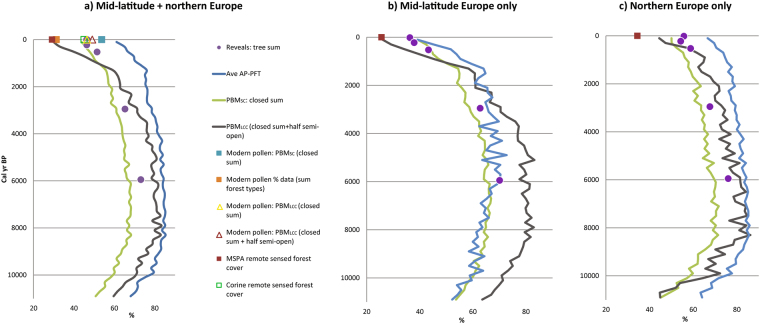
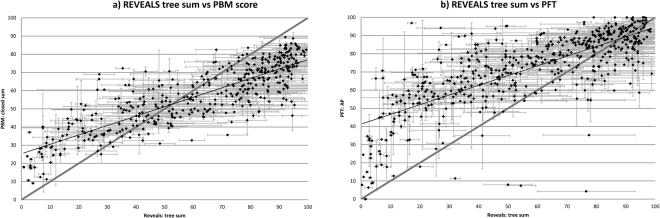
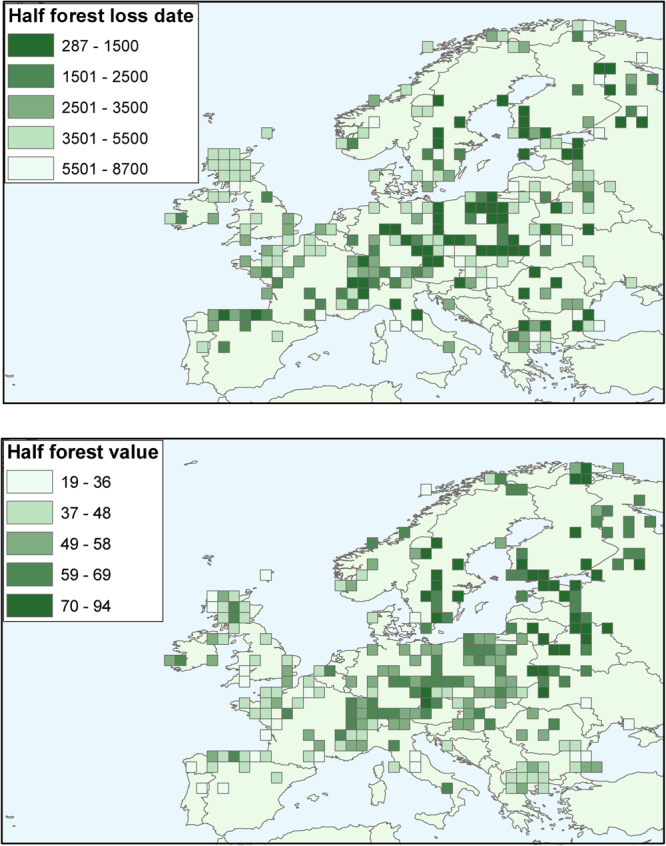
Verification
Claims the paper makes
The claims and statistics of this paper haven’t been checked yet.
Run the check — free, no account needed. It reads the open-access text and checks the sources it cites.
Claims other papers make about this one
Each is checked against this paper’s own text: does it say what the citing paper says it does?
The cited source says what the claim attributes to it.
In the citing paper
“These changes are discernible from the soil properties, and confirmed also by recent studies on pollen-based landcover reconstructions, focused on northern and central Europe (Roberts et al. 2018;Wickham 2011).”
From An explorative application of random forest algorithm for archaeological predictive modeling. A swiss case study (2021) · cites this paper as Roberts et al. 2018
Self-check
Percentages, sums and reported differences re-computed from the paper’s own numbers.
The self-check needs the paper’s full text.
Citations
Cites
Klein Goldewijk, K., Beusen, A., van Drecht, G., & de Vos, M. (2011) · Global Ecology and Biogeography · doi:10.1111/j.1466-8238.2010.00587.x · Cited by 1,270
Ellis, E. C., Kaplan, J. O., Fuller, D. Q., Vavrus, S., Klein Goldewijk, K., & Verburg, P. H. (2013) · Proceedings of the National Academy of Sciences · doi:10.1073/pnas.1217241110 · Cited by 812
Self-citation
Research works printed but not linked: 46
- Ruddiman, W. F. et al. Late Holocene climate: natural or anthropogenic? Reviews of Geophysics. 54, 93–118, https://doi.org/10.1002/2015RG000503 (2016). · DOI
- Sugita, S., Parshall, T., Calcote, R. & Walker, K. Testing the landscape reconstruction algorithm for spatially explicit reconstruction of vegetation in northern Michigan and Wisconsin. Quaternary Research. 74, 289–300 (2010). · DOI
- Nielsen, A. B., Giesecke, T. & Theuerkauf, M. et al. Quantitative reconstructions of changes in regional openness in north-central Europe reveal new insights into old questions. Quaternary Science Reviews. 47, 131–149 (2012). · DOI
- Lindbladh, M., Bradshaw, R. & Holmqvist, B. H. Pattern and process in south Swedish forests during the last 3000 years, sensed at stand and regional scales. Journal of Ecology 88(1), 113–128, https://doi.org/10.1046/j.1365-2745. 2000.00429.x (2000). · DOI
- Huntley, B. & Birks, H.J.B. An atlas of past and present pollen maps for Europe: 0-13000 years ago. (Cambridge: Cambridge University Press: 1983).
- Prentice, I. C., Guiot, J., Huntley, B., Jolly, D. & Cheddadi, R. Reconstructing biomes from palaeoecological data: a general method and its application to European pollen data at 0 and 6 ka. Climate Dynamics. 12, 185–194 (1996). · DOI
- Sugita, S. Theory of quantitative reconstruction of vegetation I: pollen from large lakes REVEALS regional vegetation composition. The Holocene. 17, 229–241 (2007). · DOI
- Gaillard, M.-J., Sugita, S. & Mazier, F. et al. Holocene land cover reconstructions for studies on land cover-climate feedbacks. Climate of the Past. 6, 483–499 (2010). · DOI
- Trondman, A.-K., Gaillard, M.-J. & Mazier, F. et al. Pollen-based quantitative reconstructions of Holocene regional vegetation cover (plant-functional types and land-cover types) in Europe suitable for climate modelling. Global Change Biology. 21, 676–697 (2015). · DOI
- Mazier, F. et al. Testing the effect of site selection and parameter setting on REVEALS-model estimates of plant abundance using the Czech Quaternary Palynological Database. Review of paleobotany and palynology 187, 38–49 (2012). · DOI
- Fyfe, R. M., Roberts, C. N. & Woodbridge, J. A pollen-based pseudo-biomisation approach to anthropogenic land cover change. The Holocene. 20, 1165–1171 (2010). · DOI
- Fyfe, R. M., Woodbridge, J. & Roberts, N. From forest to farmland: pollen inferred land cover change across Europe using the pseudobiomization approach. Global Change Biology. 21, 1197–212 (2015). · DOI · Paper page
- Woodbridge, J., Fyfe, R. M. & Roberts, N. A comparison of remote-sensed and pollen-based approaches to mapping Europe’s land cover. Journal of Biogeography. 41, 2080–2092 (2014). · DOI
- Woodbridge, J. Roberts, N. & Fyfe, R.M. (In review) Vegetation and land-use change in northern Europe during Late Antiquity: a regional-scale pollen-based reconstruction. Late Antique Archaeology
- Davis, B. A. S., Collins, P. M. & Kaplan, J. O. The age and post-glacial development of the modern European vegetation: a plant functional approach based on pollen data. Vegetation History and Archaeobotany. 2, 303–317, https://doi.org/10.1007/s00334-014-0476-9 (2015). · DOI
- Davis, M. B. On the theory of pollen analysis. American Journal of Sciences. 26, 897–554 (1963). · DOI
- Hellman, S., Gaillard, M.-J., Broström, A. & Sugita, S. The REVEALS model, a new tool to estimate past regional plant abundance from pollen data in large lakes - validation in southern Sweden. Journal of Quaternary Science. 23, 21–42 (2008). · DOI
- Fyfe, R. M. et al. The Holocene vegetation cover of Britain and Ireland: overcoming problems of scale and discerning patterns of openness. Quaternary Science Reviews. 73, 132–148 (2013). · DOI
- Soepboer, W., Sugita, S. & Lotter, A. F. Regional vegetation-cover changes on the Swiss Plateau during the past two millennia: a pollen-based reconstruction using the REVEALS model. Quaternary Science Reviews. 29, 472–483 (2010). · DOI
- Marquer, L., Gaillard, M.-J. & Sugita, S. et al. Holocene changes in vegetation composition in northern Europe: why quantitative pollen-based vegetation reconstructions matter? Quaternary Science Reviews. 90, 199–216 (2014). · DOI
- Broström, A., Nielsen, A. B. & Gaillard, M.-J. et al. Pollen productivity estimates of key European plant taxa for quantitative reconstruction of past vegetation: a review. Vegetation History and Archaeobotany. 17, 461–478 (2008). · DOI
- Kaplan, J. O., Krumhardt, K. M. & Zimmerman, N. The prehistoric and preindustrial deforestation of Europe. Quaternary Science Reviews. 28, 3016–3034 (2009). · DOI
- Ahti, T., Hämet-Ahti, L. & Jalas, J. Vegetation zones and their sections in northwestern Europe. Ann. Bot. Fennici. 5, 169–211 (1968).
- Davis, B. A. S., Zanon, M. & Collins, P. et al. The European modern pollen database (EMPD) project. Vegetation History and Archaeobotany. 22, 521–530 (2013). · DOI
- Kempeneers, P., Sedano, F., Seebach, L., Strobl, P. & San-Miguel-Ayanz, J. Data Fusion of Different Spatial Resolution Remote Sensing Images Applied to Forest-Type Mapping. IEEE Transactions on Geoscience and Remote Sensing. 49, 4977–4986 (2011). · DOI
- Mandelbrot, B. How long is the coast of Britain? Statistical self-similarity and fractional dimension. Science. 156, 636–638 (1967). · DOI
- Gaillard., M.-J. Pollen-landscape relationships in modern analogues of ancient cultural landscapes in southern Sweden – a first step towards quantification of vegetation openness in the past. Vegetation History and Archaeobotany. 7, 189–201 (1998). · DOI
- Innes, J., Blackford, J. & Simmons, I. Woodland disturbance and possible land-use regimes during the Late Mesolithic in the English uplands: pollen, charcoal and non-pollen palynomorph evidence from Bluewath Beck, North York Moors, UK. Vegetation History and Archaeobotany 19, 439–452 (2010). · DOI
- Marcott, S. A., Shakun, J. D., Clark, P. U. & Mix, A. C. A reconstruction of regional and global temperature for the past 11,300 years. Science 339, 1198–1201 (2013). · DOI · Paper page
- Gaillard, M.-J. et al. The use of modelling and simulation approach in reconstructing past landscapes from fossil pollen data: A review and results from the POLLANDCAL network. Vegetation History and Archaeobotany. 17, 419–443 (2008). · DOI
- Hammarlund, D., Barnekow, L., Birks, H. J. B., Buchardt, B. & Edwards, T. W. D. Holocene changes in atmospheric circulation recorded in the oxygen-isotope stratigraphy of lacustrine carbonates from northern Sweden. Holocene. 12, 339–351 (2002). · DOI
- Bigler, C., Barnekow, L., Heinrichs, M. L. & Hall, R. I. Holocene environmental history of Lake Vuolep Njakajaure (Abisko National Park, northern Sweden) reconstructed using biological proxy indicators. Veg. Hist. Archaeobot. 15, 309–320 (2006). · DOI
- Seppa, H. et al. Invasion of Norway spruce (Picea abies) and the rise of the boreal ecosystem in Fennoscandia. Journal of Ecology. 97, 629–640 (2009). · DOI
- Douglas Price, T. Ancient Scandinavia. An archaeological history from the first humans to the Vikings. (Oxford University Press: 2015).
- Kuneš, P. et al. The origin of grasslands in the temperate forest zone of east-central Europe: long-term legacy of climate and human impact. Quaternary Science Reviews. 116, 15–27 (2015). · DOI
- Shennan, S., Downey, S. S. & Timpson, A. et al. Regional population collapse followed initial agricultural booms in mid-Holocene Europe. Nature. Communications. 4, 2486 (2013).
- Woodbridge, J. et al. The impact of the Neolithic agricultural transition in Britain: a comparison of pollen-based land-cover and archaeological 14C date-inferred population change. Journal of Archaeological Science. 51, 216–224 (2014). · DOI
- Lechterbeck, J. et al. Is Neolithic land use correlated with demography? An evaluation of pollen derived land cover and radiocarbon inferred demographic change from central Europe. The Holocene. 24, 1297–1307 (2014). · DOI
- Marquer, L. et al. Quantifying the effects of land use and climate on Holocene vegetation in Europe. Quaternary Science Reviews 171, 20–37 (2017). · DOI
- Wickham, C. Framing the Early Middle Ages. Europe and the Mediterranean, 400-800 (Oxford: 2005). · DOI
- Williams, M. Deforesting the Earth. From Prehistory to Global Crisis. (Chicago: University of Chicago Press: 2003).
- Kirby, K. & Watkins, C. (eds.) Europe’s Changing Woods and Forests. From Wildwood to Managed Landscapes. (CABI: 2015). · DOI
- redrawn by Darby, H.C. The clearing of the woodland in Europe. In Man's changing role in changing the face of the Earth, pp. 183-216. Edited by W.L. Thomas, Jr. Chicago: University of Chicago Press (1956).
- Rackham, O. Ancient Woodland. Its History, Vegetation and Uses in England. 2nd ed. (Colvend: Castlepoint Press: 2003).
- Rippon, S., Smart, C. & Pears, B. The Fields of Britannia. Continuity and Change in the Late Roman and Early Medieval Landscape. (Oxford University Press: 2015).
- Giesecke, T., Davis, B. & Brewer, B. et al. Towards mapping the late Quaternary vegetation change of Europe. Vegetation History and Archaeobotany 23, 75–86 (2014). · DOI
Cited by
Sorted by citations
Three flaws in defining a formal ‘Anthropocene’
Ruddiman, W. F. (2018) · Progress in Physical Geography: Earth and Environment · doi:10.1177/0309133318783142 · Cited by 77
Castiello, M. E., & Tonini, M. (2021) · Journal of Computer Applications in Archaeology · doi:10.5334/jcaa.71 · Cited by 29
Metadata
- Authors
- Roberts, N., Fyfe, R. M., Woodbridge, J., Gaillard, M.-J., Davis, B. A. S., Kaplan, J. O., Marquer, L., Mazier, F., Nielsen, A. B., Sugita, S., Trondman, A.-K., & Leydet, M.
- Venue
- Scientific Reports
- Published
- 2018-01-15
- Volume
- 8
- Issue
- 1
- ISSN
- 2045-2322
- PMC
- PMC5768782
- Cited by
- 196
- References
- 2
- Language
- en
About these checks
Registry, retraction, Cites and statistics results are computed, not judged, with one exception: a printed reference that no index lists is read once by a model before it counts as a citation error. Claims are extracted by a model and kept only when their quote appears verbatim in the text; each cited source is then checked, with a model’s help, for whether it says what the claim relies on. Those verdicts can be wrong — read the claim’s quote and the cited source before relying on one.
Statistics and arithmetic are recomputed, not judged.
Confidence bands are shown only for fields calibrated on our annotated test set. None is calibrated yet, so no band is shown.
What counts as a claim ›How we measure confidence ›How we check this ›
Are you an author, or do you see a problem with this page? Request a review
