

Variability in phase and amplitude of diurnal rhythms is related to variation of mood in bipolar and borderline personality disorder
Open accessThe DOI matches its Crossref record; 54 of the 54 references it cites were found in a registry or an index.
Abstract
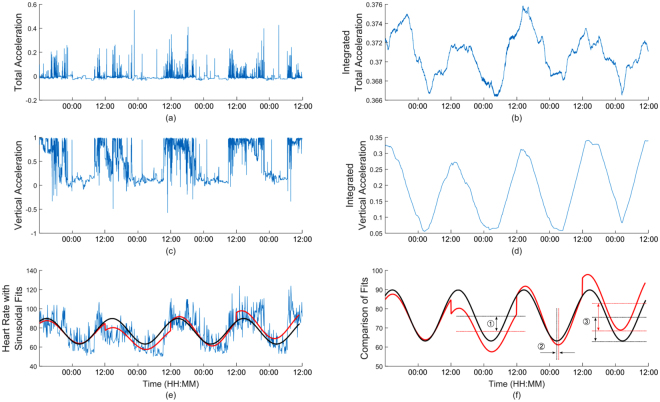
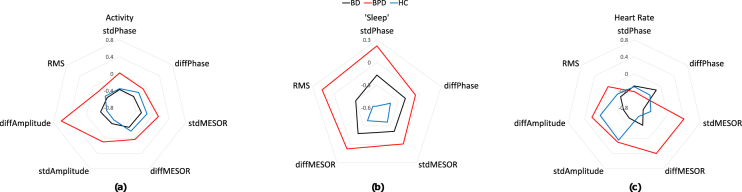
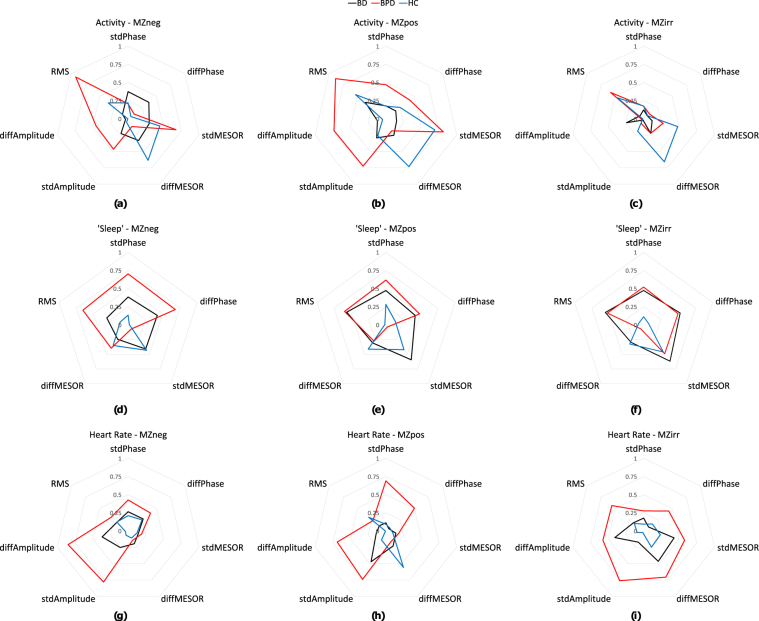
Variable mood is an important feature of psychiatric disorders. However, its measurement and relationship to objective measureas of physiology and behaviour have rarely been studied. Smart-phones facilitate continuous personalized prospective monitoring of subjective experience and behavioural and physiological signals can be measured through wearable devices. Such passive data streams allow novel estimates of diurnal variability. Phase and amplitude of diurnal rhythms were quantified using new techniques that fitted sinusoids to heart rate (HR) and acceleration signals. We investigated mood and diurnal variation for four days in 20 outpatients with bipolar disorder (BD), 14 with borderline personality disorder (BPD) and 20 healthy controls (HC) using a smart-phone app, portable electrocardiogram (ECG), and actigraphy. Variability in negative affect, positive affect, and irritability was elevated in patient groups compared with HC. The study demonstrated convincing associations between variability in subjective mood and objective variability in diurnal physiology. For BPD there was a pattern of positive correlations between mood variability and variation in activity, sleep and HR. The findings suggest BPD is linked more than currently believed with a disorder of diurnal rhythm; in both BPD and BD reducing the variability of sleep phase may be a way to reduce variability of subjective mood.
Overview
The claims and statistics of this paper haven’t been checked yet.
Free: it reads the open-access text and checks the first 5 claims that cite a source we can check. Create a free account to check every claim.
Integrity signals
Registry
Cites
Statistics
Figures
Verification
Claims the paper makes
The claims and statistics of this paper haven’t been checked yet.
Free: it reads the open-access text and checks the first 5 claims that cite a source we can check. Create a free account to check every claim.
Claims other papers make about this one
Each is checked against this paper’s own text: does it say what the citing paper says it does?
The source backs part of the claim, not all of it — or backs it for a different population, condition or comparison.
In the citing paper
“Furthermore, many of the studies on wearable technology use apps and algorithms were specifically designed by/for the research team and are not easily available to the average clinician and patient [40, 41].”
From Technology-Based Approaches for Supporting Perinatal Mental Health (2022) · cites this paper as [40]
Experimental — accuracy not yet measured
Self-check
Percentages, sums and reported differences re-computed from the paper’s own numbers.
The self-check needs the paper’s full text.
Citations
Cites
Diagnostic and Statistical Manual of Mental Disorders
American Psychiatric Association (2013) · doi:10.1176/appi.books.9780890425596 · Cited by 116,369
A Brief Measure for Assessing Generalized Anxiety Disorder: The GAD-7
Spitzer, R. L., Kroenke, K., Williams, J. B. W., & Löwe, B. (2006) · Archives of Internal Medicine · doi:10.1001/archinte.166.10.1092 · Cited by 31,765 · cited 1×
“The responses to the MZ questionnaire have been shown to be highly correlated with the results of traditional questionnaires (QIDS 29 , GAD-7 30 , and EQ-5D) for mood, anxiety and quality of life 10 .”
A Direct Approach to False Discovery Rates
Storey, J. D. (2002) · Journal of the Royal Statistical Society Series B: Statistical Methodology · doi:10.1111/1467-9868.00346 · Cited by 5,603 · cited 1×
“Correction for multiple statistical hypothesis tests was performed using the positive false discovery rate (significance at the 5% level), as defined by Storey, 2002 35 .”
Rush, A. J., Trivedi, M. H., Ibrahim, H. M., Carmody, T. J., Arnow, B., Klein, D. N., Markowitz, J. C., Ninan, P. T., Kornstein, S., Manber, R., et al. (2003) · Biological Psychiatry · doi:10.1016/s0006-3223(02)01866-8 · Cited by 3,829 · cited 1×
“The responses to the MZ questionnaire have been shown to be highly correlated with the results of traditional questionnaires (QIDS 29 , GAD-7 30 , and EQ-5D) for mood, anxiety and quality of life 10 .”
Clinical Psychology: Science and Practice
(2021) · Clinical Psychology Science and Practice · doi:10.1111/(issn)1468-2850 · Cited by 3,672
Yatham, L., & Malhi, G. (2011) · Oxford University Press eBooks · doi:10.1093/med/9780199562305.001.0001 · Cited by 3,506
Borderline personality disorder
Lieb, K., Zanarini, M. C., Schmahl, C., Linehan, M. M., & Bohus, M. (2004) · The Lancet · doi:10.1016/s0140-6736(04)16770-6 · Cited by 1,369
Clinical psychology: Science and practice.
Kazdin, A. E. (1994) · Clinical Psychology: Science and Practice · doi:10.1111/j.1468-2850.1994.tb00001.x · Cited by 1,357
Goodwin, G., Haddad, P., Ferrier, I., Aronson, J., Barnes, T., Cipriani, A., Coghill, D., Fazel, S., Geddes, Jr., Grunze, H., et al. (2016) · Journal of Psychopharmacology · doi:10.1177/0269881116636545 · Cited by 1,309
Self-citationJournal of Psychiatry and Neuroscience
(2025) · Journal of Psychiatry and Neuroscience · doi:10.1503/jpn · Cited by 1,128
Cited by
Circadian Mechanisms in Medicine
Allada, R., & Bass, J. (2021) · New England Journal of Medicine · doi:10.1056/nejmra1802337 · Cited by 519
Merikangas, K. R., Swendsen, J., Hickie, I. B., Cui, L., Shou, H., Merikangas, A. K., Zhang, J., Lamers, F., Crainiceanu, C., Volkow, N. D., et al. (2019) · JAMA Psychiatry · doi:10.1001/jamapsychiatry.2018.3546 · Cited by 231
Cho, C.-H., Lee, T., Kim, M.-G., In, H. P., Kim, L., & Lee, H.-J. (2019) · Journal of Medical Internet Research · doi:10.2196/11029 · Cited by 183
“Carr et al studied if variability in phase and amplitude of the diurnal rhythm is related to variation of mood in bipolar and borderline personality disorder [43].”
BackgroundTouchscreen typing pattern analysis for remote detection of the depressive tendency
Mastoras, R.-E., Iakovakis, D., Hadjidimitriou, S., Charisis, V., Kassie, S., Alsaadi, T., Khandoker, A., & Hadjileontiadis, L. J. (2019) · Scientific Reports · doi:10.1038/s41598-019-50002-9 · Cited by 100
“A holistic approach can extend the current method by enriching the sensed data with physical 53 and sleep activity information 54 , heart rate variability and diurnal activity 55 , as well as other informative data.”
MethodMikkelsen, K. B., Ebajemito, J. K., Bonmatí‐Carrión, M., Santhi, N., Revell, V. L., Atzori, G., della Monica, C., Debener, S., Dijk, D., Sterr, A., et al. (2018) · Journal of Sleep Research · doi:10.1111/jsr.12786 · Cited by 101
“Poor sleep quality has been shown to impact a variety of conditions, such as stroke (e.g. Bassetti, 2005), diabetes, Alzheimer and mental health (e.g. Carr et al., 2018).”
BackgroundAntosik-Wójcińska, A. Z., Dominiak, M., Chojnacka, M., Kaczmarek‐Majer, K., Opara, K. R., Radziszewska, W., Olwert, A., & Święcicki, Ł. (2020) · International Journal of Medical Informatics · doi:10.1016/j.ijmedinf.2020.104131 · Cited by 93
Real-time mobile monitoring of bipolar disorder: a review of evidence and future directions
Dunster, G. P., Swendsen, J. D., & Merikangas, K. R. (2020) · Neuropsychopharmacology · doi:10.1038/s41386-020-00830-5 · Cited by 77
Differential Diagnosis of Bipolar II Disorder and Borderline Personality Disorder
Bayes, A. J., Parker, G. B., & Paris, J. (2019) · Current Psychiatry Reports · doi:10.1007/s11920-019-1120-2 · Cited by 69
Portable technologies for digital phenotyping of bipolar disorder: A systematic review
Saccaro, L. F., Amatori, G., Cappelli, A., Mazziotti, R. M., Dell’Osso, L., & Rutigliano, G. (2021) · Journal of Affective Disorders · doi:10.1016/j.jad.2021.08.052 · Cited by 69
Gillett, G., Watson, G., Saunders, K., & McGowan, N. M. (2021) · Journal of Psychiatric Research · doi:10.1016/j.jpsychires.2021.09.043 · Cited by 60
Self-citationAssociation between solar insolation and a history of suicide attempts in bipolar I disorder
Bauer, M., Glenn, T., Alda, M., Andreassen, O. A., Angelopoulos, E. K., Ardau, R., Ayhan, Y., Baethge, C., Bauer, R., Baune, B. T., et al. (2019) · Journal of Psychiatric Research · doi:10.1016/j.jpsychires.2019.03.001 · Cited by 51
“This association of suicide rates with environmenta l factors is of considerable concern since circadian rhythm disturbances are fou nd in many psychiatric illnesses, including bipolar disorder (Carr et al., 2018; Jagannath et al., 2013; Jones and Benca, 2015; Logan and McClung, 2019).”
BackgroundEmploying of machine learning and wearable devices in healthcare system: tasks and challenges
Saad, H. S., Zaki, J. F. W., & Abdelsalam, M. M. (2024) · Neural Computing and Applications · doi:10.1007/s00521-024-10197-z · Cited by 71
“Adequate sleep is critical to maintaining good health and has been suggested as a valuable tool for the diagnosis and treatment of various diseases [128–130].”
The True Colours Remote Symptom Monitoring System: A Decade of Evolution
Goodday, S., Atkinson, L. Z., Goodwin, G. M., Saunders, K., South, M., Mackay, C. E., Denis, M., Hinds, C., Attenburrow, M.-J., Davies, J., et al. (2020) · Journal of Medical Internet Research · doi:10.2196/15188 · Cited by 53
“In recent studies, additional objective physiological measures, derived from Fitbit and wrist-worn accelerometers, were included, along with daily and weekly mood monitoring [22] as well as the proteus patch [21,25] that provides an estimate of heart rate.”
BackgroundSelf-citationOrtiz, A., Maslej, M. M., Husain, M. I., Daskalakis, Z. J., & Mulsant, B. H. (2021) · Journal of Affective Disorders · doi:10.1016/j.jad.2021.08.140 · Cited by 48
Circadian rest-activity patterns in bipolar disorder and borderline personality disorder
McGowan, N. M., Goodwin, G. M., Bilderbeck, A. C., & Saunders, K. (2019) · Translational Psychiatry · doi:10.1038/s41398-019-0526-2 · Cited by 39
Self-citationMcGowan, N. M., Goodwin, G. M., Bilderbeck, A. C., & Saunders, K. (2020) · Acta Psychiatrica Scandinavica · doi:10.1111/acps.13148 · Cited by 45
“Recently, we identified desynchronised patterns of heart rate, activity and sleep, in participants with BD and BPD (14) and correspondingly, reported an association between desynchrony and differential mood patterns (22).”
BackgroundSelf-citationTechnology-Based Approaches for Supporting Perinatal Mental Health
Novick, A. M., Kwitowski, M., Dempsey, J., Cooke, D. L., & Dempsey, A. G. (2022) · Current Psychiatry Reports · doi:10.1007/s11920-022-01349-w · Cited by 35
“Furthermore, many of the studies on wearable technology use apps and algorithms were specifically designed by/for the research team and are not easily available to the average clinician and patient [40, 41].”
BackgroundSleep differences in the UK between 1974 and 2015: Insights from detailed time diaries
Pérez, J. L. D. G., Gershuny, J., Foster, F., & Vos, M. D. (2018) · Journal of Sleep Research · doi:10.1111/jsr.12753 · Cited by 34
Desynchronization of diurnal rhythms in bipolar disorder and borderline personality disorder
Carr, O., Saunders, K., Bilderbeck, A. C., Tsanas, A., Palmius, N., Geddes, J. R., Foster, F., Vos, M. D., & Goodwin, G. M. (2018) · Translational Psychiatry · doi:10.1038/s41398-018-0125-7 · Cited by 41
Self-citationMcGowan, N. M., & Saunders, K. (2021) · Current Psychiatry Reports · doi:10.1007/s11920-021-01236-w · Cited by 33
Self-citationEnhancing cosinor analysis of circadian phase markers using the gamma distribution
Doyle, M., Murphy, T. E., Miner, B., Pisani, M. A., Lusczek, E. R., & Knauert, M. P. (2022) · Sleep Medicine · doi:10.1016/j.sleep.2022.01.015 · Cited by 26
Palmius, N., Saunders, K., Carr, O., Geddes, J. R., Goodwin, G. M., & Vos, M. D. (2018) · Journal of Medical Internet Research · doi:10.2196/10194 · Cited by 32
“We also collected physiological data during some parts of the study, as presented by Carr et al [19,20].”
MethodResultSelf-citationBalter, L. J. T., Holding, B. C., Petrović, P., & Axelsson, J. (2024) · Translational Psychiatry · doi:10.1038/s41398-024-02943-7 · Cited by 32
“Notably, symptoms relating to mood disorders are not static but can fl uctuate across the 24 h period, with patterns varying from worse symptoms in the morning, afternoon, or evening [17 – 19].”
Skubal, M., Larney, B. M., Phung, N. B., Desmaras, J. C., Dozic, A. V., Volpe, A., Ogirala, A., Machado, C. M. L., Djibankov, J., Ponomarev, V., et al. (2024) · Theranostics · doi:10.7150/thno.95334 · Cited by 26
An ecological study of objective rest–activity markers of lithium response in bipolar-I-disorder
Scott, J. L., Hennion, V., Meyrel, M., Bellivier, F., & Étain, B. (2020) · Psychological Medicine · doi:10.1017/s0033291720004171 · Cited by 24
“…between these objective markers of CR and Li response (OR: 1.41; p < 0.04), the findings for these parameters appear to identify BD-I cases with rest–activity rhythms that mimic those of healthy controls [for reviews see De Crescenzo et al. (2017); Geoffroy et al. (2015); Scott et al. (2017)].”
ResultInfluentialApps and wearables in the monitoring of mental health disorders
Patel, S. K., & Saunders, K. (2018) · British Journal of Hospital Medicine · doi:10.12968/hmed.2018.79.12.672 · Cited by 22
Self-citationLee, E., Ramsey, M., Malhotra, A., Ancoli‐Israel, S., Kaufmann, C. N., Soontornniyomkij, B., Graham, S. A., Depp, C. A., & Eyler, L. T. (2020) · Journal of Psychiatric Research · doi:10.1016/j.jpsychires.2020.12.019 · Cited by 22
“, 2016), greater mood variability (Carr et al., 2018; Melo et al., 2017), medication adherence (Kaufmann et al.”
BackgroundSchneider, J., Bakštein, E., Kolenič, M., Vostatek, P., Correll, C. U., Novák, D., & Španiel, F. (2020) · CNS Spectrums · doi:10.1017/s1092852920001777 · Cited by 23
Atkinson, L. Z., Colbourne, L., Smith, A., Harmer, C. J., Nobre, A. C., Rendell, J., Jones, H. J. S., Hinds, C., Mould, A. W., Tunbridge, E. M., et al. (2019) · Trials · doi:10.1186/s13063-019-3175-0 · Cited by 23
Self-citationChan, E. C., Sun, Y., Aitchison, K. J., & Sivapalan, S. (2021) · JMIR Formative Research · doi:10.2196/13770 · Cited by 20
“14/26 (54%) of patients with borderline personality disorder Carr et al (2018) [26] • BDc median: –0.”
InfluentialUsing Chronobiological Phenotypes to Address Heterogeneity in Bipolar Disorder
Gonzalez, R., Gonzalez, S. D., & McCarthy, M. J. (2019) · Complex Psychiatry · doi:10.1159/000506636 · Cited by 17
Taquet, M., Griffiths, K., Palmer, E. O. C., Ker, S., Liman, C., Wee, S. N., Kollins, S. H., & Patel, R. (2023) · The Lancet Psychiatry · doi:10.1016/s2215-0366(23)00066-4 · Cited by 21
Weise, S., Parzer, P., Fürer, L., Zimmermann, R., Schmeck, K., Resch, F., Kaess, M., & Koenig, J. (2021) · The World Journal of Biological Psychiatry · doi:10.1080/15622975.2020.1858155 · Cited by 15
Linking Changes in Heart Rate Variability to Mood Changes in Daily Life
Carr, O., Andreotti, F., Saunders, K., Bilderbeck, A. C., Goodwin, G. M., & Vos, M. D. (2017) · Computing in cardiology · doi:10.22489/cinc.2017.319-334 · Cited by 13
“The effects of circadian rhythms have not been corrected for as there may be some natural variation in HRV measures throughout the day [15].”
BackgroundSelf-citationRemote Monitoring for Understanding Mechanisms and Prediction in Psychiatry
Gillett, G., & Saunders, K. (2019) · Current Behavioral Neuroscience Reports · doi:10.1007/s40473-019-00176-3 · Cited by 14
Self-citationKsiążek, K., Masarczyk, W., Głomb, P., Romaszewski, M., Stokłosa, I., Ścisło, P., Dębski, P. G., Pudło, R., Búza, K., Gorczyca, P. W., et al. (2024) · Computers in Biology and Medicine · doi:10.1016/j.compbiomed.2024.108544 · Cited by 15
Edgley, K., Saunders, P. T. K., Whitaker, L. H. R., Horne, A. W., & Tsanas, A. (2025) · npj Digital Medicine · doi:10.1038/s41746-025-01629-8 · Cited by 12
“On the imputed data (with remaining missing values removed), we then computed the Teager-Kaiser energy operator (TKEO) and and root mean squared successive differences (RMSSD), as have been usedinotherstudies 53 ,which arede fi nedinEq.”
Self-citationFrom sleep medicine to medicine during sleep: a new paradigm
Behar, J. A. (2019) · SLEEP · doi:10.1093/sleep/zsz279 · Cited by 7
Cremone, I. M., Dell’Osso, L., Nardi, B., Giovannoni, F., Parri, F., Pronestì, C., Bonelli, C., Massimetti, G., Pini, S., & Carpita, B. (2024) · Brain Sciences · doi:10.3390/brainsci14121297 · Cited by 7
Ten quick tips for electrocardiogram (ECG) signal processing
Chicco, D., Karaiskou, A.-Ι., & Vos, M. D. (2024) · PeerJ Computer Science · doi:10.7717/peerj-cs.2295 · Cited by 9
“Was the ECG acquired during movement, sleep, or during a 24-hours span ( Moeyersons et al., 2019 ; Pérez-Riera et al., 2018 ; Carr et al., 2018 ; Carr, de Vos & Saunders, 2018 ; Gregg et al., 2008 ; Clifford, 2006 )?”
BackgroundThe computational psychopathology of emotion
Erdman, A., & Eldar, E. (2023) · Psychopharmacology · doi:10.1007/s00213-023-06335-5 · Cited by 7
“…and Shiffman et al. 2013) studies show that although bipolar disorder and borderline personality disorder involve similar emotions, the characteristic timescale of these emotions can be considerably longer in bipolar patients than it is in borderline patients (Carr et al. 2018; Tsanas et al. 2016).”
Backgroundvan Trigt, S., van der Zweerde, T., Someren, E. J. W. V., van Straten, A., & van Marle, H. J. F. (2025) · Sleep Medicine Reviews · doi:10.1016/j.smrv.2025.102089 · Cited by 12
EEG to fMRI Synthesis for Medical Decision Support: A Case Study on Schizophrenia DiagnosisPreprint
Calhas, D., & Henriques, R. (2023) · medRxiv · doi:10.1101/2023.08.07.23293748 · Cited by 5
Childhood Maltreatment and Borderline Personality Disorder
Salavati, M., & Selby, E. A. (2024) · Springer eBooks · doi:10.1007/978-3-031-75503-3_4 · Cited by 5
Borderline Personality Disorder and the Heart
Boldrini, A. (2020) · Springer eBooks · doi:10.1007/978-3-030-28008-6_25 · Cited by 3
Wright, L. A., Bakštein, E., Saunders, K., Guo, B., & Morriss, R. K. (2026) · International Journal of Bipolar Disorders · doi:10.1186/s40345-025-00407-5 · Cited by 4
“…it is important to acknowledge the diurnal variation in bipolar disorder (e.g. bipolar depression can display positive mood variation – worse mood on waking with improved mood in the evening) (Carr et al. 2018) and thus ambulatory assessment should ideally be administered at the same time each day.”
Self-citationMonitoring Depression in Bipolar Disorder using Circadian Measures from Smartphone AccelerometersPreprint
Carr, O., Andreotti, F., Saunders, K., Palmius, N., Goodwin, G. M., & Vos, M. D. (2020) · arXiv (Cornell University) · doi:10.48550/arxiv.2007.02064 · Cited by 5
“These studies, in addition to our previous work which found strong correlations between circadian variability of activity and sleep measures with mood instability over a week long period [30], suggest being able to monitor activity over longitudinal periods may provide objective markers for levels of depression in bip…”
ResultSelf-citationKsiążek, K., Masarczyk, W., Głomb, P., Romaszewski, M., Stokłosa, I., Ścisło, P., Dębski, P. G., Pudło, R., Búza, K., Gorczyca, P. W., et al. (2023) · medRxiv · doi:10.1101/2023.08.04.23293640 · Cited by 2
“…the assessment of schizophrenia or BD tend to: use heart rate instead of HRV as a general parameter [Osipov et al., 2015, Reinertsen et al., 2017, Carr et al., 2018], compare a short 5 min HRV reading with general activity [Freyberg et al., 2020], use accelerometry only for artifact detection…”
BackgroundInformatics Technologies in the Diagnosis and Treatment of Mental Health Conditions
Ingram, W. M., Khanna, R., & Weston, C. L. (2021) · Health informatics · doi:10.1007/978-3-030-70558-9_17 · Cited by 1
“Individuals with borderline personality disorder demonstrated significant changes in diurnal physiology (i.e. sleep, activity and heart rate), which may exacerbate symptomatology and could prove to be useful targets for intervention [73].”
BackgroundAristodemou, M., Judd, N., Klingberg, T., & Kievit, R. (2024) · PsyArXiv (OSF Preprints) · doi:10.31234/osf.io/8up6x · Cited by 1
Synchronization of Human Circadian Genes Between in vivo and Cultured Blood SamplesPreprint
Pritt, J., Counts, J. D., Campbell, M., Reed, D., & Kraus, W. E. (2024) · bioRxiv (Cold Spring Harbor Laboratory) · doi:10.1101/2024.01.20.24301529
“Circadian disruption is associated with cognitive impairment, such as altered mood and impaired learning, and occurs in patients with schizophrenia and other psychiatric disorders (Carr et al., 2018; LeGates et al., 2012; Yates, 2016).”
BackgroundKelbrick, M., da Silva, K. M., Griffiths, C., Ansari, S., Mann, N., Johnson, S., Paduret, G., & Tanner, J. (2024) · Progress in Neurology and Psychiatry · doi:10.1002/pnp.12012
“Like bipolar disorder, EUPD is associated with abnormal sleep characteristics, with evidence of mood variability in this population related to sleep phase variability and sleep disturbance associated with potential exacerbation of emotional dysregulation and suicide risk [37, 38].”
Bipolarité et trouble de la personnalité limite
Gourion, D. (2023) · Elsevier eBooks · doi:10.1016/b978-2-294-77180-4.00034-2
Digital Innovation in Mental Health
Gillett, G., Rigby, D., & Gadelrab, R. (2025) · Cambridge University Press eBooks · doi:10.1017/9781009028967.011
Digital tools for assessing bipolar disorder: A scoping review of the current landscape
Jacobson, S., Carling, H., Sarraf, L., Draper, E., Jacobson, S., St-James, M., Misiasz, C., Williamson, S., Thibaudeau, É., Sauvé, G., et al. (2026) · Neuroscience Applied · doi:10.1016/j.nsa.2026.107004 · Cited by 2
Park, C. H. K., Park, C., Rhee, S., Min, S., Song, Y., Lee, H.-J., Won, S., Lee, K. Y., Lee, D.-Y., Kim, D. H., et al. (2026) · Depression and Anxiety · doi:10.1155/da/7452200
“Variability in subjective mood has been shown to correlate with objective variability in diurnal physiology, with mood being particularly sensitive to shifts in the phase and depth of sleep [39].”
Metadata
- Authors
- Carr, O., Saunders, K. E. A., Tsanas, A., Bilderbeck, A. C., Palmius, N., Geddes, J. R., Foster, R., Goodwin, G. M., & De Vos, M.
- Affiliations
- University of Oxford (GB)
- Oxford Health NHS Foundation Trust (GB)
- Corresponding author
- Carr, O.
- Venue
- Scientific Reports
- Published
- 2018-01-26
- Volume
- 8
- Issue
- 1
- Pages
- 1649-1649
- ISSN
- 2045-2322 (ISSN-L)
- PMC
- PMC5786095
- OpenAlex
- W2791305778
- Cited by
- 57
- References
- 54
- Citations by year
- 2026: 3 · 2025: 3 · 2024: 11 · 2023: 5 · 2022: 2 · 2021: 7 · 2020: 9 · 2019: 10 · 2018: 6
- FWCI
- 10.47
- Type
- journal article
- Language
- en
- Open access
- gold
- doi.org
- Licence
- cc-by
- creativecommons.org/licenses/by/4.0 (tdm)
- creativecommons.org/licenses/by/4.0 (vor)
- Locations
- Scientific Reports (publishedVersion, cc-by)
- PubMed Central (publishedVersion, cc-by)
- PubMed (publishedVersion)
- Edinburgh Research Explorer (University of Edinburgh) (publishedVersion, cc-by)
- DOAJ (DOAJ: Directory of Open Access Journals) (submittedVersion, cc-by-sa)
- Funders
- Eli Lilly and Company
- Pfizer
- AstraZeneca
- Sunovion
- Wellcome Trust (098461, 102,616/Z, 098461/Z/12/Z, 102616, 098461/Z/12, 098461/Z)
- National Institute for Health and Care Research (NF-SI-0513-10010, NF-SI-0514-10142, 102616/Z, NF-SI-0611-10150, NF-SI-0510-10102)
- Research Councils UK
- Servier
- H. Lundbeck A/S (P1vital)
- Medical Research Council (MC_PC_17215)
- Engineering and Physical Sciences Research Council (1245156, 1515768)
- Topics
- Social Sciences › Psychology › Experimental and Cognitive Psychology › Mental Health Research Topics
- Health Sciences › Medicine › Psychiatry and Mental health › Bipolar Disorder and Treatment
- Life Sciences › Neuroscience › Endocrine and Autonomic Systems › Circadian rhythm and melatonin
- Keywords
- diurnal cycle, mood variability, bipolar disorder, borderline personality disorder, heart rate, actigraphy, sleep stages, negative affect, positive affect, irritability, smartphone-based monitoring, wearable devices, sinusoidal fitting
- MeSH terms
- Smartphone, Adult, Affect, Bipolar Disorder, Borderline Personality Disorder, Circadian Rhythm, Electrocardiography, Female, Humans, Male, Middle Aged, Prospective Studies, Young Adult, Actigraphy
About these checks
Registry, retraction, Cites and statistics results are computed, not judged, with one exception: a printed reference that no index lists is read once by a model before it counts as a citation error. Claims are extracted by a model and kept only when their quote appears verbatim in the text; each cited source is then checked, with a model’s help, for whether it says what the claim relies on. Those verdicts can be wrong — read the claim’s quote and the cited source before relying on one.
Statistics and arithmetic are recomputed, not judged.
Confidence bands are shown only for fields calibrated on our annotated test set. None is calibrated yet, so no band is shown.
What counts as a claim ›How we measure confidence ›How we check this ›
Are you an author, or do you see a problem with this page? Request a review
Data sources
Bibliographic data: Semantic Scholar, OpenAlex, Crossref.
Contains information from the Semantic Scholar Academic Graph Datasets, made available under the ODC Attribution License (ODC-BY 1.0).
Semantic Scholar’s data is described in: Kinney, R., et al. (2023). The Semantic Scholar Open Data Platform. arXiv:2301.10140.
