

Variability in phase and amplitude of diurnal rhythms is related to variation of mood in bipolar and borderline personality disorder
Open accessThe DOI matches its Crossref record; 54 of the 54 references it cites were found in a registry or an index.
Abstract
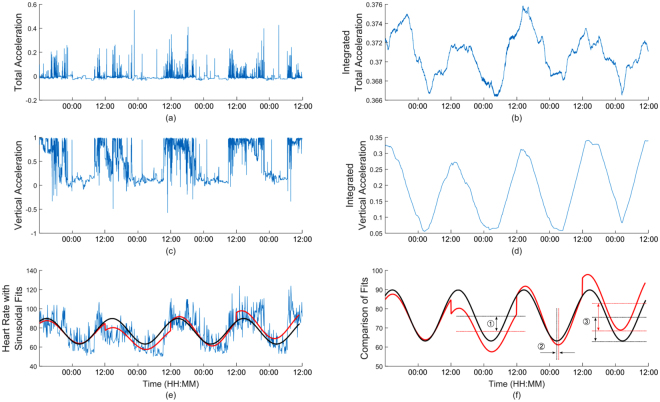
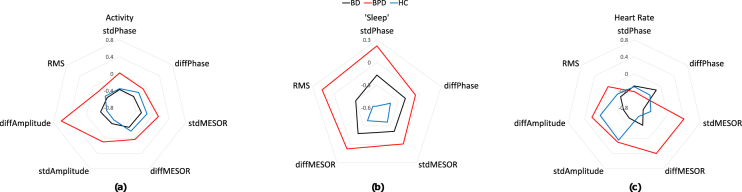
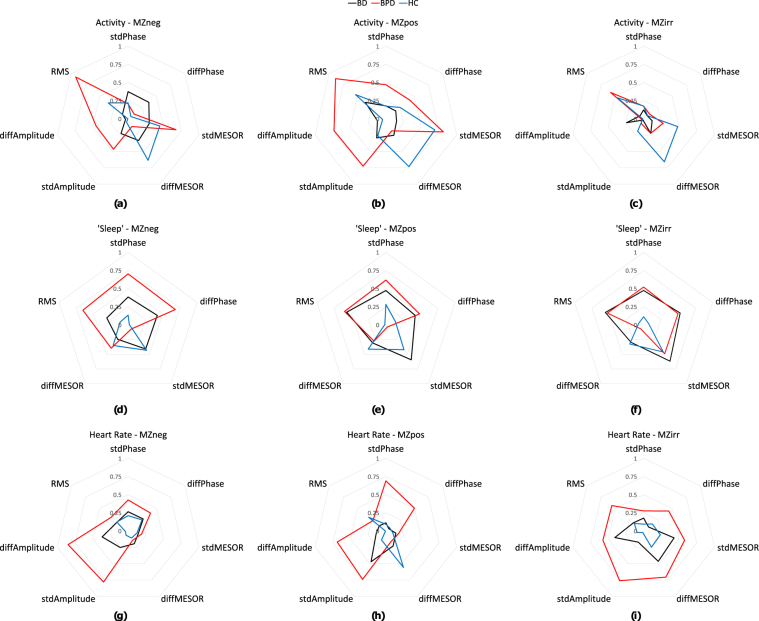
Variable mood is an important feature of psychiatric disorders. However, its measurement and relationship to objective measureas of physiology and behaviour have rarely been studied. Smart-phones facilitate continuous personalized prospective monitoring of subjective experience and behavioural and physiological signals can be measured through wearable devices. Such passive data streams allow novel estimates of diurnal variability. Phase and amplitude of diurnal rhythms were quantified using new techniques that fitted sinusoids to heart rate (HR) and acceleration signals. We investigated mood and diurnal variation for four days in 20 outpatients with bipolar disorder (BD), 14 with borderline personality disorder (BPD) and 20 healthy controls (HC) using a smart-phone app, portable electrocardiogram (ECG), and actigraphy. Variability in negative affect, positive affect, and irritability was elevated in patient groups compared with HC. The study demonstrated convincing associations between variability in subjective mood and objective variability in diurnal physiology. For BPD there was a pattern of positive correlations between mood variability and variation in activity, sleep and HR. The findings suggest BPD is linked more than currently believed with a disorder of diurnal rhythm; in both BPD and BD reducing the variability of sleep phase may be a way to reduce variability of subjective mood.
Overview
The claims and statistics of this paper haven’t been checked yet.
Free: it reads the open-access text and checks the first 5 claims that cite a source we can check. Create a free account to check every claim.
Integrity signals
Registry
Cites
Statistics
Figures
Verification
Claims the paper makes
The claims and statistics of this paper haven’t been checked yet.
Free: it reads the open-access text and checks the first 5 claims that cite a source we can check. Create a free account to check every claim.
Claims other papers make about this one
Each is checked against this paper’s own text: does it say what the citing paper says it does?
The source backs part of the claim, not all of it — or backs it for a different population, condition or comparison.
In the citing paper
“Furthermore, many of the studies on wearable technology use apps and algorithms were specifically designed by/for the research team and are not easily available to the average clinician and patient [40, 41].”
From Technology-Based Approaches for Supporting Perinatal Mental Health (2022) · cites this paper as [40]
Experimental — accuracy not yet measured
Self-check
Percentages, sums and reported differences re-computed from the paper’s own numbers.
The self-check needs the paper’s full text.
Citations
Cites
Diagnostic and Statistical Manual of Mental Disorders
American Psychiatric Association (2013) · doi:10.1176/appi.books.9780890425596 · Cited by 116,369
A Brief Measure for Assessing Generalized Anxiety Disorder: The GAD-7
Spitzer, R. L., Kroenke, K., Williams, J. B. W., & Löwe, B. (2006) · Archives of Internal Medicine · doi:10.1001/archinte.166.10.1092 · Cited by 31,765 · cited 1×
“The responses to the MZ questionnaire have been shown to be highly correlated with the results of traditional questionnaires (QIDS 29 , GAD-7 30 , and EQ-5D) for mood, anxiety and quality of life 10 .”
A Direct Approach to False Discovery Rates
Storey, J. D. (2002) · Journal of the Royal Statistical Society Series B: Statistical Methodology · doi:10.1111/1467-9868.00346 · Cited by 5,603 · cited 1×
“Correction for multiple statistical hypothesis tests was performed using the positive false discovery rate (significance at the 5% level), as defined by Storey, 2002 35 .”
Rush, A. J., Trivedi, M. H., Ibrahim, H. M., Carmody, T. J., Arnow, B., Klein, D. N., Markowitz, J. C., Ninan, P. T., Kornstein, S., Manber, R., et al. (2003) · Biological Psychiatry · doi:10.1016/s0006-3223(02)01866-8 · Cited by 3,829 · cited 1×
“The responses to the MZ questionnaire have been shown to be highly correlated with the results of traditional questionnaires (QIDS 29 , GAD-7 30 , and EQ-5D) for mood, anxiety and quality of life 10 .”
Clinical Psychology: Science and Practice
(2021) · Clinical Psychology Science and Practice · doi:10.1111/(issn)1468-2850 · Cited by 3,672
Yatham, L., & Malhi, G. (2011) · Oxford University Press eBooks · doi:10.1093/med/9780199562305.001.0001 · Cited by 3,506
Borderline personality disorder
Lieb, K., Zanarini, M. C., Schmahl, C., Linehan, M. M., & Bohus, M. (2004) · The Lancet · doi:10.1016/s0140-6736(04)16770-6 · Cited by 1,369
Clinical psychology: Science and practice.
Kazdin, A. E. (1994) · Clinical Psychology: Science and Practice · doi:10.1111/j.1468-2850.1994.tb00001.x · Cited by 1,357
Goodwin, G., Haddad, P., Ferrier, I., Aronson, J., Barnes, T., Cipriani, A., Coghill, D., Fazel, S., Geddes, Jr., Grunze, H., et al. (2016) · Journal of Psychopharmacology · doi:10.1177/0269881116636545 · Cited by 1,309
Self-citationJournal of Psychiatry and Neuroscience
(2025) · Journal of Psychiatry and Neuroscience · doi:10.1503/jpn · Cited by 1,128
Two-Year Outcomes for Interpersonal and Social Rhythm Therapy in Individuals With Bipolar I Disorder
Frank, E., Kupfer, D. J., Thase, M. E., Mallinger, A. G., Swartz, H. A., Fagiolini, A. M., Grochocinski, V., Houck, P., Scott, J., Thompson, W., et al. (2005) · Archives of General Psychiatry · doi:10.1001/archpsyc.62.9.996 · Cited by 770 · cited 1×
“It would support the emphasis on sleep regularity on a day to day basis enshrined in the social rhythm metric 36 and other behavioural approaches to mood stabilization in BD 37 .”
Procedures for numerical analysis of circadian rhythms
Refinetti, R., Cornélissen, G., & Halberg, F. (2007) · Biological Rhythm Research · doi:10.1080/09291010600903692 · Cited by 726
Alterations in the circadian rest-activity rhythm in aging and Alzheimer's disease
Witting, W., Kwa, I. H., Eikelenboom, P., Mirmiran, M., & Swaab, D. F. (1990) · Biological Psychiatry · doi:10.1016/0006-3223(90)90523-5 · Cited by 621 · cited 2×
“The standard measures reported in the literature are based on actigraphy measures defined almost two decades ago: these include most active and least active periods and transitions between rest and activity 16 .”
Life expectancy among persons with schizophrenia or bipolar affective disorder
Laursen, T. M. (2011) · Schizophrenia Research · doi:10.1016/j.schres.2011.06.008 · Cited by 508 · cited 1×
“BD and BPD are important conditions with high morbidity and premature mortality (from suicide and cardiovascular disease) 23 .”
Circadian System Phase — An Aspect of Temporal Morphology; Procedures and Illustrative Examples
Halberg, F., Tong, Y. L., & Johnson, E. A. (1967) · The Cellular Aspects of Biorhythms · doi:10.1007/978-3-642-88394-1_2 · Cited by 479
Characterizing affective instability in borderline personality disorder
Koenigsberg, H. W., Harvey, P. D., Mitropoulou, V., Schmeidler, J., New, A. S., Goodman, M., Silverman, J. M., Serby, M., Schopick, F., & Siever, L. J. (2002) · American Journal of Psychiatry · doi:10.1176/appi.ajp.159.5.784 · Cited by 379 · cited 1×
“Patients with BPD are not as widely studied, however similar affective lability has been described in BPD 9 .”
Chronotype and circadian rhythm in bipolar disorder: A systematic review
Melo, M. C. A., Abreu, R. L. C., Linhares Neto, V. B., de Bruin, P. F. C., & de Bruin, V. M. S. (2017) · Sleep Medicine Reviews · doi:10.1016/j.smrv.2016.06.007 · Cited by 324 · cited 1×
“More recently, actigraphy and melatonin levels have been employed as more objective measures 13–15 .”
Actigraphic assessment of circadian activity and sleep patterns in bipolar disorder
Jones, S. H., Hare, D. J., & Evershed, K. (2005) · Bipolar Disorders · doi:10.1111/j.1399-5618.2005.00187.x · Cited by 322 · cited 2×
“These measures, in addition to quantifying the phase of 24 hours of activity through fitting a sinusoid, found BD participants to have less regular diurnal rhythms compared to controls 17,18 .”
Influence of sleep-wake and circadian rhythm disturbances in psychiatric disorders.
Boivin, D. B. (2000) · PubMed Central · Cited by 309
Circadian rhythm of heart rate and heart rate variability
Massin, M. M. (2000) · Archives of Disease in Childhood · doi:10.1136/adc.83.2.179 · Cited by 283
Circadian rhythms and sleep in bipolar disorder
Murray, G., & Harvey, A. (2010) · Bipolar Disorders · doi:10.1111/j.1399-5618.2010.00843.x · Cited by 248 · cited 1×
“More recently, actigraphy and melatonin levels have been employed as more objective measures 13–15 .”
Henry, C., Van den Bulke, D., Bellivier, F., Roy, I., Swendsen, J., M'Baïlara, K., Siever, L. J., & Leboyer, M. (2008) · Psychiatry Research · doi:10.1016/j.psychres.2005.11.016 · Cited by 242 · cited 1×
“restricted to episodes of depression and mania but is also associated with mood instability between episodes 6 .”
Anderson, I. M., Haddad, P. M., & Scott, J. (2012) · BMJ · doi:10.1136/bmj.e8508 · Cited by 238
Ebner-Priemer, U. W., Welch, S. S., Grossman, P., Reisch, T., Linehan, M. M., & Bohus, M. (2007) · Psychiatry Research · doi:10.1016/j.psychres.2006.04.014 · Cited by 207 · cited 1×
“While altered HRV has been reported in BD 40,41 , alterations to HRV in BPD are not as well defined 42,43 .”
Heart rate variability in bipolar mania and schizophrenia
Henry, B. L., Minassian, A., Paulus, M. P., Geyer, M. A., & Perry, W. (2010) · Journal of Psychiatric Research · doi:10.1016/j.jpsychires.2009.07.011 · Cited by 197 · cited 2×
“While altered HRV has been reported in BD 40,41 , alterations to HRV in BPD are not as well defined 42,43 .”
Sleep disturbance in bipolar disorder across the lifespan.
Harvey, A. G., Talbot, L. S., & Gershon, A. (2009) · Clinical Psychology: Science and Practice · doi:10.1111/j.1468-2850.2009.01164.x · Cited by 187
The circadian basis of mood disorders: Recent developments and treatment implications
Monteleone, P., & Maj, M. (2008) · European Neuropsychopharmacology · doi:10.1016/j.euroneuro.2008.06.007 · Cited by 185
Borderline personality disorder and emotion regulation: Insights from the Polyvagal Theory
Austin, M. A., Riniolo, T. C., & Porges, S. W. (2007) · Brain and Cognition · doi:10.1016/j.bandc.2006.05.007 · Cited by 183
Detecting Bipolar Depression From Geographic Location Data
Palmius, N., Tsanas, A., Saunders, K. E. A., Bilderbeck, A. C., Geddes, J. R., Goodwin, G. M., & De Vos, M. (2017) · IEEE Transactions on Biomedical Engineering · doi:10.1109/tbme.2016.2611862 · Cited by 180 · cited 1×
“The AMoSS study collected behavioural data from participants 31 , in addition to self-reported mood scores using a smartphone app, as well as self-reported clinically validated questionnaires to determine psychiatric state 10,27 .”
Self-citationValenza, G., Nardelli, M., Lanata, A., Gentili, C., Bertschy, G., Paradiso, R., & Scilingo, E. P. (2014) · IEEE Journal of Biomedical and Health Informatics · doi:10.1109/jbhi.2013.2290382 · Cited by 165 · cited 1×
“The traditional measure of heart rate variability (HRV) derived from an ECG, is the most common analysis method used in the study of physiology in BD and other psychiatric disorders, with links to emotion 39 .”
Tsanas, A., Saunders, K. E. A., Bilderbeck, A. C., Palmius, N., Osipov, M., Clifford, G. D., Goodwin, G. Μ., & De Vos, M. (2016) · Journal of Affective Disorders · doi:10.1016/j.jad.2016.06.065 · Cited by 162
Self-citationAutonomic impairment in Borderline Personality Disorder: A laboratory investigation
Weinberg, A., Klonsky, E. D., & Hajcak, G. (2009) · Brain and Cognition · doi:10.1016/j.bandc.2009.07.014 · Cited by 139
Relationship between social rhythms and mood in patients with rapid cycling bipolar disorder
Ashman, S. B., Monk, T. H., Kupfer, D. J., Clark, C. H., Myers, F. S., Frank, E., & Leibenluft, E. (1999) · Psychiatry Research · doi:10.1016/s0165-1781(99)00019-0 · Cited by 124 · cited 1×
“Initial studies on BD measured diurnal disturbance through alterations to the sleep-wake cycle using simple estimates of sleep onset and offset from diaries and questionnaires 12 .”
Moon, E., Lee, S.-H., Kim, D.-H., & Hwang, B. (2013) · Clinical Psychopharmacology and Neuroscience · doi:10.9758/cpn.2013.11.3.137 · Cited by 120
The Relationship Between Bipolar Disorder and Biological Rhythms
Gonzalez, R. (2014) · The Journal of Clinical Psychiatry · doi:10.4088/jcp.13r08507 · Cited by 117
Touchscreen typing pattern analysis for remote detection of the depressive tendency
Mastoras, R.-E., Iakovakis, D., Hadjidimitriou, S., Charisis, V., Kassie, S., Alsaadi, T., Khandoker, A., & Hadjileontiadis, L. J. (2019) · Scientific Reports · doi:10.1038/s41598-019-50002-9 · Cited by 100
Schwartz, S., Schultz, S., Reider, A., & Saunders, E. F. H. (2016) · Journal of Affective Disorders · doi:10.1016/j.jad.2015.11.013 · Cited by 91 · cited 1×
“More recent studies have used more continuous daily monitoring of mood in BD with smartphones, again finding increased mood variability in inter-episodic periods 7,8 .”
MIKLOWITZ, D. J., GOODWIN, G. M., BAUER, M. S., & GEDDES, J. R. (2008) · Journal of Psychiatric Practice · doi:10.1097/01.pra.0000314314.94791.c9 · Cited by 89
Self-citationFaurholt‐Jepsen, M., Brage, S., Vinberg, M., Christensen, E. M., Knorr, U., Jensen, H. M., & Kessing, L. V. (2012) · Journal of Affective Disorders · doi:10.1016/j.jad.2012.02.020 · Cited by 84 · cited 1×
“These measures, in addition to quantifying the phase of 24 hours of activity through fitting a sinusoid, found BD participants to have less regular diurnal rhythms compared to controls 17,18 .”
Association between circadian genes, bipolar disorders and chronotypes
Etain, B., Jamain, S., Milhiet, V., Lajnef, M., Boudebesse, C., Dumaine, A., Mathieu, F., Gombert, A., Ledudal, K., Gard, S., et al. (2014) · Chronobiology International · doi:10.3109/07420528.2014.906445 · Cited by 84 · cited 1×
“Preliminary candidate gene studies have also suggested a link between circadian genes and susceptibility to BD 20 .”
Faurholt‐Jepsen, M., Ritz, C., Frost, M. M., Mikkelsen, R. L., Christensen, E. M., Bardram, J. E., Vinberg, M., & Kessing, L. V. (2015) · Journal of Affective Disorders · doi:10.1016/j.jad.2015.06.026 · Cited by 79 · cited 1×
“More recent studies have used more continuous daily monitoring of mood in BD with smartphones, again finding increased mood variability in inter-episodic periods 7,8 .”
The role of disturbed sleep in the early recognition of bipolar disorder: a systematic review
Ritter, P. S., Marx, C., Bauer, M., Lepold, K., & Pfennig, A. (2011) · Bipolar Disorders · doi:10.1111/j.1399-5618.2011.00917.x · Cited by 76
The role of the circadian clock in animal models of mood disorders.
Landgraf, D., McCarthy, M. J., & Welsh, D. K. (2014) · Behavioral Neuroscience · doi:10.1037/a0036029 · Cited by 75
Differential Diagnosis of Bipolar II Disorder and Borderline Personality Disorder
Bayes, A. J., Parker, G. B., & Paris, J. (2019) · Current Psychiatry Reports · doi:10.1007/s11920-019-1120-2 · Cited by 69
Chang, H.-A., Chang, C.-C., Kuo, T. B. J., & Huang, S.-Y. (2015) · The World Journal of Biological Psychiatry · doi:10.3109/15622975.2015.1017606 · Cited by 64
Sleep-Wake Patterns of Adolescents with Borderline Personality Disorder and Bipolar Disorder
Huỳnh, C., Guilé, J.-M., Breton, J., & Godbout, R. (2015) · Child Psychiatry & Human Development · doi:10.1007/s10578-015-0557-8 · Cited by 49 · cited 1×
“This is not reflected in current practice 38 .”
Lee, H.-J., Son, G.-H., & Geum, D. (2013) · Psychiatry Investigation · doi:10.4306/pi.2013.10.3.225 · Cited by 48 · cited 2×
“While altered HRV has been reported in BD 40,41 , alterations to HRV in BPD are not as well defined 42,43 .”
Boschloo, L., Nolen, W. A., Spijker, A. T., Hoencamp, E., Kupka, R., Penninx, B. W. J. H., & Schoevers, R. A. (2013) · Journal of Affective Disorders · doi:10.1016/j.jad.2013.05.078 · Cited by 36
Sleep disturbances and circadian CLOCK genes in borderline personality disorder
Fleischer, M., Schäfer, M., Coogan, A., Hässler, F., & Thome, J. (2012) · Journal of neural transmission · doi:10.1007/s00702-012-0860-5 · Cited by 34 · cited 2×
“There have been far fewer studies on diurnal disruption in BPD but a relatively recent review by Fleischer et al . described evidence of altered diurnal rhythms in BPD, along with considerable sleep disturbance 19 .”
Palmius, N., Saunders, K., Osipov, M., Goodwin, G. M., Clifford, G. D., Bilderbeck, A. C., & Tsanas, A. (2014) · Appropriate Healthcare Technologies for Low Resource Settings (AHT 2014) · doi:10.1049/cp.2014.0764 · Cited by 32
Self-citationTsanas, A., Saunders, K., Bilderbeck, A. C., Palmius, N., Goodwin, G. M., & Vos, M. D. (2017) · JMIR Mental Health · doi:10.2196/mental.6917 · Cited by 28 · cited 2×
“We had previously demonstrated that mood variability differed significantly between BD, BPD, and healthy control (HC) participants, when monitored over a longitudinal ( multiple months ) period 10,27 .”
Self-citationMcDonald, K. C., Saunders, K., & Geddes, J. R. (2017) · Australian & New Zealand Journal of Psychiatry · doi:10.1177/0004867416687398 · Cited by 27
Self-citationPsychoimmunology and cellular nutrition: An alternative hypothesis
Newsholme, E. A. (1990) · Biological Psychiatry · doi:10.1016/0006-3223(90)90014-s · Cited by 23
Using Chronobiological Phenotypes to Address Heterogeneity in Bipolar Disorder
Gonzalez, R., Gonzalez, S. D., & McCarthy, M. J. (2019) · Complex Psychiatry · doi:10.1159/000506636 · Cited by 17
Cited by
Circadian Mechanisms in Medicine
Allada, R., & Bass, J. (2021) · New England Journal of Medicine · doi:10.1056/nejmra1802337 · Cited by 519
Merikangas, K. R., Swendsen, J., Hickie, I. B., Cui, L., Shou, H., Merikangas, A. K., Zhang, J., Lamers, F., Crainiceanu, C., Volkow, N. D., et al. (2019) · JAMA Psychiatry · doi:10.1001/jamapsychiatry.2018.3546 · Cited by 231
Cho, C.-H., Lee, T., Kim, M.-G., In, H. P., Kim, L., & Lee, H.-J. (2019) · Journal of Medical Internet Research · doi:10.2196/11029 · Cited by 183
“Carr et al studied if variability in phase and amplitude of the diurnal rhythm is related to variation of mood in bipolar and borderline personality disorder [43].”
BackgroundTouchscreen typing pattern analysis for remote detection of the depressive tendency
Mastoras, R.-E., Iakovakis, D., Hadjidimitriou, S., Charisis, V., Kassie, S., Alsaadi, T., Khandoker, A., & Hadjileontiadis, L. J. (2019) · Scientific Reports · doi:10.1038/s41598-019-50002-9 · Cited by 100
“A holistic approach can extend the current method by enriching the sensed data with physical 53 and sleep activity information 54 , heart rate variability and diurnal activity 55 , as well as other informative data.”
MethodMikkelsen, K. B., Ebajemito, J. K., Bonmatí‐Carrión, M., Santhi, N., Revell, V. L., Atzori, G., della Monica, C., Debener, S., Dijk, D., Sterr, A., et al. (2018) · Journal of Sleep Research · doi:10.1111/jsr.12786 · Cited by 101
“Poor sleep quality has been shown to impact a variety of conditions, such as stroke (e.g. Bassetti, 2005), diabetes, Alzheimer and mental health (e.g. Carr et al., 2018).”
Background
Metadata
- Authors
- Carr, O., Saunders, K. E. A., Tsanas, A., Bilderbeck, A. C., Palmius, N., Geddes, J. R., Foster, R., Goodwin, G. M., & De Vos, M.
- Affiliations
- University of Oxford (GB)
- Oxford Health NHS Foundation Trust (GB)
- Corresponding author
- Carr, O.
- Venue
- Scientific Reports
- Published
- 2018-01-26
- Volume
- 8
- Issue
- 1
- Pages
- 1649-1649
- ISSN
- 2045-2322 (ISSN-L)
- PMC
- PMC5786095
- OpenAlex
- W2791305778
- Cited by
- 57
- References
- 54
- Citations by year
- 2026: 3 · 2025: 3 · 2024: 11 · 2023: 5 · 2022: 2 · 2021: 7 · 2020: 9 · 2019: 10 · 2018: 6
- FWCI
- 10.47
- Type
- journal article
- Language
- en
- Open access
- gold
- doi.org
- Licence
- cc-by
- creativecommons.org/licenses/by/4.0 (tdm)
- creativecommons.org/licenses/by/4.0 (vor)
- Locations
- Scientific Reports (publishedVersion, cc-by)
- PubMed Central (publishedVersion, cc-by)
- PubMed (publishedVersion)
- Edinburgh Research Explorer (University of Edinburgh) (publishedVersion, cc-by)
- DOAJ (DOAJ: Directory of Open Access Journals) (submittedVersion, cc-by-sa)
- Funders
- Eli Lilly and Company
- Pfizer
- AstraZeneca
- Sunovion
- Wellcome Trust (098461, 102,616/Z, 098461/Z/12/Z, 102616, 098461/Z/12, 098461/Z)
- National Institute for Health and Care Research (NF-SI-0513-10010, NF-SI-0514-10142, 102616/Z, NF-SI-0611-10150, NF-SI-0510-10102)
- Research Councils UK
- Servier
- H. Lundbeck A/S (P1vital)
- Medical Research Council (MC_PC_17215)
- Engineering and Physical Sciences Research Council (1245156, 1515768)
- Topics
- Social Sciences › Psychology › Experimental and Cognitive Psychology › Mental Health Research Topics
- Health Sciences › Medicine › Psychiatry and Mental health › Bipolar Disorder and Treatment
- Life Sciences › Neuroscience › Endocrine and Autonomic Systems › Circadian rhythm and melatonin
- Keywords
- diurnal cycle, mood variability, bipolar disorder, borderline personality disorder, heart rate, actigraphy, sleep stages, negative affect, positive affect, irritability, smartphone-based monitoring, wearable devices, sinusoidal fitting
- MeSH terms
- Smartphone, Adult, Affect, Bipolar Disorder, Borderline Personality Disorder, Circadian Rhythm, Electrocardiography, Female, Humans, Male, Middle Aged, Prospective Studies, Young Adult, Actigraphy
About these checks
Registry, retraction, Cites and statistics results are computed, not judged, with one exception: a printed reference that no index lists is read once by a model before it counts as a citation error. Claims are extracted by a model and kept only when their quote appears verbatim in the text; each cited source is then checked, with a model’s help, for whether it says what the claim relies on. Those verdicts can be wrong — read the claim’s quote and the cited source before relying on one.
Statistics and arithmetic are recomputed, not judged.
Confidence bands are shown only for fields calibrated on our annotated test set. None is calibrated yet, so no band is shown.
What counts as a claim ›How we measure confidence ›How we check this ›
Are you an author, or do you see a problem with this page? Request a review
Data sources
Bibliographic data: Semantic Scholar, OpenAlex, Crossref.
Contains information from the Semantic Scholar Academic Graph Datasets, made available under the ODC Attribution License (ODC-BY 1.0).
Semantic Scholar’s data is described in: Kinney, R., et al. (2023). The Semantic Scholar Open Data Platform. arXiv:2301.10140.
