

The effect of Clostridium butyricum on symptoms and fecal microbiota in diarrhea-dominant irritable bowel syndrome: a randomized, double-blind, placebo-controlled trial
Open accessThe DOI matches its Crossref record; 40 of the 40 references it cites were found in a registry or an index.
Abstract
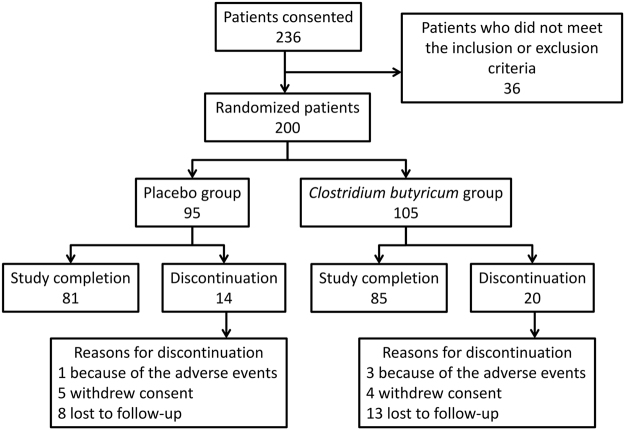
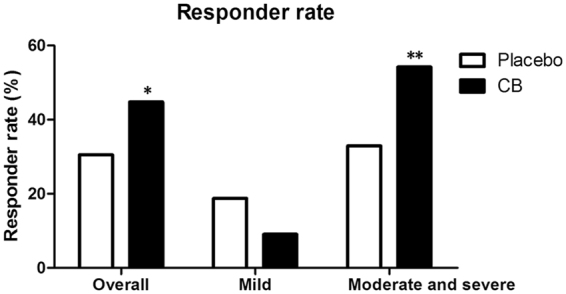
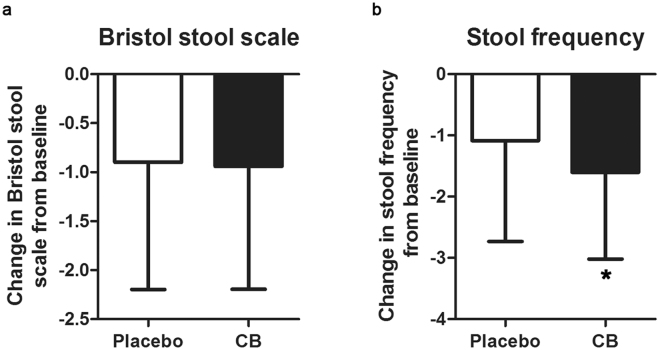
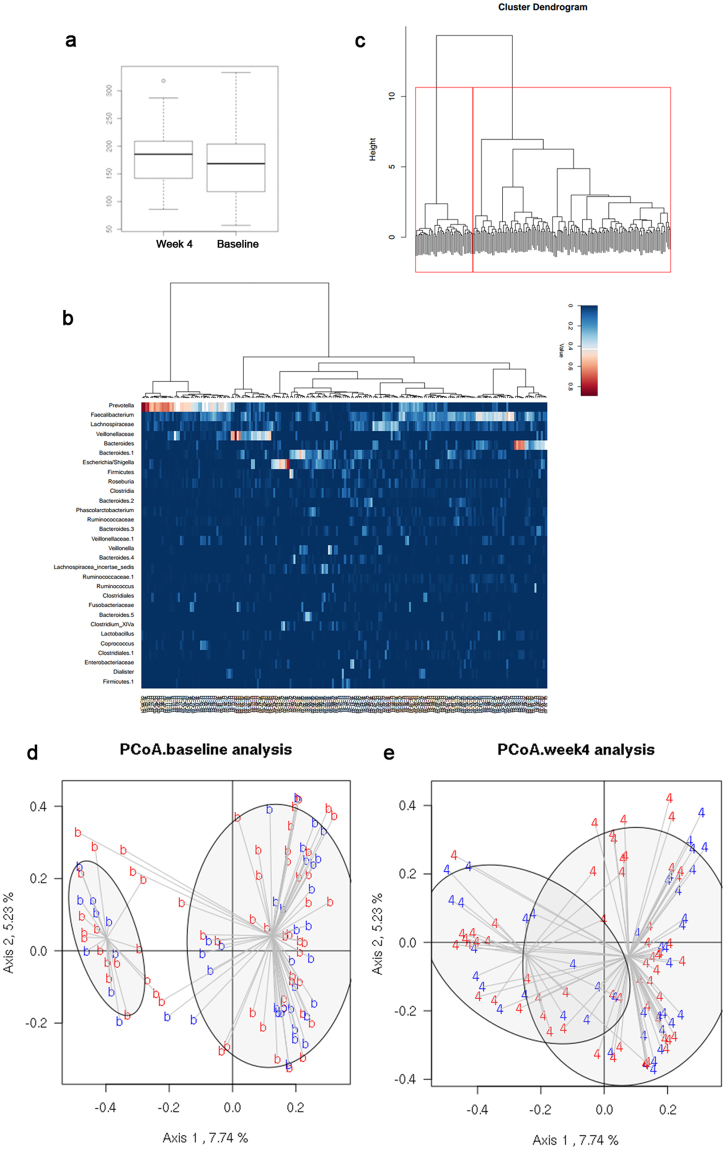
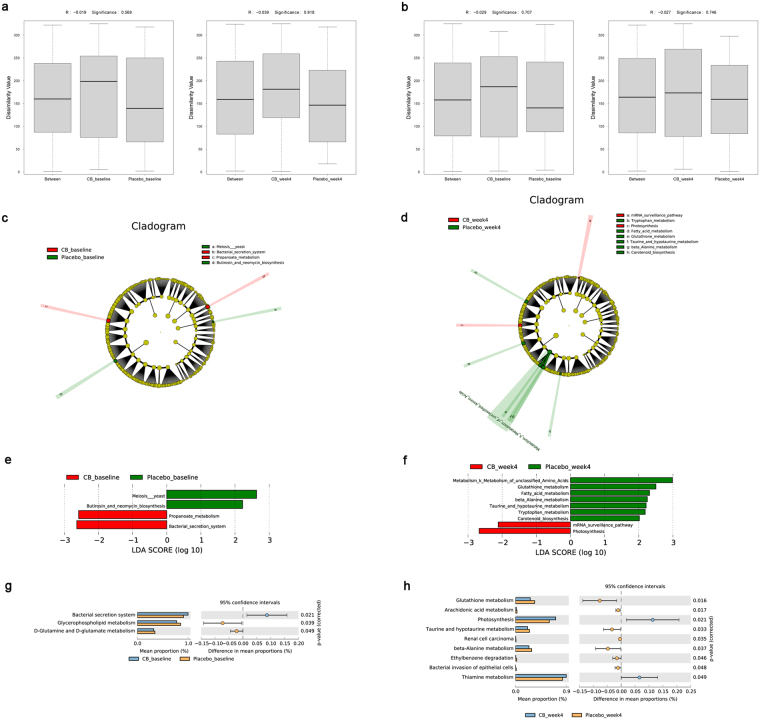
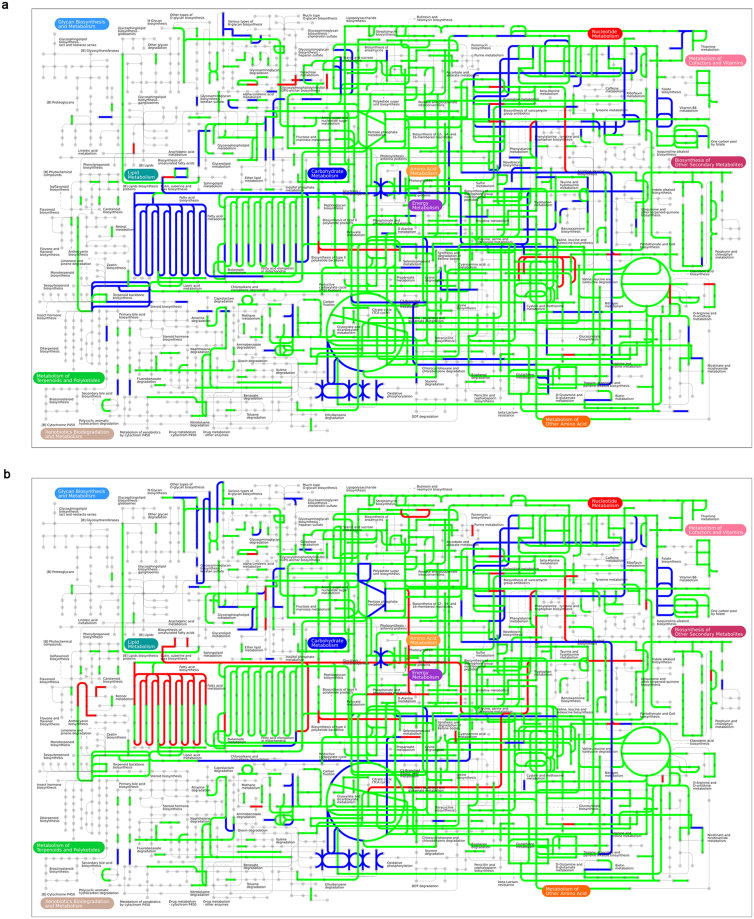
Irritable bowel syndrome (IBS) is a common disorder in gastrointestinal system and impairs the quality of life of the patients. Clostridium butyricum ( CB ) is a probiotics that has been used in several gastrointestinal diseases. The efficacy of CB in treating IBS is still unknown. This prospective, multi-centre, randomized, double-blind, placebo-controlled trial aimed to assess the efficacy and safety of CB in treating diarrhea-predominant IBS (IBS-D) and analyze the fecal microbiota after treatment. Two hundred patients with IBS-D were recruited and were given CB or placebo for 4 weeks. End points included change from baseline in IBS symptoms, quality of life, stool consistency and frequency. Compared with placebo, CB is effective in improving the overall IBS-D symptoms (−62.12 ± 74.00 vs. −40.74 ± 63.67, P = 0.038) as well as quality of life (7.232 ± 14.06 vs. 3.159 ± 11.73, P = 0.032) and stool frequency (−1.602 ± 1.416 vs. −1.086 ± 1.644, P = 0.035). The responder rates are found higher in CB compared with the placebo (44.76% vs. 30.53%, P = 0.042). The change in fecal microbiota was analyzed and function pathways of CB in treating IBS-D were predicted. In conclusion, CB improves overall symptoms, quality of life and stool frequency in IBS-D patients and is considered to be used as a probiotics in treating IBS-D clinically.
Overview
The claims and statistics of this paper haven’t been checked yet.
Free: it reads the open-access text and checks the first 5 claims that cite a source we can check. Create a free account to check every claim.
Integrity signals
Registry
Cites
Statistics
Figures
Verification
Claims the paper makes
The claims and statistics of this paper haven’t been checked yet.
Free: it reads the open-access text and checks the first 5 claims that cite a source we can check. Create a free account to check every claim.
Self-check
Percentages, sums and reported differences re-computed from the paper’s own numbers.
The self-check needs the paper’s full text.
Citations
Cites
Longstreth, G. F., Thompson, W. G., Chey, W. D., Houghton, L. A., Mearin, F., & Spiller, R. C. (2006) · Gastroenterology · doi:10.1053/j.gastro.2005.11.061 · Cited by 4,856
Stool form scale as a useful guide to intestinal transit time
Lewis, S. J., & Heaton, K. W. (1997) · Scandinavian Journal of Gastroenterology · doi:10.3109/00365529709011203 · Cited by 3,244
Peng, L., Li, Z.-R., Green, R. S., Holzmanr, I. R., & Lin, J. (2009) · The Journal of Nutrition · doi:10.3945/jn.109.104638 · Cited by 2,130
Self-citationFRANCIS, C. Y., MORRIS, J., & WHORWELL, P. J. (1997) · Alimentary Pharmacology & Therapeutics · doi:10.1046/j.1365-2036.1997.142318000.x · Cited by 1,708
O’Mahony, L., McCarthy, J., Kelly, P., Hurley, G., Luo, F., Chen, K., O’Sullivan, G. C., Kiely, B., Collins, J. K., Shanahan, F., et al. (2005) · Gastroenterology · doi:10.1053/j.gastro.2004.11.050 · Cited by 1,448
Rajilić–Stojanović, M., Biagi, E., Heilig, H. G. H. J., Kajander, K., Kekkonen, R. A., Tims, S., & de Vos, W. M. (2011) · Gastroenterology · doi:10.1053/j.gastro.2011.07.043 · Cited by 1,041
An irritable bowel syndrome subtype defined by species-specific alterations in faecal microbiota
Jeffery, I. B., O'Toole, P. W., Öhman, L., Claesson, M. J., Deane, J., Quigley, E. M. M., & Simrén, M. (2012) · Gut · doi:10.1136/gutjnl-2011-301501 · Cited by 835
From the gut to the peripheral tissues: the multiple effects of butyrate
Guilloteau, P., Martin, L., Eeckhaut, V., Ducatelle, R., Zabielski, R., & Van Immerseel, F. (2010) · Nutrition Research Reviews · doi:10.1017/s0954422410000247 · Cited by 806
Lactobacillus acidophilus modulates intestinal pain and induces opioid and cannabinoid receptors
Rousseaux, C., Thuru, X., Gelot, A., Barnich, N., Neut, C., Dubuquoy, L., Dubuquoy, C., Merour, E., Geboes, K., Chamaillard, M., et al. (2007) · Nature Medicine · doi:10.1038/nm1521 · Cited by 793
Patrick, D. L., Drossman, D. A., Frederick, I. O., Dicesare, J., & Puder, K. L. (1998) · Digestive Diseases and Sciences · doi:10.1023/a:1018831127942 · Cited by 761
Cited by
Items 101–129 of 129
Hussain, S., & Bhattacharyya, N. (2024) · Springer eBooks · doi:10.1007/978-3-031-72757-3_21 · Cited by 2
Probióticos en el síndrome de intestino irritable con predominio de diarrea
Camina, M., Alvarez, A. E. M., & Franco, J. V. A. (2020) · Evidencia actualizacion en la práctica ambulatoria · doi:10.51987/evidencia.v23i1.4274 · Cited by 2
“2018 Apr;47(8):1054-70 Esta revisión sistemática 5 incluyó 70 estudios que fueron publicados entre enero de 2012 y junio de 2017, con población adulta mayor de 18 años, con SII u otros trastornos gastrointestinales, diarrea asociada a antibióticos y personas sin diagnóstico específico de patología gastrointestinal.”
BackgroundWang, Y. (2019) · Institutional Repositories DataBase (IRDB) · doi:10.18926/56831
Maxillary Sinusitis by Staphylococcus aureus Infection in a Thoroughbred Gelding: Case Report
Lee, S. K., & Lee, I. (2021) · Journal of Veterinary Clinics · doi:10.17555/jvc.2021.38.5.225
Probióticos como suplemento alimenticio y su efecto en enfermedades gastrointestinales
de Guadalajara, U., Camarena-Alvarado, I., Rodríguez-Mendoza, V., de Guadalajara, U., Méndez-Robles, M. D., de Guadalajara, U., Esparza, L. M. A., de Guadalajara, U., Villagrán, Z., & de Guadalajara, U. (2021) · Acta de Ciencia en Salud · doi:10.32870/acs.v0i16.104 · Cited by 13
Clostridium butyricum and Clostridium tyrobutyricum : angle or devil for Necrotizing enterocolitis?Preprint
Tao, R., Zong, G., Pan, Y., Li, H., Cheng, P., Deng, R., Chen, W., Wang, A., Xia, S., Tang, W., et al. (2023) · bioRxiv (Cold Spring Harbor Laboratory) · doi:10.1101/2023.04.10.536220
“Therefore, we focused our attention on two probiotics of Clostridium : C. butyricum and C. tyrobutyricum , both of which are butyric acid-producing bacteria and have been applied to treat gastroenteritis clinically or experimentally (15–17).”
BackgroundAdjuvant nutraceuticals in the management of gastrointestinal diseases
Balio, B. G., Giro, R., & Roriz, M. (2023) · Acta Portuguesa de Nutrição · doi:10.21011/apn.2023.3210
Liu, X., & Wu, S. (2023) · World Chinese Journal of Digestology · doi:10.11569/wcjd.v31.i22.922
Liu, T., Gu, X., Li, L., Li, M. D., Li, B., Cui, X., & Zuo, X. (2020) · Figshare · doi:10.6084/m9.figshare.12502949
Self-citationLiu, T., Gu, X., Li, L., Li, M. D., Li, B., Cui, X., & Zuo, X. (2020) · Figshare · doi:10.6084/m9.figshare.12502943
Self-citationLiu, T., Gu, X., Li, L., Li, M. D., Li, B., Cui, X., & Zuo, X. (2020) · Figshare · doi:10.6084/m9.figshare.12502955
Self-citationLiu, T., Gu, X., Li, L., Li, M., Li, B., Cui, X., & Zuo, X. (2020) · Figshare · doi:10.6084/m9.figshare.12502961
Self-citationAn optimised approach to evaluate variability in gut health markers in healthy adultsPreprint
Krüger, K., Myeonghyun, Y., van der Wielen, N., Kok, D. E. G., Hooiveld, G. J. E. J., Keshtkar, S., Bruin, M. D.-D., Balvers, M. G. J., Grootte-Bromhaar, M., Mudde, K., et al. (2024) · bioRxiv (Cold Spring Harbor Laboratory) · doi:10.1101/2024.07.25.604267
Kebede, B., & Tilahun, A. (2024) · American Journal of Bioscience and Bioengineering · doi:10.11648/j.bio.20241206.12
Yang, H., Wang, Y., Jiang, Y., Ni, S., Chen, Y., Chen, D., Wang, W., & Ma, W. (2025) · The Veterinary Journal · doi:10.1016/j.tvjl.2025.106320
Feng, J., Ding, L., & Yang, T. (2025) · Gastroenterología y Hepatología (English Edition) · doi:10.1016/j.gastrohep.2025.502604
Liu, T., Gu, X., Li, L.-X., Li, M., Li, B., Cui, X., & Zuo, X.-L. (2020) · Figshare · doi:10.6084/m9.figshare.12502937
Self-citationKim, H.-W., Sohn, S.-O., & Kim, J.-K. (2025) · Food Preservation and Processing Industry · doi:10.11002/fppi.2025.24.2.119
IRRITABLE BOWEL SYNDROME: THE ROLE OF GUT MICROBIOTA IN ETIOLOGY AND TREATMENT. A LITERATURE REVIEW
Cieślik-Porębska, M., & Cieślik, A. (2026) · International Journal of Innovative Technologies in Social Science · doi:10.31435/ijitss.1(49).2026.4612
Fernandez, W. D., Vargas, V. P. S., Padilla-Zambrano, H., Cerino-Peñaloza, M. S., Saldaña-Ruiz, M. A., & Leggett, C. L. (2026) · Revista de Gastroenterología del Perú · doi:10.47892/rgp.2026.462.2230 · Cited by 1
Yang, X., Zeng, F., Xu, J., Xiang, Y., Yi, F., Zhu, C., Zhang, P., Pan, W., Hu, M., He, C., et al. (2026) · International Immunopharmacology · doi:10.1016/j.intimp.2026.117199
Self-citationLiu, M., Guo, L., Lin, M., Li, J., Zhen, A., Li, J., Zhang, L., Li, S., Huang, S., & Jian, F. (2026) · Journal of Agricultural and Food Chemistry · doi:10.1021/acs.jafc.6c09444
Zhou, Y., Guan, Y., Sun, P., Zhang, J., Shentu, D., Rong, X., & Chen, Z. (2026) · Probiotics and Antimicrobial Proteins · doi:10.1007/s12602-026-11268-4
Селиванова, Г. Б., & Потешкина, Н. Г. (2026) · Meditsinskiy sovet = Medical Council · doi:10.21518/ms2026-408
Metadata
- Authors
- Sun, Y.-Y., Li, M., Li, Y.-Y., Li, L.-X., Zhai, W.-Z., Wang, P., Yang, X.-X., Gu, X., Song, L.-J., Li, Z., Zuo, X.-L., & Li, Y.-Q.
- Affiliations
- Shandong University (CN)
- Venue
- Scientific Reports
- Published
- 2018-02-14
- Volume
- 8
- Issue
- 1
- Pages
- 2964-2964
- ISSN
- 2045-2322 (ISSN-L)
- PMC
- PMC5813237
- OpenAlex
- W2807514642
- Semantic Scholar
- 360d2d73c5a5851bb724d72621e5d331ada4c5cd
- Cited by
- 126
- References
- 40
- Citations by year
- 2026: 11 · 2025: 13 · 2024: 24 · 2023: 16 · 2022: 21 · 2021: 18 · 2020: 14 · 2019: 7 · 2018: 2
- FWCI
- 10.72
- Type
- journal article
- Language
- en
- Open access
- gold
- doi.org
- Licence
- cc-by
- creativecommons.org/licenses/by/4.0 (tdm)
- creativecommons.org/licenses/by/4.0 (vor)
- Locations
- Scientific Reports (publishedVersion, cc-by)
- PubMed Central (publishedVersion, cc-by)
- PubMed (publishedVersion)
- DOAJ (DOAJ: Directory of Open Access Journals) (submittedVersion)
- Funders
- National Natural Science Foundation of China (81330012)
- Natural Science Foundation of Shandong Province (ZR2015H2003)
- Topics
- Health Sciences › Medicine › Gastroenterology › Gastrointestinal motility and disorders
- Life Sciences › Biochemistry, Genetics and Molecular Biology › Molecular Biology › Gut microbiota and health
- Life Sciences › Agricultural and Biological Sciences › Food Science › Probiotics and Fermented Foods
- Keywords
- Clostridium butyricum, diarrhea-predominant irritable bowel syndrome, probiotics, fecal microbiota, IBS symptoms, quality of life, stool frequency, stool consistency, responder rate
- MeSH terms
- Fecal Microbiota Transplantation, Adult, Diarrhea, Double-Blind Method, Feces, Female, Humans, Male, Middle Aged, Placebos, Prospective Studies, Quality of Life, Treatment Outcome, Probiotics, Irritable Bowel Syndrome, Clostridium butyricum
About these checks
Registry, retraction, Cites and statistics results are computed, not judged, with one exception: a printed reference that no index lists is read once by a model before it counts as a citation error. Claims are extracted by a model and kept only when their quote appears verbatim in the text; each cited source is then checked, with a model’s help, for whether it says what the claim relies on. Those verdicts can be wrong — read the claim’s quote and the cited source before relying on one.
Statistics and arithmetic are recomputed, not judged.
Confidence bands are shown only for fields calibrated on our annotated test set. None is calibrated yet, so no band is shown.
What counts as a claim ›How we measure confidence ›How we check this ›
Are you an author, or do you see a problem with this page? Request a review
Data sources
Bibliographic data: Semantic Scholar, OpenAlex, Crossref.
Contains information from the Semantic Scholar Academic Graph Datasets, made available under the ODC Attribution License (ODC-BY 1.0).
Semantic Scholar’s data is described in: Kinney, R., et al. (2023). The Semantic Scholar Open Data Platform. arXiv:2301.10140.
