

The DOI matches its Crossref record; 85 of the 85 references it cites were found in a registry or an index.
Biogeographical Differences in the Influence of Maternal Microbial Sources on the Early Successional Development of the Bovine Neonatal Gastrointestinal tract
Open accessAbstract
The impact of maternal microbial influences on the early choreography of the neonatal calf microbiome were investigated. Luminal content and mucosal scraping samples were collected from ten locations in the calf gastrointestinal tract (GIT) over the first 21 days of life, along with postpartum maternal colostrum, udder skin, and vaginal scrapings. Microbiota were found to vary by anatomical location, between the lumen and mucosa at each GIT location, and differentially enriched for maternal vaginal, skin, and colostral microbiota. Most calf sample sites exhibited a gradual increase in α-diversity over the 21 days beginning the first few days after birth. The relative abundance of Firmicutes was greater in the proximal GIT, while Bacteroidetes were greater in the distal GIT. Proteobacteria exhibited greater relative abundances in mucosal scrapings relative to luminal content. Forty-six percent of calf luminal microbes and 41% of mucosal microbes were observed in at-least one maternal source, with the majority being shared with microbes on the skin of the udder. The vaginal microbiota were found to harbor and uniquely share many common and well-described fibrolytic rumen bacteria, as well as methanogenic archaea, potentially indicating a role for the vagina in populating the developing rumen and reticulum with microbes important to the nutrition of the adult animal.
Overview
The claims and statistics of this paper haven’t been checked yet.
Run the check — free, no account needed. It reads the open-access text and checks the sources it cites.
Integrity signals
Registry
Cites
Statistics
Figures
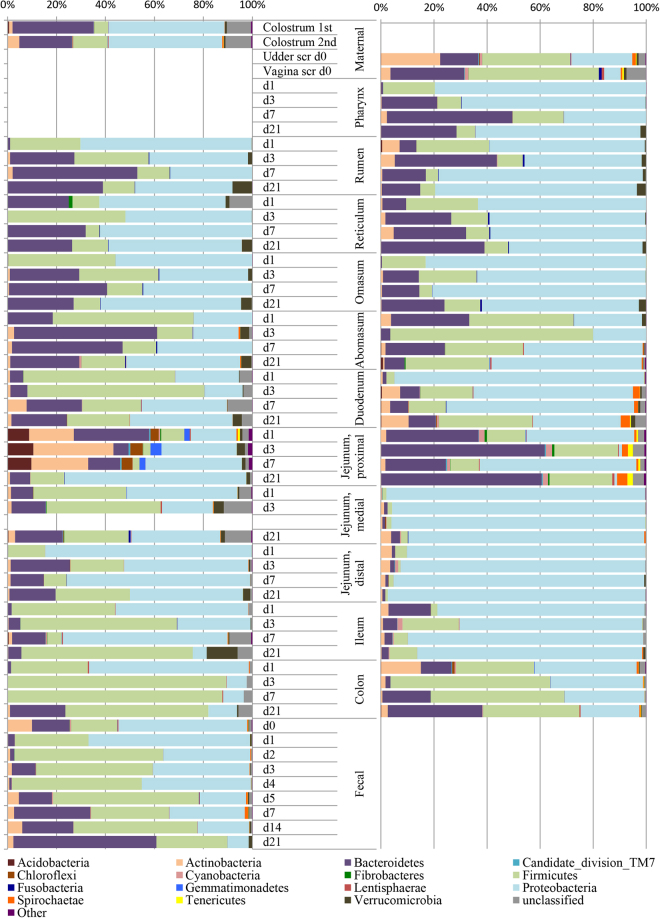
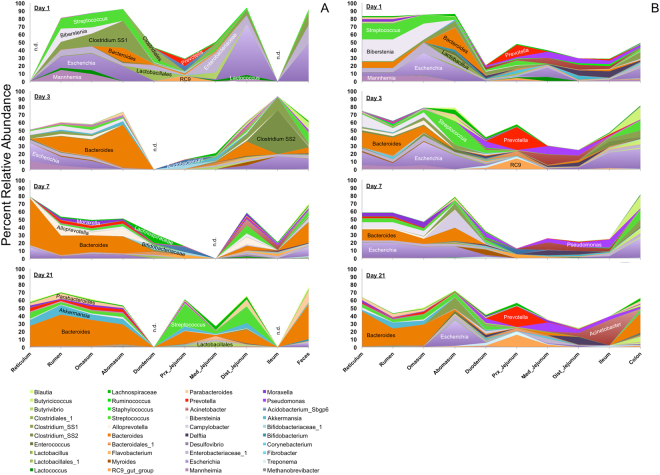
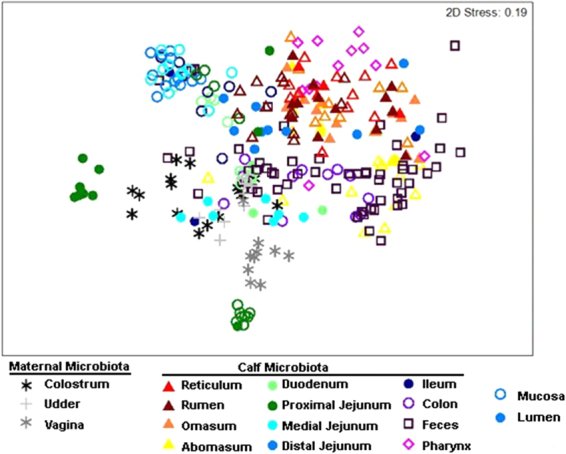
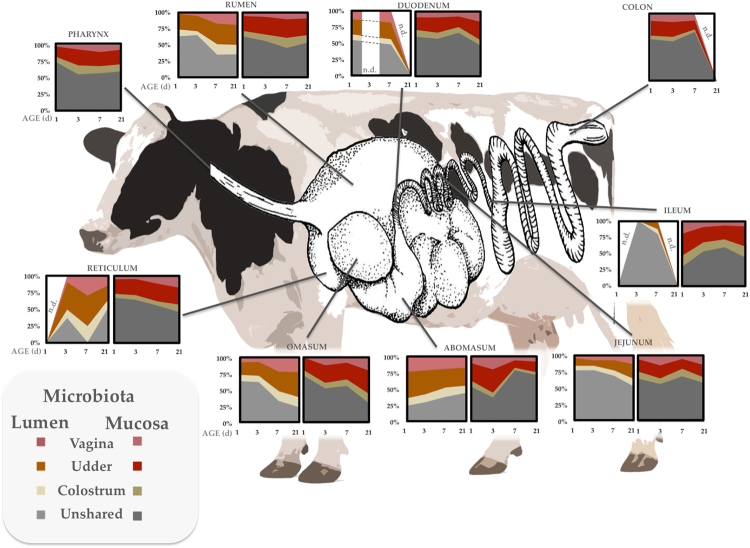
Verification
Claims the paper makes
The claims and statistics of this paper haven’t been checked yet.
Run the check — free, no account needed. It reads the open-access text and checks the sources it cites.
Claims other papers make about this one
Each is checked against this paper’s own text: does it say what the citing paper says it does?
The cited source says what the claim attributes to it.
In the citing paper
“Mucosa-associated communities differ from those associated with luminal contents; and also vary among intestinal regions (Malmuthuge et al., 2014; Mao et al., 2015; Yeoman et al., 2018).”
From Addressing global ruminant agricultural challenges through understanding the rumen microbiome: past, present, and future (2018) · cites this paper as Yeoman et al., 2018
In the citing paper
“Direct contact with the mother offers a constant source of microbes through the mouth, feces, skin and milk (Yeoman et al., 2018), sources that are not available for calves raised in isolation on milk replacer.”
From Addressing global ruminant agricultural challenges through understanding the rumen microbiome: past, present, and future (2018) · cites this paper as Yeoman et al., 2018
In the citing paper
“(i) initial colonization (0–2 days post-partum) originated from a combination of sources such as microbiota of mother's vagina, skin, colostrum and microbes within the environment (Van Nimwegen et al., 2011; Yeoman et al., 2018);”
From Addressing global ruminant agricultural challenges through understanding the rumen microbiome: past, present, and future (2018) · cites this paper as Yeoman et al., 2018
In the citing paper
“Most microbes flowing from the rumen into the abomasum are lysed by the low pH and enzymatic activity within the organ.”
From Addressing global ruminant agricultural challenges through understanding the rumen microbiome: past, present, and future (2018) · cites this paper as Yeoman et al., 2018
In the citing paper
“As a consequence of the harsh environmental conditions prevailing in the abomasum and at the beginning of the small intestine, microbial numbers and diversity plummet by several orders of magnitude in the abomasum, duodenum and jejunum as compared to the rumen (Frey et al., 2010; He et al., 2018; Yeoman et al., 2018).”
From Addressing global ruminant agricultural challenges through understanding the rumen microbiome: past, present, and future (2018) · cites this paper as Yeoman et al., 2018
Self-check
Percentages, sums and reported differences re-computed from the paper’s own numbers.
The self-check needs the paper’s full text.
Citations
Cites
A Mathematical Theory of Communication
Shannon, C. E. (1948) · Bell System Technical Journal · doi:10.1002/j.1538-7305.1948.tb01338.x · Cited by 88,486
Naive Bayesian Classifier for Rapid Assignment of rRNA Sequences into the New Bacterial Taxonomy
Wang, Q., Garrity, G. M., Tiedje, J. M., & Cole, J. R. (2007) · Applied and Environmental Microbiology · doi:10.1128/aem.00062-07 · Cited by 20,145
Schloss, P. D., Westcott, S. L., Ryabin, T., Hall, J. R., Hartmann, M., Hollister, E. B., Lesniewski, R. A., Oakley, B. B., Parks, D. H., Robinson, C. J., et al. (2009) · Applied and Environmental Microbiology · doi:10.1128/aem.01541-09 · Cited by 19,549
UCHIME improves sensitivity and speed of chimera detection
Edgar, R. C., Haas, B. J., Clemente, J. C., Quince, C., & Knight, R. (2011) · Bioinformatics · doi:10.1093/bioinformatics/btr381 · Cited by 15,114
ggplot2: Elegant Graphics for Data Analysis
Wickham, H. (2009) · doi:10.1007/978-0-387-98141-3 · Cited by 14,447
UniFrac: a New Phylogenetic Method for Comparing Microbial Communities
Lozupone, C., & Knight, R. (2005) · Applied and Environmental Microbiology · doi:10.1128/aem.71.12.8228-8235.2005 · Cited by 8,227
Human gut microbiome viewed across age and geography
Yatsunenko, T., Rey, F. E., Manary, M. J., Trehan, I., Dominguez-Bello, M. G., Contreras, M., Magris, M., Hidalgo, G., Baldassano, R. N., Anokhin, A. P., et al. (2012) · Nature · doi:10.1038/nature11053 · Cited by 7,815
The gut microbiota shapes intestinal immune responses during health and disease
Round, J. L., & Mazmanian, S. K. (2009) · Nature Reviews Immunology · doi:10.1038/nri2515 · Cited by 5,029
Dominguez-Bello, M. G., Costello, E. K., Contreras, M., Magris, M., Hidalgo, G., Fierer, N., & Knight, R. (2010) · Proceedings of the National Academy of Sciences · doi:10.1073/pnas.1002601107 · Cited by 4,774
Jost, L. (2006) · Oikos · doi:10.1111/j.2006.0030-1299.14714.x · Cited by 4,669
Research works printed but not linked: 1
- Ward, G. Effect of pre-weaning diet on lamb’s rumen development. American-Eurasian. Journal of Agricultural & Environmental Sciences 3, 561–567 (2008).
Cited by
Sorted by citations
Huws, S. A., Creevey, C. J., Oyama, L. B., Mizrahi, I., Denman, S. E., Popova, M., Muñoz-Tamayo, R., Forano, E., Waters, S. M., Hess, M., et al. (2018) · Frontiers in Microbiology · doi:10.3389/fmicb.2018.02161 · Cited by 487
The composition of the perinatal intestinal microbiota in cattle
Alipour, M. J., Jalanka, J., Pessa‐Morikawa, T., Kokkonen, T., Satokari, R. M., Hynönen, U., Iivanainen, A., & Niku, M. (2018) · Scientific Reports · doi:10.1038/s41598-018-28733-y · Cited by 229
Milk Microbiota: What Are We Exactly Talking About?
Oikonomou, G., Addis, M. F., Chassard, C., Nader-Macı́as, M. E., Grant, I. R., Delbès, C., Bogni, C. I., Loir, Y. L., & Even, S. (2020) · Frontiers in Microbiology · doi:10.3389/fmicb.2020.00060 · Cited by 192
Arshad, M. A., Hassan, F., Rehman, M. S.-U., Huws, S., Cheng, Y., & Din, A. U. (2021) · Animal nutrition · doi:10.1016/j.aninu.2021.03.004 · Cited by 151
Klein-Jöbstl, D., Quijada, N. M., Dzieciol, M., Feldbacher, B., Wagner, M., Drillich, M., Schmitz‐Esser, S., & Mann, E. (2019) · PLoS ONE · doi:10.1371/journal.pone.0220554 · Cited by 126
Metadata
- Authors
- Yeoman, C. J., Ishaq, S. L., Bichi, E., Olivo, S. K., Lowe, J., & Aldridge, B. M.
- Affiliations
- Montana State University (US)
- University of Illinois Urbana-Champaign (US)
- Corresponding author
- Yeoman, Carl J.
- Aldridge, Brian M.
- Venue
- Scientific Reports
- Published
- 2018-02-16
- Volume
- 8
- Issue
- 1
- Pages
- 3197-3197
- ISSN
- 2045-2322 (ISSN-L)
- PMC
- PMC5816665
- OpenAlex
- W2805505033
- Cited by
- 168
- References
- 85
- Citations by year
- 2026: 12 · 2025: 13 · 2024: 23 · 2023: 25 · 2022: 18 · 2021: 25 · 2020: 26 · 2019: 17 · 2018: 9
- FWCI
- 32.48
- Type
- journal article
- Language
- en
- Open access
- gold
- doi.org
- Locations
- Scientific Reports (publishedVersion, cc-by)
- PubMed Central (publishedVersion, cc-by)
- PubMed (publishedVersion)
- Montana State University ScholarWorks (Montana State University) (submittedVersion, cc-by)
- DOAJ (DOAJ: Directory of Open Access Journals) (submittedVersion)
- Funders
- U.S. Department of Agriculture
- Montana State University
- Montana Agricultural Experiment Station (MONB00113)
- National Institute of Food and Agriculture (W4177)
- Topics
- Life Sciences › Agricultural and Biological Sciences › Animal Science and Zoology › Ruminant Nutrition and Digestive Physiology
- Life Sciences › Biochemistry, Genetics and Molecular Biology › Molecular Biology › Gut microbiota and health
- Life Sciences › Agricultural and Biological Sciences › Animal Science and Zoology › Animal Nutrition and Physiology
- Keywords
- gastrointestinal tract development, colostrum, vaginal microbiota, rumen bacteria, methanogenic archaea, Firmicutes, Bacteroidetes, Proteobacteria, microbial diversity
- MeSH terms
- Animals, Animals, Newborn, Cattle, Colostrum, Female, Mothers, Mucous Membrane, Pregnancy, Rumen, Vagina, Euryarchaeota, Gastrointestinal Tract, Microbiota
About these checks
Registry, retraction, Cites and statistics results are computed, not judged, with one exception: a printed reference that no index lists is read once by a model before it counts as a citation error. Claims are extracted by a model and kept only when their quote appears verbatim in the text; each cited source is then checked, with a model’s help, for whether it says what the claim relies on. Those verdicts can be wrong — read the claim’s quote and the cited source before relying on one.
Statistics and arithmetic are recomputed, not judged.
Confidence bands are shown only for fields calibrated on our annotated test set. None is calibrated yet, so no band is shown.
What counts as a claim ›How we measure confidence ›How we check this ›
Are you an author, or do you see a problem with this page? Request a review
