

Evidence that the Great Pacific Garbage Patch is rapidly accumulating plastic
Open accessThe DOI matches its Crossref record; 55 of the 56 references it cites were found in a registry or an index.
Abstract
Ocean plastic can persist in sea surface waters, eventually accumulating in remote areas of the world’s oceans. Here we characterise and quantify a major ocean plastic accumulation zone formed in subtropical waters between California and Hawaii: The Great Pacific Garbage Patch (GPGP). Our model, calibrated with data from multi-vessel and aircraft surveys, predicted at least 79 (45–129) thousand tonnes of ocean plastic are floating inside an area of 1.6 million km 2 ; a figure four to sixteen times higher than previously reported. We explain this difference through the use of more robust methods to quantify larger debris. Over three-quarters of the GPGP mass was carried by debris larger than 5 cm and at least 46% was comprised of fishing nets. Microplastics accounted for 8% of the total mass but 94% of the estimated 1.8 (1.1–3.6) trillion pieces floating in the area. Plastic collected during our study has specific characteristics such as small surface-to-volume ratio, indicating that only certain types of debris have the capacity to persist and accumulate at the surface of the GPGP. Finally, our results suggest that ocean plastic pollution within the GPGP is increasing exponentially and at a faster rate than in surrounding waters.
Overview
The claims and statistics of this paper haven’t been checked yet.
Free: it reads the open-access text and checks the first 5 claims that cite a source we can check. Create a free account to check every claim.
Integrity signals
Registry
Cites
Statistics
Figures
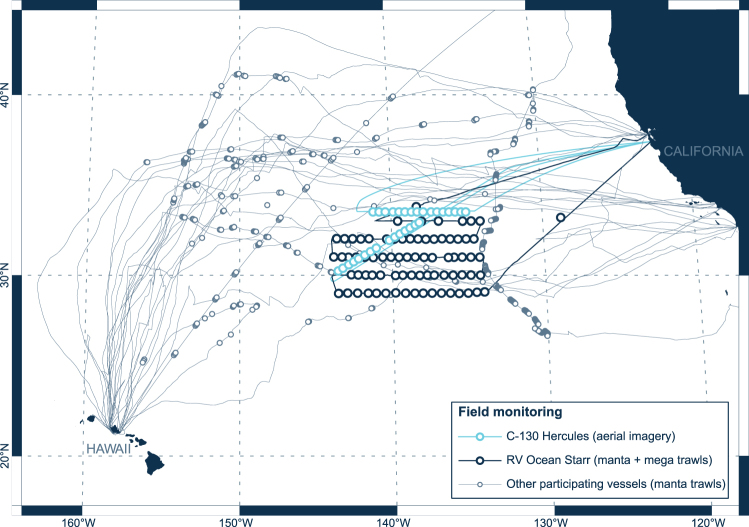
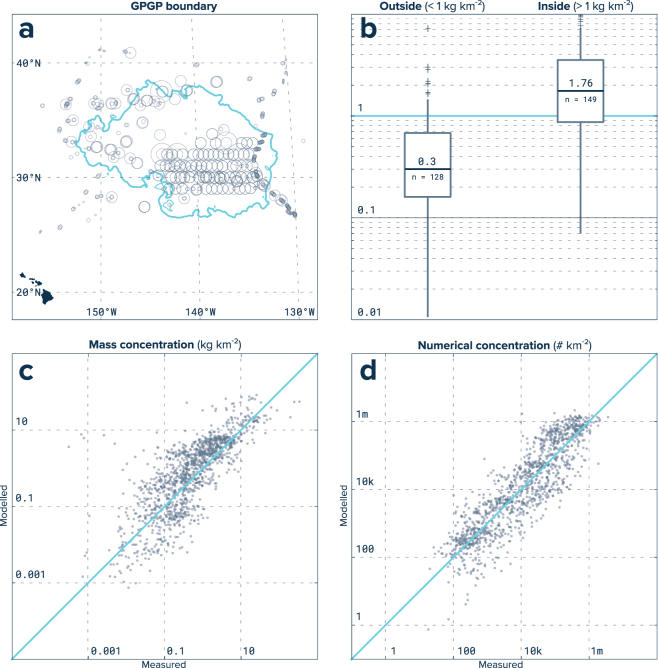
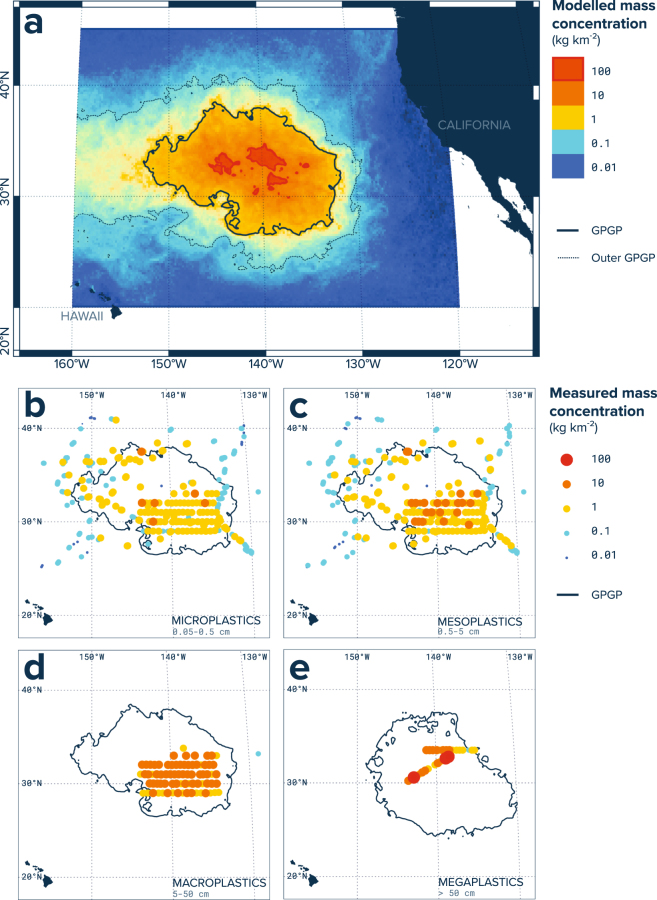
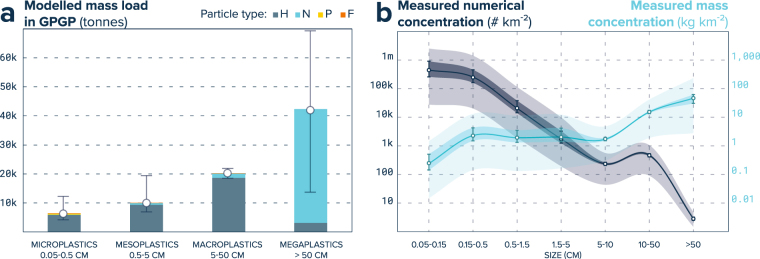
Verification
Claims the paper makes
The claims and statistics of this paper haven’t been checked yet.
Free: it reads the open-access text and checks the first 5 claims that cite a source we can check. Create a free account to check every claim.
Claims other papers make about this one
Each is checked against this paper’s own text: does it say what the citing paper says it does?
In the citing paper
“Surface trawl observations may be underestimated by a factor of 4-16.55”
From The fate of plastic in the ocean environment – a minireview (2021) · cites this paper as [55]
Self-check
Percentages, sums and reported differences re-computed from the paper’s own numbers.
The self-check needs the paper’s full text.
Citations
Cites
The NCEP/NCAR 40-Year Reanalysis Project
Kalnay, E., Kanamitsu, M., Kistler, R., Collins, W., Deaven, D., Gandin, L., Iredell, M., Saha, S., White, G., Woollen, J., et al. (1996) · Bulletin of the American Meteorological Society · doi:10.1175/1520-0477(1996)077<0437:tnyrp>2.0.co;2 · Cited by 28,360 · cited 1×
“We sourced global sea surface currents (1993 to 2012) from the HYCOM + NCODA global 1/12° reanalysis (experiment 19.0 and 19.1 36–38 ), and wind (10 m above sea level) speed and direction data (1993 to 2012) from NCEP/NCAR global reanalysis 39 .”
MethodInfluentialProduction, use, and fate of all plastics ever made
Geyer, R., Jambeck, J. R., & Law, K. L. (2017) · Science Advances · doi:10.1126/sciadv.1700782 · Cited by 18,606
Plastic waste inputs from land into the ocean
Jambeck, J. R., Geyer, R., Wilcox, C., Siegler, T. R., Perryman, M., Andrady, A., Narayan, R., & Law, K. L. (2015) · Science · doi:10.1126/science.1260352 · Cited by 13,163 · cited 1×
“…were identically and continuously released in time from 1993 to 2012 following spatial distributions and amplitudes of significant ocean plastic sources on land (coastal population hotspots 23 and major rivers 24 ) as well as at sea (fishing 26,41 , aquaculture 42 and shipping industries 43 ).”
BackgroundMicroplastics in the marine environment
Andrady, A. L. (2011) · Marine Pollution Bulletin · doi:10.1016/j.marpolbul.2011.05.030 · Cited by 8,105 · cited 2×
“Buoyant plastic represents about 60% of the global plastic demand 10 , thus nearly half of the plastic input into the oceans should sink to the floor soon after release, accumulating in sediments 53 and underwater canyons 54 . rest may strand in coastlines 13,55,56 , be ingested by marine life 57…”
BackgroundLost at sea: where is all the plastic?
Thompson, R. C., Olsen, Y., Mitchell, R. P., Davis, A., Rowland, S. J., John, A. W. G., McGonigle, D., & Russell, A. E. (2004) · Science · doi:10.1126/science.1094559 · Cited by 7,765
A global map of human impact on marine ecosystems
Halpern, B. S., Walbridge, S., Selkoe, K. A., Kappel, C. V., Micheli, F., D'Agrosa, C., Bruno, J. F., Casey, K. S., Ebert, C., Fox, H. E., et al. (2008) · Science · doi:10.1126/science.1149345 · Cited by 6,627
Accumulation and fragmentation of plastic debris in global environments
Barnes, D. K. A., Galgani, F., Thompson, R. C., & Barlaz, M. (2009) · Philosophical Transactions of the Royal Society B: Biological Sciences · doi:10.1098/rstb.2008.0205 · Cited by 6,126 · cited 1×
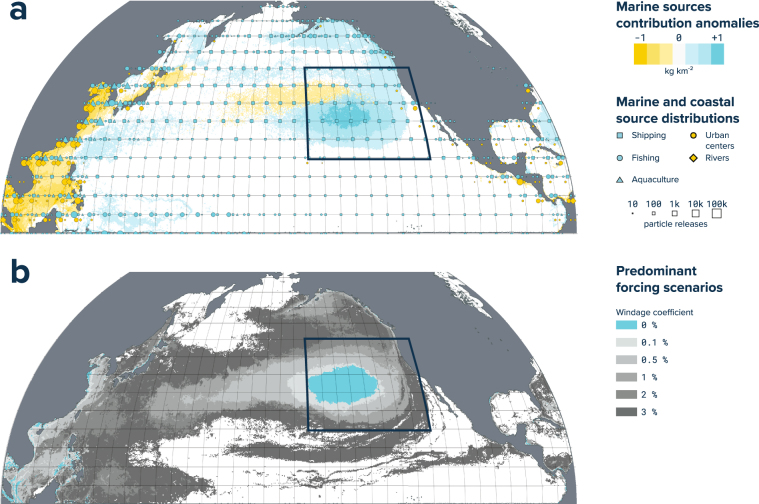
“…it seems the bulk mass of material currently present in the GPGP is very unlikely to leave the area and may slowly degrade into increasingly smaller pieces that can eventually either sink to the seafloor 14 , or behave as water tracer due to its microscopic size and low Reynolds number 66 .”
BackgroundEriksen, M., Lebreton, L. C. M., Carson, H. S., Thiel, M., Moore, C. J., Borerro, J. C., Galgani, F., Ryan, P. G., & Reisser, J. (2014) · PLoS ONE · doi:10.1371/journal.pone.0111913 · Cited by 4,710 · cited 3×
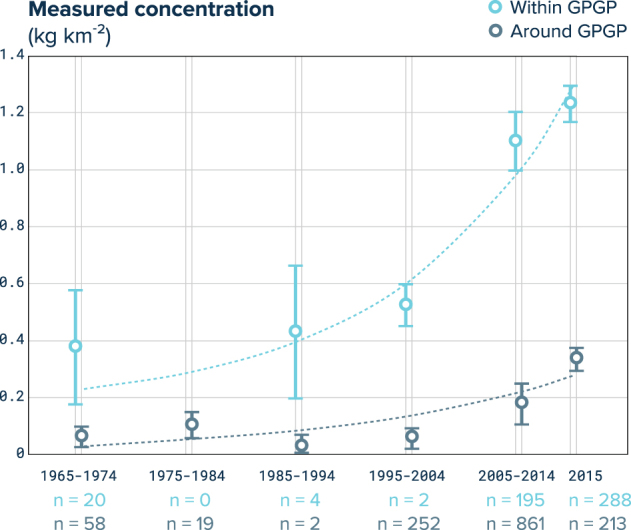
“A dynamic GPGP model boundary allowed us to determine whether surface net tows from previous studies 17,21,22,46–49 were sampling inside or outside the GPGP. Average plastic mass concentration measured by net tows inside the GPGP boundary showed an exponential increase over the last decades, rising…”
ResultInfluentialSelf-citationRiver plastic emissions to the world’s oceans
Lebreton, L. C. M., van der Zwet, J., Damsteeg, J.-W., Slat, B., Andrady, A., & Reisser, J. (2017) · Nature Communications · doi:10.1038/ncomms15611 · Cited by 4,011 · cited 1×
“…were identically and continuously released in time from 1993 to 2012 following spatial distributions and amplitudes of significant ocean plastic sources on land (coastal population hotspots 23 and major rivers 24 ) as well as at sea (fishing 26,41 , aquaculture 42 and shipping industries 43 ).”
BackgroundSelf-citationPlastic debris in the open ocean
Cózar, A., Echevarría, F., González-Gordillo, J. I., Irigoien, X., Úbeda, B., Hernández-León, S., Palma, Á. T., Navarro, S., García-de-Lomas, J., Ruiz, A., et al. (2014) · Proceedings of the National Academy of Sciences · doi:10.1073/pnas.1314705111 · Cited by 3,133 · cited 1×
“Our plastic mass estimate for the GPGP (~79 k tonnes) was nearly sixteen times higher than a previous study (~4.8 k tonnes) that used net trawl data only 29 and four times higher than another assessment (~21 k tonnes) that combined net trawl data with vessel-based visual surveys 21 .”
ResultInfluentialBerg, H. C. (2025) · Princeton University Press eBooks · doi:10.1515/9780691279886 · Cited by 2,367
The deep sea is a major sink for microplastic debris
Woodall, L. C., Sanchez-Vidal, A., Canals, M., Paterson, G. L. J., Coppock, R., Sleight, V., Calafat, A., Rogers, A. D., Narayanaswamy, B. E., & Thompson, R. C. (2014) · Royal Society Open Science · doi:10.1098/rsos.140317 · Cited by 1,946 · cited 1×
“…plastic demand 10 , thus nearly half of the plastic input into the oceans should sink to the floor soon after release, accumulating in sediments 53 and underwater canyons 54 . rest may strand in coastlines 13,55,56 , be ingested by marine life 57 or removed from the sea surface due to loss of…”
BackgroundA global inventory of small floating plastic debris
van Sebille, E., Wilcox, C., Lebreton, L., Maximenko, N., Hardesty, B. D., van Franeker, J. A., Eriksen, M., Siegel, D., Galgani, F., & Law, K. L. (2015) · Environmental Research Letters · doi:10.1088/1748-9326/10/12/124006 · Cited by 1,713
Self-citationA Comparison of Plastic and Plankton in the North Pacific Central Gyre
Moore, C. J., Moore, S. L., Leecaster, M. K., & Weisberg, S. B. (2001) · Marine Pollution Bulletin · doi:10.1016/s0025-326x(01)00114-x · Cited by 1,018 · cited 2×
“A dynamic GPGP model boundary allowed us to determine whether surface net tows from previous studies 17,21,22,46–49 were sampling inside or outside the GPGP. Average plastic mass concentration measured by net tows inside the GPGP boundary showed an exponential increase over the last decades, rising…”
ResultLaist, D. W. (1997) · Springer Series on Environmental Management · doi:10.1007/978-1-4613-8486-1_10 · Cited by 867
Numerical modelling of floating debris in the world’s oceans
Lebreton, L. C.-M., Greer, S. D., & Borrero, J. C. (2012) · Marine Pollution Bulletin · doi:10.1016/j.marpolbul.2011.10.027 · Cited by 845
Self-citationOperational multivariate ocean data assimilation
Cummings, J. A. (2005) · Quarterly Journal of the Royal Meteorological Society · doi:10.1256/qj.05.105 · Cited by 778
The effect of wind mixing on the vertical distribution of buoyant plastic debris
Kukulka, T., Proskurowski, G., Morét‐Ferguson, S., Meyer, D. W., & Law, K. L. (2012) · Geophysical Research Letters · doi:10.1029/2012gl051116 · Cited by 713
Interactions between microplastics and phytoplankton aggregates: Impact on their respective fates
Long, M., Moriceau, B., Gallinari, M., Lambert, C., Huvet, A., Raffray, J., & Soudant, P. (2015) · Marine Chemistry · doi:10.1016/j.marchem.2015.04.003 · Cited by 711 · cited 1×
“…in coastlines 13,55,56 , be ingested by marine life 57 or removed from the sea surface due to loss of buoyancy through biofouling 58 or aggregation 59 . specific characteristics of the GPGP debris suggest that only certain types of plastic have the capacity to persist at the sea surface for…”
BackgroundPathways of marine debris derived from trajectories of Lagrangian drifters
Maximenko, N., Hafner, J., & Niiler, P. (2012) · Marine Pollution Bulletin · doi:10.1016/j.marpolbul.2011.04.016 · Cited by 675
Nanoplastics in the Aquatic Environment. Critical Review
Koelmans, A. A., Besseling, E., & Shim, W. J. (2015) · Marine Anthropogenic Litter · doi:10.1007/978-3-319-16510-3_12 · Cited by 648
Brandon, J., Goldstein, M., & Ohman, M. D. (2016) · Marine Pollution Bulletin · doi:10.1016/j.marpolbul.2016.06.048 · Cited by 626
Fazey, F. M. C., & Ryan, P. G. (2016) · Environmental Pollution · doi:10.1016/j.envpol.2016.01.026 · Cited by 588 · cited 2×
“We hypothesize that most buoyant plastic with insufficient volume-to-surface ratios such as films may never reach the surface waters of the GPGP as they may rapidly sink to the seafloor due to biofouling 58 and/or fragment into microscopic pieces that are removed from surface layers 61 .”
BackgroundLitter on the Sea Floor Along European Coasts
Galgani, F., Leaute, J. P., Moguedet, P., Souplet, A., Verin, Y., Carpentier, A., Goraguer, H., Latrouite, D., Andral, B., Cadiou, Y., et al. (2000) · Marine Pollution Bulletin · doi:10.1016/s0025-326x(99)00234-9 · Cited by 572 · cited 1×
“…nearly half of the plastic input into the oceans should sink to the floor soon after release, accumulating in sediments 53 and underwater canyons 54 . rest may strand in coastlines 13,55,56 , be ingested by marine life 57 or removed from the sea surface due to loss of buoyancy through…”
BackgroundQiu, B., & Chen, S. (2005) · Journal of Physical Oceanography · doi:10.1175/jpo2807.1 · Cited by 565
Lavers, J. L., & Bond, A. L. (2017) · Proceedings of the National Academy of Sciences · doi:10.1073/pnas.1619818114 · Cited by 545
Origin, dynamics and evolution of ocean garbage patches from observed surface drifters
van Sebille, E., England, M. H., & Froyland, G. (2012) · Environmental Research Letters · doi:10.1088/1748-9326/7/4/044040 · Cited by 518
Distribution of Surface Plastic Debris in the Eastern Pacific Ocean from an 11-Year Data Set
Law, K. L., Morét-Ferguson, S. E., Goodwin, D. S., Zettler, E. R., DeForce, E., Kukulka, T., & Proskurowski, G. (2014) · Environmental Science & Technology · doi:10.1021/es4053076 · Cited by 478
Increased oceanic microplastic debris enhances oviposition in an endemic pelagic insect
Goldstein, M. C., Rosenberg, M., & Cheng, L. (2012) · Biology Letters · doi:10.1098/rsbl.2012.0298 · Cited by 442 · cited 5×
“When data was reported in unit of mass per volume of water 48 , we used the net tow depth to calculate the concentration per surface area unit.”
BackgroundMethodResultInfluentialSmall plastic debris changes water movement and heat transfer through beach sediments
Carson, H. S., Colbert, S. L., Kaylor, M. J., & McDermid, K. J. (2011) · Marine Pollution Bulletin · doi:10.1016/j.marpolbul.2011.05.032 · Cited by 422
Variational Data Assimilation for the Global Ocean
Cummings, J. A., & Smedstad, O. M. (2013) · Data Assimilation for Atmospheric, Oceanic and Hydrologic Applications (Vol. II) · doi:10.1007/978-3-642-35088-7_13 · Cited by 394 · cited 1×
“We sourced global sea surface currents (1993 to 2012) from the HYCOM + NCODA global 1/12° reanalysis (experiment 19.0 and 19.1 36–38 ), and wind (10 m above sea level) speed and direction data (1993 to 2012) from NCEP/NCAR global reanalysis 39 .”
MethodInfluentialKalogerakis, N., Karkanorachaki, K., Kalogerakis, G. C., Triantafyllidi, E. I., Gotsis, A. D., Partsinevelos, P., & Fava, F. (2017) · Frontiers in Marine Science · doi:10.3389/fmars.2017.00084 · Cited by 361 · cited 1×
“We hypothesize that most buoyant plastic with insufficient volume-to-surface ratios such as films may never reach the surface waters of the GPGP as they may rapidly sink to the seafloor due to biofouling 58 and/or fragment into microscopic pieces that are removed from surface layers 61 .”
BackgroundLake‐size dependency of wind shear and convection as controls on gas exchange
Read, J. S., Hamilton, D. P., Desai, A. R., Rose, K. C., MacIntyre, S., Lenters, J. D., Smyth, R. L., Hanson, P. C., Cole, J. J., Staehr, P. A., et al. (2012) · Geophysical Research Letters · doi:10.1029/2012gl051886 · Cited by 317
The Modular Ocean Data Assimilation System (MODAS)*
Fox, D. N., Teague, W. J., Barron, C. N., Carnes, M. R., & Lee, C. M. (2002) · Journal of Atmospheric and Oceanic Technology · doi:10.1175/1520-0426(2002)019<0240:tmodas>2.0.co;2 · Cited by 317 · cited 1×
“We sourced global sea surface currents (1993 to 2012) from the HYCOM + NCODA global 1/12° reanalysis (experiment 19.0 and 19.1 36–38 ), and wind (10 m above sea level) speed and direction data (1993 to 2012) from NCEP/NCAR global reanalysis 39 .”
MethodInfluentialGlobal marine yield halved as fishing intensity redoubles
Watson, R. A., Cheung, W. W. L., Anticamara, J. A., Sumaila, R. U., Zeller, D., & Pauly, D. (2013) · Fish and Fisheries · doi:10.1111/j.1467-2979.2012.00483.x · Cited by 272 · cited 1×
“…were identically and continuously released in time from 1993 to 2012 following spatial distributions and amplitudes of significant ocean plastic sources on land (coastal population hotspots 23 and major rivers 24 ) as well as at sea (fishing 26,41 , aquaculture 42 and shipping industries 43 ).”
BackgroundOn North Pacific circulation and associated marine debris concentration
Howell, E. A., Bograd, S. J., Morishige, C., Seki, M. P., & Polovina, J. J. (2012) · Marine Pollution Bulletin · doi:10.1016/j.marpolbul.2011.04.034 · Cited by 187 · cited 1×
“…(R 2 = 0.52) as the July–September GPGP position varied substantially among years. relation between the accumulation of marine debris in the North Pacific and climate events such as El Niño Southern Oscillation (ENSO) and the Pacific Decadal Oscillation (PDO) has previously been discussed 18 .”
BackgroundInfluentialQuantitative Tar and Plastic Waste Distributions in the Pacific Ocean
WONG, C. S., GREEN, D. R., & CRETNEY, W. J. (1974) · Nature · doi:10.1038/247030a0 · Cited by 170 · cited 4×
“A dynamic GPGP model boundary allowed us to determine whether surface net tows from previous studies 17,21,22,46–49 were sampling inside or outside the GPGP. Average plastic mass concentration measured by net tows inside the GPGP boundary showed an exponential increase over the last decades, rising…”
BackgroundMethodInfluentialWilcox, C., Heathcote, G., Goldberg, J., Gunn, R., Peel, D. A., & Hardesty, B. D. (2014) · Conservation Biology · doi:10.1111/cobi.12355 · Cited by 169
Modeling of marine litter drift and beaching in the Japan Sea
Yoon, J., Kawano, S., & Igawa, S. (2009) · Marine Pollution Bulletin · doi:10.1016/j.marpolbul.2009.09.033 · Cited by 163 · cited 1×
“…the oceans should sink to the floor soon after release, accumulating in sediments 53 and underwater canyons 54 . rest may strand in coastlines 13,55,56 , be ingested by marine life 57 or removed from the sea surface due to loss of buoyancy through biofouling 58 or aggregation 59 . specific…”
BackgroundGlobal fishing capacity and fishing effort from 1950 to 2012
Bell, J. D., Watson, R. A., & Ye, Y. (2016) · Fish and Fisheries · doi:10.1111/faf.12187 · Cited by 159
Patterns in the abundance of pelagic plastic and tar in the north pacific ocean, 1976–1985
Day, R. H., & SHAW, D. G. (1987) · Marine Pollution Bulletin · doi:10.1016/s0025-326x(87)80017-6 · Cited by 112
Young, L. C., Vanderlip, C., Duffy, D. C., Afanasyev, V., & Shaffer, S. A. (2009) · PLoS ONE · doi:10.1371/journal.pone.0007623 · Cited by 107
Kako, S., Isobe, A., Kataoka, T., & Hinata, H. (2014) · Marine Pollution Bulletin · doi:10.1016/j.marpolbul.2014.01.057 · Cited by 105
Out of sight but not out of mind: Harmful effects of derelict traps in selected U.S. coastal waters
Arthur, C., Sutton‐Grier, A. E., Murphy, P. M., & Bamford, H. A. (2014) · Marine Pollution Bulletin · doi:10.1016/j.marpolbul.2014.06.050 · Cited by 88 · cited 2×
“For every sighting, we recorded position (latitude, longitude), length (widest dimension of the object), width, and object type: (1) ‘bundled net’ – a group of fishing nets bundled tightly together; they are commonly colourful and of a rounded shape; (2) ‘loose net’ – a single fishing net; they were generally quite tr…”
BackgroundNature of Plastic Marine Pollution in the Subtropical Gyres
Eriksen, M., Thiel, M., & Lebreton, L. (2016) · The handbook of environmental chemistry · doi:10.1007/698_2016_123 · Cited by 85
Self-citationNew Net for Sampling the Ocean Surface
Brown, D., & Cheng, L. (1981) · Marine Ecology Progress Series · doi:10.3354/meps005225 · Cited by 82
Catches of lost fish traps (ghost fishing) from fishing grounds near Muscat, Sultanate of Oman
Al-Masroori, H. S., Al‐Oufi, H. S., McIlwain, J. L., & McLean, E. (2004) · Fisheries Research · doi:10.1016/j.fishres.2004.05.014 · Cited by 70 · cited 1×
“For every sighting, we recorded position (latitude, longitude), length (widest dimension of the object), width, and object type: (1) ‘bundled net’ – a group of fishing nets bundled tightly together; they are commonly colourful and of a rounded shape; (2) ‘loose net’ – a single fishing net; they were generally quite tr…”
BackgroundHumborstad, O., Løkkeborg, S., Hareide, N.-R., & Furevik, D. M. (2003) · Fisheries Research · doi:10.1016/s0165-7836(03)00215-7 · Cited by 67 · cited 1×
“For every sighting, we recorded position (latitude, longitude), length (widest dimension of the object), width, and object type: (1) ‘bundled net’ – a group of fishing nets bundled tightly together; they are commonly colourful and of a rounded shape; (2) ‘loose net’ – a single fishing net; they were generally quite tr…”
BackgroundSurface circulation and the distribution of pelagic tar and plastic
SHAW, D. G., & Mapes, G. (1979) · Marine Pollution Bulletin · doi:10.1016/0025-326x(79)90421-1 · Cited by 59 · cited 3×
“A dynamic GPGP model boundary allowed us to determine whether surface net tows from previous studies 17,21,22,46–49 were sampling inside or outside the GPGP. Average plastic mass concentration measured by net tows inside the GPGP boundary showed an exponential increase over the last decades, rising…”
MethodChu, S., Wang, J., Leong, G., Woodward, L. A., Letcher, R. J., & Li, Q. X. (2015) · Chemosphere · doi:10.1016/j.chemosphere.2015.05.043 · Cited by 49
Marine debris in five national parks in Alaska
Polasek, L. K., Bering, J., Kim, H.-W., Neitlich, P. N., Pister, B., Terwilliger, M., Nicolato, K., Turner, C. N., & Jones, T. (2017) · Marine Pollution Bulletin · doi:10.1016/j.marpolbul.2017.01.085 · Cited by 49 · cited 1×
“…coastline. negligible amounts of foam collected within the GPGP, together with the high abundance of foam removed from Alaska during beach clean-ups 63 , and early sightings of highly buoyant debris originated from the 2011 Tohoku tsunami along shorelines (i.e. floating docks, boats and large…”
BackgroundCatch rates of monkfish (Lophius spp.) by lost tangle nets in the Cantabrian Sea (northern Spain)
Sancho, G., Puente, E., Bilbao, A., Gómez, E. D., & Arregi, L. (2003) · Fisheries Research · doi:10.1016/s0165-7836(03)00212-1 · Cited by 45 · cited 8×
“More information on how we estimated the mass of each spotted objects is provided in Supplementary Methods 3.”
MethodInfluentialInverse estimation of drifting-object outflows using actual observation data
Kako, S., Isobe, A., SEINO, S., & Kojima, A. (2010) · Journal of Oceanography · doi:10.1007/s10872-010-0025-9 · Cited by 37
A citizens guide to plastics in the ocean : more than a litter problem
O'Hara, K. J., & Iudicello, S. (1988) · Medical Entomology and Zoology · Cited by 30
Lebreton, L., & Reisser, J. (2018) · Figshare · doi:10.6084/m9.figshare.5873142 · Cited by 3
Self-citation
Research works printed but not linked: 11
- Plastics Europe. Plastics - the facts 2016: an analysis of European plastics production, demand and waste data. Preprint at http://www.plasticseurope.org (2016).
- Weisskopf M Plastic reaps a grim harvest in the oceans of the world Smithsonian 1988 18 59
- American Plastics Council. Understanding plastic film: its uses, benefits and waste management options. Preprint at https://plastics.americanchemistry.com/Understanding-Plastic-Film/ (1996).
- Tolman HL The numerical model WAVEWATCH: a third-generation model for the hindcasting of wind waves on tides in shelf seas Communications on Hydraulic and Geotechnical Engineering, Delft Univ. of Techn. 1989 89 72
- FAO. The state of world fisheries and aquaculture 2014. Preprint at http://www.fao.org/3/a-i3720e.pdf (2014).
- NOAA. Detecting Japan tsunami marine debris at sea: a synthesis of efforts and lessons learned. Preprint at https://marinedebris.noaa.gov/sites/default/files/JTMD_Detection_Report.pdf (2015)
- U.S. EPA. Characterization of municipal solid waste in the United States: 1997 update. Preprint at https://archive.epa.gov/epawaste/nonhaz/municipal/web/pdf/msw97rpt.pdf (1998).
- International Coastal Cleanup. Tracking trash - 25 years of action for the ocean. Preprint at http://act.oceanconservancy.org/pdf/Marine_Debris_2011_Report_OC.pdf (2011).
- GESAMP. Sources, fate and effects of microplastics in the marine environment: part two of a global assessment (eds Kershaw, P. J. & Rochman, C. M.). (IMO/FAO/UNESCO-IOC/UNIDO/WMO/IAEA/UN/UNEP/UNDP Joint Group of Experts on the Scientific Aspects of Marine Environmental Protection). Rep. Stud. GESAMP, 93, 220 (2016).
- Maximenko, N. et al. Remote sensing of marine debris to study dynamics, balances and trends. Preprint at https://ecocast.arc.nasa.gov/las/Reports%20and%20Papers/Marine-Debris-Workshop-2017.pdf (2017).
- NASA. Satellite-respondent buoys identify ocean debris. Preprint at https://www.nasa.gov/offices/oct/home/tech_life_buoy.html (2010).
Cited by
Microplastics: Finding a consensus on the definition
Frias, J. P. G. L., & Nash, R. (2019) · Marine Pollution Bulletin · doi:10.1016/j.marpolbul.2018.11.022 · Cited by 2,167
Evaluating scenarios toward zero plastic pollution
Lau, W. W. Y., Shiran, Y., Bailey, R. M., Cook, E., Stuchtey, M. R., Koskella, J., Velis, C. A., Godfrey, L., Boucher, J., Murphy, M. B., et al. (2020) · Science · doi:10.1126/science.aba9475 · Cited by 1,766
More than 1000 rivers account for 80% of global riverine plastic emissions into the ocean
Meijer, L. J. J., van Emmerik, T., van der Ent, R., Schmidt, C., & Lebreton, L. (2021) · Science Advances · doi:10.1126/sciadv.aaz5803 · Cited by 1,386
“INTRODUCTION Plastic pollution in oceans and rivers is an emerging environmental hazard (1), and accumulation on riverbanks, deltas, coastlines (2), and the ocean surface (3) is rapidly increasing.”
BackgroundSelf-citationA Global Perspective on Microplastics
Hale, R. C., Seeley, M. E., La Guardia, M. J., Mai, L., & Zeng, E. Y. (2020) · Journal of Geophysical Research: Oceans · doi:10.1029/2018jc014719 · Cited by 1,338
“Lebreton et al. (2018) estimated 45,000 to 129,000 tons of plastic were floating within the Great Pacific Garbage Patch.”
BackgroundEmergence of Nanoplastic in the Environment and Possible Impact on Human Health
Lehner, R., Weder, C., Petri-Fink, A., & Rothen-Rutishauser, B. (2019) · Environmental Science & Technology · doi:10.1021/acs.est.8b05512 · Cited by 1,242
Metadata
- Authors
- Lebreton, L., Slat, B., Ferrari, F., Sainte-Rose, B., Aitken, J., Marthouse, R., Hajbane, S., Cunsolo, S., Schwarz, A., Levivier, A., Noble, K., Debeljak, P., Maral, H., Schoeneich-Argent, R., Brambini, R., & Reisser, J.
- Affiliations
- The Ocean Cleanup (NL)
- Centre National de la Recherche Scientifique (FR)
- Corresponding author
- Lebreton, L.
- Venue
- Scientific Reports
- Published
- 2018-03-22
- Volume
- 8
- Issue
- 1
- Pages
- 4666-4666
- ISSN
- 2045-2322 (ISSN-L)
- PMC
- PMC5864935
- OpenAlex
- W2791727655
- Cited by
- 1,839
- References
- 56
- Citations by year
- 2026: 152 · 2025: 242 · 2024: 252 · 2023: 257 · 2022: 289 · 2021: 272 · 2020: 193 · 2019: 141 · 2018: 40
- FWCI
- 60.53
- Type
- journal article
- Language
- en
- Open access
- gold
- doi.org
- Licence
- cc-by
- creativecommons.org/licenses/by/4.0 (tdm)
- creativecommons.org/licenses/by/4.0 (vor)
- Locations
- Scientific Reports (publishedVersion, cc-by)
- Europe PMC (PubMed Central) (publishedVersion, cc-by)
- PubMed Central (publishedVersion, cc-by)
- PubMed (publishedVersion)
- VBN Forskningsportal (Aalborg Universitet) (publishedVersion, cc-by)
- Roger Williams University - Digital Commons (Roger Williams University) (submittedVersion)
- HAL (submittedVersion, other-oa)
- DOAJ (DOAJ: Directory of Open Access Journals) (submittedVersion)
- Funders
- Technische Universiteit Delft
- Topics
- Physical Sciences › Environmental Science › Pollution › Microplastics and Plastic Pollution
- Physical Sciences › Environmental Science › Pollution › Oil Spill Detection and Mitigation
- Physical Sciences › Environmental Science › Waste Management and Disposal › Waste Management and Recycling
- Keywords
- Great Pacific Garbage Patch, marine plastic pollution, plastic accumulation, fishing nets, microplastics, debris size distribution, surface-to-volume ratio, subtropical gyre
- MeSH terms
- California, Environmental Monitoring, Garbage, Hawaii, Models, Theoretical, Pacific Ocean, Plankton, Plastics, Sampling Studies, Spectrophotometry, Infrared, Waste Products, Water Pollutants, Chemical, Water Pollution, Chemical, Wind, Satellite Imagery
About these checks
Registry, retraction, Cites and statistics results are computed, not judged, with one exception: a printed reference that no index lists is read once by a model before it counts as a citation error. Claims are extracted by a model and kept only when their quote appears verbatim in the text; each cited source is then checked, with a model’s help, for whether it says what the claim relies on. Those verdicts can be wrong — read the claim’s quote and the cited source before relying on one.
Statistics and arithmetic are recomputed, not judged.
Confidence bands are shown only for fields calibrated on our annotated test set. None is calibrated yet, so no band is shown.
What counts as a claim ›How we measure confidence ›How we check this ›
Are you an author, or do you see a problem with this page? Request a review
Data sources
Bibliographic data: Semantic Scholar, OpenAlex, Crossref.
Contains information from the Semantic Scholar Academic Graph Datasets, made available under the ODC Attribution License (ODC-BY 1.0).
Semantic Scholar’s data is described in: Kinney, R., et al. (2023). The Semantic Scholar Open Data Platform. arXiv:2301.10140.
