

Evidence that the Great Pacific Garbage Patch is rapidly accumulating plastic
Open accessThe DOI matches its Crossref record; 55 of the 56 references it cites were found in a registry or an index.
Abstract
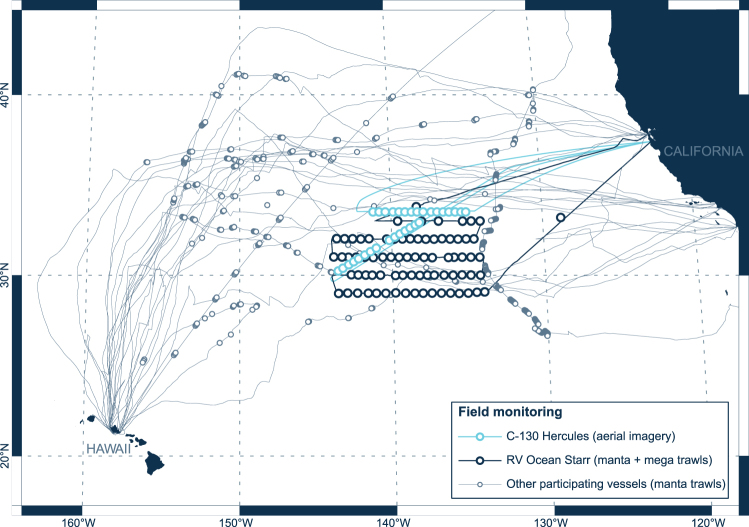
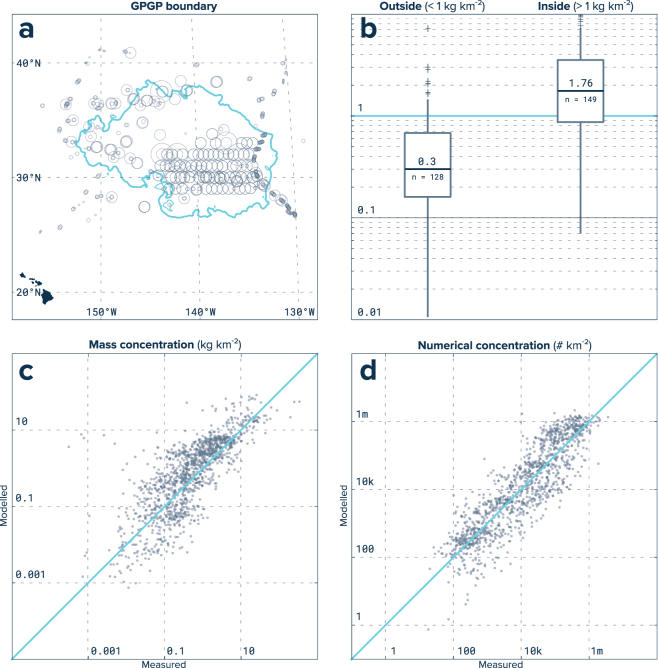
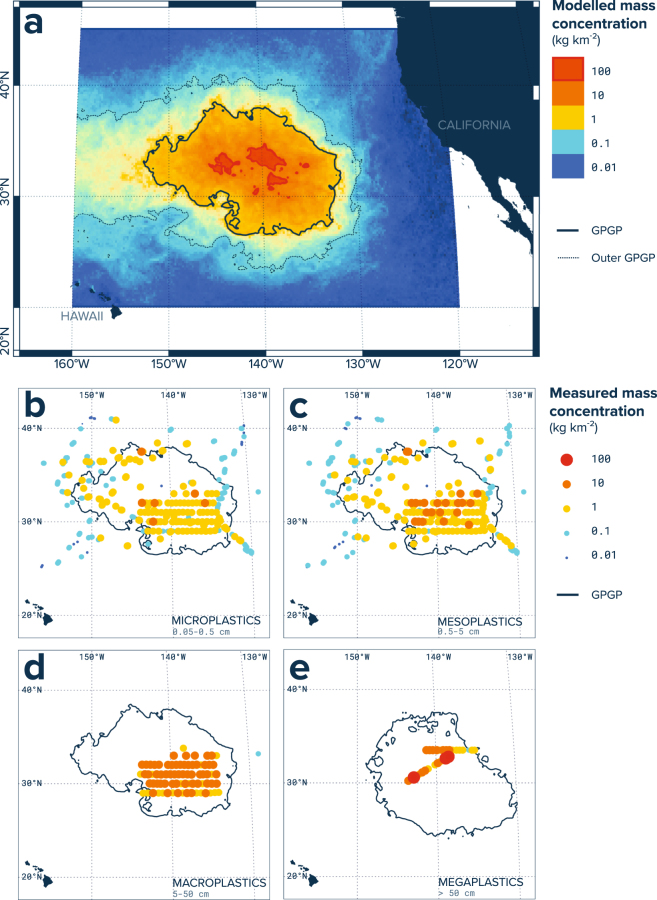
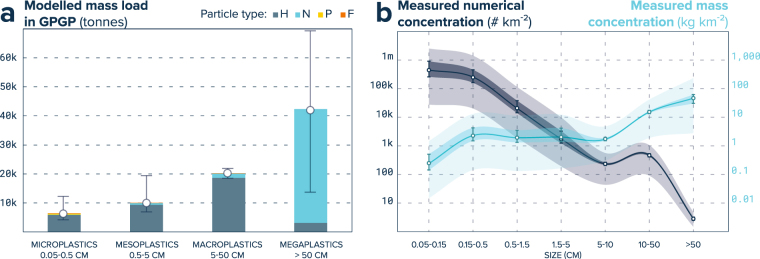
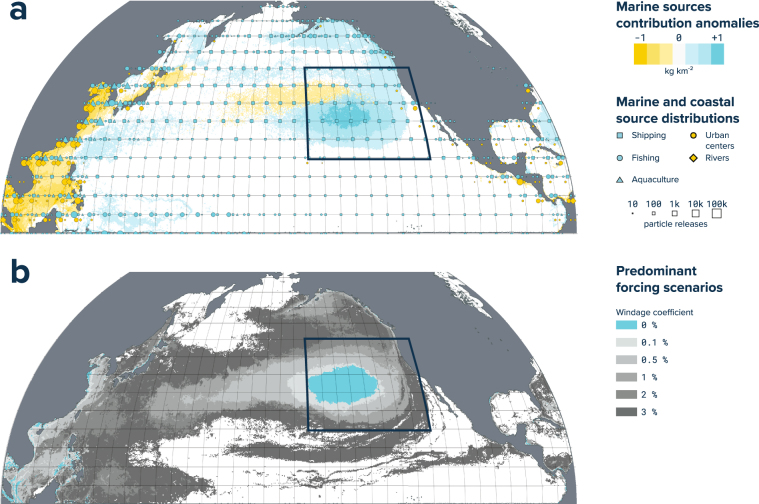
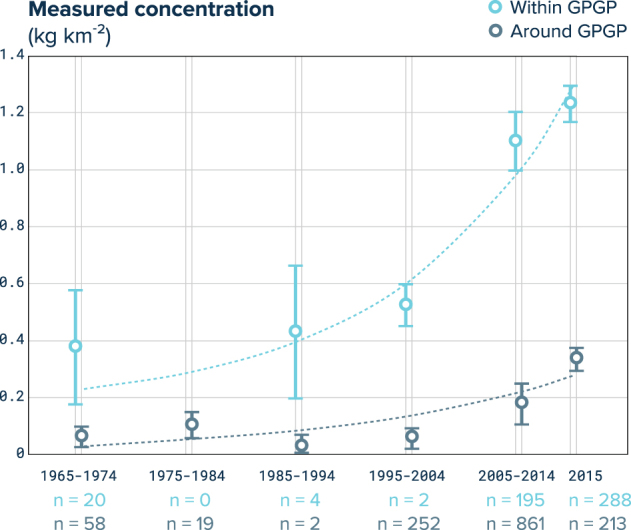
Ocean plastic can persist in sea surface waters, eventually accumulating in remote areas of the world’s oceans. Here we characterise and quantify a major ocean plastic accumulation zone formed in subtropical waters between California and Hawaii: The Great Pacific Garbage Patch (GPGP). Our model, calibrated with data from multi-vessel and aircraft surveys, predicted at least 79 (45–129) thousand tonnes of ocean plastic are floating inside an area of 1.6 million km 2 ; a figure four to sixteen times higher than previously reported. We explain this difference through the use of more robust methods to quantify larger debris. Over three-quarters of the GPGP mass was carried by debris larger than 5 cm and at least 46% was comprised of fishing nets. Microplastics accounted for 8% of the total mass but 94% of the estimated 1.8 (1.1–3.6) trillion pieces floating in the area. Plastic collected during our study has specific characteristics such as small surface-to-volume ratio, indicating that only certain types of debris have the capacity to persist and accumulate at the surface of the GPGP. Finally, our results suggest that ocean plastic pollution within the GPGP is increasing exponentially and at a faster rate than in surrounding waters.
Overview
The claims and statistics of this paper haven’t been checked yet.
Free: it reads the open-access text and checks the first 5 claims that cite a source we can check. Create a free account to check every claim.
Integrity signals
Registry
Cites
Statistics
Figures
Verification
Claims the paper makes
The claims and statistics of this paper haven’t been checked yet.
Free: it reads the open-access text and checks the first 5 claims that cite a source we can check. Create a free account to check every claim.
Claims other papers make about this one
Each is checked against this paper’s own text: does it say what the citing paper says it does?
In the citing paper
“Surface trawl observations may be underestimated by a factor of 4-16.55”
From The fate of plastic in the ocean environment – a minireview (2021) · cites this paper as [55]
Self-check
Percentages, sums and reported differences re-computed from the paper’s own numbers.
The self-check needs the paper’s full text.
Citations
Cites
The NCEP/NCAR 40-Year Reanalysis Project
Kalnay, E., Kanamitsu, M., Kistler, R., Collins, W., Deaven, D., Gandin, L., Iredell, M., Saha, S., White, G., Woollen, J., et al. (1996) · Bulletin of the American Meteorological Society · doi:10.1175/1520-0477(1996)077<0437:tnyrp>2.0.co;2 · Cited by 28,360 · cited 1×
“We sourced global sea surface currents (1993 to 2012) from the HYCOM + NCODA global 1/12° reanalysis (experiment 19.0 and 19.1 36–38 ), and wind (10 m above sea level) speed and direction data (1993 to 2012) from NCEP/NCAR global reanalysis 39 .”
MethodInfluentialProduction, use, and fate of all plastics ever made
Geyer, R., Jambeck, J. R., & Law, K. L. (2017) · Science Advances · doi:10.1126/sciadv.1700782 · Cited by 18,606
Plastic waste inputs from land into the ocean
Jambeck, J. R., Geyer, R., Wilcox, C., Siegler, T. R., Perryman, M., Andrady, A., Narayan, R., & Law, K. L. (2015) · Science · doi:10.1126/science.1260352 · Cited by 13,163 · cited 1×
“…were identically and continuously released in time from 1993 to 2012 following spatial distributions and amplitudes of significant ocean plastic sources on land (coastal population hotspots 23 and major rivers 24 ) as well as at sea (fishing 26,41 , aquaculture 42 and shipping industries 43 ).”
BackgroundMicroplastics in the marine environment
Andrady, A. L. (2011) · Marine Pollution Bulletin · doi:10.1016/j.marpolbul.2011.05.030 · Cited by 8,105 · cited 2×
“Buoyant plastic represents about 60% of the global plastic demand 10 , thus nearly half of the plastic input into the oceans should sink to the floor soon after release, accumulating in sediments 53 and underwater canyons 54 . rest may strand in coastlines 13,55,56 , be ingested by marine life 57…”
BackgroundLost at sea: where is all the plastic?
Thompson, R. C., Olsen, Y., Mitchell, R. P., Davis, A., Rowland, S. J., John, A. W. G., McGonigle, D., & Russell, A. E. (2004) · Science · doi:10.1126/science.1094559 · Cited by 7,765
A global map of human impact on marine ecosystems
Halpern, B. S., Walbridge, S., Selkoe, K. A., Kappel, C. V., Micheli, F., D'Agrosa, C., Bruno, J. F., Casey, K. S., Ebert, C., Fox, H. E., et al. (2008) · Science · doi:10.1126/science.1149345 · Cited by 6,627
Accumulation and fragmentation of plastic debris in global environments
Barnes, D. K. A., Galgani, F., Thompson, R. C., & Barlaz, M. (2009) · Philosophical Transactions of the Royal Society B: Biological Sciences · doi:10.1098/rstb.2008.0205 · Cited by 6,126 · cited 1×
“…it seems the bulk mass of material currently present in the GPGP is very unlikely to leave the area and may slowly degrade into increasingly smaller pieces that can eventually either sink to the seafloor 14 , or behave as water tracer due to its microscopic size and low Reynolds number 66 .”
BackgroundEriksen, M., Lebreton, L. C. M., Carson, H. S., Thiel, M., Moore, C. J., Borerro, J. C., Galgani, F., Ryan, P. G., & Reisser, J. (2014) · PLoS ONE · doi:10.1371/journal.pone.0111913 · Cited by 4,710 · cited 3×
“A dynamic GPGP model boundary allowed us to determine whether surface net tows from previous studies 17,21,22,46–49 were sampling inside or outside the GPGP. Average plastic mass concentration measured by net tows inside the GPGP boundary showed an exponential increase over the last decades, rising…”
ResultInfluentialSelf-citationRiver plastic emissions to the world’s oceans
Lebreton, L. C. M., van der Zwet, J., Damsteeg, J.-W., Slat, B., Andrady, A., & Reisser, J. (2017) · Nature Communications · doi:10.1038/ncomms15611 · Cited by 4,011 · cited 1×
“…were identically and continuously released in time from 1993 to 2012 following spatial distributions and amplitudes of significant ocean plastic sources on land (coastal population hotspots 23 and major rivers 24 ) as well as at sea (fishing 26,41 , aquaculture 42 and shipping industries 43 ).”
BackgroundSelf-citationPlastic debris in the open ocean
Cózar, A., Echevarría, F., González-Gordillo, J. I., Irigoien, X., Úbeda, B., Hernández-León, S., Palma, Á. T., Navarro, S., García-de-Lomas, J., Ruiz, A., et al. (2014) · Proceedings of the National Academy of Sciences · doi:10.1073/pnas.1314705111 · Cited by 3,133 · cited 1×
“Our plastic mass estimate for the GPGP (~79 k tonnes) was nearly sixteen times higher than a previous study (~4.8 k tonnes) that used net trawl data only 29 and four times higher than another assessment (~21 k tonnes) that combined net trawl data with vessel-based visual surveys 21 .”
ResultInfluential
Research works printed but not linked: 11
- Plastics Europe. Plastics - the facts 2016: an analysis of European plastics production, demand and waste data. Preprint at http://www.plasticseurope.org (2016).
- Weisskopf M Plastic reaps a grim harvest in the oceans of the world Smithsonian 1988 18 59
- American Plastics Council. Understanding plastic film: its uses, benefits and waste management options. Preprint at https://plastics.americanchemistry.com/Understanding-Plastic-Film/ (1996).
- Tolman HL The numerical model WAVEWATCH: a third-generation model for the hindcasting of wind waves on tides in shelf seas Communications on Hydraulic and Geotechnical Engineering, Delft Univ. of Techn. 1989 89 72
- FAO. The state of world fisheries and aquaculture 2014. Preprint at http://www.fao.org/3/a-i3720e.pdf (2014).
- NOAA. Detecting Japan tsunami marine debris at sea: a synthesis of efforts and lessons learned. Preprint at https://marinedebris.noaa.gov/sites/default/files/JTMD_Detection_Report.pdf (2015)
- U.S. EPA. Characterization of municipal solid waste in the United States: 1997 update. Preprint at https://archive.epa.gov/epawaste/nonhaz/municipal/web/pdf/msw97rpt.pdf (1998).
- International Coastal Cleanup. Tracking trash - 25 years of action for the ocean. Preprint at http://act.oceanconservancy.org/pdf/Marine_Debris_2011_Report_OC.pdf (2011).
- GESAMP. Sources, fate and effects of microplastics in the marine environment: part two of a global assessment (eds Kershaw, P. J. & Rochman, C. M.). (IMO/FAO/UNESCO-IOC/UNIDO/WMO/IAEA/UN/UNEP/UNDP Joint Group of Experts on the Scientific Aspects of Marine Environmental Protection). Rep. Stud. GESAMP, 93, 220 (2016).
- Maximenko, N. et al. Remote sensing of marine debris to study dynamics, balances and trends. Preprint at https://ecocast.arc.nasa.gov/las/Reports%20and%20Papers/Marine-Debris-Workshop-2017.pdf (2017).
- NASA. Satellite-respondent buoys identify ocean debris. Preprint at https://www.nasa.gov/offices/oct/home/tech_life_buoy.html (2010).
Cited by
Microplastics: Finding a consensus on the definition
Frias, J. P. G. L., & Nash, R. (2019) · Marine Pollution Bulletin · doi:10.1016/j.marpolbul.2018.11.022 · Cited by 2,167
Evaluating scenarios toward zero plastic pollution
Lau, W. W. Y., Shiran, Y., Bailey, R. M., Cook, E., Stuchtey, M. R., Koskella, J., Velis, C. A., Godfrey, L., Boucher, J., Murphy, M. B., et al. (2020) · Science · doi:10.1126/science.aba9475 · Cited by 1,766
More than 1000 rivers account for 80% of global riverine plastic emissions into the ocean
Meijer, L. J. J., van Emmerik, T., van der Ent, R., Schmidt, C., & Lebreton, L. (2021) · Science Advances · doi:10.1126/sciadv.aaz5803 · Cited by 1,386
“INTRODUCTION Plastic pollution in oceans and rivers is an emerging environmental hazard (1), and accumulation on riverbanks, deltas, coastlines (2), and the ocean surface (3) is rapidly increasing.”
BackgroundSelf-citationA Global Perspective on Microplastics
Hale, R. C., Seeley, M. E., La Guardia, M. J., Mai, L., & Zeng, E. Y. (2020) · Journal of Geophysical Research: Oceans · doi:10.1029/2018jc014719 · Cited by 1,338
“Lebreton et al. (2018) estimated 45,000 to 129,000 tons of plastic were floating within the Great Pacific Garbage Patch.”
BackgroundEmergence of Nanoplastic in the Environment and Possible Impact on Human Health
Lehner, R., Weder, C., Petri-Fink, A., & Rothen-Rutishauser, B. (2019) · Environmental Science & Technology · doi:10.1021/acs.est.8b05512 · Cited by 1,242
The physical oceanography of the transport of floating marine debris
van Sebille, E., Aliani, S., Law, K. L., Maximenko, N., Alsina, J. M., Bagaev, A., Bergmann, M., Chapron, B., Chubarenko, I., Cózar, A., et al. (2020) · Environmental Research Letters · doi:10.1088/1748-9326/ab6d7d · Cited by 982
Self-citationPlastics: Environmental and Biotechnological Perspectives on Microbial Degradation
Danso, D., Chow, J., & Streit, W. R. (2019) · Applied and Environmental Microbiology · doi:10.1128/aem.01095-19 · Cited by 918
Distribution of plastic polymer types in the marine environment; A meta-analysis
Erni-Cassola, G., Zadjelovic, V., Gibson, M. I., & Christie-Oleza, J. A. (2019) · Journal of Hazardous Materials · doi:10.1016/j.jhazmat.2019.02.067 · Cited by 874
Stubbins, A., Law, K. L., Muñoz, S. E., Bianchi, T. S., & Zhu, L. (2021) · Science · doi:10.1126/science.abb0354 · Cited by 829
Micro- and nano-plastics in marine environment: Source, distribution and threats — A review
Peng, L., Fu, D., Qi, H., Lan, C. Q., Yu, H., & Ge, C. (2020) · Science of The Total Environment · doi:10.1016/j.scitotenv.2019.134254 · Cited by 790
Immunotoxicity and intestinal effects of nano- and microplastics: a review of the literature
Hirt, N., & Body-Malapel, M. (2020) · Particle and Fibre Toxicology · doi:10.1186/s12989-020-00387-7 · Cited by 758
“5–5 cm), macroplastics (5–50 cm), and megaplastics (> 50 cm) [24].”
Plastic Pollution and Potential Solutions
Rhodes, C. J. (2018) · Science Progress · doi:10.3184/003685018x15294876706211 · Cited by 663
Schwarz, A. E., Ligthart, T. N., Boukris, E., & van Harmelen, T. (2019) · Marine Pollution Bulletin · doi:10.1016/j.marpolbul.2019.04.029 · Cited by 652
Self-citationReview of micro- and nanoplastic contamination in the food chain
Toussaint, B., Raffael, B., Angers-Loustau, A., Gilliland, D., Kestens, V., Petrillo, M., Rio-Echevarria, I. M., & Van den Eede, G. (2019) · Food Additives & Contaminants: Part A · doi:10.1080/19440049.2019.1583381 · Cited by 643
“The appalling example is the Great Pacific Garbage Patch (Moore and Phillips 2012; Lebreton et al. 2018), also named the 7th continent, in the Pacific Ocean.”
BackgroundDegradation of plastics and plastic-degrading bacteria in cold marine habitats
Urbanek, A. K., Rymowicz, W., & Mirończuk, A. M. (2018) · Applied Microbiology and Biotechnology · doi:10.1007/s00253-018-9195-y · Cited by 619
Veerasingam, S., Ranjani, M., Venkatachalapathy, R., Bagaev, A., Mukhanov, V., Litvinyuk, D., Mugilarasan, M., Gurumoorthi, K., Guganathan, L., Aboobacker, V. M., et al. (2021) · Critical Reviews in Environmental Science and Technology · doi:10.1080/10643389.2020.1807450 · Cited by 561
van Emmerik, T., & Schwarz, A. (2020) · WIREs Water · doi:10.1002/wat2.1398 · Cited by 511
“Most used terms are nanoplastics, microplastics, mesoplastics, macroplastics, and megaplastics (Blettler et al., 2017; Frias & Nash, 2019; Lebreton et al., 2018).”
BackgroundInfluentialSelf-citationBiodegradation of polyethylene: a brief review
Ghatge, S., Yang, Y., Ahn, J.-H., & Hur, H.-G. (2020) · Applied Biological Chemistry · doi:10.1186/s13765-020-00511-3 · Cited by 583
The Minderoo-Monaco Commission on Plastics and Human Health
Landrigan, P. J., Raps, H., Cropper, M., Bald, C., Brunner, M., Canonizado, E. M., Charles, D., Chiles, T. C., Donohue, M. J., Enck, J., et al. (2023) · Annals of Global Health · doi:10.5334/aogh.4056 · Cited by 471
A Review of Biodegradable Plastics: Chemistry, Applications, Properties, and Future Research Needs
Kim, M. S., Chang, H., Zheng, L., Yan, Q., Pfleger, B. F., Klier, J., Nelson, K., Majumder, E. L.-W., & Huber, G. W. (2023) · Chemical Reviews · doi:10.1021/acs.chemrev.2c00876 · Cited by 542
A global mass budget for positively buoyant macroplastic debris in the ocean
Lebreton, L., Egger, M., & Slat, B. (2019) · Scientific Reports · doi:10.1038/s41598-019-49413-5 · Cited by 563
Self-citationAre we underestimating the sources of microplastic pollution in terrestrial environment?
Xu, C., Zhang, B., Gu, C., Shen, C., Yin, S., Aamir, M., & Li, F. (2020) · Journal of Hazardous Materials · doi:10.1016/j.jhazmat.2020.123228 · Cited by 531
Environmental occurrences, fate, and impacts of microplastics
Wu, P., Huang, J., Zheng, Y., Yang, Y., Zhang, Y., He, F., Chen, H., Quan, G., Yan, J., Li, T., et al. (2019) · Ecotoxicology and Environmental Safety · doi:10.1016/j.ecoenv.2019.109612 · Cited by 515
Jacquin, J., Cheng, J., Odobel, C., Pandin, C., Conan, P., Pujo-Pay, M., Barbe, V., Meistertzheim, A.-L., & Ghiglione, J.-F. (2019) · Frontiers in Microbiology · doi:10.3389/fmicb.2019.00865 · Cited by 535
Why is the global governance of plastic failing the oceans?
Dauvergne, P. (2018) · Global Environmental Change · doi:10.1016/j.gloenvcha.2018.05.002 · Cited by 478
Reducing environmental plastic pollution by designing polymer materials for managed end-of-life
Law, K. L., & Narayan, R. (2021) · Nature Reviews Materials · doi:10.1038/s41578-021-00382-0 · Cited by 478
Plastic contamination of the food chain: A threat to human health?
Waring, R. H., Harris, R. M., & Mitchell, S. C. (2018) · Maturitas · doi:10.1016/j.maturitas.2018.06.010 · Cited by 510
An inshore–offshore sorting system revealed from global classification of ocean litter
Morales-Caselles, C., Viejo, J., Martí, E., González-Fernández, D., Pragnell-Raasch, H., González-Gordillo, J. I., Montero, E., Arroyo, G. M., Hanke, G., Salvo, V. S., et al. (2021) · Nature Sustainability · doi:10.1038/s41893-021-00720-8 · Cited by 457
“The main ocean pathways were depicted for the most abundant litter items found: (1) bags, (2) plastic bottles, (3) food containers and cutlery, (4) plastic wrappers, (5) synthetic ropes, strings, cords, threads and nets, (6) beverage cans, (7) glass bottles, (8) plastic caps and lids, and (9) industrial packaging.”
BackgroundSelf-citationGreen bioplastics as part of a circular bioeconomy
Karan, H., Funk, C., Grabert, M., Oey, M., & Hankamer, B. (2019) · Trends in Plant Science · doi:10.1016/j.tplants.2018.11.010 · Cited by 485
Ariza-Tarazona, M. C., Villarreal-Chiu, J. F., Hernández-López, J. M., Rivera De la Rosa, J., Barbieri, V., Siligardi, C., & Cedillo-González, E. I. (2020) · Journal of Hazardous Materials · doi:10.1016/j.jhazmat.2020.122632 · Cited by 468
Sangkham, S., Faikhaw, O., Munkong, N., Sakunkoo, P., Arunlertaree, C., Chavali, M., Mousazadeh, M., & Tiwari, A. (2022) · Marine Pollution Bulletin · doi:10.1016/j.marpolbul.2022.113832 · Cited by 465
The potential impacts of micro-and-nano plastics on various organ systems in humans
Ali, N., Katsouli, J., Marczylo, E. L., Gant, T. W., Wright, S., & Bernardino de la Serna, J. (2024) · eBioMedicine · doi:10.1016/j.ebiom.2023.104901 · Cited by 407
Environmental samples of microplastics induce significant toxic effects in fish larvae
Pannetier, P., Morin, B., Le Bihanic, F., Dubreil, L., Clérandeau, C., Chouvellon, F., Van Arkel, K., Danion, M., & Cachot, J. (2020) · Environment International · doi:10.1016/j.envint.2019.105047 · Cited by 439
Global Plastics Outlook: Policy Scenarios to 2060
OECD (2022) · OECD eBooks · doi:10.1787/aa1edf33-en · Cited by 293
Payne, J., & Jones, M. D. (2021) · ChemSusChem · doi:10.1002/cssc.202100400 · Cited by 426
Mangrove forests as traps for marine litter
Martin, C., Almahasheer, H., & Duarte, C. M. (2019) · Environmental Pollution · doi:10.1016/j.envpol.2019.01.067 · Cited by 395
Review on plastic wastes in marine environment – Biodegradation and biotechnological solutions
A., G. K., K., A., M., H., K., S., & G., D. (2020) · Marine Pollution Bulletin · doi:10.1016/j.marpolbul.2019.110733 · Cited by 406
Microplastic pollution in deep-sea sediments and organisms of the Western Pacific Ocean
Zhang, D., Liu, X., Huang, W., Li, J., Wang, C., Zhang, D., & Zhang, C. (2020) · Environmental Pollution · doi:10.1016/j.envpol.2020.113948 · Cited by 396
Napper, I. E., Baroth, A., Barrett, A. C., Bhola, S., Chowdhury, G. W., Davies, B. F. R., Duncan, E. M., Kumar, S., Nelms, S. E., Hasan Niloy, M. N., et al. (2021) · Environmental Pollution · doi:10.1016/j.envpol.2020.116348 · Cited by 404
Wang, Y.-L., Lee, Y.-H., Hsu, Y.-H., Chiu, I.-J., Huang, C. C.-Y., Huang, C.-C., Chia, Z.-C., Lee, C.-P., Lin, Y.-F., & Chiu, H.-W. (2021) · Environmental Health Perspectives · doi:10.1289/ehp7612 · Cited by 383
“(2018),plastic waste accumulation in the Paci fi c Ocean had formed what is commonly called the Great Paci fi c Garbage Patch (Lebreton et al. 2018), from which plastic can be broken into small fragments via physico-chemical decomposition to become microplastics (MPs) and nano-plastics (NPs) (Song et al. 2017; Yousif an…”
Zhu, L., Zhao, S., Bittar, T. B., Stubbins, A., & Li, D. (2020) · Journal of Hazardous Materials · doi:10.1016/j.jhazmat.2019.121065 · Cited by 394
The missing ocean plastic sink: Gone with the rivers
Weiss, L., Ludwig, W., Heussner, S., Canals, M., Ghiglione, J.-F., Estournel, C., Constant, M., & Kerhervé, P. (2021) · Science · doi:10.1126/science.abe0290 · Cited by 372
Occurrence, toxicity and remediation of polyethylene terephthalate plastics. A review
Dhaka, V., Singh, S., Anil, A. G., Sunil Kumar Naik, T. S., Garg, S., Samuel, J., Kumar, M., Ramamurthy, P. C., & Singh, J. (2022) · Environmental Chemistry Letters · doi:10.1007/s10311-021-01384-8 · Cited by 331
A Review of Bioplastics and Their Adoption in the Circular Economy
Di Bartolo, A., Infurna, G., & Dintcheva, N. T. (2021) · Polymers · doi:10.3390/polym13081229 · Cited by 331
Stereochemical enhancement of polymer properties
Worch, J. C., Prydderch, H., Jimaja, S., Bexis, P., Becker, M. L., & Dove, A. P. (2019) · Nature Reviews Chemistry · doi:10.1038/s41570-019-0117-z · Cited by 336
Wang, X., Li, C., Liu, K., Zhu, L., Song, Z., & Li, D. (2020) · Journal of Hazardous Materials · doi:10.1016/j.jhazmat.2019.121846 · Cited by 336
Plastic pollutants: effective waste management for pollution control and abatement
Rajmohan, K. V. S., Ramya, C., Raja Viswanathan, M., & Varjani, S. (2019) · Current Opinion in Environmental Science & Health · doi:10.1016/j.coesh.2019.08.006 · Cited by 326
Microplastic fibers—Underestimated threat to aquatic organisms
Rebelein, A., Int-Veen, I., Kammann, U., & Scharsack, J. P. (2021) · Science of The Total Environment · doi:10.1016/j.scitotenv.2021.146045 · Cited by 338
A scientific perspective on microplastics in nature and society: Evidence review report
Koelmans, B., Pahl, S., Backhaus, T., Bessa, F., CALSTER, G. V., Contzen, N., Cronin, R. J. F., Galloway, T. S., Hart, A., Henderson, L., et al. (2019) · RUCforsk (Roskilde University) · doi:10.26356/microplastics · Cited by 279
Making sense of microplastics? Public understandings of plastic pollution
Henderson, L., & Green, C. (2020) · Marine Pollution Bulletin · doi:10.1016/j.marpolbul.2020.110908 · Cited by 300
Toward the Integrated Marine Debris Observing System
Maximenko, N., Corradi, P., Law, K. L., Van Sebille, E., Garaba, S. P., Lampitt, R. S., Galgani, F., Martinez-Vicente, V., Goddijn-Murphy, L., Veiga, J. M., et al. (2019) · Frontiers in Marine Science · doi:10.3389/fmars.2019.00447 · Cited by 306
Self-citationThe occurrence and transport of microplastics: The state of the science
Petersen, F., & Hubbart, J. A. (2021) · Science of The Total Environment · doi:10.1016/j.scitotenv.2020.143936 · Cited by 312
Bollinger, A., Thies, S., Knieps-Grünhagen, E., Gertzen, C., Kobus, S., Höppner, A., Ferrer, M., Gohlke, H., Smits, S. H. J., & Jaeger, K.-E. (2020) · Frontiers in Microbiology · doi:10.3389/fmicb.2020.00114 · Cited by 320
The fate of plastic in the ocean environment – a minireview
Wayman, C., & Niemann, H. (2021) · Environmental Science: Processes & Impacts · doi:10.1039/d0em00446d · Cited by 325
Exponential increase of plastic burial in mangrove sediments as a major plastic sink
Martin, C., Baalkhuyur, F., Valluzzi, L., Saderne, V., Cusack, M., Almahasheer, H., Krishnakumar, P. K., Rabaoui, L., Qurban, M. A., Arias-Ortiz, A., et al. (2020) · Science Advances · doi:10.1126/sciadv.aaz5593 · Cited by 306
Zhao, S., Wang, T., Zhu, L., Xu, P., Wang, X., Gao, L., & Li, D. (2019) · Water Research · doi:10.1016/j.watres.2019.06.019 · Cited by 312
Global mass of buoyant marine plastics dominated by large long-lived debris
Kaandorp, M. L. A., Lobelle, D., Kehl, C., Dijkstra, H. A., & van Sebille, E. (2023) · Nature Geoscience · doi:10.1038/s41561-023-01216-0 · Cited by 297
Microplastics in the Marine Environment: Sources, Fates, Impacts and Microbial Degradation
Yang, H., Chen, G., & Wang, J. (2021) · Toxics · doi:10.3390/toxics9020041 · Cited by 269
Bacterial Candidates for Colonization and Degradation of Marine Plastic Debris
Roager, L., & Sonnenschein, E. C. (2019) · Environmental Science & Technology · doi:10.1021/acs.est.9b02212 · Cited by 305
Waldschläger, K., Lechthaler, S., Stauch, G., & Schüttrumpf, H. (2020) · Science of The Total Environment · doi:10.1016/j.scitotenv.2020.136584 · Cited by 291
Chen, Q., Allgeier, A., Yin, D., & Hollert, H. (2019) · Environment International · doi:10.1016/j.envint.2019.104938 · Cited by 304
“Microplastics and mesoplastics are dominant plastic pieces in the marine environment and could reenter our daily life (Lebreton et al., 2018; Ter Halle et al., 2016).”
BackgroundBenavides, P. T., Lee, U., & Zarè-Mehrjerdi, O. (2020) · Journal of Cleaner Production · doi:10.1016/j.jclepro.2020.124010 · Cited by 274
Plastic ingestion by marine fish is widespread and increasing
Savoca, M. S., McInturf, A. G., & Hazen, E. L. (2021) · Global Change Biology · doi:10.1111/gcb.15533 · Cited by 282
“…damage (Mattsson et al., 2015, 2017; Rochman et al., 2014; Wardrop et al., 2016); however, laboratory studies often use concentrations of microplastics that are an order (or several orders) of magnitude greater than average environmental concentrations (Lenz et al., 2016; Paul- Pont et al., 2018).”
BackgroundSuaria, G., Perold, V., Lee, J. R., Lebouard, F., Aliani, S., & Ryan, P. G. (2020) · Environment International · doi:10.1016/j.envint.2020.105494 · Cited by 282
A Methodology to Characterize Riverine Macroplastic Emission Into the Ocean
van Emmerik, T., Kieu-Le, T.-C., Loozen, M., van Oeveren, K., Strady, E., Bui, X.-T., Egger, M., Gasperi, J., Lebreton, L., Nguyen, P.-D., et al. (2018) · Frontiers in Marine Science · doi:10.3389/fmars.2018.00372 · Cited by 277
Self-citationThe Chemical Recycling of PLA: A Review
McKeown, P., & Jones, M. D. (2020) · Sustainable Chemistry · doi:10.3390/suschem1010001 · Cited by 294
Kiran, B. R., Kopperi, H., & Venkata Mohan, S. (2022) · Reviews in Environmental Science and Bio/Technology · doi:10.1007/s11157-021-09609-6 · Cited by 268
“41 million tonnes of plastic trash into the sea (Lebreton et al. 2018).”
BackgroundInfluentialOnink, V., Wichmann, D., Delandmeter, P., & van Sebille, E. (2019) · Journal of Geophysical Research: Oceans · doi:10.1029/2018jc014547 · Cited by 275
Green extraction techniques in green analytical chemistry
Armenta, S., Garrigues, S., Esteve-Turrillas, F. A., & de la Guardia, M. (2019) · TrAC Trends in Analytical Chemistry · doi:10.1016/j.trac.2019.03.016 · Cited by 280
The ocean’s ultimate trashcan: Hadal trenches as major depositories for plastic pollution
Peng, G., Bellerby, R., Zhang, F., Sun, X., & Li, D. (2020) · Water Research · doi:10.1016/j.watres.2019.115121 · Cited by 274
“The heavily populated NW Pacific and the rapidly expanding Great Pacific Garbage Patch (GPGP) may contribute to the quantity of microplastics at the ocean surface (Moore et al., 2001; Lebreton et al., 2018).”
BackgroundMicroplastic abundance, distribution and composition in the mid-west Pacific Ocean
Wang, S., Chen, H., Zhou, X., Tian, Y., Lin, C., Wang, W., Zhou, K., Zhang, Y., & Lin, H. (2020) · Environmental Pollution · doi:10.1016/j.envpol.2020.114125 · Cited by 260
Plastic additives and microplastics as emerging contaminants: Mechanisms and analytical assessment
Costa, J. P. D., Avellan, A., Mouneyrac, C., Duarte, A., & Rocha-Santos, T. (2023) · TrAC Trends in Analytical Chemistry · doi:10.1016/j.trac.2022.116898 · Cited by 248
Harmful effects of the microplastic pollution on animal health: a literature review
Zolotova, N., Kosyreva, A., Dzhalilova, D., Fokichev, N., & Makarova, O. (2022) · PeerJ · doi:10.7717/peerj.13503 · Cited by 236
“plastic, about 8% of which is constituted by MP (Lebreton et al., 2018).”
BackgroundEstimates of fishing gear loss rates at a global scale: A literature review and meta‐analysis
Richardson, K., Hardesty, B. D., & Wilcox, C. (2019) · Fish and Fisheries · doi:10.1111/faf.12407 · Cited by 240
“Search terms were designed to capture commonly used terminology such as “abandoned, lost or otherwise discarded fishing gear (ALDFG),” “derelict fishing gear (DFG),” “ghost gear” and “ghost fishing.””
BackgroundInfluentialDey, A., Dhumal, C. V., Sengupta, P., Kumar, A., Pramanik, N. K., & Alam, T. (2021) · Journal of Food Science and Technology · doi:10.1007/s13197-020-04885-6 · Cited by 237
Naik, R. K., Naik, M. M., D'Costa, P. M., & Shaikh, F. (2019) · Marine Pollution Bulletin · doi:10.1016/j.marpolbul.2019.110525 · Cited by 244
Occurrence, human exposure, and risk of microplastics in the indoor environment
Ageel, H. K., Harrad, S., & Abdallah, M. A.-E. (2022) · Environmental Science: Processes & Impacts · doi:10.1039/d1em00301a · Cited by 237
Plastic pollution on the world’s coral reefs
Pinheiro, H. T., MacDonald, C., Santos, R. G., Ali, R., Bobat, A., Cresswell, B. J., Francini-Filho, R., Freitas, R., Galbraith, G. F., Musembi, P., et al. (2023) · Nature · doi:10.1038/s41586-023-06113-5 · Cited by 229
“The density of debris found here is within the range of regional-scale surveys of Indo-Pacific coral reefs 3 , and higher than estimates of macroplastic in oceanic waters 15–17 and the seabed 16,18 .”
BackgroundTetu, S. G., Sarker, I., Schrameyer, V., Pickford, R., Elbourne, L. D. H., Moore, L. R., & Paulsen, I. T. (2019) · Communications Biology · doi:10.1038/s42003-019-0410-x · Cited by 239
Jolaosho, T. L., Rasaq, M. F., Omotoye, E. V., Araomo, O. V., Adekoya, O. S., Abolaji, O. Y., & Hungbo, J. J. (2025) · Ecotoxicology and Environmental Safety · doi:10.1016/j.ecoenv.2025.118036 · Cited by 198
Plastic Waste Management: A Review of Existing Life Cycle Assessment Studies
Alhazmi, H., Almansour, F. H., & Aldhafeeri, Z. (2021) · Sustainability · doi:10.3390/su13105340 · Cited by 225
Global simulations of marine plastic transport show plastic trapping in coastal zones
Onink, V., Jongedijk, C. E., Hoffman, M. J., van Sebille, E., & Laufkötter, C. (2021) · Environmental Research Letters · doi:10.1088/1748-9326/abecbd · Cited by 240
“PBMPD has been found at the surface up to 50 years after its estimated production date [10], and while this PBMPD might not have floated at the ocean surface over this entire time period, it does suggest biofouling requires more than 66 d to sink PBMPD in the open ocean.”
BackgroundMethodInfluentialPathways of human exposure to microplastics, and estimation of the total burden
Domenech, J., & Marcos, R. (2021) · Current Opinion in Food Science · doi:10.1016/j.cofs.2021.01.004 · Cited by 240
“In that area, microplastics account for 8% of the total mass but 94% of the estimated 1.8 (1.1–3.6) trillion pieces floating in the area [13].”
BackgroundInfluentialBhatt, P., Pathak, V. M., Bagheri, A. R., & Bilal, M. (2021) · Environmental Research · doi:10.1016/j.envres.2021.111762 · Cited by 233
Seasonality of riverine macroplastic transport
van Emmerik, T., Strady, E., Kieu-Le, T.-C., Nguyen, L., & Gratiot, N. (2019) · Scientific Reports · doi:10.1038/s41598-019-50096-1 · Cited by 228
A marine fungus Alternaria alternata FB1 efficiently degrades polyethylene
Gao, R., Liu, R., & Sun, C. (2022) · Journal of Hazardous Materials · doi:10.1016/j.jhazmat.2022.128617 · Cited by 235
Characterization of microplastics in indoor and ambient air in northern New Jersey
Yao, Y., Glamoclija, M., Murphy, A., & Gao, Y. (2022) · Environmental Research · doi:10.1016/j.envres.2021.112142 · Cited by 226
The Use of Heterogeneous Catalysis in the Chemical Valorization of Plastic Waste
Mark, L. O., Cendejas, M. C., & Hermans, I. (2020) · ChemSusChem · doi:10.1002/cssc.202001905 · Cited by 220
Potent Impact of Plastic Nanomaterials and Micromaterials on the Food Chain and Human Health
Wang, Y.-L., Lee, Y.-H., Chiu, I.-J., Lin, Y.-F., & Chiu, H.-W. (2020) · International Journal of Molecular Sciences · doi:10.3390/ijms21051727 · Cited by 204
“The use of plastic products has increased rapidly, and 33 billion tons of plastic will likely be produced by 2050 [11], making the Pacific Ocean a giant garbage dump [12].”
BackgroundSarker, A., Deepo, D. M., Nandi, R., Rana, J., Islam, S., Rahman, S., Hossain, M. N., Islam, M. S., Baroi, A., & Kim, J.-E. (2020) · Science of The Total Environment · doi:10.1016/j.scitotenv.2020.139296 · Cited by 212
Marcharla, E., Vinayagam, S., Gnanasekaran, L., Soto-Moscoso, M., Chen, W.-H., Thanigaivel, S., & Ganesan, S. (2024) · Environmental Research · doi:10.1016/j.envres.2024.119181 · Cited by 198
First evidence of plastic fallout from the North Pacific Garbage Patch
Egger, M., Sulu-Gambari, F., & Lebreton, L. (2020) · Scientific Reports · doi:10.1038/s41598-020-64465-8 · Cited by 195
Self-citationMicroplastics pollution in wastewater: Characteristics, occurrence and removal technologies
Bui, X.-T., Vo, T.-D.-H., Nguyen, P.-T., Nguyen, V.-T., Dao, T.-S., & Nguyen, P.-D. (2020) · Environmental Technology & Innovation · doi:10.1016/j.eti.2020.101013 · Cited by 198
Future Directions in Conservation Research on Petrels and Shearwaters
Rodríguez, A., Arcos, J. M., Bretagnolle, V., Dias, M. P., Holmes, N. D., Louzao, M., Provencher, J., Raine, A. F., Ramírez, F., Rodríguez, B., et al. (2019) · Frontiers in Marine Science · doi:10.3389/fmars.2019.00094 · Cited by 198
Hasan Anik, A., Hossain, S., Alam, M., Binte Sultan, M., Hasnine, M. T., & Rahman, M. M. (2021) · Environmental Nanotechnology, Monitoring & Management · doi:10.1016/j.enmm.2021.100530 · Cited by 190
Mazhandu, Z. S., Muzenda, E., Mamvura, T. A., Belaid, M., & Nhubu, T. (2020) · Sustainability · doi:10.3390/su12208360 · Cited by 189
Sarkar, B., Dissanayake, P. D., Bolan, N. S., Dar, J. Y., Kumar, M., Haque, M. N., Mukhopadhyay, R., Ramanayaka, S., Biswas, J. K., Tsang, D. C. W., et al. (2022) · Environmental Research · doi:10.1016/j.envres.2021.112179 · Cited by 201
Global transportation of plastics and microplastics: A critical review of pathways and influences
Su, L., Xiong, X., Zhang, Y., Wu, C., Xu, X., Sun, C., & Shi, H. (2022) · Science of The Total Environment · doi:10.1016/j.scitotenv.2022.154884 · Cited by 191
Business models and sustainable plastic management: A systematic review of the literature
Dijkstra, H., van Beukering, P., & Brouwer, R. (2020) · Journal of Cleaner Production · doi:10.1016/j.jclepro.2020.120967 · Cited by 170
The Way of Macroplastic through the Environment
Lechthaler, S., Waldschläger, K., Stauch, G., & Schüttrumpf, H. (2020) · Environments · doi:10.3390/environments7100073 · Cited by 191
“(2018) [77], 46% of the plastics that float in the North Pacific garbage patch are fishing nets.”
BackgroundMethodInfluential
Metadata
- Authors
- Lebreton, L., Slat, B., Ferrari, F., Sainte-Rose, B., Aitken, J., Marthouse, R., Hajbane, S., Cunsolo, S., Schwarz, A., Levivier, A., Noble, K., Debeljak, P., Maral, H., Schoeneich-Argent, R., Brambini, R., & Reisser, J.
- Affiliations
- The Ocean Cleanup (NL)
- Centre National de la Recherche Scientifique (FR)
- Corresponding author
- Lebreton, L.
- Venue
- Scientific Reports
- Published
- 2018-03-22
- Volume
- 8
- Issue
- 1
- Pages
- 4666-4666
- ISSN
- 2045-2322 (ISSN-L)
- PMC
- PMC5864935
- OpenAlex
- W2791727655
- Semantic Scholar
- cbd6216cc4dd8bc948ba20943141090562992fab
- Cited by
- 1,839
- References
- 56
- Citations by year
- 2026: 152 · 2025: 242 · 2024: 252 · 2023: 257 · 2022: 289 · 2021: 272 · 2020: 193 · 2019: 141 · 2018: 40
- FWCI
- 60.53
- Type
- journal article
- Language
- en
- Open access
- gold
- doi.org
- Licence
- cc-by
- creativecommons.org/licenses/by/4.0 (tdm)
- creativecommons.org/licenses/by/4.0 (vor)
- Locations
- Scientific Reports (publishedVersion, cc-by)
- Europe PMC (PubMed Central) (publishedVersion, cc-by)
- PubMed Central (publishedVersion, cc-by)
- PubMed (publishedVersion)
- VBN Forskningsportal (Aalborg Universitet) (publishedVersion, cc-by)
- Roger Williams University - Digital Commons (Roger Williams University) (submittedVersion)
- HAL (submittedVersion, other-oa)
- DOAJ (DOAJ: Directory of Open Access Journals) (submittedVersion)
- Funders
- Technische Universiteit Delft
- Topics
- Physical Sciences › Environmental Science › Pollution › Microplastics and Plastic Pollution
- Physical Sciences › Environmental Science › Pollution › Oil Spill Detection and Mitigation
- Physical Sciences › Environmental Science › Waste Management and Disposal › Waste Management and Recycling
- Keywords
- Great Pacific Garbage Patch, marine plastic pollution, plastic accumulation, fishing nets, microplastics, debris size distribution, surface-to-volume ratio, subtropical gyre
- MeSH terms
- California, Environmental Monitoring, Garbage, Hawaii, Models, Theoretical, Pacific Ocean, Plankton, Plastics, Sampling Studies, Spectrophotometry, Infrared, Waste Products, Water Pollutants, Chemical, Water Pollution, Chemical, Wind, Satellite Imagery
About these checks
Registry, retraction, Cites and statistics results are computed, not judged, with one exception: a printed reference that no index lists is read once by a model before it counts as a citation error. Claims are extracted by a model and kept only when their quote appears verbatim in the text; each cited source is then checked, with a model’s help, for whether it says what the claim relies on. Those verdicts can be wrong — read the claim’s quote and the cited source before relying on one.
Statistics and arithmetic are recomputed, not judged.
Confidence bands are shown only for fields calibrated on our annotated test set. None is calibrated yet, so no band is shown.
What counts as a claim ›How we measure confidence ›How we check this ›
Are you an author, or do you see a problem with this page? Request a review
Data sources
Bibliographic data: Semantic Scholar, OpenAlex, Crossref.
Contains information from the Semantic Scholar Academic Graph Datasets, made available under the ODC Attribution License (ODC-BY 1.0).
Semantic Scholar’s data is described in: Kinney, R., et al. (2023). The Semantic Scholar Open Data Platform. arXiv:2301.10140.
