

TMS Over the Cerebellum Interferes with Short-term Memory of Visual Sequences
Open accessThe DOI matches its Crossref record; 64 of the 64 references it cites were found in a registry or an index.
Abstract
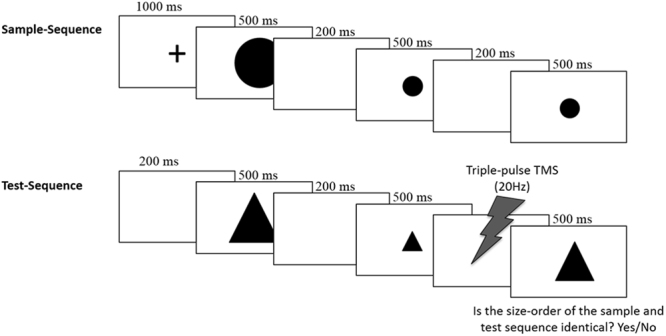
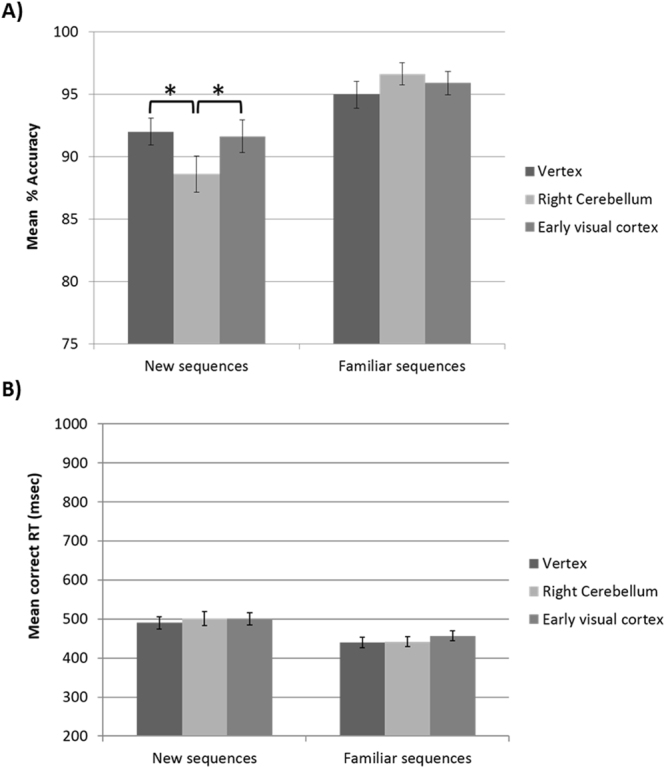
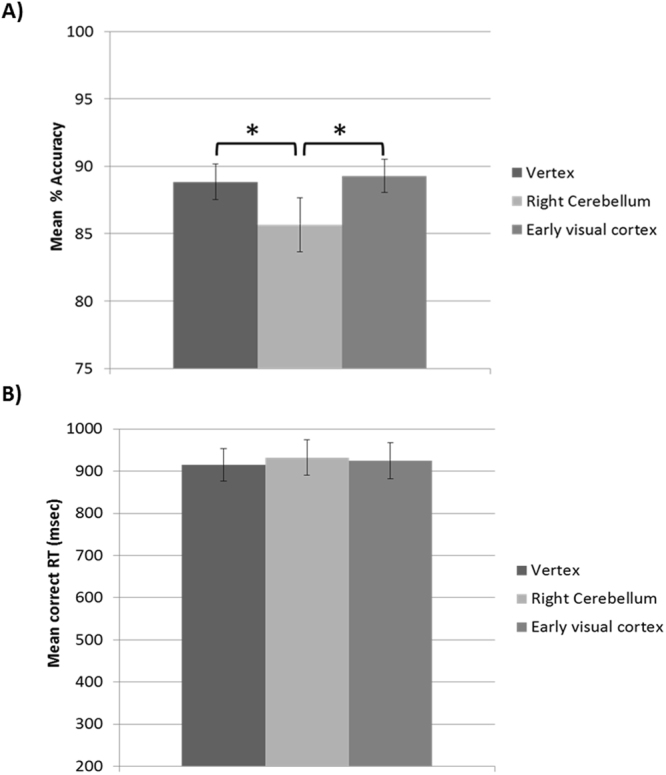
Growing evidence suggests that the cerebellum is not only involved in motor functions, but it significantly contributes to sensory and cognitive processing as well. In particular, it has been hypothesized that the cerebellum identifies recurrent serial events and recognizes their violations. Here we used transcranial magnetic stimulation (TMS) to shed light on the role of the cerebellum in short-term memory of visual sequences. In two experiments, we found that TMS over the right cerebellar hemisphere impaired participants’ ability to recognize the correct order of appearance of geometrical stimuli varying in shape and/or size. In turn, cerebellar TMS did not affect recognition of highly familiar short sequences of letters or numbers. Overall, our data suggest that the cerebellum is involved in memorizing the order in which (concatenated) stimuli appear, this process being important for sequence learning.
Overview
The claims and statistics of this paper haven’t been checked yet.
Free: it reads the open-access text and checks the first 5 claims that cite a source we can check. Create a free account to check every claim.
Integrity signals
Registry
Cites
Statistics
Figures
Verification
Claims the paper makes
The claims and statistics of this paper haven’t been checked yet.
Free: it reads the open-access text and checks the first 5 claims that cite a source we can check. Create a free account to check every claim.
Claims other papers make about this one
Each is checked against this paper’s own text: does it say what the citing paper says it does?
The source backs part of the claim, not all of it — or backs it for a different population, condition or comparison.
In the citing paper
“the cemi field theory proposes that EM fields are involved in memory and learning and so would predict that external EM fields, such as those delivered by TMS, will interfere with these processes, as found in several studies (Ferrari et al., 2018; Bang et al., 2019)”
From Consciousness: Matter or EMF? (2023) · cites this paper as Ferrari et al., 2018
Experimental — accuracy not yet measuredThe source backs part of the claim, not all of it — or backs it for a different population, condition or comparison.
In the citing paper
“which aligns with prior studies (Casula et al., 2016; Esterman et al., 2017; Ferrari et al., 2018; Gatti et al., 2021; Lesage et al., 2012; Shinn et al., 2023)”
From A double-blind, randomized, sham-controlled clinical trial of cerebellar intermittent theta burst stimulation for bipolar disorder: Safety, tolerability, mood and cognitive effects (2025) · cites this paper as Ferrari et al., 2018
Experimental — accuracy not yet measured
Self-check
Percentages, sums and reported differences re-computed from the paper’s own numbers.
The self-check needs the paper’s full text.
Citations
Cites
Co-Planar Stereotaxic Atlas of the Human Brain
Talairach, J., & Tournoux, P. (1988) · Medical Entomology and Zoology · Cited by 11,798
Motor sequence learning: a study with positron emission tomography
Jenkins, I., Brooks, D., Nixon, P., Frackowiak, R., & Passingham, R. (1994) · The Journal of Neuroscience · doi:10.1523/jneurosci.14-06-03775.1994 · Cited by 1,150
Consensus Paper: The Cerebellum's Role in Movement and Cognition
Koziol, L. F., Budding, D., Andreasen, N., D’Arrigo, S., Bulgheroni, S., Imamizu, H., Ito, M., Manto, M., Marvel, C., Parker, K., et al. (2014) · The Cerebellum · doi:10.1007/s12311-013-0511-x · Cited by 1,133 · cited 7×
“Neither the main effect of TMS, F(2, 34) = 1.”
BackgroundMethodInfluentialManto, M., Bower, J. M., Conforto, A. B., Delgado-García, J. M., da Guarda, S. N. F., Gerwig, M., Habas, C., Hagura, N., Ivry, R. B., Mariën, P., et al. (2012) · The Cerebellum · doi:10.1007/s12311-011-0331-9 · Cited by 1,002 · cited 2×
“The ANOVA on mean accuracy scores revealed a significant main effect of task condition, F(1, 17) = 19.”
MethodPrediction, cognition and the brain
Bubic (2010) · Frontiers in Human Neuroscience · doi:10.3389/fnhum.2010.00025 · Cited by 647
Screening questionnaire before TMS: An update
Rossi, S., Hallett, M., Rossini, P. M., & Pascual-Leone, A. (2011) · Clinical Neurophysiology · doi:10.1016/j.clinph.2010.12.037 · Cited by 629
Houk, J. C., & Wise, S. P. (1995) · Cerebral Cortex · doi:10.1093/cercor/5.2.95 · Cited by 593
Prediction of external events with our motor system: towards a new framework
Schubotz, R. I. (2007) · Trends in Cognitive Sciences · doi:10.1016/j.tics.2007.02.006 · Cited by 549
A meta-analysis of cerebellar contributions to higher cognition from PET and fMRI studies
E, K., Chen, S. A., Ho, M. R., & Desmond, J. E. (2014) · Human Brain Mapping · doi:10.1002/hbm.22194 · Cited by 516
Consensus Paper: Language and the Cerebellum: an Ongoing Enigma
Mariën, P., Ackermann, H., Adamaszek, M., Barwood, C. H. S., Beaton, A., Desmond, J., De Witte, E., Fawcett, A. J., Hertrich, I., Küper, M., et al. (2013) · The Cerebellum · doi:10.1007/s12311-013-0540-5 · Cited by 495
Procedural learning in Parkinson's disease and cerebellar degeneration
Pascual‐Leone, A., Grafman, J., Clark, K., Stewart, M., Massaquoi, S., Lou, J., & Hallett, M. (1993) · Annals of Neurology · doi:10.1002/ana.410340414 · Cited by 481
Experience-dependent changes in cerebellar contributions to motor sequence learning
Doyon, J., Song, A. W., Karni, A., Lalonde, F., Adams, M. M., & Ungerleider, L. G. (2002) · Proceedings of the National Academy of Sciences · doi:10.1073/pnas.022615199 · Cited by 477
Transcranial magnetic stimulation of deep brain regions: evidence for efficacy of the H-Coil
Zangen, A., Roth, Y., Voller, B., & Hallett, M. (2005) · Clinical Neurophysiology · doi:10.1016/j.clinph.2004.11.008 · Cited by 473
Consensus Paper: The Role of the Cerebellum in Perceptual Processes
Baumann, O., Borra, R. J., Bower, J. M., Cullen, K. E., Habas, C., Ivry, R. B., Leggio, M., Mattingley, J. B., Molinari, M., Moulton, E. A., et al. (2015) · The Cerebellum · doi:10.1007/s12311-014-0627-7 · Cited by 462
Stimulus Predictability Reduces Responses in Primary Visual Cortex
Alink, A., Schwiedrzik, C. M., Kohler, A., Singer, W., & Muckli, L. (2010) · The Journal of Neuroscience · doi:10.1523/jneurosci.3730-10.2010 · Cited by 435
D'Angelo, E., & Casali, S. (2013) · Frontiers in Neural Circuits · doi:10.3389/fncir.2012.00116 · Cited by 407
Self-citationAttentional Processing: The Brain’s Art of Mindfulness
LaBerge, D. (1995) · Harvard University Press eBooks · doi:10.4159/harvard.9780674183940 · Cited by 369
Cerebellum and procedural learning: evidence from focal cerebellar lesions
Molinari, M. (1997) · Brain · doi:10.1093/brain/120.10.1753 · Cited by 355 · cited 5×
“The ANOVA on mean accuracy scores revealed a significant main effect of task condition, F(1, 17) = 19.”
BackgroundMethodResultInfluentialStudies in Cognition: The Problems Solved and Created by Transcranial Magnetic Stimulation
Robertson, E. M., Théoret, H., & Pascual-Leone, A. (2003) · Journal of Cognitive Neuroscience · doi:10.1162/089892903770007344 · Cited by 338
Attentional processing: the brain's art of mindfulness
(1995) · Choice Reviews Online · doi:10.5860/choice.33-1523 · Cited by 325
The cerebellar cognitive profile
Tedesco, A. M., Chiricozzi, F. R., Clausi, S., Lupo, M., Molinari, M., & Leggio, M. G. (2011) · Brain · doi:10.1093/brain/awr266 · Cited by 252
Repetitive TMS of cerebellum interferes with millisecond time processing
Koch, G., Oliveri, M., Torriero, S., Salerno, S., Gerfo, E. L., & Caltagirone, C. (2007) · Experimental Brain Research · doi:10.1007/s00221-006-0791-1 · Cited by 218
Kirschen, M. P., Chen, S. H. A., Schraedley-Desmond, P., & Desmond, J. E. (2005) · NeuroImage · doi:10.1016/j.neuroimage.2004.08.036 · Cited by 216
Predicting events of varying probability: uncertainty investigated by fMRI
Volz, K. G., Schubotz, R. I., & von Cramon, D. Y. (2003) · NeuroImage · doi:10.1016/s1053-8119(03)00122-8 · Cited by 214
Interval and Ordinal Properties of Sequences Are Associated with Distinct Premotor Areas
Schubotz, R. I. (2001) · Cerebral Cortex · doi:10.1093/cercor/11.3.210 · Cited by 211
Cerebellar Sequencing: a Trick for Predicting the Future
Leggio, M., & Molinari, M. (2015) · The Cerebellum · doi:10.1007/s12311-014-0616-x · Cited by 205
Schubotz, R. I., & von Cramon, D. Y. (2004) · The Journal of Neuroscience · doi:10.1523/jneurosci.1169-04.2004 · Cited by 199
Anticipatory cerebellar responses during somatosensory omission in man
Tesche, C. D., & Karhu, J. J. T. (2000) · Human Brain Mapping · doi:10.1002/(sici)1097-0193(200003)9:3<119::aid-hbm2>3.0.co;2-r · Cited by 177
Cerebellum and Detection of Sequences, from Perception to Cognition
Molinari, M., Chiricozzi, F. R., Clausi, S., Tedesco, A. M., De Lisa, M., & Leggio, M. G. (2008) · The Cerebellum · doi:10.1007/s12311-008-0060-x · Cited by 173
Cognitive sequencing impairment in patients with focal or atrophic cerebellar damage
Leggio, M. G., Tedesco, A. M., Chiricozzi, F. R., Clausi, S., Orsini, A., & Molinari, M. (2008) · Brain · doi:10.1093/brain/awn040 · Cited by 170
Role of the Cerebellum in Externally Paced Rhythmic Finger Movements
Del Olmo, M. F., Cheeran, B., Koch, G., & Rothwell, J. C. (2007) · Journal of Neurophysiology · doi:10.1152/jn.01088.2006 · Cited by 163
Suppression of the motor cortex by magnetic stimulation of the cerebellum
Pinto, A. D., & Chen, R. (2001) · Experimental Brain Research · doi:10.1007/s002210100862 · Cited by 159
The cerebellum in the spatial problem solving: a co-star or a guest star?
Petrosini, L., Leggio, M. G., & Molinari, M. (1998) · Progress in Neurobiology · doi:10.1016/s0301-0082(98)00036-7 · Cited by 149
Restuccia, D., Marca, G. D., Valeriani, M., Leggio, M. G., & Molinari, M. (2006) · Brain · doi:10.1093/brain/awl236 · Cited by 148
Spatial and Temporal Sequence Learning in Patients with Parkinson's Disease or Cerebellar Lesions
Shin, J. C., & Ivry, R. B. (2003) · Journal of Cognitive Neuroscience · doi:10.1162/089892903322598175 · Cited by 139
The neuropsychological profile of cerebellar damage: The sequencing hypothesis
Leggio, M. G., Chiricozzi, F. R., Clausi, S., Tedesco, A. M., & Molinari, M. (2009) · Cortex · doi:10.1016/j.cortex.2009.08.011 · Cited by 133
Effects of lateral lesions on medial activation during autobiographical remembering
R Shayna, R. (2010) · Frontiers in Human Neuroscience · doi:10.3389/conf.fnins.2010.14.00162 · Cited by 125
Interference of Left and Right Cerebellar rTMS with Procedural Learning
Torriero, S., Oliveri, M., Koch, G., Caltagirone, C., & Petrosini, L. (2004) · Journal of Cognitive Neuroscience · doi:10.1162/0898929042568488 · Cited by 119
Leggio, M. G., Molinari, M., Neri, P., Graziano, A., Mandolesi, L., & Petrosini, L. (2000) · Proceedings of the National Academy of Sciences · doi:10.1073/pnas.040554297 · Cited by 110
The Recognition of Facial Emotions in Spinocerebellar Ataxia Patients
D’Agata, F., Caroppo, P., Baudino, B., Caglio, M., Croce, M., Bergui, M., Tamietto, M., Mortara, P., & Orsi, L. (2011) · The Cerebellum · doi:10.1007/s12311-011-0276-z · Cited by 105
Schubotz, R. I., & von Cramon, D. Y. (2002) · NeuroImage · doi:10.1006/nimg.2002.1183 · Cited by 104
Ferrari, C., Lega, C., Vernice, M., Tamietto, M., Mende-Siedlecki, P., Vecchi, T., Todorov, A., & Cattaneo, Z. (2016) · Cerebral Cortex · doi:10.1093/cercor/bhu186 · Cited by 102
Self-citationCerebellar contribution to spatial event processing: characterization of procedural learning
Leggio, M. G., Neri, P. E., Graziano, A., Mandolesi, L., Molinari, M., & Petrosini, L. (1999) · Experimental Brain Research · doi:10.1007/s002210050768 · Cited by 97
Cattaneo, Z., Devlin, J. T., Salvini, F., Vecchi, T., & Silvanto, J. (2009) · NeuroImage · doi:10.1016/j.neuroimage.2009.10.048 · Cited by 95
Self-citationAttout, L., Fias, W., Salmon, É., & Majerus, S. (2014) · PLoS ONE · doi:10.1371/journal.pone.0092049 · Cited by 90
Cerebellum, temporal predictability and the updating of a mental model
Kotz, S. A., Stockert, A., & Schwartze, M. (2014) · Philosophical Transactions of the Royal Society B Biological Sciences · doi:10.1098/rstb.2013.0403 · Cited by 86
Boecker, H., Ceballos-Baumann, A., Bartenstein, P., Dagher, A., Forster, K., Haslinger, B. A., Brooks, D. J., Schwaiger, M., & Conrad, B. (2002) · NeuroImage · doi:10.1006/nimg.2002.1139 · Cited by 86
Spatial patterns of functional activation of the cerebellum investigated using high field (4 T) MRI
Ellerman, J. M., Flament, D., Kim, S. ‐., Fu, Q. ‐., Merkle, H., Ebner, T. J., & Ugurbil, K. (1994) · NMR in Biomedicine · doi:10.1002/nbm.1940070110 · Cited by 80
Bona, S., Cattaneo, Z., & Silvanto, J. (2015) · Journal of Neuroscience · doi:10.1523/jneurosci.3733-14.2015 · Cited by 79
Self-citationHanajima, R., Wang, R., Nakatani‐Enomoto, S., Hamada, M., Terao, Y., Furubayashi, T., Okabe, S., Inomata‐Terada, S., Yugeta, A., Rothwell, J. C., et al. (2007) · Clinical Neurophysiology · doi:10.1016/j.clinph.2007.05.067 · Cited by 79
Ferrari, C., Oldrati, V., Gallucci, M., Vecchi, T., & Cattaneo, Z. (2017) · NeuroImage · doi:10.1016/j.neuroimage.2017.12.026 · Cited by 78
Self-citationAccuracy of an individualized MR-based head model for navigated brain stimulation.
Carducci, F., & Brusco, R. (2012) · Psychiatry Research · doi:10.1016/j.pscychresns.2011.12.013 · Cited by 73 · cited 7×
“Neither the main effect of TMS, F(2, 34) = 1.”
BackgroundMethodInfluentialNetwork-targeted cerebellar transcranial magnetic stimulation improves attentional control
Esterman, M., Thai, M., Okabe, H., DeGutis, J., Saad, E., Laganiere, S. E., & Halko, M. A. (2017) · NeuroImage · doi:10.1016/j.neuroimage.2017.05.011 · Cited by 71
Violation of Expectation: Neural Correlates Reflect Bases of Prediction
Bubic, A., von Cramon, D. Y., Jacobsen, T., Schröger, E., & Schubotz, R. I. (2009) · Journal of Cognitive Neuroscience · doi:10.1162/jocn.2009.21013 · Cited by 69
Repetitive transcranial magnetic stimulation: a tool for human cerebellar plasticity.
Koch, G. (2011) · PubMed · Cited by 68
Cattaneo, Z., Mattavelli, G. C., Platania, E., & Papagno, C. (2011) · NeuroImage · doi:10.1016/j.neuroimage.2011.02.037 · Cited by 62
Self-citationHoen, M., Pachot-Clouard, M., Segebarth, C., & Dominey, P. F. (2006) · Cortex · doi:10.1016/s0010-9452(08)70398-8 · Cited by 59
Mattavelli, G. C., Cattaneo, Z., & Papagno, C. (2011) · Neuropsychologia · doi:10.1016/j.neuropsychologia.2011.01.038 · Cited by 57
Self-citationCerebellar vermis plays a causal role in visual motion discrimination
Cattaneo, Z., Renzi, C., Casali, S., Silvanto, J., Vecchi, T., Papagno, C., & D'Angelo, E. U. (2014) · Cortex · doi:10.1016/j.cortex.2014.01.012 · Cited by 56
Self-citationFarzan, F., Pascual-Leone, A., Schmahmann, J. D., & Halko, M. (2016) · Scientific Reports · doi:10.1038/srep23599 · Cited by 53
Use of sequence information in associative learning in control subjects and cerebellar patients
Timmann, D., Drepper, J., Calabrese, S., rgerhoff, K. B. X. F., Maschke, M., Kolb, F. P., Daum, I., & Diener, H. (2004) · The Cerebellum · doi:10.1080/14734220310024890 · Cited by 41
Gamond, L., Ferrari, C., Rocca, S. L., & Cattaneo, Z. (2017) · European Journal of Neuroscience · doi:10.1111/ejn.13529 · Cited by 40
Self-citationDoes the cerebellum contribute to human navigation by processing sequential information?
Tedesco, A. M., Bianchini, F., Piccardi, L., Clausi, S., Berthoz, A., Molinari, M., Guariglia, C., & Leggio, M. G. (2017) · Neuropsychology · doi:10.1037/neu0000354 · Cited by 32
Phosphene induction by cerebellar transcranial magnetic stimulation
Renzi, C., Vecchi, T., D'Angelo, E. U., Silvanto, J., & Cattaneo, Z. (2014) · Clinical Neurophysiology · doi:10.1016/j.clinph.2014.01.031 · Cited by 19
Self-citation
Cited by
Siebner, H. R., Funke, K., Aberra, A. S., Antal, A., Bestmann, S., Chen, R., Classen, J., Davare, M., Di Lazzaro, V., Fox, P. T., et al. (2022) · Clinical Neurophysiology · doi:10.1016/j.clinph.2022.04.022 · Cited by 566
Multimodal neuroimaging in post-COVID syndrome and correlation with cognition
Díez-Cirarda, M., Yus, M., Gómez-Ruiz, N., Polidura, C., Gil-Martínez, L., Delgado-Alonso, C., Jorquera, M., Gómez-Pinedo, U., Matias-Guiu, J., Arrazola, J., et al. (2023) · Brain · doi:10.1093/brain/awac384 · Cited by 208
Cerebellar disruption impairs working memory during evidence accumulation
Deverett, B., Kislin, M., Tank, D. W., & Wang, S. S. ‐. (2019) · Nature Communications · doi:10.1038/s41467-019-11050-x · Cited by 67
New Horizons on Non-invasive Brain Stimulation of the Social and Affective Cerebellum
Cattaneo, Z., Ferrari, C., Ciricugno, A., Heleven, E., Schutter, D. J. L. G., Manto, M. U., & Overwalle, F. V. (2021) · The Cerebellum · doi:10.1007/s12311-021-01300-4 · Cited by 64
“Whereas prior TMS studies targeted hemispheric regions that were somehow at the intersection of Crus I and II [13, 16], it would be certainly of interest to selectively test the role of Crus II and Crus I in different social processes.”
MethodResultSelf-citationCerebellar contribution to emotional body language perception: a TMS study
Ferrari, C., Ciricugno, A., Urgesi, C., & Cattaneo, Z. (2019) · Social Cognitive and Affective Neuroscience · doi:10.1093/scan/nsz074 · Cited by 58
Self-citation
Metadata
- Authors
- Ferrari, C., Cattaneo, Z., Oldrati, V., Casiraghi, L., Castelli, F., D’Angelo, E., & Vecchi, T.
- Affiliations
- University of Milano-Bicocca (IT)
- Fondazione Istituto Neurologico Nazionale Casimiro Mondino (IT)
- University of Pavia (IT)
- Corresponding author
- Ferrari, C.
- Venue
- Scientific Reports
- Published
- 2018-04-30
- Volume
- 8
- Issue
- 1
- Pages
- 6722-6722
- ISSN
- 2045-2322 (ISSN-L)
- PMC
- PMC5928079
- OpenAlex
- W2801371507
- Cited by
- 45
- References
- 64
- Citations by year
- 2026: 3 · 2025: 4 · 2024: 6 · 2023: 10 · 2022: 2 · 2021: 7 · 2020: 8 · 2019: 4 · 2018: 1
- FWCI
- 2.25
- Type
- journal article
- Language
- en
- Open access
- gold
- doi.org
- Licence
- cc-by
- creativecommons.org/licenses/by/4.0 (tdm)
- creativecommons.org/licenses/by/4.0 (vor)
- Locations
- Scientific Reports (publishedVersion, cc-by)
- Europe PMC (PubMed Central) (publishedVersion, cc-by)
- PubMed Central (publishedVersion, cc-by)
- PubMed (publishedVersion)
- Aisberg (University of Bergamo) (submittedVersion, cc-by)
- BOA (University of Milano-Bicocca) (submittedVersion, other-oa)
- DOAJ (DOAJ: Directory of Open Access Journals) (submittedVersion, cc-by-sa)
- Funders
- Ministero della Salute
- Regione Lombardia
- Topics
- Life Sciences › Neuroscience › Neurology › Transcranial Magnetic Stimulation Studies
- Life Sciences › Neuroscience › Cognitive Neuroscience › Memory and Neural Mechanisms
- Life Sciences › Neuroscience › Cognitive Neuroscience › Motor Control and Adaptation
- Keywords
- cerebellum, short-term memory, visual sequences, sequence learning, serial order memory, transcranial magnetic stimulation
- MeSH terms
- Cerebellum, Cognition, Humans, Male, Memory, Short-Term, Motor Activity, Transcranial Magnetic Stimulation, Young Adult, Central Nervous System Sensitization
About these checks
Registry, retraction, Cites and statistics results are computed, not judged, with one exception: a printed reference that no index lists is read once by a model before it counts as a citation error. Claims are extracted by a model and kept only when their quote appears verbatim in the text; each cited source is then checked, with a model’s help, for whether it says what the claim relies on. Those verdicts can be wrong — read the claim’s quote and the cited source before relying on one.
Statistics and arithmetic are recomputed, not judged.
Confidence bands are shown only for fields calibrated on our annotated test set. None is calibrated yet, so no band is shown.
What counts as a claim ›How we measure confidence ›How we check this ›
Are you an author, or do you see a problem with this page? Request a review
Data sources
Bibliographic data: Semantic Scholar, OpenAlex, Crossref.
Contains information from the Semantic Scholar Academic Graph Datasets, made available under the ODC Attribution License (ODC-BY 1.0).
Semantic Scholar’s data is described in: Kinney, R., et al. (2023). The Semantic Scholar Open Data Platform. arXiv:2301.10140.
