

Terrein is an inhibitor of quorum sensing and c-di-GMP in Pseudomonas aeruginosa: a connection between quorum sensing and c-di-GMP
Open accessThe DOI matches its Crossref record; 59 of the 60 references it cites were found in a registry or an index.
Abstract
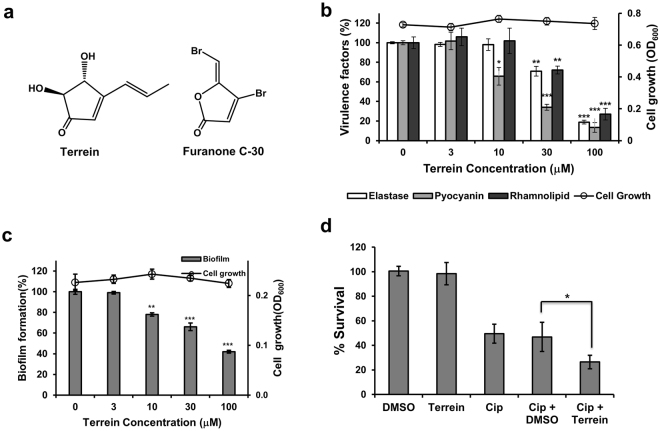
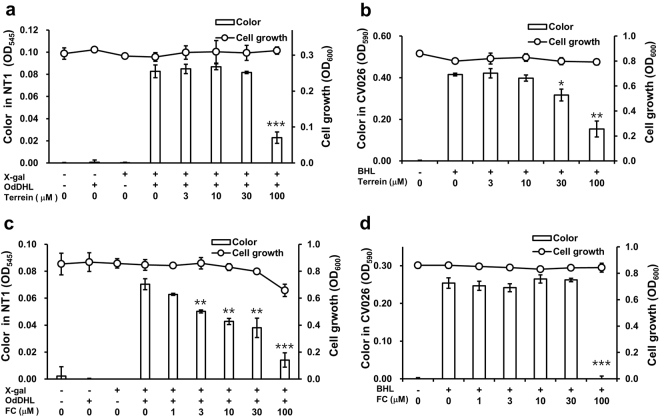
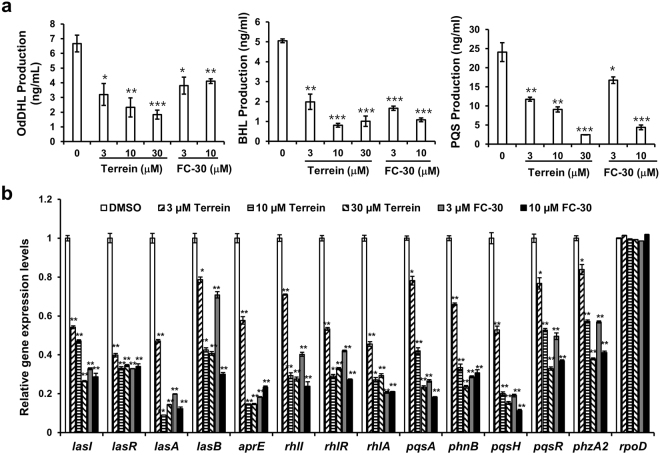
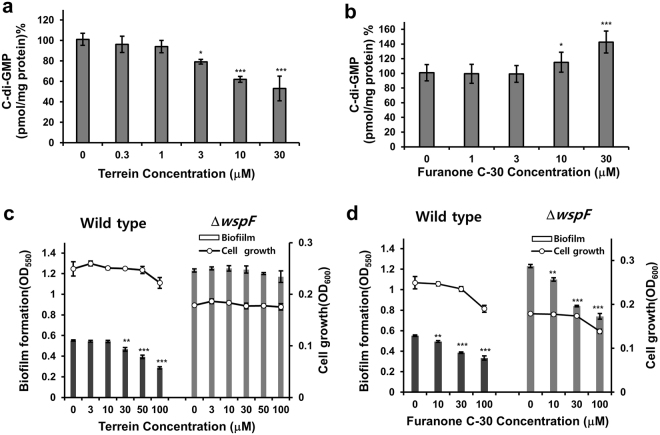
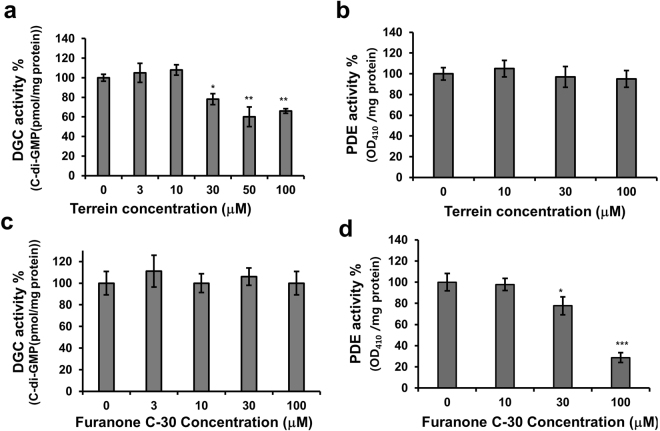
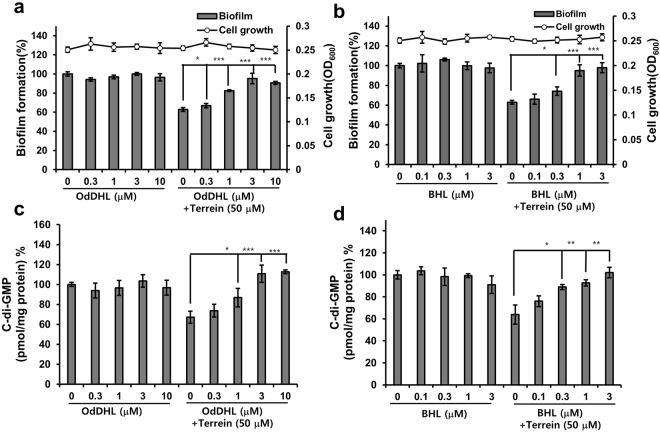
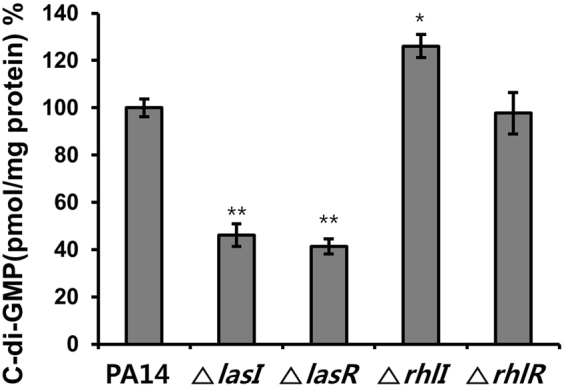
To address the drug-resistance of bacterial pathogens without imposing a selective survival pressure, virulence and biofilms are highly attractive targets. Here, we show that terrein, which was isolated from Aspergillus terreus, reduced virulence factors (elastase, pyocyanin, and rhamnolipid) and biofilm formation via antagonizing quorum sensing (QS) receptors without affecting Pseudomonas aeruginosa cell growth. Additionally, the effects of terrein on the production of QS signaling molecules and expression of QS-related genes were verified. Interestingly, terrein also reduced intracellular 3,5-cyclic diguanylic acid (c-di-GMP) levels by decreasing the activity of a diguanylate cyclase (DGC). Importantly, the inhibition of c-di-GMP levels by terrein was reversed by exogenous QS ligands, suggesting a regulation of c-di-GMP levels by QS; this regulation was confirmed using P. aeruginosa QS mutants. This is the first report to demonstrate a connection between QS signaling and c-di-GMP metabolism in P. aeruginosa, and terrein was identified as the first dual inhibitor of QS and c-di-GMP signaling.
Overview
The claims and statistics of this paper haven’t been checked yet.
Free: it reads the open-access text and checks the first 5 claims that cite a source we can check. Create a free account to check every claim.
Integrity signals
Registry
Cites
Statistics
Figures
Verification
Claims the paper makes
The claims and statistics of this paper haven’t been checked yet.
Free: it reads the open-access text and checks the first 5 claims that cite a source we can check. Create a free account to check every claim.
Claims other papers make about this one
Each is checked against this paper’s own text: does it say what the citing paper says it does?
In the citing paper
“other fungal metabolites can impact bacterial quorum sensing and c-diGMP signaling (584)”
From Aspergillus fumigatus and Aspergillosis in 2019 (2019) · cites this paper as [584]
Self-check
Percentages, sums and reported differences re-computed from the paper’s own numbers.
The self-check needs the paper’s full text.
Citations
Cites
1 retracted
Ryan, R. P., Fouhy, Y., Lucey, J. F., Crossman, L. C., Spiro, S., He, Y.-W., Zhang, L.-H., Heeb, S., Cámara, M., Williams, P., et al. (2006) · Proceedings of the National Academy of Sciences · doi:10.1073/pnas.0600345103 · Cited by 507
RetractedBad Bugs, No Drugs: No ESKAPE! An Update from the Infectious Diseases Society of America
Boucher, H. W., Talbot, G. H., Bradley, J. S., Edwards, J. E., Gilbert, D., Rice, L. B., Scheld, M., Spellberg, B., & Bartlett, J. (2009) · Clinical Infectious Diseases · doi:10.1086/595011 · Cited by 4,958
QUORUM SENSING: Cell-to-Cell Communication in Bacteria
Waters, C. M., & Bassler, B. L. (2005) · Annual Review of Cell and Developmental Biology · doi:10.1146/annurev.cellbio.21.012704.131001 · Cited by 3,979
Understanding biofilm resistance to antibacterial agents
Davies, D. (2003) · Nature Reviews Drug Discovery · doi:10.1038/nrd1008 · Cited by 2,781
Quorum sensing signal-response systems in Gram-negative bacteria
Papenfort, K., & Bassler, B. L. (2016) · Nature Reviews Microbiology · doi:10.1038/nrmicro.2016.89 · Cited by 2,256
Bacterial Quorum Sensing: Its Role in Virulence and Possibilities for Its Control
Rutherford, S. T., & Bassler, B. L. (2012) · Cold Spring Harbor Perspectives in Medicine · doi:10.1101/cshperspect.a012427 · Cited by 2,129
McClean, K. H., Winson, M. K., Fish, L., Taylor, A., Chhabra, S. R., Camara, M., Daykin, M., Lamb, J. H., Swift, S., Bycroft, B. W., et al. (1997) · Microbiology · doi:10.1099/00221287-143-12-3703 · Cited by 1,744
Cyclic di-GMP: the First 25 Years of a Universal Bacterial Second Messenger
Römling, U., Galperin, M. Y., & Gomelsky, M. (2013) · Microbiology and Molecular Biology Reviews · doi:10.1128/mmbr.00043-12 · Cited by 1,700
Bacterial Quorum-Sensing Network Architectures
Ng, W.-L., & Bassler, B. L. (2009) · Annual Review of Genetics · doi:10.1146/annurev-genet-102108-134304 · Cited by 1,679
Attenuation of Pseudomonas aeruginosa virulence by quorum sensing inhibitors
Hentzer, M. (2003) · The EMBO Journal · doi:10.1093/emboj/cdg366 · Cited by 1,422
Cited by
Aspergillus fumigatus and Aspergillosis in 2019
Latgé, J.-P., & Chamilos, G. (2019) · Clinical Microbiology Reviews · doi:10.1128/cmr.00140-18 · Cited by 1,400
Pseudomonas aeruginosa Biofilms
Thi, M. T. T., Wibowo, D., & Rehm, B. H. A. (2020) · International Journal of Molecular Sciences · doi:10.3390/ijms21228671 · Cited by 911
Fleitas Martínez, O., Cardoso, M. H., Ribeiro, S. M., & Franco, O. L. (2019) · Frontiers in Cellular and Infection Microbiology · doi:10.3389/fcimb.2019.00074 · Cited by 304
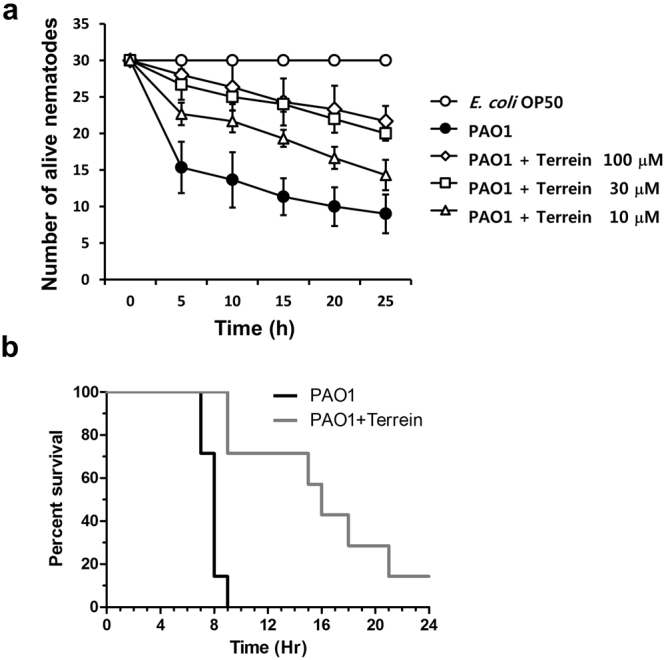
“Anti-biofilm P. aeruginosa PAO1 • Reduced elastase, pyocyanin, rhamnolipid, and biofilm production • Attenuated in vivo virulence of P. aeruginosa PAO1 toward C. elegans and mice Kim et al., 2018”
BackgroundPseudomonas aeruginosa biofilms and their partners in crime
Cendra, M. D. M., & Torrents, E. (2021) · Biotechnology Advances · doi:10.1016/j.biotechadv.2021.107734 · Cited by 176
Multiple Roles of c-di-GMP Signaling in Bacterial Pathogenesis
Valentini, M., & Filloux, A. (2019) · Annual Review of Microbiology · doi:10.1146/annurev-micro-020518-115555 · Cited by 170
Metadata
- Authors
- Kim, B., Park, J.-S., Choi, H.-Y., Yoon, S. S., & Kim, W.-G.
- Affiliations
- Korea Research Institute of Bioscience and Biotechnology (KR)
- Yonsei University (KR)
- Corresponding author
- Kim, Won-Gon
- Venue
- Scientific Reports
- Published
- 2018-06-05
- Volume
- 8
- Issue
- 1
- Pages
- 8617-8617
- ISSN
- 2045-2322 (ISSN-L)
- PMC
- PMC5988783
- OpenAlex
- W2806156239
- Cited by
- 103
- References
- 60
- Citations by year
- 2026: 7 · 2025: 11 · 2024: 17 · 2023: 10 · 2022: 22 · 2021: 8 · 2020: 14 · 2019: 13 · 2018: 1
- FWCI
- 3.20
- Type
- journal article
- Language
- en
- Open access
- gold
- doi.org
- Licence
- cc-by
- creativecommons.org/licenses/by/4.0 (tdm)
- creativecommons.org/licenses/by/4.0 (vor)
- Locations
- Scientific Reports (publishedVersion, cc-by)
- Europe PMC (PubMed Central) (publishedVersion, other-oa)
- PubMed Central (publishedVersion, cc-by)
- PubMed (publishedVersion)
- DOAJ (DOAJ: Directory of Open Access Journals) (submittedVersion)
- KRIBB Repository (submittedVersion)
- YUHSpace (Yonsei University Medical Library) (submittedVersion, cc-by-nc-nd)
- Funders
- Korea Health Industry Development Institute (HI17C1807)
- Korea Research Institute of Bioscience and Biotechnology
- Topics
- Life Sciences › Biochemistry, Genetics and Molecular Biology › Molecular Biology › Bacterial biofilms and quorum sensing
- Life Sciences › Biochemistry, Genetics and Molecular Biology › Molecular Biology › Phosphodiesterase function and regulation
- Life Sciences › Immunology and Microbiology › Applied Microbiology and Biotechnology › Antimicrobial agents and applications
- Keywords
- terrein, Pseudomonas aeruginosa, quorum sensing, c-di-GMP, diguanylate cyclase, biofilm formation, virulence factors, elastase, pyocyanin, rhamnolipids, Aspergillus terreus, virulence factor inhibition
- MeSH terms
- Aspergillus, Cyclopentanes, Cyclic GMP, Pseudomonas aeruginosa, Virulence, Biofilms, Quorum Sensing
About these checks
Registry, retraction, Cites and statistics results are computed, not judged, with one exception: a printed reference that no index lists is read once by a model before it counts as a citation error. Claims are extracted by a model and kept only when their quote appears verbatim in the text; each cited source is then checked, with a model’s help, for whether it says what the claim relies on. Those verdicts can be wrong — read the claim’s quote and the cited source before relying on one.
Statistics and arithmetic are recomputed, not judged.
Confidence bands are shown only for fields calibrated on our annotated test set. None is calibrated yet, so no band is shown.
What counts as a claim ›How we measure confidence ›How we check this ›
Are you an author, or do you see a problem with this page? Request a review
How to cite
Cite CoChat for the checks on this page, and the paper for its own findings.
- This page
- CoChat. (2026). Citation check: Terrein is an inhibitor of quorum sensing and c-di-GMP in Pseudomonas aeruginosa: a connection between quorum sensing and c-di-GMP. https://app.cochat.ai/papers/10.1038/s41598-018-26974-5
- The paper
- Kim, B., Park, J.-S., Choi, H.-Y., Yoon, S. S., & Kim, W.-G. (2018). Terrein is an inhibitor of quorum sensing and c-di-GMP in Pseudomonas aeruginosa: a connection between quorum sensing and c-di-GMP. Scientific Reports. https://doi.org/10.1038/s41598-018-26974-5
Data sources
Bibliographic data: Semantic Scholar, OpenAlex, Crossref.
Contains information from the Semantic Scholar Academic Graph Datasets, made available under the ODC Attribution License (ODC-BY 1.0).
Semantic Scholar’s data is described in: Kinney, R., et al. (2023). The Semantic Scholar Open Data Platform. arXiv:2301.10140.
