

Inhibition of the glutaredoxin and thioredoxin systems and ribonucleotide reductase by mutant p53-targeting compound APR-246
Open accessThe DOI matches its Crossref record; 50 of the 51 references it cites were found in a registry or an index; 18 of the 50 sources its claims cite were checked for support.
Abstract
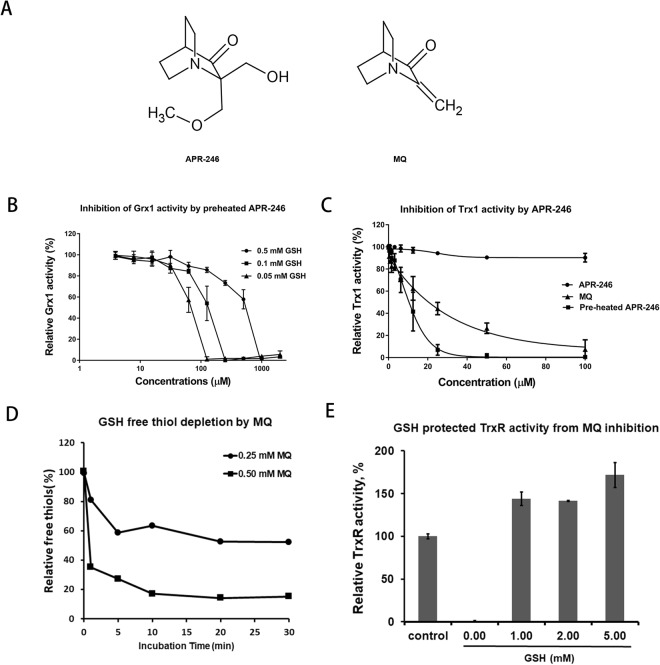
The tumor suppressor p53 is commonly inactivated in human tumors, allowing evasion of p53-dependent apoptosis and tumor progression. The small molecule APR-246 (PRIMA-1 Met ) can reactive mutant p53 in tumor cells and trigger cell death by apoptosis. The thioredoxin (Trx) and glutaredoxin (Grx) systems are important as antioxidants for maintaining cellular redox balance and providing electrons for thiol-dependent reactions like those catalyzed by ribonucleotide reductase and peroxiredoxins (Prxs). We show here that the Michael acceptor methylene quinuclidinone (MQ), the active form of APR-246, is a potent direct inhibitor of Trx1 and Grx1 by reacting with sulfhydryl groups in the enzymes. The inhibition of Trx1 and Grx1 by APR-246/MQ is reversible and the inhibitory efficiency is dependent on the presence of glutathione. APR-246/MQ also inhibits Trxs in mutant p53-expressing Saos-2 His-273 cells, showing modification of Trx1 and mitochondrial Trx2. Inhibition of the Trx and Grx systems leads to insufficient reducing power to deoxyribonucleotide production for DNA replication and repair and peroxiredoxin for removal of ROS. We also demonstrate that APR-246 and MQ inhibit ribonucleotide reductase (RNR) in vitro and in living cells. Our results suggest that APR-246 induces tumor cell death through both reactivations of mutant p53 and inhibition of cellular thiol-dependent redox systems, providing a novel strategy for cancer therapy.
Overview
CoChat Summary
TL;DR
APR-246’s active metabolite MQ directly and reversibly inhibits Trx1 and Grx1 by modifying thiols, and APR-246/MQ also inhibits ribonucleotide reductase (RNR) in vitro and in cells. These redox-system effects occur alongside mutant p53 reactivation and may contribute to APR-246-induced tumor cell death.
Key findings
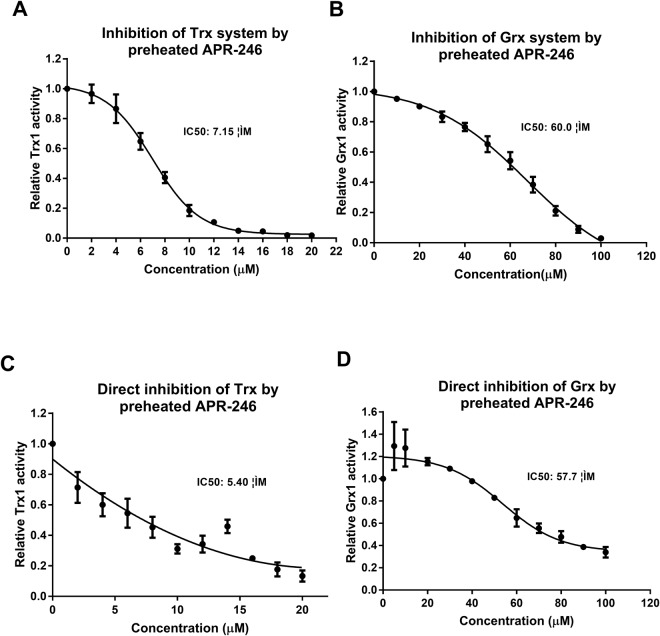
- Preheated APR-246 inhibited the Trx system with an IC50 of 7.15 µM and the Grx system with an IC50 of 60.0 µM; direct inhibition of Trx1 and Grx1 gave IC50 values of 5.40 µM and 57.7 µM, respectively.
- MQ formed adducts with Trx1 and Grx1: MALDI-TOF showed mass shifts of 137 Da, with all 5 Trx1 thiols modified at 0.5 mM MQ, whereas Grx1 showed 4 adducts at 0.5 mM MQ and required 1 mM MQ for modification of all 5 thiols.
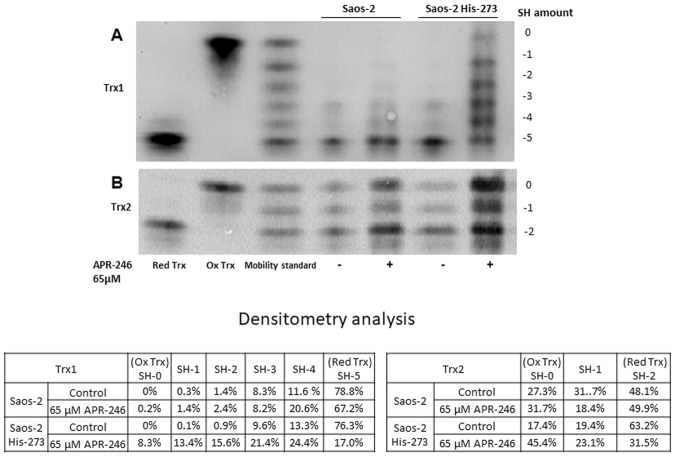
- In Saos-2-His-273 cells treated with 65 µM APR-246 for 24 h, fully reduced Trx1 decreased from 76.3% to 17.0%, and Trx2 without free thiols increased from 17% to 45%.
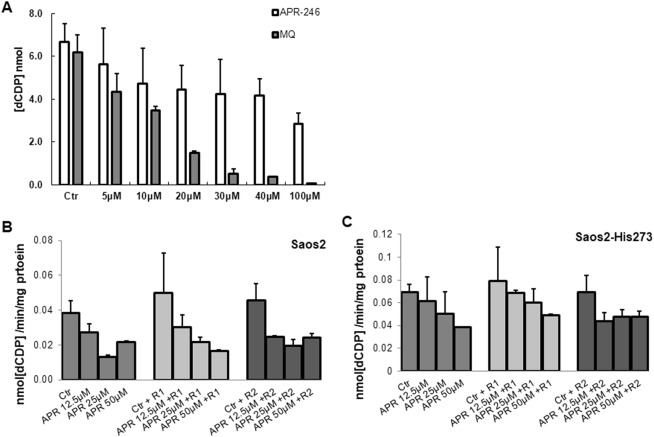
- APR-246 and MQ inhibited RNR in vitro, with MQ at 40 µM almost completely inhibiting activity; APR-246 also dose-dependently inhibited RNR in Saos-2 and Saos-2-His-273 cells at 12.5, 25, and 50 µM.
Methods
- In vitro assays used recombinant human Trx1 and Grx1, rat TrxR, yeast GR, NADPH, GSH, and fluorescent substrates (FITC-insulin or E-GS-BSA); thiol content was measured with DTNB, and MQ adducts were analyzed by MALDI-TOF mass spectrometry.
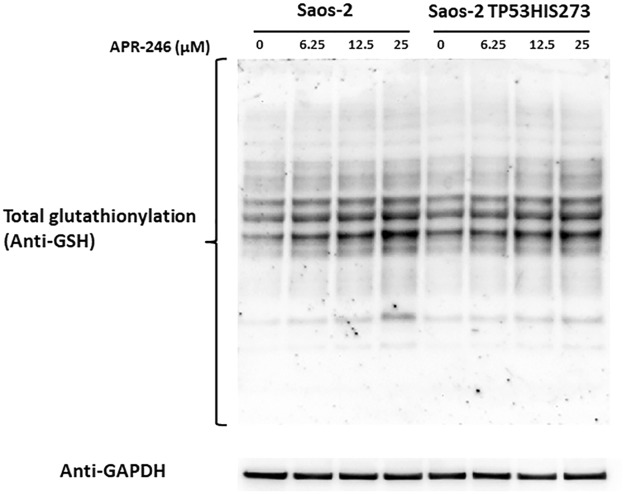
- Cell experiments used p53-null Saos-2 and mutant p53-expressing Saos-2-His-273 cells treated with APR-246 for 24 h, followed by redox Western blotting for Trx1/Trx2, anti-glutathione Western blotting for total glutathionylation, and RNR activity assays.
- RNR activity was measured by conversion of [3H]CDP to [3H]dCDP in vitro and in cell lysates; data were analyzed with GraphPad Prism 5 and Quantity One software.
Limitations
- The paper does not state a formal limitations section.
- Evident from the text: most mechanistic evidence comes from in vitro recombinant proteins and high concentrations (e.g., 0.5–1 mM MQ for mass spectrometry), while cell data are limited to Saos-2 osteosarcoma lines with or without His-273 mutant p53, so generalizability is unclear.
- The paper states that Trx1 activity was fully restored after long-term kinetic measurements (data not shown), indicating transient inhibition; this is stated but not shown, and no in vivo animal or clinical data are presented.
Model-written summary. Check it against the paper before relying on it.
Integrity signals
Registry
Cites
Statistics
Figures
Verification
Claims the paper makes
14 Valid · 1 Not valid · 19 Not checked · 56 Own results and interpretations
Every source the paper cites for this claim was checked and supports it.
In the paper
“APR-246/MQ has also been shown to inhibit thioredoxin reductase (TrxR) in vitro and in living cells15.”
§ Inhibition of the glutaredoxin and thioredoxin systems and ribonucleotide reductase by mutant p53-targeting compound APR-246 > Introduction
What the sources say
- Supportedcites [15] Peng X APR-246/PRIMA-1MET inhibits thioredoxin reductase 1 and converts the enzyme to a dedicated NADPH oxidase Cell Death Dis 2013 4 e881 10.1038/cddis.2013.417 24157875 PMC3920950 source
The Results section on in vitro inhibition reports that MQ and preheated APR-246 inhibit TrxR1. The Results section on cells reports a 40–80% decrease in cellular TrxR activity after APR-246 treatment and identifies MQ as the mediator of APR-246’s effect. The paper notes that reduced TrxR1 protein levels may also contribute in some cells. (LLM, conf=0.94)
plainstates a cause- Asserted: passes — The authors put it forward as true.
- Checkable: passes — It can be checked against evidence.
- Load-bearing: passes — The paper’s conclusions depend on it.
- Based: passes — The paper gives a reason why it holds.
- Supported
The cited sources support only part of this claim — read each source’s verdict below.
In the paper
“These changes of Trx redox status correlate with induction of cell death in Saos-2 and Saos-2-His-273 cells, as previously described15.”
§ Inhibition of the glutaredoxin and thioredoxin systems and ribonucleotide reductase by mutant p53-targeting compound APR-246 > Results > APR-246 modifies Trx1 and Trx2 in living cells
What the sources say
- Partly supportedcites [15] Peng X APR-246/PRIMA-1MET inhibits thioredoxin reductase 1 and converts the enzyme to a dedicated NADPH oxidase Cell Death Dis 2013 4 e881 10.1038/cddis.2013.417 24157875 PMC3920950 sourceExperimental — accuracy not yet measured
The Results section on TrxR inhibition in cells reports reduced thioredoxin reductase activity in Saos-2 and Saos-2-His273 cells after APR-246 treatment. A separate Results section links APR-246-induced oxidation and cell death in H1299 cell lines, not the Saos-2 lines. The copy therefore does not establish the claimed correlation between thioredoxin (Trx) redox status and cell death in Saos-2 and Saos-2-His273 cells; no page numbers are provided. (LLM, conf=0.82)
plainstates an association- Asserted: passes — The authors put it forward as true.
- Checkable: passes — It can be checked against evidence.
- Load-bearing: unclear — It is unclear whether the paper’s conclusions depend on it.
- Based: passes — The paper gives a reason why it holds.
- Partly supported
Every source the paper cites for this claim was checked and supports it.
In the paper
“Thessoulin and colleagues have shown that APR-246 (PRIMA-1Met) induces cell death in myeloma cells by GSH depletion17.”
§ Inhibition of the glutaredoxin and thioredoxin systems and ribonucleotide reductase by mutant p53-targeting compound APR-246 > Discussion
What the sources say
- Supportedcites [17] Tessoulin B PRIMA-1(Met) induces myeloma cell death independent of p53 by impairing the GSH/ROS balance Blood 2014 124 1626 1636 10.1182/blood-2014-01-548800 25006124 source
The Discussion reports that PRIMA-1Met depletes GSH and that GSH plays a central role in myeloma-cell sensitivity. It describes GSH depletion as necessary, though not sufficient on its own, for the induced cell death. (LLM, conf=0.90)
plainstates a cause- Asserted: passes — The authors put it forward as true.
- Checkable: passes — It can be checked against evidence.
- Load-bearing: passes — The paper’s conclusions depend on it.
- Based: passes — The paper gives a reason why it holds.
- Supported
Every source the paper cites for this claim was checked and supports it.
In the paper
“Thus, MQ reacts with GSH, in agreement with recent studies16.”
§ Inhibition of the glutaredoxin and thioredoxin systems and ribonucleotide reductase by mutant p53-targeting compound APR-246 > Results > Effects of GSH on the inhibition of glutaredoxin and thioredoxin systems by APR-246
What the sources say
- Supportedcites [16] Mohell N APR-246 overcomes resistance to cisplatin and doxorubicin in ovarian cancer cells Cell Death Dis 2015 6 e1794 10.1038/cddis.2015.143 26086967 PMC4669826 source
The Results section, under “MQ binds to glutathione,” directly reports that MQ reacts rapidly with glutathione (GSH) to form a Michael adduct, verified by HPLC-MS. This supports the cited claim. (LLM, conf=0.95)
plainstates a cause- Asserted: passes — The authors put it forward as true.
- Checkable: passes — It can be checked against evidence.
- Load-bearing: passes — The paper’s conclusions depend on it.
- Based: passes — The paper gives a reason why it holds.
- Supported
Every source the paper cites for this claim was checked and supports it.
In the paper
“The results showed that APR-246 may kill cancer cells independent of p5348.”
§ Inhibition of the glutaredoxin and thioredoxin systems and ribonucleotide reductase by mutant p53-targeting compound APR-246 > Discussion
What the sources say
- Supportedcites [48] Yin ZX PARP-1 inhibitors sensitize HNSCC cells to APR-246 by inactivation of thioredoxin reductase 1 (TrxR1) and promotion of ROS accumulation Oncotarget 2018 9 1885 1897 29416738 PMC5788606 source
The Discussion (page unavailable) reports effects of APR-246 on p53-null cancer cells and describes a possible route to cell death through its conversion to MQ. The Results (page unavailable) also report that APR-246 combined with a PARP inhibitor caused cell death in p53-deficient HNSCC cells. Together, these support the hedged claim, although this paper's direct p53-independence finding concerns the combination treatment. (LLM, conf=0.87)
hedgedstates a possible cause- Asserted: passes — The authors put it forward as true.
- Checkable: passes — It can be checked against evidence.
- Load-bearing: unclear — It is unclear whether the paper’s conclusions depend on it.
- Based: passes — The paper gives a reason why it holds.
- Supported
45 more claims · 2 with their cited sources checked
Create a free account to see all 90 claims and to verify the 10 references still open.
- It may state two separate claims as one. 33
- Probably not a substantial claim. 8
Claims other papers make about this one
Each is checked against this paper’s own text: does it say what the citing paper says it does?
The cited source says what the claim attributes to it.
In the citing paper
“As a result, the anticancer effects of eprenetapopt have been linked to GSH depletion and inhibition of the thioredoxin antioxidant system (7–9).”
From Eprenetapopt triggers ferroptosis, inhibits NFS1 cysteine desulfurase, and synergizes with serine and glycine dietary restriction (2022) · cites this paper as [9]
The cited source says what the claim attributes to it.
In the citing paper
“Furthermore, in contradiction to previous investigations (9), we found that eprenetapopt treatment decreases the level of glutathionylation in cells (fig. S2K)”
From Eprenetapopt triggers ferroptosis, inhibits NFS1 cysteine desulfurase, and synergizes with serine and glycine dietary restriction (2022) · cites this paper as [9]
Self-check
Percentages, sums and reported differences re-computed from the paper’s own numbers.
Each contradiction between two passages listed here was confirmed by an independent check.
Rated minor: it would not touch a result — a value no result rests on, a p-value that stays on the same side of the significance level, or a conflict that is clerical, resolved elsewhere in the paper, or outside its own findings.
In the paper
§ Inhibition of the glutaredoxin and thioredoxin systems and ribonucleotide reductase by mutant p53-targeting compound APR-246 > Results > Inhibition of Trx1 and Grx1 by preheated APR-246 is thiol-dependent and reversible
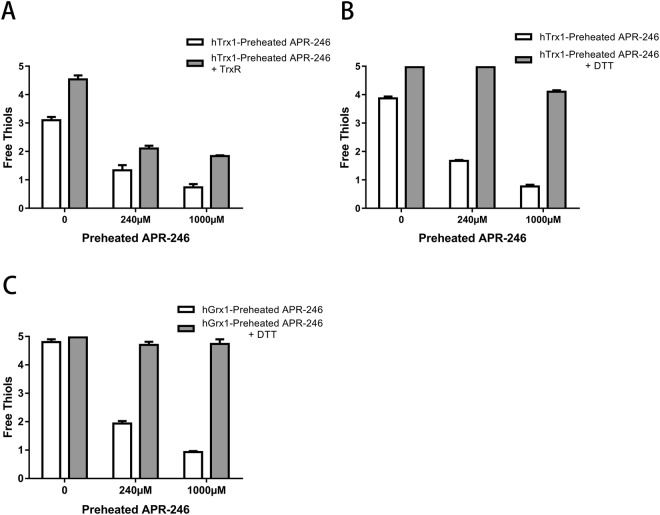
“Grx1 had five thiols, demonstrating that it is in a fully reduced form (Fig. 3A).”
§ Inhibition of the glutaredoxin and thioredoxin systems and ribonucleotide reductase by mutant p53-targeting compound APR-246 > Results > Inhibition of Trx1 and Grx1 by preheated APR-246 is thiol-dependent and reversible
“(C) Inhibition of 20 µM Grx1 is significantly reversed upon incubation with 10 mM DTT.”
Rated minor: it would not touch a result — a value no result rests on, a p-value that stays on the same side of the significance level, or a conflict that is clerical, resolved elsewhere in the paper, or outside its own findings.
In the paper
§ Inhibition of the glutaredoxin and thioredoxin systems and ribonucleotide reductase by mutant p53-targeting compound APR-246 > Results > Direct reaction of preheated APR-246 with Trx1 and Grx1
“We used MQ 0.5 mM in order to override the reductant DTT in the protein preparation.”
§ Inhibition of the glutaredoxin and thioredoxin systems and ribonucleotide reductase by mutant p53-targeting compound APR-246 > Materials and Methods > Mass spectrometry analysis
“Pre-reduced recombinant hTrx1 and hGrx1 (50 µM) were incubated with 0.1 and 0.5 mM MQ, respectively, for one hour at 37 °C.”
Rated minor: it would not touch a result — a value no result rests on, a p-value that stays on the same side of the significance level, or a conflict that is clerical, resolved elsewhere in the paper, or outside its own findings.
In the paper
§ Inhibition of the glutaredoxin and thioredoxin systems and ribonucleotide reductase by mutant p53-targeting compound APR-246 > Materials and Methods > Assay for ribonucleotide reductase activity in cultured cells
“Assays were performed according to the method described by Lepoiver et al. [47] with some modifications using [3H]CDP as a substrate, ATP as effector and DTT as a reductant.”
§ Inhibition of the glutaredoxin and thioredoxin systems and ribonucleotide reductase by mutant p53-targeting compound APR-246 > References
“47. Harris IS Glutathione and thioredoxin antioxidant pathways synergize to drive cancer initiation and progression Cancer cell 2015 27 211 222 10.1016/j.ccell.2014.11.019 25620030”
Citations
Cites
Ellman, G. L. (1959) · Archives of Biochemistry and Biophysics · doi:10.1016/0003-9861(59)90090-6 · Cited by 26,311
Mutational landscape and significance across 12 major cancer types
Kandoth, C., McLellan, M. D., Vandin, F., Ye, K., Niu, B., Lu, C., Xie, M., Zhang, Q., McMichael, J. F., Wyczalkowski, M. A., et al. (2013) · Nature · doi:10.1038/nature12634 · Cited by 4,419
Modulation of oxidative stress as an anticancer strategy
Gorrini, C., Harris, I. S., & Mak, T. W. (2013) · Nature Reviews Drug Discovery · doi:10.1038/nrd4002 · Cited by 3,579
A model for p53-induced apoptosis
Polyak, K., Xia, Y., Zweier, J. L., Kinzler, K. W., & Vogelstein, B. (1997) · Nature · doi:10.1038/38525 · Cited by 2,500
Mammalian thioredoxin is a direct inhibitor of apoptosis signal‐regulating kinase (ASK) 1
Saitoh, M., Nishitoh, H., Fujii, M., Takeda, K., Tobiume, K., Sawada, Y., Kawabata, M., Miyazono, K., & Ichijo, H. (1998) · The EMBO Journal · doi:10.1093/emboj/17.9.2596 · Cited by 2,377
The thioredoxin antioxidant system
Lu, J., & Holmgren, A. (2014) · Free Radical Biology and Medicine · doi:10.1016/j.freeradbiomed.2013.07.036 · Cited by 2,055
Self-citationKastenhuber, E. R., & Lowe, S. W. (2017) · Cell · doi:10.1016/j.cell.2017.08.028 · Cited by 1,906
Thioredoxin and Glutaredoxin Systems
Holmgren, A. (1989) · Journal of Biological Chemistry · doi:10.1016/s0021-9258(18)71625-6 · Cited by 1,796
Self-citationRestoration of the tumor suppressor function to mutant p53 by a low-molecular-weight compound
Bykov, V. J. N., Issaeva, N., Shilov, A., Hultcrantz, M., Pugacheva, E., Chumakov, P., Bergman, J., Wiman, K. G., & Selivanova, G. (2002) · Nature Medicine · doi:10.1038/nm0302-282 · Cited by 1,067
Self-citationHarris, I. S., Treloar, A. E., Inoue, S., Sasaki, M., Gorrini, C., Lee, K. C., Yung, K. Y., Brenner, D., Knobbe-Thomsen, C. B., Cox, M. A., et al. (2015) · Cancer Cell · doi:10.1016/j.ccell.2014.11.019 · Cited by 993
Cited by
Targeting p53 pathways: mechanisms, structures, and advances in therapy
Wang, H., Guo, M., Wei, H., & Chen, Y. (2023) · Signal Transduction and Targeted Therapy · doi:10.1038/s41392-023-01347-1 · Cited by 1,016
“…of pathways independent of p53, 401 – 404 such as downregulating glutathione concentrations in tumor cells, 405,406 regulating oxidation-reduction homeostasis 407 – 409 in tumor cells to trigger ferroptosis, 410 – 412 and inducing endoplasmic reticulum stress 413 or unfolded protein responses.”
BackgroundTargeting p53 for the treatment of cancer
Duffy, M. J., Synnott, N. C., O’Grady, S., & Crown, J. (2022) · Seminars in Cancer Biology · doi:10.1016/j.semcancer.2020.07.005 · Cited by 349
Macrophage Polarization and Reprogramming in Acute Inflammation: A Redox Perspective
Pérez, S., & Rius-Pérez, S. (2022) · Antioxidants · doi:10.3390/antiox11071394 · Cited by 312
“Therefore, if we bear in mind that the GRX1 levels in the M1-type macrophages were high [173], the use of different specific inhibitors of GRX1, such as CWR-J02 or APR-246/MQ, to modulate the macrophage polarization process during inflammation would appear to be a promising therapeutic strategy [171,174].”
BackgroundRecent advances in targeted therapies in acute myeloid leukemia
Bhansali, R. S., Pratz, K. W., & Lai, C. (2023) · Journal of Hematology & Oncology · doi:10.1186/s13045-023-01424-6 · Cited by 275
“Recent reports have demonstrated that MQ can drive p53-independent cell death through ROS accumulation [156, 157]”
BackgroundReactive oxygen species: Role in carcinogenesis, cancer cell signaling and tumor progression
Sarmiento-Salinas, F. L., Perez-Gonzalez, A., Acosta-Casique, A., Ix-Ballote, A., Diaz, A., Treviño, S., Rosas-Murrieta, N. H., Millán-Perez-Peña, L., & Maycotte, P. (2021) · Life Sciences · doi:10.1016/j.lfs.2021.119942 · Cited by 197
Glutaredoxin: Discovery, redox defense and much more
Ogata, F. T., Branco, V., Vale, F. F., & Coppo, L. (2021) · Redox Biology · doi:10.1016/j.redox.2021.101975 · Cited by 186
“the small molecule APR-246 (PRIMA-1Met) [184].”
Self-citationThioredoxin Reductase Inhibition for Cancer Therapy
Gencheva, R., & Arnér, E. S. J. (2022) · Annual Review of Pharmacology and Toxicology · doi:10.1146/annurev-pharmtox-052220-102509 · Cited by 173
p53 as a hub in cellular redox regulation and therapeutic target in cancer
Eriksson, S. E., Ceder, S., Bykov, V. J. N., & Wiman, K. G. (2019) · Journal of Molecular Cell Biology · doi:10.1093/jmcb/mjz005 · Cited by 123
“The ability of APR-246, via MQ, to bind and deplete GSH (Tessoulin et al., 2014; Mohell et al., 2015) and inhibit Grx and Trx (Haffo et al., 2018) will have the same effect on the redox balance, and is consistent with the identification of SLC7A11 as marker for decreased sensitivity to APR-246 (Liu et al., 2017a).”
BackgroundResultSelf-citationFujihara, K. M., Zhang, B. Z., Jackson, T. D., Ogunkola, M. O., Nijagal, B., Milne, J. V., Sallman, D. A., Ang, C.-S., Nikolic, I., Kearney, C. J., et al. (2022) · Science Advances · doi:10.1126/sciadv.abm9427 · Cited by 102
“As a result, the anticancer effects of eprenetapopt have been linked to GSH depletion and inhibition of the thioredoxin antioxidant system ( 7 – 9 ).”
Pharmacological reactivation of p53 in the era of precision anticancer medicine
Tuval, A., Strandgren, C., Heldin, A., Palomar-Siles, M., & Wiman, K. G. (2024) · Nature Reviews Clinical Oncology · doi:10.1038/s41571-023-00842-2 · Cited by 93
Self-citationDrugging “undruggable” genes for cancer treatment: Are we making progress?
Duffy, M. J., & Crown, J. P. (2020) · International Journal of Cancer · doi:10.1002/ijc.33197 · Cited by 94
Degtjarik, O., Golovenko, D., Diskin-Posner, Y., Abrahmsén, L., Rozenberg, H., & Shakked, Z. (2021) · Nature Communications · doi:10.1038/s41467-021-27142-6 · Cited by 78
An Update on Glutathione's Biosynthesis, Metabolism, Functions, and Medicinal Purposes
Gasmi, A., Nasreen, A., Lenchyk, L. V., Lysiuk, R., Peana, M., Shapovalova, N., Piscopo, S., Komisarenko, M. A., Shanaida, M., Smetanina, K., et al. (2023) · Current Medicinal Chemistry · doi:10.2174/0109298673251025230919105818 · Cited by 94
Exploring the Thioredoxin System as a Therapeutic Target in Cancer: Mechanisms and Implications
Seitz, R., Tümen, D., Kunst, C., Heumann, P., Schmid, S. A., Kandulski, A., Müller, M., & Gülow, K. (2024) · Antioxidants · doi:10.3390/antiox13091078 · Cited by 85
“Eprenetapopt (APR-246, PRIMA-1Met), a small molecule originally developed to restore the activity of mutated, inactive p53, also inhibits Trx1 and Grx1 [154].”
BackgroundThe Yin-Yang Regulation of Reactive Oxygen Species and MicroRNAs in Cancer
Babu, K. R., & Tay, Y. (2019) · International Journal of Molecular Sciences · doi:10.3390/ijms20215335 · Cited by 69
Thioredoxin Signaling Pathways in Cancer
Zhang, J., Li, X., Zhao, Z., Cai, W., & Fang, J. (2023) · Antioxidants and Redox Signaling · doi:10.1089/ars.2022.0074 · Cited by 73
Therapeutic targeting of mutant p53 in pediatric acute lymphoblastic leukemia
Demir, S., Boldrin, E., Sun, Q., Hampp, S., Tausch, E., Eckert, C., Ebinger, M., Handgretinger, R., Kronnie, G. T., Wiesmüller, L., et al. (2020) · Haematologica · doi:10.3324/haematol.2018.199364 · Cited by 55
“APR-246 was reported to interfere with different regulators of the cellular redox system, such as thioredoxin reductase, thioredoxin and glutathione, and with the transcription factor NRF2, leading to induction of reactive oxygen species (ROS).(28,30-33,44-47) Given the activity of APR-246 in TP53mut ALL, we addressed…”
BackgroundSLC7A11 Is a Superior Determinant of APR-246 (Eprenetapopt) Response than TP53 Mutation Status
Fujihara, K. M., Corrales Benitez, M., Cabalag, C. S., Zhang, B. Z., Ko, H. S., Liu, D. S., Simpson, K. J., Haupt, Y., Lipton, L., Haupt, S., et al. (2021) · Molecular Cancer Therapeutics · doi:10.1158/1535-7163.mct-21-0067 · Cited by 48
“5 Haffo, L. et al. Inhibition of the glutaredoxin and thioredoxin systems and ribonucleotide reductase by mutant p53-targeting compound APR-246. Sci Rep 8, 12671, doi:10.1038/s41598-018-31048-7 (2018). preprint (which was not certified by peer review) is the author/funder.”
BackgroundInfluentialTargeting Mutant p53 for Cancer Treatment: Moving Closer to Clinical Use?
Duffy, M. J., Tang, M., Rajaram, S., O’Grady, S., & Crown, J. P. (2022) · Cancers · doi:10.3390/cancers14184499 · Cited by 55
p53 and Zinc: A Malleable Relationship
Ha, J., Prela, O., Carpizo, D. R., & Loh, S. N. (2022) · Frontiers in Molecular Biosciences · doi:10.3389/fmolb.2022.895887 · Cited by 54
Wang, Z., Hu, H., Heitink, L., Rogers, K., You, Y., Tan, T., Suen, C. L. W., Garnham, A., Chen, H., Lieschke, E., et al. (2023) · Cell Death & Differentiation · doi:10.1038/s41418-023-01122-3 · Cited by 46
“This is likely to impact a broad range of cellular processes, as for example shown for redox homeostasis in cancer cells through inhibition of thioredoxin reductase, thioredoxin, glutaredoxin, ribonucleotide reductase and depletion of glutathione [13 – 16].”
Gencheva, R., Cheng, Q., & Arnér, E. S. J. (2022) · Free Radical Biology and Medicine · doi:10.1016/j.freeradbiomed.2022.07.020 · Cited by 54
A thiol-bound drug reservoir enhances APR-246-induced mutant p53 tumor cell death
Ceder, S., Eriksson, S. E., Cheteh, E. H., Dawar, S., Corrales Benitez, M., Bykov, V. J. N., Fujihara, K. M., Grandin, M., Li, X., Ramm, S., et al. (2021) · EMBO Molecular Medicine · doi:10.15252/emmm.201910852 · Cited by 41
“…shown that APR-246 (through MQ) exhibits pro-oxidant activities through depletion of glutathione (GSH) and inhibition of the GSH and thioredoxin (TXN) antioxidant systems (Peng et al, 2013; Tessoulin et al, 2014; Mohell et al, 2015; Haffo et al, 2018; Hang et al, 2018; Mlakar et al, 2019).”
BackgroundInfluentialSelf-citationS-Denitrosylation: A Crosstalk between Glutathione and Redoxin Systems
Chakraborty, S., Sircar, E., Bhattacharyya, C., Choudhuri, A., Mishra, A., Dutta, S., Bhatta, S., Sachin, K., & Sengupta, R. (2022) · Antioxidants · doi:10.3390/antiox11101921 · Cited by 42
Follow the Mutations: Toward Class-Specific, Small-Molecule Reactivation of p53
Loh, S. N. (2020) · Biomolecules · doi:10.3390/biom10020303 · Cited by 30
“By alkylating cellular thiol groups, the methylene quinuclidinone (MQ) decomposition product of APR-246 depletes cellular glutathione [77,78], inhibits thioredoxin and glutaredoxin systems [79,80], and inhibits ribonucleotide reductase [80], leading to oxidative stress and cancer cell death through these p53-independe…”
BackgroundMagri, J., Gasparetto, A., Conti, L., Calautti, E., Cossu, C., Ruiu, R., Barutello, G., & Cavallo, F. (2021) · Cells · doi:10.3390/cells10010108 · Cited by 34
Targeting TP53-Mutated Acute Myeloid Leukemia: Research and Clinical Developments
Granowicz, E. M., & Jonas, B. A. (2022) · OncoTargets and Therapy · doi:10.2147/ott.s265637 · Cited by 35
“Increasing oxidative stress through depletion of glutathione and induction of ferroptosis also contributes to eprenetapopt’s mechanism of action.(90,91) Two phase 1b/2 studies have been conducted evaluating the combination of eprenetapopt with AZA, which was shown to have synergistic cytotoxicity in TP53-mutated AML c…”
BackgroundThe Development of p53-Targeted Therapies for Human Cancers
Lu, Y., Wu, M. Y., Xu, Y., & Yu, L. (2023) · Cancers · doi:10.3390/cancers15143560 · Cited by 32
“APR-246/MQ inhibits oxidoreductase enzyme thioredoxin reductase 1 (TrxR1), thioredoxin, and glutaredoxin, leading to oxidative stress [52,53].”
BackgroundReactive Oxygen Species in Acute Lymphoblastic Leukaemia: Reducing Radicals to Refine Responses
Mannan, A., Germon, Z. P., Chamberlain, J., Sillar, J. R., Nixon, B., & Dun, M. D. (2021) · Antioxidants · doi:10.3390/antiox10101616 · Cited by 31
“APR-246 (Phase I clinical trials) Redox enzymes ↑ ROS by inhibiting TRX1 and glutaredoxin [241]”
Auberger, P., Favreau, C., Savy, C., Jacquel, A., & Robert, G. (2024) · Cellular & Molecular Biology Letters · doi:10.1186/s11658-024-00613-6 · Cited by 31
“Of note, besides p53 the ability of APR-246 to induce cell death has also been ascribed to the inhibition of TXNRD1 [57, 58].”
BackgroundChemistry and biology of enzymes in protein glutathionylation
Oppong, D., Schiff, W., Shivamadhu, M. C., & Ahn, Y. (2023) · Current Opinion in Chemical Biology · doi:10.1016/j.cbpa.2023.102326 · Cited by 24
Redox Sensitive Cysteine Residues as Crucial Regulators of Wild-Type and Mutant p53 Isoforms
Butturini, E., Butera, G., Pacchiana, R., de Prati, A. C., Mariotto, S., & Donadelli, M. (2021) · Cells · doi:10.3390/cells10113149 · Cited by 28
Joardar, N., & Babu, S. P. S. (2019) · International Journal of Biological Macromolecules · doi:10.1016/j.ijbiomac.2019.09.083 · Cited by 23
Personalized Medicine for TP53 Mutated Myelodysplastic Syndromes and Acute Myeloid Leukemia
Cluzeau, T., Loschi, M. L., Fenaux, P., Komrokji, R. S., & Sallman, D. A. (2021) · International Journal of Molecular Sciences · doi:10.3390/ijms221810105 · Cited by 20
Ceder, S., Eriksson, S. E., Liang, Y. Y., Cheteh, E. H., Zhang, S. M., Fujihara, K. M., Bianchi, J., Bykov, V. J. N., Abrahmsen, L., Clemons, N. J., et al. (2021) · Cell Death & Disease · doi:10.1038/s41419-021-03988-y · Cited by 18
“Taken together, these data suggest that the thermal stabilization may be derived from MQ binding to this active site cysteine in ASNS, and if so, it is conceivable that MQ inhibits enzyme activity as demonstrated for TrxR1 [9] and other redox enzymes [10].”
BackgroundSelf-citationAbrams, S. L., Duda, P., Akula, S. M., Steelman, L. S., Follo, M. L., Cocco, L., Ratti, S., Martelli, A. M., Montalto, G., Emma, M. R., et al. (2022) · Cells · doi:10.3390/cells11050794 · Cited by 17
“ROS could have multiple effects on the cells and alter the structure of the mutant TP53 protein, which allows the mutant protein to have some of the growth-regulatory effects present in WT TP53 [21,22].”
BackgroundBunik, V. I., Aleshin, V. A., Zhou, X., Tabakov, V. Y., & Karlsson, A. (2020) · International Journal of Molecular Sciences · doi:10.3390/ijms21113759 · Cited by 17
“Overexpression of glutaredoxin and thioredoxin in cancer cells [69] may further perturb the mechanisms limiting production of ROS by OGDHC in normal cells.”
BackgroundFregni, M., Ciribilli, Y., & Zawacka‐Pankau, J. (2022) · International Journal of Molecular Sciences · doi:10.3390/ijms23137213 · Cited by 18
Pharmacological Targeting of Ferroptosis in Cancer Treatment
Roushandeh, A. M., Roudkenar, M. H., Valashedi, M. R., Nikoo, A., Najafi-Ghalehlou, N., Tomita, K., Kuwahara, Y., & Sato, T. (2021) · Current Cancer Drug Targets · doi:10.2174/1568009621666211202091523 · Cited by 18
de la Rosa, J., Urdiciain, A., Zelaya, M. V., Zazpe, I., Meléndez, B., REY, J. A., Idoate, M. A., & Castresana, J. S. (2021) · International Journal of Oncology · doi:10.3892/ijo.2021.5177 · Cited by 16
PTC596-Induced BMI-1 Inhibition Fights Neuroblastoma Multidrug Resistance by Inducing Ferroptosis
Valenti, G. E., Roveri, A., Venerando, R., Menichini, P., Monti, P., Tasso, B., Traverso, N., Domenicotti, C., & Marengo, B. (2023) · Antioxidants · doi:10.3390/antiox13010003 · Cited by 17
How I Treat TP53-Mutated Acute Myeloid Leukemia and Myelodysplastic Syndromes
Loschi, M. L., Fenaux, P., & Cluzeau, T. (2022) · Cancers · doi:10.3390/cancers14184519 · Cited by 17
Klett, T., Stahlecker, J., Jaag, S., Masberg, B., Knappe, C., Lämmerhofer, M., Coles, M. P., Stehle, T., & Boeckler, F. M. (2024) · ACS Pharmacology & Translational Science · doi:10.1021/acsptsci.4c00414 · Cited by 15
McCubrey, J. A., Abrams, S. L., Steelman, L. S., Cocco, L., Ratti, S., Martelli, A. M., Lombardi, P., Gizak, A., & Duda, P. (2022) · Biomolecules · doi:10.3390/biom12020276 · Cited by 10
“Part of the effects of APR-246 may be through the generation of reactive oxygen species (ROS), which could alter the structure of the mutant TP53 protein [38,46], but APR-246 can also bind the critical cysteine residues in the core binding domain of mutant TP53 protein and change its conformation [47].”
BackgroundLin, Y., Ku, C., Wuputra, K., Wu, D., & Yokoyama, K. K. (2024) · Cells · doi:10.3390/cells13191648 · Cited by 11
“The APR-246 mutant inhibited thioredoxin reductase 1 (TrxR1) [170], thioredoxin (Trx), glutaredoxin, and ribonucleotide reductase [171] and depleted cellular GSH [172,173].”
BackgroundMilne, J. V., Zhang, B. Z., Fujihara, K. M., Dawar, S., Phillips, W. A., & Clemons, N. J. (2021) · Scientific Reports · doi:10.1038/s41598-021-83979-3 · Cited by 6
Barutello, G., Lorenzo, A. D., Gasparetto, A., Galiazzi, C., Bolli, E., Conti, L., & Cavallo, F. (2022) · Biomedicines · doi:10.3390/biomedicines10112843 · Cited by 6
“However, the antitumor activity of APR-246 seems to lean also on the perturbation of the antioxidant pathways due to GSH targeting and depletion [25,26], which triggers ferroptosis [23].”
BackgroundKoh, W. X., Coppo, L., Ganguly, R., Holmgren, A., & Leong, W. K. (2021) · Journal of Organometallic Chemistry · doi:10.1016/j.jorganchem.2021.121822 · Cited by 6
Self-citationBrahme, A. (2022) · Radiation Research · doi:10.1667/rade-22-00011.1 · Cited by 6
Antonelli, A., Scarpa, E. S., Bruzzone, S., Astigiano, C., Piacente, F., Bruschi, M., Fraternale, A., Buduo, C. A. D., Balduini, A., & Magnani, M. (2023) · International Journal of Molecular Sciences · doi:10.3390/ijms24065157 · Cited by 5
“Regeneration of the ribonucleotide reductase is accomplished either by GSH-dependent glutaredoxin (Grx) or thioredoxin (Trx), which have been recognized as the primary electron donors to reduce RR [52].”
BackgroundZeng, H.-H., Yang, Z. R., Qiu, Y., Bashir, S., Li, Y., & Xu, M. Q. (2022) · World Journal of Clinical Cases · doi:10.12998/wjcc.v10.i15.4761 · Cited by 6
Thioredoxin and glutathione reductases
Arnér, E. S. J. (2022) · Elsevier eBooks · doi:10.1016/b978-0-323-90219-9.00009-1 · Cited by 7
Alshehri, S., Nadeem, A., Ahmad, S. F., Alqarni, S. S., Al-Harbi, N. O., AL-Ayadhi, L. Y., Attia, S. M., Alqarni, S. A., & Bakheet, S. A. (2023) · Metabolites · doi:10.3390/metabo13020286 · Cited by 6
“Therefore, Trx1/TrxR1 expression/activity may be required for proliferative and antiapoptotic effects of immune cells, such as T cells [7,13].”
BackgroundAPR-246 increases tumor antigenicity independent of p53
Michels, J., Venkatesh, D., Liu, C., Budhu, S., Zhong, H., George, M. M., Thach, D., Yao, Z., Ouerfelli, O., Liu, H., et al. (2023) · Life Science Alliance · doi:10.26508/lsa.202301999 · Cited by 9
“…manner by interfering with antioxidant pathways through the formation of protein adducts pursuant to modi fi cation of cysteines and selenocysteines of glutathione and thioredoxin reductase, respectively (Peng et al, 2013; Mohell et al, 2015; Liu et al, 2017; Haffo et al, 2018; Milne et al, 2021).”
BackgroundCrosstalk of thioredoxin system and programmed cell death: from pathophysiology to novel therapy
Wu, Y., Su, Y., Pan, F., Jin, F., Huang, H., Deng, A., Lu, Y., Lu, Y., Li, T., Du, J., et al. (2026) · Redox Biology · doi:10.1016/j.redox.2026.104209 · Cited by 4
“A notable example is eprenetapopt (APR-246), developed as a p53 reactivator, which also inhibits Trx-1 and Grx1, though the therapeutic significance of this activity remains under investigation [307,308].”
Pharmacological Targeting of Ferroptosis in Cancer Treatment
Khan, M. A., Satapathy, T., Sen, K., Sahu, S., Pradhan, B., Gupta, A., Satapathy, A., & Satapathy, A. (2024) · Journal of Drug Delivery and Therapeutics · doi:10.22270/jddt.v14i2.6371 · Cited by 3
“144 145-146 It might therefore be a good fit for ferroptosis induction.”
BackgroundCohen, Z., Petrenko, E., Barisaac, A. S., Abu‐Zhayia, E. R., Yanovich-Ben-Uriel, C., Ayoub, N., & Aran, D. (2025) · NAR Genomics and Bioinformatics · doi:10.1093/nargab/lqaf052 · Cited by 3
“Studies demonstrate that simultaneously disabling glutathione and thioredoxin antioxidant pathways is lethal to cancer cells, making these compelling targets for p53-mutant tumors [ 10 ].”
The combined inhibition of SLC1A3 and glutaminase in osimertinib-resistant EGFR mutant cells
Ochi, N., Miyake, N., Takeyama, M., Yamane, H., Fukazawa, T., Nagasaki, Y., Kawahara, T., Ichiyama, N., Kosaka, Y., Mimura, A., et al. (2024) · Biochimica et Biophysica Acta (BBA) - General Subjects · doi:10.1016/j.bbagen.2024.130675 · Cited by 4
Mitochondrial sirtuins at the crossroads of energy metabolism and oncogenic transformation
Grabacka, M., & Plonka, P. M. (2021) · Elsevier eBooks · doi:10.1016/b978-0-12-822467-0.00001-2 · Cited by 3
Harnessing the ROS for Cancer Treatment
Osama, A., Zhang, J., & Fang, J. (2023) · Springer eBooks · doi:10.1007/978-3-030-80962-1_255-1 · Cited by 2
Small-Molecule Drugs in Pediatric Neuro-Oncology
Vairy, S., & Michaiel, G. (2025) · Current Oncology · doi:10.3390/curroncol32080417 · Cited by 2
“This MQ can influence a very large number of proteins, including several enzymes, and could therefore probably act more on a wider scale [82,83].”
Eprenetapopt in combination with Palbociclib exerts synthetic lethality in mantle cell lymphoma
Dong, L., Zhang, Y., Chen, F., Jiang, W., Qian, S., Song, W., Yang, S., Wu, X., Li, Z., & Zhang, M. (2026) · Translational Oncology · doi:10.1016/j.tranon.2026.102794 · Cited by 1
“Additional studies also found that APR-246 can triggers p53-independent cell death mechanisms, such as inducing oxidative stress by depleting glutathione (GSH) or increasing intracellular ROS [13 – 16] and enhancing tumor immunogenicity [17].”
Identifying potential regulatory interactions of peroxiredoxin PRXQ
Jason, K. (2020) · Archive of biochemistry. · doi:10.17352/ab.000003
“Trx and Grx were selected for their well-studied mechanism in redox catalysis and molecular signaling in many organisms, as well as for their potential health signifi cance [11-14].”
BackgroundTargeting thioredoxin reductase with organometallics
Koh, W. X. (2021) · DR-NTU (Nanyang Technological University) · doi:10.32657/10356/152387
Alhammer, A. H., Mudhafar, S. A., & Abdulfattah, S. Y. (2025) · European Journal of Pharmacology · doi:10.1016/j.ejphar.2025.178195 · Cited by 1
Zhang, C., Cao, S., Zeng, G., Dong, Y., Li, H., Ma, X., Zhang, X., Li, Z., & Huang, Y. (2026) · Scientific Reports · doi:10.1038/s41598-026-44653-8
“…aligns with prevailing views of the mechanism of action of APR-246 (eprenetapopt): its activity extends beyond restoring wild-type p53 function and includes induction of oxidative stress through disruption of thiol metabolism and redox balance, thereby engaging programmed cell death 18,35–37 .”
Research Progress on Targeted Therapeutic Strategies for Mutant p53 in Cancer
罗, 开. (2026) · World Journal of Cancer Research · doi:10.12677/wjcr.2026.162010
Etude de la ferroptose dans les leucémies aiguës myéloïdes : nouvelles stratégies thérapeutiques
Birsen, R. (2020) · theses.fr (ABES) · doi:10.70675/45ca3261z22a8z4237z8076zf98342173232
The p53/Mdm2 Pathway in Hepatocellular Carcinoma: From Molecular Pathogenesis to Targeted Therapies
Kirkness, K., & Mann, D. A. (2026) · Livers · doi:10.3390/livers6030039
“However, PRIMA-1 and its derivative APR-246, are not entirely specific for mutant p53, and can form covalent adducts with cysteine residues in other proteins including thioredoxin reductase and glutathione, which are abundant in liver tissue [172,173].”
Zhao, T., Moriwaki, T., Yan, L., Wang, W., & Zhang-Akiyama, Q.-M. (2026) · Journal of Radiation Research · doi:10.1093/jrr/rrag061
Phytochemistry and functional potential of Alpinia: Bridging food use, and therapeutic insight
Sarkar, S., & Pariyar, G. C. (2026) · Biochimie · doi:10.1016/j.biochi.2026.08.007
Metadata
- Authors
- Haffo, L., Lu, J., Bykov, V. J. N., Martin, S. S., Ren, X., Coppo, L., Wiman, K. G., & Holmgren, A.
- Affiliations
- Karolinska Institutet (SE)
- Southwest University (CN)
- Corresponding author
- Wiman, Klas G.
- Holmgren, Arne
- ORCID
- Venue
- Scientific Reports
- Published
- 2018-08-23
- Volume
- 8
- Issue
- 1
- Pages
- 12671-12671
- ISSN
- 2045-2322 (ISSN-L)
- PMC
- PMC6107631
- OpenAlex
- W2887430569
- Cited by
- 73
- References
- 51
- Citations by year
- 2026: 7 · 2025: 5 · 2024: 6 · 2023: 12 · 2022: 16 · 2021: 16 · 2020: 7 · 2019: 4
- FWCI
- 2.40
- Type
- journal article
- Language
- en
- Open access
- gold
- doi.org
- Licence
- cc-by
- creativecommons.org/licenses/by/4.0 (tdm)
- creativecommons.org/licenses/by/4.0 (vor)
- Locations
- Scientific Reports (publishedVersion, cc-by)
- Europe PMC (PubMed Central) (publishedVersion, other-oa)
- PubMed Central (publishedVersion, cc-by)
- PubMed (publishedVersion)
- DOAJ (DOAJ: Directory of Open Access Journals) (submittedVersion, cc-by-sa)
- Funders
- Cancerfonden
- Karolinska Institutet
- Vetenskapsrådet
- Radiumhemmets Forskningsfonder
- Topics
- Life Sciences › Biochemistry, Genetics and Molecular Biology › Molecular Biology › Redox biology and oxidative stress
- Health Sciences › Medicine › Oncology › Cancer-related Molecular Pathways
- Life Sciences › Pharmacology, Toxicology and Pharmaceutics › Toxicology › Bioactive Compounds and Antitumor Agents
- Keywords
- APR-246, mutant p53, thioredoxin, glutaredoxin, ribonucleotide reductase, redox homeostasis, glutathione, peroxiredoxin, apoptosis, reactive oxygen species, DNA replication, cancer therapy, Saos-2 cells
- MeSH terms
- Antioxidants, DNA Repair, Humans, Mitochondria, Oxidation-Reduction, Quinuclidines, Ribonucleotide Reductases, Mass Spectrometry, Sulfhydryl Compounds, Thioredoxins, Blotting, Western, Reactive Oxygen Species, Cell Line, Tumor, Glutaredoxins
About these checks
Registry, retraction, Cites and statistics results are computed, not judged, with one exception: a printed reference that no index lists is read once by a model before it counts as a citation error. Claims are extracted by a model and kept only when their quote appears verbatim in the text; each cited source is then checked, with a model’s help, for whether it says what the claim relies on. Those verdicts can be wrong — read the claim’s quote and the cited source before relying on one.
The claim verdicts this report counts are experimental: their accuracy is not yet measured.
A language model drew the claims from the paper on 2026-10-10, under version 3 of the claim definition (model deepseek-v4.1-flash, prompt extract-v3).
A second model labelled each claim on 2026-10-10 (model jev-1.13-20260917, definition revision gold-guideline-v0.2).
Cited sources are checked with a language model’s help (gpt-6-sol).
Statistics and arithmetic are recomputed, not judged.
Confidence bands are shown only for fields calibrated on our annotated test set. None is calibrated yet, so no band is shown.
What counts as a claim ›How we measure confidence ›How we check this ›
Are you an author, or do you see a problem with this page? Request a review
Data sources
Bibliographic data: Semantic Scholar, OpenAlex, Crossref.
Contains information from the Semantic Scholar Academic Graph Datasets, made available under the ODC Attribution License (ODC-BY 1.0).
Semantic Scholar’s data is described in: Kinney, R., et al. (2023). The Semantic Scholar Open Data Platform. arXiv:2301.10140.
