Cited by 116Gut microbiota and healthTryptophan and brain disordersGastrointestinal motility and disorders

The DOI matches its Crossref record; 56 of the 56 references it cites were found in a registry or an index.

Immobilization stress-induced Escherichia coli causes anxiety by inducing NF-κB activation through gut microbiota disturbance

Open access
Jang, Hyo-Min, Lee, Kyung-Eon, Lee, Hae-Ji, Kim, Dong-Hyun·2018·Scientific Reports

Abstract

The present study aimed to understand the crosstalk between anxiety and gut microbiota. Exposure of mice to immobilization stress (IS) led to anxiety-like behaviors, increased corticosterone and tumor necrosis factor-α levels in the blood, increased nuclear factor (NF)-κB activation and microglia/monocyte populations in the hippocampus, and suppressed brain-derived neurotrophic factor (BDNF) expression in the hippocampus. Furthermore, IS exposure increased NF-κB activation and monocyte population in the colon and increased Proteobacteria and Escherichia coli populations in the gut microbiota and fecal and blood lipopolysaccharide (LPS) levels while decreasing the lactobacilli population. Oral administration of the fecal microbiota of mice treated with IS (FIS) or E. coli led to the increased NF-κB activation and monocyte population in the colon. These treatments increased blood corticosterone and LPS levels and anxiety-like behaviors, decreased BDNF expression, and induced NF-κB activation and microglia/monocyte populations in the hippocampus. Intraperitoneal injection of LPS purified from E. coli also led to anxiety and colitis in mice. Oral administration of commensal lactobacilli, particularly Lactobacillus johnsonii, attenuated IS- or E. coli-induced colitis and anxiety-like behaviors and biomarkers. These findings suggest that exposure to stressors can increase Proteobacteria populations and fecal LPS levels and cause gastrointestinal inflammation, resulting in the deterioration of anxiety through NF-κB activation. However, the amelioration of gastrointestinal inflammation by treatment with probiotics including L. johnsonii can alleviate anxiety.

Overview

The claims and statistics of this paper haven’t been checked yet.

Run the check — free, no account needed. It reads the open-access text and checks the sources it cites.

A few free checks a day · papers already verified open instantly · results are public

Integrity signals

Registry

Crossref · 10.1038/s41598-018-31764-0

Cites

56 of 56 references verified0 citation errors · 0 not checkable

Statistics

Figures

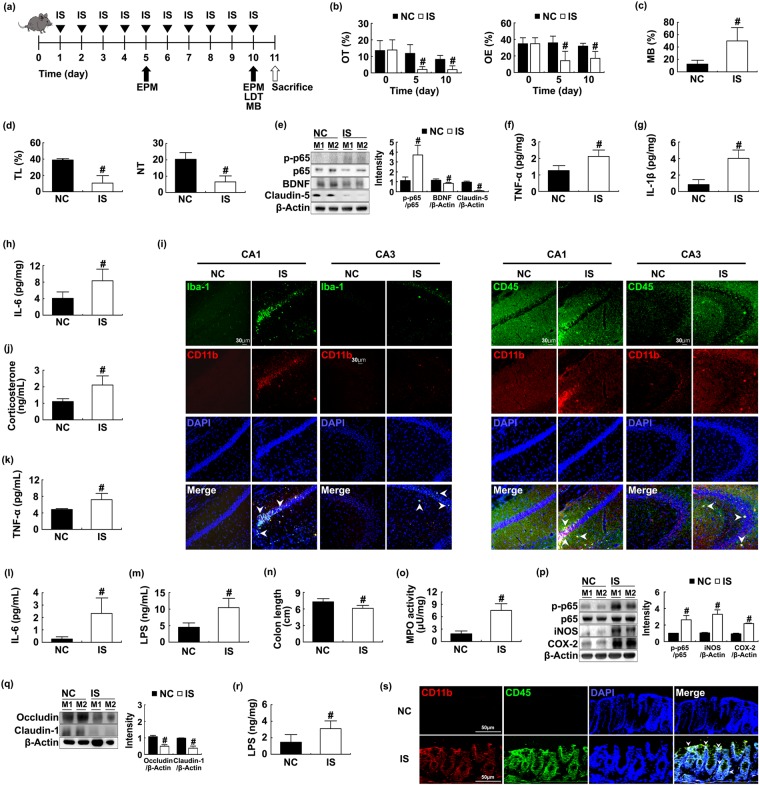
Figure 1 Immobilization stress (IS) induced anxiety-like behaviors and colitis in mice. Experimental time (a). Anxiety-like behaviors of mice were measured in the EPM (b) (time spent in open arms [OT] and open arm entries [OE]), MB (marble buried, c) and LDT (d, time spent in light area [TL] and number of transitions [NT]). Control mice (NC) were not treated with IS. NF-κB (p-p65 and p65), BDNF, claudin-5, and β-actin were measured in the hippocampus by immunoblotting (e). Brain TNF-α (f) IL-1β (g) and IL-6 levels (h) were analyzed by ELISA kit. Iba-1+/CD11b+ and CD11b+/CD11b+ populations were assayed in CA1 and CA3 regions of the hippocampus by a confocal microscope (i). Blood corticosterone (j) TNF-α (k), IL-6 (l) and LPS levels (m) were analyzed by ELISA or LAL kit. Colitis markers colon length (n) and myeloperoxidase (MPO) activity (o) were measured in the colon. Colonic iNOS and COX-2 expression, NF-κB activation (p) and tight junction proteins (occludin and claudin-1), and β-actin (q) were analyzed by immunoblotting. Fecal LPS level (r) and CD11b+/CD11b+ population (s) were analyzed by ELISA kit and confocal microscope (i) respectively. All data except immunoblotting data (n = 4) were expressed as mean ± SD (n = 8). #p < 0.05 vs. NC group.
Figure 1 Immobilization stress (IS) induced anxiety-like behaviors and colitis in mice. Experimental time (a). Anxiety-like behaviors of mice were measured in the EPM (b) (time spent in open arms [OT] and open arm entries [OE]), MB (marble buried, c) and LDT (d, time spent in light area [TL] and number of transitions [NT]). Control mice (NC) were not treated with IS. NF-κB (p-p65 and p65), BDNF, claudin-5, and β-actin were measured in the hippocampus by immunoblotting (e). Brain TNF-α (f) IL-1β (g) and IL-6 levels (h) were analyzed by ELISA kit. Iba-1+/CD11b+ and CD11b+/CD11b+ populations were assayed in CA1 and CA3 regions of the hippocampus by a confocal microscope (i). Blood corticosterone (j) TNF-α (k), IL-6 (l) and LPS levels (m) were analyzed by ELISA or LAL kit. Colitis markers colon length (n) and myeloperoxidase (MPO) activity (o) were measured in the colon. Colonic iNOS and COX-2 expression, NF-κB activation (p) and tight junction proteins (occludin and claudin-1), and β-actin (q) were analyzed by immunoblotting. Fecal LPS level (r) and CD11b+/CD11b+ population (s) were analyzed by ELISA kit and confocal microscope (i) respectively. All data except immunoblotting data (n = 4) were expressed as mean ± SD (n = 8). #p < 0.05 vs. NC group.CC BY · PubMed Central
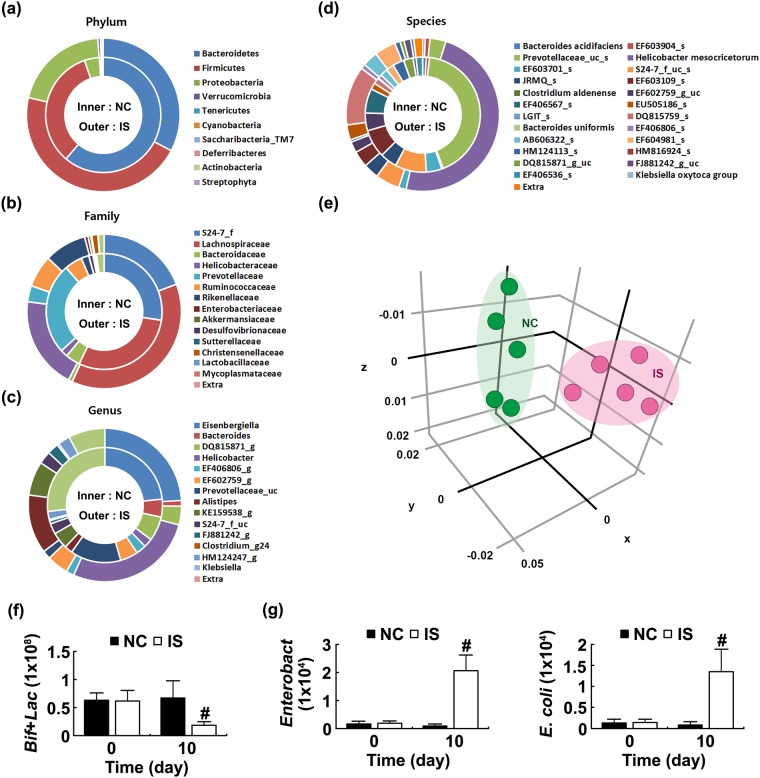
Figure 2 Effects of immobilization stress (IS) on the fecal microbiota composition in mice. The composition of gut microbiota was analyzed using the pyrosequencing: (a) phylum, (b) family, (c) genus, and (d) species. (e) Gut microbiota composition was analyzed by using principal coordinate analysis (PCoA) plot. The plot shows the clustering pattern between mice treated with IS (IS) and not treat with IS (NC) based on weighted pairwise Fast UniFrac analysis. All data were expressed as mean ± S.D. (n = 5). Gut microbiota composition of mice were also analyzed by the selective media (f) BL agar plates selective for Bifidobacteria [Bif] and Lactobacilli [Lac] and (g) DHL agar plates selective for Enterobacteriaceae [Enterobact]). All data were expressed as mean ± S.D. (n = 8). All data were expressed as mean ± SD (n = 8). #p < 0.05 vs. NC group.
Figure 2 Effects of immobilization stress (IS) on the fecal microbiota composition in mice. The composition of gut microbiota was analyzed using the pyrosequencing: (a) phylum, (b) family, (c) genus, and (d) species. (e) Gut microbiota composition was analyzed by using principal coordinate analysis (PCoA) plot. The plot shows the clustering pattern between mice treated with IS (IS) and not treat with IS (NC) based on weighted pairwise Fast UniFrac analysis. All data were expressed as mean ± S.D. (n = 5). Gut microbiota composition of mice were also analyzed by the selective media (f) BL agar plates selective for Bifidobacteria [Bif] and Lactobacilli [Lac] and (g) DHL agar plates selective for Enterobacteriaceae [Enterobact]). All data were expressed as mean ± S.D. (n = 8). All data were expressed as mean ± SD (n = 8). #p < 0.05 vs. NC group.CC BY · PubMed Central
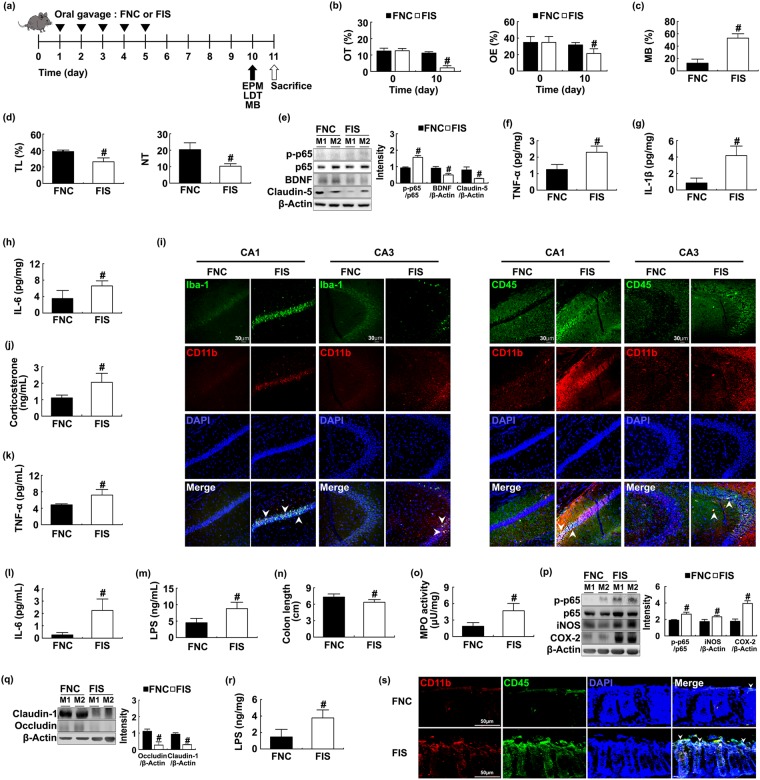
Figure 3 The fecal microbiota transplantation of IS-treated mice (FIS) induced anxiety-like behaviors and colitis in mice. FNC (fecal microbiota of control mice not treated with IS [NC]) and FIS were orally gavaged. Experimental time (a). Anxiety-like behaviors of mice were measured in the EPM (b, time spent in open arms [OT] and open arm entries [OE]), MB (marble buried, c) and LDT (d, time spent in light area [TL] and number of transitions [NT]) tasks. NF-κB (p-p65 and p65), BDNF, claudin-5, and β-actin were measured in the hippocampus by immunoblotting (e). Brain TNF-α (f) IL-1β (g) and IL-6 levels (h) were analyzed by ELISA kit. Blood corticosterone (f) IL-6 (g) and LPS levels (h) were analyzed by ELISA or LAL kit. Iba-1+/CD11b+ and CD11b+/CD11b+ populations were assayed by a confocal microscope (i). Blood corticosterone (j) TNF-α (k) IL-6 (l) and LPS levels (m) were analyzed by ELISA or LAL kit. Colitis markers colon length (n) and myeloperoxidase (MPO) activity (o) were measured in the colon. Colonic iNOS, COX-2, NF-κB (p) and tight junction proteins (occludin and claudin-1), and β-actin (q) were analyzed by immunoblotting. Fecal LPS level (r) and CD11b+/CD11b+ population (s) were analyzed by ELISA and confocal microscopy (i) respectively. FNC and FIS in figures indicate groups treated with fecal microbiota of control and IS-treated mice (suspended in 1% dextrose), respectively. All data except immunoblotting data (n = 4) were expressed as mean ± SD (n = 8). #p < 0.05 vs. FNC group.
Figure 3 The fecal microbiota transplantation of IS-treated mice (FIS) induced anxiety-like behaviors and colitis in mice. FNC (fecal microbiota of control mice not treated with IS [NC]) and FIS were orally gavaged. Experimental time (a). Anxiety-like behaviors of mice were measured in the EPM (b, time spent in open arms [OT] and open arm entries [OE]), MB (marble buried, c) and LDT (d, time spent in light area [TL] and number of transitions [NT]) tasks. NF-κB (p-p65 and p65), BDNF, claudin-5, and β-actin were measured in the hippocampus by immunoblotting (e). Brain TNF-α (f) IL-1β (g) and IL-6 levels (h) were analyzed by ELISA kit. Blood corticosterone (f) IL-6 (g) and LPS levels (h) were analyzed by ELISA or LAL kit. Iba-1+/CD11b+ and CD11b+/CD11b+ populations were assayed by a confocal microscope (i). Blood corticosterone (j) TNF-α (k) IL-6 (l) and LPS levels (m) were analyzed by ELISA or LAL kit. Colitis markers colon length (n) and myeloperoxidase (MPO) activity (o) were measured in the colon. Colonic iNOS, COX-2, NF-κB (p) and tight junction proteins (occludin and claudin-1), and β-actin (q) were analyzed by immunoblotting. Fecal LPS level (r) and CD11b+/CD11b+ population (s) were analyzed by ELISA and confocal microscopy (i) respectively. FNC and FIS in figures indicate groups treated with fecal microbiota of control and IS-treated mice (suspended in 1% dextrose), respectively. All data except immunoblotting data (n = 4) were expressed as mean ± SD (n = 8). #p < 0.05 vs. FNC group.CC BY · PubMed Central
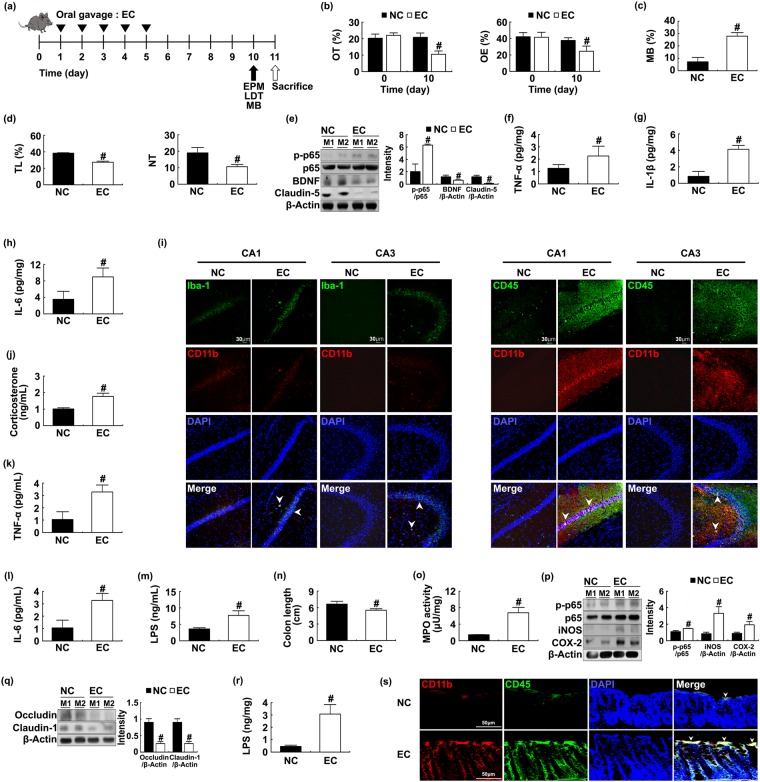
Figure 4 Escherichia coli caused anxiety and colitis in mice. E. coli (1 × 10⁹ CFU/0.2 mL/mouse) was orally gavaged. Experimental time (a). Anxiety-like behaviors of mice were measured in the EPM (b, time spent in open arms [OT] and open arm entries [OE]), MB (marble buried, c) and LDT (d, time spent in light area [TL] and number of transitions [NT]) tasks. NF-κB (p-p65 and p65), BDNF, claudin-5, and β-actin were measured in the hippocampus by immunoblotting (e). Brain TNF-α (f) IL-1β (g) and IL-6 levels (h) were analyzed by ELISA kit. Blood corticosterone (f) IL-6 (g) and LPS levels (h) were analyzed by ELISA or LAL kit. Iba-1+/CD11b+ and CD11b+/CD11b+ populations were assayed by a confocal microscope (i). Blood corticosterone (j) TNF-α (k) IL-6 (l) and LPS levels (m) were analyzed by ELISA or LAL kit. Colitis markers colon length (n) and myeloperoxidase (MPO) activity (o) were measured in the colon. Colonic iNOS, COX-2, NF-κB (p) and tight junction proteins (occludin and claudin-1), and β-actin (q) were analyzed by immunoblotting. Fecal LPS level (r) and CD11b+/CD11b+ population (s) were analyzed by ELISA and confocal microscopy (i) respectively. NC and EC in figures indicate groups treated with vehicle alone (1% dextrose) and E. coli, respectively. All data except immunoblotting data (n = 4) were expressed as mean ± SD (n = 8). #p < 0.05 vs. NC group.
Figure 4 Escherichia coli caused anxiety and colitis in mice. E. coli (1 × 10⁹ CFU/0.2 mL/mouse) was orally gavaged. Experimental time (a). Anxiety-like behaviors of mice were measured in the EPM (b, time spent in open arms [OT] and open arm entries [OE]), MB (marble buried, c) and LDT (d, time spent in light area [TL] and number of transitions [NT]) tasks. NF-κB (p-p65 and p65), BDNF, claudin-5, and β-actin were measured in the hippocampus by immunoblotting (e). Brain TNF-α (f) IL-1β (g) and IL-6 levels (h) were analyzed by ELISA kit. Blood corticosterone (f) IL-6 (g) and LPS levels (h) were analyzed by ELISA or LAL kit. Iba-1+/CD11b+ and CD11b+/CD11b+ populations were assayed by a confocal microscope (i). Blood corticosterone (j) TNF-α (k) IL-6 (l) and LPS levels (m) were analyzed by ELISA or LAL kit. Colitis markers colon length (n) and myeloperoxidase (MPO) activity (o) were measured in the colon. Colonic iNOS, COX-2, NF-κB (p) and tight junction proteins (occludin and claudin-1), and β-actin (q) were analyzed by immunoblotting. Fecal LPS level (r) and CD11b+/CD11b+ population (s) were analyzed by ELISA and confocal microscopy (i) respectively. NC and EC in figures indicate groups treated with vehicle alone (1% dextrose) and E. coli, respectively. All data except immunoblotting data (n = 4) were expressed as mean ± SD (n = 8). #p < 0.05 vs. NC group.CC BY · PubMed Central
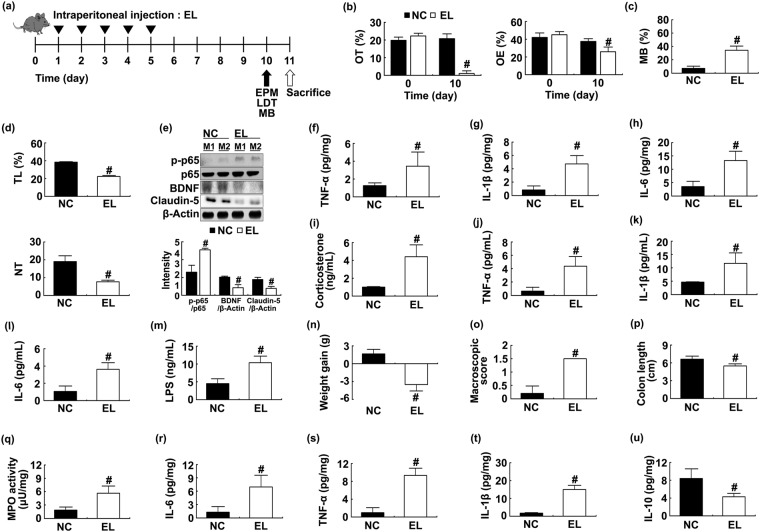
Figure 5 LPS purified from Escherichia coli (EL) caused anxiety and colitis in mice. Experimental schedule (a). Anxiety-like behaviors were measured on the 10th day after the initial treatment with LPS in the EPM (b) MB (d) and LDT (d) tasks. LPS (10 μg/kg) was intraperitoneally treated for 5 days. NF-κB activation and BDNF and claudin-5 expression were measured in the hippocampus (e). Brain TNF-α (f) IL-1β (g) and IL-6 (h) levels were analyzed by ELISA kits. Blool corticosterone (i) IL-6 (f) TNF-α (j) IL-1β (k) IL-6 (l) and LPS (m) levels were by ELISA kits. Colitis markers body weight gain (n) macroscopic score (o) colon shortening (p) and MPO activity (q) IL-6 (r) TNF-α (s) IL-1β (t) and IL-10 (u) expression were measured in the colon. NC and EL in figures indicate groups treated with vehicle alone (1% dextrose) and E. coli LPS, respectively. All data except immunoblotting data (n = 4) were expressed as mean ± SD (n = 8). #p < 0.05 vs. NC group.
Figure 5 LPS purified from Escherichia coli (EL) caused anxiety and colitis in mice. Experimental schedule (a). Anxiety-like behaviors were measured on the 10th day after the initial treatment with LPS in the EPM (b) MB (d) and LDT (d) tasks. LPS (10 μg/kg) was intraperitoneally treated for 5 days. NF-κB activation and BDNF and claudin-5 expression were measured in the hippocampus (e). Brain TNF-α (f) IL-1β (g) and IL-6 (h) levels were analyzed by ELISA kits. Blool corticosterone (i) IL-6 (f) TNF-α (j) IL-1β (k) IL-6 (l) and LPS (m) levels were by ELISA kits. Colitis markers body weight gain (n) macroscopic score (o) colon shortening (p) and MPO activity (q) IL-6 (r) TNF-α (s) IL-1β (t) and IL-10 (u) expression were measured in the colon. NC and EL in figures indicate groups treated with vehicle alone (1% dextrose) and E. coli LPS, respectively. All data except immunoblotting data (n = 4) were expressed as mean ± SD (n = 8). #p < 0.05 vs. NC group.CC BY · PubMed Central
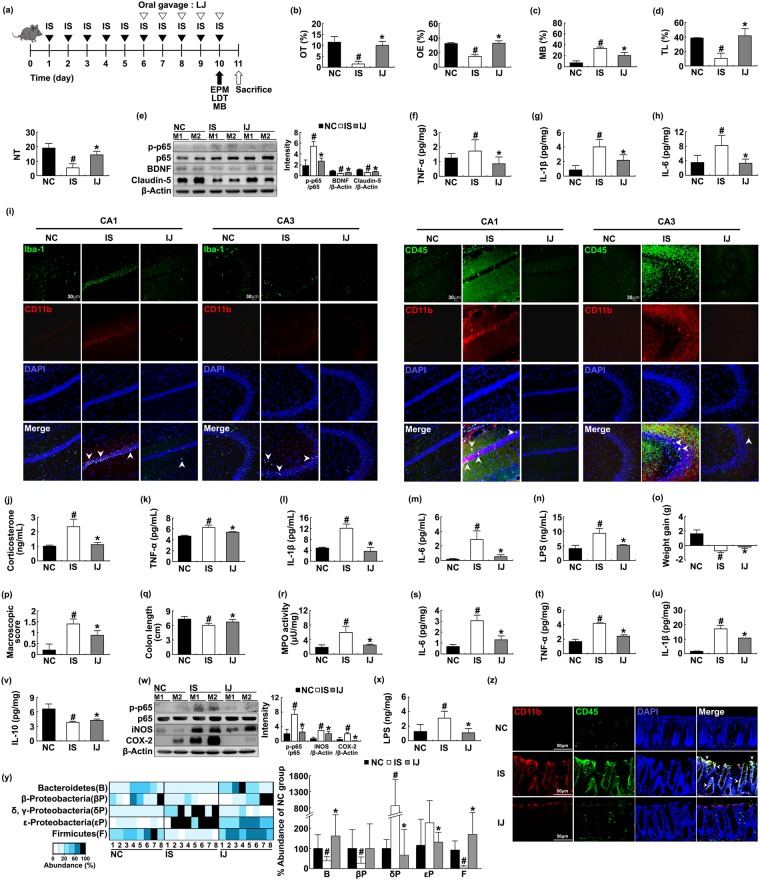
Figure 6 Oral administration of Lactobacillus johnsonii alleviated immobilization stress (IS)-induced anxiety-like behaviors and colitis in mice. Experimental schedule (a). Anxiety-like behaviors were measured on the 10th day after the initial treatment with FIS in the EPM (b) MB (c) and LDT (d) tasks. IS was treated for 10 days. NF-κB activation and BDNF and claudin-5 expression were measured in the hippocampus (e). Brain TNF-α (f) IL-1β (g) and IL-6 (h) levels were analyzed by ELISA kits. Iba-1+/CD11b+ and CD11b+/CD11b+ populations were assayed in CA1 and CA3 regions of the hippocampus by a confocal microscope (i). Blood corticosterone (j) TNF-α (k) IL-1β (l) IL-6 (m) and LPS (n) levels in the blood. Colitis markers body weight gain (o) macroscopic score (p) colon shortening (q) and MPO activity (r) TNF-α (s) IL-1β (t) IL-6 (u) IL-10 (v), and NF-κB activation, iNOS, and COX-2 expression (w) were measured in the colon. Fecal LPS level (x) and gut microbiota (y) were measured in the feces. CD11b+/CD11b+ populations were assayed in the colon by a confocal microscope (z). NC, IS, and IJ in figures indicate groups treated with vehicle alone (1% dextrose) in normal control mice, vehicle in IS-treated mice, and L. johnsonii in IS-treated mice, respectively. The bacterial abundance was indicated as % of NC. All data except immunoblotting data (n = 4) were expressed as mean ± SD (n = 8). #p < 0.05 vs. NC group. *p < 0.05 vs. IS-treated control (IS) group.
Figure 6 Oral administration of Lactobacillus johnsonii alleviated immobilization stress (IS)-induced anxiety-like behaviors and colitis in mice. Experimental schedule (a). Anxiety-like behaviors were measured on the 10th day after the initial treatment with FIS in the EPM (b) MB (c) and LDT (d) tasks. IS was treated for 10 days. NF-κB activation and BDNF and claudin-5 expression were measured in the hippocampus (e). Brain TNF-α (f) IL-1β (g) and IL-6 (h) levels were analyzed by ELISA kits. Iba-1+/CD11b+ and CD11b+/CD11b+ populations were assayed in CA1 and CA3 regions of the hippocampus by a confocal microscope (i). Blood corticosterone (j) TNF-α (k) IL-1β (l) IL-6 (m) and LPS (n) levels in the blood. Colitis markers body weight gain (o) macroscopic score (p) colon shortening (q) and MPO activity (r) TNF-α (s) IL-1β (t) IL-6 (u) IL-10 (v), and NF-κB activation, iNOS, and COX-2 expression (w) were measured in the colon. Fecal LPS level (x) and gut microbiota (y) were measured in the feces. CD11b+/CD11b+ populations were assayed in the colon by a confocal microscope (z). NC, IS, and IJ in figures indicate groups treated with vehicle alone (1% dextrose) in normal control mice, vehicle in IS-treated mice, and L. johnsonii in IS-treated mice, respectively. The bacterial abundance was indicated as % of NC. All data except immunoblotting data (n = 4) were expressed as mean ± SD (n = 8). #p < 0.05 vs. NC group. *p < 0.05 vs. IS-treated control (IS) group.CC BY · PubMed Central
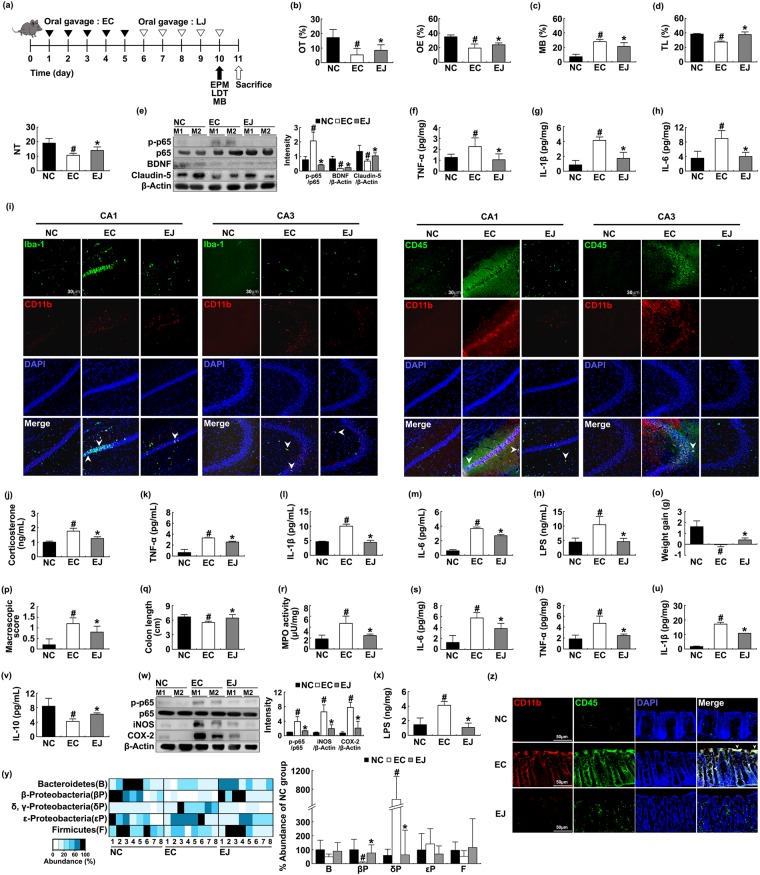
Figure 7 Oral administration of Lactobacillus johnsonii alleviated Escherichia coli-induced anxiety-like behaviors and colitis in mice. Experimental schedule (a). Anxiety-like behaviors were measured on the 10th day after the initial treatment with FIS in the EPM (b) MB (c) and LDT (d) tasks. IS was treated for 10 days. NF-κB activation and BDNF and claudin-5 expression were measured in the hippocampus (e). Brain TNF-α (f) IL-1β (g) and IL-6 (h) levels were analyzed by ELISA kits. Iba-1+/CD11b+ and CD11b+/CD11b+ populations were assayed in CA1 and CA3 regions of the hippocampus by a confocal microscope (i). Blood corticosterone (j) TNF-α (k) IL-1β (l) IL-6 (m) and LPS (n) levels in the blood. Colitis markers body weight gain (o) macroscopic score (p) colon shortening (q) and MPO activity (r) TNF-α (s) IL-1β (t) IL-6 (u) IL-10 (v) and NF-κB activation, iNOS, and COX-2 expression (w) were measured in the colon. Fecal LPS level (x) and gut microbiota (y) were measured in the feces. CD11b+/CD11b+ populations were assayed in the colon by a confocal microscope (z). NC, EC, and EJ in figures indicate groups treated with vehicle alone (1% dextrose) in control mice, vehicle in E. coli-treated mice, and L. johnsonii in E. coli-treated mice, respectively. The bacterial abundance was indicated as % of NC. All data except immunoblotting data (n = 4) were expressed as mean ± SD (n = 8). #p < 0.05 vs. NC group. *p < 0.05 vs. EC-treated control (EC) group.
Figure 7 Oral administration of Lactobacillus johnsonii alleviated Escherichia coli-induced anxiety-like behaviors and colitis in mice. Experimental schedule (a). Anxiety-like behaviors were measured on the 10th day after the initial treatment with FIS in the EPM (b) MB (c) and LDT (d) tasks. IS was treated for 10 days. NF-κB activation and BDNF and claudin-5 expression were measured in the hippocampus (e). Brain TNF-α (f) IL-1β (g) and IL-6 (h) levels were analyzed by ELISA kits. Iba-1+/CD11b+ and CD11b+/CD11b+ populations were assayed in CA1 and CA3 regions of the hippocampus by a confocal microscope (i). Blood corticosterone (j) TNF-α (k) IL-1β (l) IL-6 (m) and LPS (n) levels in the blood. Colitis markers body weight gain (o) macroscopic score (p) colon shortening (q) and MPO activity (r) TNF-α (s) IL-1β (t) IL-6 (u) IL-10 (v) and NF-κB activation, iNOS, and COX-2 expression (w) were measured in the colon. Fecal LPS level (x) and gut microbiota (y) were measured in the feces. CD11b+/CD11b+ populations were assayed in the colon by a confocal microscope (z). NC, EC, and EJ in figures indicate groups treated with vehicle alone (1% dextrose) in control mice, vehicle in E. coli-treated mice, and L. johnsonii in E. coli-treated mice, respectively. The bacterial abundance was indicated as % of NC. All data except immunoblotting data (n = 4) were expressed as mean ± SD (n = 8). #p < 0.05 vs. NC group. *p < 0.05 vs. EC-treated control (EC) group.CC BY · PubMed Central

Verification

Claims the paper makes

The claims and statistics of this paper haven’t been checked yet.

Run the check — free, no account needed. It reads the open-access text and checks the sources it cites.

A few free checks a day · papers already verified open instantly · results are public

Claims other papers make about this one

Each is checked against this paper’s own text: does it say what the citing paper says it does?

Self-check

Percentages, sums and reported differences re-computed from the paper’s own numbers.

The self-check needs the paper’s full text.

Citations

Cites

Show all 56 references

Cited by

Sorted by citations

Items 101–116 of 116

Metadata

Authors
Jang, H.-M., Lee, K.-E., Lee, H.-J., & Kim, D.-H.
Affiliations
Kyung Hee University (KR)
Corresponding author
Kim, Dong-Hyun
Venue
Scientific Reports
Published
2018-09-17
Volume
8
Issue
1
Pages
13897-13897
ISSN
2045-2322 (ISSN-L)
OpenAlex
W2891852769
Cited by
116
References
56
Citations by year
2026: 7 · 2025: 11 · 2024: 15 · 2023: 21 · 2022: 28 · 2021: 20 · 2020: 9 · 2019: 5
FWCI
3.02
Type
journal article
Language
en
Open access
Locations
  • Scientific Reports (publishedVersion, cc-by)
  • Europe PMC (PubMed Central) (publishedVersion, other-oa)
  • PubMed Central (publishedVersion, cc-by)
  • PubMed (publishedVersion)
  • DOAJ (DOAJ: Directory of Open Access Journals) (submittedVersion)
Funders
  • National Research Foundation
  • National Research Foundation of Korea (NRF-2017R1A5A2014768, 2017R1A5A2014768)
  • Ministry of Science and ICT, South Korea (NRF-2017R1A5A2014768, 2017R1A5A2014768)
Topics
  • Life Sciences › Biochemistry, Genetics and Molecular Biology › Molecular Biology › Gut microbiota and health
  • Life Sciences › Neuroscience › Biological Psychiatry › Tryptophan and brain disorders
  • Health Sciences › Medicine › Gastroenterology › Gastrointestinal motility and disorders
Keywords
restraint stress, anxiety-like behavior, gut microbiota, Escherichia coli, NF-κB activation, lipopolysaccharide, Proteobacteria, Lactobacillus johnsonii, probiotics, colitis, hippocampus, microglia, monocytes, brain-derived neurotrophic factor, corticosterone, TNF-α, gut-brain axis, gastrointestinal inflammation
MeSH terms
Gastrointestinal Microbiome, Fecal Microbiota Transplantation, Animals, Anxiety, Colitis, Escherichia coli, Immobilization, Male, Mice, Inbred C57BL, Stress, Physiological, NF-kappa B, Probiotics, Mice

About these checks

Registry, retraction, Cites and statistics results are computed, not judged, with one exception: a printed reference that no index lists is read once by a model before it counts as a citation error. Claims are extracted by a model and kept only when their quote appears verbatim in the text; each cited source is then checked, with a model’s help, for whether it says what the claim relies on. Those verdicts can be wrong — read the claim’s quote and the cited source before relying on one.

Statistics and arithmetic are recomputed, not judged.

Confidence bands are shown only for fields calibrated on our annotated test set. None is calibrated yet, so no band is shown.

What counts as a claim ›How we measure confidence ›How we check this ›

Are you an author, or do you see a problem with this page? Request a review