

Variable training but not sleep improves consolidation of motor adaptation
Open accessPublished version of a preprint
The DOI matches its Crossref record; 61 of the 63 references it cites were found in a registry or an index.
Abstract
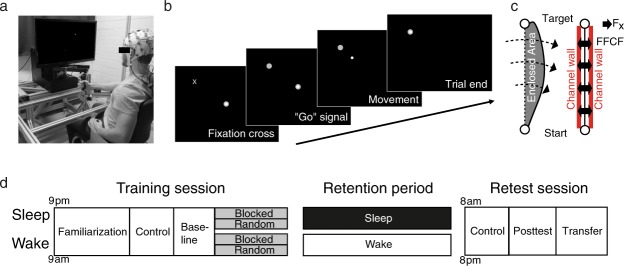
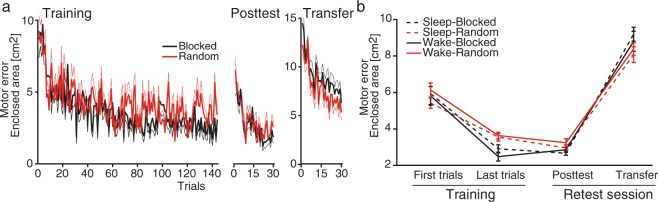
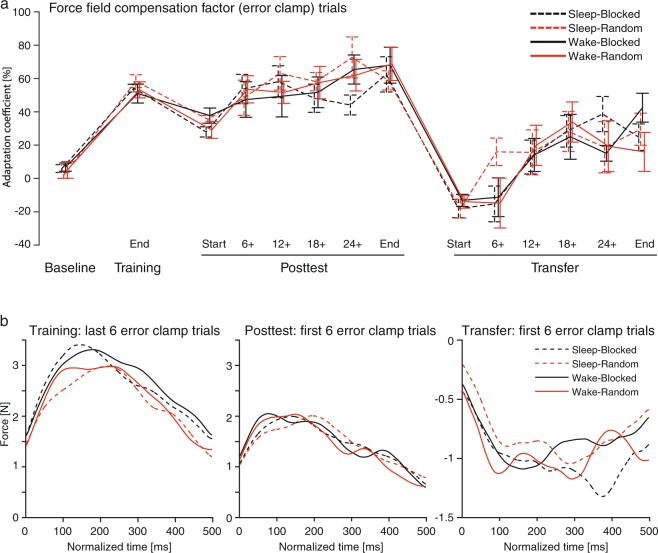
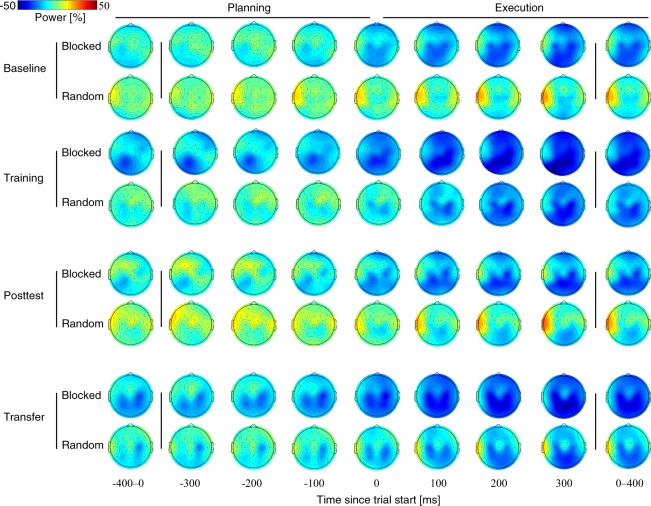
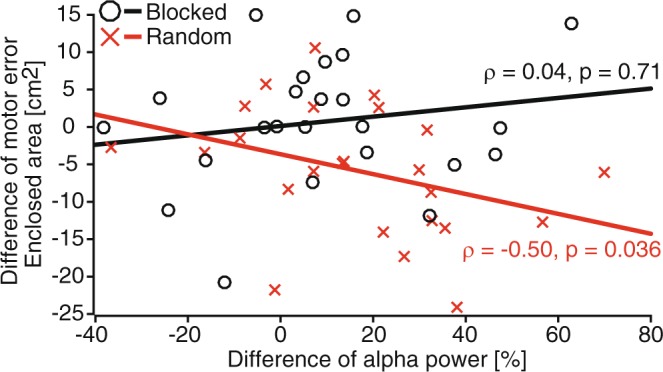
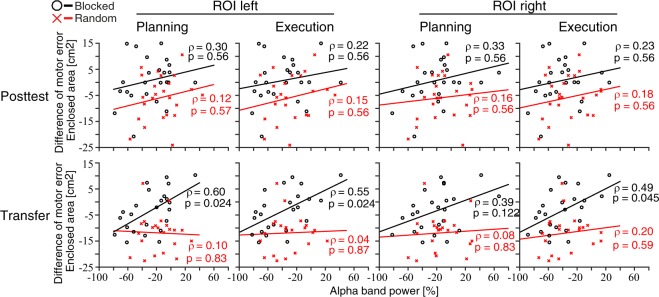
How motor memory consolidates still remains elusive. Consolidation of motor skills has been shown to depend on periods of sleep. Conversely, motor adaptation during tasks not dependent on the hippocampus may not depend on sleep. Some research suggests that the training schedule affects the sleep dependency of motor adaptation tasks. Here, we investigated whether sleep differentially affects memory consolidation that depends on the training schedule. Healthy men were trained with their dominant, right hand on a force-field adaptation task and re-tested after an 11-h consolidation period involving overnight sleep (Sleep) or daytime wakefulness (Wake). Retesting included a transfer test of the non-dominant hand. Half of the subjects in each group adapted to different force-field magnitudes during training with low inter-trial force variability (Sleep-Blocked; Wake-Blocked), and the other half were trained with a high-variability schedule (Sleep-Random; Wake-Random). EEG was recorded during task execution and overnight polysomnography. Consolidation was comparable between Wake and Sleep groups, although performance changes over sleep correlated with sleep spindles nesting in slow-wave upstates. Higher training variability improved retest performance, including transfer learning, and these improvements correlated with higher alpha power in contralateral parietal areas. These enhanced consolidation effects might be fostered by feedback rather than feedforward mechanisms.
Overview
The claims and statistics of this paper haven’t been checked yet.
Free: it reads the open-access text and checks the first 5 claims that cite a source we can check. Create a free account to check every claim.
Integrity signals
Registry
Cites
Statistics
Figures
Verification
Claims the paper makes
The claims and statistics of this paper haven’t been checked yet.
Free: it reads the open-access text and checks the first 5 claims that cite a source we can check. Create a free account to check every claim.
Claims other papers make about this one
Each is checked against this paper’s own text: does it say what the citing paper says it does?
The source backs part of the claim, not all of it — or backs it for a different population, condition or comparison.
In the citing paper
“tasks requiring motor adaptation (such as pursuit rotor task) might represent an exception as they do not seem to benefit from sleep.”
From Sleep—A brain-state serving systems memory consolidation (2023) · cites this paper as [19]
Experimental — accuracy not yet measured
Self-check
Percentages, sums and reported differences re-computed from the paper’s own numbers.
The self-check needs the paper’s full text.
Citations
Cites
Controlling the False Discovery Rate: A Practical and Powerful Approach to Multiple Testing
Benjamini, Y., & Hochberg, Y. (1995) · Journal of the Royal Statistical Society Series B: Statistical Methodology · doi:10.1111/j.2517-6161.1995.tb02031.x · Cited by 109,482
The assessment and analysis of handedness: The Edinburgh inventory
Oldfield, R. C. (1971) · Neuropsychologia · doi:10.1016/0028-3932(71)90067-4 · Cited by 35,900
Development and validation of brief measures of positive and negative affect: The PANAS scales.
Watson, D., Clark, L. A., & Tellegen, A. (1988) · Journal of Personality and Social Psychology · doi:10.1037/0022-3514.54.6.1063 · Cited by 32,433
Delorme, A., & Makeig, S. (2004) · Journal of Neuroscience Methods · doi:10.1016/j.jneumeth.2003.10.009 · Cited by 24,371
Rechtschaffen, A. (1968) · Medical Entomology and Zoology · Cited by 12,675
The control of the false discovery rate in multiple testing under dependency
Benjamini, Y., & Yekutieli, D. (2001) · The Annals of Statistics · doi:10.1214/aos/1013699998 · Cited by 10,490
Event-related EEG/MEG synchronization and desynchronization: basic principles
Pfurtscheller, G., & Lopes da Silva, F. H. (1999) · Clinical Neurophysiology · doi:10.1016/s1388-2457(99)00141-8 · Cited by 7,328
Motor Control and Learning: A Behavioral Emphasis
Schmidt, R. A. (1982) · Cited by 4,770
Frequency Dependence of Signal Power and Spatial Reach of the Local Field Potential
Leski, S., Lindén, H., Tetzlaff, T., Pettersen, K. H., & Einevoll, G. T. (2013) · PubMed · doi:10.18154/rwth-conv-084442 · Cited by 3,639
Alpha-band oscillations, attention, and controlled access to stored information
Klimesch, W. (2012) · Trends in Cognitive Sciences · doi:10.1016/j.tics.2012.10.007 · Cited by 3,310
Cited by
Sleep—A brain-state serving systems memory consolidation
Brodt, S., Inostroza, M., Niethard, N., & Born, J. (2023) · Neuron · doi:10.1016/j.neuron.2023.03.005 · Cited by 343
Sleep’s contribution to memory formation
Lutz, N. D., Harkotte, M., & Born, J. (2025) · Physiological Reviews · doi:10.1152/physrev.00054.2024 · Cited by 60
Sleeping with Hippocampal Damage
Spanò, G., Weber, F. D., Pizzamiglio, G., McCormick, C., Miller, T. D., Rosenthal, C. R., Edgin, J. O., & Maguire, E. A. (2020) · Current Biology · doi:10.1016/j.cub.2019.11.072 · Cited by 43
Self-citationChampetier, P., André, C., Weber, F. D., Rehel, S., Ourry, V., Lanièpce, A., Lutz, A., Bertran, F., Cabé, N., Pitel, A., et al. (2022) · SLEEP · doi:10.1093/sleep/zsac282 · Cited by 39
Self-citationSolano, A., Riquelme, L. A., Pérez-Chada, D., & Della‐Maggiore, V. (2021) · Cerebral Cortex · doi:10.1093/cercor/bhab360 · Cited by 38
Non-REM sleep in major depressive disorder
Bovy, L., Weber, F. D., Tendolkar, I., Fernández, G., Czisch, M., Steiger, A., Zeising, M., & Dresler, M. (2022) · NeuroImage Clinical · doi:10.1016/j.nicl.2022.103275 · Cited by 40
“Parameters for coupled sleep spindles to SW (SW-spindles) were as described elsewhere [32], with the exception that SW was identified with a factor of 1.”
MethodSelf-citationRandom Practice Enhances Retention and Spatial Transfer in Force Field Adaptation
Herzog, M., Focke, A., Maurus, P., Thürer, B., & Stein, T. (2022) · Frontiers in Human Neuroscience · doi:10.3389/fnhum.2022.816197 · Cited by 34
Self-citationSpindle-dependent memory consolidation in healthy adults: a meta-analysis
Kumral, D., Matzerath, A., Leonhart, R., & Schönauer, M. (2023) · Neuropsychologia · doi:10.1016/j.neuropsychologia.2023.108661 · Cited by 32
Spindle-dependent memory consolidation in healthy adults: A meta-analysis
(2022) · doi:10.1101/2022.07.18.500433 · Cited by 32
Brain oscillatory correlates of visuomotor adaptive learning
Struber, L., Baumont, M., Barraud, P.-A., Nougier, V., & Cignetti, F. (2021) · NeuroImage · doi:10.1016/j.neuroimage.2021.118645 · Cited by 25
Diamond-Ouellette, G., Telonio, A., Karakolis, T., Leblond, J., Bouyer, L. J., & Best, K. L. (2022) · IISE Transactions on Occupational Ergonomics and Human Factors · doi:10.1080/24725838.2022.2124325 · Cited by 25
“Principles such as training variability, integrating progression, or allowing feedback are known to enhance learning, retention, and transfer of novel movements (Klassen et al., 2005; Sharma et al., 2016; Th€urer et al., 2018).”
BackgroundMemory Reactivation during Sleep Improves Execution of a Challenging Motor Skill
Cheng, L. Y., Che, T., Tomic, G., Slutzky, M. W., & Paller, K. A. (2021) · Journal of Neuroscience · doi:10.1523/jneurosci.0265-21.2021 · Cited by 16
“…for the importance of sleep in either sequence learning or motor adaptation has remained mixed, with evidence both for and against a role for sleep (Fischer et al., 2002; Walker and Stickgold, 2004; Krakauer and Shadmehr, 2006; Nemeth et al., 2010; Backhaus et al., 2016; Thürer et al., 2018).”
BackgroundSleep Consolidation Potentiates Sensorimotor Adaptation
Solano, A., Lerner, G., Griffa, G., Deleglise, Á., Caffaro, P., Riquelme, L. A., Pérez-Chada, D., & Della‐Maggiore, V. (2024) · Journal of Neuroscience · doi:10.1523/jneurosci.0325-24.2024 · Cited by 11
Neural circuit plasticity for complex non-declarative sensorimotor memory consolidation during sleep
Miyamoto, D. (2022) · Neuroscience Research · doi:10.1016/j.neures.2022.12.020 · Cited by 8
Large reaching datasets quantify the impact of age, sex/gender, and experience on motor control
Zhang, A., Ruitenberg, M. F. L., Warburton, M., Scott, S., & Tsay, J. S. (2026) · Communications Psychology · doi:10.1038/s44271-025-00383-7 · Cited by 3
“In contrast to the variables above, handedness and the amount of sleep prior to the task had no appreciable effect on motor control, consistent with many prior studies 75 – 77 .”
Post‐training sleep modulates motor adaptation and task‐related beta oscillations
Ameen, M. S., Petzka, M., Peigneux, P., & Hoedlmoser, K. (2023) · Journal of Sleep Research · doi:10.1111/jsr.14082 · Cited by 7
“Several other studies, however, found no effect of sleep on motor adaptation, suggesting that time, whether spent awake or asleep, is the limiting factor for the consolidation of motor adaptation (Debas et al., 2010; Doyon et al., 2009; Thürer et al., 2018).”
Thürer, B., Gedemer, S., Focke, A., & Stein, T. (2019) · Frontiers in Human Neuroscience · doi:10.3389/fnhum.2019.00165 · Cited by 10
Self-citationEffenberg, A. O., & Schmitz, G. H. (2022) · Springer eBooks · doi:10.1007/978-3-662-53386-4_60-1 · Cited by 4
Potential Benefits of Daytime Naps on Consecutive Days for Motor Adaptation Learning
Murata, Y., Nishida, M., Ichinose, A., Suyama, S., Youn, S., & Shioda, K. (2022) · Clocks & Sleep · doi:10.3390/clockssleep4030033 · Cited by 2
“A greater effect on MA consolidation is induced by practice and not by sleep [19].”
BackgroundEffenberg, A. O., & Schmitz, G. H. (2023) · Springer eBooks · doi:10.1007/978-3-662-53410-6_60 · Cited by 3
Osu, R., Sugimoto, N., Yoshioka, T., Schweighofer, N., & Kawato, M. (2024) · bioRxiv (Cold Spring Harbor Laboratory) · doi:10.1101/2024.07.15.603502 · Cited by 1
Champetier, P. (2023) · theses.fr (ABES) · doi:10.70675/323f5d1dz6fd3z49d7z9d48z77d2f3bf899e
EEG Brain Rhythms During Resting‐State Wakefulness and Sleep in Elderly Expert Meditators
Champetier, P., Hamel, A., André, C., Ourry, V., Lacroix, T., Rehel, S., Chauveau, L., Haudry, S., Bertran, F., Sayette, V. D. L., et al. (2025) · Journal of Sleep Research · doi:10.1111/jsr.70161 · Cited by 1
Metadata
- Authors
- Thürer, B., Weber, F. D., Born, J., & Stein, T.
- Affiliations
- Karlsruhe Institute of Technology (DE)
- Radboud University Nijmegen (NL)
- Corresponding author
- Thürer, Benjamin
- Weber, Frederik D.
- Venue
- Scientific Reports
- Published
- 2018-10-29
- Volume
- 8
- Issue
- 1
- Pages
- 15977-15977
- ISSN
- 2045-2322 (ISSN-L)
- PMC
- PMC6206141
- OpenAlex
- W2953090507
- Cited by
- 20
- References
- 63
- Citations by year
- 2026: 1 · 2025: 2 · 2024: 2 · 2023: 4 · 2022: 8 · 2021: 1 · 2020: 1 · 2019: 1
- FWCI
- 0.45
- Type
- journal article
- Language
- en
- Open access
- gold
- doi.org
- Licence
- cc-by
- creativecommons.org/licenses/by/4.0 (tdm)
- creativecommons.org/licenses/by/4.0 (vor)
- Locations
- Scientific Reports (publishedVersion, cc-by)
- bioRxiv (Cold Spring Harbor Laboratory) (acceptedVersion, cc-by)
- Europe PMC (PubMed Central) (publishedVersion, other-oa)
- PubMed Central (publishedVersion, cc-by)
- Repository KITopen (Karlsruhe Institute of Technology) (publishedVersion, cc-by)
- PubMed (publishedVersion)
- DOAJ (DOAJ: Directory of Open Access Journals) (submittedVersion)
- Radboud Repository (Radboud University) (submittedVersion)
- Radboud Repository (Radboud University) (submittedVersion, other-oa)
- KITopen (cc-by)
- Funders
- Karlsruhe Institute of Technology
- Deutsche Forschungsgemeinschaft (SFB654)
- Topics
- Life Sciences › Neuroscience › Cognitive Neuroscience › Sleep and Wakefulness Research
- Life Sciences › Neuroscience › Cognitive Neuroscience › Motor Control and Adaptation
- Life Sciences › Neuroscience › Cognitive Neuroscience › Memory and Neural Mechanisms
- Keywords
- motor memory consolidation, motor adaptation, force field adaptation, training variability, sleep, sleep spindles, slow-wave sleep, transfer learning, alpha power, parietal EEG, wakefulness
- MeSH terms
- Memory Consolidation, Adaptation, Physiological, Adult, Electroencephalography, Humans, Learning, Male, Sleep, Wakefulness, Polysomnography, Young Adult
About these checks
Registry, retraction, Cites and statistics results are computed, not judged, with one exception: a printed reference that no index lists is read once by a model before it counts as a citation error. Claims are extracted by a model and kept only when their quote appears verbatim in the text; each cited source is then checked, with a model’s help, for whether it says what the claim relies on. Those verdicts can be wrong — read the claim’s quote and the cited source before relying on one.
Statistics and arithmetic are recomputed, not judged.
Confidence bands are shown only for fields calibrated on our annotated test set. None is calibrated yet, so no band is shown.
What counts as a claim ›How we measure confidence ›How we check this ›
Are you an author, or do you see a problem with this page? Request a review
Data sources
Bibliographic data: Semantic Scholar, OpenAlex, Crossref.
Contains information from the Semantic Scholar Academic Graph Datasets, made available under the ODC Attribution License (ODC-BY 1.0).
Semantic Scholar’s data is described in: Kinney, R., et al. (2023). The Semantic Scholar Open Data Platform. arXiv:2301.10140.
