

Variable training but not sleep improves consolidation of motor adaptation
Open accessPublished version of a preprint
The DOI matches its Crossref record; 61 of the 63 references it cites were found in a registry or an index.
Abstract
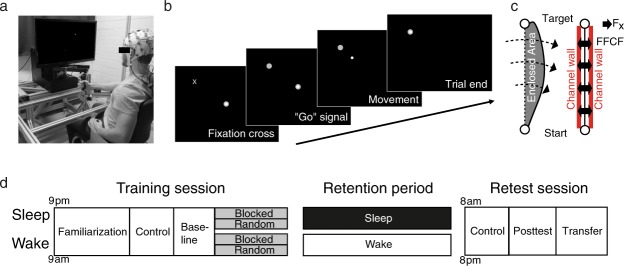
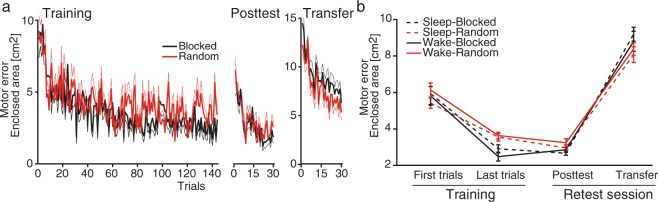
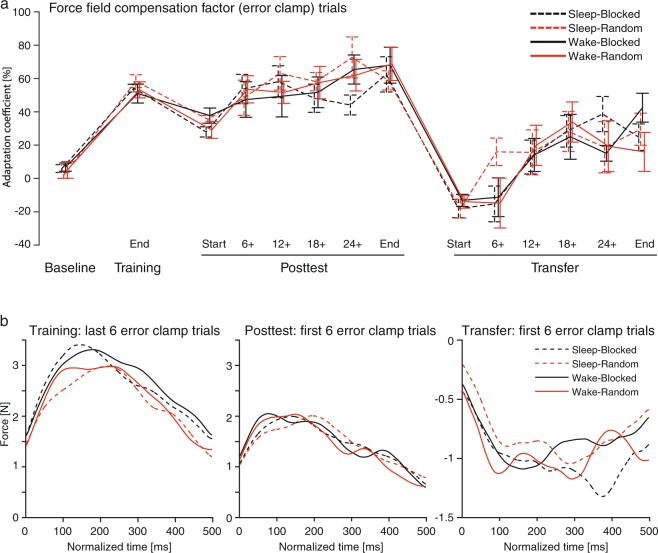
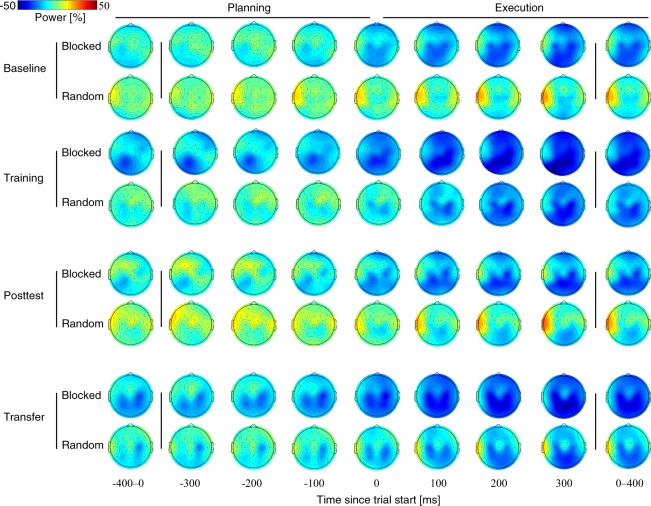
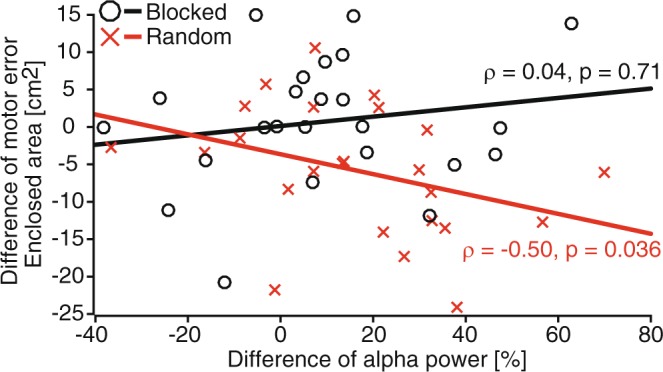
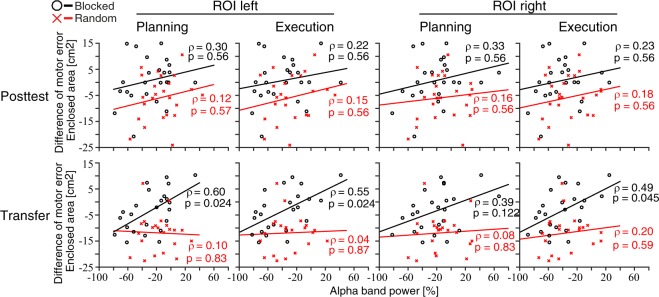
How motor memory consolidates still remains elusive. Consolidation of motor skills has been shown to depend on periods of sleep. Conversely, motor adaptation during tasks not dependent on the hippocampus may not depend on sleep. Some research suggests that the training schedule affects the sleep dependency of motor adaptation tasks. Here, we investigated whether sleep differentially affects memory consolidation that depends on the training schedule. Healthy men were trained with their dominant, right hand on a force-field adaptation task and re-tested after an 11-h consolidation period involving overnight sleep (Sleep) or daytime wakefulness (Wake). Retesting included a transfer test of the non-dominant hand. Half of the subjects in each group adapted to different force-field magnitudes during training with low inter-trial force variability (Sleep-Blocked; Wake-Blocked), and the other half were trained with a high-variability schedule (Sleep-Random; Wake-Random). EEG was recorded during task execution and overnight polysomnography. Consolidation was comparable between Wake and Sleep groups, although performance changes over sleep correlated with sleep spindles nesting in slow-wave upstates. Higher training variability improved retest performance, including transfer learning, and these improvements correlated with higher alpha power in contralateral parietal areas. These enhanced consolidation effects might be fostered by feedback rather than feedforward mechanisms.
Overview
The claims and statistics of this paper haven’t been checked yet.
Free: it reads the open-access text and checks the first 5 claims that cite a source we can check. Create a free account to check every claim.
Integrity signals
Registry
Cites
Statistics
Figures
Verification
Claims the paper makes
The claims and statistics of this paper haven’t been checked yet.
Free: it reads the open-access text and checks the first 5 claims that cite a source we can check. Create a free account to check every claim.
Claims other papers make about this one
Each is checked against this paper’s own text: does it say what the citing paper says it does?
The source backs part of the claim, not all of it — or backs it for a different population, condition or comparison.
In the citing paper
“tasks requiring motor adaptation (such as pursuit rotor task) might represent an exception as they do not seem to benefit from sleep.”
From Sleep—A brain-state serving systems memory consolidation (2023) · cites this paper as [19]
Experimental — accuracy not yet measured
Self-check
Percentages, sums and reported differences re-computed from the paper’s own numbers.
The self-check needs the paper’s full text.
Citations
Cites
Controlling the False Discovery Rate: A Practical and Powerful Approach to Multiple Testing
Benjamini, Y., & Hochberg, Y. (1995) · Journal of the Royal Statistical Society Series B: Statistical Methodology · doi:10.1111/j.2517-6161.1995.tb02031.x · Cited by 109,482
The assessment and analysis of handedness: The Edinburgh inventory
Oldfield, R. C. (1971) · Neuropsychologia · doi:10.1016/0028-3932(71)90067-4 · Cited by 35,900
Development and validation of brief measures of positive and negative affect: The PANAS scales.
Watson, D., Clark, L. A., & Tellegen, A. (1988) · Journal of Personality and Social Psychology · doi:10.1037/0022-3514.54.6.1063 · Cited by 32,433
Delorme, A., & Makeig, S. (2004) · Journal of Neuroscience Methods · doi:10.1016/j.jneumeth.2003.10.009 · Cited by 24,371
Rechtschaffen, A. (1968) · Medical Entomology and Zoology · Cited by 12,675
The control of the false discovery rate in multiple testing under dependency
Benjamini, Y., & Yekutieli, D. (2001) · The Annals of Statistics · doi:10.1214/aos/1013699998 · Cited by 10,490
Event-related EEG/MEG synchronization and desynchronization: basic principles
Pfurtscheller, G., & Lopes da Silva, F. H. (1999) · Clinical Neurophysiology · doi:10.1016/s1388-2457(99)00141-8 · Cited by 7,328
Motor Control and Learning: A Behavioral Emphasis
Schmidt, R. A. (1982) · Cited by 4,770
Frequency Dependence of Signal Power and Spatial Reach of the Local Field Potential
Leski, S., Lindén, H., Tetzlaff, T., Pettersen, K. H., & Einevoll, G. T. (2013) · PubMed · doi:10.18154/rwth-conv-084442 · Cited by 3,639
Alpha-band oscillations, attention, and controlled access to stored information
Klimesch, W. (2012) · Trends in Cognitive Sciences · doi:10.1016/j.tics.2012.10.007 · Cited by 3,310
Rasch, B., & Born, J. (2013) · Physiological Reviews · doi:10.1152/physrev.00032.2012 · Cited by 2,783
Adaptive representation of dynamics during learning of a motor task
Shadmehr, R., & Mussa-Ivaldi, F. (1994) · The Journal of Neuroscience · doi:10.1523/jneurosci.14-05-03208.1994 · Cited by 2,612
Quantification of Sleepiness: A New Approach
Hoddes, E., Zarcone, V., Smythe, H., Phillips, R., & Dement, W. C. (1973) · Psychophysiology · doi:10.1111/j.1469-8986.1973.tb00801.x · Cited by 2,538
Independent Component Analysis of Electroencephalographic Data
Makeig, S., Bell, A. J., Jung, T., & B, T. J. S. A. (1995) · neural information processing systems · Cited by 2,476
Analyzing Neural Time Series Data: Theory and Practice
Cohen, M. X. (2014) · doi:10.7551/mitpress/9609.001.0001 · Cited by 2,105
Huber, R., Felice Ghilardi, M., Massimini, M., & Tononi, G. (2004) · Nature · doi:10.1038/nature02663 · Cited by 1,854
Pipkins, H. R., Bradshaw, J. L., Keller, L. E., Swiatlo, E., & McDaniel, L. S. (2017) · PLOS ONE · doi:10.1371/journal.pone.0179159 · Cited by 1,338
Contextual interference effects on the acquisition, retention, and transfer of a motor skill.
Shea, J. B., & Morgan, R. L. (1979) · Journal of Experimental Psychology: Human Learning and Memory · doi:10.1037/0278-7393.5.2.179 · Cited by 1,227
The neural and behavioural organization of goal-directed movements
Jeannerod, M. (1988) · Medical Entomology and Zoology · Cited by 1,164
Effects of early and late nocturnal sleep on declarative and procedural memory
Plihal, W., & Born, J. (1997) · Journal of Cognitive Neuroscience · doi:10.1162/jocn.1997.9.4.534 · Cited by 1,026
Consolidation in human motor memory
Brashers-Krug, T., Shadmehr, R., & Bizzi, E. (1996) · Nature · doi:10.1038/382252a0 · Cited by 985
Functional Stages in the Formation of Human Long-Term Motor Memory
Shadmehr, R., & Brashers-Krug, T. (1997) · The Journal of Neuroscience · doi:10.1523/jneurosci.17-01-00409.1997 · Cited by 706
A review of the contextual interference effect in motor skill acquisition
Magill, R. A., & Hall, K. G. (1990) · Human Movement Science · doi:10.1016/0167-9457(90)90005-x · Cited by 701
Hippocampo-cortical coupling mediates memory consolidation during sleep
Maingret, N., Girardeau, G., Todorova, R., Goutierre, M., & Zugaro, M. (2016) · Nature Neuroscience · doi:10.1038/nn.4304 · Cited by 667
Untersuchungen mit einer deutschen Version der "Positive and Negative Affect Schedule" (PANAS).
Krohne, H. W., Egloff, B., Kohlmann, C., & Tausch, A. (1996) · Diagnostica · Cited by 609
Sleep forms memory for finger skills
Fischer, S., Hallschmid, M., Elsner, A. L., & Born, J. (2002) · Proceedings of the National Academy of Sciences · doi:10.1073/pnas.182178199 · Cited by 589
EEG-Neurofeedback as a Tool to Modulate Cognition and Behavior: A Review Tutorial
Enriquez-Geppert, S., Huster, R. J., & Herrmann, C. S. (2017) · Frontiers in Human Neuroscience · doi:10.3389/fnhum.2017.00051 · Cited by 515
Awareness Modifies the Skill-Learning Benefits of Sleep
Robertson, E. M., Pascual-Leone, A., & Press, D. Z. (2004) · Current Biology · doi:10.1016/j.cub.2004.01.027 · Cited by 450
Persistence of Motor Adaptation During Constrained, Multi-Joint, Arm Movements
Scheidt, R. A., Reinkensmeyer, D. J., Conditt, M. A., Rymer, W. Z., & Mussa-Ivaldi, F. A. (2000) · Journal of Neurophysiology · doi:10.1152/jn.2000.84.2.853 · Cited by 403
Learning-enhanced coupling between ripple oscillations in association cortices and hippocampus
Khodagholy, D., Gelinas, J. N., & Buzsáki, G. (2017) · Science · doi:10.1126/science.aan6203 · Cited by 357
Positive and Negative Affect Schedule
Watson, D., Clark, L. A., & Tellegen, A. (2011) · PsycTESTS Dataset · doi:10.1037/t03592-000 · Cited by 287
Whitlock, J. R. (2017) · Current Biology · doi:10.1016/j.cub.2017.06.007 · Cited by 257
Malfait, N., & Ostry, D. J. (2004) · The Journal of Neuroscience · doi:10.1523/jneurosci.1742-04.2004 · Cited by 217 · cited 1×
“This agrees with the literature (9) but contradicts the 224 preference of extrinsic coordinates in other studies (30,31).”
ResultAge-related decline of sleep-dependent consolidation
Spencer, R. M. C., Gouw, A. M., & Ivry, R. B. (2007) · Learning & Memory · doi:10.1101/lm.569407 · Cited by 201
Sleeping on the motor engram: The multifaceted nature of sleep-related motor memory consolidation
King, B. R., Hoedlmoser, K., Hirschauer, F., Dolfen, N., & Albouy, G. (2017) · Neuroscience & Biobehavioral Reviews · doi:10.1016/j.neubiorev.2017.04.026 · Cited by 201
Kasten, F. H., & Herrmann, C. S. (2017) · Frontiers in Human Neuroscience · doi:10.3389/fnhum.2017.00002 · Cited by 196
Long-Term Retention Explained by a Model of Short-Term Learning in the Adaptive Control of Reaching
Joiner, W. M., & Smith, M. A. (2008) · Journal of Neurophysiology · doi:10.1152/jn.90706.2008 · Cited by 189
Roach, G. D., Dawson, D., & Lamond, N. (2006) · Chronobiology International · doi:10.1080/07420520601067931 · Cited by 174
Sleep does not enhance motor sequence learning.
Rickard, T. C., Cai, D. J., Rieth, C. A., Jones, J., & Ard, M. C. (2008) · Journal of Experimental Psychology: Learning, Memory, and Cognition · doi:10.1037/0278-7393.34.4.834 · Cited by 171
Repetition and variation in motor practice: A review of neural correlates
Lage, G. M., Ugrinowitsch, H., Apolinário‐Souza, T., Vieira, M. M., Albuquerque, M. R., & Benda, R. N. (2015) · Neuroscience & Biobehavioral Reviews · doi:10.1016/j.neubiorev.2015.08.012 · Cited by 159
Sleep-Dependent Consolidation of Contextual Learning
Spencer, R. M. C., Sunm, M., & Ivry, R. B. (2006) · Current Biology · doi:10.1016/j.cub.2006.03.094 · Cited by 138
Mechanisms Influencing Acquisition and Recall of Motor Memories
Donchin, O., Sawaki, L., Madupu, G., Cohen, L. G., & Shadmehr, R. (2002) · Journal of Neurophysiology · doi:10.1152/jn.2002.88.4.2114 · Cited by 103
Implicit oculomotor sequence learning in humans: Time course of offline processing
Albouy, G., Ruby, P. M., Phillips, C. L. M., Luxen, A., Peigneux, P., & Maquet, P. (2006) · Brain Research · doi:10.1016/j.brainres.2006.03.076 · Cited by 101
Berniker, M., Franklin, D. W., Flanagan, J. R., Wolpert, D. M., & Kording, K. P. (2013) · Journal of Neurophysiology · doi:10.1152/jn.00493.2013 · Cited by 86
Campbell, M., Susser, E., Mall, S., Mqulwana, S. G., Mndini, M. M., Ntola, O. A., Nagdee, M., Zingela, Z., van Wyk, S., & Stein, D. J. (2017) · PLoS ONE · doi:10.1371/journal.pone.0188466 · Cited by 85
Learning a Motor Skill: Effects of Blocked Versus Random Practice a Review
Merbah, S., & Meulemans, T. (2011) · Psychologica Belgica · doi:10.5334/pb-51-1-15 · Cited by 79
Sleep consolidates the effector-independent representation of a motor skill
Witt, K., Margraf, N., Bieber, C., Born, J., & Deuschl, G. (2010) · Neuroscience · doi:10.1016/j.neuroscience.2010.07.062 · Cited by 70
Self-citationDick, M. B., Hsieh, S., Bricker, J., & Dick‐Muehlke, C. (2003) · Neuropsychology · doi:10.1037/0894-4105.17.2.202 · Cited by 67
Martel, G., Blanchard, J., Mons, N. E., Gastambide, F., Micheau, J., & Guillou, J.-L. (2007) · Neuroscience · doi:10.1016/j.neuroscience.2007.10.004 · Cited by 58
Stockinger, C., Thürer, B., Focke, A., & Stein, T. (2015) · Journal of Neurophysiology · doi:10.1152/jn.00727.2015 · Cited by 46
Self-citationVariable motor imagery training induces sleep memory consolidation and transfer improvements
Debarnot, U., Abichou, K., Kalenzaga, S., Sperduti, M., & Piolino, P. (2015) · Neurobiology of Learning and Memory · doi:10.1016/j.nlm.2014.12.010 · Cited by 43
Tactile stimulation during sleep alters slow oscillation and spindle densities but not motor skill
Pereira, S. I. R., Beijamini, F., Weber, F. D., Vincenzi, R. A., da Silva, F. A. C., & Louzada, F. M. (2016) · Physiology & Behavior · doi:10.1016/j.physbeh.2016.11.024 · Cited by 39
Self-citationSleep stabilizes visuomotor adaptation memory: a functional magnetic resonance imaging study
Albouy, G., Vandewalle, G., Sterpenich, V., Rauchs, G., Desseilles, M., Balteau, E., Degueldre, C., Phillips, C., Luxen, A., & Maquet, P. (2013) · Journal of Sleep Research · doi:10.1111/j.1365-2869.2012.01059.x · Cited by 38
More effective consolidation of episodic long-term memory in children than adults-unrelated to sleep
Wang, J.-Y., Weber, F. D., Zinke, K., Inostroza, M., & Born, J. (2018) · Child Development · doi:10.1111/cdev.12839 · Cited by 29
Self-citationAdi‐Japha, E., & Karni, A. (2016) · Psychological Bulletin · doi:10.1037/bul0000048 · Cited by 28
Thürer, B., Stockinger, C., Putze, F., Schultz, T., & Stein, T. (2017) · Frontiers in Human Neuroscience · doi:10.3389/fnhum.2017.00403 · Cited by 22
Self-citationRickard, T. C., & Pan, S. C. (2017) · Psychological Bulletin · doi:10.1037/bul0000094 · Cited by 20
The Sensorimotor System Can Sculpt Behaviorally Relevant Representations for Motor Learning
Franklin, D. W., Batchelor, A. V., & Wolpert, D. M. (2016) · eNeuro · doi:10.1523/eneuro.0070-16.2016 · Cited by 20
Optimizing effort: increased efficiency of motor memory with time away from practice
Pekny, S. E., & Shadmehr, R. (2014) · Journal of Neurophysiology · doi:10.1152/jn.00638.2014 · Cited by 19
Skill Memory Escaping from Distraction by Sleep—Evidence from Dual-Task Performance
Ertelt, D., Witt, K., Reetz, K., Frank, W., Junghanns, K., Backhaus, J., Tadić, V., Pellicano, A., Born, J., & Binkofski, F. (2012) · PLoS ONE · doi:10.1371/journal.pone.0050983 · Cited by 17
Stockinger, C., Thürer, B., & Stein, T. (2017) · PLoS ONE · doi:10.1371/journal.pone.0176594 · Cited by 9
Self-citation
Cited by
Sleep—A brain-state serving systems memory consolidation
Brodt, S., Inostroza, M., Niethard, N., & Born, J. (2023) · Neuron · doi:10.1016/j.neuron.2023.03.005 · Cited by 343
Sleep’s contribution to memory formation
Lutz, N. D., Harkotte, M., & Born, J. (2025) · Physiological Reviews · doi:10.1152/physrev.00054.2024 · Cited by 60
Sleeping with Hippocampal Damage
Spanò, G., Weber, F. D., Pizzamiglio, G., McCormick, C., Miller, T. D., Rosenthal, C. R., Edgin, J. O., & Maguire, E. A. (2020) · Current Biology · doi:10.1016/j.cub.2019.11.072 · Cited by 43
Self-citationChampetier, P., André, C., Weber, F. D., Rehel, S., Ourry, V., Lanièpce, A., Lutz, A., Bertran, F., Cabé, N., Pitel, A., et al. (2022) · SLEEP · doi:10.1093/sleep/zsac282 · Cited by 39
Self-citationSolano, A., Riquelme, L. A., Pérez-Chada, D., & Della‐Maggiore, V. (2021) · Cerebral Cortex · doi:10.1093/cercor/bhab360 · Cited by 38
Metadata
- Authors
- Thürer, B., Weber, F. D., Born, J., & Stein, T.
- Affiliations
- Karlsruhe Institute of Technology (DE)
- Radboud University Nijmegen (NL)
- Corresponding author
- Thürer, Benjamin
- Weber, Frederik D.
- Venue
- Scientific Reports
- Published
- 2018-10-29
- Volume
- 8
- Issue
- 1
- Pages
- 15977-15977
- ISSN
- 2045-2322 (ISSN-L)
- PMC
- PMC6206141
- OpenAlex
- W2953090507
- Cited by
- 20
- References
- 63
- Citations by year
- 2026: 1 · 2025: 2 · 2024: 2 · 2023: 4 · 2022: 8 · 2021: 1 · 2020: 1 · 2019: 1
- FWCI
- 0.45
- Type
- journal article
- Language
- en
- Open access
- gold
- doi.org
- Licence
- cc-by
- creativecommons.org/licenses/by/4.0 (tdm)
- creativecommons.org/licenses/by/4.0 (vor)
- Locations
- Scientific Reports (publishedVersion, cc-by)
- bioRxiv (Cold Spring Harbor Laboratory) (acceptedVersion, cc-by)
- Europe PMC (PubMed Central) (publishedVersion, other-oa)
- PubMed Central (publishedVersion, cc-by)
- Repository KITopen (Karlsruhe Institute of Technology) (publishedVersion, cc-by)
- PubMed (publishedVersion)
- DOAJ (DOAJ: Directory of Open Access Journals) (submittedVersion)
- Radboud Repository (Radboud University) (submittedVersion)
- Radboud Repository (Radboud University) (submittedVersion, other-oa)
- KITopen (cc-by)
- Funders
- Karlsruhe Institute of Technology
- Deutsche Forschungsgemeinschaft (SFB654)
- Topics
- Life Sciences › Neuroscience › Cognitive Neuroscience › Sleep and Wakefulness Research
- Life Sciences › Neuroscience › Cognitive Neuroscience › Motor Control and Adaptation
- Life Sciences › Neuroscience › Cognitive Neuroscience › Memory and Neural Mechanisms
- Keywords
- motor memory consolidation, motor adaptation, force field adaptation, training variability, sleep, sleep spindles, slow-wave sleep, transfer learning, alpha power, parietal EEG, wakefulness
- MeSH terms
- Memory Consolidation, Adaptation, Physiological, Adult, Electroencephalography, Humans, Learning, Male, Sleep, Wakefulness, Polysomnography, Young Adult
About these checks
Registry, retraction, Cites and statistics results are computed, not judged, with one exception: a printed reference that no index lists is read once by a model before it counts as a citation error. Claims are extracted by a model and kept only when their quote appears verbatim in the text; each cited source is then checked, with a model’s help, for whether it says what the claim relies on. Those verdicts can be wrong — read the claim’s quote and the cited source before relying on one.
Statistics and arithmetic are recomputed, not judged.
Confidence bands are shown only for fields calibrated on our annotated test set. None is calibrated yet, so no band is shown.
What counts as a claim ›How we measure confidence ›How we check this ›
Are you an author, or do you see a problem with this page? Request a review
Data sources
Bibliographic data: Semantic Scholar, OpenAlex, Crossref.
Contains information from the Semantic Scholar Academic Graph Datasets, made available under the ODC Attribution License (ODC-BY 1.0).
Semantic Scholar’s data is described in: Kinney, R., et al. (2023). The Semantic Scholar Open Data Platform. arXiv:2301.10140.
