

The two phases of the Cambrian Explosion
Open accessThe DOI matches its Crossref record; 105 of the 107 references it cites were found in a registry or an index.
Abstract
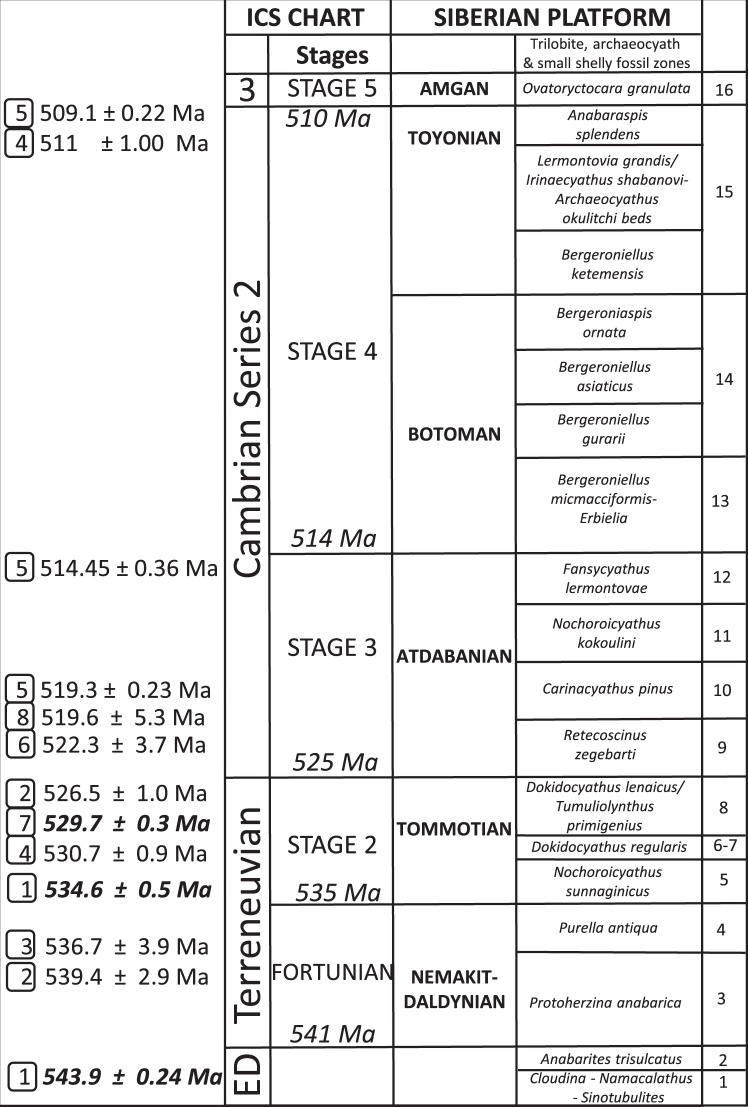
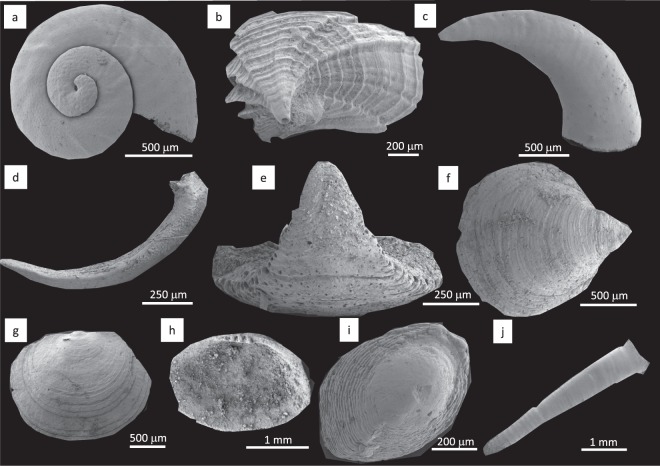
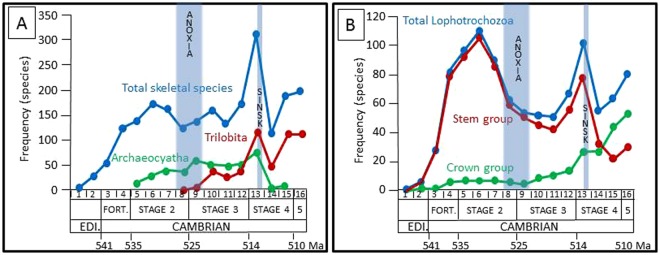
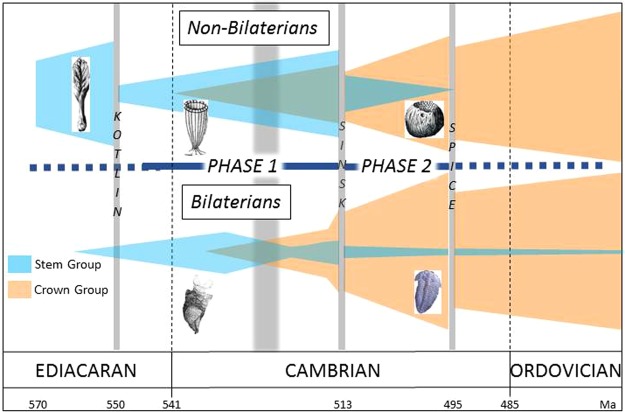
The dynamics of how metazoan phyla appeared and evolved – known as the Cambrian Explosion – remains elusive. We present a quantitative analysis of the temporal distribution (based on occurrence data of fossil species sampled in each time interval) of lophotrochozoan skeletal species (n = 430) from the terminal Ediacaran to Cambrian Stage 5 (~545 – ~505 Million years ago (Ma)) of the Siberian Platform, Russia. We use morphological traits to distinguish between stem and crown groups. Possible skeletal stem group lophophorates, brachiopods, and molluscs (n = 354) appear in the terminal Ediacaran (~542 Ma) and diversify during the early Cambrian Terreneuvian and again in Stage 2, but were devastated during the early Cambrian Stage 4 Sinsk extinction event (~513 Ma) never to recover previous diversity. Inferred crown group brachiopod and mollusc species (n = 76) do not appear until the Fortunian, ~537 Ma, radiate in the early Cambrian Stage 3 (~522 Ma), and with minimal loss of diversity at the Sinsk Event, continued to diversify into the Ordovician. The Sinsk Event also removed other probable stem groups, such as archaeocyath sponges. Notably, this diversification starts before, and extends across the Ediacaran/Cambrian boundary and the Basal Cambrian Carbon Isotope Excursion (BACE) interval (~541 to ~540 Ma), ascribed to a possible global perturbation of the carbon cycle. We therefore propose two phases of the Cambrian Explosion separated by the Sinsk extinction event, the first dominated by stem groups of phyla from the late Ediacaran, ~542 Ma, to early Cambrian stage 4, ~513 Ma, and the second marked by radiating bilaterian crown group species of phyla from ~513 Ma and extending to the Ordovician Radiation.
Overview
The claims and statistics of this paper haven’t been checked yet.
Free: it reads the open-access text and checks the first 5 claims that cite a source we can check. Create a free account to check every claim.
Integrity signals
Registry
Cites
Statistics
Figures
Verification
Claims the paper makes
The claims and statistics of this paper haven’t been checked yet.
Free: it reads the open-access text and checks the first 5 claims that cite a source we can check. Create a free account to check every claim.
Claims other papers make about this one
Each is checked against this paper’s own text: does it say what the citing paper says it does?
The source backs part of the claim, not all of it — or backs it for a different population, condition or comparison.
In the citing paper
“Mo and U isotopes show that an increase in oxygenation was punctuated by intervals of expanded anoxic seafloor (41-43)”
From Integrated records of environmental change and evolution challenge the Cambrian Explosion (2019) · cites this paper as [42]
Experimental — accuracy not yet measuredThe source backs part of the claim, not all of it — or backs it for a different population, condition or comparison.
In the citing paper
“Shallow carbonate platforms, such as the Aldan-Lena rivers region, evidence relatively high animal origination rates and biodiversity 42,43 .”
From Possible links between extreme oxygen perturbations and the Cambrian radiation of animals (2019) · cites this paper as [43]
Experimental — accuracy not yet measured
Self-check
Percentages, sums and reported differences re-computed from the paper’s own numbers.
The self-check needs the paper’s full text.
Citations
Cites
The Magnitude of Global Marine Species Diversity
Appeltans, W., Ahyong, S. T., Anderson, G., Angel, M. V., Artois, T., Bailly, N., Bamber, R., Barber, A., Bartsch, I., Berta, A., et al. (2012) · Current Biology · doi:10.1016/j.cub.2012.09.036 · Cited by 1,070
Paleophysiology and end-Permian mass extinction
Knoll, A. H., Bambach, R. K., Payne, J. L., Pruss, S., & Fischer, W. W. (2007) · Earth and Planetary Science Letters · doi:10.1016/j.epsl.2007.02.018 · Cited by 665
The Neoproterozoic assembly of Gondwana and its relationship to the Ediacaran–Cambrian radiation
Meert, J. G., & Lieberman, B. S. (2008) · Gondwana Research · doi:10.1016/j.gr.2007.06.007 · Cited by 549
Calibrating Rates of Early Cambrian Evolution
Bowring, S. A., Grotzinger, J. P., Isachsen, C. E., Knoll, A. H., Pelechaty, S. M., & Kolosov, P. (1993) · Science · doi:10.1126/science.11539488 · Cited by 526
Dynamics of origination and extinction in the marine fossil record
Alroy, J. (2008) · Proceedings of the National Academy of Sciences · doi:10.1073/pnas.0802597105 · Cited by 525
Detecting Regular Sound Changes in Linguistics as Events of Concerted Evolution
Hruschka, D. J., Branford, S., Smith, E. D., Wilkins, J., Meade, A., Pagel, M., & Bhattacharya, T. (2015) · Current Biology · doi:10.1016/j.cub.2014.10.064 · Cited by 522
Co-evolution of eukaryotes and ocean oxygenation in the Neoproterozoic era
Lenton, T. M., Boyle, R. A., Poulton, S. W., Shields-Zhou, G. A., & Butterfield, N. J. (2014) · Nature Geoscience · doi:10.1038/ngeo2108 · Cited by 424
The Cambrian Substrate Revolution
Bottjer, D. J., Hagadorn, J. W., & Dornbos, S. Q. (2000) · CaltechAUTHORS (California Institute of Technology) · Cited by 411
Sepkoski, J. J. (1979) · Paleobiology · doi:10.1017/s0094837300006539 · Cited by 387
The Late Precambrian fossil Kimberella is a mollusc-like bilaterian organism
Fedonkin, M. A., & Waggoner, B. M. (1997) · Nature · doi:10.1038/42242 · Cited by 373
End-Permian Mass Extinction in the Oceans: An Ancient Analog for the Twenty-First Century?
Payne, J. L., & Clapham, M. E. (2012) · Annual Review of Earth and Planetary Sciences · doi:10.1146/annurev-earth-042711-105329 · Cited by 367
Pu, J. P., Bowring, S. A., Ramezani, J., Myrow, P., Raub, T. D., Landing, E., Mills, A., Hodgin, E., & Macdonald, F. A. (2016) · Geology · doi:10.1130/g38284.1 · Cited by 357
The Great Ordovician Biodiversification Event (GOBE): The palaeoecological dimension
Servais, T., Owen, A. W., Harper, D. A. T., Kröger, B., & Munnecke, A. (2010) · Palaeogeography, Palaeoclimatology, Palaeoecology · doi:10.1016/j.palaeo.2010.05.031 · Cited by 342
Preservation of Species Abundance in Marine Death Assemblages
Kidwell, S. M. (2001) · Science · doi:10.1126/science.1064539 · Cited by 339
Morris, S. C., & Peel, J. S. (1995) · Philosophical Transactions of the Royal Society of London. Series B: Biological Sciences · doi:10.1098/rstb.1995.0029 · Cited by 325
Phosphorus, phosphorites and skeletal evolution at the Precambrian—Cambrian boundary
Cook, P. J., & Shergold, J. H. (1984) · Nature · doi:10.1038/308231a0 · Cited by 298
Spiralian Phylogeny Informs the Evolution of Microscopic Lineages
Laumer, C. E., Bekkouche, N., Kerbl, A., Goetz, F., Neves, R. C., Sørensen, M. V., Kristensen, R. M., Hejnol, A., Dunn, C. W., Giribet, G., et al. (2015) · Current Biology · doi:10.1016/j.cub.2015.06.068 · Cited by 278
Seawater chemistry and the advent of biocalcification
Brennan, S. T., Lowenstein, T. K., & Horita, J. (2004) · Geology · doi:10.1130/g20251.1 · Cited by 273
Compilation and Network Analyses of Cambrian Food Webs
Dunne, J. A., Williams, R. J., Martinez, N. D., Wood, R. A., & Erwin, D. H. (2008) · PLoS Biology · doi:10.1371/journal.pbio.0060102 · Cited by 269
Self-citationBudd, G. E., & Jensen, S. (2017) · Biological Reviews · doi:10.1111/brv.12239 · Cited by 242
Ediacaran Extinction and Cambrian Explosion
Darroch, S. A. F., Smith, E. F., Laflamme, M., & Erwin, D. H. (2018) · Trends in Ecology & Evolution · doi:10.1016/j.tree.2018.06.003 · Cited by 236
Duration of the Early Cambrian: U-Pb ages of volcanic ashes from Avalon and Gondwana
Landing, E., Bowring, S. A., Davidek, K. L., Westrop, S. R., Geyer, G., & Heldmaier, W. (1998) · Canadian Journal of Earth Sciences · doi:10.1139/cjes-35-4-329 · Cited by 228
Chronology of early Cambrian biomineralization
KOUCHINSKY, A., BENGTSON, S., RUNNEGAR, B., SKOVSTED, C., STEINER, M., & VENDRASCO, M. (2012) · Geological Magazine · doi:10.1017/s0016756811000720 · Cited by 224
Ecology and Evolution of the African Great Lakes and Their Faunas
Salzburger, W., Van Bocxlaer, B., & Cohen, A. S. (2014) · Annual Review of Ecology, Evolution, and Systematics · doi:10.1146/annurev-ecolsys-120213-091804 · Cited by 221
Phylogenomics of Lophotrochozoa with Consideration of Systematic Error
Kocot, K. M., Struck, T. H., Merkel, J., Waits, D. S., Todt, C., Brannock, P. M., Weese, D. A., Cannon, J. T., Moroz, L. L., Lieb, B., et al. (2016) · Systematic Biology · doi:10.1093/sysbio/syw079 · Cited by 208
Animals and the invention of the Phanerozoic Earth system
Butterfield, N. J. (2011) · Trends in Ecology & Evolution · doi:10.1016/j.tree.2010.11.012 · Cited by 195
Anoxia as the cause of the mid-Early Cambrian (Botomian) extinction event
Zhuravlev, A. Y., & Wood, R. A. (1996) · Geology · doi:10.1130/0091-7613(1996)024<0311:aatcot>2.3.co;2 · Cited by 195
Self-citationExceptionally preserved fossil assemblages through geologic time and space
Muscente, A. D., Schiffbauer, J. D., Broce, J., Laflamme, M., O'Donnell, K., Boag, T. H., Meyer, M., Hawkins, A. D., Huntley, J. W., McNamara, M., et al. (2017) · Gondwana Research · doi:10.1016/j.gr.2017.04.020 · Cited by 194
New U–Pb zircon ages of the Ediacaran–Cambrian boundary strata in South China
Chen, D., Zhou, X., Fu, Y., Wang, J., & Yan, D. (2015) · Terra Nova · doi:10.1111/ter.12134 · Cited by 181
Oxygen-Collagen Priority and the Early Metazoan Fossil Record
Towe, K. M. (1970) · Proceedings of the National Academy of Sciences · doi:10.1073/pnas.65.4.781 · Cited by 180
Zhu, M., Zhuravlev, A. Y., Wood, R. A., Zhao, F., & Sukhov, S. S. (2017) · Geology · doi:10.1130/g38865.1 · Cited by 176
Self-citationFurther SHRIMP geochronology on the early Cambrian of South China
Compston, W., Zhang, Z., Cooper, J. A., Ma, G., & Jenkins, R. J. F. (2008) · American Journal of Science · doi:10.2475/04.2008.01 · Cited by 159
Marine redox fluctuation as a potential trigger for the Cambrian explosion
Wei, G.-Y., Planavsky, N. J., Tarhan, L. G., Chen, X., Wei, W., Li, D., & Ling, H.-F. (2018) · Geology · doi:10.1130/g40150.1 · Cited by 155
Carlson, S. J. (2016) · Annual Review of Earth and Planetary Sciences · doi:10.1146/annurev-earth-060115-012348 · Cited by 141
CARBONATES IN SKELETON-POOR SEAS: NEW INSIGHTS FROM CAMBRIAN AND ORDOVICIAN STRATA OF LAURENTIA
PRUSS, S. B., FINNEGAN, S., FISCHER, W. W., & KNOLL, A. H. (2010) · PALAIOS · doi:10.2110/palo.2009.p09-101r · Cited by 139
Early fossil record of Euarthropoda and the Cambrian explosion
Daley, A. C., Antcliffe, J. B., Drage, H. B., & Pates, S. (2018) · Proceedings of the National Academy of Sciences · doi:10.1073/pnas.1719962115 · Cited by 138
Quantifying ecological impacts of mass extinctions with network analysis of fossil communities
Muscente, A. D., Prabhu, A., Zhong, H., Eleish, A., Meyer, M. B., Fox, P., Hazen, R. M., & Knoll, A. H. (2018) · Proceedings of the National Academy of Sciences · doi:10.1073/pnas.1719976115 · Cited by 134
Okada, Y., Sawaki, Y., Komiya, T., Hirata, T., Takahata, N., Sano, Y., Han, J., & Maruyama, S. (2013) · Gondwana Research · doi:10.1016/j.gr.2013.05.001 · Cited by 128
Halwaxiids and the Early Evolution of the Lophotrochozoans
Morris, S. C., & Caron, J.-B. (2007) · Science · doi:10.1126/science.1137187 · Cited by 127
Coupled oceanic oxygenation and metazoan diversification during the early–middle Cambrian?
Li, C., Jin, C., Planavsky, N. J., Algeo, T. J., Cheng, M., Yang, X., Zhao, Y., & Xie, S. (2017) · Geology · doi:10.1130/g39208.1 · Cited by 127
Zhu, R., Li, X., Hou, X., Pan, Y., Wang, F., Deng, C., & He, H. (2009) · Science in China Series D: Earth Sciences · doi:10.1007/s11430-009-0152-6 · Cited by 126
Early sponge evolution: A review and phylogenetic framework
Botting, J. P., & Muir, L. A. (2018) · Palaeoworld · doi:10.1016/j.palwor.2017.07.001 · Cited by 125
Primordial metazoan-calcimicrobial reefs; Tommotian (Early Cambrian) of the Siberian Platform
Kruse, P. D., Zhuravlev, A. Y., & James, N. P. (1995) · PALAIOS · doi:10.2307/3515157 · Cited by 122
Self-citationNagovitsin, K. E., Rogov, V. I., Marusin, V. V., Karlova, G. A., Kolesnikov, A. V., Bykova, N., & Grazhdankin, D. V. (2015) · Precambrian Research · doi:10.1016/j.precamres.2015.09.012 · Cited by 116
Changes in the trace fossil biota across the Proterozoic-Phanerozoic boundary
CRIMES, T. P. (1992) · Journal of the Geological Society · doi:10.1144/gsjgs.149.4.0637 · Cited by 116
Ancestral morphology of crown-group molluscs revealed by a new Ordovician stem aculiferan
Vinther, J., Parry, L. A., Briggs, D. E. G., & Roy, P. V. (2017) · Nature · doi:10.1038/nature21055 · Cited by 114
Extinction of Cloudina and Namacalathus at the Precambrian-Cambrian boundary in Oman
(2003) · doi:10.1130/0091-7613(2003)031 · Cited by 113
Butterfield, N. J., & Nicholas, C. J. (1996) · Journal of Paleontology · doi:10.1017/s0022336000038579 · Cited by 108
Bengtson, S. (1992) · Lethaia · doi:10.1111/j.1502-3931.1992.tb01644.x · Cited by 107
Scratch Traces of Large Ediacara Bilaterian Animals
Gehling, J. G., Runnegar, B. N., & Droser, M. L. (2014) · Journal of Paleontology · doi:10.1666/13-054 · Cited by 105
The Cambrian Fossil Record and the Origin of the Phyla
Budd, G. E. (2003) · Integrative and Comparative Biology · doi:10.1093/icb/43.1.157 · Cited by 102
Hyoliths are Palaeozoic lophophorates
Moysiuk, J., Smith, M. R., & Caron, J.-B. (2017) · Nature · doi:10.1038/nature20804 · Cited by 101
Terreneuvian stratigraphy and faunas from the Anabar Uplift, Siberia.
Kouchinsky, A., Bengtson, S., Landing, E., Steiner, M., Vendrasco, M., & Ziegler, K. (2017) · Acta Palaeontologica Polonica · doi:10.4202/app.00289.2016 · Cited by 101
Brasier (1979) · Cited by 96
Diversity partitioning during the Cambrian radiation
Na, L., & Kiessling, W. (2015) · Proceedings of the National Academy of Sciences · doi:10.1073/pnas.1424985112 · Cited by 95
SKOVSTED, C. B., BROCK, G. A., TOPPER, T. P., PATERSON, J. R., & HOLMER, L. E. (2011) · Palaeontology · doi:10.1111/j.1475-4983.2010.01031.x · Cited by 83
The oldest echinoderm faunas from Gondwana show that echinoderm body plan diversification was rapid
Smith, A. B., Zamora, S., & Álvaro, J. J. (2013) · Nature Communications · doi:10.1038/ncomms2391 · Cited by 77
Saving the stem group—a contradiction in terms?
Donoghue, P. C. J. (2005) · Paleobiology · doi:10.1666/0094-8373(2005)031[0553:stsgci]2.0.co;2 · Cited by 77
New animal phylogeny: future challenges for animal phylogeny in the age of phylogenomics
Giribet, G. (2015) · Organisms Diversity & Evolution · doi:10.1007/s13127-015-0236-4 · Cited by 75
Álvaro, J. J., Ahlberg, P., Babcock, L. E., Bordonaro, O. L., Choi, D. K., Cooper, R. A., Ergaliev, G. K., Gapp, I. W., Pour, M. G., Hughes, N. C., et al. (2013) · Geological Society, London, Memoirs · doi:10.1144/m38.19 · Cited by 75
The Early Cambrian Radiation of Mollusca
Parkhaev, P. Y. (2008) · Phylogeny and Evolution of the Mollusca · doi:10.1525/california/9780520250925.003.0003 · Cited by 75
VENDRASCO, M. J., CHECA, A. G., & KOUCHINSKY, A. V. (2011) · Palaeontology · doi:10.1111/j.1475-4983.2011.01056.x · Cited by 74
Williams, M., Siveter, D. J., Popov, L. E., & Vannier, J. (2006) · Palaeogeography Palaeoclimatology Palaeoecology · doi:10.1016/j.palaeo.2006.12.004 · Cited by 73
A lower Cambrian fauna of skeletal fossils from the Emyaksin Formation, northern Siberia
Kouchinsky, A. (2013) · Acta Palaeontologica Polonica · doi:10.4202/app.2012.0004 · Cited by 70
Ediacaran biota in the aftermath of the Kotlinian Crisis: Asha Group of the South Urals
Kolesnikov, A. V., Marusin, V. V., Nagovitsin, K. E., Maslov, A. V., & Grazhdankin, D. V. (2015) · Precambrian Research · doi:10.1016/j.precamres.2015.03.011 · Cited by 68
New reconstruction of Kimberella, problematic Vendian metazoan
Ivantsov, A. Y. (2009) · Paleontological Journal · doi:10.1134/s003103010906001x · Cited by 67
Tarhan, L. G., Droser, M. L., Cole, D. B., & Gehling, J. G. (2018) · Integrative and Comparative Biology · doi:10.1093/icb/icy020 · Cited by 65
A refined chronology for the Cambrian succession of southern Britain
Harvey, T. H. P., Williams, M., Condon, D. J., Wilby, P. R., Siveter, D. J., Rushton, A. W. A., Leng, M. J., & Gabbott, S. E. (2011) · Journal of the Geological Society · doi:10.1144/0016-76492010-031 · Cited by 62
Duration of the first biozone in the Siberian hypostratotype of the Vendian
Rogov, V. I., Karlova, G. A., Marusin, V. V., Kochnev, B. B., Nagovitsin, K. E., & Grazhdankin, D. V. (2015) · Russian Geology and Geophysics · doi:10.1016/j.rgg.2015.03.016 · Cited by 62
A middle Cambrian fauna of skeletal fossils from the Kuonamka Formation, northern Siberia
Kouchinsky, A., Bengtson, S., Clausen, S., Gubanov, A. P., Malinky, J. M., & Peel, J. S. (2010) · Alcheringa An Australasian Journal of Palaeontology · doi:10.1080/03115518.2010.496529 · Cited by 60
Homologous skeletal secretion in tommotiids and brachiopods
Balthasar, U., Skovsted, C. B., Holmer, L. E., & Brock, G. A. (2009) · Geology · doi:10.1130/g30323a.1 · Cited by 60
Park, T.-Y., Woo, J., Lee, D.-J., Lee, D.-C., Lee, S.-B., Han, Z., Chough, S. K., & Choi, D. K. (2011) · Nature Communications · doi:10.1038/ncomms1457 · Cited by 57
Diversification and diversity partitioning
Hautmann, M. (2014) · Paleobiology · doi:10.1666/13041 · Cited by 53
SKELETAL MICROSTRUCTURE INDICATES CHANCELLORIIDS AND HALKIERIIDS ARE CLOSELY RELATED
PORTER, S. M. (2008) · Palaeontology · doi:10.1111/j.1475-4983.2008.00792.x · Cited by 52
Cambrian petalonamid Stromatoveris phylogenetically links Ediacaran biota to later animals
Hoyal Cuthill, J. F., & Han, J. (2018) · Palaeontology · doi:10.1111/pala.12393 · Cited by 51
Dynamic response of Permian brachiopod communities to long-term environmental change
Olszewski, T. D., & Erwin, D. H. (2004) · Nature · doi:10.1038/nature02464 · Cited by 50
Functional morphology, evolution and systematics of Early Palaeozoic univalved molluscs
Peel, J. S. (1991) · Bulletin Grønlands Geologiske Undersøgelse · doi:10.34194/bullggu.v161.6717 · Cited by 50
Clapham, M. E., & Bottjer, D. J. (2007) · Proceedings of the National Academy of Sciences · doi:10.1073/pnas.0705280104 · Cited by 49
Chancelloriids of the Cambrian Burgess Shale
Bengtson, S., & Collins, D. (2015) · Palaeontologia Electronica · doi:10.26879/498 · Cited by 47
Proterozoic-Early Cambrian diversification of metazoans and metaphytes
Sepkoski, J. J. (1992) · Medical Entomology and Zoology · Cited by 41
Larsson, C. M., Skovsted, C. B., Brock, G. A., Balthasar, U., Topper, T. P., & Holmer, L. E. (2014) · Palaeontology · doi:10.1111/pala.12072 · Cited by 39
New reconstruction of the Wiwaxia scleritome, with data from Chengjiang juveniles
Zhang, Z., Smith, M. R., & Shu, D. (2015) · Scientific Reports · doi:10.1038/srep14810 · Cited by 38
Zhuravlev, A. Y., Наймарк, Е. Б., & Wood, R. A. (2015) · Earth-Science Reviews · doi:10.1016/j.earscirev.2015.04.008 · Cited by 35
Self-citationAlpha, beta, or gamma: Numerical view on the Early Cambrian world
Zhuravlev, A. Y., & Naimark, E. B. (2005) · Palaeogeography, Palaeoclimatology, Palaeoecology · doi:10.1016/j.palaeo.2004.08.009 · Cited by 34
Self-citationProvenance and temporal constraints of the Early Cambrian Maotianshan Shale, Yunnan Province, China
Hofmann, M., Li, X.-H., Chen, J., Mackenzie, L., & Hinman, N. (2016) · Gondwana Research · doi:10.1016/j.gr.2015.08.015 · Cited by 32
Ontogeny and microstructure of the enigmatic Cambrian tommotiid Sunnaginia Missarzhevsky, 1969
MURDOCK, D. J. E., DONOGHUE, P. C. J., BENGTSON, S., & MARONE, F. (2012) · Palaeontology · doi:10.1111/j.1475-4983.2012.01131.x · Cited by 32
HOLMER, L. E., SKOVSTED, C. B., LARSSON, C., BROCK, G. A., & ZHANG, Z. (2011) · Palaeontology · doi:10.1111/j.1475-4983.2010.01030.x · Cited by 30
Evaluating scenarios for the evolutionary assembly of the brachiopod body plan
Murdock, D. J. E., Bengtson, S., Marone, F., Greenwood, J. M., & Donoghue, P. C. J. (2014) · Evolution & Development · doi:10.1111/ede.12059 · Cited by 29
The early history of the metazoa—a paleontologist’s viewpoint
Zhuravlev, A. Y. (2015) · Biology Bulletin Reviews · doi:10.1134/s2079086415050084 · Cited by 28
Self-citationSkovsted, C. B., Ushatinskaya, G. T., Holmer, L. E., Popov, L. E., & Kouchinsky, A. (2014) · GFF · doi:10.1080/11035897.2014.982700 · Cited by 27
A New Tannuolinid Problematic from the Lower Cambrian of the Sukharikha River in Northern Siberia
Kouchinsky, A., Bengtson, S., & Murdock, D. J. E. (2010) · Acta Palaeontologica Polonica · doi:10.4202/app.2009.1102 · Cited by 21
Wei, S., Fu, Y., Liang, H., Ge, Z., Zhou, W., & Wang, G. (2017) · Acta Geochimica · doi:10.1007/s11631-017-0228-5 · Cited by 21
Shell microstructure and its inheritance in the calcitic helcionellid Mackinnonia; pp. 99–104
Vendrasco, M. J., & Checa, A. G. (2015) · Proceedings of the Estonian Academy of Sciences Geology · doi:10.3176/earth.2015.18 · Cited by 20
On the genus Auricullina Vassiljeva, 1998 and shell pores of the Cambrian helcionelloid mollusks
Parkhaev, P. Y. (2006) · Paleontological Journal · doi:10.1134/s0031030106010035 · Cited by 16
On the position of Cambrian archaeobranchians in the system of the class Gastropoda
Parkhaev, P. Y. (2017) · Paleontological Journal · doi:10.1134/s0031030117050070 · Cited by 16
The new stem-group brachiopod Oymurania from the lower Cambrian of Siberia
Kouchinsky, A., Holmer, L. E., Ushatinskaya, G. T., & Steiner, M. (2014) · Acta Palaeontologica Polonica · doi:10.4202/app.00037.2013 · Cited by 14
Parkhaev, P. Y. (2014) · Paleontological Journal · doi:10.1134/s0031030114010092 · Cited by 11
Kouchinsky, A., & Bengtson, S. (2017) · Acta Palaeontologica Polonica · doi:10.4202/app.00320.2016 · Cited by 10
8. Biotic Diversity and Structure During the Neoproterozoic-Ordovician Transition
Zhuravlev, A. Y. (2000) · The Ecology of the Cambrian Radiation · doi:10.7312/zhur10612-008 · Cited by 10
Self-citationSun, H., Malinky, J. M., Zhu, M., & Huang, D. (2018) · Acta Palaeontologica Polonica · doi:10.4202/app.00413.2017 · Cited by 8
Skovsted, C. B. (2012) · Acta Palaeontologica Polonica · doi:10.4202/app.2012.0084 · Cited by 7
[Early history of the Metazoa--a palaeontologist's viewpoint].
Zhuravlev, A. Y. (2014) · PubMed · Cited by 7
Self-citationPermian Hyolithida from Australia: the last of the hyoliths?
Malinky, J. M. (2008) · Journal of Paleontology · doi:10.1666/08-094r.1 · Cited by 5
Permian Hyolithida from Australia: the last of the hyoliths?
Malinky, J. M. (2009) · Journal of Paleontology · doi:10.1017/s0022336000058212 · Cited by 3
(1996) · American Scientist
Research works printed but not linked: 4
- Brock GA Palaeobiogeographic affinities of Australian Cambrian faunas Assoc. Australas. Palaeontols Mem. 2000 23 1 61
- Larsson CM Paterimitra pyramidalis from South Australia: scleritome, shell structure and evolution of a lower Cambrian stem group brachiopod Palaeontology 2014 54 414 446
- Ponder WF Parkhaev P Yu. Beechey DL A remarkable similarity in scaly shell structure in Early Cambrian univalved limpets (Monoplacophora; Maikhanellidae) and a Recent fissurellid limpet (Gastropoda: Vetigastropoda) with a review of Maikhanellidae Mollusc. Res. 2007 27 153 163
- Erwin, D. H. Extinction: How Life Nearly Died 250 Million Years Ago. (Princeton University Press, Princeton, 2006).
Cited by
Integrated records of environmental change and evolution challenge the Cambrian Explosion
Wood, R., Liu, A. G., Bowyer, F., Wilby, P. R., Dunn, F. S., Kenchington, C. G., Cuthill, J. F. H., Mitchell, E. G., & Penny, A. (2019) · Nature Ecology & Evolution · doi:10.1038/s41559-019-0821-6 · Cited by 337
Self-citationPossible links between extreme oxygen perturbations and the Cambrian radiation of animals
He, T., Zhu, M., Mills, B. J. W., Wynn, P. M., Zhuravlev, A. Y., Tostevin, R., Pogge von Strandmann, P. A. E., Yang, A., Poulton, S. W., & Shields, G. A. (2019) · Nature Geoscience · doi:10.1038/s41561-019-0357-z · Cited by 193
Self-citationThe Scaly-foot Snail genome and implications for the origins of biomineralised armour
Sun, J., Chen, C., Miyamoto, N., Li, R., Sigwart, J. D., Xu, T., Sun, Y., Wong, W. C., Ip, J. C., Zhang, W., et al. (2020) · Nature Communications · doi:10.1038/s41467-020-15522-3 · Cited by 139
Atmosphere-ocean oxygen and productivity dynamics during early animal radiations
Dahl, T. W., Connelly, J. N., Li, D., Kouchinsky, A., Gill, B. C., Porter, S., Maloof, A. C., & Bizzarro, M. (2019) · Proceedings of the National Academy of Sciences · doi:10.1073/pnas.1901178116 · Cited by 113
Diverse biomineralizing animals in the terminal Ediacaran Period herald the Cambrian explosion
Cai, Y., Xiao, S., Li, G., & Hua, H. (2019) · Geology · doi:10.1130/g45949.1 · Cited by 94
Metadata
- Authors
- Zhuravlev, A. Y., & Wood, R. A.
- Affiliations
- Lomonosov Moscow State University (RU)
- University of Edinburgh (GB)
- Corresponding author
- Wood, Rachel A.
- Venue
- Scientific Reports
- Published
- 2018-11-09
- Volume
- 8
- Issue
- 1
- Pages
- 16656-16656
- ISSN
- 2045-2322 (ISSN-L)
- PMC
- PMC6226464
- OpenAlex
- W2900125886
- Cited by
- 92
- References
- 107
- Citations by year
- 2026: 11 · 2025: 13 · 2024: 15 · 2023: 12 · 2022: 5 · 2021: 10 · 2020: 13 · 2019: 13
- FWCI
- 6.62
- Type
- journal article
- Language
- en
- Open access
- gold
- doi.org
- Licence
- cc-by
- creativecommons.org/licenses/by/4.0 (tdm)
- creativecommons.org/licenses/by/4.0 (vor)
- Locations
- Scientific Reports (publishedVersion, cc-by)
- Europe PMC (PubMed Central) (publishedVersion, other-oa)
- PubMed Central (publishedVersion, cc-by)
- PubMed (publishedVersion)
- DOAJ (DOAJ: Directory of Open Access Journals) (submittedVersion)
- Edinburgh Research Explorer (University of Edinburgh) (submittedVersion, cc-by)
- Topics
- Physical Sciences › Earth and Planetary Sciences › Paleontology › Paleontology and Stratigraphy of Fossils
- Physical Sciences › Earth and Planetary Sciences › Paleontology › Evolution and Paleontology Studies
- Physical Sciences › Earth and Planetary Sciences › Paleontology › Paleontology and Evolutionary Biology
- Keywords
- Cambrian explosion, lophotrochozoans, Ediacaran-Cambrian boundary, brachiopods, Mollusca, lophophorates, metazoan diversification, Siberian Platform, Ordovician radiation
- MeSH terms
- Animals, Biological Evolution, Fossils, Invertebrates, Biodiversity, Biota, Animal Distribution
About these checks
Registry, retraction, Cites and statistics results are computed, not judged, with one exception: a printed reference that no index lists is read once by a model before it counts as a citation error. Claims are extracted by a model and kept only when their quote appears verbatim in the text; each cited source is then checked, with a model’s help, for whether it says what the claim relies on. Those verdicts can be wrong — read the claim’s quote and the cited source before relying on one.
Statistics and arithmetic are recomputed, not judged.
Confidence bands are shown only for fields calibrated on our annotated test set. None is calibrated yet, so no band is shown.
What counts as a claim ›How we measure confidence ›How we check this ›
Are you an author, or do you see a problem with this page? Request a review
Data sources
Bibliographic data: Semantic Scholar, OpenAlex, Crossref.
Contains information from the Semantic Scholar Academic Graph Datasets, made available under the ODC Attribution License (ODC-BY 1.0).
Semantic Scholar’s data is described in: Kinney, R., et al. (2023). The Semantic Scholar Open Data Platform. arXiv:2301.10140.
