

The two phases of the Cambrian Explosion
Open accessThe DOI matches its Crossref record; 105 of the 107 references it cites were found in a registry or an index.
Abstract
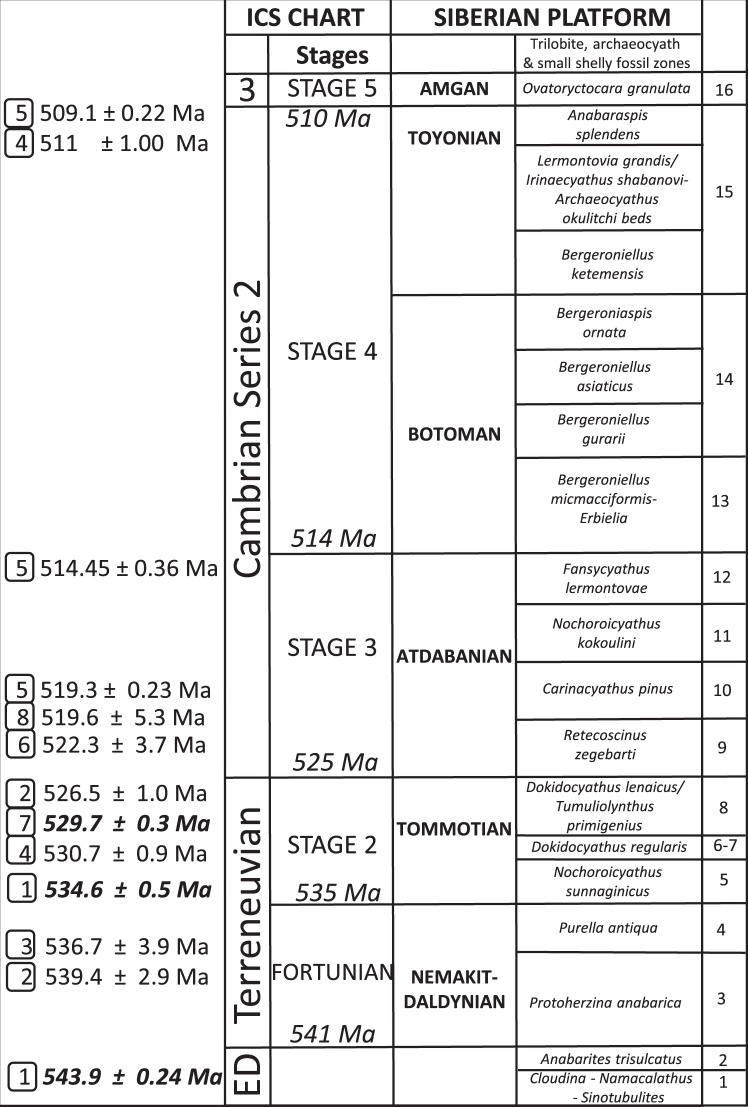
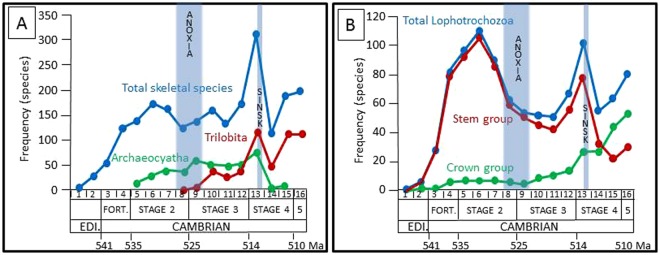
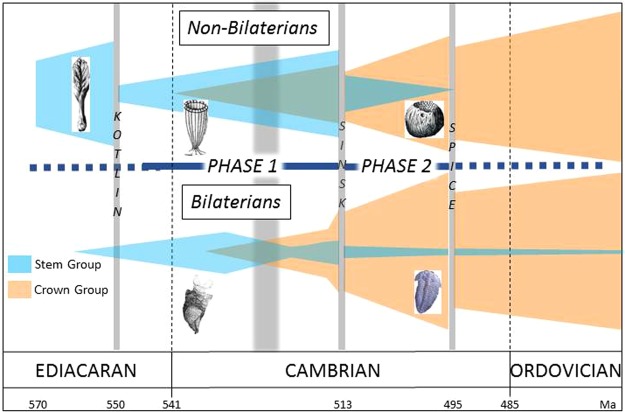
The dynamics of how metazoan phyla appeared and evolved – known as the Cambrian Explosion – remains elusive. We present a quantitative analysis of the temporal distribution (based on occurrence data of fossil species sampled in each time interval) of lophotrochozoan skeletal species (n = 430) from the terminal Ediacaran to Cambrian Stage 5 (~545 – ~505 Million years ago (Ma)) of the Siberian Platform, Russia. We use morphological traits to distinguish between stem and crown groups. Possible skeletal stem group lophophorates, brachiopods, and molluscs (n = 354) appear in the terminal Ediacaran (~542 Ma) and diversify during the early Cambrian Terreneuvian and again in Stage 2, but were devastated during the early Cambrian Stage 4 Sinsk extinction event (~513 Ma) never to recover previous diversity. Inferred crown group brachiopod and mollusc species (n = 76) do not appear until the Fortunian, ~537 Ma, radiate in the early Cambrian Stage 3 (~522 Ma), and with minimal loss of diversity at the Sinsk Event, continued to diversify into the Ordovician. The Sinsk Event also removed other probable stem groups, such as archaeocyath sponges. Notably, this diversification starts before, and extends across the Ediacaran/Cambrian boundary and the Basal Cambrian Carbon Isotope Excursion (BACE) interval (~541 to ~540 Ma), ascribed to a possible global perturbation of the carbon cycle. We therefore propose two phases of the Cambrian Explosion separated by the Sinsk extinction event, the first dominated by stem groups of phyla from the late Ediacaran, ~542 Ma, to early Cambrian stage 4, ~513 Ma, and the second marked by radiating bilaterian crown group species of phyla from ~513 Ma and extending to the Ordovician Radiation.
Overview
The claims and statistics of this paper haven’t been checked yet.
Free: it reads the open-access text and checks the first 5 claims that cite a source we can check. Create a free account to check every claim.
Integrity signals
Registry
Cites
Statistics
Figures
Verification
Claims the paper makes
The claims and statistics of this paper haven’t been checked yet.
Free: it reads the open-access text and checks the first 5 claims that cite a source we can check. Create a free account to check every claim.
Claims other papers make about this one
Each is checked against this paper’s own text: does it say what the citing paper says it does?
The source backs part of the claim, not all of it — or backs it for a different population, condition or comparison.
In the citing paper
“Mo and U isotopes show that an increase in oxygenation was punctuated by intervals of expanded anoxic seafloor (41-43)”
From Integrated records of environmental change and evolution challenge the Cambrian Explosion (2019) · cites this paper as [42]
Experimental — accuracy not yet measuredThe source backs part of the claim, not all of it — or backs it for a different population, condition or comparison.
In the citing paper
“Shallow carbonate platforms, such as the Aldan-Lena rivers region, evidence relatively high animal origination rates and biodiversity 42,43 .”
From Possible links between extreme oxygen perturbations and the Cambrian radiation of animals (2019) · cites this paper as [43]
Experimental — accuracy not yet measured
Self-check
Percentages, sums and reported differences re-computed from the paper’s own numbers.
The self-check needs the paper’s full text.
Citations
Cites
The Magnitude of Global Marine Species Diversity
Appeltans, W., Ahyong, S. T., Anderson, G., Angel, M. V., Artois, T., Bailly, N., Bamber, R., Barber, A., Bartsch, I., Berta, A., et al. (2012) · Current Biology · doi:10.1016/j.cub.2012.09.036 · Cited by 1,070
Paleophysiology and end-Permian mass extinction
Knoll, A. H., Bambach, R. K., Payne, J. L., Pruss, S., & Fischer, W. W. (2007) · Earth and Planetary Science Letters · doi:10.1016/j.epsl.2007.02.018 · Cited by 665
The Neoproterozoic assembly of Gondwana and its relationship to the Ediacaran–Cambrian radiation
Meert, J. G., & Lieberman, B. S. (2008) · Gondwana Research · doi:10.1016/j.gr.2007.06.007 · Cited by 549
Calibrating Rates of Early Cambrian Evolution
Bowring, S. A., Grotzinger, J. P., Isachsen, C. E., Knoll, A. H., Pelechaty, S. M., & Kolosov, P. (1993) · Science · doi:10.1126/science.11539488 · Cited by 526
Dynamics of origination and extinction in the marine fossil record
Alroy, J. (2008) · Proceedings of the National Academy of Sciences · doi:10.1073/pnas.0802597105 · Cited by 525
Detecting Regular Sound Changes in Linguistics as Events of Concerted Evolution
Hruschka, D. J., Branford, S., Smith, E. D., Wilkins, J., Meade, A., Pagel, M., & Bhattacharya, T. (2015) · Current Biology · doi:10.1016/j.cub.2014.10.064 · Cited by 522
Co-evolution of eukaryotes and ocean oxygenation in the Neoproterozoic era
Lenton, T. M., Boyle, R. A., Poulton, S. W., Shields-Zhou, G. A., & Butterfield, N. J. (2014) · Nature Geoscience · doi:10.1038/ngeo2108 · Cited by 424
The Cambrian Substrate Revolution
Bottjer, D. J., Hagadorn, J. W., & Dornbos, S. Q. (2000) · CaltechAUTHORS (California Institute of Technology) · Cited by 412
Sepkoski, J. J. (1979) · Paleobiology · doi:10.1017/s0094837300006539 · Cited by 387
The Late Precambrian fossil Kimberella is a mollusc-like bilaterian organism
Fedonkin, M. A., & Waggoner, B. M. (1997) · Nature · doi:10.1038/42242 · Cited by 373
Research works printed but not linked: 4
- Brock GA Palaeobiogeographic affinities of Australian Cambrian faunas Assoc. Australas. Palaeontols Mem. 2000 23 1 61
- Larsson CM Paterimitra pyramidalis from South Australia: scleritome, shell structure and evolution of a lower Cambrian stem group brachiopod Palaeontology 2014 54 414 446
- Ponder WF Parkhaev P Yu. Beechey DL A remarkable similarity in scaly shell structure in Early Cambrian univalved limpets (Monoplacophora; Maikhanellidae) and a Recent fissurellid limpet (Gastropoda: Vetigastropoda) with a review of Maikhanellidae Mollusc. Res. 2007 27 153 163
- Erwin, D. H. Extinction: How Life Nearly Died 250 Million Years Ago. (Princeton University Press, Princeton, 2006).
Cited by
Integrated records of environmental change and evolution challenge the Cambrian Explosion
Wood, R., Liu, A. G., Bowyer, F., Wilby, P. R., Dunn, F. S., Kenchington, C. G., Cuthill, J. F. H., Mitchell, E. G., & Penny, A. (2019) · Nature Ecology & Evolution · doi:10.1038/s41559-019-0821-6 · Cited by 337
Self-citationPossible links between extreme oxygen perturbations and the Cambrian radiation of animals
He, T., Zhu, M., Mills, B. J. W., Wynn, P. M., Zhuravlev, A. Y., Tostevin, R., Pogge von Strandmann, P. A. E., Yang, A., Poulton, S. W., & Shields, G. A. (2019) · Nature Geoscience · doi:10.1038/s41561-019-0357-z · Cited by 193
Self-citationThe Scaly-foot Snail genome and implications for the origins of biomineralised armour
Sun, J., Chen, C., Miyamoto, N., Li, R., Sigwart, J. D., Xu, T., Sun, Y., Wong, W. C., Ip, J. C., Zhang, W., et al. (2020) · Nature Communications · doi:10.1038/s41467-020-15522-3 · Cited by 139
Atmosphere-ocean oxygen and productivity dynamics during early animal radiations
Dahl, T. W., Connelly, J. N., Li, D., Kouchinsky, A., Gill, B. C., Porter, S., Maloof, A. C., & Bizzarro, M. (2019) · Proceedings of the National Academy of Sciences · doi:10.1073/pnas.1901178116 · Cited by 113
Diverse biomineralizing animals in the terminal Ediacaran Period herald the Cambrian explosion
Cai, Y., Xiao, S., Li, G., & Hua, H. (2019) · Geology · doi:10.1130/g45949.1 · Cited by 94
The Great Ordovician Biodiversification Event (GOBE) is not a single event
Servais, T., Cascales-Miñana, B., & Harper, D. A. T. (2021) · Paleontological Research · doi:10.2517/2021pr001 · Cited by 88
Early Palaeozoic diversifications and extinctions in the marine biosphere: a continuum of change
Harper, D. A. T., Cascales-Miñana, B., & Servais, T. (2020) · Geological Magazine · doi:10.1017/s0016756819001298 · Cited by 83
Servais, T., Cascales-Miñana, B., Harper, D. A. T., Lefebvre, B., Munnecke, A., Wang, W., & Zhang, Y. (2023) · Palaeogeography, Palaeoclimatology, Palaeoecology · doi:10.1016/j.palaeo.2023.111592 · Cited by 74
Topper, T., Betts, M. J., Dorjnamjaa, D., Li, G., Li, L., Altanshagai, G., Enkhbaatar, B., & Skovsted, C. B. (2022) · Earth-Science Reviews · doi:10.1016/j.earscirev.2022.104017 · Cited by 64
“…between Ediacaran and Cambrian biotas may have been overestimated and the skeletal faunas of the latest Ediacaran and earliest Cambrian therefore represent a continuous evolutionary progression (Zhu et al., 2017; Zhuravlev and Wood, 2018; Wood et al., 2019; Cai et al., 2019; Bowyer et al., 2022).”
BackgroundThe Ediacaran–Cambrian boundary: Evaluating stratigraphic completeness and the Great Unconformity
Shahkarami, S., Buatois, L. A., Mángano, M. G., Hagadorn, J. W., & Almond, J. (2020) · Precambrian Research · doi:10.1016/j.precamres.2020.105721 · Cited by 49
Yang, H., Xiao, J., Xia, Y., Xie, Z., Tan, Q., Xu, J., He, S., Wu, S., Liu, X., & Gong, X. (2021) · Geoscience Frontiers · doi:10.1016/j.gsf.2021.101187 · Cited by 45
Crouch, N. M. A., Edie, S. M., Collins, K. S., Bieler, R., & Jablonski, D. (2021) · Proceedings of the Royal Society B Biological Sciences · doi:10.1098/rspb.2021.2178 · Cited by 75
Scaphopoda is the sister taxon to Bivalvia: Evidence of ancient incomplete lineage sorting
Song, H., Wang, Y., Shao, H., Li, Z., Hu, P., Yap-Chiongco, M. K., Shi, P., Zhang, T., Li, C., Wang, Y., et al. (2023) · Proceedings of the National Academy of Sciences · doi:10.1073/pnas.2302361120 · Cited by 52
Dynamic and synchronous changes in metazoan body size during the Cambrian Explosion
Zhuravlev, A. Y., & Wood, R. (2020) · Scientific Reports · doi:10.1038/s41598-020-63774-2 · Cited by 38
Self-citationLai, Q., Yao, S., Zha, Y., Zhang, H., Zhang, H., Ye, Y., Zhang, Y., Bai, H. W., & Ning, K. (2025) · Nucleic Acids Research · doi:10.1093/nar/gkaf305 · Cited by 53
Amorim, K. B., Afonso, J. W. L., Leme, J. D. M., Diniz, C. Q. C., Rivera, L. C. M., Gómez‐Gutiérrez, J. C., Boggiani, P. C., & Trindade, R. I. F. (2020) · Sedimentology · doi:10.1111/sed.12749 · Cited by 43
Huang, W., Tarduno, J. A., Zhou, T., Ibáñez-Mejía, M., Olmo‐Barbosa, L. D., Koester, E., Blackman, E. G., Smirnov, A. V., Ahrendt, G. C., Cottrell, R. D., et al. (2024) · Communications Earth & Environment · doi:10.1038/s43247-024-01360-4 · Cited by 49
Mussini, G., & Dunn, F. S. (2023) · Biological reviews/Biological reviews of the Cambridge Philosophical Society · doi:10.1111/brv.13014 · Cited by 37
(Re)proposal of three Cambrian Subsystems and their Geochronology
Landing, E., Geyer, G., Schmitz, M. D., Wotte, T., & Kouchinsky, A. (2020) · Episodes · doi:10.18814/epiiugs/2020/020088 · Cited by 33
Guo, J., Han, J., Iten, H. V., Song, Z., Qiang, Y., Wang, W., Zhang, Z., Li, G., Sun, Y., & Sun, J. (2019) · Journal of Paleontology · doi:10.1017/jpa.2019.101 · Cited by 32
Khor, J. M., & Ettensohn, C. A. (2020) · Frontiers in Genetics · doi:10.3389/fgene.2020.569314 · Cited by 29
Makashov, A. A., Malov, S. V., & Kozlov, A. P. (2019) · Scientific Reports · doi:10.1038/s41598-019-52835-w · Cited by 31
Wernström, J. V., Gąsiorowski, L., & Hejnol, A. (2022) · EvoDevo · doi:10.1186/s13227-022-00202-8 · Cited by 26
Luo, C., & Miao, L. (2020) · Palaeogeography Palaeoclimatology Palaeoecology · doi:10.1016/j.palaeo.2020.109635 · Cited by 25
O’Connor, O., & McVeigh, T. P. (2025) · BJC Reports · doi:10.1038/s44276-025-00135-4 · Cited by 44
Tarduno, J. A., Zhou, T., Huang, W., & Jodder, J. (2025) · National Science Review · doi:10.1093/nsr/nwaf082 · Cited by 46
Protomelission is an early dasyclad alga and not a Cambrian bryozoan
Yang, J., Lan, T., Zhang, X., & Smith, M. R. (2023) · Nature · doi:10.1038/s41586-023-05775-5 · Cited by 22
The fossil record of freshwater Gastropoda – a global review
Neubauer, T. A. (2023) · Biological reviews/Biological reviews of the Cambridge Philosophical Society · doi:10.1111/brv.13016 · Cited by 25
From organisms to biodiversity: the ecology of the Ediacaran/Cambrian transition
Mitchell, E. G., & Pates, S. (2025) · Paleobiology · doi:10.1017/pab.2024.21 · Cited by 30
Tectonic trigger to the first major extinction of the Phanerozoic: the early Cambrian Sinsk event
Myrow, P. M., Goodge, J. W., Brock, G. A., Betts, M. J., Park, T.-Y. S., Hughes, N. C., & Gaines, R. R. (2024) · Science Advances · doi:10.1126/sciadv.adl3452 · Cited by 22
Sun, H., Zhao, F., Steiner, M., Li, G., Na, L., Pan, B., Yin, Z., Zeng, H., Iten, H. V., & Zhu, M. (2020) · Palaeogeography Palaeoclimatology Palaeoecology · doi:10.1016/j.palaeo.2019.109580 · Cited by 20
Low oxygen but dynamic marine redox conditions permitted the Cambrian Radiation
Alexander, R. D., Zhuravlev, A. Y., Bowyer, F. T., Pichevin, L., Poulton, S. W., Kouchinsky, A., & Wood, R. A. (2025) · Science Advances · doi:10.1126/sciadv.ads2846 · Cited by 24
Self-citationZhang, L., Chang, S., Khan, M. Z., Feng, Q., Luo, C., Steiner, M., Forel, M., Liu, K., & Clausen, S. (2020) · Palaeogeography Palaeoclimatology Palaeoecology · doi:10.1016/j.palaeo.2020.109696 · Cited by 14
Oxygen increase and the pacing of early animal evolution
Kaiho, K., Shizuya, A., Kikuchi, M., Komiya, T., Chen, Z., Tong, J., Tian, L., Gorjan, P., Takahashi, S., Baud, A., et al. (2024) · Global and Planetary Change · doi:10.1016/j.gloplacha.2024.104364 · Cited by 14
Transgression–regression cycles drive correlations in Ediacaran–Cambrian rock and fossil records
Segessenman, D. C., & Peters, S. E. (2024) · Paleobiology · doi:10.1017/pab.2023.31 · Cited by 13
“In addition to the stark changes in rock quantity and biodiversity discussed above, there is an equally dramatic shift in the over-all character of metazoans from the Ediacaran to the Cambrian (Butterfield 2009; Darroch et al. 2018; Zhuravlev and Wood 2018; Bowyer et al. 2022).”
BackgroundPhylogenetic response of naraoiid arthropods to early–middle Cambrian environmental change
Bond, A. D., & Edgecombe, G. D. (2020) · Palaeontology · doi:10.1111/pala.12516 · Cited by 12
Etemad‐Saeed, N., Knoll, A. H., Najafi, M., Bergmann, K., Haseley, N. R., & Karimi, S. (2021) · Gondwana Research · doi:10.1016/j.gr.2021.07.001 · Cited by 11
Korovnikov, I. V., Marusin, V. V., Tokarev, D. A., & Obut, O. T. (2019) · Paleontological Journal · doi:10.1134/s0031030119060030 · Cited by 11
Quantifying the rise of animals during the Ediacaran–Cambrian using ichnodissimilarity
Wang, Z., Rahman, I. A., & Zhang, L. (2024) · Paleobiology · doi:10.1017/pab.2024.40 · Cited by 8
A Cambrian soft-bodied biota after the first Phanerozoic mass extinction
Zeng, H., Liu, Q., Zhao, F., Luo, C., Wang, D., Zhu, Y., Liu, Y., Chen, K., Sun, Z., Hong, Y. T., et al. (2026) · Nature · doi:10.1038/s41586-025-10030-0 · Cited by 14
Renewed perspectives on the sedentary-pelagic last common bilaterian ancestor
Martynov, A. V., & Korshunova, T. (2022) · Bijdragen tot de Dierkunde · doi:10.1163/18759866-bja10034 · Cited by 7
Marshall, P. E., Faggetter, L. E., & Widdowson, M. (2021) · Geophysical monograph · doi:10.1002/9781119507444.ch19 · Cited by 10
Murphy, A., Penny, A., Zhuravlev, A. Y., & Wood, R. A. (2025) · Proceedings of the Royal Society B Biological Sciences · doi:10.1098/rspb.2025.0968 · Cited by 10
Self-citationWei, K., Cao, H., Chen, F., Wang, Z., An, Z., Huang, H., & Chen, C. (2023) · Geological Magazine · doi:10.1017/s0016756823000833 · Cited by 5
The struggle to equilibrate outer and inner milieus: Renal evolution revisited
Keogh, L., Kilroy, D. P., & Bhattacharjee, S. (2020) · Annals of Anatomy - Anatomischer Anzeiger · doi:10.1016/j.aanat.2020.151610 · Cited by 11
Luo, J., Hua, H., Gong, M., Hou, Y., Dai, Q., Zhang, S., Wang, X., & Bai, L. (2024) · Papers in Palaeontology · doi:10.1002/spp2.1596 · Cited by 6
Cordie, D. R. (2023) · Evolving Earth · doi:10.1016/j.eve.2023.100002 · Cited by 5
Adachi, N., Ezaki, Y., Liu, J., & Yan, Z. (2023) · Palaeogeography Palaeoclimatology Palaeoecology · doi:10.1016/j.palaeo.2023.111804 · Cited by 5
Pruss, S. B., Karbowski, G., Zhuravlev, A. Y., WEBSTER, M., & Smith, E. F. (2024) · Palaios · doi:10.2110/palo.2024.005 · Cited by 5
Self-citationHe, Q., Shi, K., Ma, Y., Liu, B., Han, J., Li, J., Bai, X., Wu, C. H., McArthur, A. D., & Mountney, N. P. (2024) · Marine and Petroleum Geology · doi:10.1016/j.marpetgeo.2024.107215 · Cited by 5
Neilson, J., Barili, R., Brasier, M., Ros, L. F. D., & Ledingham, S. R. (2021) · The Depositional Record · doi:10.1002/dep2.172 · Cited by 6
Rise and fall of archaeocyath reefs shaped early Cambrian skeletal animal abundance
Pruss, S. B., Smith, E. F., Zhuravlev, A. Y., Nolan, R. Z., & McGann, T. C. (2025) · Palaeogeography Palaeoclimatology Palaeoecology · doi:10.1016/j.palaeo.2025.112852 · Cited by 4
Self-citationOh, Y., Park, T. S., & Peel, J. S. (2025) · Palaeogeography Palaeoclimatology Palaeoecology · doi:10.1016/j.palaeo.2025.113338 · Cited by 5
Hammarlund, E. U., Bukkuri, A., Norling, M. D., Islam, M., Posth, N. R., Baratchart, E., Carroll, C., Amend, S. R., Gatenby, R. A., Pienta, K. J., et al. (2025) · Nature Communications · doi:10.1038/s41467-025-57345-0 · Cited by 6
Evolutionary Trajectories of Consciousness: From Biological Foundations to Technological Horizons
Gusev, E., Sarapultsev, A., & Komelkova, M. V. (2025) · Brain Sciences · doi:10.3390/brainsci15070734 · Cited by 6
Animal abundance and redox conditions during the Furongian Cambrian SPICE event, western Utah
Olsen, A. E., Jones, D. S. J., Fike, D. A., & Pruss, S. B. (2023) · Palaeogeography Palaeoclimatology Palaeoecology · doi:10.1016/j.palaeo.2023.111794 · Cited by 6
Ecological novelty at the start of the Cambrian and Ordovician radiations of echinoderms
Novack‐Gottshall, P. M., Purcell, J. N., Sultan, A., Ranjha, I., Deline, B., & Sumrall, C. D. (2024) · Palaeontology · doi:10.1111/pala.12688 · Cited by 4
Cui, L., Liu, W., Li, J., & Zhang, X. (2024) · Palaeogeography Palaeoclimatology Palaeoecology · doi:10.1016/j.palaeo.2024.112339 · Cited by 5
Dub, S. A. (2021) · Russian Geology and Geophysics · doi:10.2113/rgg20204205 · Cited by 4
Morphological disparity and evolutionary patterns of Cambrian hyoliths
Liu, F., Topper, T. P., Strotz, L. C., Liang, Y., Hu, Y., Skovsted, C. B., & Zhang, Z. (2024) · Papers in Palaeontology · doi:10.1002/spp2.1554 · Cited by 3
Yang, B., Chen, D., & Liu, M. (2025) · Palaeogeography Palaeoclimatology Palaeoecology · doi:10.1016/j.palaeo.2025.112881 · Cited by 4
Lee, J., Park, J., Seo, J., Choi, T., Park, S.-I., Lee, Y., & Lee, G. (2025) · Earth-Science Reviews · doi:10.1016/j.earscirev.2025.105244 · Cited by 4
Zhang, Y.-N., Liu, Y.-H., Shao, T.-Q., Wang, Q., Qin, J., Li, L.-L., & Zhou, X. (2022) · Palaeoworld · doi:10.1016/j.palwor.2022.03.008 · Cited by 3
Aftabi, A., & Mohseni, S. (2019) · Ore Geology Reviews · doi:10.1016/j.oregeorev.2019.103113 · Cited by 3
Kono, S., Isozaki, Y., Sato, T., Zhang, X., & Wei, L. I. U. (2021) · Journal of Geography (Chigaku Zasshi) · doi:10.5026/jgeography.130.43 · Cited by 2
Wendt, J. (2020) · Journal of Paleontology · doi:10.1017/jpa.2019.109 · Cited by 4
Cabej, N. R. (2019) · Elsevier eBooks · doi:10.1016/b978-0-12-814311-7.00004-4 · Cited by 2
��, Ï., ��, �., ��, �., ��, �., & ��, �. (2019) · SCIENTIA SINICA Terrae · doi:10.1360/sste-2019-0183 · Cited by 1
Marshall, P. E., Faggetter, L. E., & Widdowson, M. (2022) · EarthArXiv (California Digital Library) · doi:10.31223/x56c7q · Cited by 2
Wang, Z., Fang, H., Xie, Y., Jiao, P., Wen, Z., Lin, J., & Xie, X. (2025) · Palaeogeography Palaeoclimatology Palaeoecology · doi:10.1016/j.palaeo.2025.113098 · Cited by 1
Zhang, D., Zhou, M., Zhou, Z.-F., Xue, X., Fan, H.-F., Zhou, L., Yang, E.-L., Zhang, Z., Wu, Z., & Luo, T. (2026) · Communications Earth & Environment · doi:10.1038/s43247-026-03243-2 · Cited by 1
Luo, M., Topper, T. P., Li, G., Song, B., Wang, Z., Zhang, C., Zhao, J., Wang, P., Fu, R., Liu, F., et al. (2026) · Palaeogeography Palaeoclimatology Palaeoecology · doi:10.1016/j.palaeo.2026.113749 · Cited by 1
Oh, Y., Park, T. S., & Peel, J. S. (2026) · Papers in Palaeontology · doi:10.1002/spp2.70113 · Cited by 1
Goswami, V., Hannah, J. L., Stein, H. J., Ahlberg, P., Maletz, J., Lundberg, F., & Ebbestad, J. O. R. (2024) · Global and Planetary Change · doi:10.1016/j.gloplacha.2024.104580 · Cited by 1
Morphological Evolution and Extinction of Eodiscids and Agnostoid Arthropods
Li, H., Dai, T., Chen, Y., Xue, C., & Strotz, L. C. (2024) · Life · doi:10.3390/life15010038 · Cited by 1
På sporet av de mystiske ediacara-skapningenestapte tid
Rugstad, A. (2019) · Naturen · doi:10.18261/issn.1504-3118-2019-04-06
Sarsembaev, Z. A., & Marusin, V. V. (2019) · Estudios Geológicos · doi:10.3989/egeol.43595.568 · Cited by 4
Condie, K. C. (2021) · Elsevier eBooks · doi:10.1016/b978-0-12-819914-5.00003-2
(2021) · Elsevier eBooks · doi:10.1016/b978-0-12-819914-5.00008-1
Helcionelloids from the Cambrian Fortunian of the Northern Yangtze Platform, China
Zhang, M., Yanchun, P. A. N. G., Ben, Y. A. N. G., He, Y., Liang, S., Hu, Q., & Li, L. (2023) · Acta Geologica Sinica - English Edition · doi:10.1111/1755-6724.15109
Simulation of Ediacaran Cloudina tubular growth model via electrochemical synthesis
Cao, J., Meng, F., & Cai, Y. (2024) · Journal of Asian Earth Sciences · doi:10.1016/j.jseaes.2024.106056
Neilson, J., Gómez-Rivas, E., Martín‐Martín, J. D., Barili, R., & Ros, L. F. D. (2024) · SSRN Electronic Journal · doi:10.2139/ssrn.4768318
The nature of the rock record: Through the lens of the rock cycle
Walton, C. R. (2024) · Elsevier eBooks · doi:10.1016/b978-0-323-99762-1.00120-0 · Cited by 1
Wernström, J. V., Gąsiorowski, L., & Hejnol, A. (2022) · Figshare · doi:10.6084/m9.figshare.21162865
Zhang, Q., Bai, L., Li, J. M., Chen, Y. M., Chang, C., Strotz, L., Liu, F., Zhang, L., & Zhang, Z. Q. (2026) · Palaeogeography Palaeoclimatology Palaeoecology · doi:10.1016/j.palaeo.2026.114011
Luo, J., Zhang, S., Min, X., Hua, H., Gong, M., Dai, Q., Bai, L., Hou, Y., Wang, X., Wang, X., et al. (2026) · Gondwana Research · doi:10.1016/j.gr.2026.06.013
Wei, K., Cao, H., Wang, Z., An, Z., Chen, F., Huang, H., Chen, C., & Zeng, Y. (2026) · Palaeogeography Palaeoclimatology Palaeoecology · doi:10.1016/j.palaeo.2026.114146
An updated strontium isotope curve for early Cambrian seawater
Xu, A., He, T., Shields, G., von Strandmann, P. A. E. P., Zhuravlev, A. Y., Zhou, Y., THIRLWALL, M. F., Manning, C., Zhang, Y., Yang, C., et al. (2026) · Palaeogeography Palaeoclimatology Palaeoecology · doi:10.1016/j.palaeo.2026.114244
Self-citationHuang, J., Xing, C., Sun, Y., Kershaw, S., & Shen, B. (2026) · Gondwana Research · doi:10.1016/j.gr.2026.09.006
Extreme post-Marinoan warmth constrained by continental weathering and paleolatitude
Kaiho, K., Roser, B., Roy, D. K., Kamei, A., Chen, Z.-Q., Tong, J., Takahashi, S., Baud, A., & Shizuya, A. (2026) · Palaeogeography Palaeoclimatology Palaeoecology · doi:10.1016/j.palaeo.2026.114292
Exploring Plant Consciousness: A Critical Review of Cellular Basis, Local, and Non-Local Theories
Torabi, S., & Semsarha, F. (2026) · Biosemiotics · doi:10.1007/s12304-026-09670-0
Metadata
- Authors
- Zhuravlev, A. Y., & Wood, R. A.
- Affiliations
- Lomonosov Moscow State University (RU)
- University of Edinburgh (GB)
- Corresponding author
- Wood, Rachel A.
- Venue
- Scientific Reports
- Published
- 2018-11-09
- Volume
- 8
- Issue
- 1
- Pages
- 16656-16656
- ISSN
- 2045-2322 (ISSN-L)
- PMC
- PMC6226464
- OpenAlex
- W2900125886
- Cited by
- 92
- References
- 107
- Citations by year
- 2026: 11 · 2025: 13 · 2024: 15 · 2023: 12 · 2022: 5 · 2021: 10 · 2020: 13 · 2019: 13
- FWCI
- 6.62
- Type
- journal article
- Language
- en
- Open access
- gold
- doi.org
- Licence
- cc-by
- creativecommons.org/licenses/by/4.0 (tdm)
- creativecommons.org/licenses/by/4.0 (vor)
- Locations
- Scientific Reports (publishedVersion, cc-by)
- Europe PMC (PubMed Central) (publishedVersion, other-oa)
- PubMed Central (publishedVersion, cc-by)
- PubMed (publishedVersion)
- DOAJ (DOAJ: Directory of Open Access Journals) (submittedVersion)
- Edinburgh Research Explorer (University of Edinburgh) (submittedVersion, cc-by)
- Topics
- Physical Sciences › Earth and Planetary Sciences › Paleontology › Paleontology and Stratigraphy of Fossils
- Physical Sciences › Earth and Planetary Sciences › Paleontology › Evolution and Paleontology Studies
- Physical Sciences › Earth and Planetary Sciences › Paleontology › Paleontology and Evolutionary Biology
- Keywords
- Cambrian explosion, lophotrochozoans, Ediacaran-Cambrian boundary, brachiopods, Mollusca, lophophorates, metazoan diversification, Siberian Platform, Ordovician radiation
- MeSH terms
- Animals, Biological Evolution, Fossils, Invertebrates, Biodiversity, Biota, Animal Distribution
About these checks
Registry, retraction, Cites and statistics results are computed, not judged, with one exception: a printed reference that no index lists is read once by a model before it counts as a citation error. Claims are extracted by a model and kept only when their quote appears verbatim in the text; each cited source is then checked, with a model’s help, for whether it says what the claim relies on. Those verdicts can be wrong — read the claim’s quote and the cited source before relying on one.
Statistics and arithmetic are recomputed, not judged.
Confidence bands are shown only for fields calibrated on our annotated test set. None is calibrated yet, so no band is shown.
What counts as a claim ›How we measure confidence ›How we check this ›
Are you an author, or do you see a problem with this page? Request a review
Data sources
Bibliographic data: Semantic Scholar, OpenAlex, Crossref.
Contains information from the Semantic Scholar Academic Graph Datasets, made available under the ODC Attribution License (ODC-BY 1.0).
Semantic Scholar’s data is described in: Kinney, R., et al. (2023). The Semantic Scholar Open Data Platform. arXiv:2301.10140.
