

Evolutionary dynamics of the chromatophore genome in three photosynthetic Paulinella species
Open accessThe DOI matches its Crossref record; 87 of the 87 references it cites were found in a registry or an index.
Abstract
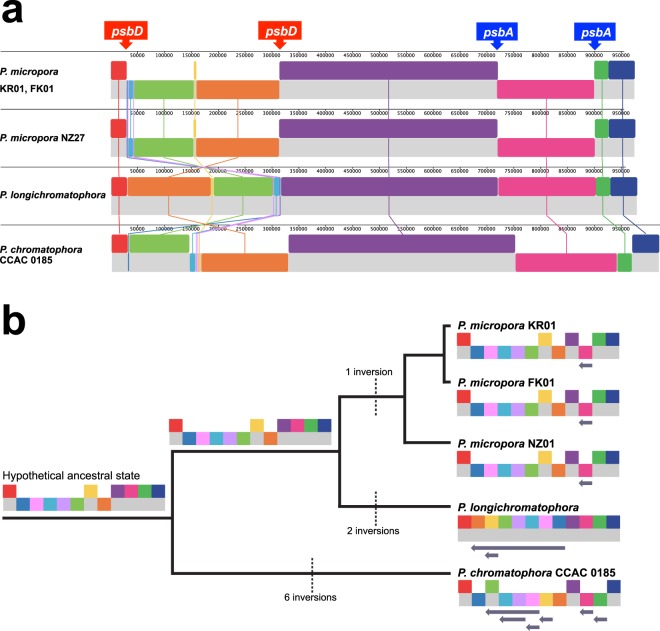
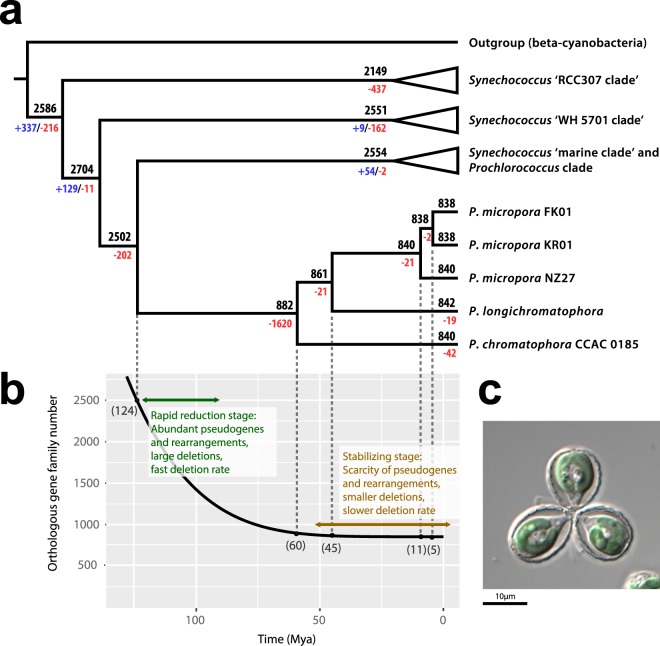
The thecate amoeba Paulinella is a valuable model for understanding plastid organellogenesis because this lineage has independently gained plastids (termed chromatophores) of alpha-cyanobacterial provenance. Plastid primary endosymbiosis in Paulinella occurred relatively recently (90–140 million years ago, Mya), whereas the origin of the canonical Archaeplastida plastid occurred >1,500 Mya. Therefore, these two events provide independent perspectives on plastid formation on vastly different timescales. Here we generated the complete chromatophore genome sequence from P . longichromatophora (979,356 bp, GC-content = 38.8%, 915 predicted genes) and P . micropora NZ27 (977,190 bp, GC-content = 39.9%, 911 predicted genes) and compared these data to that from existing chromatophore genomes. Our analysis suggests that when a basal split occurred among photosynthetic Paulinella species ca. 60 Mya, only 35% of the ancestral orthologous gene families from the cyanobacterial endosymbiont remained in chromatophore DNA. Following major gene losses during the early stages of endosymbiosis, this process slowed down significantly, resulting in a conserved gene content across extant taxa. Chromatophore genes faced relaxed selection when compared to homologs in free-living alpha-cyanobacteria, likely reflecting the homogeneous intracellular environment of the Paulinella host. Comparison of nucleotide substitution and insertion/deletion events among different P . micropora strains demonstrates that increases in AT-content and genome reduction are ongoing and dynamic processes in chromatophore evolution.
Overview
The claims and statistics of this paper haven’t been checked yet.
Free: it reads the open-access text and checks the first 5 claims that cite a source we can check. Create a free account to check every claim.
Integrity signals
Registry
Cites
Statistics
Figures
Verification
Claims the paper makes
The claims and statistics of this paper haven’t been checked yet.
Free: it reads the open-access text and checks the first 5 claims that cite a source we can check. Create a free account to check every claim.
Claims other papers make about this one
Each is checked against this paper’s own text: does it say what the citing paper says it does?
The source backs part of the claim, not all of it — or backs it for a different population, condition or comparison.
In the citing paper
“The differential loss of some genes between the studied chromatophore genomes indicates that genome reduction is still underway, but overall the chromatophore appears to be in a stabilizing stage (i.e., the rate of EGT has significantly decreased).”
From Genomic Insights into Plastid Evolution (2020) · cites this paper as Lhee et al. 2019
Experimental — accuracy not yet measuredThe cited source says what the claim attributes to it.
In the citing paper
“Lhee et al. (2019) showed conservation of gene content and genome structure between the chromatophore genomes of a variety of Paulinella species and strains, suggesting that most of the genome reduction (∼65% of the protein coding genes) occurred in the common ancestor of studied Paulinella species before they diverged from one another.”
From Genomic Insights into Plastid Evolution (2020) · cites this paper as Lhee et al. 2019
Self-check
Percentages, sums and reported differences re-computed from the paper’s own numbers.
The self-check needs the paper’s full text.
Citations
Cites
MAFFT Multiple Sequence Alignment Software Version 7: Improvements in Performance and Usability
Katoh, K., & Standley, D. M. (2013) · Molecular Biology and Evolution · doi:10.1093/molbev/mst010 · Cited by 46,209
KEGG: Kyoto Encyclopedia of Genes and Genomes
Kanehisa, M. (2000) · Nucleic Acids Research · doi:10.1093/nar/28.1.27 · Cited by 37,077
KEGG: Kyoto Encyclopedia of Genes and Genomes
Ogata, H., Goto, S., Sato, K., Fujibuchi, W., Bono, H., & Kanehisa, M. (1999) · Nucleic Acids Research · doi:10.1093/nar/27.1.29 · Cited by 31,232
IQ-TREE: A Fast and Effective Stochastic Algorithm for Estimating Maximum-Likelihood Phylogenies
Nguyen, L.-T., Schmidt, H. A., von Haeseler, A., & Minh, B. Q. (2015) · Molecular Biology and Evolution · doi:10.1093/molbev/msu300 · Cited by 26,046
BLAST+: architecture and applications
Camacho, C., Coulouris, G., Avagyan, V., Ma, N., Papadopoulos, J., Bealer, K., & Madden, T. L. (2009) · BMC Bioinformatics · doi:10.1186/1471-2105-10-421 · Cited by 22,074
Fast, scalable generation of high‐quality protein multiple sequence alignments using Clustal Omega
Sievers, F., Wilm, A., Dineen, D., Gibson, T. J., Karplus, K., Li, W., Lopez, R., McWilliam, H., Remmert, M., Söding, J., et al. (2011) · Molecular Systems Biology · doi:10.1038/msb.2011.75 · Cited by 15,355
PAML 4: Phylogenetic Analysis by Maximum Likelihood
Yang, Z. (2007) · Molecular Biology and Evolution · doi:10.1093/molbev/msm088 · Cited by 13,879
tRNAscan-SE: A Program for Improved Detection of Transfer RNA Genes in Genomic Sequence
Lowe, T. M., & Eddy, S. R. (1997) · Nucleic Acids Research · doi:10.1093/nar/25.5.955 · Cited by 10,905
MUSCLE: a multiple sequence alignment method with reduced time and space complexity
Edgar, R. C. (2004) · BMC Bioinformatics · doi:10.1186/1471-2105-5-113 · Cited by 8,970
BEAST 2: a software platform for Bayesian evolutionary analysis
Bouckaert, R., Heled, J., Kühnert, D., Vaughan, T., Wu, C.-H., Xie, D., Suchard, M. A., Rambaut, A., & Drummond, A. J. (2014) · PLoS Computational Biology · doi:10.1371/journal.pcbi.1003537 · Cited by 6,527
Research works printed but not linked: 1
- Lauterborn RP II. Paulinella chromatophora nov. gen., nov. spec., ein beschalter Rhizopode des Süßwassers mit blaugrünen chromatophorenartigen Einschlüssen Z. Wiss. Zool. 1895 59 537 544
Cited by
Genomic Insights into Plastid Evolution
Sibbald, S. J., & Archibald, J. M. (2020) · Genome Biology and Evolution · doi:10.1093/gbe/evaa096 · Cited by 161
Phytoplankton pangenome reveals extensive prokaryotic horizontal gene transfer of diverse functions
Fan, X., Qiu, H., Han, W., Wang, Y., Xu, D., Zhang, X., Bhattacharya, D., & Ye, N. (2020) · Science Advances · doi:10.1126/sciadv.aba0111 · Cited by 66
Self-citationKrauspe, V., Fahrner, M., Spät, P., Steglich, C., Frankenberg-Dinkel, N., Maček, B., Schilling, O., & Hess, W. R. (2021) · Proceedings of the National Academy of Sciences · doi:10.1073/pnas.2012277118 · Cited by 54
“Homologous genes were also detected in the three available chromatophore genomes of photosynthetic Paulinella species (53).”
Krauspe, V., Fahrner, M., Spät, P., Steglich, C., Frankenberg-Dinkel, N., Macek, B., Schilling, O., & Hess, W. R. (2020) · doi:10.1101/2020.06.14.150680 · Cited by 54
“Homologous genes were also detected in the three available 190 chromatophore genomes of photosynthetic Paulinella species (52).”
BackgroundThe convoluted history of haem biosynthesis
Kořený, L., Oborník, M., Horáková, E., Waller, R. F., & Lukeš, J. (2021) · Biological reviews/Biological reviews of the Cambridge Philosophical Society · doi:10.1111/brv.12794 · Cited by 80
“This so-called chromatophore resembles a free-living cyanobacterium much more than the extant Archaeplastida plastids (Lhee et al., 2019).”
BackgroundEndosymbiotic selective pressure at the origin of eukaryotic cell biology
Raval, P. K., Garg, S. G., & Gould, S. B. (2022) · eLife · doi:10.7554/elife.81033 · Cited by 65
“The same is true for an independent plastid acquisition by a rhizarian protist (Lhee et al., 2019) and likely many other endosymbiontbearing protists (Husnik et al.”
Paulinella , a model for understanding plastid primary endosymbiosis
Gabr, A., Grossman, A. R., & Bhattacharya, D. (2020) · Journal of Phycology · doi:10.1111/jpy.13003 · Cited by 53
“In fact, preliminary analysis of the first two draft genome assemblies of Paulinella (P. micropora strains KR01, MynA) have recently been made available and demonstrate the dynamic nature of genome evolution in this phototrophic lineage (Lhee et al. 2019b, Matsuo et al. 2019).”
BackgroundInfluentialSelf-citationAmoeba Genome Reveals Dominant Host Contribution to Plastid Endosymbiosis
Lhee, D., Lee, J., Ettahi, K., Cho, C. H., Ha, J.-S., Chan, Y., Zelzion, U., Stephens, T. G., Price, D. C., Gabr, A., et al. (2020) · Molecular Biology and Evolution · doi:10.1093/molbev/msaa206 · Cited by 42
“For this reason, the Paulinella model has proven invaluable because of the many insights it has provided into plastid integration (Nowack et al. 2008; Bhattacharya et al. 2012; Lhee et al. 2019), including the evolution of novel protein import systems (Nowack and Grossman 2012; Singer et al.”
BackgroundSelf-citationGiannakis, K., Arrowsmith, S. J., Richards, L., Gasparini, S., Chustecki, J. M., Røyrvik, E. C., & Johnston, I. G. (2022) · Cell Systems · doi:10.1016/j.cels.2022.08.007 · Cited by 31
Why is primary endosymbiosis so rare?
Stephens, T. G., Gabr, A., Calatrava, V., Grossman, A. R., & Bhattacharya, D. (2021) · New Phytologist · doi:10.1111/nph.17478 · Cited by 37
“In each chromatophore genome, > 90% of genes are shared among all strains (Lhee et al., 2019) and are under strong purifying selection (dN/dS ratios << 1) (Reyes-Prieto et al.”
BackgroundInfluentialSelf-citationUthanumallian, K., Iha, C., Repetti, S. I., Chan, C. X., Bhattacharya, D., Duchêne, S., & Verbruggen, H. (2021) · Molecular Biology and Evolution · doi:10.1093/molbev/msab295 · Cited by 18
Self-citationProtein import into bacterial endosymbionts and evolving organelles
Sørensen, M., Stiller, M. L., Kröninger, L., & Nowack, E. C. M. (2024) · FEBS Journal · doi:10.1111/febs.17356 · Cited by 15
“With a size of ~ 1 Mbp and containing 878 – 860 protein-coding genes, chromatophore genomes lost around 2/3 of their original coding capacity [53,80,87,88].”
Macorano, L., & Nowack, E. (2021) · Current Biology · doi:10.1016/j.cub.2021.07.028 · Cited by 13
Bhattacharya, D., Etten, J. V., Benites, L. F., & Stephens, T. G. (2022) · BioEssays · doi:10.1002/bies.202200165 · Cited by 13
Self-citationSpeijer, D. (2021) · BioEssays · doi:10.1002/bies.202100069 · Cited by 8
“Going through the excellent Figure 2 of Patrick Keeling’s 2010 review[15], we encounter further examples, such as the secondary uptake of a green alga in the chlorarachniophytes (retaining a nucleomorph[39]), an instance of primary endosymbiosis in the case of the freshwater amoeba Paulinella taking up a cyanobacteriu…”
BackgroundEvolution of Photosynthetic Eukaryotes; Current Opinion, Perplexity, and a New Perspective
Maruyama, S., & Kim, E. (2020) · Results and problems in cell differentiation · doi:10.1007/978-3-030-51849-3_12 · Cited by 7
Brenes‐Álvarez, M., Ropp, H. R., Papagiannidis, D., Potel, C. M., Stein, F., Scholz, I., Steglich, C., Savitski, M. M., Vioque, A., Muro-Pastor, A. M., et al. (2024) · Nucleic Acids Research · doi:10.1093/nar/gkae1247 · Cited by 11
Convergent reductive evolution of cyanobacteria in symbiosis with Dinophysiales dinoflagellates
Nakayama, T., Nomura, M., Yabuki, A., Shiba, K., Inaba, K., & Inagaki, Y. (2024) · Scientific Reports · doi:10.1038/s41598-024-63502-0 · Cited by 7
“17–19 ) reported in previous studies, suggesting that CregCyn and OmCyn appear to maintain relative metabolic independence 18–20 .”
Algae obscura: The potential of rare species as model systems
Etten, J. V., Benites, L. F., Stephens, T. G., Yoon, H. S., & Bhattacharya, D. (2023) · Journal of Phycology · doi:10.1111/jpy.13321 · Cited by 8
“…(P. ovalis) single- cell amplified genome, along with five chromatophore genomes (P. micropora KR01, P. micropora FK01, and P. micropora NZ01, P. longichromatophora, and P. chromatophora CCAC0815) have been produced thus far (Bhattacharya et al., 2012; Lhee et al., 2019; Matsuo et al., 2019).”
BackgroundSelf-citationPosition of Algae on the Tree of Life
Gololobova, M. A., & Belyakova, G. A. (2022) · Doklady Biological Sciences · doi:10.1134/s0012496622060035 · Cited by 12
Pardasani, Y., Palka, M. V., Leander, B., & Burki, F. (2025) · Journal of Eukaryotic Microbiology · doi:10.1111/jeu.70040 · Cited by 3
“Overall, these photosynthetic species have been studied in some detail with genomic, transcriptomic, and even proteomic data (Nowack et al. 2008, 2016; Yoon et al. 2009; Singer et al. 2017; Lhee et al. 2019; Oberleitner et al. 2022).”
Universal features shaping organelle gene retentionPreprint
Giannakis, K., Arrowsmith, S., Richards, L., Gasparini, S., Chustecki, J. M., Røyrvik, E., & Johnston, I. G. (2021) · bioRxiv · doi:10.1101/2021.10.27.465964 · Cited by 3
“[21] Lea Bertgen, Timo Mühlhaus, and Johannes M Herrmann.”
BackgroundIndependent evolution of the thioredoxin system in photosynthetic Paulinella species
Lhee, D., Bhattacharya, D., & Yoon, H. S. (2021) · Current Biology · doi:10.1016/j.cub.2021.02.029 · Cited by 6
Self-citationPaulinella micropora KR01 holobiont genome assembly for studying primary plastid evolutionPreprint
Lhee, D., Lee, J., Cho, C. H., Ha, J.-S., Jeong, S. E., Jeon, C. O., Zelzion, U., Price, D. C., Chan, Y., Gabr, A., et al. (2019) · bioRxiv (Cold Spring Harbor Laboratory) · doi:10.1101/794941 · Cited by 3
Self-citationDating the Origin and Spread of Plastids and Chromatophores
Pietluch, F., Mackiewicz, P., Sidorczuk, K., & Gagat, P. (2025) · International Journal of Molecular Sciences · doi:10.3390/ijms26125569 · Cited by 5
“In turn, these ages are in better agreement with the results of Nowack et al. [8], Delaye et al. [59] and Lhee et al. [60].”
RNA-binding proteins identified by R-DeeP/TripepSVM are involved in heterocyst differentiationPreprint
Brenes-Álvarez, M., Ropp, H. R., Papagiannidis, D., Potel, C. M., Stein, F., Savitski, M. M., Vioque, A., Muro-Pastor, A., & Hess, W. (2024) · bioRxiv · doi:10.1101/2024.04.03.587981 · Cited by 2
Hollender, M., Salek, M., Karlicki, M., & Karnkowska, A. (2024) · Protist · doi:10.1016/j.protis.2024.126018 · Cited by 5
Hypothesis: Trans‐splicing Generates Evolutionary Novelty in the Photosynthetic Amoeba Paulinella
Gabr, A., Stephens, T. G., & Bhattacharya, D. (2022) · Journal of Phycology · doi:10.1111/jpy.13247 · Cited by 3
“PASA–validated aligned transcripts were compared against the reference KR01 predicted genes (Lhee et al. 2021) using gffcompare v0.”
BackgroundMethodInfluentialSelf-citationThe Photosynthetic Adventure of Paulinella Spp
Gagat, P., Sidorczuk, K., Pietluch, F., & Mackiewicz, P. (2020) · Results and problems in cell differentiation · doi:10.1007/978-3-030-51849-3_13 · Cited by 3
Endosymbiotic Origin of Chloroplasts in Plant Cells’ Evolution
Stadnichuk, I. N., & Kusnetsov, V. V. (2021) · Russian Journal of Plant Physiology · doi:10.1134/s1021443721010179 · Cited by 18
Evidence of Relaxed Selection in the Mitochondrial Genomes of Phototrophic Paulinella Lineages
Han, S., Lhee, D., Yang, J. H., Bhattacharya, D., & Yoon, H. S. (2026) · Genome Biology and Evolution · doi:10.1093/gbe/evag052 · Cited by 1
Self-citationJohnston, I. G. (2024) · Genome Biology and Evolution · doi:10.1093/gbe/evae132 · Cited by 1
Gabr, A., Stephens, T. G., Reinfelder, J. R., Liau, P., Calatrava, V., Grossman, A. R., & Bhattacharya, D. (2024) · Environmental Microbiology Reports · doi:10.1111/1758-2229.13304 · Cited by 1
“In contrast, analysis of the chromatophore genome from P. chromatophora (Nowack et al., 2008; NCBI accession NC_011087) and P. longichromatophora (Lhee et al., 2019; NCBI accession MG264610) reveal the presence of an inorganic carbon transporter gene ( ictB ).”
BackgroundResultInfluentialSelf-citationPietluch, F., Mackiewicz, P., Sidorczuk, K., & Gagat, P. (2022) · bioRxiv · doi:10.1101/2022.07.01.497312 · Cited by 1
“(40) estimated that photosynthetic Paulinella species diverged from their heterotrophic relatives 141-94 Mya and 19364 Mya, respectively.”
BackgroundTracking N-terminal protein processing from the Golgi to the chromatophore of a rhizarian amoeba
Meinnel, T. (2022) · PLANT PHYSIOLOGY · doi:10.1093/plphys/kiac173 · Cited by 2
“Paulinellidae , which include the freshwater Paulinella chromatophore and Paulinella micro-pora and the marine Paulinella longichromatophora (Lhee et al., 2019), are euglyphid testate amoebae of the Rhizaria supergroup (Figure 1) displaying a siliceous shell and a photosynthetic organelle, like…”
Genome reduction increases endosymbiont sensitivity and promotes mutualism evolution
Kanai, Y., & Furusawa, C. (2026) · bioRxiv · doi:10.64898/2026.10.08.756896
“…left to right, show Arsenophonus (Siozios et al., 2024), Serratia (Manzano-Marín and Latorre, 2016; Forni et al., 2026) and cyanobacteria closely related to chromatophores of Paulinella , including members of the genera Synechococcus and Prochlorococcus (Larsson et al., 2011; Lhee et al., 2019).”
Sampaio, A. (2022) · Revista de Ciência Elementar · doi:10.24927/rce2022.022
Gagniuc, P. A. (2021) · Wiley eBooks · doi:10.1002/9781119698005.ch2
Gagniuc, P. A. (2021) · Wiley eBooks · doi:10.1002/9781119698005.ref
Extreme Genomic Makeover: Evolutionary History of Maternally-transmitted Clam SymbiontsPreprint
Perez, M., Breusing, C., Angers, B., Won, Y., & Young, C. R. (2020) · bioRxiv (Cold Spring Harbor Laboratory) · doi:10.1101/2020.02.01.930370
The Game of Evolution Is Won by Competitive Cheating
Hurst, C. J. (2021) · Advances in environmental microbiology · doi:10.1007/978-3-030-63512-1_26 · Cited by 4
Metadata
- Authors
- Lhee, D., Ha, J.-S., Kim, S., Park, M. G., Bhattacharya, D., & Yoon, H. S.
- Affiliations
- Sungkyunkwan University (KR)
- Pukyong National University (KR)
- Chonnam National University (KR)
- Rutgers, The State University of New Jersey (US)
- Corresponding author
- Yoon, Hwan Su
- Venue
- Scientific Reports
- Published
- 2019-02-22
- Volume
- 9
- Issue
- 1
- Pages
- 2560-2560
- ISSN
- 2045-2322 (ISSN-L)
- PMC
- PMC6384880
- OpenAlex
- W2915660119
- Semantic Scholar
- c635d1d6f42e6a0fa6da1ca4df41dd2646cae796
- Cited by
- 54
- References
- 86
- Citations by year
- 2026: 4 · 2025: 3 · 2024: 14 · 2023: 2 · 2022: 10 · 2021: 12 · 2020: 7 · 2019: 2
- FWCI
- 2.73
- Type
- journal article
- Language
- en
- Open access
- gold
- doi.org
- Licence
- cc-by
- creativecommons.org/licenses/by/4.0 (tdm)
- creativecommons.org/licenses/by/4.0 (vor)
- Locations
- Scientific Reports (publishedVersion, cc-by)
- Europe PMC (PubMed Central) (publishedVersion, other-oa)
- PubMed Central (publishedVersion, cc-by)
- PubMed (publishedVersion)
- Rutgers University Community Repository (Rutgers University) (submittedVersion)
- Funders
- National Research Foundation (NRF-2016R1A6A1A03012647, NRF-2017R1A2B3001923)
- Ministry of Oceans and Fisheries (20180430)
- Rural Development Administration (PJ01389003)
- National Research Foundation of Korea (NRF‐2017R1A2B3001923, NRF‐2016R1A6A1A03012647, 2017R1A2B3001923, 2016R1A6A1A03012647, PJ01389003)
- Korea Institute of Marine Science and Technology promotion (20180430)
- Topics
- Life Sciences › Agricultural and Biological Sciences › Ecology, Evolution, Behavior and Systematics › Protist diversity and phylogeny
- Life Sciences › Biochemistry, Genetics and Molecular Biology › Molecular Biology › Photosynthetic Processes and Mechanisms
- Life Sciences › Biochemistry, Genetics and Molecular Biology › Genetics › Chromosomal and Genetic Variations
- Keywords
- plastid endosymbiosis, primary endosymbiosis, gene loss, relaxed selection, genome reduction, A+T content, genome evolution
- MeSH terms
- Amoeba, Chromatophores, Symbiosis, Genome, Protozoan, Evolution, Molecular
About these checks
Registry, retraction, Cites and statistics results are computed, not judged, with one exception: a printed reference that no index lists is read once by a model before it counts as a citation error. Claims are extracted by a model and kept only when their quote appears verbatim in the text; each cited source is then checked, with a model’s help, for whether it says what the claim relies on. Those verdicts can be wrong — read the claim’s quote and the cited source before relying on one.
Statistics and arithmetic are recomputed, not judged.
Confidence bands are shown only for fields calibrated on our annotated test set. None is calibrated yet, so no band is shown.
What counts as a claim ›How we measure confidence ›How we check this ›
Are you an author, or do you see a problem with this page? Request a review
Data sources
Bibliographic data: Semantic Scholar, OpenAlex, Crossref.
Contains information from the Semantic Scholar Academic Graph Datasets, made available under the ODC Attribution License (ODC-BY 1.0).
Semantic Scholar’s data is described in: Kinney, R., et al. (2023). The Semantic Scholar Open Data Platform. arXiv:2301.10140.
