

The neurophysiological correlates of religious chanting
Open accessThe DOI matches its Crossref record; 51 of the 51 references it cites were found in a registry or an index; none of the 15 sources its claims cite is checked for support yet.
Abstract
Despite extensive research on various types of meditation, research on the neural correlates of religious chanting is in a nascent stage. Using multi-modal electrophysiological and neuroimaging methods, we illustrate that during religious chanting, the posterior cingulate cortex shows the largest decrease in eigenvector centrality, potentially due to regional endogenous generation of delta oscillations. Our data show that these functional effects are not due to peripheral cardiac or respiratory activity, nor due to implicit language processing. Finally, we suggest that the neurophysiological correlates of religious chanting are likely different from those of meditation and prayer, and would possibly induce distinctive psychotherapeutic effects.
Overview
CoChat Summary
## TL;DR
Using EEG, ECG/respiration, and one illustrative fMRI case, the study found that silent religious chanting of Amitābha Buddha was associated with increased delta-band activity in the posterior cingulate cortex (PCC) and decreased PCC eigenvector centrality relative to non-religious chanting. The authors argue these effects were not explained by language, cardiac, or respiratory confounds and may differ from mindfulness meditation and prayer.
## Key findings
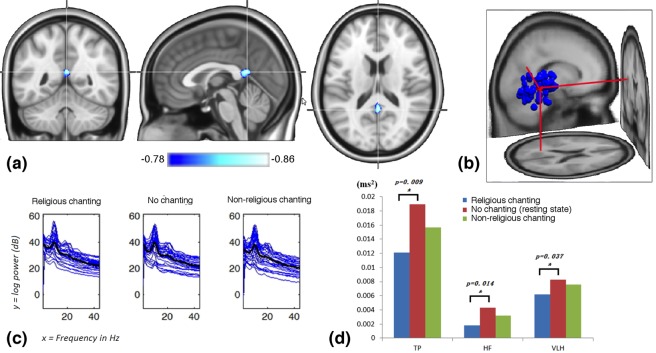
- In fMRI, the largest centrality difference during religious vs non-religious chanting was in the PCC, with a cluster volume of 81 mm³, radius ~3 mm, mean −0.86, SD 0.01, max −0.87, at peak MNI coordinates 0 −51 19.
- In EEG source-cluster analysis, a PCC cluster showed a significant main effect of condition on delta power: F(2,93) = 3.25, p = 0.043.
- Delta power was significantly higher during religious chanting than non-religious chanting (mean 37.30 vs 33.45; p = 0.011); the no-chanting resting state (mean 35.74) did not differ from either chanting condition.
- Cardiac and respiratory measures did not support a confound: mean IBI did not differ across conditions (F(2,42) = 0.026, p = 0.975), respiration was not significant for thoracic (F(2,42) = 1.752, p = 0.186) or abdominal breathing (F(2,42) = 3.118, p = 0.055), while HRV total power, HF, and VLF were lower during religious chanting than no chanting (TP p = 0.005; HF p = 0.006; VLF p = 0.019).
- The authors report no significant EEG differences in theta, alpha, beta, or gamma bands, and say the effects were not attributable to implicit language processing because of the non-religious chanting control.
## Methods
- EEG/ECG/respiration study with 22 participants who had at least one year of experience chanting Amitābha Buddha for at least 15 minutes per day; age 40–52 (mean 46.5, SD 2.6), 12 females. One participant’s EEG was dropped due to operational error, and one additional 43-year-old female Bhikṣuṇī was used for the fMRI case study.
- Participants completed three randomized conditions: silent religious chanting (Amitābha Buddha), silent non-religious chanting (Santa Claus), and resting state; each EEG condition lasted 10 minutes. The chants were matched on four Chinese characters and used to control for implicit language and affective content.
- EEG was analyzed with preprocessing, ICA, and independent-component clustering; the main comparison was spectral power across clusters, especially a PCC cluster. fMRI used eigenvector centrality mapping on the same paradigm, and ECG/respiration were analyzed via HRV with repeated-measures ANOVA and post hoc tests.
## Limitations
- The paper states that fMRI and EEG data were acquired from different subjects, with “considerable differences” in chanting experience.
- The paper states a lack of cognitive and affective ratings as another shortcoming.
- Evident from the text: the fMRI component is only an additional single-participant case study, so the imaging result is not presented as a multi-subject fMRI sample.
- Evident from the text: the study is framed as nascent and the authors repeatedly note that replication and specificity across practices and populations remain to be tested.
Model-written summary. Check it against the paper before relying on it.
Integrity signals
Registry
Cites
Statistics
Figures
Verification
Claims the paper makes
0 Valid · 0 Not valid · 8 Not checked · 43 Own results and interpretations
A result the paper reports from its own data — it cites no other source for it, so there is none to check. The quote shows it is in the paper.
In the paper
“The delta power of the no chanting resting state condition (mean = 35.74; SD = 4.70) did not differ from those of the two chanting conditions.”
§ The neurophysiological correlates of religious chanting > Results
plain- Asserted: passes — The authors put it forward as true.
- Checkable: passes — It can be checked against evidence.
- Load-bearing: unclear — It is unclear whether the paper’s conclusions depend on it.
- Based: passes — The paper gives a reason why it holds.
A result the paper reports from its own data — it cites no other source for it, so there is none to check. The quote shows it is in the paper.
In the paper
“The traditional electrode-based spectrum analysis that was computed for comparative purposes did not show any significant differences in EEG power during religious chanting, apart from a marginal trend in the vicinity of the PCC, and sporadically, in some frontal electrodes (Fig. S2).”
§ The neurophysiological correlates of religious chanting > Results
plain- Asserted: passes — The authors put it forward as true.
- Checkable: passes — It can be checked against evidence.
- Load-bearing: unclear — It is unclear whether the paper’s conclusions depend on it.
- Based: passes — The paper gives a reason why it holds.
A result the paper reports from its own data — it cites no other source for it, so there is none to check. The quote shows it is in the paper.
In the paper
“The EEG independent component clustering analysis generated 7 IC clusters corresponding to sources of EEG activity (Fig. S1).”
§ The neurophysiological correlates of religious chanting > Results
plain- Asserted: passes — The authors put it forward as true.
- Checkable: passes — It can be checked against evidence.
- Load-bearing: passes — The paper’s conclusions depend on it.
- Based: passes — The paper gives a reason why it holds.
A result the paper reports from its own data — it cites no other source for it, so there is none to check. The quote shows it is in the paper.
In the paper
“One of these seven clusters was located in the PCC, similarly to the fMRI results.”
§ The neurophysiological correlates of religious chanting > Results
plainstates an associationSingle case- Asserted: passes — The authors put it forward as true.
- Checkable: passes — It can be checked against evidence.
- Load-bearing: passes — The paper’s conclusions depend on it.
- Based: passes — The paper gives a reason why it holds.
A result the paper reports from its own data — it cites no other source for it, so there is none to check. The quote shows it is in the paper.
In the paper
“One-way repeated measures ANOVA revealed no significant difference in mean inter-beat interval across the three conditions [F(2, 42) = 0.026; p = 0.975] (religious chanting: mean = 862.9, SD = 115.1; no chanting: mean = 862.8, SD = 108.4; non-religious chanting: mean = 860.9, SD = 111.1).”
§ The neurophysiological correlates of religious chanting > Results
plain- Asserted: passes — The authors put it forward as true.
- Checkable: passes — It can be checked against evidence.
- Load-bearing: unclear — It is unclear whether the paper’s conclusions depend on it.
- Based: passes — The paper gives a reason why it holds.
18 more claims
Create a free account to see all 51 claims and to verify the 3 references still open.
- It may state two separate claims as one. 23
- The quote only partly states this claim. 1
- Probably not a substantial claim. 11
Statistics that don’t add up
Each reported p-value recomputed from its test statistic and degrees of freedom, each partial η² from its F, and each ratio, mean difference or B printed with a p checked against its own confidence interval.
Rated minor: it would not touch a result — a value no result rests on, a p-value that stays on the same side of the significance level, or a conflict that is clerical, resolved elsewhere in the paper, or outside its own findings.
In the paper
“F(2,42) = 4.16; p = 0.019”
§ The neurophysiological correlates of religious chanting > Results
Reported p = .019 · recomputed p = .022
Statistics recomputed
Every reported test result, recomputed from its test statistic and degrees of freedom. A result shows as not adding up only once an independent check has confirmed it.
- Doesn’t add upF(2, 42) = 4.16reported p = .019 · recomputed p = .022
“F(2,42) = 4.16, p = .019”
- ConsistentF(2, 93) = 3.25reported p = .043 · recomputed p = .043
“F (2,93) = 3.25, p = .043”
- ConsistentF(2, 42) = 0.026reported p = .975 · recomputed p = .974
“F(2, 42) = 0.026, p = .975”
- ConsistentF(2, 42) = 5.92reported p = .005 · recomputed p = .005
“F(2,42) = 5.92, p = .005”
- ConsistentF(2, 42) = 5.9reported p = .006 · recomputed p = .006
“F(2,42) = 5.90, p = .006”
2 more recomputed tests
Create a free account to see every test the Stats check recomputed.
Self-check
Percentages, sums and reported differences re-computed from the paper’s own numbers.
Self-check results appear here once an independent check has confirmed them.
Citations
Cites
Correspondence of the brain's functional architecture during activation and rest
Smith, S. M., Fox, P. T., Miller, K. L., Glahn, D. C., Fox, P. M., Mackay, C. E., Filippini, N., Watkins, K. E., Toro, R., Laird, A. R., et al. (2009) · Proceedings of the National Academy of Sciences · doi:10.1073/pnas.0905267106 · Cited by 5,150
Meditation states and traits: EEG, ERP, and neuroimaging studies.
Cahn, B. R., & Polich, J. (2006) · Psychological Bulletin · doi:10.1037/0033-2909.132.2.180 · Cited by 1,734
Cortical midline structures and the self
Northoff, G., & Bermpohl, F. (2004) · Trends in Cognitive Sciences · doi:10.1016/j.tics.2004.01.004 · Cited by 1,446
The Human Central Nervous System
Nieuwenhuys, R., Voogd, J., & van Huijzen, C. (2008) · doi:10.1007/978-3-540-34686-9 · Cited by 1,262
(2011) · Cited by 1,181
Sleep deprivation: effect on sleep stages and EEG power density in man
Borbély, A. A., Baumann, F., Brandeis, D., Strauch, I., & Lehmann, D. (1981) · Electroencephalography and Clinical Neurophysiology · doi:10.1016/0013-4694(81)90225-x · Cited by 1,013
Goldstein, D. S., Bentho, O., Park, M.-Y., & Sharabi, Y. (2011) · Experimental Physiology · doi:10.1113/expphysiol.2010.056259 · Cited by 846
The functional significance of delta oscillations in cognitive processing
Harmony, T. (2013) · Frontiers in Integrative Neuroscience · doi:10.3389/fnint.2013.00083 · Cited by 788
EEG delta oscillations as a correlate of basic homeostatic and motivational processes
Knyazev, G. G. (2012) · Neuroscience & Biobehavioral Reviews · doi:10.1016/j.neubiorev.2011.10.002 · Cited by 776
The Human Central Nervous System: A Synopsis and Atlas
Nieuwenhuys, R., Voogd, J., & van Huijzen, C. (2012) · Medical Entomology and Zoology · Cited by 540
Research works printed but not linked: 3
- Corless, R. J. The Theoretical Foundations of Pure Land Buddhist Practice according to Tanluan. Pacific World: Journal of the Institute of Buddhist Studies, 125–138 (2006).
- Silva, F. H. L. D. Electroencephalography, basic principles, clinical applications, and related fields (eds Ernst Niedermeyer & F. H. Lopes da Silva) Ch. 50, x, 752 p. (Lippincott Williams & Wilkins, 2011).
- Faber PL Deactivation of the medial prefrontal cortex in experienced Zen meditators. (Abstract) Brain Topogr. 2008 20 172 173
Cited by
Handbook of Religion and Health
Koenig, H. G., VanderWeele, T., & Peteet, J. R. (2024) · doi:10.1093/oso/9780190088859.001.0001 · Cited by 1,139
Review article: the role of the autonomic nervous system in the pathogenesis and therapy of IBD
Mogilevski, T., Burgell, R., Aziz, Q., & Gibson, P. R. (2019) · Alimentary Pharmacology & Therapeutics · doi:10.1111/apt.15433 · Cited by 87
AI & learning: A preferred future
Srinivasan, V. (2022) · Computers and Education Artificial Intelligence · doi:10.1016/j.caeai.2022.100062 · Cited by 126
Inbaraj, G., Rao, R. M., Ram, A., Bayari, S. K., Belur, S., Prathyusha, P. V., Sathyaprabha, T. N., & Udupa, K. (2022) · International Journal of Yoga · doi:10.4103/ijoy.ijoy_141_21 · Cited by 68
“[3] It is considered a primordial cosmic sound and the totality of all sounds, removing entire psychological pressure and worldly thoughts.[4] Chanting Address for correspondence: Dr.”
BackgroundGao, J., Skouras, S., Leung, H. K., Wu, B. W. Y., Wu, H., Chang, C., & Sik, H. H. (2020) · Frontiers in Behavioral Neuroscience · doi:10.3389/fnbeh.2020.548856 · Cited by 41
“Despite its universal popularity, very few studies have ever attempted to explore the underlying neural mechanism (Rao et al., 2018; Gao et al., 2019).”
BackgroundSelf-citationImperatori, C., Bersani, F. S., Massullo, C., Carbone, G. A., Salvati, A., Mazzi, G., Cicerale, G., Carrara, A., & Farina, B. (2020) · Neuroscience Letters · doi:10.1016/j.neulet.2020.134956 · Cited by 45
Davis, J. J. J., Kozma, R., & Schübeler, F. (2023) · Sensors · doi:10.3390/s23031293 · Cited by 17
Koenig, H. G., VanderWeele, T. J., & Peteet, J. R. (2023) · Oxford University Press eBooks · doi:10.1093/oso/9780190088859.003.0001 · Cited by 12
Gao, J., Leung, H. K., Wu, B. W. Y., Thach, T.-Q., Jenny, H. U. N. G., Chang, C., & Sik, H. H. (2023) · Heliyon · doi:10.1016/j.heliyon.2023.e20075 · Cited by 10
“The difference might stem from the lack of belief of these practitioners in Santa Claus [15].”
Self-citationRoychowdhury, D. (2021) · Asian Journal of Sport and Exercise Psychology · doi:10.1016/j.ajsep.2021.09.004 · Cited by 10
Music and Spirituality: Theological Approaches, Empirical Methods, and Christian Worship
Corbett, G., & Moerman, S. (2024) · Open Book Publishers · doi:10.11647/obp.0403 · Cited by 25
Effect of short-term chanting on electroencephalographic microstates
Tayade, P., Saini, M., Saini, G., Muthukrishnan, S. P., Kaur, S., Sharma, R., & Sahoo, A. (2024) · Pan African Medical Journal · doi:10.11604/pamj.2024.49.76.44648 · Cited by 8
“…the neurophysiological correlates of religious chanting are likely to be different from those of meditation and prayer and would possibly induce distinctive psychotherapeutic effects [18] in a study that investigated the temporal dynamics of oscillatory changes after OM mantra meditation using EEG.”
Walter, Y., & Altorfer, A. (2023) · Religion Brain & Behavior · doi:10.1080/2153599x.2023.2217238 · Cited by 5
“A Muslim prayer study yielded an increase in high frequencies (HF) of the HRV as an effect of the prayer practice (Doufesh et al., 2014), although it has been criticized that the experiment used resting state instead of a sham-prayer condition as the control (Gao et al., 2019).”
Ruggiero, M., & Hiratsuka, A. (2024) · American Journal of Immunology · doi:10.3844/ajisp.2024.11.23 · Cited by 7
“In other words, religious chanting may have a unique impact on the brain that is different from the impact of meditation or prayer (Gao et al ., 2019).”
BackgroundNature, Nurture and the Learning Brain
Rangaswami, S. (2021) · Springer eBooks · doi:10.1007/978-3-030-72400-9_17 · Cited by 8
Religious Chanting and Self-Related Brain Regions: A Multi-Modal Neuroimaging Study
Sik, H. H., Skouras, S., Gao, J., Leung, H. K., Ng, S., Lee, K. C., & Wu, B. W. Y. (2024) · Journal of Visualized Experiments · doi:10.3791/66221 · Cited by 6
Self-citationA Review on the Effects of Chanting and Solfeggio Frequencies on Well-Being
Yang, X., Nah, F. F., & Lin, F. (2023) · Lecture notes in computer science · doi:10.1007/978-3-031-48041-6_42 · Cited by 4
Original Research Article_Sanskrit Shloka Chanting and Mindfulness
Raorane, P. R., & Shetty, V. (2020) · Indian Journal of Mental Health(IJMH) · doi:10.30877/ijmh.7.4.2020.317-320 · Cited by 4
Koenig, H. G., VanderWeele, T. J., & Peteet, J. R. (2023) · Oxford University Press eBooks · doi:10.1093/oso/9780190088859.003.0002 · Cited by 5
Understanding the Religion, Mental, and Social Health Relationship
Koenig, H. G., VanderWeele, T. J., & Peteet, J. R. (2023) · Oxford University Press eBooks · doi:10.1093/oso/9780190088859.003.0016 · Cited by 7
Buddhist Practices Enhancing Positive Life: Mindfulness and Beyond
Khanna, P., Singh, K. K., & Dua, S. (2023) · Springer eBooks · doi:10.1007/978-981-99-2397-7_7 · Cited by 3
Raghuwanshi, N., Keswani, J., Sharma, H., Tewani, G. R., & Nair, P. M. K. (2022) · Clinical Epidemiology and Global Health · doi:10.1016/j.cegh.2022.101081 · Cited by 3
“Neurophysiological studies on religious chanting suggest chanting increases the endogenous neural oscillations present in the delta-band specifically in posterior cingulate cortex region of the brain.(22) This is said to act as an inhibitor of brain oscillations that can prevent the mind from swaying away while doing…”
BackgroundWalter, Y., & Altorfer, A. (2023) · Psych · doi:10.3390/psych5010010 · Cited by 2
Psychological Well-Being and Positive Emotions
Koenig, H. G., VanderWeele, T. J., & Peteet, J. R. (2023) · Oxford University Press eBooks · doi:10.1093/oso/9780190088859.003.0012 · Cited by 2
7. From the Sacred to the Ordinary through the Lens of Psychological Science
Greenberg, D. M. (2024) · Open Book Publishers · doi:10.11647/obp.0403.07 · Cited by 2
5. Religion, Science, and Music: An Augustinian Trinity
Zon, B. M. (2024) · Open Book Publishers · doi:10.11647/obp.0403.05 · Cited by 2
Spirituality: the Hindu perspective from a gerontologist’s viewpoint
Mehta, K. K. (2020) · Journal of Religion Spirituality & Aging · doi:10.1080/15528030.2020.1843590 · Cited by 2
“In a study on the neurophysiological correlates of religious chanting (Gao et al., 2019) it has been proven that religious chanting (called Jappa in Hindi) has positive benefits for the cardiac function, sleep patterns, emotional tranquillity, and mental calmness.”
BackgroundRuggiero, M. (2023) · Preprints.org · doi:10.20944/preprints202307.0669.v1 · Cited by 1
Ruggiero, M. (2023) · Preprints.org · doi:10.20944/preprints202307.0669.v2 · Cited by 1
Koenig, H. G., VanderWeele, T. J., & Peteet, J. R. (2023) · Oxford University Press eBooks · doi:10.1093/oso/9780190088859.003.0025 · Cited by 1
Substance Use and Substance Use Disorders
Koenig, H. G., VanderWeele, T. J., & Peteet, J. R. (2023) · Oxford University Press eBooks · doi:10.1093/oso/9780190088859.003.0010 · Cited by 2
Koenig, H. G., VanderWeele, T. J., & Peteet, J. R. (2023) · Oxford University Press eBooks · doi:10.1093/oso/9780190088859.003.0014 · Cited by 4
Koenig, H. G., VanderWeele, T. J., & Peteet, J. R. (2023) · Oxford University Press eBooks · doi:10.1093/oso/9780190088859.003.0015 · Cited by 1
8. An Inquiry into Musical Trance
TURAN, D. (2024) · Open Book Publishers · doi:10.11647/obp.0403.08 · Cited by 1
9. An Ethnomusicology of Spiritual Realities
Engelhardt, J. (2024) · Open Book Publishers · doi:10.11647/obp.0403.09 · Cited by 1
Manders, E. (2024) · Open Book Publishers · doi:10.11647/obp.0403.15 · Cited by 2
Krisdathiwadh, P., Chaithirayanon, S., Kotchabhakdi, N., & Siripornpanich, V. (2024) · Applied Neuropsychology Child · doi:10.1080/21622965.2024.2424215 · Cited by 2
Chants across seven traditions share acoustic traits that enhance subjective relaxation
Canessa-Pollard, V., Anikin, A., & Reby, D. (2025) · Proceedings of the National Academy of Sciences · doi:10.1073/pnas.2506480122 · Cited by 6
“…( 17 ), “Ave Maria” rosary repetitions ( 18 )], while neuroimaging research suggests that specific chants [e.g., “OM” and “Amitabha” mantras ( 19 – 21 )] can induce mental calmness, enhance emotional balance, deactivate stress - related brain regions (e.g., amygdala), and increase activity…”
Neural Pattern of Chanting-Driven Intuitive Inquiry Meditation in Expert Chan Practitioners
Lee, K. C., Sik, H. H., Leung, H. K., Wu, B. W. Y., Sun, R., & Gao, J. (2025) · Behavioral Sciences · doi:10.3390/bs15091213 · Cited by 3
“Additionally, structural MRI revealed right‑lateralized brain changes in long‑term practitioners (Gao et al., 2019).”
Self-citationSimilarity Of Effects On EEG Parameters Of Aramaic, Greek Catholic And Krishnaic Prayers
Popovych, I. L., Гоженко, А. І., Babelyuk, V., Żukow, W., Muszkieta, R., Korolyshyn, T. A., Dubkova, G. I., Klishch, I. M., Mysula, I. R., Bilas, V. R., et al. (2020) · Pedagogy and Psychology of Sport · doi:10.12775/pps.2020.06.01.010 · Cited by 1
Spirituality and Happiness: A Neuroscientific Perspective
Arora, R., & Mandal, M. K. (2023) · Springer eBooks · doi:10.1007/978-981-99-3493-5_2 · Cited by 3
Koenig, H. G., VanderWeele, T. J., & Peteet, J. R. (2023) · Oxford University Press eBooks · doi:10.1093/oso/9780190088859.003.0027 · Cited by 1
Koenig, H. G., VanderWeele, T. J., & Peteet, J. R. (2023) · Oxford University Press eBooks · doi:10.1093/oso/9780190088859.003.0008 · Cited by 2
Public Health and Human Flourishing
Koenig, H. G., VanderWeele, T. J., & Peteet, J. R. (2023) · Oxford University Press eBooks · doi:10.1093/oso/9780190088859.003.0032 · Cited by 1
Understanding the Religion–Physical Health Relationship
Koenig, H. G., VanderWeele, T. J., & Peteet, J. R. (2023) · Oxford University Press eBooks · doi:10.1093/oso/9780190088859.003.0031 · Cited by 1
Koenig, H. G., VanderWeele, T. J., & Peteet, J. R. (2023) · Oxford University Press eBooks · doi:10.1093/oso/9780190088859.003.0017 · Cited by 1
Koenig, H. G., VanderWeele, T. J., & Peteet, J. R. (2023) · Oxford University Press eBooks · doi:10.1093/oso/9780190088859.003.0006 · Cited by 1
13. Music in Christian Services as a Means to Induce Religious Feelings
Wald‐Fuhrmann, M. (2024) · Open Book Publishers · doi:10.11647/obp.0403.13 · Cited by 1
2. Cross and Consolation: Music’s Empathic Spirituality
Bouteneff, P. C. (2024) · Open Book Publishers · doi:10.11647/obp.0403.02 · Cited by 1
14. Spiritual Cultures: Innovations in Choral and Classical Music
Arnold, J. (2024) · Open Book Publishers · doi:10.11647/obp.0403.14 · Cited by 1
Koenig, H. G., VanderWeele, T. J., & Peteet, J. R. (2023) · Oxford University Press eBooks · doi:10.1093/oso/9780190088859.002.0003 · Cited by 1
CONCEPT OF MATERNAL MENTAL HEALTH IN AYURVEDA: A REVIEW
Jugran, S., & Tomar, P. (2020) · International Journal of Research in Ayurveda and Pharmacy · doi:10.7897/2277-4343.110243
Dong, Y., Trey, M., & Hsu, K.-H. (2021) · F1000Research · doi:10.12688/f1000research.50940.1
Numerological Study Proposing New Names for Sri Lanka and Rupees for Better Prosperity
Wanigasekera, I. U. (2022) · American Journal of Multidisciplinary Research and Innovation · doi:10.54536/ajmri.v1i6.1057
“A study by Gao et al(Gao et al., 2019), has found the neurophysiological correlates of religious chanting Using multi-modal electrophysiological and neuroimaging methods and emphasized that religious chanting possibly induces distinctive psychotherapeutic effects(Gao et al.”
BackgroundInfluentialKoenig, H. G., VanderWeele, T. J., & Peteet, J. R. (2023) · Oxford University Press eBooks · doi:10.1093/oso/9780190088859.003.0034
Koenig, H. G., VanderWeele, T. J., & Peteet, J. R. (2023) · Oxford University Press eBooks · doi:10.1093/oso/9780190088859.003.0021
Koenig, H. G., VanderWeele, T. J., & Peteet, J. R. (2023) · Oxford University Press eBooks · doi:10.1093/oso/9780190088859.003.0007
Koenig, H. G., VanderWeele, T. J., & Peteet, J. R. (2023) · Oxford University Press eBooks · doi:10.1093/oso/9780190088859.003.0005 · Cited by 1
Koenig, H. G., VanderWeele, T. J., & Peteet, J. R. (2023) · Oxford University Press eBooks · doi:10.1093/oso/9780190088859.003.0029
Levin, J. (2023) · Oxford University Press eBooks · doi:10.1093/oso/9780190088859.002.0007
Koenig, H. G., VanderWeele, T. J., & Peteet, J. R. (2023) · Oxford University Press eBooks · doi:10.1093/oso/9780190088859.003.0033
Koenig, H. G., VanderWeele, T. J., & Peteet, J. R. (2023) · Oxford University Press eBooks · doi:10.1093/oso/9780190088859.002.0009
Alzheimer’s Disease and Other Dementias
Koenig, H. G., VanderWeele, T. J., & Peteet, J. R. (2023) · Oxford University Press eBooks · doi:10.1093/oso/9780190088859.003.0023
Koenig, H. G., VanderWeele, T. J., & Peteet, J. R. (2023) · Oxford University Press eBooks · doi:10.1093/oso/9780190088859.003.0024
Koenig, H. G., VanderWeele, T. J., & Peteet, J. R. (2023) · Oxford University Press eBooks · doi:10.1093/oso/9780190088859.003.0020
Koenig, H. G., VanderWeele, T. J., & Peteet, J. R. (2023) · Oxford University Press eBooks · doi:10.1093/oso/9780190088859.003.0026
Disease Prevention, Detection, and Treatment
Koenig, H. G., VanderWeele, T. J., & Peteet, J. R. (2023) · Oxford University Press eBooks · doi:10.1093/oso/9780190088859.003.0030 · Cited by 1
Koenig, H. G., VanderWeele, T. J., & Peteet, J. R. (2023) · Oxford University Press eBooks · doi:10.1093/oso/9780190088859.003.0019
Koenig, H. G., VanderWeele, T. J., & Peteet, J. R. (2023) · Oxford University Press eBooks · doi:10.1093/oso/9780190088859.002.0004
Personality Traits and Disorders
Koenig, H. G., VanderWeele, T. J., & Peteet, J. R. (2023) · Oxford University Press eBooks · doi:10.1093/oso/9780190088859.003.0011
Schizophrenia and Other Psychoses
Koenig, H. G., VanderWeele, T. J., & Peteet, J. R. (2023) · Oxford University Press eBooks · doi:10.1093/oso/9780190088859.003.0009
Koenig, H. G., VanderWeele, T. J., & Peteet, J. R. (2023) · Oxford University Press eBooks · doi:10.1093/oso/9780190088859.003.0004
Koenig, H. G., VanderWeele, T. J., & Peteet, J. R. (2023) · Oxford University Press eBooks · doi:10.1093/oso/9780190088859.003.0018
Koenig, H. G., VanderWeele, T. J., & Peteet, J. R. (2023) · Oxford University Press eBooks · doi:10.1093/oso/9780190088859.003.0003 · Cited by 1
Koenig, H. G., VanderWeele, T. J., & Peteet, J. R. (2023) · Oxford University Press eBooks · doi:10.1093/oso/9780190088859.003.0013
Koh, H. K. (2023) · Oxford University Press eBooks · doi:10.1093/oso/9780190088859.002.0006
Koenig, H. G., VanderWeele, T. J., & Peteet, J. R. (2023) · Oxford University Press eBooks · doi:10.1093/oso/9780190088859.003.0028
Koenig, H. G., VanderWeele, T. J., & Peteet, J. R. (2023) · Oxford University Press eBooks · doi:10.1093/oso/9780190088859.003.0022
Studies on Religion and Health
Koenig, H. G., VanderWeele, T. J., & Peteet, J. R. (2023) · Oxford University Press eBooks · doi:10.1093/oso/9780190088859.005.0001 · Cited by 1
Chanting Among Thai Older Adults Who Are Community Dwelling in Northern Thailand
Danyuthasilpe, C., Wasuntarawat, C., Hawthorne, D. M., et al. (2023) · International Journal for Human Caring · doi:10.20467/ijhc-2022-0008
Sik, H. H., Skouras, S., Gao, J., Leung, H. K., Ng, S. M., Lee, K. C., & Wu, B. W. Y. (2024) · doi:10.3791/66221-v
Self-citation18. Music and Spirituality in Communal Song: Methodists and Welsh Sporting Crowds
Clarke, M. V. (2024) · Open Book Publishers · doi:10.11647/obp.0403.18
16. An Abductive Study of Digital Worship through the Lenses of Netnography and Digital Ecclesiology
Lazić, T. (2024) · Open Book Publishers · doi:10.11647/obp.0403.16 · Cited by 1
Begbie, J. S. (2024) · Open Book Publishers · doi:10.11647/obp.0403.01
12. The Impetus to Compose: Where is Fantasy Bred?
McGregor, R. E. (2024) · Open Book Publishers · doi:10.11647/obp.0403.12
10. The Concept of ‘Atmosphere’ as a Bridge between Music and Spirituality
Sawicki, B. Ł. (2024) · Open Book Publishers · doi:10.11647/obp.0403.10
Corbett, G., & Moerman, S. (2024) · Open Book Publishers · doi:10.11647/obp.0403.20
O’Connor, M. (2024) · Open Book Publishers · doi:10.11647/obp.0403.03
Foreword: A Composer’s Perspective’
MacMillan, J. (2024) · Open Book Publishers · doi:10.11647/obp.0403.00
17. Choral Singers and Spiritual Realities: A Perspective from St Mary’s Catholic Cathedral
Ferguson, M. (2024) · Open Book Publishers · doi:10.11647/obp.0403.17 · Cited by 1
6. Dissonant Spirituality: A Hermeneutical Aesthetics of Outlaw Country
Howell, C. M. (2024) · Open Book Publishers · doi:10.11647/obp.0403.06
4. An Adorative Posture towards Music and Spiritual Realities
Stone-Davis, F. J. (2024) · Open Book Publishers · doi:10.11647/obp.0403.04
Afterword: ‘A Psychologist’s Perspective’
SLOBODA, J. A. (2024) · Open Book Publishers · doi:10.11647/obp.0403.19
11. Spiritual Subjects: Musicking, Biography, and the Connections We Make
Heaney, M. L. (2024) · Open Book Publishers · doi:10.11647/obp.0403.11
Kumari, A., Pal, A., & Dada, R. (2024) · Cureus · doi:10.7759/cureus.71884
“Shanti mantra for two minutes induces calmness and nurtures relaxation [39].”
Swami, S. K., & Dhopeshwarkar, M. (2025) · International Journal of Advanced Research in Science Communication and Technology · doi:10.48175/ijarsct-28490
We are hardwired to sing − and it’s good for us, too
Harrison, E. C. (2025) · The Conversation · doi:10.64628/aai.jpnrjnwgm
Ożarska, M. (2026) · Life Writing · doi:10.1080/14484528.2026.2618825
“…(like Krishna’s, for instance) to effectively disrupt the ‘chatter of self-referential mind’ (Weber 2007, 135; see also Berkovich-Ohana et al. 2015; Gao et al. 2017, 2019; Perry et al. 2022; Holm et al. 2024), i.e. the human brain’s Default Mode Network (DMN), and in this way produce various…”
A Breath of Hope: A Modified Tonglen Meditation for Practitioners
Tomasulo, D. (2026) · Mindfulness · doi:10.1007/s12671-026-02897-5
“Finally, the simultaneous (internal) reciting of four words having a positive valence: joy, compassion, hope, and love, capitalizes on the known neurophysiological correlates of chanting (Gao et al., 2019).”
Girishankara, K. S. M., Shetty, S., Shetty, P., & Akshatha, R. (2026) · International Journal of Yoga · doi:10.4103/ijoy.ijoy_39_25
“[52] Functional magnetic resonance imaging research has identified activation of specific brain regions during mantra chanting, including the anterior cingulate cortex, hippocampus, angular gyrus, and middle temporal gyrus.”
Metadata
- Authors
- Gao, J., Leung, H. K., Wu, B. W. Y., Skouras, S., & Sik, H. H.
- Affiliations
- University of Hong Kong (HK)
- University of Bergen (NO)
- Corresponding author
- Sik, Hin Hung
- Venue
- Scientific Reports
- Published
- 2019-03-12
- Volume
- 9
- Issue
- 1
- Pages
- 4262-4262
- ISSN
- 2045-2322 (ISSN-L)
- PMC
- PMC6414545
- OpenAlex
- W2922149863
- Semantic Scholar
- 5f200474c4513b405c56d88b444ce7224c0cf735
- Cited by
- 110
- References
- 49
- Citations by year
- 2026: 10 · 2025: 7 · 2024: 27 · 2023: 51 · 2022: 4 · 2021: 4 · 2020: 6 · 2019: 1
- FWCI
- 3.32
- Type
- journal article
- Language
- en
- Open access
- gold
- doi.org
- Licence
- cc-by
- creativecommons.org/licenses/by/4.0 (tdm)
- creativecommons.org/licenses/by/4.0 (vor)
- Locations
- Scientific Reports (publishedVersion, cc-by)
- Europe PMC (PubMed Central) (publishedVersion, other-oa)
- PubMed Central (publishedVersion, cc-by)
- PubMed (publishedVersion)
- NORA - Norwegian Open Research Archives (submittedVersion, cc-by)
- DOAJ (DOAJ: Directory of Open Access Journals) (submittedVersion)
- Funders
- University of Hong Kong (SPF201209176152)
- Topics
- Social Sciences › Health › Religion, Spirituality, and Psychology
- Social Sciences › Arts and Humanities › Religious studies › Media, Religion, Digital Communication
- Life Sciences › Neuroscience › Cognitive Neuroscience › Neuroscience and Music Perception
- Keywords
- neural correlates, posterior cingulate cortex, eigenvector centrality, delta oscillations, meditation, prayer, psychotherapeutic effects
- MeSH terms
- Adult, Delta Rhythm, Female, Gyrus Cinguli, Hong Kong, Humans, Magnetic Resonance Imaging, Male, Middle Aged, Religion, Meditation, Neuroimaging, Singing
About these checks
Registry, retraction, Cites and statistics results are computed, not judged, with one exception: a printed reference that no index lists is read once by a model before it counts as a citation error. Claims are extracted by a model and kept only when their quote appears verbatim in the text; each cited source is then checked, with a model’s help, for whether it says what the claim relies on. Those verdicts can be wrong — read the claim’s quote and the cited source before relying on one.
A language model drew the claims from the paper on 2026-10-10, under version 3 of the claim definition (model deepseek-v4.1-flash, prompt extract-v3).
A second model labelled each claim on 2026-10-10 (model jev-1.13-20260917, definition revision gold-guideline-v0.2).
Statistics and arithmetic are recomputed, not judged.
Confidence bands are shown only for fields calibrated on our annotated test set. None is calibrated yet, so no band is shown.
What counts as a claim ›How we measure confidence ›How we check this ›
Are you an author, or do you see a problem with this page? Request a review
Data sources
Bibliographic data: Semantic Scholar, OpenAlex, Crossref.
Contains information from the Semantic Scholar Academic Graph Datasets, made available under the ODC Attribution License (ODC-BY 1.0).
Semantic Scholar’s data is described in: Kinney, R., et al. (2023). The Semantic Scholar Open Data Platform. arXiv:2301.10140.
