

The neurophysiological correlates of religious chanting
Open accessThe DOI matches its Crossref record; 51 of the 51 references it cites were found in a registry or an index; none of the 15 sources its claims cite is checked for support yet.
Abstract
Despite extensive research on various types of meditation, research on the neural correlates of religious chanting is in a nascent stage. Using multi-modal electrophysiological and neuroimaging methods, we illustrate that during religious chanting, the posterior cingulate cortex shows the largest decrease in eigenvector centrality, potentially due to regional endogenous generation of delta oscillations. Our data show that these functional effects are not due to peripheral cardiac or respiratory activity, nor due to implicit language processing. Finally, we suggest that the neurophysiological correlates of religious chanting are likely different from those of meditation and prayer, and would possibly induce distinctive psychotherapeutic effects.
Overview
CoChat Summary
## TL;DR
Using EEG, ECG/respiration, and one illustrative fMRI case, the study found that silent religious chanting of Amitābha Buddha was associated with increased delta-band activity in the posterior cingulate cortex (PCC) and decreased PCC eigenvector centrality relative to non-religious chanting. The authors argue these effects were not explained by language, cardiac, or respiratory confounds and may differ from mindfulness meditation and prayer.
## Key findings
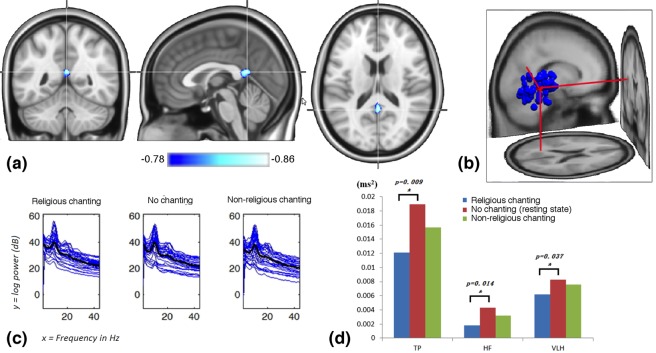
- In fMRI, the largest centrality difference during religious vs non-religious chanting was in the PCC, with a cluster volume of 81 mm³, radius ~3 mm, mean −0.86, SD 0.01, max −0.87, at peak MNI coordinates 0 −51 19.
- In EEG source-cluster analysis, a PCC cluster showed a significant main effect of condition on delta power: F(2,93) = 3.25, p = 0.043.
- Delta power was significantly higher during religious chanting than non-religious chanting (mean 37.30 vs 33.45; p = 0.011); the no-chanting resting state (mean 35.74) did not differ from either chanting condition.
- Cardiac and respiratory measures did not support a confound: mean IBI did not differ across conditions (F(2,42) = 0.026, p = 0.975), respiration was not significant for thoracic (F(2,42) = 1.752, p = 0.186) or abdominal breathing (F(2,42) = 3.118, p = 0.055), while HRV total power, HF, and VLF were lower during religious chanting than no chanting (TP p = 0.005; HF p = 0.006; VLF p = 0.019).
- The authors report no significant EEG differences in theta, alpha, beta, or gamma bands, and say the effects were not attributable to implicit language processing because of the non-religious chanting control.
## Methods
- EEG/ECG/respiration study with 22 participants who had at least one year of experience chanting Amitābha Buddha for at least 15 minutes per day; age 40–52 (mean 46.5, SD 2.6), 12 females. One participant’s EEG was dropped due to operational error, and one additional 43-year-old female Bhikṣuṇī was used for the fMRI case study.
- Participants completed three randomized conditions: silent religious chanting (Amitābha Buddha), silent non-religious chanting (Santa Claus), and resting state; each EEG condition lasted 10 minutes. The chants were matched on four Chinese characters and used to control for implicit language and affective content.
- EEG was analyzed with preprocessing, ICA, and independent-component clustering; the main comparison was spectral power across clusters, especially a PCC cluster. fMRI used eigenvector centrality mapping on the same paradigm, and ECG/respiration were analyzed via HRV with repeated-measures ANOVA and post hoc tests.
## Limitations
- The paper states that fMRI and EEG data were acquired from different subjects, with “considerable differences” in chanting experience.
- The paper states a lack of cognitive and affective ratings as another shortcoming.
- Evident from the text: the fMRI component is only an additional single-participant case study, so the imaging result is not presented as a multi-subject fMRI sample.
- Evident from the text: the study is framed as nascent and the authors repeatedly note that replication and specificity across practices and populations remain to be tested.
Model-written summary. Check it against the paper before relying on it.
Integrity signals
Registry
Cites
Statistics
Figures
Verification
Claims the paper makes
0 Valid · 0 Not valid · 8 Not checked · 43 Own results and interpretations
A result the paper reports from its own data — it cites no other source for it, so there is none to check. The quote shows it is in the paper.
In the paper
“The delta power of the no chanting resting state condition (mean = 35.74; SD = 4.70) did not differ from those of the two chanting conditions.”
§ The neurophysiological correlates of religious chanting > Results
plain- Asserted: passes — The authors put it forward as true.
- Checkable: passes — It can be checked against evidence.
- Load-bearing: unclear — It is unclear whether the paper’s conclusions depend on it.
- Based: passes — The paper gives a reason why it holds.
A result the paper reports from its own data — it cites no other source for it, so there is none to check. The quote shows it is in the paper.
In the paper
“The traditional electrode-based spectrum analysis that was computed for comparative purposes did not show any significant differences in EEG power during religious chanting, apart from a marginal trend in the vicinity of the PCC, and sporadically, in some frontal electrodes (Fig. S2).”
§ The neurophysiological correlates of religious chanting > Results
plain- Asserted: passes — The authors put it forward as true.
- Checkable: passes — It can be checked against evidence.
- Load-bearing: unclear — It is unclear whether the paper’s conclusions depend on it.
- Based: passes — The paper gives a reason why it holds.
A result the paper reports from its own data — it cites no other source for it, so there is none to check. The quote shows it is in the paper.
In the paper
“The EEG independent component clustering analysis generated 7 IC clusters corresponding to sources of EEG activity (Fig. S1).”
§ The neurophysiological correlates of religious chanting > Results
plain- Asserted: passes — The authors put it forward as true.
- Checkable: passes — It can be checked against evidence.
- Load-bearing: passes — The paper’s conclusions depend on it.
- Based: passes — The paper gives a reason why it holds.
A result the paper reports from its own data — it cites no other source for it, so there is none to check. The quote shows it is in the paper.
In the paper
“One of these seven clusters was located in the PCC, similarly to the fMRI results.”
§ The neurophysiological correlates of religious chanting > Results
plainstates an associationSingle case- Asserted: passes — The authors put it forward as true.
- Checkable: passes — It can be checked against evidence.
- Load-bearing: passes — The paper’s conclusions depend on it.
- Based: passes — The paper gives a reason why it holds.
A result the paper reports from its own data — it cites no other source for it, so there is none to check. The quote shows it is in the paper.
In the paper
“One-way repeated measures ANOVA revealed no significant difference in mean inter-beat interval across the three conditions [F(2, 42) = 0.026; p = 0.975] (religious chanting: mean = 862.9, SD = 115.1; no chanting: mean = 862.8, SD = 108.4; non-religious chanting: mean = 860.9, SD = 111.1).”
§ The neurophysiological correlates of religious chanting > Results
plain- Asserted: passes — The authors put it forward as true.
- Checkable: passes — It can be checked against evidence.
- Load-bearing: unclear — It is unclear whether the paper’s conclusions depend on it.
- Based: passes — The paper gives a reason why it holds.
18 more claims
Create a free account to see all 51 claims and to verify the 3 references still open.
- It may state two separate claims as one. 23
- The quote only partly states this claim. 1
- Probably not a substantial claim. 11
Statistics that don’t add up
Each reported p-value recomputed from its test statistic and degrees of freedom, each partial η² from its F, and each ratio, mean difference or B printed with a p checked against its own confidence interval.
Rated minor: it would not touch a result — a value no result rests on, a p-value that stays on the same side of the significance level, or a conflict that is clerical, resolved elsewhere in the paper, or outside its own findings.
In the paper
“F(2,42) = 4.16; p = 0.019”
§ The neurophysiological correlates of religious chanting > Results
Reported p = .019 · recomputed p = .022
Statistics recomputed
Every reported test result, recomputed from its test statistic and degrees of freedom. A result shows as not adding up only once an independent check has confirmed it.
- Doesn’t add upF(2, 42) = 4.16reported p = .019 · recomputed p = .022
“F(2,42) = 4.16, p = .019”
- ConsistentF(2, 93) = 3.25reported p = .043 · recomputed p = .043
“F (2,93) = 3.25, p = .043”
- ConsistentF(2, 42) = 0.026reported p = .975 · recomputed p = .974
“F(2, 42) = 0.026, p = .975”
- ConsistentF(2, 42) = 5.92reported p = .005 · recomputed p = .005
“F(2,42) = 5.92, p = .005”
- ConsistentF(2, 42) = 5.9reported p = .006 · recomputed p = .006
“F(2,42) = 5.90, p = .006”
2 more recomputed tests
Create a free account to see every test the Stats check recomputed.
Self-check
Percentages, sums and reported differences re-computed from the paper’s own numbers.
Self-check results appear here once an independent check has confirmed them.
Citations
Cites
Correspondence of the brain's functional architecture during activation and rest
Smith, S. M., Fox, P. T., Miller, K. L., Glahn, D. C., Fox, P. M., Mackay, C. E., Filippini, N., Watkins, K. E., Toro, R., Laird, A. R., et al. (2009) · Proceedings of the National Academy of Sciences · doi:10.1073/pnas.0905267106 · Cited by 5,150
Meditation states and traits: EEG, ERP, and neuroimaging studies.
Cahn, B. R., & Polich, J. (2006) · Psychological Bulletin · doi:10.1037/0033-2909.132.2.180 · Cited by 1,734
Cortical midline structures and the self
Northoff, G., & Bermpohl, F. (2004) · Trends in Cognitive Sciences · doi:10.1016/j.tics.2004.01.004 · Cited by 1,446
The Human Central Nervous System
Nieuwenhuys, R., Voogd, J., & van Huijzen, C. (2008) · doi:10.1007/978-3-540-34686-9 · Cited by 1,262
(2011) · Cited by 1,181
Sleep deprivation: effect on sleep stages and EEG power density in man
Borbély, A. A., Baumann, F., Brandeis, D., Strauch, I., & Lehmann, D. (1981) · Electroencephalography and Clinical Neurophysiology · doi:10.1016/0013-4694(81)90225-x · Cited by 1,013
Goldstein, D. S., Bentho, O., Park, M.-Y., & Sharabi, Y. (2011) · Experimental Physiology · doi:10.1113/expphysiol.2010.056259 · Cited by 846
The functional significance of delta oscillations in cognitive processing
Harmony, T. (2013) · Frontiers in Integrative Neuroscience · doi:10.3389/fnint.2013.00083 · Cited by 788
EEG delta oscillations as a correlate of basic homeostatic and motivational processes
Knyazev, G. G. (2012) · Neuroscience & Biobehavioral Reviews · doi:10.1016/j.neubiorev.2011.10.002 · Cited by 776
The Human Central Nervous System: A Synopsis and Atlas
Nieuwenhuys, R., Voogd, J., & van Huijzen, C. (2012) · Medical Entomology and Zoology · Cited by 540
A systematic review of the neurophysiology of mindfulness on EEG oscillations
Lomas, T., Ivtzan, I., & Fu, C. H. Y. (2015) · Neuroscience & Biobehavioral Reviews · doi:10.1016/j.neubiorev.2015.09.018 · Cited by 506
Eigenvector Centrality Mapping for Analyzing Connectivity Patterns in fMRI Data of the Human Brain
Lohmann, G., Margulies, D. S., Horstmann, A., Pleger, B., Lepsien, J., Goldhahn, D., Schloegl, H., Stumvoll, M., Villringer, A., & Turner, R. (2010) · PLoS ONE · doi:10.1371/journal.pone.0010232 · Cited by 505
Source modeling sleep slow waves
Murphy, M., Riedner, B. A., Huber, R., Massimini, M., Ferrarelli, F., & Tononi, G. (2009) · Proceedings of the National Academy of Sciences · doi:10.1073/pnas.0807933106 · Cited by 454
Mindfulness, spirituality, and health-related symptoms
Carmody, J., Reed, G., Kristeller, J., & Merriam, P. (2008) · Journal of Psychosomatic Research · doi:10.1016/j.jpsychores.2007.06.015 · Cited by 394
Lohmann, G., Müller, K., Bosch, V., Mentzel, H., Hessler, S., Chen, L., Zysset, S., & von Cramon, D. Y. (2001) · Computerized Medical Imaging and Graphics · doi:10.1016/s0895-6111(01)00008-8 · Cited by 363
Wachholtz, A. B., & Pargament, K. I. (2005) · Journal of Behavioral Medicine · doi:10.1007/s10865-005-9008-5 · Cited by 350
What about the “Self” is Processed in the Posterior Cingulate Cortex?
Brewer, J. A., Garrison, K. A., & Whitfield-Gabrieli, S. (2013) · Frontiers in Human Neuroscience · doi:10.3389/fnhum.2013.00647 · Cited by 263
An fMRI study measuring analgesia enhanced by religion as a belief system.
Wiech, K., Farias, M., Kahane, G., Shackel, N., Tiede, W., & Tracey, I. (2008) · Pain · doi:10.1016/j.pain.2008.07.030 · Cited by 251
Eeglab – an Open Source Matlab Toolbox for Electrophysiological Research
Brunner, C., Delorme, A., & Makeig, S. (2013) · Biomedical Engineering / Biomedizinische Technik · doi:10.1515/bmt-2013-4182 · Cited by 224
Mortara, A., Sleight, P., Pinna, G. D., Maestri, R., Prpa, A., La Rovere, M. T., Cobelli, F., & Tavazzi, L. (1997) · Circulation · doi:10.1161/01.cir.96.1.246 · Cited by 211
Hadase, M., Azuma, A., Zen, K., Asada, S., Kawasaki, T., Kamitani, T., Kawasaki, S., Sugihara, H., & Matsubara, H. (2004) · Circulation Journal · doi:10.1253/circj.68.343 · Cited by 208
Mindfulness: A Dialogue between Buddhism and Clinical Psychology
Kang, C., & Whittingham, K. (2010) · Mindfulness · doi:10.1007/s12671-010-0018-1 · Cited by 200
Kop, W. J., Synowski, S. J., Newell, M. E., Schmidt, L. A., Waldstein, S. R., & Fox, N. A. (2011) · Biological Psychology · doi:10.1016/j.biopsycho.2010.12.003 · Cited by 189
Brewer, J. A., & Garrison, K. A. (2014) · Annals of the New York Academy of Sciences · doi:10.1111/nyas.12246 · Cited by 134
HEDMAN, A. E., HARTIKAINEN, J. E. K., TAHVANAINEN, K. U. O., & HAKUMÄKI, M. O. K. (1995) · Acta Physiologica Scandinavica · doi:10.1111/j.1748-1716.1995.tb09973.x · Cited by 127
Hlinka, J., Alexakis, C., Diukova, A., Liddle, P. F., & Auer, D. P. (2010) · NeuroImage · doi:10.1016/j.neuroimage.2010.06.002 · Cited by 116
Koelsch, S., Skouras, S., & Jentschke, S. (2013) · PLoS ONE · doi:10.1371/journal.pone.0077196 · Cited by 101
Self-citationDoufesh, H., Ibrahim, F., Ismail, N. A., & Wan Ahmad, W. A. (2014) · The Journal of Alternative and Complementary Medicine · doi:10.1089/acm.2013.0426 · Cited by 98
Nijjar, P. S., Puppala, V. K., Dickinson, O., Duval, S., Duprez, D., Kreitzer, M. J., & Benditt, D. G. (2014) · International Journal of Cardiology · doi:10.1016/j.ijcard.2014.08.116 · Cited by 93
Meditators and Non-Meditators: EEG Source Imaging During Resting
Tei, S., Faber, P. L., Lehmann, D., Tsujiuchi, T., Kumano, H., Pascual-Marqui, R. D., Gianotti, L. R. R., & Kochi, K. (2009) · Brain Topography · doi:10.1007/s10548-009-0107-4 · Cited by 85
EMD APPROACH TO MULTICHANNEL EEG DATA — THE AMPLITUDE AND PHASE COMPONENTS CLUSTERING ANALYSIS
Rutkowski, T. M., Mandic, D. P., Cichocki, A. S., et al. (2010) · Journal of Circuits Systems and Computers · doi:10.1142/s0218126610006037 · Cited by 65
Entrainment of chaotic activities in brain and heart during MBSR mindfulness training
Gao, J., Fan, J., Wu, B. W. Y., Zhang, Z., Chang, C., Hung, Y.-S., Fung, P. C. W., & Sik, H. H. (2016) · Neuroscience Letters · doi:10.1016/j.neulet.2016.01.001 · Cited by 65
Self-citationWakefulness delta waves increase after cortical plasticity induction
Assenza, G., Pellegrino, G., Tombini, M., Di Pino, G., & Di Lazzaro, V. (2015) · Clinical Neurophysiology · doi:10.1016/j.clinph.2014.09.029 · Cited by 59
Gao, J., Fan, J., Wu, B. W., Halkias, G. T., Chau, M., Fung, P. C., Chang, C., Zhang, Z., Hung, Y.-S., & Sik, H. (2017) · Frontiers in Psychology · doi:10.3389/fpsyg.2016.02055 · Cited by 54
Self-citationUnderstanding the physiology of mindfulness: Aortic hemodynamics and heart rate variability
May, R. W., Bamber, M., Seibert, G. S., Sanchez-Gonzalez, M. A., Leonard, J. T., Salsbury, R. A., & Fincham, F. D. (2016) · Stress · doi:10.3109/10253890.2016.1146669 · Cited by 49
Burke, A. (2012) · EXPLORE · doi:10.1016/j.explore.2012.04.003 · Cited by 47
Garcia-Rill, E. (2009) · Encyclopedia of Neuroscience · doi:10.1016/b978-008045046-9.01767-8 · Cited by 42
Li, X., Ma, R., Pang, L., Lv, W., Xie, Y., Chen, Y., Zhang, P., Chen, J., Wu, Q., Cui, G., et al. (2017) · Scientific Reports · doi:10.1038/s41598-017-01373-4 · Cited by 42
20. Wakefulness delta waves increase after cortical plasticity induction
Assenza, G., Pellegrino, G., Tombini, M., Pino, G. D., Tomasevic, L., Tecchio, F., & Lazzaro, V. D. (2013) · Clinical Neurophysiology · doi:10.1016/j.clinph.2013.06.047 · Cited by 39
Age-related changes in sleep EEG are attenuated in highly intelligent individuals
Pótári, A., Ujma, P. P., Konrad, B. N., Genzel, L., Simor, P., Körmendi, J., Gombos, F., Steiger, A., Dresler, M., & Bódizs, R. (2016) · NeuroImage · doi:10.1016/j.neuroimage.2016.09.039 · Cited by 34
Computer-Detected Patterns of Electroencephalographic Delta Activity During and After Extended Sleep
Feinberg, I., Fein, G., & Floyd, T. C. (1982) · Science · doi:10.1126/science.215.4536.1131 · Cited by 33
Expectation, Affection and Responsibility: The Charismatic Journey of a New Buddhist Group in Taiwan
Ji, Z. (2008) · Nova Religio The Journal of Alternative and Emergent Religions · doi:10.1525/nr.2008.12.2.48 · Cited by 17
The effects of religion on subjective aging in Singapore: An interreligious comparison
Xu, J., & Mehta, K. K. (2003) · Journal of Aging Studies · doi:10.1016/s0890-4065(03)00065-3 · Cited by 16
Nguyen, D. P., Barbieri, R., Wilson, M. A., & Brown, E. N. (2008) · Annual International Conference of the IEEE Engineering in Medicine and Biology Society (EMBC) · doi:10.1109/iembs.2008.4649506 · Cited by 14
Early Indian Mahāyāna Buddhism I: Recent Scholarship
Drewes, D. (2010) · Religion Compass · doi:10.1111/j.1749-8171.2009.00195.x · Cited by 13
Foundations of Ethics and Practice in Chinese Pure Land Buddhism
Jones, C. B. (2003) · The Journal of Buddhist Ethics · Cited by 9
Independent component analysis using clustering on motor imagery EEG
Qi, H., Zhu, Y., Ming, D., & Wan, B. (2009) · Annual International Conference of the IEEE Engineering in Medicine and Biology Society (EMBC) · doi:10.1109/iembs.2009.5334189 · Cited by 6
Emotional Reactivity to Visual Content as Revealed by ERP Component Clustering
Wyczesany, M., Grzybowski, S. J., & Kaiser, J. (2015) · Journal of Psychophysiology · doi:10.1027/0269-8803/a000145 · Cited by 5
The neural correlates of two forms of spiritual love: an EEG study
Faber, E. S. L. (2016) · doi:10.1101/045898 · Cited by 5
Research works printed but not linked: 3
- Corless, R. J. The Theoretical Foundations of Pure Land Buddhist Practice according to Tanluan. Pacific World: Journal of the Institute of Buddhist Studies, 125–138 (2006).
- Silva, F. H. L. D. Electroencephalography, basic principles, clinical applications, and related fields (eds Ernst Niedermeyer & F. H. Lopes da Silva) Ch. 50, x, 752 p. (Lippincott Williams & Wilkins, 2011).
- Faber PL Deactivation of the medial prefrontal cortex in experienced Zen meditators. (Abstract) Brain Topogr. 2008 20 172 173
Cited by
Handbook of Religion and Health
Koenig, H. G., VanderWeele, T., & Peteet, J. R. (2024) · doi:10.1093/oso/9780190088859.001.0001 · Cited by 1,139
Review article: the role of the autonomic nervous system in the pathogenesis and therapy of IBD
Mogilevski, T., Burgell, R., Aziz, Q., & Gibson, P. R. (2019) · Alimentary Pharmacology & Therapeutics · doi:10.1111/apt.15433 · Cited by 87
AI & learning: A preferred future
Srinivasan, V. (2022) · Computers and Education Artificial Intelligence · doi:10.1016/j.caeai.2022.100062 · Cited by 123
Inbaraj, G., Rao, R. M., Ram, A., Bayari, S. K., Belur, S., Prathyusha, P. V., Sathyaprabha, T. N., & Udupa, K. (2022) · International Journal of Yoga · doi:10.4103/ijoy.ijoy_141_21 · Cited by 68
“[3] It is considered a primordial cosmic sound and the totality of all sounds, removing entire psychological pressure and worldly thoughts.[4] Chanting Address for correspondence: Dr.”
BackgroundGao, J., Skouras, S., Leung, H. K., Wu, B. W. Y., Wu, H., Chang, C., & Sik, H. H. (2020) · Frontiers in Behavioral Neuroscience · doi:10.3389/fnbeh.2020.548856 · Cited by 41
“Despite its universal popularity, very few studies have ever attempted to explore the underlying neural mechanism (Rao et al., 2018; Gao et al., 2019).”
BackgroundSelf-citation
Metadata
- Authors
- Gao, J., Leung, H. K., Wu, B. W. Y., Skouras, S., & Sik, H. H.
- Affiliations
- University of Hong Kong (HK)
- University of Bergen (NO)
- Corresponding author
- Sik, Hin Hung
- Venue
- Scientific Reports
- Published
- 2019-03-12
- Volume
- 9
- Issue
- 1
- Pages
- 4262-4262
- ISSN
- 2045-2322 (ISSN-L)
- PMC
- PMC6414545
- OpenAlex
- W2922149863
- Cited by
- 110
- References
- 49
- Citations by year
- 2026: 10 · 2025: 7 · 2024: 27 · 2023: 51 · 2022: 4 · 2021: 4 · 2020: 6 · 2019: 1
- FWCI
- 3.32
- Type
- journal article
- Language
- en
- Open access
- gold
- doi.org
- Licence
- cc-by
- creativecommons.org/licenses/by/4.0 (tdm)
- creativecommons.org/licenses/by/4.0 (vor)
- Locations
- Scientific Reports (publishedVersion, cc-by)
- Europe PMC (PubMed Central) (publishedVersion, other-oa)
- PubMed Central (publishedVersion, cc-by)
- PubMed (publishedVersion)
- NORA - Norwegian Open Research Archives (submittedVersion, cc-by)
- DOAJ (DOAJ: Directory of Open Access Journals) (submittedVersion)
- Funders
- University of Hong Kong (SPF201209176152)
- Topics
- Social Sciences › Health › Religion, Spirituality, and Psychology
- Social Sciences › Arts and Humanities › Religious studies › Media, Religion, Digital Communication
- Life Sciences › Neuroscience › Cognitive Neuroscience › Neuroscience and Music Perception
- Keywords
- neural correlates, posterior cingulate cortex, eigenvector centrality, delta oscillations, meditation, prayer, psychotherapeutic effects
- MeSH terms
- Adult, Delta Rhythm, Female, Gyrus Cinguli, Hong Kong, Humans, Magnetic Resonance Imaging, Male, Middle Aged, Religion, Meditation, Neuroimaging, Singing
About these checks
Registry, retraction, Cites and statistics results are computed, not judged, with one exception: a printed reference that no index lists is read once by a model before it counts as a citation error. Claims are extracted by a model and kept only when their quote appears verbatim in the text; each cited source is then checked, with a model’s help, for whether it says what the claim relies on. Those verdicts can be wrong — read the claim’s quote and the cited source before relying on one.
A language model drew the claims from the paper on 2026-10-10, under version 3 of the claim definition (model deepseek-v4.1-flash, prompt extract-v3).
A second model labelled each claim on 2026-10-10 (model jev-1.13-20260917, definition revision gold-guideline-v0.2).
Statistics and arithmetic are recomputed, not judged.
Confidence bands are shown only for fields calibrated on our annotated test set. None is calibrated yet, so no band is shown.
What counts as a claim ›How we measure confidence ›How we check this ›
Are you an author, or do you see a problem with this page? Request a review
Data sources
Bibliographic data: Semantic Scholar, OpenAlex, Crossref.
Contains information from the Semantic Scholar Academic Graph Datasets, made available under the ODC Attribution License (ODC-BY 1.0).
Semantic Scholar’s data is described in: Kinney, R., et al. (2023). The Semantic Scholar Open Data Platform. arXiv:2301.10140.
