

From Louvain to Leiden: guaranteeing well-connected communities
Open accessThe DOI matches its Crossref record; 30 of the 30 references it cites were found in a registry or an index; 1 of the 26 sources its claims cite were checked for support.
Abstract
Community detection is often used to understand the structure of large and complex networks. One of the most popular algorithms for uncovering community structure is the so-called Louvain algorithm. We show that this algorithm has a major defect that largely went unnoticed until now: the Louvain algorithm may yield arbitrarily badly connected communities. In the worst case, communities may even be disconnected, especially when running the algorithm iteratively. In our experimental analysis, we observe that up to 25% of the communities are badly connected and up to 16% are disconnected. To address this problem, we introduce the Leiden algorithm. We prove that the Leiden algorithm yields communities that are guaranteed to be connected. In addition, we prove that, when the Leiden algorithm is applied iteratively, it converges to a partition in which all subsets of all communities are locally optimally assigned. Furthermore, by relying on a fast local move approach, the Leiden algorithm runs faster than the Louvain algorithm. We demonstrate the performance of the Leiden algorithm for several benchmark and real-world networks. We find that the Leiden algorithm is faster than the Louvain algorithm and uncovers better partitions, in addition to providing explicit guarantees.
Overview
CoChat Summary
TL;DR
The Louvain algorithm can yield arbitrarily badly connected communities, including disconnected ones, especially when iterated. The Leiden algorithm guarantees connected communities and, under iteration, converges to subset-optimal partitions while running faster and finding higher-quality partitions.
Key findings
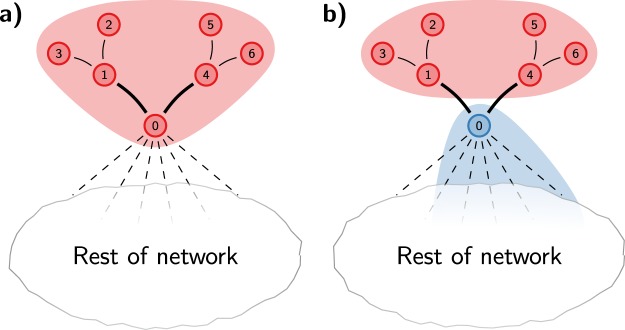
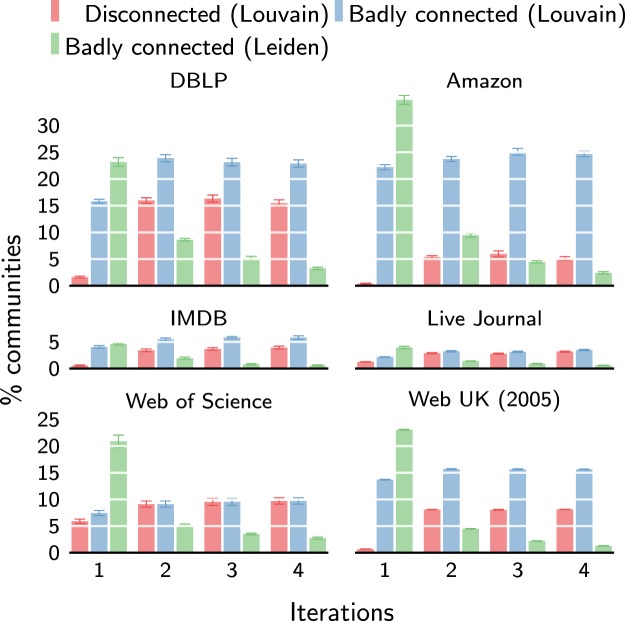
- Louvain may produce arbitrarily badly connected communities; in experiments up to 25% of communities were badly connected and up to 16% were disconnected. First-iteration badly connected percentages included Amazon 23%, DBLP 16%, and Web UK 14%; disconnected communities were usually around 1%, but exceeded 5% for Web of Science in the first iteration and jumped to 16% for DBLP in later iterations. After four iterations, Amazon had 5% disconnected but 25% badly connected communities.
- Leiden guarantees all communities are connected after each iteration, and also γ-separated and γ-connected. After a stable iteration, all nodes are locally optimally assigned and all communities are subpartition γ-dense; asymptotically, all communities are uniformly γ-dense and subset optimal.
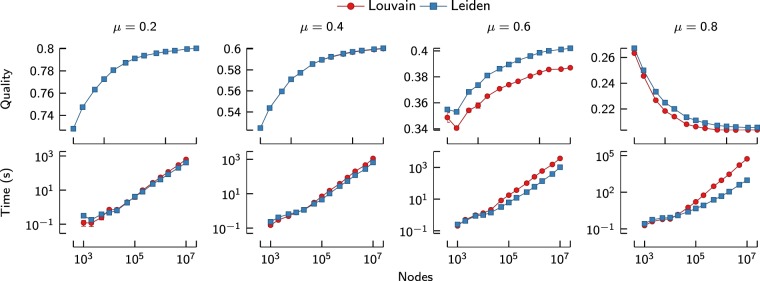
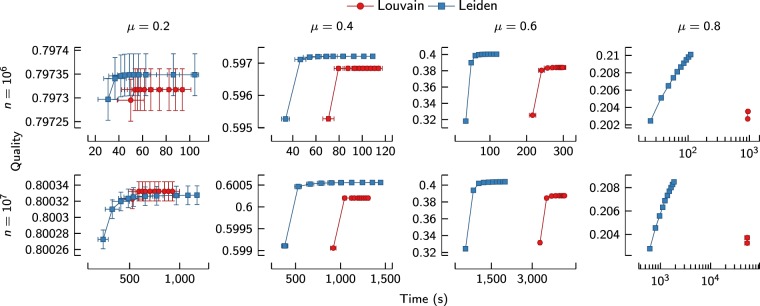
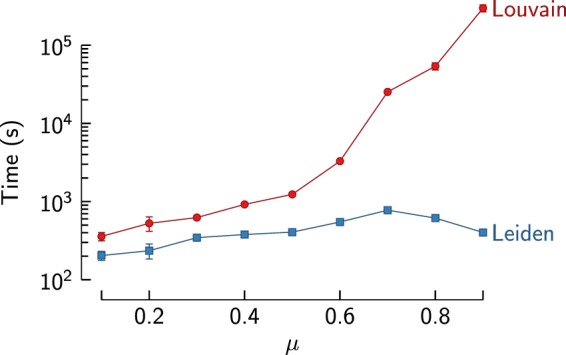
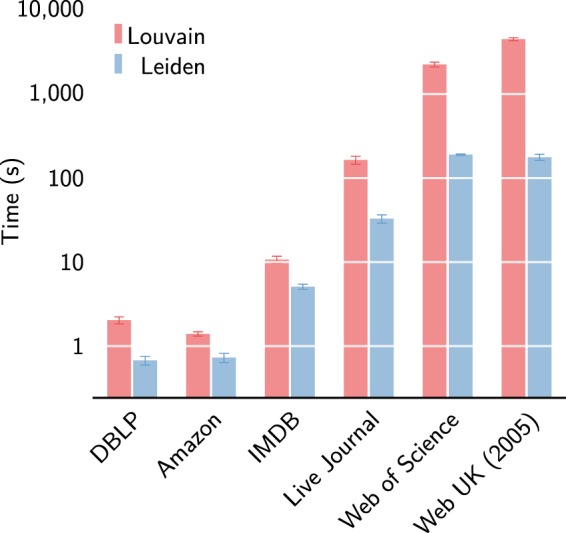
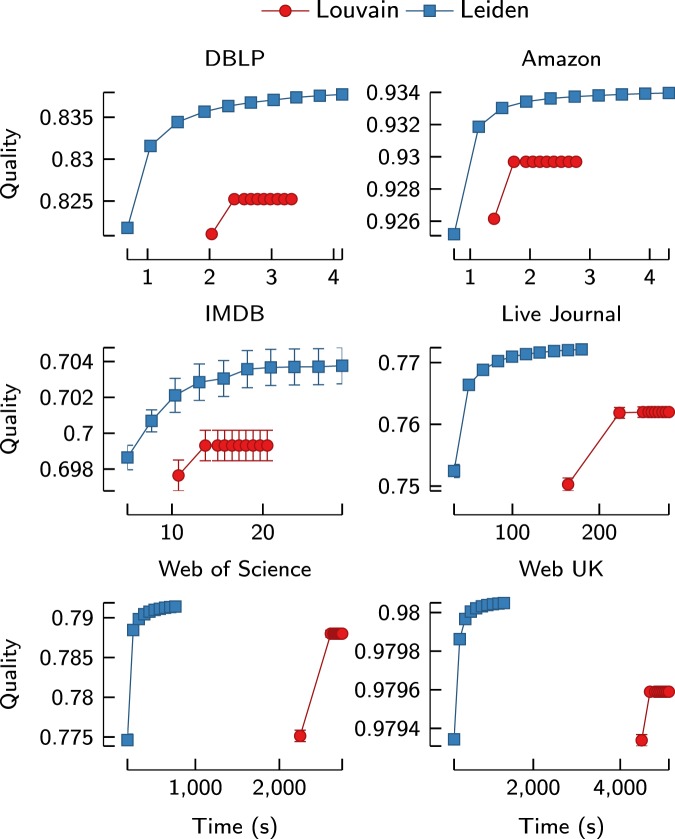
- Leiden was faster than Louvain: first iteration roughly 2–20 times faster on empirical networks, including more than 7× faster for Live Journal, more than 11× for Web of Science, and more than 20× for Web UK. On benchmark networks with difficult partitions (μ = 0.9), Louvain required almost 2.5 days while Leiden needed fewer than 10 minutes; for largest networks Leiden reached 10–100 times faster runtimes.
- Leiden found higher modularity on all six empirical networks: DBLP 0.8387 vs 0.8262, Amazon 0.9341 vs 0.9301, IMDB 0.7069 vs 0.7062, Live Journal 0.7739 vs 0.7653, Web of Science 0.7951 vs 0.7911, and Web UK 0.9801 vs 0.9796.
Methods
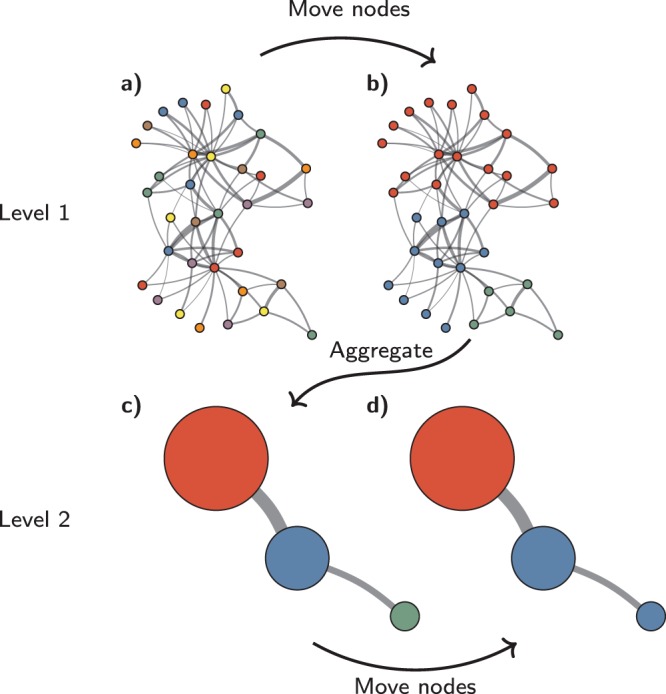
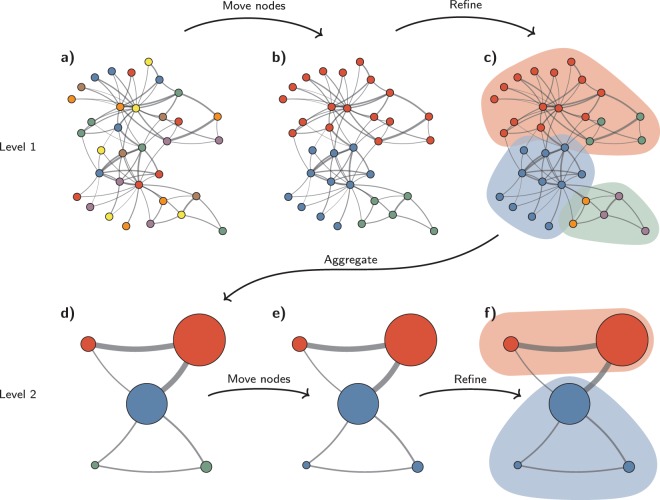
- The paper introduces the Leiden algorithm, which combines local moving, refinement of the partition, and aggregation; proofs of guarantees are relegated to Supplementary Information. It compares Leiden with Louvain on six empirical networks and on benchmark networks.
- Empirical networks: DBLP (317,080 nodes, degree 6.6), Amazon (334,863, 5.6), IMDB (374,511, 80.2), Live Journal (3,997,962, 17.4), Web of Science (9,811,130, 21.2), and Web UK (39,252,879, 39.8). Modularity was used with γ = 1; Table 2 reports maximal modularity after 10 replications of 10 iterations each. Badly connected community analysis was repeated 10 times, with Leiden run on each community’s subnetwork until a stable iteration.
- Benchmark networks ranged from n = 10^3 to n = 10^7 nodes, with community size 50 and CPM as the quality function; the mixing parameter μ varied, 10 iterations were performed, and each parameter set was repeated 10 times. The refinement randomness parameter was θ = 0.01.
Limitations
- The paper states that benchmark networks have only limited value because they are not representative of empirical real-world networks and have a rather simple structure.
- The paper states that counting communities split by Leiden gives only a lower bound on the number of badly connected communities; if Leiden does not find subcommunities, there is no guarantee that modularity cannot be increased by splitting the community.
- Evident from the text: there is no dedicated limitations section; technical details and proofs are relegated to Supplementary Information, and the experimental analysis fixes θ = 0.01 although values roughly in [0.0005, 0.1] are said to provide reasonable results.
Model-written summary. Check it against the paper before relying on it.
Integrity signals
Registry
Cites
Statistics
Figures
Verification
Claims the paper makes
1 Valid · 2 Not valid · 17 Not checked · 142 Own results and interpretations
The cited sources support only part of this claim — read each source’s verdict below.
In the paper
“Hence, the problem of Louvain outlined above is independent from the issue of the resolution limit.”
§ From Louvain to Leiden: guaranteeing well-connected communities > Louvain Algorithm > Badly connected communities
What the sources say
- Partly supportedcites [14] Fortunato S Barthélemy M Resolution Limit in Community Detection Proc. Natl. Acad. Sci. USA 2007 104 36 10.1073/pnas.0605965104 17190818 PMC1765466 sourceExperimental — accuracy not yet measured
Our copy supports the resolution-limit side of the sentence: the Conclusions (VI, p. 7) state that 'the resolution limit of modularity does not rely on particular network structures, but only on the comparison between the sizes of interconnected communities and that of the whole network', the Introduction (p. 1) calls it an 'intrinsic scale' of modularity, and Section V (pp. 5-6) shows the failure persists with simulated annealing, i.e. it is a property of the quality function rather than of one particular optimizer. What the source does not contain is the other term of the comparison: Louvain is never mentioned anywhere in the paper (the Introduction, p. 1, lists only generic greedy procedures [19,20], extremal optimization [21] and simulated annealing [22,23]), and no passage contrasts the resolution limit with an algorithm-specific defect. The independence claim is therefore the citing authors' own inference built on this paper's characterization of the resolution limit. (LLM, conf=0.70)
plain- Asserted: passes — The authors put it forward as true.
- Checkable: passes — It can be checked against evidence.
- Load-bearing: passes — The paper’s conclusions depend on it.
- Based: passes — The paper gives a reason why it holds.
- Partly supported
A result the paper states — it cites no source for it, so there is none to check. The quote shows it is in the paper.
In the paper
“The percentage of badly connected communities is less affected by the number of iterations of the Louvain algorithm.”
§ From Louvain to Leiden: guaranteeing well-connected communities > Experimental Analysis > Badly connected communities
plain- Asserted: passes — The authors put it forward as true.
- Checkable: passes — It can be checked against evidence.
- Load-bearing: unclear — It is unclear whether the paper’s conclusions depend on it.
- Based: passes — The paper gives a reason why it holds.
A result the paper states — it cites no source for it, so there is none to check. The quote shows it is in the paper.
In the paper
“In addition, we prove that, when the Leiden algorithm is applied iteratively, it converges to a partition in which all subsets of all communities are locally optimally assigned.”
- Also stated in: § Introduction · boosted
“In addition, we prove that the algorithm converges to an asymptotically stable partition in which all subsets of all communities are locally optimally assigned.”
§ From Louvain to Leiden: guaranteeing well-connected communities > Abstract
boostedstates a cause- Asserted: passes — The authors put it forward as true.
- Checkable: passes — It can be checked against evidence.
- Load-bearing: passes — The paper’s conclusions depend on it.
- Based: passes — The paper gives a reason why it holds.
- Also stated in: § Introduction · boosted
A result the paper reports from its own data — it cites no other source for it, so there is none to check. The quote shows it is in the paper.
In the paper
“The second iteration of Louvain shows a large increase in the percentage of disconnected communities.”
§ From Louvain to Leiden: guaranteeing well-connected communities > Experimental Analysis > Badly connected communities
plainstates a cause- Asserted: passes — The authors put it forward as true.
- Checkable: passes — It can be checked against evidence.
- Load-bearing: passes — The paper’s conclusions depend on it.
- Based: passes — The paper gives a reason why it holds.
A result the paper reports from its own data — it cites no other source for it, so there is none to check. The quote shows it is in the paper.
In the paper
“In terms of the percentage of badly connected communities in the first iteration, Leiden performs even worse than Louvain, as can be seen in Fig. 4.”
§ From Louvain to Leiden: guaranteeing well-connected communities > Experimental Analysis > Badly connected communities
plain- Asserted: passes — The authors put it forward as true.
- Checkable: passes — It can be checked against evidence.
- Load-bearing: unclear — It is unclear whether the paper’s conclusions depend on it.
- Based: passes — The paper gives a reason why it holds.
115 more claims
Create a free account to see all 162 claims and to verify the 24 references still open.
- Probably not a substantial claim. 23
- It may state two separate claims as one. 23
- The quote only partly states this claim. 1
Claims other papers make about this one
Each is checked against this paper’s own text: does it say what the citing paper says it does?
The cited source says what the claim attributes to it.
In the citing paper
“When compared to six common clustering algorithms, including Leiden25 and CellHarmony26, VFC was the top performing algorithm on every simulation on the T cell data and best performing, on average, on the zebrafish dataset, with a 57% increase in average performance over Louvain, which was the next best algorithm”
From Quantifying the effect of experimental perturbations at single-cell resolution (2021) · cites this paper as [25]
The cited source says what the claim attributes to it.
In the citing paper
“Louvain’s successor Leiden circumvents this issue by yielding guaranteed connected communities and is computationally more efficient52.”
From Best practices for single-cell analysis across modalities (2023) · cites this paper as [52]
The cited source says what the claim attributes to it.
In the citing paper
“However, the Louvain algorithm can lead to arbitrarily poorly connected communities52.”
From Best practices for single-cell analysis across modalities (2023) · cites this paper as [52]
The cited source says what the claim attributes to it.
In the citing paper
“We found that many t-types had total variance substantially above the variances of the k-means clusters (Fig. 5b) and an alternative analysis using entropies of Leiden clustering35 often highlighted the same t-types as variable (Extended Data Fig. 8).”
From Phenotypic variation of transcriptomic cell types in mouse motor cortex (2021) · cites this paper as [35]
The cited source says what the claim attributes to it.
In the citing paper
“Community detection uses the Leiden algorithm [28] with ModularityVertexPartition, producing hierarchical subclustering to depth 3.”
From SuperLocalMemory: Privacy-Preserving Multi-Agent Memory with Bayesian Trust Defense Against Memory Poisoning (2026) · cites this paper as [28]
6 more claims about this paper
Create a free account to see every claim other papers make about this one.
Citations
Cites
Fast unfolding of communities in large networks
Blondel, V. D., Guillaume, J.-L., Lambiotte, R., & Lefebvre, E. (2008) · Journal of Statistical Mechanics: Theory and Experiment · doi:10.1088/1742-5468/2008/10/p10008 · Cited by 21,424 · cited 3×
“The Louvain algorithm 10 is very simple and elegant.”
MethodFinding and evaluating community structure in networks
Newman, M. E. J., & Girvan, M. (2004) · Physical Review E · doi:10.1103/physreve.69.026113 · Cited by 13,931 · cited 2×
“The Leiden algorithm consists of three phases: (1) local moving of nodes, (2) refinement of the partition and (3) aggregation of the network based on the refined partition, using the non-refined partition to create an initial partition for the aggregate network.”
BackgroundMethodComplex brain networks: graph theoretical analysis of structural and functional systems
Bullmore, E., & Sporns, O. (2009) · Nature Reviews Neuroscience · doi:10.1038/nrn2575 · Cited by 11,820
Fortunato, S. (2010) · Physics Reports · doi:10.1016/j.physrep.2009.11.002 · Cited by 11,293 · cited 4×
“The Leiden algorithm consists of three phases: (1) local moving of nodes, (2) refinement of the partition and (3) aggregation of the network based on the refined partition, using the non-refined partition to create an initial partition for the aggregate network.”
BackgroundMethodInfluentialFinding community structure in very large networks
Clauset, A., Newman, M. E. J., & Moore, C. (2004) · Physical Review E · doi:10.1103/physreve.70.066111 · Cited by 7,390 · cited 1×
“Optimising modularity is NP-hard 5 , and consequentially many heuristic algorithms have been proposed, such as hierarchical agglomeration 6 , extremal optimisation 7 , simulated annealing 4,8 and spectral 9 algorithms.”
MethodFinding community structure in networks using the eigenvectors of matrices
Newman, M. E. J. (2006) · Physical Review E · doi:10.1103/physreve.74.036104 · Cited by 4,761
Functional cartography of complex metabolic networks
Guimerà, R., & Nunes Amaral, L. A. (2005) · Nature · doi:10.1038/nature03288 · Cited by 3,983 · cited 2×
“Optimising modularity is NP-hard 5 , and consequentially many heuristic algorithms have been proposed, such as hierarchical agglomeration 6 , extremal optimisation 7 , simulated annealing 4,8 and spectral 9 algorithms.”
MethodNear linear time algorithm to detect community structures in large-scale networks
Raghavan, U. N., Albert, R., & Kumara, S. (2007) · Physical Review E · doi:10.1103/physreve.76.036106 · Cited by 3,502 · cited 2×
“Trying to fix the problem by simply considering the connected components of communities 19–21 is unsatisfactory because it addresses only the most extreme case and does not resolve the more fundamental problem.”
BackgroundBenchmark graphs for testing community detection algorithms
Lancichinetti, A., Fortunato, S., & Radicchi, F. (2008) · Physical Review E · doi:10.1103/physreve.78.046110 · Cited by 3,051 · cited 1×
“To study the scaling of the Louvain and the Leiden algorithm, we rely on a variant of a well-known approach for constructing benchmark networks 28 .”
MethodResolution limit in community detection
Fortunato, S., & Barthélemy, M. (2007) · Proceedings of the National Academy of Sciences · doi:10.1073/pnas.0605965104 · Cited by 3,024 · cited 2×
“The algorithm may yield arbitrarily badly connected communities, over and above the well-known issue of the resolution limit 14 .”
Background
Research works printed but not linked: 2
- Porter MA Onnela J-P Mucha PJ Communities in Networks Not. AMS 2009 56 1082 1097
- Luecken, M. D. Application of multi-resolution partitioning of interaction networks to the study of complex disease. Ph.D. thesis, (University of Oxford, 2016).
Cited by
Items 1,601–1,700 of 7,288
Zhang, Y., Wu, M., Zhang, G., & Lü, J. (2023) · Journal of the Association for Information Science and Technology · doi:10.1002/asi.24754 · Cited by 17
Astrocytes modulate neuronal development by S100A6 signaling
Cinquina, V., Tretiakov, E. O., Kalaba, P., Alpár, A., Calvigioni, D., Piscitelli, F., Keimpema, E., Marzo, V. D., Verkhratsky, A., & Harkany, T. (2025) · Nature Communications · doi:10.1038/s41467-025-64405-y · Cited by 17
The complex nature of financial market microstructure: the case of a stock market crash
Shi, F., Broussard, J. P., & Booth, G. G. (2022) · Journal of Economic Interaction and Coordination · doi:10.1007/s11403-021-00343-4 · Cited by 17
Rossini, P. (2024) · Digital Scholarship in the Humanities · doi:10.1093/llc/fqad086 · Cited by 17
K-plex cover pooling for graph neural networks
Bacciu, D., Conte, A., Grossi, R., Landolfi, F., & Marino, A. (2021) · Data Mining and Knowledge Discovery · doi:10.1007/s10618-021-00779-z · Cited by 17
Riça, I. G., Joughin, B. A., Teke, M. E., Emmons, T. R., Griffith, A. M., Cahill, L. A., Banner‐Goodspeed, V., Robson, S. C., Hernandez, J. M., Segal, B. H., et al. (2022) · The Journal of Trauma: Injury, Infection, and Critical Care · doi:10.1097/ta.0000000000003823 · Cited by 17
Understanding Biology in the Age of Artificial IntelligencePreprint
Lawrence, E., El-Shazly, A., Seal, S., Joshi, C. K., Lió, P., Singh, S., Bender, A., Sormanni, P., & Greenig, M. (2024) · arXiv (Cornell University) · doi:10.48550/arxiv.2403.04106 · Cited by 17
Spectral Data Analysis for Forgery Detection in Official Documents: A Network-Based Approach
Al-Ameri, M. A. A., Ciylan, B., & Mahmood, B. M. (2022) · Electronics · doi:10.3390/electronics11234036 · Cited by 17
Unsupervised Forgery Detection of Documents: A Network-Inspired Approach
Al-Ameri, M. A. A., Mahmood, B. M., Ciylan, B., & Amged, A. (2023) · Electronics · doi:10.3390/electronics12071682 · Cited by 17
Eva: Attribute-Aware Network Segmentation
Citraro, S., & Rossetti, G. (2019) · Studies in computational intelligence · doi:10.1007/978-3-030-36687-2_12 · Cited by 17
Assessing the structural connectivity of international trade networks along the “Belt and Road”
Chen, W., Zhang, H., Tang, Z., & Yu, Z. (2023) · PLoS ONE · doi:10.1371/journal.pone.0282596 · Cited by 17
Wong, M., Wei, Y., & Ho, Y. (2023) · Current Opinion in HIV and AIDS · doi:10.1097/coh.0000000000000809 · Cited by 16
SumBlogger: Abstractive Summarization of Large Collections of Scientific Articles
Zakkas, P., Verberne, S., & Zavrel, J. (2024) · Lecture notes in computer science · doi:10.1007/978-3-031-56027-9_23 · Cited by 16
Fault Localization from the Semantic Code Search Perspective
Qin, Y., Wang, S., Lei, Y., Zhang, Z., Lin, B., Peng, X., Ma, J., Chen, L., & Mao, X. (2026) · ACM Transactions on Software Engineering and Methodology · doi:10.1145/3757915 · Cited by 16
Banaschewski, B. J. H., Michki, S. N., Sitaraman, S., Pan, R., Wang, J. Y., Stewart, D., Goldy, M. K., Lin, S. M., Cantu, E., Katzen, J. B., et al. (2025) · Communications Biology · doi:10.1038/s42003-025-07589-9 · Cited by 16
Evaluating the Utilities of Large Language Models in Single-cell Data AnalysisPreprint
Zhao, H., Liu, T., Li, K., Wang, Y., & Li, H. (2023) · Research Square · doi:10.21203/rs.3.rs-3376641/v1 · Cited by 16
Spatial-Omics Methods and Applications
Kulasinghe, A., Berrell, N., Donovan, M. L., & Nilges, B. S. (2025) · Methods in molecular biology · doi:10.1007/978-1-0716-4276-4_5 · Cited by 16
A global molecular code for birth order and neuronal identity in Drosophila
Cachero, S., Mitletton, M., Beckett, I. R., Marin, E. C., Capdevila, L. S., Gkantia, M., Soffers, J. H., Lacin, H., Jefferis, G. S. X. E., & Doná, E. (2026) · Nature · doi:10.1038/s41586-026-10797-w · Cited by 16
Highly sensitive spatial transcriptomics using FISHnCHIPs of multiple co-expressed genes
Zhou, X., Seow, W. Y., Ha, N., Cheng, T. H., Jiang, L., Boonruangkan, J., Goh, J. J. L., Prabhakar, S., Chou, N., & Chen, K. H. (2024) · Nature Communications · doi:10.1038/s41467-024-46669-y · Cited by 16
Nkuna, R., Mohlomi, N., & Matambo, T. S. (2026) · Minerals · doi:10.3390/min16010056 · Cited by 16
Pretending to be a VIP! Characterization and Detection of Fake and Clone Channels on Telegram
Morgia, M. L., Mei, A., Mongardini, A. M., & Wu, J. (2025) · ACM Transactions on the Web · doi:10.1145/3705014 · Cited by 16
Benchmarking LLM-based agents for single-cell omics analysis
Liu, Y., Zhou, L., Du, X., He, R., Zhang, X., Shen, R., & Li, Y. (2026) · Genome biology · doi:10.1186/s13059-026-03998-z · Cited by 16
Ye, J., Calvo, I. A., Cenzano, I., Vilas‐Zornoza, A., Martinez‐de‐Morentin, X., Lasaga, M., Alignani, D., Paiva, B., Viñado, A. C., Martín‐Úriz, P. S., et al. (2022) · iScience · doi:10.1016/j.isci.2022.104225 · Cited by 16
FactVAE: a factorized variational autoencoder for single-cell multi-omics data integration analysis
Wang, L., Zhang, H., Yi, B., Xie, W., Yu, K., Li, W., Li, K., & Zhao, D. (2025) · Briefings in Bioinformatics · doi:10.1093/bib/bbaf157 · Cited by 16
Single-cell atlas of transcriptomic vulnerability across brain disorders
Lee, D., Koutrouli, M., Masse, N. Y., Hoffman, G. E., Kinrot, S., Wang, X., N. M., P., Pjanic, M., Clarence, T., Tsetsos, F., et al. (2026) · Nature · doi:10.1038/s41586-025-09573-z · Cited by 13
Enhanced author bibliographic coupling analysis using semantic and syntactic citation information
Zhang, R., & Yuan, J. (2022) · Scientometrics · doi:10.1007/s11192-022-04333-6 · Cited by 16
A Scientometrics Analysis of Cybersecurity Using e-CSTI
Omote, K., Inoue, Y., Terada, Y., Shichijo, N., & Shirai, T. (2024) · IEEE Access · doi:10.1109/access.2024.3375910 · Cited by 16
Northstar enables automatic classification of known and novel cell types from tumor samples
Zanini, F., Berghuis, B. A., Jones, R. C., di Robilant, B. N., Nong, R. Y., Norton, J. A., Clarke, M. F., & Quake, S. R. (2020) · Scientific Reports · doi:10.1038/s41598-020-71805-1 · Cited by 16
Nested Stochastic Block Models applied to the analysis of single cell data
Morelli, L., Giansanti, V., & Cittaro, D. (2021) · BMC Bioinformatics · doi:10.1186/s12859-021-04489-7 · Cited by 16
Computational Analyses and Challenges of Single-cell ATAC-seq
Wang, C., Zhou, J., Zhang, H., Zhuang, Z., Bai, G., Tang, M., Liu, S., & Liu, T. (2025) · Genomics Proteomics & Bioinformatics · doi:10.1093/gpbjnl/qzaf115 · Cited by 16
StepChain GraphRAG: Reasoning Over Knowledge Graphs for Multi-Hop Question AnsweringPreprint
Ni, T., Yuan, X., Li, S., Wu, K., Liu, R. P., Ni, W., & Zhang, W. (2025) · arXiv (Cornell University) · doi:10.48550/arxiv.2510.02827 · Cited by 16
Community Deception in Attributed Networks
Fionda, V., & Pirrò, G. (2022) · IEEE Transactions on Computational Social Systems · doi:10.1109/tcss.2022.3213722 · Cited by 16
TIVelo: RNA velocity estimation leveraging cluster-level trajectory inference
Ge, M., Miao, J., Qi, J., Zhou, X., & Lin, Z. (2025) · Nature Communications · doi:10.1038/s41467-025-61628-x · Cited by 16
Small volume blood-brain barrier opening in macaques with a 1 MHz ultrasound phased array
Manuel, T. J., Sigona, M. K., Phipps, M. A., Kusunose, J., Luo, H., Yang, P., Newton, A. T., Gore, J. C., Grissom, W. A., Chen, L. M., et al. (2023) · Journal of Controlled Release · doi:10.1016/j.jconrel.2023.10.015 · Cited by 16
Xiao, X., Zhang, L. Y., Zhao, H., & Wang, Z. (2025) · Nature Machine Intelligence · doi:10.1038/s42256-025-01161-0 · Cited by 16
Monshizadeh, M., & Ye, Y. (2024) · Gut Microbes · doi:10.1080/19490976.2024.2302076 · Cited by 16
Bronchial epithelium epithelial-mesenchymal plasticity forms aberrant basaloid-like cells in vitro
Kumar, D. B. U., Motakis, E., Yurieva, M., Kohar, V., Martínek, J., Wu, T.-C., Khoury, J., Grassmann, J. D. S., Lu, M., Palucka, K., et al. (2022) · American Journal of Physiology-Lung Cellular and Molecular Physiology · doi:10.1152/ajplung.00254.2021 · Cited by 16
Chen, J., Hu, X., Zhao, J., Yin, X., Zheng, L., Guo, J., Chen, J., Wang, Y., Sheng, X., Dong, H., et al. (2024) · Clinical Cancer Research · doi:10.1158/1078-0432.ccr-23-2760 · Cited by 16
Cell-o1 : training LLMs to solve single-cell reasoning puzzles with reinforcement learning
Fang, Y., Jin, Q., Xiong, G., Jin, B., Zhong, X., Ouyang, S., Yang, Y., Zhang, A., Han, J., & Lu, Z. (2026) · Bioinformatics · doi:10.1093/bioinformatics/btag208 · Cited by 16
Gender biases in online communication: A case study of soccer
Macedo, M. G. D. M., & Saxena, A. (2026) · Applied Intelligence · doi:10.1007/s10489-025-06988-z · Cited by 16
Faravelli, I., Rinchetti, P., Tambalo, M., Simutin, I., Mapelli, L., Mancinelli, S., Miotto, M., Rizzuti, M., D’Angelo, A., Cordiglieri, C., et al. (2025) · Nature Communications · doi:10.1038/s41467-025-67725-1 · Cited by 16
Unidimensional community detection: A monte carlo simulation, grid search, and comparison.
Christensen, A. P. (2024) · Psychological Methods · doi:10.1037/met0000692 · Cited by 16
Endothelial LATS2 is a suppressor of bone marrow fibrosis
Sivaraj, K. K., Majev, P.-G., Dharmalingam, B., Schröder, S., Banjanin, B., Stehling, M., Zeuschner, D., Nordheim, A., Schneider, R. K., & Adams, R. H. (2024) · Nature Cardiovascular Research · doi:10.1038/s44161-024-00508-x · Cited by 16
Tonic type I interferon signaling optimizes the antiviral function of plasmacytoid dendritic cells
Pucella, J. N., Maqueda‐Alfaro, R. A., Ni, H., Sulczewski, F. B., Eichinger, A., Esteva, E., Ra, A. C., Das, A., Perez, O. A., Feng, J., et al. (2025) · Nature Immunology · doi:10.1038/s41590-025-02279-4 · Cited by 16
Impact of epizootics on mussel farms: Insights into microbiota composition of Mytilus species
Cheikh, Y. B., Massol, F., Giusti-Petrucciani, N., & Travers, M. (2023) · Microbiological Research · doi:10.1016/j.micres.2023.127593 · Cited by 16
Zhou, L., Peng, X., Chen, M., He, X., Tian, G., Yang, J., & Peng, L. (2025) · GigaScience · doi:10.1093/gigascience/giae103 · Cited by 16
A map of signaling responses in the human airway epithelium
McCauley, K. B., Kukreja, K., Walker, A. E. T., Jaffe, A. B., & Klein, A. M. (2024) · Cell Systems · doi:10.1016/j.cels.2024.02.005 · Cited by 16
Johnson, R. G., Al-khateeb, S., Forbes, A., & Cupido, K. (2023) · Communication & Sport · doi:10.1177/21674795231213330 · Cited by 16
Latency aware graph-based microservice placement in the edge-cloud continuum
Khan, S., & Khan, S. (2024) · Cluster Computing · doi:10.1007/s10586-024-04824-6 · Cited by 16
CD74 + fibroblasts proliferate upon mechanical stretching to promote angiogenesis in keloids
Zhang, J., Li, S., 匡春梅, Shen, Y., Yu, H., Chen, F., Tang, R., Mao, S., Lv, L., Qi, M., et al. (2024) · The FASEB Journal · doi:10.1096/fj.202401302r · Cited by 16
He, Z., Li, Y., Feng, G., Yuan, X., Lu, Z., Dai, M., Hu, Y., Zhang, Y., Zhou, Q., & Li, W. (2022) · Advanced Science · doi:10.1002/advs.202104682 · Cited by 16
Combining denoising of RNA-seq data and flux balance analysis for cluster analysis of single cells
Galuzzi, B. G., Vanoni, M., & Damiani, C. (2022) · BMC Bioinformatics · doi:10.1186/s12859-022-04967-6 · Cited by 16
Hong, J. P., Reynoso, G. V., Andhey, P. S., Swain, A., Turner, J. S., Boon, A. C. M., Krammer, F., Ellebedy, A. H., Zanini, F., Artyomov, M. N., et al. (2020) · Cell Reports Medicine · doi:10.1016/j.xcrm.2020.100035 · Cited by 16
Akbaritabar, A. (2021) · Quantitative Science Studies · doi:10.1162/qss_a_00131 · Cited by 16
Li, L., Cho, K. H., Yu, X., & Cheng, S. (2025) · Computers in Biology and Medicine · doi:10.1016/j.compbiomed.2025.110000 · Cited by 16
Νικολακοπούλου, Κ., Ybañez, W. S., Klaeylé, L., Frugoli, L., Cindrová‐Davies, T., Hotz, H.-R., Soneson, C., & Turco, M. Y. (2026) · Cell stem cell · doi:10.1016/j.stem.2026.04.005 · Cited by 16
The plurivocal university: Typologizing the diverse voices of a research university on social media
Volk, S. C., Vogler, D., Fürst, S., & Schäfer, M. S. (2024) · Public Understanding of Science · doi:10.1177/09636625241268700 · Cited by 16
Frischholz, S., Schuster, E.-M., Grotz, M., Schülein, C., Benz, J., Kocher, K., Klotz, L., Varga, S., Hiltner, T., Alsalameh, R. J., et al. (2026) · Nature Immunology · doi:10.1038/s41590-026-02421-w · Cited by 16
Tian, H., Chen, Y., Zhao, T., Ye, L., Li, H., Li, Z., Qiu, W., Wang, W., Li, R., Liu, F., et al. (2025) · Signal Transduction and Targeted Therapy · doi:10.1038/s41392-025-02438-x · Cited by 16
Community formation and detection on GitHub collaboration networks
Moradi-Jamei, B., Kramer, B. L., Calderón, J. B. S., & Korkmaz, G. (2021) · IEEE/ACM International Conference on Advances in Social Networks Analysis and Mining (ASONAM) · doi:10.1145/3487351.3488278 · Cited by 16
Lee, M., & Sharma, P. R. (2024) · International Journal of Educational Technology in Higher Education · doi:10.1186/s41239-024-00495-w · Cited by 16
Tang, W., Carrette, P., Cai, Y., Williamson, J. M., & Daoutidis, P. (2023) · Computers & Chemical Engineering · doi:10.1016/j.compchemeng.2023.108382 · Cited by 16
Strategic attitude expressions as identity performance and identity creation in interaction
O’Reilly, C., Mannion, S., Maher, P. J., Smith, E. M., MacCarron, P., & Quayle, M. (2024) · Communications Psychology · doi:10.1038/s44271-024-00076-7 · Cited by 16
Deep learning-based prediction of future growth potential of technologies
Lee, J. Y., Ahn, S., & Kim, D. (2021) · PLoS ONE · doi:10.1371/journal.pone.0252753 · Cited by 16
More persistent bacterial than fungal associations in the microbiota of a pest insect
Gurung, K., Vink, S. N., Salles, J. F., & Wertheim, B. (2022) · Journal of Pest Science · doi:10.1007/s10340-022-01524-1 · Cited by 16
A network community-based differential evolution for multimodal optimization problems
Chen, X.-Y., Zhao, H., & Liu, J. (2023) · Information Sciences · doi:10.1016/j.ins.2023.119359 · Cited by 16
Pervasive and programmed nucleosome distortion on single chromatin fibres
Yang, M. G., Richter, H. J., Wang, S., McNally, C. P., Moore, C. M., Emadi, A., Harris, N., Dhillon, S., Maresca, M., Pan, H., et al. (2026) · Nature · doi:10.1038/s41586-026-10418-6 · Cited by 16
Signed Networks: theory, methods, and applicationsPreprint
Diaz-Diaz, F., Candellone, E., González-Casado, M. Á., Fraxanet, E., Vendeville, A., Ferri, I., & Teixeira, A. S. (2025) · arXiv · doi:10.48550/arxiv.2511.17247 · Cited by 16
Preferential attachment hypergraph with high modularity
Giroire, F., Nisse, N., Trolliet, T., & Sulkowska, M. (2022) · Network Science · doi:10.1017/nws.2022.35 · Cited by 17
Modularity maximization to design contiguous policy zones for pandemic response
Baghersad, M., Emadikhiav, M., Huang, C., & Behara, R. S. (2022) · European Journal of Operational Research · doi:10.1016/j.ejor.2022.01.012 · Cited by 16
Gu, M., Zhao, T.-F., Zhong, J., & Chen, W. (2025) · IEEE Transactions on Network Science and Engineering · doi:10.1109/tnse.2025.3544429 · Cited by 16
LargeNetVis: Visual Exploration of Large Temporal Networks Based On Community Taxonomies
Linhares, C. D. G., Ponciano, J. R., Pedro, D. S., Rocha, L. E. C., Traina, A. J. M., & Poco, J. (2022) · IEEE Transactions on Visualization and Computer Graphics · doi:10.1109/tvcg.2022.3209477 · Cited by 16
Social Network Analysis: A Novel Paradigm for Improving Community Detection
Hernández, R., Gutiérrez, I., & Castro, J. (2025) · International Journal of Computational Intelligence Systems · doi:10.1007/s44196-025-00812-9 · Cited by 16
Zack, T., Losert, K. P., Maisel, S. M., Wild, J., Yaqubie, A., Herman, M., Knox, J. J., Mayer, R. J., Venook, A. P., Butte, A., et al. (2023) · npj Precision Oncology · doi:10.1038/s41698-023-00371-2 · Cited by 13
Dey, A., Mudunuri, S. B., & Kiran, M. (2024) · PLoS Computational Biology · doi:10.1371/journal.pcbi.1012336 · Cited by 16
Liu, L., & Wang, F. (2025) · Cities · doi:10.1016/j.cities.2025.105721 · Cited by 16
Zeng, F., & Sun, H. (2024) · Mathematics · doi:10.3390/math12091285 · Cited by 16
PPA-Relevant Clustering-Driven Placement for Large-Scale VLSI Designs
Kahng, A. B., Kang, S., Kundu, S., Min, K., Park, S., & Pramanik, B. (2024) · ACM/IEEE Design Automation Conference (DAC) · doi:10.1145/3649329.3655991 · Cited by 16
Martínez-Hernández, E., Valencia, D., Arvizu, C., Alatorre, D. F. R., & Aburto, J. (2021) · ACS Sustainable Chemistry & Engineering · doi:10.1021/acssuschemeng.1c00841 · Cited by 16
Huzsvár, T., Wéber, R., Szabó, M., & Hős, C. (2023) · Water Resources Management · doi:10.1007/s11269-023-03590-1 · Cited by 16
Digital humanities e culture documentarie: un modello di analisi, valutazione, interpretazione
Vivarelli, M. (2020) · AIB Studi · doi:10.2426/aibstudi-12471 · Cited by 16
ATF4 drives regulatory T cell functional specification in homeostasis and obesity
Wang, K., Farrell, A., Zhou, E., Qin, H., Zeng, Z., Zhou, K., Cunha e Rocha, K., Zhang, D., Wang, G., Atakilit, A., et al. (2025) · Science Immunology · doi:10.1126/sciimmunol.adp7193 · Cited by 15
Baskar, R., Chen, A. F., Favaro, P. M. B., Reynolds, W. D., Müller, F., Borges, L., Jiang, S., Park, H. S., Kool, E. T., Greenleaf, W. J., et al. (2022) · Cell Reports Methods · doi:10.1016/j.crmeth.2022.100188 · Cited by 15
Disease similarity network analysis of Autism Spectrum Disorder and comorbid brain disorders
Vilela, J. E. R., Martiniano, H., Marques, A. R., Santos, J. X., Rasga, C., Oliveira, G., & Vicente, A. M. (2022) · Frontiers in Molecular Neuroscience · doi:10.3389/fnmol.2022.932305 · Cited by 15
Exploring machine learning strategies for single-cell transcriptomic analysis in wound healing
Cui, J., Wang, M., Lin, C., Xu, X., & Zhang, Z. (2025) · Burns & Trauma · doi:10.1093/burnst/tkaf032 · Cited by 15
Palko, S. I., Benoit, M., Yao, A. Y., Mohan, R., & Yan, R. (2024) · Glia · doi:10.1002/glia.24514 · Cited by 15
Jaiswal, A., Kooistra, T., Pokatayev, V., Bastos, H. N., Santos, R. F., Sarraf, T. R., Segerstolpe, Å., Lin, C., Amir-Zilberstein, L., Twardus, S. W., et al. (2026) · Cell Genomics · doi:10.1016/j.xgen.2025.101066 · Cited by 15
Webster, J. M., Yang, Y.-T., Miller, A. T., Zane, A., Scholz, K., Stone, W. J., Mudium, N., Corbin-Stein, N. J., Won, W.-J., Stoll, A. C., et al. (2026) · Neurobiology of Disease · doi:10.1016/j.nbd.2026.107323 · Cited by 15
Meng, D., Feng, Y., Yuan, K., Yu, Z., Cao, Q., Cheng, L., & Zheng, X. (2024) · Briefings in Bioinformatics · doi:10.1093/bib/bbaf010 · Cited by 15
Evaluation of cell type annotation reliability using a large language model-based identifier
Ye, W., Ma, Y., Xiang, J., Liang, H., Luo, J., Li, Y., Wang, T., Xiang, Q., Song, W., Li, W., et al. (2025) · Communications Biology · doi:10.1038/s42003-025-08745-x · Cited by 15
A single-cell mass cytometry-based atlas of the developing mouse brain
Deusen, A. L. V., Kumar, S., Calhan, O. Y., Goggin, S. M., Shi, J., Williams, C. M., Keeler, A. B., Fread, K., Gadani, I. C., Deppmann, C. D., et al. (2024) · Nature Neuroscience · doi:10.1038/s41593-024-01786-1 · Cited by 15
Single-cell RNAseq analysis of spinal locomotor circuitry in larval zebrafish
Kelly, J. J., Wen, H., & Brehm, P. (2023) · eLife · doi:10.7554/elife.89338 · Cited by 15
Muse-gnn: Learning unified gene representation from multimodal biological graph data
Liu, T., Wang, Y., Ying, R., & Zhao, H. (2023) · Advances in Neural Information Processing Systems 36 · doi:10.52202/075280-1071 · Cited by 15
Kriukov, E., Soucy, J. R., Labrecque, E., & Baranov, P. Y. (2025) · Developmental Biology · doi:10.1016/j.ydbio.2025.08.025 · Cited by 15
Desmosomal connectomics of all somatic muscles in an annelid larva
Jasek, S., Verasztó, C., Brodrick, E., Shahidi, R., Kazimiers, T., Kerbl, A., & Jékely, G. (2022) · eLife · doi:10.7554/elife.71231 · Cited by 15
The social acceptance of neurodiverse children in Irish primary schools
Jones, M. H., Symonds, J. E., Downey, S., Sloan, S., Devine, D., & Kinsella, W. (2023) · International Journal of Inclusive Education · doi:10.1080/13603116.2023.2195861 · Cited by 15
Increased risk of kidney failure in patients with genetic kidney disorders
Elliott, M. D., Vena, N., Marasà, M., Cocchi, E., Bheda, S., Bogyo, K., Shang, N., Zanoni, F., Verbitsky, M., Wang, C., et al. (2024) · Journal of Clinical Investigation · doi:10.1172/jci178573 · Cited by 15
LazySlide: accessible and interoperable whole-slide image analysis
Zheng, Y., Abila, E., Chrenková, E., Buljan, I., Winkler, J., & Rendeiro, A. F. (2026) · Nature Methods · doi:10.1038/s41592-026-03044-7 · Cited by 15
Gentili, M., Carlson, R. J., Liu, B., Hellier, Q., Andrews, J. O., Qin, Y., Blainey, P. C., & Hacohen, N. (2024) · Cell Systems · doi:10.1016/j.cels.2024.11.004 · Cited by 15
Let There Be Claws: An Early Social Network Analysis of AI Agents on MoltbookPreprint
Price, H. C. W., AlMuhanna, H., Bassani, P. M., Ho, M., & Evans, T. (2026) · arXiv (Cornell University) · doi:10.48550/arxiv.2602.20044 · Cited by 15
Metadata
- Authors
- Traag, V. A., Waltman, L., & van Eck, N. J.
- Affiliations
- Leiden University (NL)
- Corresponding author
- Traag, V. A.
- Venue
- Scientific Reports
- Published
- 2019-03-26
- Volume
- 9
- Issue
- 1
- Pages
- 5233-5233
- ISSN
- 2045-2322 (ISSN-L)
- PMC
- PMC6435756
- OpenAlex
- W2897249806
- Semantic Scholar
- 79cdbabb22ef80074f5659430fe6fc97932798f5
- Cited by
- 5,635
- References
- 27
- Citations by year
- 2026: 1250 · 2025: 1281 · 2024: 980 · 2023: 757 · 2022: 639 · 2021: 466 · 2020: 213 · 2019: 46
- FWCI
- 158.78
- Type
- journal article
- Language
- en
- Open access
- gold
- doi.org
- Licence
- cc-by
- creativecommons.org/licenses/by/4.0 (tdm)
- creativecommons.org/licenses/by/4.0 (vor)
- Locations
- Scientific Reports (publishedVersion, cc-by)
- Europe PMC (PubMed Central) (publishedVersion, other-oa)
- PubMed Central (publishedVersion, cc-by)
- PubMed (publishedVersion)
- arXiv (Cornell University) (submittedVersion)
- Leiden Repository (Leiden University) (submittedVersion, cc-by)
- Data Archiving and Networked Services (DANS) (submittedVersion, cc-by)
- DOAJ (DOAJ: Directory of Open Access Journals) (submittedVersion)
- Leiden Repository (Leiden University) (submittedVersion)
- arXiv (Cornell University)
- Topics
- Physical Sciences › Physics and Astronomy › Statistical and Nonlinear Physics › Complex Network Analysis Techniques
- Physical Sciences › Computer Science › Artificial Intelligence › Advanced Clustering Algorithms Research
- Life Sciences › Biochemistry, Genetics and Molecular Biology › Molecular Biology › Bioinformatics and Genomic Networks
- Keywords
- community detection, Louvain algorithm, Leiden algorithm, network partitioning, community connectivity, complex networks
About these checks
Registry, retraction, Cites and statistics results are computed, not judged, with one exception: a printed reference that no index lists is read once by a model before it counts as a citation error. Claims are extracted by a model and kept only when their quote appears verbatim in the text; each cited source is then checked, with a model’s help, for whether it says what the claim relies on. Those verdicts can be wrong — read the claim’s quote and the cited source before relying on one.
The claim verdicts this report counts are experimental: their accuracy is not yet measured.
A language model drew the claims from the paper on 2026-11-23, under version 3 of the claim definition (model deepseek-v4.1-flash, prompt extract-v3).
A second model labelled each claim on 2026-11-23 (model jev-1.13-20260917, definition revision gold-guideline-v0.2).
Cited sources are checked with a language model’s help (qwen3.8-omni-flash).
Statistics and arithmetic are recomputed, not judged.
Confidence bands are shown only for fields calibrated on our annotated test set. None is calibrated yet, so no band is shown.
What counts as a claim ›How we measure confidence ›How we check this ›
Are you an author, or do you see a problem with this page? Request a review
Data sources
Bibliographic data: Semantic Scholar, OpenAlex, Crossref.
Contains information from the Semantic Scholar Academic Graph Datasets, made available under the ODC Attribution License (ODC-BY 1.0).
Semantic Scholar’s data is described in: Kinney, R., et al. (2023). The Semantic Scholar Open Data Platform. arXiv:2301.10140.
