

From Louvain to Leiden: guaranteeing well-connected communities
Open accessThe DOI matches its Crossref record; 30 of the 30 references it cites were found in a registry or an index; 1 of the 26 sources its claims cite were checked for support.
Abstract
Community detection is often used to understand the structure of large and complex networks. One of the most popular algorithms for uncovering community structure is the so-called Louvain algorithm. We show that this algorithm has a major defect that largely went unnoticed until now: the Louvain algorithm may yield arbitrarily badly connected communities. In the worst case, communities may even be disconnected, especially when running the algorithm iteratively. In our experimental analysis, we observe that up to 25% of the communities are badly connected and up to 16% are disconnected. To address this problem, we introduce the Leiden algorithm. We prove that the Leiden algorithm yields communities that are guaranteed to be connected. In addition, we prove that, when the Leiden algorithm is applied iteratively, it converges to a partition in which all subsets of all communities are locally optimally assigned. Furthermore, by relying on a fast local move approach, the Leiden algorithm runs faster than the Louvain algorithm. We demonstrate the performance of the Leiden algorithm for several benchmark and real-world networks. We find that the Leiden algorithm is faster than the Louvain algorithm and uncovers better partitions, in addition to providing explicit guarantees.
Overview
CoChat Summary
TL;DR
The Louvain algorithm can yield arbitrarily badly connected communities, including disconnected ones, especially when iterated. The Leiden algorithm guarantees connected communities and, under iteration, converges to subset-optimal partitions while running faster and finding higher-quality partitions.
Key findings
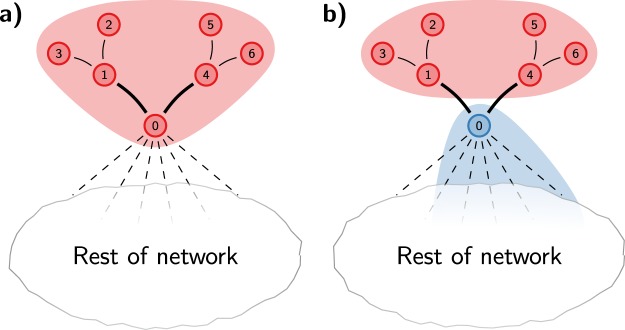
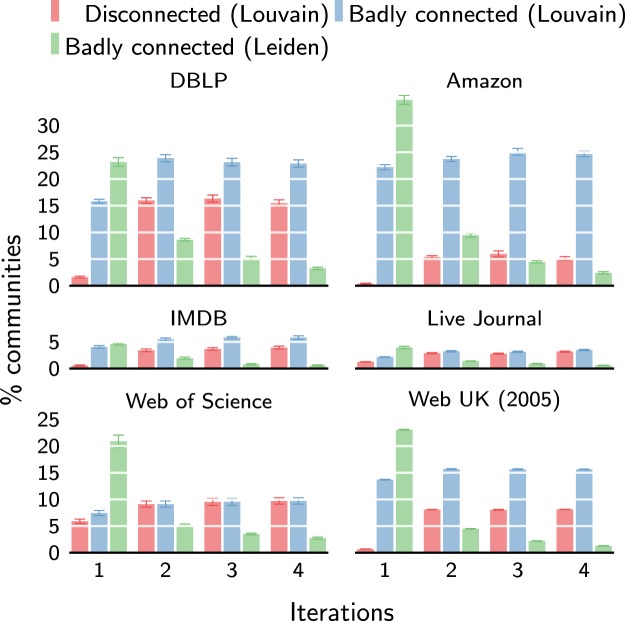
- Louvain may produce arbitrarily badly connected communities; in experiments up to 25% of communities were badly connected and up to 16% were disconnected. First-iteration badly connected percentages included Amazon 23%, DBLP 16%, and Web UK 14%; disconnected communities were usually around 1%, but exceeded 5% for Web of Science in the first iteration and jumped to 16% for DBLP in later iterations. After four iterations, Amazon had 5% disconnected but 25% badly connected communities.
- Leiden guarantees all communities are connected after each iteration, and also γ-separated and γ-connected. After a stable iteration, all nodes are locally optimally assigned and all communities are subpartition γ-dense; asymptotically, all communities are uniformly γ-dense and subset optimal.
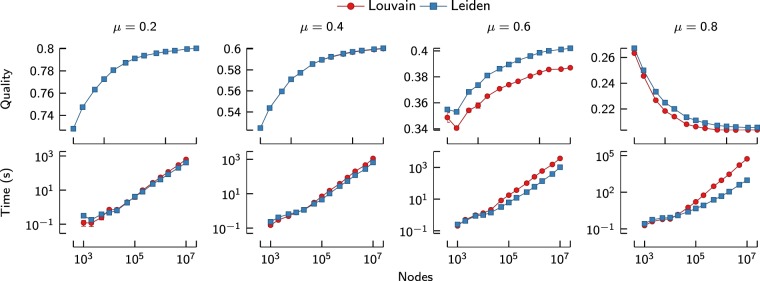
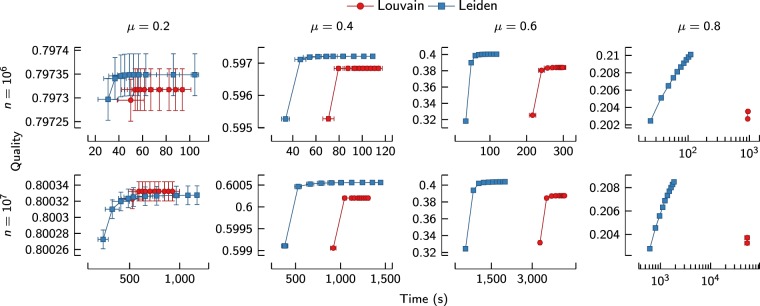
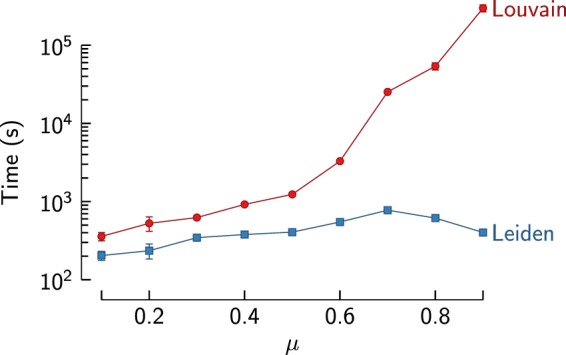
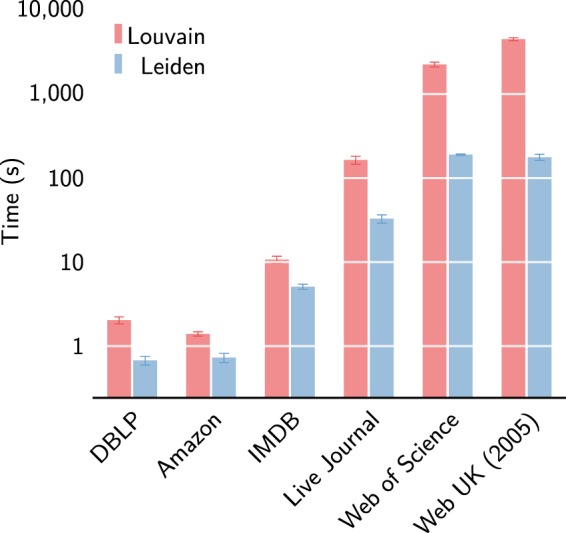
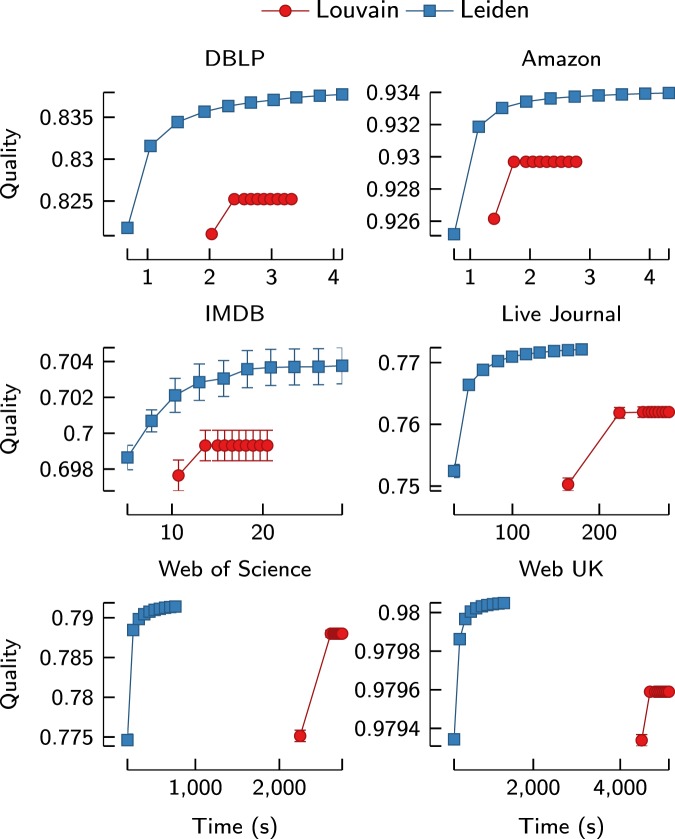
- Leiden was faster than Louvain: first iteration roughly 2–20 times faster on empirical networks, including more than 7× faster for Live Journal, more than 11× for Web of Science, and more than 20× for Web UK. On benchmark networks with difficult partitions (μ = 0.9), Louvain required almost 2.5 days while Leiden needed fewer than 10 minutes; for largest networks Leiden reached 10–100 times faster runtimes.
- Leiden found higher modularity on all six empirical networks: DBLP 0.8387 vs 0.8262, Amazon 0.9341 vs 0.9301, IMDB 0.7069 vs 0.7062, Live Journal 0.7739 vs 0.7653, Web of Science 0.7951 vs 0.7911, and Web UK 0.9801 vs 0.9796.
Methods
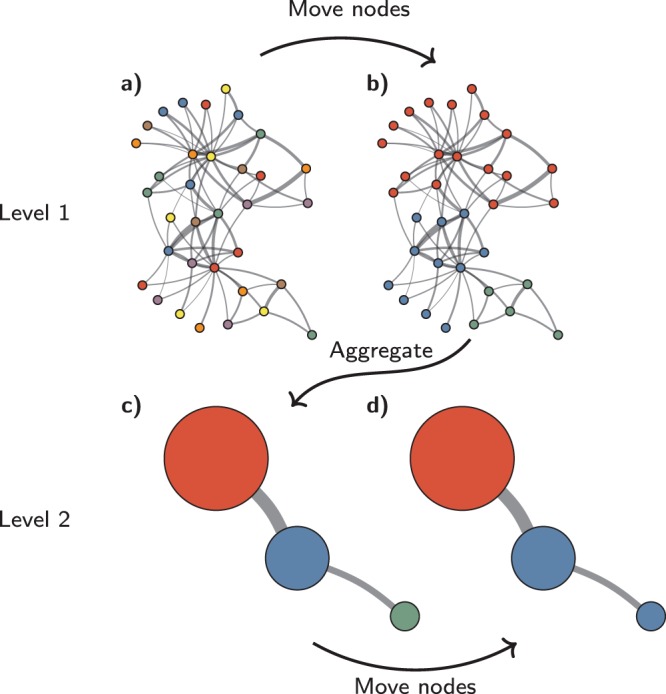
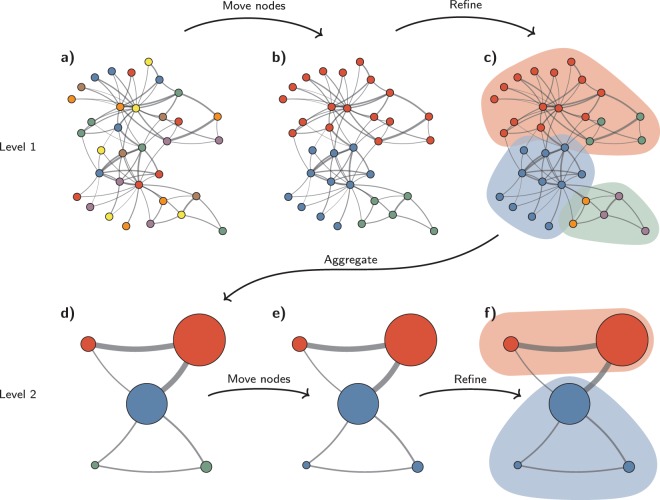
- The paper introduces the Leiden algorithm, which combines local moving, refinement of the partition, and aggregation; proofs of guarantees are relegated to Supplementary Information. It compares Leiden with Louvain on six empirical networks and on benchmark networks.
- Empirical networks: DBLP (317,080 nodes, degree 6.6), Amazon (334,863, 5.6), IMDB (374,511, 80.2), Live Journal (3,997,962, 17.4), Web of Science (9,811,130, 21.2), and Web UK (39,252,879, 39.8). Modularity was used with γ = 1; Table 2 reports maximal modularity after 10 replications of 10 iterations each. Badly connected community analysis was repeated 10 times, with Leiden run on each community’s subnetwork until a stable iteration.
- Benchmark networks ranged from n = 10^3 to n = 10^7 nodes, with community size 50 and CPM as the quality function; the mixing parameter μ varied, 10 iterations were performed, and each parameter set was repeated 10 times. The refinement randomness parameter was θ = 0.01.
Limitations
- The paper states that benchmark networks have only limited value because they are not representative of empirical real-world networks and have a rather simple structure.
- The paper states that counting communities split by Leiden gives only a lower bound on the number of badly connected communities; if Leiden does not find subcommunities, there is no guarantee that modularity cannot be increased by splitting the community.
- Evident from the text: there is no dedicated limitations section; technical details and proofs are relegated to Supplementary Information, and the experimental analysis fixes θ = 0.01 although values roughly in [0.0005, 0.1] are said to provide reasonable results.
Model-written summary. Check it against the paper before relying on it.
Integrity signals
Registry
Cites
Statistics
Figures
Verification
Claims the paper makes
1 Valid · 2 Not valid · 17 Not checked · 142 Own results and interpretations
The cited sources support only part of this claim — read each source’s verdict below.
In the paper
“Hence, the problem of Louvain outlined above is independent from the issue of the resolution limit.”
§ From Louvain to Leiden: guaranteeing well-connected communities > Louvain Algorithm > Badly connected communities
What the sources say
- Partly supportedcites [14] Fortunato S Barthélemy M Resolution Limit in Community Detection Proc. Natl. Acad. Sci. USA 2007 104 36 10.1073/pnas.0605965104 17190818 PMC1765466 sourceExperimental — accuracy not yet measured
Our copy supports the resolution-limit side of the sentence: the Conclusions (VI, p. 7) state that 'the resolution limit of modularity does not rely on particular network structures, but only on the comparison between the sizes of interconnected communities and that of the whole network', the Introduction (p. 1) calls it an 'intrinsic scale' of modularity, and Section V (pp. 5-6) shows the failure persists with simulated annealing, i.e. it is a property of the quality function rather than of one particular optimizer. What the source does not contain is the other term of the comparison: Louvain is never mentioned anywhere in the paper (the Introduction, p. 1, lists only generic greedy procedures [19,20], extremal optimization [21] and simulated annealing [22,23]), and no passage contrasts the resolution limit with an algorithm-specific defect. The independence claim is therefore the citing authors' own inference built on this paper's characterization of the resolution limit. (LLM, conf=0.70)
plain- Asserted: passes — The authors put it forward as true.
- Checkable: passes — It can be checked against evidence.
- Load-bearing: passes — The paper’s conclusions depend on it.
- Based: passes — The paper gives a reason why it holds.
- Partly supported
A result the paper states — it cites no source for it, so there is none to check. The quote shows it is in the paper.
In the paper
“The percentage of badly connected communities is less affected by the number of iterations of the Louvain algorithm.”
§ From Louvain to Leiden: guaranteeing well-connected communities > Experimental Analysis > Badly connected communities
plain- Asserted: passes — The authors put it forward as true.
- Checkable: passes — It can be checked against evidence.
- Load-bearing: unclear — It is unclear whether the paper’s conclusions depend on it.
- Based: passes — The paper gives a reason why it holds.
A result the paper states — it cites no source for it, so there is none to check. The quote shows it is in the paper.
In the paper
“In addition, we prove that, when the Leiden algorithm is applied iteratively, it converges to a partition in which all subsets of all communities are locally optimally assigned.”
- Also stated in: § Introduction · boosted
“In addition, we prove that the algorithm converges to an asymptotically stable partition in which all subsets of all communities are locally optimally assigned.”
§ From Louvain to Leiden: guaranteeing well-connected communities > Abstract
boostedstates a cause- Asserted: passes — The authors put it forward as true.
- Checkable: passes — It can be checked against evidence.
- Load-bearing: passes — The paper’s conclusions depend on it.
- Based: passes — The paper gives a reason why it holds.
- Also stated in: § Introduction · boosted
A result the paper reports from its own data — it cites no other source for it, so there is none to check. The quote shows it is in the paper.
In the paper
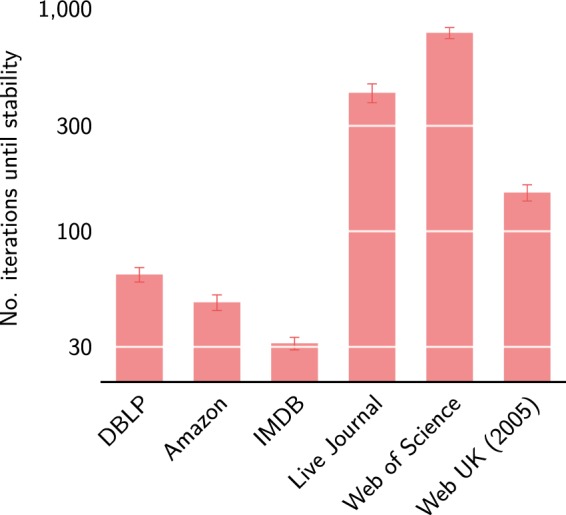
“The second iteration of Louvain shows a large increase in the percentage of disconnected communities.”
§ From Louvain to Leiden: guaranteeing well-connected communities > Experimental Analysis > Badly connected communities
plainstates a cause- Asserted: passes — The authors put it forward as true.
- Checkable: passes — It can be checked against evidence.
- Load-bearing: passes — The paper’s conclusions depend on it.
- Based: passes — The paper gives a reason why it holds.
A result the paper reports from its own data — it cites no other source for it, so there is none to check. The quote shows it is in the paper.
In the paper
“In terms of the percentage of badly connected communities in the first iteration, Leiden performs even worse than Louvain, as can be seen in Fig. 4.”
§ From Louvain to Leiden: guaranteeing well-connected communities > Experimental Analysis > Badly connected communities
plain- Asserted: passes — The authors put it forward as true.
- Checkable: passes — It can be checked against evidence.
- Load-bearing: unclear — It is unclear whether the paper’s conclusions depend on it.
- Based: passes — The paper gives a reason why it holds.
115 more claims
Create a free account to see all 162 claims and to verify the 24 references still open.
- Probably not a substantial claim. 23
- It may state two separate claims as one. 23
- The quote only partly states this claim. 1
Claims other papers make about this one
Each is checked against this paper’s own text: does it say what the citing paper says it does?
The cited source says what the claim attributes to it.
In the citing paper
“When compared to six common clustering algorithms, including Leiden25 and CellHarmony26, VFC was the top performing algorithm on every simulation on the T cell data and best performing, on average, on the zebrafish dataset, with a 57% increase in average performance over Louvain, which was the next best algorithm”
From Quantifying the effect of experimental perturbations at single-cell resolution (2021) · cites this paper as [25]
The cited source says what the claim attributes to it.
In the citing paper
“Louvain’s successor Leiden circumvents this issue by yielding guaranteed connected communities and is computationally more efficient52.”
From Best practices for single-cell analysis across modalities (2023) · cites this paper as [52]
The cited source says what the claim attributes to it.
In the citing paper
“However, the Louvain algorithm can lead to arbitrarily poorly connected communities52.”
From Best practices for single-cell analysis across modalities (2023) · cites this paper as [52]
The cited source says what the claim attributes to it.
In the citing paper
“We found that many t-types had total variance substantially above the variances of the k-means clusters (Fig. 5b) and an alternative analysis using entropies of Leiden clustering35 often highlighted the same t-types as variable (Extended Data Fig. 8).”
From Phenotypic variation of transcriptomic cell types in mouse motor cortex (2021) · cites this paper as [35]
The cited source says what the claim attributes to it.
In the citing paper
“Community detection uses the Leiden algorithm [28] with ModularityVertexPartition, producing hierarchical subclustering to depth 3.”
From SuperLocalMemory: Privacy-Preserving Multi-Agent Memory with Bayesian Trust Defense Against Memory Poisoning (2026) · cites this paper as [28]
6 more claims about this paper
Create a free account to see every claim other papers make about this one.
Citations
Cites
Fast unfolding of communities in large networks
Blondel, V. D., Guillaume, J.-L., Lambiotte, R., & Lefebvre, E. (2008) · Journal of Statistical Mechanics: Theory and Experiment · doi:10.1088/1742-5468/2008/10/p10008 · Cited by 21,424 · cited 3×
“The Louvain algorithm 10 is very simple and elegant.”
MethodFinding and evaluating community structure in networks
Newman, M. E. J., & Girvan, M. (2004) · Physical Review E · doi:10.1103/physreve.69.026113 · Cited by 13,931 · cited 2×
“The Leiden algorithm consists of three phases: (1) local moving of nodes, (2) refinement of the partition and (3) aggregation of the network based on the refined partition, using the non-refined partition to create an initial partition for the aggregate network.”
BackgroundMethodComplex brain networks: graph theoretical analysis of structural and functional systems
Bullmore, E., & Sporns, O. (2009) · Nature Reviews Neuroscience · doi:10.1038/nrn2575 · Cited by 11,820
Fortunato, S. (2010) · Physics Reports · doi:10.1016/j.physrep.2009.11.002 · Cited by 11,293 · cited 4×
“The Leiden algorithm consists of three phases: (1) local moving of nodes, (2) refinement of the partition and (3) aggregation of the network based on the refined partition, using the non-refined partition to create an initial partition for the aggregate network.”
BackgroundMethodInfluentialFinding community structure in very large networks
Clauset, A., Newman, M. E. J., & Moore, C. (2004) · Physical Review E · doi:10.1103/physreve.70.066111 · Cited by 7,390 · cited 1×
“Optimising modularity is NP-hard 5 , and consequentially many heuristic algorithms have been proposed, such as hierarchical agglomeration 6 , extremal optimisation 7 , simulated annealing 4,8 and spectral 9 algorithms.”
MethodFinding community structure in networks using the eigenvectors of matrices
Newman, M. E. J. (2006) · Physical Review E · doi:10.1103/physreve.74.036104 · Cited by 4,761
Functional cartography of complex metabolic networks
Guimerà, R., & Nunes Amaral, L. A. (2005) · Nature · doi:10.1038/nature03288 · Cited by 3,983 · cited 2×
“Optimising modularity is NP-hard 5 , and consequentially many heuristic algorithms have been proposed, such as hierarchical agglomeration 6 , extremal optimisation 7 , simulated annealing 4,8 and spectral 9 algorithms.”
MethodNear linear time algorithm to detect community structures in large-scale networks
Raghavan, U. N., Albert, R., & Kumara, S. (2007) · Physical Review E · doi:10.1103/physreve.76.036106 · Cited by 3,502 · cited 2×
“Trying to fix the problem by simply considering the connected components of communities 19–21 is unsatisfactory because it addresses only the most extreme case and does not resolve the more fundamental problem.”
BackgroundBenchmark graphs for testing community detection algorithms
Lancichinetti, A., Fortunato, S., & Radicchi, F. (2008) · Physical Review E · doi:10.1103/physreve.78.046110 · Cited by 3,051 · cited 1×
“To study the scaling of the Louvain and the Leiden algorithm, we rely on a variant of a well-known approach for constructing benchmark networks 28 .”
MethodResolution limit in community detection
Fortunato, S., & Barthélemy, M. (2007) · Proceedings of the National Academy of Sciences · doi:10.1073/pnas.0605965104 · Cited by 3,024 · cited 2×
“The algorithm may yield arbitrarily badly connected communities, over and above the well-known issue of the resolution limit 14 .”
Background
Research works printed but not linked: 2
- Porter MA Onnela J-P Mucha PJ Communities in Networks Not. AMS 2009 56 1082 1097
- Luecken, M. D. Application of multi-resolution partitioning of interaction networks to the study of complex disease. Ph.D. thesis, (University of Oxford, 2016).
Cited by
Items 4,101–4,200 of 7,288
Xiao, B., Chen, Y. Q., & Wang, S. (2026) · Biomedicines · doi:10.3390/biomedicines14050998 · Cited by 1
Palii, C. G., Tur, S., Yan, S., Longabaugh, W. J. R., Solano, R., Dilworth, F. J., Ranish, J. A., & Brand, M. (2025) · bioRxiv (Cold Spring Harbor Laboratory) · doi:10.1101/2025.09.11.675740 · Cited by 1
Divergent CD45+ immune landscapes shape the lung tumor microenvironment
Dizdarević, S., Wiegandt, R., Weigert, A., Stiewe, T., Eul, B. G., Guenther, S., Grimminger, F., Seeger, W., Pullamsetti, S. S., Looso, M., et al. (2026) · Frontiers in Immunology · doi:10.3389/fimmu.2026.1765833 · Cited by 1
Cell-Level Pathway Scoring Comparison with a Biologically Constrained Variational Autoencoder
Gundogdu, P., Payá‐Milans, M., Álamo-Álvarez, I., Nepomuceno-Chamorro, I. A., Dopazo, J., & Loucera, C. (2023) · Lecture notes in computer science · doi:10.1007/978-3-031-42697-1_5 · Cited by 1
de Campos‐Mata, L., Yong, S., Du, L., Wan, H., Marani, E., Nilsén, V., Sekine, T., Marchalot, A., Tibbitt, C. A., Kammann, T., et al. (2026) · bioRxiv (Cold Spring Harbor Laboratory) · doi:10.64898/2026.05.05.722858 · Cited by 1
Bimodal masked language modeling for bulk RNA-seq and DNA methylation representation learningPreprint
Gélard, M., Benkirane, H., Pierrot, T., Richard, G., & Cournède, P.-H. (2025) · bioRxiv (Cold Spring Harbor Laboratory) · doi:10.1101/2025.06.25.661237 · Cited by 1
Pan, Z., & Hutchins, B. I. (2026) · bioRxiv (Cold Spring Harbor Laboratory) · doi:10.64898/2026.06.26.734852 · Cited by 1
Enríquez, C. V. B., Carrión, E. N. Q., Álvarez, P. F. P., & Vaca, C. V. B. (2025) · Esprint Investigación · doi:10.61347/ei.v4i1.117 · Cited by 1
Who makes open source code? The hybridisation of commercial and open source practices
Mehler, P., Otto, E. I., & Sapienza, A. (2024) · EPJ Data Science · doi:10.1140/epjds/s13688-024-00475-0 · Cited by 1
Aguilar-Soto, M., Robinson‐García, N., & Vargas‐Quesada, B. (2023) · El Profesional de la Informacion · doi:10.3145/epi.2023.nov.10 · Cited by 1
van Harten, A., Donnelly, S., de Boer, P.-T., & van Rijswijk-Deij, R. (2024) · European Security · doi:10.1080/09662839.2024.2421262 · Cited by 1
Sheng, Z., Sun, R., Xu, J., Luo, H., Chen, P., Zhang, W., & Cui, B. (2026) · Proceedings of the VLDB Endowment · doi:10.14778/3819518.3819546 · Cited by 1
Eraslan, B., Brown, E., Benson, M. E., Amir-Zilberstein, L., Park, S., Tusi, B. K., Pokatayev, V., Hecht, C. J. S., Pishesha, N., Phillips, D., et al. (2022) · Research Square · doi:10.21203/rs.3.rs-1416969/v1 · Cited by 1
Semantic Document Graphs for Knowledge Retrieval
Reisinger, J., Fischer, A., & Igl, A. (2025) · International Generative AI and Computational Language Modelling Conference (GACLM) · doi:10.1109/gaclm67198.2025.11231968 · Cited by 1
Soelter, T. M., Jones, E. F., Howton, T. C., Crumley, A. B., Wilk, E. J., & Lasseigne, B. N. (2026) · Disease Models & Mechanisms · doi:10.1242/dmm.052402 · Cited by 1
LiverDCP: A Disease–Cell–Protein Framework for Multi-scale Modeling of Disease BiologyPreprint
Shi, Z., Song, Z., Steveson-Lerner, H., Dong, B., & Zhao, H. (2026) · bioRxiv (Cold Spring Harbor Laboratory) · doi:10.64898/2026.08.07.743628 · Cited by 1
q-Diffusion leverages the full dimensionality of gene coexpression in single-cell transcriptomics
Marmarelis, M. G., Littman, R., Battaglin, F., Niedzwiecki, D., Venook, A. P., Ambite, J. L., Galstyan, A., Lenz, H., & Steeg, G. V. (2024) · Communications Biology · doi:10.1038/s42003-024-06104-w · Cited by 1
The confirmation of scientific theories using Bayesian causal networks and citation sentiments
Small, H. G. (2022) · Quantitative Science Studies · doi:10.1162/qss_a_00189 · Cited by 1
A sequence knowledge-guided deep learning method for single-cell multi-omics translation
Zhao, M., Li, J., Jiang, Y., Yan, J., Tang, X., Liang, C., Tang, J., & Guo, F. (2026) · Genome biology · doi:10.1186/s13059-026-04070-6 · Cited by 1
Evaluating Accuracy and Performance Tradeoffs in GPU Accelerated Single Cell RNA-seq Analysis
Gardner, C., Jeong, S., Khatavkar, O., Moon, A. S., Cao, Q., & Ahn, T.-H. (2025) · International Conference for High Performance Computing, Networking, Storage and Analysis (SC) · doi:10.1145/3731599.3767378 · Cited by 1
Arachchilage, K. H., Risgaard, R. D., Sheng, J., Kumarage, P., Choi, J. J., Alatkar, S. A., Gupta, C., Zhao, X., Sousa, A. M. M., & Wang, D. (2025) · bioRxiv (Cold Spring Harbor Laboratory) · doi:10.1101/2025.10.07.681016 · Cited by 1
Charting the computational landscape of single-cell genetic perturbation
Zhang, Y., Huang, J., Li, Y., Liu, T., Ren, L., Huang, J. H., Lin, H., Feng, J., & Zhang, Y. (2026) · Journal of Advanced Research · doi:10.1016/j.jare.2026.06.012 · Cited by 1
Eyewire II – A connectomic resource for resolving cell types and circuits of the mouse retinaPreprint
Ströh, S., Ebert, S., Fadjukov, J., Lause, J., Oesterle, J., Franke, K., Huang, Z., Lu, R., Matsliah, A., Berson, D. M., et al. (2026) · bioRxiv (Cold Spring Harbor Laboratory) · doi:10.64898/2026.05.28.727403 · Cited by 1
Evaluating the instrumental quality of LLM-generated assessment items
Crk, I., & Gultepe, E. (2026) · Frontiers in Education · doi:10.3389/feduc.2026.1837523 · Cited by 1
Connectivity Network Feature Sharing in Single-Cell RNA Sequencing Data Identifies Rare Cells
Wang, S., Li, H., Liu, Y., Pang, S., Qiao, S., Su, J., Wang, S., & Zhang, Y. (2024) · Journal of Chemical Information and Modeling · doi:10.1021/acs.jcim.4c00796 · Cited by 1
In silico integrative scRNA analysis of human colonic epithelium indicates four tuft cell subtypes
Herik, A., Sinha, S., Arora, R., Small, C., Dufour, A., Biernaskie, J. A., Cobo, E. R., & McKay, D. M. (2024) · American Journal of Physiology-Gastrointestinal and Liver Physiology · doi:10.1152/ajpgi.00182.2024 · Cited by 1
Single-cell technology for plant systems biology
Amini, S., Thibivilliers, S., Farmer, A. A., Martin, O., & Libault, M. (2025) · Elsevier eBooks · doi:10.1016/b978-0-443-23736-2.00008-3 · Cited by 1
Advancing Cardiovascular Medicine: Innovative Therapeutic Pathways with Single-Cell Technologies
Ji, J., Lindberg, E. L., & Reichart, D. (2025) · Current Treatment Options in Cardiovascular Medicine · doi:10.1007/s11936-025-01100-7 · Cited by 1
Terrian, L., Thompson, J., Bowman, D. E., Panda, V., Contreras, G. A., Rockwell, C. E., Sather, L., Fink, G. D., Lauver, A. A., Nault, R., et al. (2025) · bioRxiv (Cold Spring Harbor Laboratory) · doi:10.1101/2025.02.13.636878 · Cited by 1
Moosmann, C., Drost, F., Schuster, E.-M., Kristensen, N. P., Sousa, M., Böttcher, M., Pavlova, À., Reinecke, V., Bruns, H., Uderhardt, S., et al. (2025) · bioRxiv (Cold Spring Harbor Laboratory) · doi:10.1101/2025.10.07.680634 · Cited by 1
SingleRust: A High-Performance Toolkit for Single-Cell Data Analysis at ScalePreprint
Diks, I. F., Flotho, M., & Keller, A. (2025) · bioRxiv (Cold Spring Harbor Laboratory) · doi:10.1101/2025.08.04.668429 · Cited by 1
Benchmarking component choices for unpaired single cell RNA and epigenomic integration
Naqing, F., Yuan, Q., & Duren, Z. (2026) · Genome biology · doi:10.1186/s13059-026-04071-5 · Cited by 1
jazzPanda: spatially aware marker gene detection for imaging-based spatial transcriptomicsPreprint
Jin, X., Putri, G., Cheng, J., Asselin-Labat, M.-L., Smyth, G. K., & Phipson, B. (2026) · bioRxiv (Cold Spring Harbor Laboratory) · doi:10.64898/2026.02.13.705867 · Cited by 1
Cell-specific RNA isoform remodeling in the aging mouse brainPreprint
Rehman, A., Duffy, M. F., Grešová, K., Belair, C., Yang, N., Wang, L., Lee, C. T., Payea, M. J., Malla, S., Dar, S. A., et al. (2025) · bioRxiv (Cold Spring Harbor Laboratory) · doi:10.1101/2025.06.05.658133 · Cited by 1
Abdelkareem, A. O., Gill, G. S., Manoharan, V. T., Verhey, T. B., & Morrissy, A. S. (2026) · Briefings in Bioinformatics · doi:10.1101/2025.08.02.668292 · Cited by 1
Optimal gene panel selection for targeted spatial transcriptomics experiments
Lu, H., Fang, L., Zeng, O., Zhong, W., Yuan, G., & Ma, P. (2026) · Nucleic Acids Research · doi:10.1093/nar/gkag621 · Cited by 1
Homebuilt Imaging-Based Spatial Transcriptomics: Tertiary Lymphoid Structures as a Case Example
Defard, T., Desrentes, A., Fouillade, C., & Mueller, F. (2024) · Methods in molecular biology · doi:10.1007/978-1-0716-4184-2_5 · Cited by 1
Automated Cell Type Annotation with Reference Cluster MappingPreprint
Galanti, V., Shi, L., Azizi, E., Liu, Y., & Blumberg, A. J. (2024) · bioRxiv (Cold Spring Harbor Laboratory) · doi:10.1101/2024.11.30.626130 · Cited by 1
Discrete Morse Graph Construction for High-Dimensional Transcriptomic DataPreprint
Magee, L., Gala, R., Travaglini, K. J., Sümbül, U., Haynor, D. R., Chen, S., Brugère, T., Wang, Y., Mitra, P. P., & Hawrylycz, M. (2026) · bioRxiv (Cold Spring Harbor Laboratory) · doi:10.64898/2026.09.22.753642 · Cited by 1
Yun, Z., Ye, W., Ji, N., Wang, Y., Rong, J., Li, T., Li, Y., Shen, Q., Wang, R., Zhang, H., et al. (2026) · Nature Neuroscience · doi:10.1038/s41593-026-02376-z · Cited by 1
Graph Neural Networks to Identify Genetic Modifiers of Rare Complex Inheritable Diseases
Niktab, E. (2023) · Open Access Victoria University of Wellington | Te Herenga Waka (Figshare) · doi:10.26686/wgtn.22714963 · Cited by 1
DM-RAG: Enhancing User Support in Dameng Databases with Retrieval-Augmented Generation
Huang, Q., Liu, K., Deng, L., Zhang, S., Hu, C., Qian, T., Yan, X., & Jiang, J. (2026) · IEEE International Conference on Data Engineering (ICDE) · doi:10.1109/icde65706.2026.00304 · Cited by 1
Lin, D., Rizi, M. M., O’Neill, C., Lotz, J. C., Anderson, P. E., & Espin, A. T. (2026) · Journal of Biomedical Informatics · doi:10.1016/j.jbi.2026.105102 · Cited by 1
Knowledge Graph-Enhanced Retrieval-Augmented Generation for Nutrigenetics
Filippis, G. M. D., Benfenati, D., Carlo, G. D., & Rinaldi, A. M. (2026) · Communications in computer and information science · doi:10.1007/978-3-032-17216-7_8 · Cited by 1
Dammu, P. P. S., Palkhiwala, A., Roosta, T. G., & Shah, C. (2026) · International ACM SIGIR Conference on Research and Development in Information Retrieval (SIGIR) · doi:10.1145/3805712.3808627 · Cited by 1
Towards efficient Knowledge Graph-based Retrieval Augmented Generation for conversational agents
Schaeffer, M. (2025) · theses.fr (ABES) · doi:10.70675/d674545fzad62z4631z9327zab503346771d · Cited by 1
The Distribution Characteristics and Influencing Factors of Global Armed Conflict Clusters
Hao, M., Ma, S., Jiang, D., Ding, F., Chen, S., Zhuo, J., Wu, G., Dong, J., & Wu, J. (2025) · Systems · doi:10.3390/systems13080670 · Cited by 1
Mitigating bias in spatial transcriptomic pipelines via human feedback with CSDE
Boyeau, P., Bates, S., Ergen, C., Jordan, M. I., & Yosef, N. (2026) · Genome biology · doi:10.64898/2026.01.15.699786 · Cited by 1
Loreto, V., Servedio, V. D. P., & Tria, F. (2026) · doi:10.1093/9780191834615.001.0001 · Cited by 1
Heaps’ law in the Urn Model with Semantic Triggering
Loreto, V., Servedio, V. D. P., & Tria, F. (2026) · Oxford University Press eBooks · doi:10.1093/9780191834615.003.0021 · Cited by 1
Ruiz-Amezcua, P., Hernández, M. N., Flores, J. G., Alonso, C. P., Reigada, D., Muñoz‐Galdeano, T., Vargas, E., Maza, R. M., Esteban, F. J., & Nieto‐Díaz, M. (2025) · BioTech · doi:10.3390/biotech14030070 · Cited by 1
Beyond Memory Leaderboards: Evaluating Scientific Memory as Budgeted Context RestorationPreprint
Sheverev, M., Finkelstein, D., & Nikolenko, S. (2026) · arXiv.org · doi:10.48550/arxiv.2607.16848 · Cited by 3
Yang, J., Li, Y., Wu, Z., She, C., Duan, Q., Wang, Q., & Sun, J. (2026) · Energy storage materials · doi:10.1016/j.ensm.2026.105089 · Cited by 1
Kojima, Y., Arioka, Y., Hirose, H., Hayashi, S., Mizuno, Y., Nagaharu, K., Okumura, H., Ishikawa, M., Ohishi, K., Suzuki, Y., et al. (2024) · bioRxiv (Cold Spring Harbor Laboratory) · doi:10.1101/2024.04.01.587302 · Cited by 1
Integrating Graph Convolutional Networks for Missing Gene Expression Imputation
Zhang, Y., Yu, H., Yan, Z., Pan, T., Zhang, Y., Liu, Y., Li, S., Guo, Y., Song, J., & Yu, D. (2025) · IEEE Transactions on Computational Biology and Bioinformatics · doi:10.1109/tcbbio.2025.3605719 · Cited by 1
Exploring Augmentation-Driven Invariances for Graph Self-supervised Learning in Spatial OmicsPreprint
Rabuzin, L., Tarnow, M., & Boeva, V. (2025) · bioRxiv (Cold Spring Harbor Laboratory) · doi:10.1101/2025.09.23.678050 · Cited by 1
DNA Methylation Dynamics of Dose-dependent Acute Exercise, Training Adaptation, and DetrainingPreprint
Hariharan, M., Patel, S., Song, H., Rehman, A., Barragan, C., Bartlett, A., Castanon, R., Nery, J. R., Rothenberg, V., Chen, H., et al. (2025) · bioRxiv (Cold Spring Harbor Laboratory) · doi:10.1101/2025.04.22.650067 · Cited by 1
Psychometric Properties of the Spanish Adaptation of the School Failure Coping Scale
Elizalde, P. D. Z., Álvarez-Montero, F. J., & Reyes-Sosa, H. (2026) · Psychology in the Schools · doi:10.1002/pits.70140 · Cited by 1
Campbell, M. L., Le, C. T. U., & Hewitt, C. L. (2026) · iScience · doi:10.1016/j.isci.2026.115486 · Cited by 1
Metastatic Osteosarcoma is Characterized by Loss of Osteoblastic Lineage FidelityPreprint
Tanaka, Y., Morrow, J. J., Casaní-Galdón, S., Pimenta, E. M., Li, J., Butaney, B., Farran, C. A. E., Karam, J., D’Antonio, J. P., Bi, K., et al. (2026) · bioRxiv (Cold Spring Harbor Laboratory) · doi:10.64898/2026.06.10.731352 · Cited by 1
SCITO-seq2: ultra-high-throughput single-cell transcriptome and epitope sequencing
Lee, S.-H., Jin, B.-Y., Lee, C.-R., Kim, D. R., Shin, A., Park, S., Kim, Y.-J., Kim, S. H., Choi, M., & Hwang, B. (2026) · Genome biology · doi:10.1186/s13059-026-03954-x · Cited by 1
Jansen, M. G., Salami, A., Martínez, F. R., Mitchell, D. J., Oosterman, J. M., & Geerligs, L. (2026) · Imaging Neuroscience · doi:10.1162/imag.a.1074 · Cited by 1
Caldarelli, M., Zucca, S., Viglione, A., Stella, A., Nisar, R., Sagona, G., Papini, E. M., Carrara, F., Bovetti, S., Mazziotti, R. M., et al. (2026) · iScience · doi:10.1016/j.isci.2026.114827 · Cited by 1
Unifying multimodal single-cell data with a mixture-of-experts β-variational autoencoder framework
Ashford, A. J., Enright, T., Somers, J., Nikolova, O. H., & Demir, E. (2026) · Genome Research · doi:10.1101/gr.281431.125 · Cited by 1
Cossa, A., Dalmasso, A., Campani, G., Bugani, E., Caprioli, C., Bulla, N., Tirelli, A., Zhan, Y., & Pelicci, P. G. (2026) · Nature Communications · doi:10.1038/s41467-026-71607-5 · Cited by 1
MuVEH and mitoMuVEH improve discovery of genetic variation from single cellsPreprint
Ransom, M., Engel, K. L., Stevens, B. M., Jordan, C. T., & Gillen, A. E. (2022) · bioRxiv (Cold Spring Harbor Laboratory) · doi:10.1101/2022.11.22.517553 · Cited by 1
An ancient retrotransposon provides species-specific tuning of IL-18 inflammatory signalingPreprint
Ordonez, A. D., Allen, H. L., Sanford, L., Ivancevic, A. M., Agyepong, A., Chaw, M., Bridges, J. P., Schountz, T., & Chuong, E. B. (2026) · bioRxiv (Cold Spring Harbor Laboratory) · doi:10.64898/2026.05.25.727421 · Cited by 1
An empirical study of network reduction: the measurement and comparison
Yang, C.-L., Cheng, M.-C., Lumveerakul, A., Hsu, Y.-W., & Lai, P.-S. (2024) · Social Network Analysis and Mining · doi:10.1007/s13278-024-01276-z · Cited by 1
Developmental reversion underlies resistance to immune checkpoint blockade in kidney cancerPreprint
Yarlagadda, D. V. K., Wang, Z., Jiang, H., Vuong, L. H., Sanmiguel, A. L., Yang, C.-Y., Kotecha, R. R., Chen, Y., Hakimi, A. A., Leslie, C. S., et al. (2026) · bioRxiv (Cold Spring Harbor Laboratory) · doi:10.64898/2026.08.05.743137 · Cited by 1
The Workflow for Computational Analysis of Single-cell RNA-sequencing Data
Woo, S.-H., & Jung, B. C. (2024) · Korean Journal of Clinical Laboratory Science · doi:10.15324/kjcls.2024.56.1.10 · Cited by 1
Le, B., Nguyen, D. P. Q., Binh, D. H. N., Vo, B. L., Anh, L. D., & Ta, H. D. K. (2026) · Computational Biology and Chemistry · doi:10.1016/j.compbiolchem.2026.109154 · Cited by 1
Multi-sample and multi-group spatial colocalization analysis using PANORAMIC
Chang, J., Espín-Pérez, A., Molina, P., Khurana, R., Zhang, W., Tian, L., & Plevritis, S. K. (2026) · Bioinformatics · doi:10.1093/bioinformatics/btag546 · Cited by 1
Yadav, O., & Andreopoulos, W. (2025) · IEEE International Conference on Big Data Computing Service and Applications (BigDataService) · doi:10.1109/bigdataservice65758.2025.00036 · Cited by 1
Cross-Sample Community Detection and Sentiment Analysis: South African Twitter
Cornelissen, L. A., de Bruyn, C., Ledingwane, M. K., Theron, P. P. A., Schoonwinkel, P., & Barnett, R. J. (2019) · South African Institute of Computer Scientists and Information Technologists · doi:10.1145/3351108.3351135 · Cited by 1
Misuraca, M., Spano, M., & D’Aniello, L. (2026) · Energy Research & Social Science · doi:10.1016/j.erss.2026.104945 · Cited by 1
Pericytes are organ-specific regulators of tissue morphogenesis
Rasouli, S. J., Kruse, K., Diéguez‐Hurtado, R., Ghanbari, P., Aravamudhan, A., Pitulescu, M. E., & Adams, R. H. (2026) · Nature Communications · doi:10.1038/s41467-026-71643-1 · Cited by 1
Agentic LLMs for Social Network Generation using Explainable Adversarial Re-prompting
Yan, H., Chen, L., Zhang, B., Liu, H., Peng, H., Li, S., Bai, Y., & Qu, Z. (2026) · ACM SIGKDD Conference on Knowledge Discovery and Data Mining (KDD) · doi:10.1145/3770855.3818076 · Cited by 1
Big data analytics in bioinformatics
Bjørnholt), G. A. (. (2020) · Research Publications (Maastricht University) · doi:10.26481/dis.20200828ag · Cited by 1
Hu, C., Czajkowsky, D. M., Liang, J., & Shao, Z. (2026) · Biophysical Journal · doi:10.1016/j.bpj.2026.04.010 · Cited by 1
Mich, J. K., Sunil, S., Johansen, N., Martinez, R. A., Liu, J., Gore, B. B., Mahoney, J. T., Leytze, M., Ben‐Simon, Y., Bertagnolli, D., et al. (2026) · eLife · doi:10.7554/elife.108640 · Cited by 1
Linking live-cell behavior to transcriptional responses across perturbations using dynamic cagingPreprint
Orcutt-Jahns, B. T., Hueros, R. A. R., Meireles, A. M., Cox, C., Ghita, L., Kamm, J., Celen, C., Yang, Y., Pariset, E., Rouzbeh, N., et al. (2026) · bioRxiv (Cold Spring Harbor Laboratory) · doi:10.64898/2026.05.05.723043 · Cited by 1
EventHorizon: A Foundation Model for Clinical Flow CytometryPreprint
Grespan, M. M., Morrison, M. J., O’Fallon, B. D., Jacobsen, J. R., Shean, R. C., Spies, N. C., & Ng, D. P. (2026) · bioRxiv (Cold Spring Harbor Laboratory) · doi:10.64898/2026.06.18.733197 · Cited by 1
ComMGAE: Community Aware Masked Graph AutoEncoder
Jiang, G., Xu, J. A., Luo, M., Chen, J., Huang, Z., & Wang, J. (2024) · Lecture notes in computer science · doi:10.1007/978-3-031-72344-5_5 · Cited by 2
scCLIP: A contrastive masked-reconstruction framework for paired single-cell multi-omics integration
Xu, X., & Du, L. (2026) · Journal of Biomedical Informatics · doi:10.1016/j.jbi.2026.105078 · Cited by 1
Liu, Y., Zhang, Z., Qui, M., Wang, S., Salim, F. D., Shen, J., Chen, T., Razzak, I., Li, F., & Bian, J. (2026) · Briefings in Bioinformatics · doi:10.1093/bib/bbag330 · Cited by 1
Yan, X., Han, F., Wu, Y., & Tian, Z. (2026) · BMC Biology · doi:10.1186/s12915-026-02590-y · Cited by 1
Probabilistic clustering of cells using single-cell RNA-seq dataPreprint
Saha, J., Tanvir, R. H., Samee, M. A. H., & Rahman, A. H. (2023) · bioRxiv (Cold Spring Harbor Laboratory) · doi:10.1101/2023.12.12.571199 · Cited by 1
scGCRC: Graph and Contrastive-Based Representation Learning for Single-Cell RNA-Seq Data Clustering
Shi, Y., Wan, J., Zhang, X., & Yin, Y. (2025) · IEEE Transactions on Computational Biology and Bioinformatics · doi:10.1109/tcbbio.2025.3629161 · Cited by 1
Feature-preserving manifold approximation and projection to analyze single-cell data
Yang, Y., Gong, J., Sun, H., Choo, A., Mar, J. C., Wei, Y., Zhang, Y., Zhang, W., Shu, M., Tuong, Z. K., et al. (2026) · Nature Computational Science · doi:10.1038/s43588-026-00970-6 · Cited by 1
Zhao, S., Ye, R., Tang, Q.-Y., Attaallah, B., Toniolo, S., Saleh, Y., Rouse, M. A., Garrard, P., Broulidakis, J., Thompson, S., et al. (2026) · Translational Psychiatry · doi:10.1038/s41398-026-04023-4 · Cited by 1
Multi-agent and knowledge graph-based social and emotional learning question-answering
Tang, S., Liu, M., Yang, B., Xu, X., Chen, D., Peng, Y., & Li, T. (2026) · The Computer Journal · doi:10.1093/comjnl/bxag033 · Cited by 1
CARIBOU: Computational AI Research Interface for Bioinformatics, Omics, and Unifying AgentsPreprint
Riffle, D., Shirooni, N., Sureshkumar, P., Vijay, V., & Rose, M. F. (2026) · bioRxiv (Cold Spring Harbor Laboratory) · doi:10.64898/2026.05.25.727730 · Cited by 1
Targeted Training for Multi-organization Recommendation
Tomlinson, K., Wan, M., Lu, C., Hecht, B. J., Teevan, J. B., & Yang, L. (2023) · ACM Transactions on Recommender Systems · doi:10.1145/3603508 · Cited by 1
Schuyler: Self-Supervised Clustering of Tables in Relational Databases
Laskowski, L., Panse, F., Hladik, M., Portisch, J., & Naumann, F. (2025) · Proceedings of the VLDB Endowment · doi:10.14778/3785297.3785307 · Cited by 1
Advancing Academic Chatbots: Evaluation of Non Traditional OutputsPreprint
Favero, N., Salute, F., & Hardt, D. (2025) · arXiv (Cornell University) · doi:10.48550/arxiv.2512.00991 · Cited by 1
Scalable Prompt Routing via Fine-Grained Latent Task DiscoveryPreprint
Zhang, Y., Adeshina, S., Guan, P., Ganesh, A., Han, Z., Ioannidis, V. N., Rangwala, H., & Karypis, G. (2026) · arXiv (Cornell University) · doi:10.48550/arxiv.2603.19415 · Cited by 1
Liu, W., Vesterinen, M., Andersson, A., Partanen, P., Knapič, S., Juvonen, J. J., Siebenhühner, F., Salonen, A., Renvall, H., Ilmoniemi, R. J., et al. (2026) · Nature Mental Health · doi:10.1038/s44220-026-00723-4 · Cited by 1
Ge, S., He, Q., Ren, Y., Xu, Y., Wang, M., Nie, Z., Xu, H., Cheng, Q. S., Sun, S., & Ren, Z. (2026) · bioRxiv (Cold Spring Harbor Laboratory) · doi:10.64898/2026.03.05.709973 · Cited by 1
scGenoByte: a GenoByte embedding transformer with biological priors for cell type annotation
Yao, J., Xu, Y., Ma, J., Shen, W., & Wu, S. (2026) · Briefings in Bioinformatics · doi:10.1093/bib/bbag369 · Cited by 1
Gåsvær, K. S., Lind, P. G., Langguth, J., Hjorth-Jensen, M., Kreil, M., & Schroeder, D. T. (2026) · PLoS ONE · doi:10.1371/journal.pone.0343661 · Cited by 1
Metadata
- Authors
- Traag, V. A., Waltman, L., & van Eck, N. J.
- Affiliations
- Leiden University (NL)
- Corresponding author
- Traag, V. A.
- Venue
- Scientific Reports
- Published
- 2019-03-26
- Volume
- 9
- Issue
- 1
- Pages
- 5233-5233
- ISSN
- 2045-2322 (ISSN-L)
- PMC
- PMC6435756
- OpenAlex
- W2897249806
- Semantic Scholar
- 79cdbabb22ef80074f5659430fe6fc97932798f5
- Cited by
- 5,635
- References
- 27
- Citations by year
- 2026: 1250 · 2025: 1281 · 2024: 980 · 2023: 757 · 2022: 639 · 2021: 466 · 2020: 213 · 2019: 46
- FWCI
- 158.78
- Type
- journal article
- Language
- en
- Open access
- gold
- doi.org
- Licence
- cc-by
- creativecommons.org/licenses/by/4.0 (tdm)
- creativecommons.org/licenses/by/4.0 (vor)
- Locations
- Scientific Reports (publishedVersion, cc-by)
- Europe PMC (PubMed Central) (publishedVersion, other-oa)
- PubMed Central (publishedVersion, cc-by)
- PubMed (publishedVersion)
- arXiv (Cornell University) (submittedVersion)
- Leiden Repository (Leiden University) (submittedVersion, cc-by)
- Data Archiving and Networked Services (DANS) (submittedVersion, cc-by)
- DOAJ (DOAJ: Directory of Open Access Journals) (submittedVersion)
- Leiden Repository (Leiden University) (submittedVersion)
- arXiv (Cornell University)
- Topics
- Physical Sciences › Physics and Astronomy › Statistical and Nonlinear Physics › Complex Network Analysis Techniques
- Physical Sciences › Computer Science › Artificial Intelligence › Advanced Clustering Algorithms Research
- Life Sciences › Biochemistry, Genetics and Molecular Biology › Molecular Biology › Bioinformatics and Genomic Networks
- Keywords
- community detection, Louvain algorithm, Leiden algorithm, network partitioning, community connectivity, complex networks
About these checks
Registry, retraction, Cites and statistics results are computed, not judged, with one exception: a printed reference that no index lists is read once by a model before it counts as a citation error. Claims are extracted by a model and kept only when their quote appears verbatim in the text; each cited source is then checked, with a model’s help, for whether it says what the claim relies on. Those verdicts can be wrong — read the claim’s quote and the cited source before relying on one.
The claim verdicts this report counts are experimental: their accuracy is not yet measured.
A language model drew the claims from the paper on 2026-11-23, under version 3 of the claim definition (model deepseek-v4.1-flash, prompt extract-v3).
A second model labelled each claim on 2026-11-23 (model jev-1.13-20260917, definition revision gold-guideline-v0.2).
Cited sources are checked with a language model’s help (qwen3.8-omni-flash).
Statistics and arithmetic are recomputed, not judged.
Confidence bands are shown only for fields calibrated on our annotated test set. None is calibrated yet, so no band is shown.
What counts as a claim ›How we measure confidence ›How we check this ›
Are you an author, or do you see a problem with this page? Request a review
Data sources
Bibliographic data: Semantic Scholar, OpenAlex, Crossref.
Contains information from the Semantic Scholar Academic Graph Datasets, made available under the ODC Attribution License (ODC-BY 1.0).
Semantic Scholar’s data is described in: Kinney, R., et al. (2023). The Semantic Scholar Open Data Platform. arXiv:2301.10140.
