

Single trial prestimulus oscillations predict perception of the sound-induced flash illusion
Open accessThe DOI matches its Crossref record; 40 of the 40 references it cites were found in a registry or an index.
Abstract
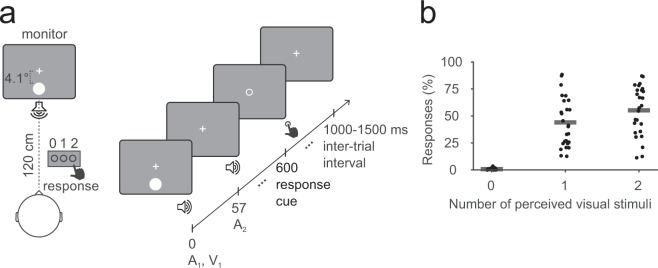
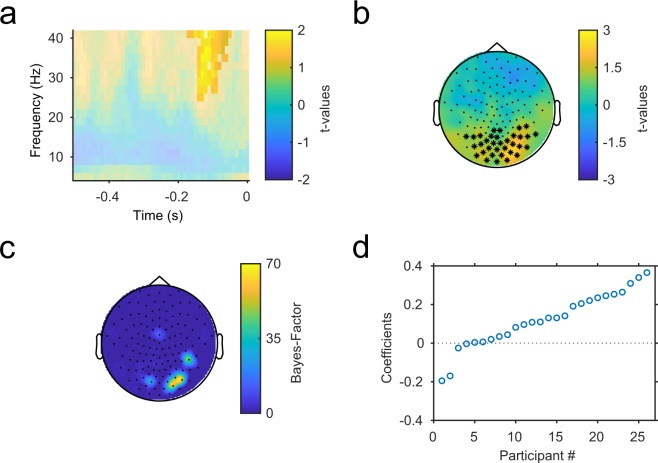
In the sound-induced flash illusion, auditory input affects the perception of visual stimuli with a large inter- and intraindividual variability. Crossmodal influence in this illusion has been shown to be associated with activity in visual and temporal areas. In this electroencephalography study, we investigated the relationship between oscillatory brain activity prior to stimulus presentation and subsequent perception of the illusion on the level of single trials. Using logistic regression, we modeled the perceptual outcome dependent on oscillatory power. We found that 25 Hz to 41 Hz activity over occipital electrodes from 0.17 s to 0.05 s prior to stimulus onset predicted the perception of the illusion. A t-test of power values, averaged over the significant cluster, between illusion and no-illusion trials showed higher power in illusion trials, corroborating the modeling result. We conclude that the observed power modulation predisposes the integration of audiovisual signals, providing further evidence for the governing role of prestimulus brain oscillations in multisensory perception.
Overview
The claims and statistics of this paper haven’t been checked yet.
Free: it reads the open-access text and checks the first 5 claims that cite a source we can check. Create a free account to check every claim.
Integrity signals
Registry
Cites
Statistics
Figures
Verification
Claims the paper makes
The claims and statistics of this paper haven’t been checked yet.
Free: it reads the open-access text and checks the first 5 claims that cite a source we can check. Create a free account to check every claim.
Claims other papers make about this one
Each is checked against this paper’s own text: does it say what the citing paper says it does?
The cited source says what the claim attributes to it.
In the citing paper
“EEG signals—and thereby the brain's EM field—also correlate with perception in change blindness (Koivisto and Revonsuo, 2003), perceptual masking (Schubert et al., 2009), sound-induced flash illusions (Kaiser et al., 2019) and classic perceptual switching such as when viewing the Rubin's vase/face illusion (Müller et al., 2000).”
From Consciousness: Matter or EMF? (2023) · cites this paper as Kaiser et al., 2019
Self-check
Percentages, sums and reported differences re-computed from the paper’s own numbers.
The self-check needs the paper’s full text.
Citations
Cites
Delorme, A., & Makeig, S. (2004) · Journal of Neuroscience Methods · doi:10.1016/j.jneumeth.2003.10.009 · Cited by 24,371
Oostenveld, R., Fries, P., Maris, E., & Schoffelen, J.-M. (2011) · Computational Intelligence and Neuroscience · doi:10.1155/2011/156869 · Cited by 10,323
Nonparametric statistical testing of EEG- and MEG-data
Maris, E., & Oostenveld, R. (2007) · Journal of Neuroscience Methods · doi:10.1016/j.jneumeth.2007.03.024 · Cited by 8,496
Lee, T.-W., Girolami, M., & Sejnowski, T. J. (1999) · Neural Computation · doi:10.1162/089976699300016719 · Cited by 1,967
Visual areas exert feedforward and feedback influences through distinct frequency channels
Bastos, A. M., Vezoli, J., Bosman, C. A., Schoffelen, J.-M., Oostenveld, R., Dowdall, J. R., De Weerd, P., Kennedy, H., & Fries, P. (2015) · Neuron · doi:10.1016/j.neuron.2014.12.018 · Cited by 1,320
Shams, L., Kamitani, Y., & Shimojo, S. (2000) · Nature · doi:10.1038/35048669 · Cited by 1,262
Neuronal oscillations and multisensory interaction in primary auditory cortex
Lakatos, P., Chen, C.-M., O'Connell, M. N., Mills, A., & Schroeder, C. E. (2007) · Neuron · doi:10.1016/j.neuron.2006.12.011 · Cited by 961
Molholm, S., Ritter, W., Murray, M. M., Javitt, D. C., Schroeder, C. E., & Foxe, J. J. (2002) · Cognitive Brain Research · doi:10.1016/s0926-6410(02)00066-6 · Cited by 902
Anatomical evidence of multimodal integration in primate striate cortex
Falchier, A., Clavagnier, S., Barone, P., & Kennedy, H. (2002) · The Journal of Neuroscience · doi:10.1523/jneurosci.22-13-05749.2002 · Cited by 892
Michalareas, G., Vezoli, J., van Pelt, S., Schoffelen, J.-M., Kennedy, H., & Fries, P. (2016) · Neuron · doi:10.1016/j.neuron.2015.12.018 · Cited by 696
Cited by
Spontaneous Brain Oscillations and Perceptual Decision-Making
Samaha, J., Iemi, L., Haegens, S., & Busch, N. A. (2020) · Trends in Cognitive Sciences · doi:10.1016/j.tics.2020.05.004 · Cited by 192
Self-citationWhat you see is what you hear: Twenty years of research using the Sound-Induced Flash Illusion
Hirst, R. J., McGovern, D. P., Setti, A., Shams, L. B., & Newell, F. N. (2020) · Neuroscience & Biobehavioral Reviews · doi:10.1016/j.neubiorev.2020.09.006 · Cited by 124
Multi-timescale neural dynamics for multisensory integration
Senkowski, D., & Engel, A. K. (2024) · Nature reviews. Neuroscience · doi:10.1038/s41583-024-00845-7 · Cited by 119
“Furthermore, spontaneous fluctuations in prestimulus gamma and beta oscillation power predicted audiovisual integration in the double flash illusion 90,92 (Fig.”
Self-citationDouble Flash Illusions: Current Findings and Future Directions
Keil, J. (2020) · Frontiers in Neuroscience · doi:10.3389/fnins.2020.00298 · Cited by 83
“Similarly, Kaiser et al. (2019) analyzed single-trial power prior to the SIFI and found that increased beta- and gamma-band power in occipital electrodes predicted the illusion perception.”
BackgroundSelf-citationChan, J. S., Wibral, M., Stawowsky, C., Brandl, M., Helbling, S., Naumer, M. J., Kaiser, J., & Wollstadt, P. (2021) · Frontiers in Aging Neuroscience · doi:10.3389/fnagi.2021.631599 · Cited by 49
“, 2014), however, a direct replication was not possible in a later study (Kaiser et al., 2019).”
BackgroundAlpha Activity Reflects the Magnitude of an Individual Bias in Human Perception
Grabot, L., & Kayser, C. (2020) · Journal of Neuroscience · doi:10.1523/jneurosci.2359-19.2020 · Cited by 41
“, 2019) and b increase to illusory (hence incorrect) perception (for review, see Keil and Senkowski, 2018; Kaiser et al., 2019) .”
BackgroundMemory Load Alters Perception-Related Neural Oscillations during Multisensory Integration
Michail, G., Senkowski, D., Niedeggen, M., & Keil, J. (2020) · Journal of Neuroscience · doi:10.1523/jneurosci.1397-20.2020 · Cited by 39
“Contrasting brain responses to audiovisual stimuli that evoke these two perceptual states allows the investigation of crossmodal interactions underlying the SIFI (Keil et al., 2014; Kaiser et al., 2019).”
BackgroundResultSelf-citationParaskevopoulou, S. E., Coon, W. G., Brunner, P., Miller, K. J., & Schalk, G. (2021) · NeuroImage · doi:10.1016/j.neuroimage.2021.118127 · Cited by 38
McFadden, J. (2023) · Frontiers in Human Neuroscience · doi:10.3389/fnhum.2022.1024934 · Cited by 27
“, 2009), sound-induced flash illusions (Kaiser et al., 2019) and classic perceptual switching such as when viewing the Rubin’s vase/face illusion (Müller et al.”
BackgroundDigital filters for low-latency quantification of brain rhythms in real time
Smetanin, N., Belinskaya, A., Lebedev, M., & Ossadtchi, A. E. (2020) · Journal of Neural Engineering · doi:10.1088/1741-2552/ab890f · Cited by 17
Long-term training reduces the responses to the sound-induced flash illusion
Huang, J., Wang, E., Lu, K., Wang, A., & Zhang, M. (2021) · Attention Perception & Psychophysics · doi:10.3758/s13414-021-02363-5 · Cited by 16
“As mentioned in the introduction, the SiFI effect has shown strong interindividual differences (de Haas et al., 2012; Kaiser et al., 2019; Keil & Senkowski, 2017; Mishra et al., 2007), which means it does not happen to everyone.”
BackgroundEffects of Repetition Suppression on Sound Induced Flash Illusion With Aging
Sun, Y., Liu, X., Li, B., Sava‐Segal, C., Wang, A., & Zhang, M. (2020) · Frontiers in Psychology · doi:10.3389/fpsyg.2020.00216 · Cited by 12
Shared Physiological Correlates of Multisensory and Expectation-Based Facilitation
Kayser, S. J., & Kayser, C. (2020) · eNeuro · doi:10.1523/eneuro.0435-19.2019 · Cited by 8
“Previous work has shown that multisensory perception is shaped by the state of oscillatory brain activity prior to a stimulus (Keil et al., 2012; Lange et al., 2013; Gleiss and Kayser, 2014b; Kaiser et al., 2019).”
BackgroundKvamme, T. L., Sarmanlu, M., Bailey, C. J., & Overgaard, M. S. (2021) · Neuroscience · doi:10.1016/j.neuroscience.2021.11.028 · Cited by 7
“Critically, greater gamma activity is also correlated with greater audiovisual binding as measured by increased flash reports in the SIFI (Bhattacharya et al., 2002; Mishra et al., 2007; Lange et al., 2013; Balz et al., 2016; Kaiser et al., 2019; Rohe et al., 2019).”
Crossmodal Postdiction: Conscious Perception as Revisionist History
Stiles, N. R. B., Tanguay, A. R., & Shimojo, S. (2022) · Journal of Perceptual Imaging · doi:10.2352/j.percept.imaging.2022.5.000403 · Cited by 9
Kvamme, T. L., Sarmanlu, M., & Overgaard, M. S. (2022) · Consciousness and Cognition · doi:10.1016/j.concog.2022.103381 · Cited by 6
Sun, Y., Zhou, H., Liu, C., Wang, A., Yue, C., & Zhang, M. (2022) · Attention Perception & Psychophysics · doi:10.3758/s13414-022-02537-9 · Cited by 6
“Existing studies have shown that SiFI perception varies across individuals (Kaiser et al., 2019; Keil & Senkowski, 2018), ranging from 3% to 86% (Mishra et al., 2007).”
BackgroundWang, A., HUANG, J., Lu, F., He, J., Tang, X., & ZHANG, M. (2020) · Advances in Psychological Science · doi:10.3724/sp.j.1042.2020.01662 · Cited by 6
Differences in eccentricity for sound-induced flash illusion in four visual fields
Chang, C., Wang, E., Yang, J., Luan, X., Wang, A., & Zhang, M. (2022) · Perception · doi:10.1177/03010066221136670 · Cited by 5
Cai, X., Li, G., Wang, L., Zhao, W., Wang, Y., Yan, C., Lui, S. S. Y., Li, J., & Chan, R. C. K. (2021) · PsyCh Journal · doi:10.1002/pchj.479 · Cited by 3
The role of beta band phase resetting in audio-visual temporal order judgment
Li, Y., & Noguchi, Y. (2025) · Cognitive Neurodynamics · doi:10.1007/s11571-024-10183-0 · Cited by 3
Repetition Suppression in Visual and Auditory Modalities Affects the Sound-Induced Flash Illusion
Wang, A., Zhou, H., Yu, W., Zhang, F., Sang, H., Tang, X., Zhang, T., & Zhang, M. (2021) · Perception · doi:10.1177/03010066211018614 · Cited by 4
“The results of this study were consistent with previous studies on prestimulus neural activity influencing perception of the SiFI (Kaiser et al., 2019; Keil, 2020; Keil et al., 2014; Keil & Senkowski, 2017), and other multisensory effects (Keil & Senkowski, 2018).”
ResultPredicting Response to McGurk Illusion Based on Periodic and Aperiodic Prestimulus EEG ActivityPreprint
Singh, V. A. V., Kumar, V. G., Banerjee, A., & Roy, D. (2022) · bioRxiv (Cold Spring Harbor Laboratory) · doi:10.1101/2022.01.20.477172 · Cited by 2
“Interestingly, however, our results deviate from multisensory illusion studies where they have reported a higher prestimulus beta power before the illusory percept (Keil et al., 2012; for review, see Keil & Senkowski, 2018; Kaiser et al., 2019).”
ResultPrestimulus Periodic and Aperiodic Neural Activity Shapes McGurk Perception
Singh, V. A. V., Kumar, V. G., Banerjee, A., & Roy, D. (2025) · eNeuro · doi:10.1523/eneuro.0431-24.2025 · Cited by 6
“The role of internal state in shaping perception has been investigated in both unisensory (Kayser et al., 2016; Krasich et al., 2022) and multisensory domains (Kaiser et al., 2019; Rohe et al., 2019).”
SmartERD: a pipeline for referencing subjects to a common peak in the analysis of ERD dynamics
Spadone, S., Sestieri, C., Capotosto, P., Baldassarre, A., Sensi, S. L., & Penna, S. D. (2025) · Scientific Reports · doi:10.1038/s41598-025-28583-5 · Cited by 1
“However, previous studies have demonstrated that, in some contexts, pre-stimulus inter-trial variability could be physiologically significant, for example, by influencing stimulus-evoked/induced activity 30,31 or predicting saccadic response 32 and perception of sound-induced illusion 33 .”
Yang, H., Ding, D., Qin, H., Miao, H., Wang, C., Zang, Y., Chi, L., & Wu, B. (2026) · Behavioral and Brain Functions · doi:10.1186/s12993-026-00344-y · Cited by 1
“…occipital and multisensory ERP responses have been reported on illusion trials, suggesting that these components should be interpreted as context-sensitive neural correlates of percept formation rather than as invariant markers that map one-to-one onto physical stimulus structure [18, 21, 27, 28].”
Smetanin, N., Belinskaya, A., Lebedev, M., & Ossadtchi, A. E. (2019) · bioRxiv (Cold Spring Harbor Laboratory) · doi:10.1101/2019.12.18.880450 · Cited by 1
“This is because the brain handles cognitive tasks differently depending on 70 the brain oscillatory patterns taking place just before the task onset [21, 22, 23, 24, 25, 26, 27].”
BackgroundMetacognitive Awareness in the Sound-Induced Flash IllusionPreprint
Mims, C. E., & Odegaard, B. (2020) · PsyArXiv (OSF Preprints) · doi:10.31234/osf.io/5yexg · Cited by 1
O’Dowd, A., Hirst, R. J., Setti, A., Kenny, R. A., & Newell, F. N. (2023) · Psychophysiology · doi:10.1111/psyp.14430
Intégration multisensorielle : implications du thalamus et du cortex
Vittek, A. (2022) · theses.fr (ABES) · doi:10.70675/1a20d6e3ze332z493fzb423zc8e06cd8a1e4
Drowsiness Alters the Neural Dynamics But Not the Core Computations of Multisensory Integration
Alameda, C., Avancini, C., Sanabria, D., Bekinschtein, T. A., & Ciria, L. F. (2026) · Journal of Neuroscience · doi:10.1523/jneurosci.0363-26.2026 · Cited by 1
Metadata
- Authors
- Kaiser, M., Senkowski, D., Busch, N. A., Balz, J., & Keil, J.
- Affiliations
- Humboldt-Universität zu Berlin (DE)
- Charité – Universitätsmedizin Berlin (DE)
- University of Münster (DE)
- Christian-Albrechts-Universität zu Kiel (DE)
- Corresponding author
- Kaiser, Mathis
- Venue
- Scientific Reports
- Published
- 2019-04-12
- Volume
- 9
- Issue
- 1
- Pages
- 5983-5983
- ISSN
- 2045-2322 (ISSN-L)
- PMC
- PMC6461663
- OpenAlex
- W2937372169
- Cited by
- 31
- References
- 39
- Citations by year
- 2026: 2 · 2025: 3 · 2024: 1 · 2023: 2 · 2022: 6 · 2021: 6 · 2020: 10 · 2019: 1
- FWCI
- 6.75
- Type
- journal article
- Language
- en
- Open access
- gold
- doi.org
- Licence
- cc-by
- creativecommons.org/licenses/by/4.0 (tdm)
- creativecommons.org/licenses/by/4.0 (vor)
- Locations
- Scientific Reports (publishedVersion, cc-by)
- Europe PMC (PubMed Central) (publishedVersion, cc-by)
- PubMed Central (publishedVersion, cc-by)
- PubMed (publishedVersion)
- DOAJ (DOAJ: Directory of Open Access Journals) (submittedVersion, cc-by-sa)
- Funders
- Deutsche Forschungsgemeinschaft (SE1859/4-1, BU2400/9-1, KE1828/2-1, KE1828/4-1)
- Topics
- Social Sciences › Psychology › Experimental and Cognitive Psychology › Multisensory perception and integration
- Life Sciences › Neuroscience › Cognitive Neuroscience › Neural dynamics and brain function
- Life Sciences › Neuroscience › Cognitive Neuroscience › Visual perception and processing mechanisms
- Keywords
- sound-induced flash illusion, audiovisual integration, single-trial EEG, occipital cortex, multisensory perception, perceptual variability, oscillatory power
- MeSH terms
- Adolescent, Adult, Auditory Perception, Brain, Electroencephalography, Female, Humans, Illusions, Male, Middle Aged, Signal Processing, Computer-Assisted, Time Factors, Visual Perception, Logistic Models, Young Adult
About these checks
Registry, retraction, Cites and statistics results are computed, not judged, with one exception: a printed reference that no index lists is read once by a model before it counts as a citation error. Claims are extracted by a model and kept only when their quote appears verbatim in the text; each cited source is then checked, with a model’s help, for whether it says what the claim relies on. Those verdicts can be wrong — read the claim’s quote and the cited source before relying on one.
Statistics and arithmetic are recomputed, not judged.
Confidence bands are shown only for fields calibrated on our annotated test set. None is calibrated yet, so no band is shown.
What counts as a claim ›How we measure confidence ›How we check this ›
Are you an author, or do you see a problem with this page? Request a review
Data sources
Bibliographic data: Semantic Scholar, OpenAlex, Crossref.
Contains information from the Semantic Scholar Academic Graph Datasets, made available under the ODC Attribution License (ODC-BY 1.0).
Semantic Scholar’s data is described in: Kinney, R., et al. (2023). The Semantic Scholar Open Data Platform. arXiv:2301.10140.
