

Short-term mindfulness practice attenuates reward prediction errors signals in the brain
Open accessThe DOI matches its Crossref record; 29 of the 29 references it cites were found in a registry or an index.
Abstract
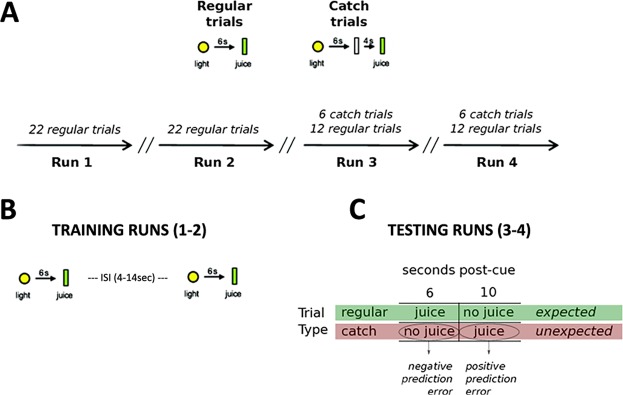
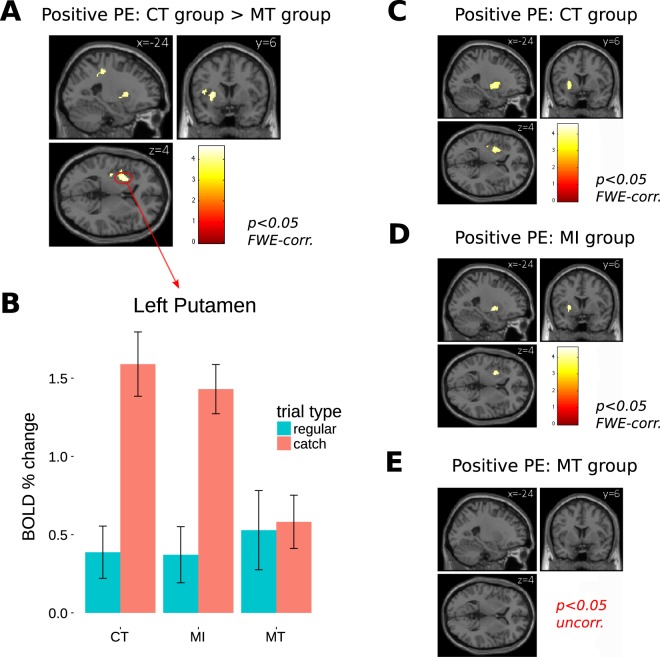
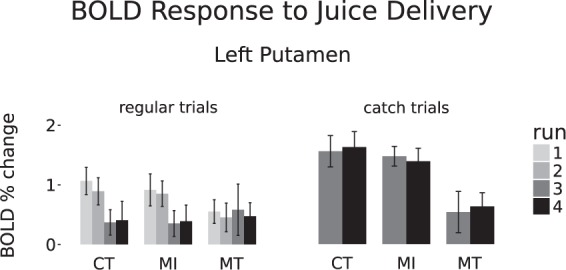
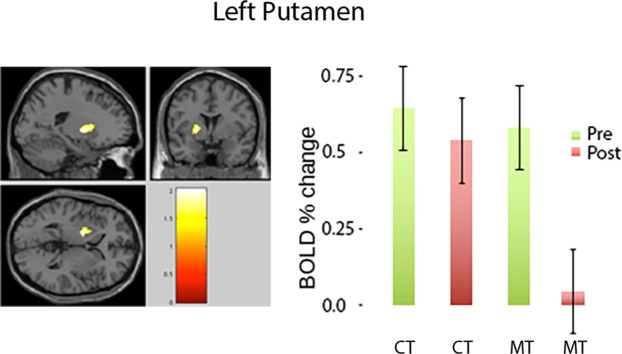
Activity changes in dopaminergic neurons encode the ongoing discrepancy between expected and actual value of a stimulus, providing a teaching signal for a reward prediction process. Previous work comparing a cohort of long-term Zen meditators to controls demonstrated an attenuation of reward prediction signals to appetitive reward in the striatum. Using a cross-commodity design encompassing primary- and secondary-reward conditioning experiments, the present study asks the question of whether reward prediction signals are causally altered by mindfulness training in naïve subjects. Volunteers were randomly assigned to 8 weeks of mindfulness training (MT), active control training (CT), or a one-time mindfulness induction group (MI). We observed a decreased response to positive prediction errors in the putamen in the MT group compared to CT using both a primary and a secondary-reward experiment. Furthermore, the posterior insula showed greater activation to primary rewards, independently of their predictability, in the MT group, relative to CT and MI group. These results support the notion that increased attention to the present moment and its interoceptive features - a core component of mindfulness practice - may reduce predictability effects in reward processing, without dampening (in fact, enhancing) the response to the actual delivery of the stimulus.
Overview
The claims and statistics of this paper haven’t been checked yet.
Free: it reads the open-access text and checks the first 5 claims that cite a source we can check. Create a free account to check every claim.
Integrity signals
Registry
Cites
Statistics
Figures
Verification
Claims the paper makes
The claims and statistics of this paper haven’t been checked yet.
Free: it reads the open-access text and checks the first 5 claims that cite a source we can check. Create a free account to check every claim.
Claims other papers make about this one
Each is checked against this paper’s own text: does it say what the citing paper says it does?
The source backs part of the claim, not all of it — or backs it for a different population, condition or comparison.
In the citing paper
“Mindfulness enhances awareness of interoceptive signals and facilitates the accurate detection of prediction errors, and ultimately contributes to the development of more accurate predictive models that more closely align with reality (Kirk and Montague, 2015; Kirk et al., 2019).”
From Listen to your inner body: embodied emotions in predictive neuroscience and traditional East Asian medicine (2026) · cites this paper as Kirk et al., 2019
Experimental — accuracy not yet measuredThe cited source says what the claim attributes to it.
In the citing paper
“Mindfulness meditation increases activation of the posterior insula, a region associated with interoceptive processing, and modulates prediction-error signaling, suggesting that mindfulness training may support improved emotional regulation (Kirk and Montague, 2015; Kirk et al., 2019).”
From Listen to your inner body: embodied emotions in predictive neuroscience and traditional East Asian medicine (2026) · cites this paper as Kirk et al., 2019
Self-check
Percentages, sums and reported differences re-computed from the paper’s own numbers.
The self-check needs the paper’s full text.
Citations
Cites
A neural substrate of prediction and reward
Schultz, W., Dayan, P., & Montague, P. R. (1997) · Science · doi:10.1126/science.275.5306.1593 · Cited by 9,388
Baer, R. A., Smith, G. T., Lykins, E., Button, D., Krietemeyer, J., Sauer, S., Walsh, E., Duggan, D., & Williams, J. M. G. (2008) · Assessment · doi:10.1177/1073191107313003 · Cited by 2,930
Buckner, R. L., & Carroll, D. C. (2007) · Trends in Cognitive Sciences · doi:10.1016/j.tics.2006.11.004 · Cited by 2,691
Rethinking feelings: an fMRI study of the cognitive regulation of emotion
Ochsner, K. N., Bunge, S. A., Gross, J. J., & Gabrieli, J. D. E. (2002) · Journal of Cognitive Neuroscience · doi:10.1162/089892902760807212 · Cited by 2,520
Thompson, E. R. (2007) · Journal of Cross-Cultural Psychology · doi:10.1177/0022022106297301 · Cited by 2,399
A framework for mesencephalic dopamine systems based on predictive Hebbian learning
Montague, P., Dayan, P., & Sejnowski, T. (1996) · The Journal of Neuroscience · doi:10.1523/jneurosci.16-05-01936.1996 · Cited by 2,066
Mrazek, M. D., Franklin, M. S., Phillips, D. T., Baird, B., & Schooler, J. W. (2013) · Psychological Science · doi:10.1177/0956797612459659 · Cited by 1,063
Computational roles for dopamine in behavioural control
Montague, P. R., Hyman, S. E., & Cohen, J. D. (2004) · Nature · doi:10.1038/nature03015 · Cited by 966
Temporal Prediction Errors in a Passive Learning Task Activate Human Striatum
McClure, S. M., Berns, G. S., & Montague, P. R. (2003) · Neuron · doi:10.1016/s0896-6273(03)00154-5 · Cited by 917
Self-citationFox, K. C. R., Nijeboer, S., Dixon, M. L., Floman, J. L., Ellamil, M., Rumak, S. P., Sedlmeier, P., & Christoff, K. (2014) · Neuroscience & Biobehavioral Reviews · doi:10.1016/j.neubiorev.2014.03.016 · Cited by 804
Cited by
Galante, J., Friedrich, C., Dawson, A. F., Modrego-Alarcón, M., Gebbing, P., Delgado-Suárez, I., Gupta, R., Dean, L., Dalgleish, T., White, I. R., et al. (2021) · PLOS Medicine · doi:10.1371/journal.pmed.1003481 · Cited by 319
Kirk, U., & Axelsen, J. L. (2020) · PLOS ONE · doi:10.1371/journal.pone.0243488 · Cited by 108
Self-citationRichey, J. A., Brewer, J. A., Sullivan-Toole, H., Strege, M. V., Kim-Spoon, J., White, S. W., & Ollendick, T. H. (2019) · Clinical Psychology Review · doi:10.1016/j.cpr.2019.101756 · Cited by 79
Spontaneous thought and microstate activity modulation by social imitation
Tomescu, M. I., Papasteri, C., Sofonea, A., Boldasu, R., Kebets, V., Pistol, C., Poalelungi, C., Benescu, V., Podina, I. R., Nedelcea, C., et al. (2022) · NeuroImage · doi:10.1016/j.neuroimage.2022.118878 · Cited by 54
Mindfulness Meditation and Network Neuroscience: Review, Synthesis, and Future Directions
Prakash, R. S., Shankar, A., Tripathi, V., Yang, W. F. Z., Fisher, M. E., Bauer, C. C. C., Betzel, R. F., & Sacchet, M. D. (2024) · Biological Psychiatry Cognitive Neuroscience and Neuroimaging · doi:10.1016/j.bpsc.2024.11.005 · Cited by 47
Matsumoto, N., Watson, L. A., Fujino, M., Ito, Y., & Kobayashi, M. (2022) · Memory & Cognition · doi:10.3758/s13421-022-01280-8 · Cited by 20
Joss, D., Teicher, M. H., & Lazar, S. W. (2024) · Journal of Affective Disorders Reports · doi:10.1016/j.jadr.2024.100769 · Cited by 17
“…facilitates the update of prior internal prediction model in response to unexpected sensory input to reduce prediction error, leading to adaptive behaviors well-adjusted to new contexts (Barrett, 2017; Barrett and Simmons, 2015; Farb et al., 2015; Kirk et al., 2019; Laukkonen and Slagter, 2021).”
BackgroundSim, S., Maldonado, I. L., Castelnau, P., Barantin, L., El‐Hage, W., Andersson, F., & Cottier, J. (2023) · Journal of Neuroradiology · doi:10.1016/j.neurad.2023.11.002 · Cited by 17
Kirk, U., Lilleholt, L., & Freedberg, D. (2020) · Brain and Behavior · doi:10.1002/brb3.1761 · Cited by 17
Self-citation一方面, 不., & 曾红 (2022) · Advances in Psychological Science · doi:10.3724/sp.j.1042.2023.00274 · Cited by 9
“00 16 5v 1 错误(reward prediction error)反应时,与控制组相比,不论是经过短期训练者或长期练习者 都表现出较弱的奖赏预期加工反应(Kirk et al., 2019),但面对初级奖赏(如食物)时后脑岛的 激活程度更强(Kirk & Montague, 2015)。这种关注当下内在感受的干预方式,减少奖赏加工 中预期效应的干扰,但并未影响(甚至提升)个体对奖赏刺激物直接做出反应的可能。 一方面,正念干预通过降低食物相关线索的凸显性,从而降低个体对于食物的奖赏预 期,减弱寻求不良适应行为所带来的紧迫感与渴求感,进而减少过量进食等冲动行为的发…”
A cognitive neuroscience approach to understanding aggression and its treatment
Blair, J., Habel, U., Votinov, M., Wagels, L., & Denson, T. F. (2025) · Neuroscience & Biobehavioral Reviews · doi:10.1016/j.neubiorev.2025.106386 · Cited by 11
Tripathi, V., Devaney, K. J., Lazar, S. W., & Somers, D. C. (2024) · Mindfulness · doi:10.1007/s12671-024-02316-7 · Cited by 8
“…the hierarchical predictive processing engaged by these large-scale networks as some studies have suggested (Kirk et al., 2019; Lutz et al., 2019; Pagnoni, 2019) and can disengage anticipatory processing and the modulations of the mind, thus allowing the practitioner to be more present and…”
王雪珂, & 冯廷勇 (2023) · Advances in Psychological Science · doi:10.3724/sp.j.1042.2023.02106 · Cited by 11
Golubickis, M., Tan, L., Jalalian, P., Falbén, J. K., & Macrae, N. (2024) · Quarterly Journal of Experimental Psychology · doi:10.1177/17470218241228859 · Cited by 11
“…the relationship between mindfulness and reward-based learning is complex, with processing influenced both by the specific requirements of the task at hand, situational constraints, and people’s levels of medita-tive expertise (e.g., Kirk & Montague, 2015; Kirk et al., 2019; Knytl & Opitz, 2019).”
BackgroundAssessing the influence of dopamine and mindfulness on the formation of routines in visual search
Garner, K., Leow, L., Uchida, A., Nolan, C. R., Jensen, O. B., Garrido, M. I., & Dux, P. E. (2024) · Psychophysiology · doi:10.1111/psyp.14571 · Cited by 2
“…have been used to posit that mindfulness and dopamine engage common mechanisms; increased mindfulness attenuates striatal reward prediction errors (Kirk et al., 2019; Kirk & Montague, 2015), possibly via greater regulation from stronger cortical representations of subjective values and internal…”
Striatal functional connectivity associated with Sahaja Yoga meditation
Perez-Diaz, O., Hernández, S. E., Brown, L. L., Xiao, Y., González–Mora, J. L., Rubia, K., & Barrós‐Loscertales, A. (2025) · Scientific Reports · doi:10.1038/s41598-025-98256-w · Cited by 3
“susceptibility to reward incentives in mindfulness meditators during reward anticipation and outcome 34,45 .”
Brief mindfulness meditation increases risk-taking behavior
Tan, L., Golubickis, M., & Macrae, C. N. (2026) · Scientific Reports · doi:10.1038/s41598-026-37597-6 · Cited by 2
“At least for experienced meditators, mindfulness practices dampen activity in subcortical (i.e., striatum) and pre-frontal areas involved in reward-related processing and valuation 36–38 .”
Effect of app-based mindfulness on extinction recall – a 7T-fMRI study
Björkstrand, J., Olsson, E., Clancy, O., Möller, S., Björkman-Burtscher, I. M., Raheja, N., Sjöström, D., Persiani, M. T. L., Staiano, W., & Kirk, U. (2026) · Scientific Reports · doi:10.1038/s41598-026-45569-z · Cited by 1
“This interpretation is supported by previous work showing that emotion regulation strategies reduce both physiological responses and ventral striatal activity to emotional stimuli 76 , and that mindfulness training attenuates prediction error signals in striatal regions 77 .”
Self-citationLee, S., Yoon, S.-I., Liao, H.-Y., Kim, J. W., Lee, I.-S., & Chae, Y. (2026) · Frontiers in Human Neuroscience · doi:10.3389/fnhum.2026.1807034
Young, J. H. (2023) · Wiley eBooks · doi:10.1002/9781119767398.furread
Sim, S., Maldonado, I. L., Castelnau, P., Barantin, L., El‐Hage, W., Andersson, F., & Cottier, J. (2024) · Douleurs Évaluation - Diagnostic - Traitement · doi:10.1016/j.douler.2024.03.001
The Role of Meditation in Shaping Resilience
Mo, R., Liu, C., & Hao, J. (2026) · Annals of the New York Academy of Sciences · doi:10.1111/nyas.70300 · Cited by 1
“Neural evidence further reveals that short-term FAM attenuates RPEs, whereas long-term practitioners exhibit diminished VS responsiveness, suggesting downregulated reward reactivity [ 78, 79 ].”
An, X., Ye, W., & Fan, Y. (2026) · Frontiers in Psychology · doi:10.3389/fpsyg.2026.1782953
“This molecular surge is theorized to provide a potential material substrate for repairing damaged synaptic connections, ultimately enhancing memory consolidation and cognitive flexibility in adolescents.”
Metadata
- Authors
- Kirk, U., Pagnoni, G., Hétu, S., & Montague, R.
- Affiliations
- University of London (GB)
- University of Modena and Reggio Emilia (IT)
- Université de Montréal (CA)
- Corresponding author
- Kirk, Ulrich
- Venue
- Scientific Reports
- Published
- 2019-05-06
- Volume
- 9
- Issue
- 1
- Pages
- 6964-6964
- ISSN
- 2045-2322 (ISSN-L)
- PMC
- PMC6502850
- OpenAlex
- W2942644458
- Cited by
- 23
- References
- 29
- Citations by year
- 2026: 5 · 2025: 2 · 2024: 6 · 2023: 3 · 2022: 3 · 2021: 1 · 2020: 2 · 2019: 1
- FWCI
- 2.04
- Type
- journal article
- Language
- en
- Open access
- gold
- doi.org
- Licence
- cc-by
- creativecommons.org/licenses/by/4.0 (tdm)
- creativecommons.org/licenses/by/4.0 (vor)
- Locations
- Scientific Reports (publishedVersion, cc-by)
- PubMed Central (publishedVersion, cc-by)
- PubMed (publishedVersion)
- University of Southern Denmark Research Portal (University of Southern Denmark) (acceptedVersion, cc-by)
- IRIS UNIMORE (University of Modena and Reggio Emilia) (submittedVersion, cc-by)
- VTechWorks (Virginia Tech) (submittedVersion, cc-by)
- Funders
- Wellcome Trust
- Forsknings- og Innovationsstyrelsen
- Danish Agency for Science and Higher Education
- National Institute on Drug Abuse (R01DA011723)
- National Institute of Neurological Disorders and Stroke (R01NS045790)
- Topics
- Social Sciences › Psychology › Clinical Psychology › Mindfulness and Compassion Interventions
- Life Sciences › Neuroscience › Cellular and Molecular Neuroscience › Neurotransmitter Receptor Influence on Behavior
- Life Sciences › Neuroscience › Cognitive Neuroscience › Neural and Behavioral Psychology Studies
- Keywords
- mindfulness training, reward prediction error, dopaminergic neurons, putamen, posterior insula, primary reward, reward conditioning, interoception, striatum
- MeSH terms
- Attention, Brain, Humans, Longitudinal Studies, Reward, Meditation, Anticipation, Psychological, Mindfulness
About these checks
Registry, retraction, Cites and statistics results are computed, not judged, with one exception: a printed reference that no index lists is read once by a model before it counts as a citation error. Claims are extracted by a model and kept only when their quote appears verbatim in the text; each cited source is then checked, with a model’s help, for whether it says what the claim relies on. Those verdicts can be wrong — read the claim’s quote and the cited source before relying on one.
Statistics and arithmetic are recomputed, not judged.
Confidence bands are shown only for fields calibrated on our annotated test set. None is calibrated yet, so no band is shown.
What counts as a claim ›How we measure confidence ›How we check this ›
Are you an author, or do you see a problem with this page? Request a review
Data sources
Bibliographic data: Semantic Scholar, OpenAlex, Crossref.
Contains information from the Semantic Scholar Academic Graph Datasets, made available under the ODC Attribution License (ODC-BY 1.0).
Semantic Scholar’s data is described in: Kinney, R., et al. (2023). The Semantic Scholar Open Data Platform. arXiv:2301.10140.
