

Social and Physiological Context can Affect the Meaning of Physiological Synchrony
Open accessThe DOI matches its Crossref record; 29 of the 30 references it cites were found in a registry or an index.
Abstract
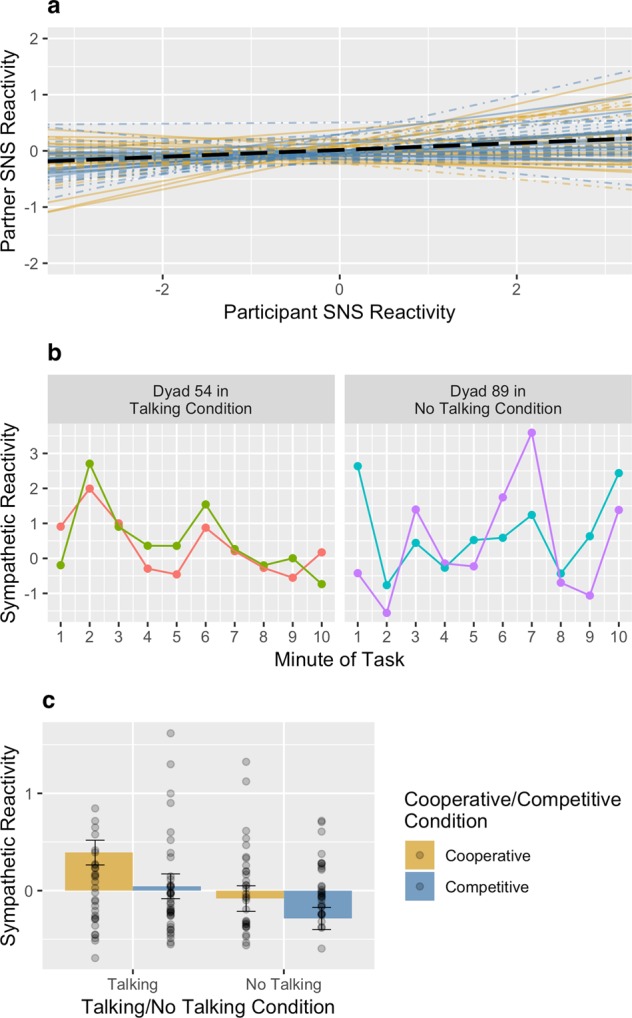
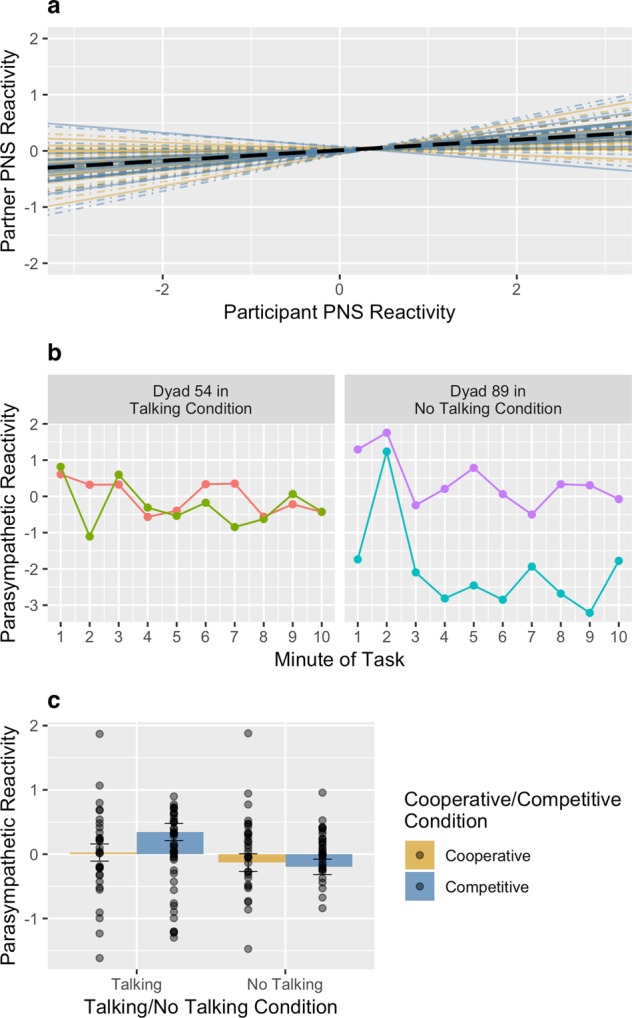
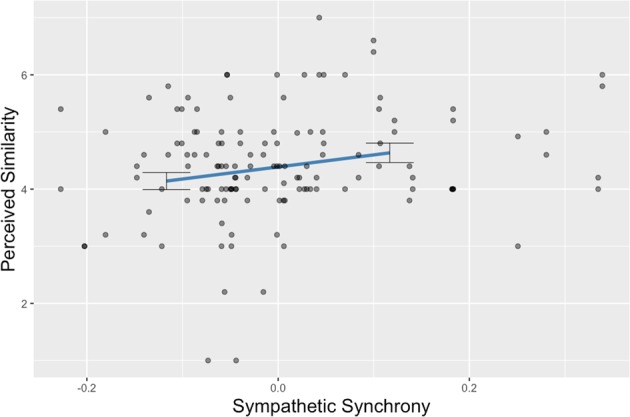
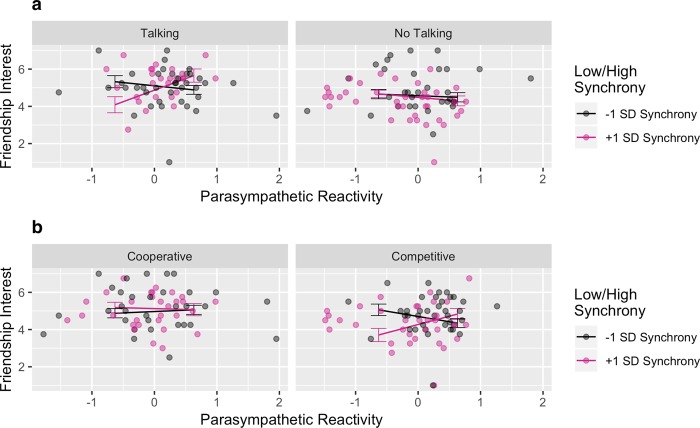
Survival of many species, from insects and birds to human and non-human mammals, requires synchronized activity. Among humans, synchrony occurs even at the level of autonomic functioning; people interacting often show mutual, simultaneous changes in activity of the sympathetic or parasympathetic branches of the autonomic nervous system. Critically, autonomic reactivity predicts many mental states and, when synchronized, may reflect higher-order social processes like affiliation. Here, using data from 134 strangers interacting in pairs, we manipulated two features of social context to test their impact on synchrony in sympathetic and parasympathetic reactivity. Participants completed a knot-tying task within a collective reward (“cooperation”) or individual reward (“competition”) framework while conversing or not (“talking” condition). Autonomic reactivity varied by features of social context. Synchrony occurred across social contexts in both autonomic branches. We then examined how synchrony predicted affiliation. Sympathetic synchrony alone predicted affiliation yet social context and parasympathetic reactivity moderated associations between parasympathetic synchrony and affiliation. Thus, social and physiological context of parasympathetic synchrony predicted affiliation better than parasympathetic synchrony alone. We argue that social context and the degree of physiological reactivity underlying physiological synchrony, not the mere existence of physiological synchrony, are key to interpreting physiological synchrony as a social process.
Overview
The claims and statistics of this paper haven’t been checked yet.
Free: it reads the open-access text and checks the first 5 claims that cite a source we can check. Create a free account to check every claim.
Integrity signals
Registry
Cites
Statistics
Figures
Verification
Claims the paper makes
The claims and statistics of this paper haven’t been checked yet.
Free: it reads the open-access text and checks the first 5 claims that cite a source we can check. Create a free account to check every claim.
Claims other papers make about this one
Each is checked against this paper’s own text: does it say what the citing paper says it does?
The cited source doesn’t support the claim as written.
In the citing paper
“Autonomic synchrony during joint action seems to be modulated by task‐related constraints, such as whether the task is presented as competitive or cooperative (Chanel et al. 2012; Danyluck and Page‐Gould 2019; Järvelä et al. 2014).”
From Interpersonal Physiological Synchrony During Dyadic Joint Action Is Increased by Task Novelty and Reduced by Social Anxiety (2025) · cites this paper as Danyluck and Page‐Gould 2019
Checked by a reasoning model — may be wrong.
Experimental — accuracy not yet measuredThe source backs part of the claim, not all of it — or backs it for a different population, condition or comparison.
In the citing paper
“Yet, to date, much of the existing research on IPS has focused on contexts where individuals are explicitly instructed to perform a social task.”
From Interpersonal Synchronization of Autonomic Physiology via Mere Visual Contact (2026) · cites this paper as [27]
Experimental — accuracy not yet measuredThe source backs part of the claim, not all of it — or backs it for a different population, condition or comparison.
In the citing paper
“In task-based stranger dyads, talking during interaction increased the physiologic attunement corresponding to the sympathetic branch and improved social outcomes, compared to no-talking conditions (77).”
From Physiological attunement and flourishing: understanding the influence of relationships on health (2025) · cites this paper as [77]
Experimental — accuracy not yet measuredThe cited source says what the claim attributes to it.
In the citing paper
“Conversation and cooperation elicited the greatest sympathetic reactivity while conversation and competition elicited the greatest parasympathetic reactivity.”
From Physiological attunement and flourishing: understanding the influence of relationships on health (2025) · cites this paper as [77]
The cited source says what the claim attributes to it.
In the citing paper
“Physiological synchrony was observed across both social contexts with variations in sympathetic and parasympathetic reactivity.”
From Physiological attunement and flourishing: understanding the influence of relationships on health (2025) · cites this paper as [77]
Self-check
Percentages, sums and reported differences re-computed from the paper’s own numbers.
The self-check needs the paper’s full text.
Citations
Cites
Faul, F., Erdfelder, E., Lang, A.-G., & Buchner, A. (2007) · Behavior Research Methods · doi:10.3758/bf03193146 · Cited by 65,971
Development and validation of brief measures of positive and negative affect: The PANAS scales.
Watson, D., Clark, L. A., & Tellegen, A. (1988) · Journal of Personality and Social Psychology · doi:10.1037/0022-3514.54.6.1063 · Cited by 32,433
Heart Rate Variability: Standards of Measurement, Physiological Interpretation, and Clinical Use
Electrophysiology, T. F. O. T. E. S. O. C. T. N. A. (1996) · Circulation · doi:10.1161/01.cir.93.5.1043 · Cited by 17,159
Heart rate variability: Standards of measurement, physiological interpretation, and clinical use
Malik, M., Bigger, J. T., Camm, A. J., Kleiger, R. E., Malliani, A., Moss, A. J., & Schwartz, P. J. (1996) · European Heart Journal · doi:10.1093/oxfordjournals.eurheartj.a014868 · Cited by 15,289
The polyvagal theory: phylogenetic substrates of a social nervous system.
Porges, S. W. (2001) · International Journal of Psychophysiology · doi:10.1016/s0167-8760(01)00162-3 · Cited by 1,582
Marital interaction: Physiological linkage and affective exchange.
Levenson, R. W., & Gottman, J. M. (1983) · Journal of Personality and Social Psychology · doi:10.1037/0022-3514.45.3.587 · Cited by 855
Menstrual Synchrony and Suppression
MCCLINTOCK, M. K. (1971) · Nature · doi:10.1038/229244a0 · Cited by 777
Interpersonal autonomic physiology: a systematic review of the literature
Palumbo, R. V., Marraccini, M. E., Weyandt, L. L., Wilder-Smith, O., McGee, H. A., Liu, S., & Goodwin, M. S. (2017) · Personality and Social Psychology Review · doi:10.1177/1088868316628405 · Cited by 566
The many metrics of cardiac chronotropy: A pragmatic primer and a brief comparison of metrics
Allen, J. J. B., Chambers, A. S., & Towers, D. N. (2007) · Biological Psychology · doi:10.1016/j.biopsycho.2006.08.005 · Cited by 491
Kashdan, T. B., & Steger, M. F. (2006) · Psychological Science · doi:10.1111/j.1467-9280.2006.01674.x · Cited by 458
Cardiac vagal tone and sustained attention in school‐age children
SUESS, P. E., PORGES, S. W., & PLUDE, D. J. (1994) · Psychophysiology · doi:10.1111/j.1469-8986.1994.tb01020.x · Cited by 351
Toichi, M., Sugiura, T., Murai, T., & Sengoku, A. (1997) · Journal of the Autonomic Nervous System · doi:10.1016/s0165-1838(96)00112-9 · Cited by 318
Kelsey, R. M. (2011) · American Psychological Association eBooks · doi:10.1037/13090-002 · Cited by 158
Coregulation of respiratory sinus arrhythmia in adult romantic partners
Helm, J. L., Sbarra, D. A., & Ferrer, E. (2014) · Emotion · doi:10.1037/a0035960 · Cited by 154
Unexpected diversity in socially synchronized rhythms of shorebirds
Bulla, M., Vâlcu, M., Dokter, A. M., Dondua, A. G., Kosztolányi, A., Rutten, A. L., Helm, B., Sandercock, B. K., Casler, B., Ens, B. J., et al. (2016) · Nature · doi:10.1038/nature20563 · Cited by 141
Social Psychophysiology for Social and Personality Psychology
Blascovich, J., Vanman, E., Mendes, W., & Dickerson, S. (2011) · SAGE Publications Ltd eBooks · doi:10.4135/9781446287842 · Cited by 129
Partner influence and in-phase versus anti-phase physiological linkage in romantic couples
Reed, R. G., Randall, A. K., Post, J. H., & Butler, E. A. (2012) · International Journal of Psychophysiology · doi:10.1016/j.ijpsycho.2012.08.009 · Cited by 128
Physiological compliance for social gaming analysis: Cooperative versus competitive play
Chanel, G., Kivikangas, J. M., & Ravaja, N. (2012) · Interacting with Computers · doi:10.1016/j.intcom.2012.04.012 · Cited by 110
Abdel-Sayed, P., Kaeppeli, A., Siriwardena, T., Darbre, T., Perron, K., Jafari, P., Reymond, J.-L., Pioletti, D. P., & Applegate, L. A. (2016) · Scientific Reports · doi:10.1038/srep23872 · Cited by 102
Firefly Synchrony: A Behavioral Strategy to Minimize Visual Clutter
Moiseff, A., & Copeland, J. (2010) · Science · doi:10.1126/science.1190421 · Cited by 101
Reproductive competition and the evolution of extreme birth synchrony in a cooperative mammal
Hodge, S. J., Bell, M. B. V., & Cant, M. A. (2010) · Biology Letters · doi:10.1098/rsbl.2010.0555 · Cited by 87
Social Interaction in Games: Measuring Physiological Linkage and Social Presence
Ekman, I., Chanel, G., Järvelä, S., Kivikangas, J. M., Salminen, M., & Ravaja, N. (2012) · Simulation & Gaming · doi:10.1177/1046878111422121 · Cited by 74
Brambilla, M., Sacchi, S., Menegatti, M., & Moscatelli, S. (2016) · Journal of Nonverbal Behavior · doi:10.1007/s10919-016-0229-9 · Cited by 51
Dynamics of social coordination: The synchronization of internal states in close relationships
Vallacher, R. R., Nowak, A., & Zochowski, M. (2005) · Interaction Studies. Social Behaviour and Communication in Biological and Artificial Systems · doi:10.1075/is.6.1.04val · Cited by 45
The Effects of Operant Heart Rate Conditioning on Cognitive Elaboration and Attitude Change
Cacioppo, J. T., Sandman, C. A., & Walker, B. B. (1978) · Psychophysiology · doi:10.1111/j.1469-8986.1978.tb01389.x · Cited by 38
Intergroup dissimilarity predicts physiological synchrony and affiliation in intergroup interaction
Danyluck, C., & Page-Gould, E. (2018) · Journal of Experimental Social Psychology · doi:10.1016/j.jesp.2017.08.001 · Cited by 35
Self-citationPerrot, C., Béchet, A., Hanzen, C., Arnaud, A., Pradel, R., & Cézilly, F. (2016) · Scientific Reports · doi:10.1038/srep36242 · Cited by 30
Affective Orientation and Physiological Activity (GSR) in Small Peer Groups
KAPLAN, H. B., BURCH, N. R., BLOOM, S. W., & EDELBERG, R. (1963) · Psychosomatic Medicine · doi:10.1097/00006842-196305000-00006 · Cited by 29
(1996) · PubMed
Research works printed but not linked: 1
- Lenth R emmeans: Estimated Marginal Means, aka Least-Squares Means R package version 1.2.4. 2019 34 216 221
Cited by
Physiological synchrony is associated with cooperative success in real-life interactions
Behrens, F., Snijdewint, J. A., Moulder, R. G., Prochazkova, E., Sjak-Shie, E. E., Boker, S. M., & Kret, M. E. (2020) · Scientific Reports · doi:10.1038/s41598-020-76539-8 · Cited by 93
Strangers, Friends, and Lovers Show Different Physiological Synchrony in Different Emotional States
Bizzego, A., Azhari, A., Campostrini, N., Truzzi, A., Ng, L. Y., Gabrieli, G., Bornstein, M. H., Setoh, P., & Esposito, G. (2019) · Behavioral Sciences · doi:10.3390/bs10010011 · Cited by 85
“arousal has been observed in strangers who shared the same immediate social environment [9,10].”
BackgroundMayo, O., Lavidor, M., & Gordon, I. (2021) · Physiology & Behavior · doi:10.1016/j.physbeh.2021.113391 · Cited by 73
How and why people synchronize: An integrated perspective
daSilva, E. B., & Wood, A. (2025) · Personality and Social Psychology Review · doi:10.1177/10888683241252036 · Cited by 56
“Among adults who were previously unacquainted, higher levels of physiological synchrony of heart rate (HR) and electrodermal activity (EDA) have been linked to greater cooperation, affiliation, and consensus (Behrens et al., 2020; Danyluck & Page-Gould, 2019; Thorson et al., 2021).”
Gordon, I., Wallot, S., & Berson, Y. (2021) · Psychophysiology · doi:10.1111/psyp.13857 · Cited by 45
“It is important to note, that research has shown physiological synchrony to emerge not only in cooperation but also in competitive and conflictual experiences (Danyluck & Page- Gould, 2018, 2019; Levenson & Gottman, 1983).”
Background
Metadata
- Authors
- Danyluck, C., & Page-Gould, E.
- Affiliations
- Colorado School of Public Health (US)
- Corresponding author
- Danyluck, Chad
- ORCID
- Danyluck, Chad
- Venue
- Scientific Reports
- Published
- 2019-06-03
- Volume
- 9
- Issue
- 1
- Pages
- 8222-8222
- ISSN
- 2045-2322 (ISSN-L)
- PMC
- PMC6547677
- OpenAlex
- W2946911389
- Cited by
- 56
- References
- 30
- Citations by year
- 2026: 9 · 2025: 5 · 2024: 11 · 2023: 7 · 2022: 7 · 2021: 13 · 2020: 3 · 2019: 1
- FWCI
- 4.34
- Type
- journal article
- Language
- en
- Update notices
- correction (2019-08-15)
- Open access
- gold
- doi.org
- Licence
- cc-by
- creativecommons.org/licenses/by/4.0 (tdm)
- creativecommons.org/licenses/by/4.0 (vor)
- Locations
- Scientific Reports (publishedVersion, cc-by)
- PubMed Central (publishedVersion, cc-by)
- PubMed (publishedVersion)
- Carleton University's Institutional Repository (MacOdrum Library, Carleton University) (submittedVersion, other-oa)
- DOAJ (DOAJ: Directory of Open Access Journals) (submittedVersion)
- Funders
- Gouvernement du Canada | Social Sciences and Humanities Research Council of Canada (435130767, 410101498)
- The reference does not have a grant number. It was a doctoral fellowship provided to the first author.
- Topics
- Health Sciences › Medicine › Cardiology and Cardiovascular Medicine › Heart Rate Variability and Autonomic Control
- Social Sciences › Psychology › Social Psychology › Action Observation and Synchronization
- Social Sciences › Psychology › Experimental and Cognitive Psychology › Evolutionary Psychology and Human Behavior
- Keywords
- physiological synchrony, autonomic nervous system, sympathetic response, parasympathetic reactivity, affiliation, social environment, cooperation, competition, conversation, individual rewards
- MeSH terms
- Female, Humans, Male, Models, Biological, Parasympathetic Nervous System, Social Behavior, Sympathetic Nervous System, Multivariate Analysis, Friends, Young Adult
About these checks
Registry, retraction, Cites and statistics results are computed, not judged, with one exception: a printed reference that no index lists is read once by a model before it counts as a citation error. Claims are extracted by a model and kept only when their quote appears verbatim in the text; each cited source is then checked, with a model’s help, for whether it says what the claim relies on. Those verdicts can be wrong — read the claim’s quote and the cited source before relying on one.
Statistics and arithmetic are recomputed, not judged.
Confidence bands are shown only for fields calibrated on our annotated test set. None is calibrated yet, so no band is shown.
What counts as a claim ›How we measure confidence ›How we check this ›
Are you an author, or do you see a problem with this page? Request a review
Data sources
Bibliographic data: Semantic Scholar, OpenAlex, Crossref.
Contains information from the Semantic Scholar Academic Graph Datasets, made available under the ODC Attribution License (ODC-BY 1.0).
Semantic Scholar’s data is described in: Kinney, R., et al. (2023). The Semantic Scholar Open Data Platform. arXiv:2301.10140.
