

Success of Montreal Protocol Demonstrated by Comparing High-Quality UV Measurements with “World Avoided” Calculations from Two Chemistry-Climate Models
Open accessThe DOI matches its Crossref record; 40 of the 40 references it cites were found in a registry or an index.
Abstract
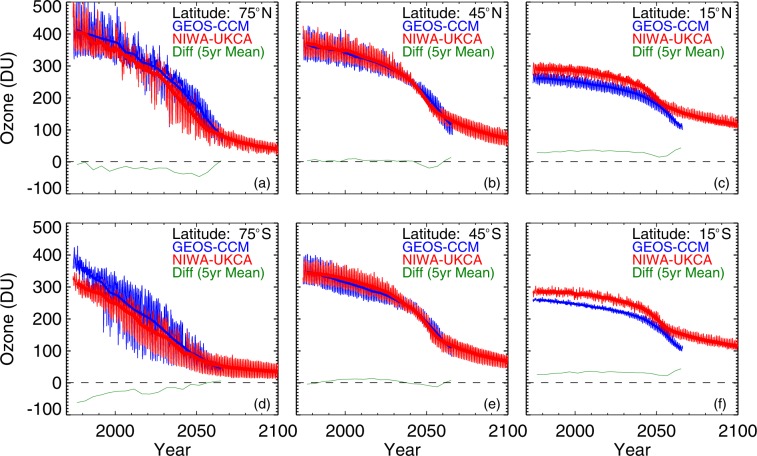
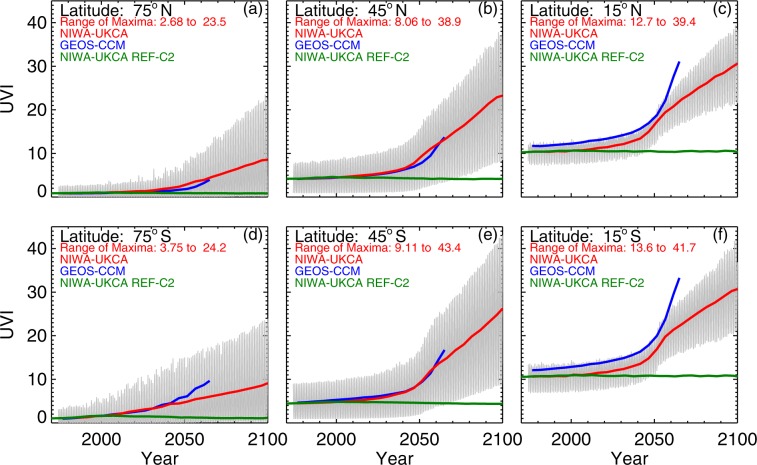
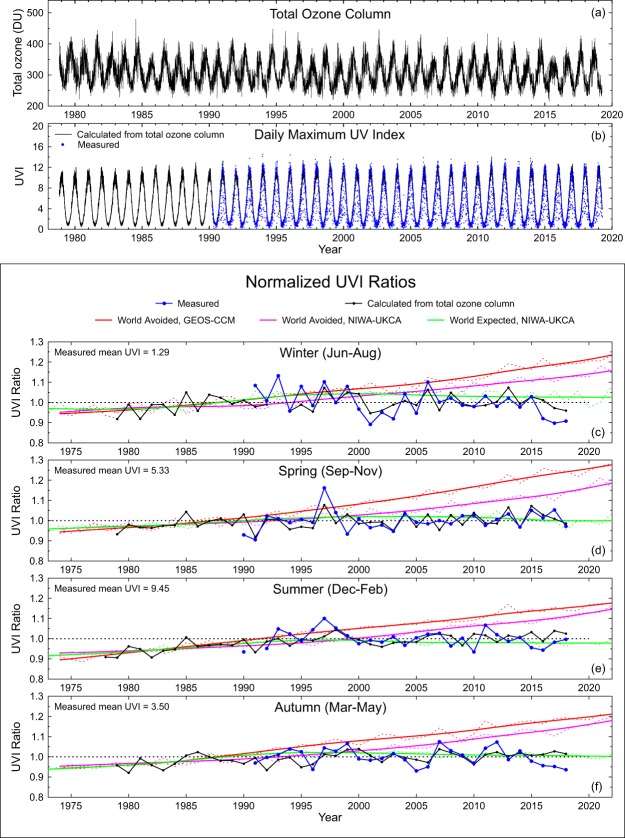
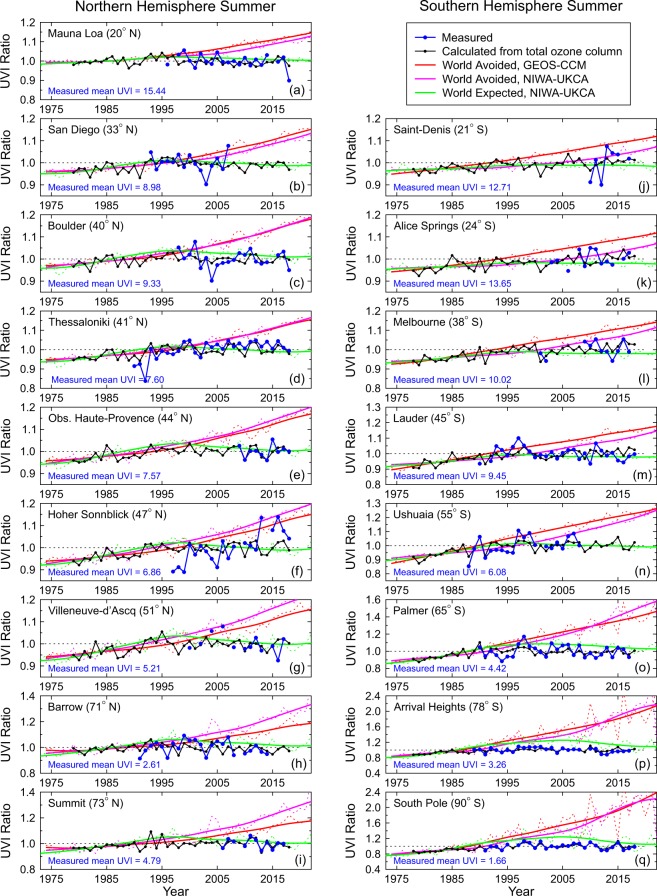
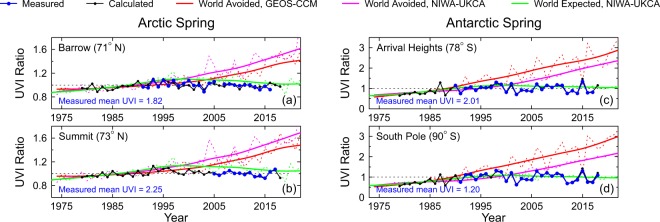
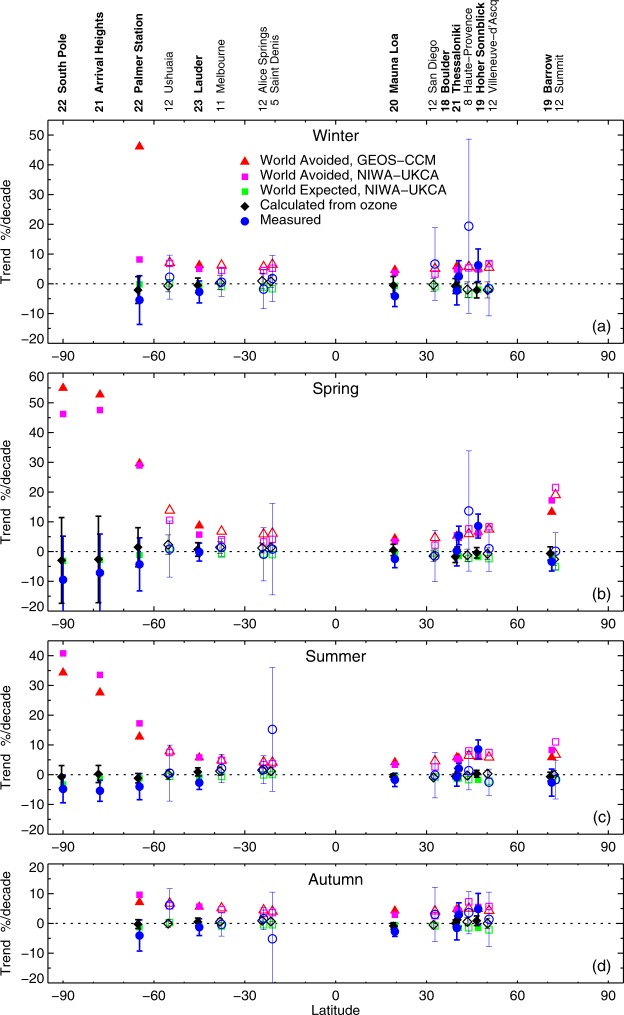
The Montreal Protocol on Substances that Deplete the Ozone Layer has been hailed as the most successful environmental treaty ever (https://www.unenvironment.org/news-and-stories/story/montreal-protocol-triumph-treaty). Yet, although our main concern about ozone depletion is the subsequent increase in harmful solar UV radiation at the Earth’s surface, no studies to date have demonstrated its effectiveness in that regard. Here we use long-term UV Index (UVI) data derived from high-quality UV spectroradiometer measurements to demonstrate its success in curbing increases in UV radiation. Without this landmark agreement, UVI values would have increased at mid-latitude locations by approximately 20% between the early 1990s and today and would approximately quadruple at mid-latitudes by 2100. In contrast, an analysis of UVI data from multiple clean-air sites shows that maximum daily UVI values have remained essentially constant over the last ~20 years in all seasons, and may even have decreased slightly in the southern hemisphere, especially in Antarctica, where effects of ozone depletion were larger. Reconstructions of the UVI from total ozone data show evidence of increasing UVI levels in the 1980s, but unfortunately, there are no high-quality UV measurements available prior to the early 1990s to confirm these increases with direct observations.
Overview
The claims and statistics of this paper haven’t been checked yet.
Free: it reads the open-access text and checks the first 5 claims that cite a source we can check. Create a free account to check every claim.
Integrity signals
Registry
Cites
Statistics
Figures
Verification
Claims the paper makes
The claims and statistics of this paper haven’t been checked yet.
Free: it reads the open-access text and checks the first 5 claims that cite a source we can check. Create a free account to check every claim.
Claims other papers make about this one
Each is checked against this paper’s own text: does it say what the citing paper says it does?
The source backs part of the claim, not all of it — or backs it for a different population, condition or comparison.
In the citing paper
“Without the Montreal Protocol (i.e., the “world avoided” scenario), emissions of ozone-depleting substances (ODS) would have continued to increase and large decreases in tropical stratospheric ozone would have occurred by the end of the twenty-first century [1, 2].”
From Environmental consequences of interacting effects of changes in stratospheric ozone, ultraviolet radiation, and climate: UNEP Environmental Effects Assessment Panel, Update 2024 (2025) · cites this paper as [2]
Experimental — accuracy not yet measuredThe cited source says what the claim attributes to it.
In the citing paper
“Much larger changes would have occurred without the implementation of the Montreal Protocol (the “world avoided”), where unabated growth of emissions of CFCs would have resulted in catastrophic global loss of stratospheric O3 [24], with major impacts on UV radiation [25], incidence of skin cancer [26, 27], and reduction of the global carbon sink by damage to vegetation [28].”
From Changes in tropospheric air quality related to the protection of stratospheric ozone in a changing climate (2023) · cites this paper as [25]
Self-check
Percentages, sums and reported differences re-computed from the paper’s own numbers.
The self-check needs the paper’s full text.
Citations
Cites
The RCP greenhouse gas concentrations and their extensions from 1765 to 2300
Meinshausen, M., Smith, S. J., Calvin, K., Daniel, J. S., Kainuma, M. L. T., Lamarque, J.-F., Matsumoto, K., Montzka, S. A., Raper, S. C. B., Riahi, K., et al. (2011) · Climatic Change · doi:10.1007/s10584-011-0156-z · Cited by 3,584
Large losses of total ozone in Antarctica reveal seasonal ClOx/NOx interaction
Farman, J. C., Gardiner, B. G., & Shanklin, J. D. (1985) · Nature · doi:10.1038/315207a0 · Cited by 3,520
Stamnes, K., Tsay, S.-C., Wiscombe, W., & Jayaweera, K. (1988) · Applied Optics · doi:10.1364/ao.27.002502 · Cited by 3,350
THE WORLD METEOROLOGICAL ORGANIZATION
Ashford, O. M. (1966) · Weather · doi:10.1002/j.1477-8696.1966.tb02810.x · Cited by 2,083
The Role of Solar Radiation in Atmospheric Chemistry
Madronich, S., & Flocke, S. (1999) · The Handbook of Environmental Chemistry · doi:10.1007/978-3-540-69044-3_1 · Cited by 582
Review of the global models used within phase 1 of the Chemistry–Climate Model Initiative (CCMI)
Morgenstern, O., Hegglin, M. I., Rozanov, E., O'Connor, F. M., Abraham, N. L., Akiyoshi, H., Archibald, A. T., Bekki, S., Butchart, N., Chipperfield, M. P., et al. (2017) · Geoscientific Model Development · doi:10.5194/gmd-10-639-2017 · Cited by 401
Self-citationAn unexpected and persistent increase in global emissions of ozone-depleting CFC-11
Montzka, S. A., Dutton, G. S., Yu, P., Ray, E., Portmann, R. W., Daniel, J. S., Kuijpers, L., Hall, B. D., Mondeel, D., Siso, C., et al. (2018) · Nature · doi:10.1038/s41586-018-0106-2 · Cited by 401
De Mazière, M., Thompson, A. M., Kurylo, M. J., Wild, J. D., Bernhard, G., Blumenstock, T., Braathen, G. O., Hannigan, J. W., Lambert, J.-C., Leblanc, T., et al. (2018) · Atmospheric Chemistry and Physics · doi:10.5194/acp-18-4935-2018 · Cited by 378
Self-citationEvaluation of the new UKCA climate-composition model – Part 2: The Troposphere
O'Connor, F. M., Johnson, C. E., Morgenstern, O., Abraham, N. L., Braesicke, P., Dalvi, M., Folberth, G. A., Sanderson, M. G., Telford, P. J., Voulgarakis, A., et al. (2014) · Geoscientific Model Development · doi:10.5194/gmd-7-41-2014 · Cited by 327
Self-citationDong, B., & Dai, A. (2015) · Climate Dynamics · doi:10.1007/s00382-015-2500-x · Cited by 311
Research works printed but not linked: 2
- Morgenstern, O., McKenzie, R., van Dijk, A. & Newman, P. New Zealand’s “World Avoided” by the success of the Montreal Protocol. 2014 UV Workshop (ed. McKenzie, R.), https://www.niwa.co.nz/atmosphere/uv-ozone/uv-science-workshops/2014-uv-workshop (2014).
- McKinlay, A. F. & Diffey, B. L. A reference action spectrum for ultraviolet induced erythema in human skin. In Human Exposure to Ultraviolet Radiation: Risks and Regulations (eds Passchier, W. F. & Bosnajakovic, B. F. M.), 83–87, Elsevier, New York (1987).
Cited by
Andrady, A. L., Barnes, P. W., Bornman, J. F., Gouin, T., Madronich, S., White, C. C., Zepp, R. G., & Jansen, M. A. K. (2022) · Science of The Total Environment · doi:10.1016/j.scitotenv.2022.158022 · Cited by 422
“The “world avoided” refers to the success of the Montreal Protocol in avoiding high UV-B irradiances (McKenzie et al., 2019).”
BackgroundMethodInfluentialBais, A. F., Lucas, R. M., Bornman, J. F., Williamson, C. E., Sulzberger, B., Austin, A. T., Wilson, S. R., Andrady, A. L., Bernhard, G., McKenzie, R. L., et al. (2018) · Photochemical & Photobiological Sciences · doi:10.1039/c7pp90043k · Cited by 350
Self-citationNeale, R. E., Barnes, P. W., Robson, T. M., Neale, P. J., Williamson, C. E., Zepp, R. G., Wilson, S. R., Madronich, S., Andrady, A. L., Heikkilä, A. M., et al. (2021) · Photochemical & Photobiological Sciences · doi:10.1007/s43630-020-00001-x · Cited by 225
Self-citationStratospheric ozone, UV radiation, and climate interactions
Bernhard, G. H., Bais, A. F., Aucamp, P. J., Klekociuk, A. R., Liley, J. B., & McKenzie, R. L. (2023) · Photochemical & Photobiological Sciences · doi:10.1007/s43630-023-00371-y · Cited by 138
“Satellite measurements of TCO became available in the late 1970s and have also been used for reconstructing the UVI at several ground stations under the assumption that changes in aerosol and clouds were small during this period [56].”
BackgroundMethodInfluentialSelf-citationBernhard, G. H., Neale, R. E., Barnes, P. W., Neale, P. J., Zepp, R. G., Wilson, S. R., Andrady, A. L., Bais, A. F., McKenzie, R. L., Aucamp, P. J., et al. (2020) · Photochemical & Photobiological Sciences · doi:10.1039/d0pp90011g · Cited by 122
Self-citationBarnes, P. W., Robson, T. M., Zepp, R. G., Bornman, J. F., Jansen, M. A. K., Ossola, R., Wang, Q.-W., Robinson, S. A., Foereid, B., Klekociuk, A. R., et al. (2023) · Photochemical & Photobiological Sciences · doi:10.1007/s43630-023-00376-7 · Cited by 113
“Other relevant contributions of the Montreal Protocol are related to pollution and contamination (SDG 3: Good health and well-being ), and climate change ( SGD 13: Climate action ).”
BackgroundInfluentialBănăduc, D., Curtean–Bănăduc, A., Barinova, S. S., Lozano, V. L., Afanasyev, S. A., Leite, T., Branco, P., Isaza, D. F. G., Geist, J. P., Tegos, A., et al. (2024) · Water · doi:10.3390/w16111483 · Cited by 117
Physical Determinants of Vitamin D Photosynthesis: A Review
Neville, J. J., Palmieri, T., & Young, A. R. (2021) · JBMR Plus · doi:10.1002/jbm4.10460 · Cited by 113
“The Montreal Protocol has already prevented a 20% increase in the UVI at midlatitudes between the early 1990s and today.((69)) The solar zenith angle (SZA) is the angle between the local vertical and the position of the sun.”
BackgroundThe Montreal Protocol protects the terrestrial carbon sink
Young, P. J., Harper, A., Huntingford, C., PAUL, N. D., Morgenstern, O., Newman, P. A., Oman, L. D., Madronich, S., & García, R. R. (2021) · Nature · doi:10.1038/s41586-021-03737-3 · Cited by 102
“Here we simulate the global effect of this interaction using a modelling framework that combines the following (Methods): (1) meteorological and ozone (and then UV-B) outputs from the National Institute for Water and Atmospheric Research version of the UK chemistry and aerosol (NIWA–UKCA) chemistry–climate model(28);…”
BackgroundMethodSelf-citationJansen, M. A. K., Andrady, A. L., Bornman, J. F., Aucamp, P. J., Bais, A. F., Banaszak, A. T., Barnes, P. W., Bernhard, G. H., Bruckman, L. S., Busquets, R., et al. (2024) · Photochemical & Photobiological Sciences · doi:10.1007/s43630-024-00552-3 · Cited by 83
“…that Deplete the Ozone Layer (hereafter referred to as the “Montreal Protocol”) has been universally ratified by all 198 member states of the United Nations and this treaty has successfully prevented large, global-scale increases in solar UV-B radiation (290–315 nm) at the Earth’s surface [1].”
Self-citationMadronich, S., Sulzberger, B., Longstreth, J. D., Schikowski, T., Andersen, M. P. S., Solomon, K. R., & Wilson, S. R. (2023) · Photochemical & Photobiological Sciences · doi:10.1007/s43630-023-00369-6 · Cited by 64
“Much larger changes would have occurred without the implementation of the Montreal Protocol (the “world avoided”), where unabated growth of emissions of CFCs would have resulted in catastrophic global loss of stratospheric O3 [24], with major impacts on UV radiation [25], incidence of skin cancer [26, 27], and reducti…”
BackgroundFountoulakis, I., Diémoz, H., Siani, A. M., Laschewski, G., Filippa, G., Arola, A., Bais, A. F., Backer, H. D., Lakkala, K., Webb, A. R., et al. (2019) · Environments · doi:10.3390/environments7010001 · Cited by 68
Self-citationThe Epidemiology of Skin Cancer and Public Health Strategies for Its Prevention in Southern Africa
Wright, C., du Preez, D. J., Millar, D. A., & Norval, M. (2020) · International Journal of Environmental Research and Public Health · doi:10.3390/ijerph17031017 · Cited by 40
Persistent extreme ultraviolet irradiance in Antarctica despite the ozone recovery onset
Cordero, R. R., Feron, S., Damiani, A., Redondas, A., Carrasco, J., Sepúlveda, E., Jorquera, J., Fernandoy, F., Llanillo, P., Rowe, P. M., et al. (2022) · Scientific Reports · doi:10.1038/s41598-022-05449-8 · Cited by 47
Trends of UV Radiation in Antarctica
Bernhard, G., & Stierle, S. (2020) · Atmosphere · doi:10.3390/atmos11080795 · Cited by 37
“Further analysis suggested that differences in the sampling protocol have virtually no effect on the results discussed in this study [14].”
BackgroundMethodResultInfluentialSelf-citationKosmopoulos, P., Kazadzis, S., Schmalwieser, A. W., Raptis, P. I., Papachristopoulou, K., Fountoulakis, I., Masoom, A., Bais, A. F., Bilbao, J., Blumthaler, M., et al. (2021) · Atmospheric measurement techniques · doi:10.5194/amt-14-5657-2021 · Cited by 39
Self-citationZerefos, C., Fountoulakis, I., Eleftheratos, K., & Kazantzidis, A. (2023) · Physiological Reviews · doi:10.1152/physrev.00031.2022 · Cited by 37
Grouping strategies for assessing and managing persistent and mobile substances
Chirsir, P., Palm, E. H., Baskaran, S., Schymanski, E., Wang, Z., Wolf, R. L., Hale, S. E., & Arp, H. P. H. (2024) · Environmental Sciences Europe · doi:10.1186/s12302-024-00919-4 · Cited by 39
“A key example is the series of restrictions related to the Montreal Protocol that began with a global phase-out of CFCs [86, 87].”
BackgroundEleftheratos, K., Kapsomenakis, J., Zerefos, C. S., Bais, A. F., Fountoulakis, I., Dameris, M., Jöckel, P., Haslerud, A. S., Godin-Beekmann, S., Steinbrecht, W., et al. (2020) · Atmosphere · doi:10.3390/atmos11030228 · Cited by 35
Self-citationNeale, P. J., Hylander, S., Banaszak, A. T., Häder, D.-P., Rose, K. C., Vione, D., Wängberg, S.-Å., Jansen, M. A. K., Busquets, R., Andersen, M. P. S., et al. (2025) · Photochemical & Photobiological Sciences · doi:10.1007/s43630-025-00687-x · Cited by 32
Self-citationThe future ozone trends in changing climate simulated with SOCOLv4
Karagodin‐Doyennel, A., Rozanov, E., Sukhodolov, T., Egorova, T. A., Sedláčék, J., & Peter, T. (2023) · Atmospheric chemistry and physics · doi:10.5194/acp-23-4801-2023 · Cited by 35
Automated Aerosol Classification from Spectral UV Measurements Using Machine Learning Clustering
Σιώμος, Ν., Fountoulakis, I., Natsıs, A., Δρόσογλου, Θ., & Bais, A. F. (2020) · Remote Sensing · doi:10.3390/rs12060965 · Cited by 29
Self-citationIndicators of Antarctic ozone depletion: 1979 to 2019
Bodeker, G. E., & Kremser, S. (2021) · Atmospheric chemistry and physics · doi:10.5194/acp-21-5289-2021 · Cited by 29
Aquatic Productivity under Multiple Stressors
Häder, D., & Gao, K. (2023) · Water · doi:10.3390/w15040817 · Cited by 30
Barnes, P. W., Bornman, J. F., Pandey, K. K., Bernhard, G., Bais, A. F., Neale, R. Ε., Robson, T. M., Neale, P. J., Williamson, C. E., Zepp, R. G., et al. (2021) · Global Change Biology · doi:10.1111/gcb.15841 · Cited by 29
Self-citationFountoulakis, I., Diémoz, H., Siani, A. M., di Sarra, A. G., Meloni, D., & Sferlazzo, D. M. (2021) · Atmospheric chemistry and physics · doi:10.5194/acp-21-18689-2021 · Cited by 26
“…than double with respect to the UVB levels in the 1970s over northern and southern midlatitudes by 2100) which would have been detrimental for the viability of ecosystems as well as for human health (McKenzie et al., 2019; Morgenstern et al., 2008; Newman and McKenzie, 2011; Young et al., 2021).”
BackgroundLorenz, S., Heinzl, F., Bauer, S., Janßen, M., Bock, V. D., Mangold, A., Scholz-Kreisel, P., & Weiskopf, D. (2024) · Photochemical & Photobiological Sciences · doi:10.1007/s43630-024-00658-8 · Cited by 24
“McKenzie et al. [91] see differences in the use of single maximum values instead of mean maximum values for the UVI max determination and attribute this to reduced cloud effects in the case of single maximum values.”
Xue, S., Zang, Y., Chen, J., Shang, S., & Tang, X. (2022) · Environmental and Experimental Botany · doi:10.1016/j.envexpbot.2022.104888 · Cited by 27
Bernhard, G., McKenzie, R., Lantz, K., & Stierle, S. (2022) · Photochemical & Photobiological Sciences · doi:10.1007/s43630-022-00178-3 · Cited by 21
“However, UV radiation at this latitude has likely not changed since the last 13 years [24] and the dataset for San Diego would likely change very little if such data could be included.”
BackgroundResultInfluentialSelf-citationGender Equality, Climate Action, and Technological Innovation for Sustainable Development in Africa
Adeola, O., Evans, O., & Ngare, I. O. (2023) · Sustainable development goals series · doi:10.1007/978-3-031-40124-4 · Cited by 23
Fifteen Years of HFC‐134a Satellite Observations: Comparisons With SLIMCAT Calculations
Harrison, J. J., Chipperfield, M. P., Boone, C. D., Dhomse, S. S., & Bernath, P. F. (2021) · Journal of Geophysical Research Atmospheres · doi:10.1029/2020jd033208 · Cited by 19
“One of the most successful environmental treaties ever signed (McKenzie et al., 2019), the Montreal Protocol has reduced the emissions of these ODSs under a legal framework, thereby saving millions of people from the ravages of skin cancer (Chipperfield et al.”
BackgroundNational Action Plans: Effectiveness and requirements for the Global Plastics Treaty
March, A., Tsouza, A., Nieminen, L. K., Winton, S., Arora, H., Shejuti, S.-M., Walker, T. R., & Fletcher, S. (2024) · Cambridge Prisms Plastics · doi:10.1017/plc.2024.11 · Cited by 22
“…to highlight that other international and multilateral agreements, which do not rely on NAP-based approaches for their implementation have been deemed relatively effective and, in some cases, highly successful such as the Montreal Protocol (UNEP, 2017; Mckenzie et al., 2019; Barnes et al., 2021).”
BackgroundZuber, R., Köhler, U., Egli, L., Ribnitzky, M., Steinbrecht, W., & Gröbner, J. (2021) · Atmospheric measurement techniques · doi:10.5194/amt-14-4915-2021 · Cited by 19
“McKenzie et al. (2019) showed for instance that no global, statistically significant recovery of the ozone layer has taken place yet, but no further decline has been observed either.”
BackgroundClimate Justice, Capitalism, and the Political Role of the Psychological Professions
Oladejo, A. O., Malherbe, N., & van Niekerk, A. (2023) · Review of General Psychology · doi:10.1177/10892680231175394 · Cited by 28
“The Montreal Protocol has been ad-judged the most successful of all environmental treaties (Birmpili, 2018; McKenzie et al., 2019).”
BackgroundEleftheratos, K., Kapsomenakis, J., Fountoulakis, I., Zerefos, C., Jöckel, P., Dameris, M., Bais, A. F., Bernhard, G., Kouklaki, D., Tourpali, K., et al. (2022) · Atmospheric chemistry and physics · doi:10.5194/acp-22-12827-2022 · Cited by 18
“…http://www.ndaccdemo.org/, last access: 4 September 2022) at https://www-air.larc.nasa.gov/pub/ NDACC/PUBLIC/stations/ (last access: 4 September 2022) (De Mazière et al., 2018) and have been reported among those possessing high-quality long-term UV irradiance measurements (McKenzie et al., 2019).”
BackgroundSelf-citationMadronich, S., Bernhard, G. H., Neale, P. J., Heikkilä, A., Andersen, M. P. S., Andrady, A. L., Aucamp, P. J., Bais, A. F., Banaszak, A. T., Barnes, P. J., et al. (2024) · Photochemical & Photobiological Sciences · doi:10.1007/s43630-024-00577-8 · Cited by 15
“According to model calculations [19], the clear-sky UV Index observed at noon during summer at mid-latitudes and the tropics would have been as high as 40 by the end of the twenty-first century in the absence of the Montreal Protocol, even before considering additional enhancements by clouds.”
Self-citationLi, B., Zhao, X., Li, X., Hu, X., Hu, L., Chen, D., An, M., Yang, Y., Feng, R., Guo, L., et al. (2023) · Journal of Cleaner Production · doi:10.1016/j.jclepro.2023.137573 · Cited by 15
Risk-sensitive innovation: leveraging interactions between technologies to navigate technology risks
Sandbrink, J. B., Hobbs, H., Swett, J. L., Dafoe, A., & Sandberg, A. (2024) · Science and Public Policy · doi:10.1093/scipol/scae043 · Cited by 16
Relationship between ozone and biologically relevant UV at 4 NDACC sites
McKenzie, R., Liley, B., Kotkamp, M., Geddes, A., Querel, R., Stierle, S., Lantz, K., Rhodes, S., & Madronich, S. (2022) · Photochemical & Photobiological Sciences · doi:10.1007/s43630-022-00281-5 · Cited by 14
Self-citationLinkages between COVID-19, solar UV radiation, and the Montreal Protocol
Bernhard, G. H., Madronich, S., Lucas, R. M., Byrne, S. N., Schikowski, T., & Neale, R. E. (2023) · Photochemical & Photobiological Sciences · doi:10.1007/s43630-023-00373-w · Cited by 12
“[109], the Montreal Protocol has averted increases of erythemal (sunburning) irradiances by approximately 20% between the early 1990s and 2018 at mid-latitudes.”
BackgroundSelf-citationKaragodin‐Doyennel, A., Rozanov, E., Sukhodolov, T., Egorova, T. A., Sedláčék, J., Ball, W. T., & Peter, T. (2022) · Atmospheric chemistry and physics · doi:10.5194/acp-22-15333-2022 · Cited by 12
Zhang, C., Gao, N., Na, X., Li, K., Pu, M., Sun, H., Song, Y., Peng, T., Fei, P., Li, J., et al. (2025) · Soil Biology and Biochemistry · doi:10.1016/j.soilbio.2025.109767 · Cited by 12
Evaluation of Antarctic Ozone Profiles derived from OMPS-LP by using Balloon-borne Ozonesondes
Sepúlveda, E., Cordero, R. R., Damiani, A., Feron, S. C., Pizarro, J., Zamorano, F., Kivi, R., Sánchez, R., Yela, M., Jumelet, J., et al. (2021) · Scientific Reports · doi:10.1038/s41598-021-81954-6 · Cited by 13
Barentine, J. C. (2020) · International Journal of Sustainable Lighting · doi:10.26607/ijsl.v22i2.104 · Cited by 13
Sun exposure: An environmental preventer of metabolic dysfunction?
Gorman, S. (2019) · Current Opinion in Endocrine and Metabolic Research · doi:10.1016/j.coemr.2019.11.001 · Cited by 11
Yamamoto, A. L. C., Corrêa, M. D. P., Torres, R. R., Martins, F. B., & Godin-Beekmann, S. (2024) · Photochemical & Photobiological Sciences · doi:10.1007/s43630-024-00594-7 · Cited by 7
“The TOC increase due to the ozone layer recovery [32, 58] implies a maximum decrease of 1.5 UVI in the far future.”
InfluentialObservation of a 27 Days Periodicity in Melanoma Diagnosis
Zioutas, K., Maroudas, M., Hofmann, S., Kryemadhi, A., & Matteson, E. L. (2020) · Biophysical Reviews and Letters · doi:10.1142/s1793048020500083 · Cited by 7
Alton, L. A., Novelo, M., Beaman, J. E., Arnold, P. A., Bywater, C. L., Kerton, E. J., Lombardi, E. J., Koh, C., & McGraw, E. A. (2023) · Global Change Biology · doi:10.1111/gcb.16906 · Cited by 6
“…of ODSs are decreasing, global ozone is no longer declining, and ozone recovery is evident as a result of broad compliance with the Montreal Protocol, which has regulated the production and consumption of ODSs since 1987 (McKenzie et al., 2019; World Meteorological Organization, 2018).”
BackgroundAssessment of spectral UV radiation at Marambio Base, Antarctic Peninsula
Čížková, K., Láska, K., Metelka, L., & Staněk, M. (2023) · Atmospheric chemistry and physics · doi:10.5194/acp-23-4617-2023 · Cited by 6
Learning from the Montreal Protocol to improve the global governance of antimicrobial resistance
Nanyangwe-Moyo, T., Fezza, G. C., Katwyk, S. R. V., Hoffman, S. J., Ruckert, A., Orubu, E. S. F., & Poirier, M. J. P. (2024) · BMJ Global Health · doi:10.1136/bmjgh-2024-015690 · Cited by 9
“29 With technical assistance from Japan, industries in Thai-land phased out ODS use 1 year ahead of their domestic schedules.”
CFC‐12 Emissions in China Inferred From Observation and Inverse Modeling
Ma, M., Hu, X., Yao, B., Li, B., An, M., & Fang, X. (2024) · Geophysical Research Letters · doi:10.1029/2024gl109541 · Cited by 6
Etiology of the ecological crisis
Peppoloni, S., & Capua, G. D. (2024) · Elsevier eBooks · doi:10.1016/b978-0-443-15654-0.00009-8 · Cited by 6
Chatzopoulou, A., Tourpali, K., Bais, A. F., & Braesicke, P. (2024) · Photochemical & Photobiological Sciences · doi:10.1007/s43630-024-00676-6 · Cited by 6
Self-citationHow states deal with long-term destabilizing risks
van Voss, B. H., & Helsloot, I. (2023) · Journal of Risk Research · doi:10.1080/13669877.2023.2259405 · Cited by 4
“In fact, there are positive examples to follow, such as the Montreal Protocol on Substances that Deplete the Ozone Layer (e.g. Mckenzie et al. 2019).”
BackgroundGeddes, A., Liley, B., McKenzie, R., Kotkamp, M., & Querel, R. (2024) · Atmospheric measurement techniques · doi:10.5194/amt-17-827-2024 · Cited by 4
Self-citationJansen, M. A. K., Ač, A., Grace, J., & Urban, O. (2025) · Plant Cell & Environment · doi:10.1111/pce.15643 · Cited by 3
The limits of cross-border environmental policies: Trade diversion as leakage
Abman, R., Jenkins, H., & Lundberg, C. (2026) · Journal of Environmental Economics and Management · doi:10.1016/j.jeem.2026.103298 · Cited by 9
Assessment of the accuracy in UV index modelling using the UVIOS2 system during the UVC-III campaign
Fountoulakis, I., Papachristopoulou, K., Kazadzis, S., Hülsen, G., Gröbner, J., Raptis, P. I., Kouklaki, D., Masoom, A., Kouremeti, N., Kontoes, C., et al. (2025) · Geoscientific model development · doi:10.5194/gmd-18-7451-2025 · Cited by 3
“…and the successful implementation of the Montreal Protocol prevented further depletion of stratospheric ozone and the consequent dangerous UV levels (McKenzie et al., 2019; Morgenstern et al., 2008), the future evolution of the levels of surface solar UV radiation is still uncertain, mainly due…”
Pino, A. F. S., Palechor, G. A. R., & Realpe, L. F. A. (2021) · Ingeniería y Ciencia · doi:10.17230/ingciencia.17.33.7 · Cited by 3
Raymond, N., Bernath, P. F., Boone, C. D., & Chipperfield, M. P. (2026) · Journal of Geophysical Research Atmospheres · doi:10.1029/2025jd045176 · Cited by 2
“This reduction helps restore the natural ozone shield that protects life on Earth from harmful UV radiation as well as mitigating the associated health and ecological risks (McKenzie et al., 2019).”
Lee‐Taylor, J., Hu, Z., Kyle, J., Karipidis, K., Henderson, S. I., Landolfi, R., Tasich, C. M., & Madronich, S. (2026) · GeoHealth · doi:10.1029/2024gh001283 · Cited by 2
Raymond, N. (2025) · White Rose Research Online (University of Leeds, The University of Sheffield, University of York) · doi:10.5281/zenodo.17612885 · Cited by 1
Yet another benefit from sunlight in the fight against COVID‐19?
McKenzie, R., & Liley, B. (2021) · British Journal of Dermatology · doi:10.1111/bjd.20516 · Cited by 1
Self-citationAdeola, O., Evans, O., & Ngare, I. O. (2023) · Sustainable development goals series · doi:10.1007/978-3-031-40124-4_1 · Cited by 1
Marine plastic pollution treaty: How should it look like?
Ramadhan, M. R. (2024) · E3S Web of Conferences · doi:10.1051/e3sconf/202457701010 · Cited by 1
Laschewski, G. (2025) · Environments · doi:10.3390/environments12010013 · Cited by 1
Peaceful Settlement and International Law: A Jus ad PacemPreprint
Hollis, D. B., & Tikk, E. (2021) · SSRN Electronic Journal · doi:10.2139/ssrn.3908182 · Cited by 1
Sandbrink, J. B. (2023) · Oxford University Research Archive (ORA) (University of Oxford) · doi:10.5287/ora-bpqk58ead · Cited by 6
The COVID-19 Outbreak’s Multiple Effects
Lâjili, M. (2020) · International Journal of Engineering Research and · doi:10.17577/ijertv9is050220
Fountoulakis, I. (2021) · Atmospheric chemistry and physics · doi:10.5194/acp-2021-616-ac1
(2021) · Atmospheric chemistry and physics · doi:10.5194/acp-2021-616-rc2
The description of the effect of the ozone profile on UV radiation should be modified
(2021) · Atmospheric chemistry and physics · doi:10.5194/acp-2021-616-rc1
Braga, P. C. R., Duleba, W., Pinto, N. A., Bastos, M. F. R., & Morizono, V. H. M. R. (2022) · Editora Blucher eBooks · doi:10.5151/9786555502343-02
Čížková, K. (2022) · doi:10.5194/egusphere-2022-688-ac1
Čížková, K. (2022) · doi:10.5194/egusphere-2022-688-ac2
Karagodin‐Doyennel, A. (2023) · doi:10.5194/egusphere-2022-1260-ac1
(2023) · Atmospheric measurement techniques · doi:10.5194/amt-2023-107-rc1
Geddes, A. (2023) · Atmospheric measurement techniques · doi:10.5194/amt-2023-107-ac1
Geddes, A. (2023) · Atmospheric measurement techniques · doi:10.5194/amt-2023-107-ac2
Radiation Transfer in the Atmosphere: Ultraviolet, Surface
McKenzie, R., & Madronich, S. (2024) · Elsevier eBooks · doi:10.1016/b978-0-323-96026-7.00055-2
Self-citationMarch, A. (2023) · Cambridge Prisms Plastics · doi:10.1017/plc.2024.11.pr1
(2024) · Cambridge Prisms Plastics · doi:10.1017/plc.2024.11.pr6
March, A. (2024) · Cambridge Prisms Plastics · doi:10.1017/plc.2024.11.pr4
(2024) · Cambridge Prisms Plastics · doi:10.1017/plc.2024.11.pr3
(2024) · Cambridge Prisms Plastics · doi:10.1017/plc.2024.11.pr5
(2024) · Cambridge Prisms Plastics · doi:10.1017/plc.2024.11.pr2
Environmental health and population issues
Sharma, M., & Lakhan, R. (2024) · Elsevier eBooks · doi:10.1016/b978-0-443-29098-5.00007-2
Trade and Atmospheric Protection at Stockholm+50: Plus ça Change?
van Asselt, H. (2026) · Cambridge University Press eBooks · doi:10.1017/9781009445740.017
Observations and potential source regions of HFC-152a in southeastern China
Xu, Y., Cao, Z., Lü, Y., Wang, P., Wu, Z., Huang, X., Zhang, Y., Zhang, Z., Jiang, X., Lei, H., et al. (2025) · Environmental Research · doi:10.1016/j.envres.2025.122562
Montreal Protocol: an international law achievement
Castro, J. A. Y. (2025) · Revista Peruana de Derecho Internacional · doi:10.38180/rpdi.v75i180.595
Ympäristönsuojelu ja peliteoria
Hakkarainen, V. (2023) · Theseus (Ammattikorkeakoulujen)
Jansen, M., Andrady, A. L., Bornman, J. F., Aucamp, P. J., Μπάης, Α., Banaszak, A., Barnes, P., Bernhard, G., Bruckman, L., Busquets, R., et al. (2023) · Research Online (University of Wollongong)
Torres-Brito, D. I., Aké, S. C., & Venegas-Martínez, F. (2023) · Munich Personal RePEc Archive (Ludwig Maximilian University of Munich)
Study of hybrid organic-inorganic materials for enviromentally friendly refrigeration
Bonilla-Omil, P. (2020) · RUC (Universidade Da Coruña)
Strengthening International Environmental Agreements through Trade PolicyPreprint
Lundberg, C., Abman, R., & Szmurlo, D. (2026) · SSRN Electronic Journal · doi:10.2139/ssrn.6126993
Walleni, C. (2025) · Rovira & Virgili repository
Fountoulakis, I., Garane, K., Eleftheratos, K., Kouklaki, D., Kapoulas, A., Bais, A. F., Papadimitriou, N. I., Fragkos, K., Papachristopoulou, K., Kazadzis, S., et al. (2025) · IOP Conference Series Earth and Environmental Science · doi:10.1088/1755-1315/1522/1/012036
“…of stratospheric ozone in the 1980s and the 1990s due to the anthropogenic emission of Ozone Depleting Substances caused global awareness, since continuation of stratospheric ozone depletion would subsequently result in extreme UV levels over wide, densely populated regions of the planet [3].”
Self-citation
Metadata
- Authors
- McKenzie, R., Bernhard, G., Liley, B., Disterhoft, P., Rhodes, S., Bais, A., Morgenstern, O., Newman, P., Oman, L., Brogniez, C., & Simic, S.
- Affiliations
- National Institute of Water and Atmospheric Research (NZ)
- Biospherical Instruments (United States) (US)
- National Oceanic and Atmospheric Administration (US)
- Bureau of Meteorology (AU)
- Aristotle University of Thessaloniki (GR)
- Goddard Space Flight Center (US)
- Centre National de la Recherche Scientifique (FR)
- Corresponding author
- McKenzie, Richard
- ORCID
- Venue
- Scientific Reports
- Published
- 2019-09-03
- Volume
- 9
- Issue
- 1
- Pages
- 12332-12332
- ISSN
- 2045-2322 (ISSN-L)
- PMC
- PMC6722083
- OpenAlex
- W2971752615
- Semantic Scholar
- ef2e4704754caf75177bd602d59ba220ccd83e1e
- Cited by
- 88
- References
- 40
- Citations by year
- 2026: 5 · 2025: 7 · 2024: 20 · 2023: 18 · 2022: 11 · 2021: 16 · 2020: 8 · 2019: 2
- FWCI
- 3.67
- Type
- journal article
- Language
- en
- Open access
- gold
- doi.org
- Licence
- cc-by
- creativecommons.org/licenses/by/4.0 (tdm)
- creativecommons.org/licenses/by/4.0 (vor)
- Locations
- Scientific Reports (publishedVersion, cc-by)
- PubMed Central (publishedVersion, cc-by)
- PubMed (publishedVersion)
- HAL (submittedVersion, cc-by)
- DOAJ (DOAJ: Directory of Open Access Journals) (submittedVersion)
- LillOA (Université de Lille (University Of Lille)) (submittedVersion, cc-by)
- NOAA Institutional Repository (submittedVersion)
- Funders
- Ministry for Business Innovation and Employment
- Ministry of Business, Innovation and Employment
- CNES, France
- Topics
- Physical Sciences › Earth and Planetary Sciences › Atmospheric Science › Atmospheric Ozone and Climate
- Physical Sciences › Earth and Planetary Sciences › Atmospheric Science › Atmospheric chemistry and aerosols
- Physical Sciences › Environmental Science › Global and Planetary Change › Climate variability and models
- Keywords
- Montreal Protocol, ozone depletion, surface UV radiation, UV index, total ozone, Antarctic ozone hole
About these checks
Registry, retraction, Cites and statistics results are computed, not judged, with one exception: a printed reference that no index lists is read once by a model before it counts as a citation error. Claims are extracted by a model and kept only when their quote appears verbatim in the text; each cited source is then checked, with a model’s help, for whether it says what the claim relies on. Those verdicts can be wrong — read the claim’s quote and the cited source before relying on one.
Statistics and arithmetic are recomputed, not judged.
Confidence bands are shown only for fields calibrated on our annotated test set. None is calibrated yet, so no band is shown.
What counts as a claim ›How we measure confidence ›How we check this ›
Are you an author, or do you see a problem with this page? Request a review
Data sources
Bibliographic data: Semantic Scholar, OpenAlex, Crossref.
Contains information from the Semantic Scholar Academic Graph Datasets, made available under the ODC Attribution License (ODC-BY 1.0).
Semantic Scholar’s data is described in: Kinney, R., et al. (2023). The Semantic Scholar Open Data Platform. arXiv:2301.10140.
