

Resting-state brain functional connectivity in patients with chronic pain who responded to subanesthetic-dose ketamine
Open accessThe DOI matches its Crossref record; 45 of the 45 references it cites were found in a registry or an index.
Abstract
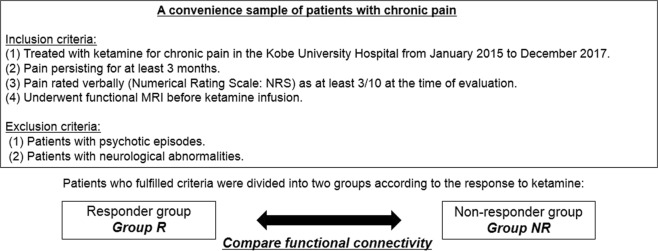
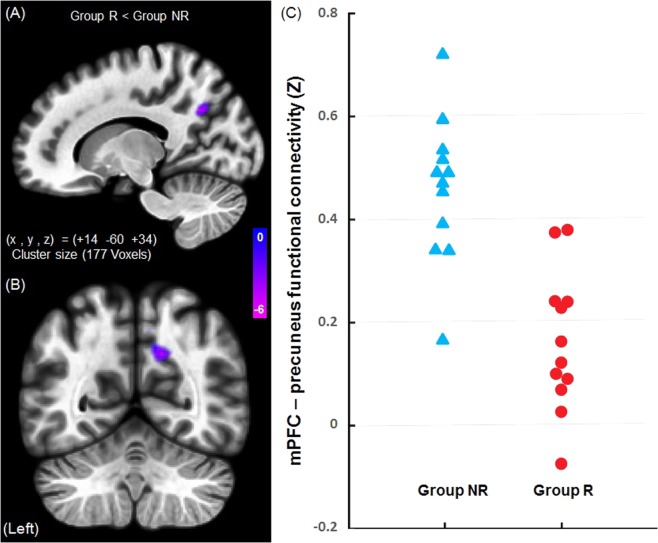
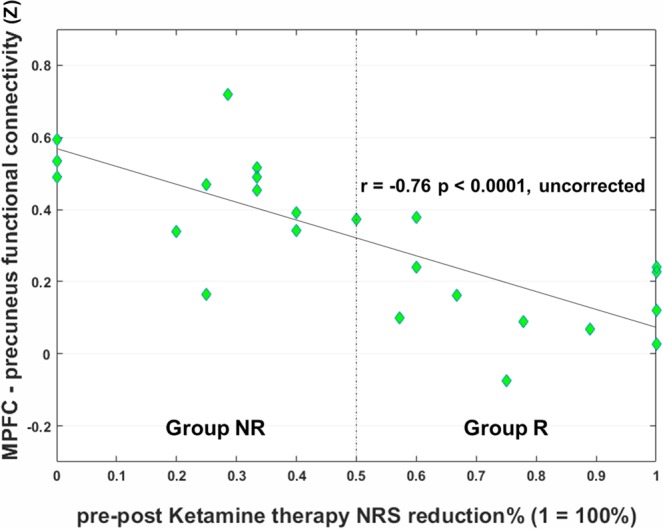
Ketamine has been used to treat chronic pain; however, it is still unknown as to what types of chronic pain is ketamine effective against. To identify the effect of administration of subanesthetic-dose ketamine in patients with chronic pain and to clarify the mechanism of the effect, we retrospectively investigated brain functional connectivity using resting-state functional magnetic resonance imaging (rs-fMRI). Patients were divided into responders (Group R: ≥50% improvement on Numerical Rating Scale) and non-responders (Group NR). We compared the differences in terms of brain functional connectivity by seed-to-voxel correlation analysis. Two-sample t-test revealed significant lower connectivity between the medial prefrontal cortex (mPFC) and precuneus in Group R. We also found a significant negative correlation between the improvement rate and functional connectivity strength between the mPFC and precuneus. These findings suggest that subanesthetic-dose ketamine is effective in patients with chronic pain whose brain functional connectivity between the mPFC and precuneus is low. We believe that the current study explored for the first time the correlation between brain functional connectivity and the effect of subanesthetic-dose ketamine for chronic pain and indicated the possibility of use of the predictive marker in pharmacological treatment of chronic pain.
Overview
The claims and statistics of this paper haven’t been checked yet.
Free: it reads the open-access text and checks the first 5 claims that cite a source we can check. Create a free account to check every claim.
Integrity signals
Registry
Cites
Statistics
Figures
Verification
Claims the paper makes
The claims and statistics of this paper haven’t been checked yet.
Free: it reads the open-access text and checks the first 5 claims that cite a source we can check. Create a free account to check every claim.
Claims other papers make about this one
Each is checked against this paper’s own text: does it say what the citing paper says it does?
The source backs part of the claim, not all of it — or backs it for a different population, condition or comparison.
In the citing paper
“a recent resting-state functional magnetic resonance imaging (fMRI) study (n = 24) determined that ketamine targeted chronic pain most effectively in participants with low baseline functional connectivity strength between the medial prefrontal cortex and precuneus [133]”
From Ketamine in neuropsychiatric disorders: an update (2024) · cites this paper as [133]
Experimental — accuracy not yet measured
Self-check
Percentages, sums and reported differences re-computed from the paper’s own numbers.
The self-check needs the paper’s full text.
Citations
Cites
The Hospital Anxiety and Depression Scale
Zigmond, A. S., & Snaith, R. P. (1983) · Acta Psychiatrica Scandinavica · doi:10.1111/j.1600-0447.1983.tb09716.x · Cited by 47,139
The Pain Catastrophizing Scale: Development and validation.
Sullivan, M. J. L., Bishop, S. R., & Pivik, J. (1995) · Psychological Assessment · doi:10.1037//1040-3590.7.4.524 · Cited by 8,227
Power, J. D., Barnes, K. A., Snyder, A. Z., Schlaggar, B. L., & Petersen, S. E. (2012) · NeuroImage · doi:10.1016/j.neuroimage.2011.10.018 · Cited by 7,429
The precuneus: a review of its functional anatomy and behavioural correlates
Cavanna, A. E., & Trimble, M. R. (2006) · Brain · doi:10.1093/brain/awl004 · Cited by 5,128
Conn : A Functional Connectivity Toolbox for Correlated and Anticorrelated Brain Networks
Whitfield-Gabrieli, S., & Nieto-Castanon, A. (2012) · Brain Connectivity · doi:10.1089/brain.2012.0073 · Cited by 4,885
Antidepressant effects of ketamine in depressed patients
Berman, R. M., Cappiello, A., Anand, A., Oren, D. A., Heninger, G. R., Charney, D. S., & Krystal, J. H. (2000) · Biological Psychiatry · doi:10.1016/s0006-3223(99)00230-9 · Cited by 3,856
Methods to detect, characterize, and remove motion artifact in resting state fMRI
Power, J. D., Mitra, A., Laumann, T. O., Snyder, A. Z., Schlaggar, B. L., & Petersen, S. E. (2014) · NeuroImage · doi:10.1016/j.neuroimage.2013.08.048 · Cited by 3,748
The influence of head motion on intrinsic functional connectivity MRI
Van Dijk, K. R. A., Sabuncu, M. R., & Buckner, R. L. (2012) · NeuroImage · doi:10.1016/j.neuroimage.2011.07.044 · Cited by 2,344
Lamm, C., Decety, J., & Singer, T. (2011) · NeuroImage · doi:10.1016/j.neuroimage.2010.10.014 · Cited by 2,016
Cortical midline structures and the self
Northoff, G., & Bermpohl, F. (2004) · Trends in Cognitive Sciences · doi:10.1016/j.tics.2004.01.004 · Cited by 1,446
Clinical applications of resting state functional connectivity
Fox, M. D. (2010) · Frontiers in Systems Neuroscience · doi:10.3389/fnsys.2010.00019 · Cited by 1,167
The evidence for pharmacological treatment of neuropathic pain
Finnerup, N. B., Sindrup, S. H., & Jensen, T. S. (2010) · Pain · doi:10.1016/j.pain.2010.06.019 · Cited by 1,045
Precuneus Is a Functional Core of the Default-Mode Network
Utevsky, A. V., Smith, D. V., & Huettel, S. A. (2014) · The Journal of Neuroscience · doi:10.1523/jneurosci.4227-13.2014 · Cited by 897
Beyond Feeling: Chronic Pain Hurts the Brain, Disrupting the Default-Mode Network Dynamics
Baliki, M. N., Geha, P. Y., Apkarian, A. V., & Chialvo, D. R. (2008) · The Journal of Neuroscience · doi:10.1523/jneurosci.4123-07.2008 · Cited by 853
Hashmi, J. A., Baliki, M. N., Huang, L., Baria, A. T., Torbey, S., Hermann, K. M., Schnitzer, T. J., & Apkarian, A. V. (2013) · Brain · doi:10.1093/brain/awt211 · Cited by 762
Ketamine: A Review of Clinical Pharmacokinetics and Pharmacodynamics in Anesthesia and Pain Therapy
Peltoniemi, M. A., Hagelberg, N. M., Olkkola, K. T., & Saari, T. I. (2016) · Clinical Pharmacokinetics · doi:10.1007/s40262-016-0383-6 · Cited by 672
Kucyi, A., & Davis, K. D. (2015) · Trends in Neurosciences · doi:10.1016/j.tins.2014.11.006 · Cited by 587
Schwenk, E. S., Viscusi, E. R., Buvanendran, A., Hurley, R. W., Wasan, A. D., Narouze, S., Bhatia, A., Davis, F. N., Hooten, W. M., & Cohen, S. P. (2018) · Regional Anesthesia and Pain Medicine · doi:10.1097/aap.0000000000000806 · Cited by 584
Functional connectivity mapping of the human precuneus by resting state fMRI
Zhang, S., & Li, C.-S. R. (2012) · NeuroImage · doi:10.1016/j.neuroimage.2011.11.023 · Cited by 559
Contributions of the prefrontal cortex to the neural basis of human decision making
Krawczyk, D. C. (2002) · Neuroscience & Biobehavioral Reviews · doi:10.1016/s0149-7634(02)00021-0 · Cited by 534
Rapid-acting glutamatergic antidepressants: the path to ketamine and beyond
Krystal, J. H., Sanacora, G., & Duman, R. S. (2013) · Biological Psychiatry · doi:10.1016/j.biopsych.2013.03.026 · Cited by 406
Kucyi, A., Moayedi, M., Weissman-Fogel, I., Goldberg, M. B., Freeman, B. V., Tenenbaum, H. C., & Davis, K. D. (2014) · The Journal of Neuroscience · doi:10.1523/jneurosci.5055-13.2014 · Cited by 396
Cohen, S. P., Bhatia, A., Buvanendran, A., Schwenk, E. S., Wasan, A. D., Hurley, R. W., Viscusi, E. R., Narouze, S., Davis, F. N., Ritchie, E. C., et al. (2018) · Regional Anesthesia and Pain Medicine · doi:10.1097/aap.0000000000000808 · Cited by 350
Ketamine Treatment and Global Brain Connectivity in Major Depression
Abdallah, C. G., Averill, L. A., Collins, K. A., Geha, P., Schwartz, J., Averill, C., DeWilde, K. E., Wong, E., Anticevic, A., Tang, C. Y., et al. (2017) · Neuropsychopharmacology · doi:10.1038/npp.2016.186 · Cited by 300
Meerwijk, E. L., Ford, J. M., & Weiss, S. J. (2013) · Brain Imaging and Behavior · doi:10.1007/s11682-012-9179-y · Cited by 226
Tracey, I. (2008) · British Journal of Anaesthesia · doi:10.1093/bja/aen102 · Cited by 219
Disruption of default mode network dynamics in acute and chronic pain states
Alshelh, Z., Marciszewski, K. K., Akhter, R., Di Pietro, F., Mills, E. P., Vickers, E. R., Peck, C. C., Murray, G. M., & Henderson, L. A. (2018) · NeuroImage: Clinical · doi:10.1016/j.nicl.2017.10.019 · Cited by 179
Wang, J., Goffer, Y., Xu, D., Tukey, D. S., Shamir, D. B., Eberle, S. E., Zou, A. H., Blanck, T. J. J., & Ziff, E. B. (2011) · Anesthesiology · doi:10.1097/aln.0b013e31822f16ae · Cited by 171
Niesters, M., Khalili-Mahani, N., Martini, C., Aarts, L., van Gerven, J., van Buchem, M. A., Dahan, A., & Rombouts, S. (2012) · Anesthesiology · doi:10.1097/aln.0b013e31826a0db3 · Cited by 147
Ketamine as a promising prototype for a new generation of rapid‐acting antidepressants
Abdallah, C. G., Averill, L. A., & Krystal, J. H. (2015) · Annals of the New York Academy of Sciences · doi:10.1111/nyas.12718 · Cited by 121
Pujol, J., Blanco‐Hinojo, L., Batalla, A., López‐Solà, M., Harrison, B. J., Soriano‐Mas, C., Crippa, J. A. S., Fagundo, A. B., Deus, J., de la Torre, R., et al. (2014) · Journal of Psychiatric Research · doi:10.1016/j.jpsychires.2013.12.008 · Cited by 120
Ketamine for chronic non-cancer pain
Bell, R. F. (2009) · Pain · doi:10.1016/j.pain.2008.12.003 · Cited by 104
Bosma, R. L., Cheng, J. C., Rogachov, A., Kim, J. A., Hemington, K. S., Osborne, N. R., Venkat Raghavan, L., Bhatia, A., & Davis, K. D. (2018) · Anesthesiology · doi:10.1097/aln.0000000000002417 · Cited by 100
Maltbie, E. A., Gopinath, K., & Howell, L. L. (2017) · Behavioural Pharmacology · doi:10.1097/fbp.0000000000000354 · Cited by 94
Imaging Pain Modulation by Subanesthetic S-(+)-Ketamine
Sprenger, T., Valet, M., Woltmann, R., Zimmer, C., Freynhagen, R., Kochs, E. F., T??lle, T. R., & Wagner, K. J. (2006) · Anesthesia & Analgesia · doi:10.1213/01.ane.0000231635.14872.40 · Cited by 79
Ketamine administration reduces amygdalo‐hippocampal reactivity to emotional stimulation
Scheidegger, M., Henning, A., Walter, M., Lehmann, M., Kraehenmann, R., Boeker, H., Seifritz, E., & Grimm, S. (2016) · Human Brain Mapping · doi:10.1002/hbm.23148 · Cited by 79
Self, cortical midline structures and the resting state: Implications for Alzheimer’s disease
Weiler, M., Northoff, G., Damasceno, B. P., & Balthazar, M. L. F. (2016) · Neuroscience & Biobehavioral Reviews · doi:10.1016/j.neubiorev.2016.05.028 · Cited by 65
Jonkman, K., Dahan, A., van de Donk, T., Aarts, L., Niesters, M., & van Velzen, M. (2017) · F1000Research · doi:10.12688/f1000research.11372.1 · Cited by 61
Default mode network connectivity change corresponds to ketamine’s delayed glutamatergic effects
Li, M., Woelfer, M., Čolić, L., Safron, A., Chang, C., Heinze, H., Speck, O., Mayberg, H. S., Biswal, B. B., Salvadore, G., et al. (2018) · European Archives of Psychiatry and Clinical Neuroscience · doi:10.1007/s00406-018-0942-y · Cited by 61
Becerra, L., Schwartzman, R. J., Kiefer, R. T., Rohr, P., Moulton, E. A., Wallin, D., Pendse, G., Morris, S., & Borsook, D. (2015) · Pain Medicine · doi:10.1111/pme.12939 · Cited by 52
Letzen, J. E., Craggs, J. G., Perlstein, W. M., Price, D. D., & Robinson, M. E. (2013) · Journal of Pain · doi:10.1016/j.jpain.2013.04.003 · Cited by 48
Resting‐state functional brain networks in adults with a new diagnosis of focal epilepsy
Alonazi, B., Keller, S. S., Fallon, N. B., Adams, V. L., Das, K., Marson, A. G., & Sluming, V. (2018) · Brain and Behavior · doi:10.1002/brb3.1168 · Cited by 28
Becerra, L., Schwartzman, R. J., Kiefer, R. T., Rohr, P., Moulton, E. A., Wallin, D., Pendse, G., Morris, S., & Borsook, D. (2009) · Pain Medicine · doi:10.1111/j.1526-4637.2009.00559.x · Cited by 26
Rikandi, E., Mäntylä, T. J. S., Lindgren, M., Kieseppä, T., Suvisaari, J., & Raij, T. T. (2018) · Schizophrenia Research · doi:10.1016/j.schres.2018.03.018 · Cited by 15
Matsuda, Y., Kan, S., Uematsu, H., Shibata, M., & Fujino, Y. (2015) · Pain Medicine · doi:10.1111/pme.12771 · Cited by 14
Self-citation
Cited by
Ketamine in neuropsychiatric disorders: an update
Johnston, J. N., Kadriu, B., Kraus, C., Henter, I. D., & Zarate, C. A. (2024) · Neuropsychopharmacology · doi:10.1038/s41386-023-01632-1 · Cited by 108
“Finally, a recent resting-state functional magnetic resonance imaging (fMRI) study ( n = 24) determined that ketamine targeted chronic pain most effectively in participants with low baseline functional connectivity strength between the medial prefrontal cortex and precuneus [133].”
BackgroundInfluentialHoeppli, M., Nahman‐Averbuch, H., Hinkle, W., Leon, E., Peugh, J., López‐Solà, M., King, C. D., Goldschneider, K. R., & Coghill, R. C. (2022) · Nature Communications · doi:10.1038/s41467-022-31039-3 · Cited by 55
“As the addition of covariates to the main regression did not reveal any further relationship between perceived pain intensity and brain activation, we chose not to further explore potential effects of these covariates in the between classes ANOVA.”
Neural basis of attentional focus during endurance exercise
Bigliassi, M. (2020) · International Review of Sport and Exercise Psychology · doi:10.1080/1750984x.2020.1762240 · Cited by 40
Sorella, S., Vellani, V., Šiugždaitė, R., Feraco, P., & Grecucci, A. (2021) · European Journal of Neuroscience · doi:10.1111/ejn.15537 · Cited by 31
“Thus, one of the main advantages that led us to rely on ICA-based resting state analyses is to identify naturally grouping functional connections patterns of brain regions not restricted to predefined boundaries of network nodes (Kornelsen et al., 2020; Motoyama et al., 2019).”
BackgroundResultBeating pain with psychedelics: Matter over mind?
Elman, I., Pustilnik, A. C., & Borsook, D. (2021) · Neuroscience & Biobehavioral Reviews · doi:10.1016/j.neubiorev.2021.12.005 · Cited by 31
Metadata
- Authors
- Motoyama, Y., Oshiro, Y., Takao, Y., Sato, H., Obata, N., Izuta, S., Mizobuchi, S., & Kan, S.
- Affiliations
- Kobe University (JP)
- Hyogo Medical University (JP)
- The University of Osaka (JP)
- Corresponding author
- Motoyama, Yasushi
- Venue
- Scientific Reports
- Published
- 2019-09-09
- Volume
- 9
- Issue
- 1
- Pages
- 12912-12912
- ISSN
- 2045-2322 (ISSN-L)
- PMC
- PMC6733873
- OpenAlex
- W2972332915
- Cited by
- 26
- References
- 45
- Citations by year
- 2026: 3 · 2025: 5 · 2024: 5 · 2023: 2 · 2022: 3 · 2021: 6 · 2020: 2
- FWCI
- 1.60
- Type
- journal article
- Language
- en
- Open access
- gold
- doi.org
- Licence
- cc-by
- creativecommons.org/licenses/by/4.0 (tdm)
- creativecommons.org/licenses/by/4.0 (vor)
- Locations
- Scientific Reports (publishedVersion, cc-by)
- Europe PMC (PubMed Central) (publishedVersion, cc-by)
- PubMed Central (publishedVersion, cc-by)
- PubMed (publishedVersion)
- Institutional Repositories DataBase (IRDB) (acceptedVersion, cc-by)
- Kobe University Repository Kernel (Kobe University) (submittedVersion, cc-by)
- Kobe University Repository Kernel (Kobe University) (submittedVersion)
- DOAJ (DOAJ: Directory of Open Access Journals) (submittedVersion)
- Topics
- Life Sciences › Neuroscience › Cognitive Neuroscience › Functional Brain Connectivity Studies
- Health Sciences › Medicine › Physiology (medical) › Pain Mechanisms and Treatments
- Life Sciences › Neuroscience › Cognitive Neuroscience › Pain Management and Placebo Effect
- Keywords
- chronic pain, subanesthetic ketamine, resting-state functional connectivity, medial prefrontal cortex, precuneus, treatment response prediction, predictive biomarkers
- MeSH terms
- Adult, Aged, Aged, 80 and over, Analgesics, Brain, Brain Mapping, Female, Humans, Ketamine, Magnetic Resonance Imaging, Male, Middle Aged, Rest, Time Factors, Head Movements, Chronic Pain, Connectome
About these checks
Registry, retraction, Cites and statistics results are computed, not judged, with one exception: a printed reference that no index lists is read once by a model before it counts as a citation error. Claims are extracted by a model and kept only when their quote appears verbatim in the text; each cited source is then checked, with a model’s help, for whether it says what the claim relies on. Those verdicts can be wrong — read the claim’s quote and the cited source before relying on one.
Statistics and arithmetic are recomputed, not judged.
Confidence bands are shown only for fields calibrated on our annotated test set. None is calibrated yet, so no band is shown.
What counts as a claim ›How we measure confidence ›How we check this ›
Are you an author, or do you see a problem with this page? Request a review
Data sources
Bibliographic data: Semantic Scholar, OpenAlex, Crossref.
Contains information from the Semantic Scholar Academic Graph Datasets, made available under the ODC Attribution License (ODC-BY 1.0).
Semantic Scholar’s data is described in: Kinney, R., et al. (2023). The Semantic Scholar Open Data Platform. arXiv:2301.10140.
